Showing posts with label Benjamin Netanyahu. Show all posts

Tuesday, February 14, 2017

#OYVeyDonaldTrump at AIPAC 2016 he acquired the 82nd Airbourne Division of Fans in Israel. High expectations .... but will he deliver on all his promises in his AIPAC Speech.


Israel is a very pro-American country, possibly more so than any other country in the world. As in the past, Israelis followed the US presidential election with great interest, amazed that the American political system had not produced more palatable presidential candidates. After eight years of a frosty relationship with the US Commander in Chief, many Israelis cautiously welcome the advent of Donald Trump.
In a poll taken following Donald Trump’s victory, 83% of Israelis said they consider Trump a pro-Israel leader; by contrast, another poll showed that 63% view Barack Obama as the “worst” US president with regard to Israel in the last 30 years. Indeed, after eight years of tense relations with the Obama administration, most Israelis are relieved to see a friend in the White House. Moreover, on issues that are important to Israel – Iran and the Palestinians – there seems to be a greater convergence of views than before.
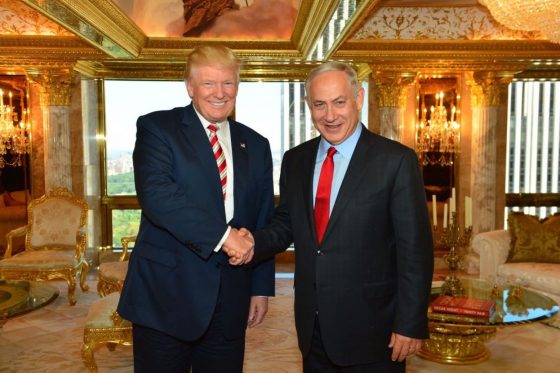
Trump’s stance on Iran is particularly important now, as Iran recently held a military exercise to test its missile and radar systems after the Trump administration imposed sanctions on Tehran for a ballistic missile test. When Israeli Prime Minister Benjamin Netanyahu visits Trump in Washington DC this week, it will be worth noting what the leaders say about the Iran nuclear deal and what kind of role the US will play in Israel.
Netanyahu fought tooth and nail against the nuclear agreement negotiated by the Obama administration with Iran. Trump slammed it as “one of the dumbest deals ever.” Senior members of his administration share this view and are apprehensive about Iranian intentions.
Obama gave a high priority to negotiating the Israeli-Palestinian conflict and was obsessed with Jewish settlements in the West Bank. He estranged Israelis by not distinguishing between Israeli building in Jerusalem and in the West Bank. He often dished out “tough love” to Israel, as he called it when addressing a synagogue in Washington, DC.
Trump and his advisors, by contrast, seem more relaxed about the Israeli-Palestinian issue, correctly understanding that it is by no means the most important problem in the chaotic Middle East. Even the White House criticism of new settlement building plans – it called them unhelpful to the peace process, but added that they are not impediments to peace – represents a positive change to many Israelis.
Furthermore, Trump’s promise to move the American embassy in Israel from Tel Aviv to Jerusalem seems more sincere than similar promises made by previous presidential candidates. Throughout his campaign and into the early days of his presidency, Trump has shown that he follows through, and is more concerned with fulfilling his promises than flattering the electorate. Israelis cannot understand why other countries refuse to accept Jerusalem as their capital and to place their embassies in western Jerusalem, which is not, after all, disputed territory. Picking David Friedman – an Orthodox, pro-settlement, Jewish American who owns an apartment in Jerusalem – as ambassador to Israel lends credence to Trump’s promise.
Several of Trump’s positions that draw tremendous criticism at home and abroad are less problematic for Israelis. For example, the idea of building a wall along the US-Mexico border to stop illegal immigration is viewed in Israel as the expression of the sovereign right of any nation to prevent undesirable elements from entering its territory. Israel has built walls and fences to stop the infiltration of terrorists and illegal immigrants from Palestinian territory.
Trump’s diatribes against Muslims are unseemly, but Israelis can understand where he is coming from, since they have been subjected to Muslim terrorism and Arab state aggression for 100 years. The political correctness of the Obama years – when the president refused to acknowledge radical Islam as the source of most of the terrorism in the world – frustrated Israelis.
Thus, Trump’s willingness to speak his mind is appreciated in Israel, even if some of his statements border on the vulgar. It is refreshing to the Israeli ear to hear an American president decline to beat around the bush, but rather to address issues directly, without the constraints of liberal political correctness. This quality has earned Trump some popularity in Israel.
Israelis well know that a portion of the Washington bureaucracy, especially at the Department of State, and some of the media and academic elites are unfriendly to Israel. They welcome a president who dislikes that bureaucracy and is critical of those elites.
We should not forget that since the late 1960s, Israelis have largely preferred Republican presidents. Yitzhak Rabin, who served as Israel’s ambassador to Washington from 1968 to 1973, openly supported the Republican presidential candidate, Richard Nixon. Similarly, Prime Minister Netanyahu made his preference for Mitt Romney over Obama abundantly clear. Unlike many European politicians and American Democrats, Israelis are substantially nationalist and conservative. The conservative Israeli Likud party has won more elections than any other party since 1977.
Israelis followed the decline of American international fortunes during the Obama years with alarm. It frightens them to see America so weakened. Thus, a Trump who wants to make his country great again by increasing defense spending and standing tall against America’s enemies abroad (especially Iran) strikes a responsive chord among Israelis.
Finally, Trump’s family biography endears him to Israelis. His daughter converted to Judaism and belongs to an Orthodox community. Trump has Jewish grandchildren of whom he is proud. His Jewish son-in-law, Jared Kushner, is an important advisor. Living in New York may have sensitized him to the sensibilities of the Jewish community. Moreover, he has always expressed strong support for the Jewish state.
After eight years of the distant President Obama in the White House – a president who used his last days in office to lash out at Israel at the UN – it should not be surprising that Israelis are looking forward, with some trepidation but even more hope, to working with the new American president. While the euphoria displayed by some right-wing circles in Israel is not warranted, an improvement in bilateral relations is a realistic expectation.

Thursday, February 2, 2017

#OyVeyDonaldTrump bear hugs Obama's M.E. Policy. Pax Americana returns.Netanyahu is given a Putz on his Touchas and sent to bed without "gifts' of Caviar, Cigar and a Magnum of Champagne


Trump Embraces Pillars of Obama’s Foreign Policy


Israeli Prime Minister Benjamin Netanyahu delivers a speech during a memorial ceremony for Ron Nahman, the founder of Ariel, one of the largest Israeli settlements in the occupied West Bank on Thursday.CreditJack Guez/Agence France-Presse — Getty Images

WASHINGTON — President Trump, after promising a radical break with the foreign policy of Barack Obama, is embracing key pillars of the former administration’s strategy, including warning Israel to curb construction of settlements, demanding that Russia withdraw from Crimea and threatening Iran with sanctions for ballistic missile tests.

In the most startling shift, the White House issued an unexpected statement appealing to the Israeli government not to expand the construction of Jewish settlements beyond their current borders in East Jerusalem and the West Bank. Such expansion, it said, “may not be helpful in achieving” the goal of peace.

At the United Nations, Ambassador Nikki R. Haley declared that the United States would not lift sanctions against Russia until it stopped destabilizing Ukraine and pulled troops out of Crimea.

On Iran, the administration is preparing a set of economic sanctions that are similar to what the Obama administration imposed just over a year ago. The White House has also shown no indication that it plans to rip up Mr. Obama’s landmark nuclear deal, despite Mr. Trump’s withering criticism of it during the presidential campaign.Continue reading the main story


The Trump White House
Stories about President Trump’s administration.


Melania Trump’s Absence From Washington Raises Questions About Her RoleFEB 2


New C.I.A. Deputy Director Had Leading Role in Torture of DetaineesFEB 2


Trump Looks to Another Finance Veteran for Senior RoleFEB 2


Pointing to Trump, Groups Reject U.S. Aid to Fight ExtremismFEB 2


For Europe, There’s a New Threat in Town: The U.S.FEB 2


See More »


ADVERTISEMENTContinue reading the main story


New administrations often fail to change the foreign policies of their predecessors as radically as they promised, in large part because statecraft is so different from campaigning. And of course, today’s positions could shift over time. But the Trump administration’s reversals were particularly stark because they came after days of tempestuous phone calls between Mr. Trump and foreign leaders, in which he gleefully challenged diplomatic orthodoxy and appeared to jeopardize one relationship after another.

Mr. Trump, for example, made warmer relations with Russia the centerpiece of his foreign policy during the campaign, and European leaders were steeling for him to lift the sanctions that they and Mr. Obama imposed on President Vladimir V. Putin after he annexed Crimea. But on Thursday, Mr. Trump’s United Nations ambassador, Ms. Haley, sounded a lot like her predecessor, Samantha Power.

“We do want to better our relations with Russia,” Ms. Haley said in her first remarks to an open session of the United Nations Security Council. “However, the dire situation in eastern Ukraine is one that demands clear and strong condemnation of Russian actions.”

Similarly, Mr. Trump presented himself during the campaign as a stalwart supporter of Israel and sharply criticized the Obama administration for allowing the passage of a Security Council resolution in December that condemned Israel for its expansion of settlements.

“While we don’t believe the existence of settlements is an impediment to peace,” the White House press secretary, Sean Spicer, said in a statement, “the construction of new settlements or the expansion of existing settlements beyond their current borders may not be helpful in achieving that goal.”

The White House noted that the president “has not taken an official position on settlement activity.” It said Mr. Trump would discuss the issue with Prime Minister Benjamin Netanyahu of Israel when they meet Feb. 15, in effect telling Mr. Netanyahu to wait until then. Emboldened by Mr. Trump’s support, Israel had announced more than 5,000 new homes in the West Bank since his inauguration.

Mr. Trump shifted his policy after he met briefly with King Abdullah II of Jordan on the sidelines of the National Prayer Breakfast — an encounter that put the king, one of the most respected leaders of the Arab world, ahead of Mr. Netanyahu in seeing the new president. Jordan, with its large Palestinian population, has been steadfastly critical of settlements.

The administration’s abrupt turnaround also coincided with Secretary of State Rex W. Tillerson’s first day at the State Department and the arrival of Defense Secretary Jim Mattis in South Korea on his first official trip. Both men are viewed as potentially capable of exerting a moderating influence on the president and his cadre of White House advisers, though it was unclear how much they had to do with the shifts.

With Iran, Mr. Trump has indisputably taken a harder line than his predecessor. While the Obama administration often looked for ways to avoid confrontation with Iran in its last year, Mr. Trump seems equally eager to challenge what he has said is an Iranian expansion across the region, especially in Iraq and Yemen.

Get the Morning Briefing by Email

What you need to know to start your day, delivered to your inbox Monday through Friday.

Sign Up

Receive occasional updates and special offers for The New York Times's products and services.


SEE SAMPLE
PRIVACY POLICY

In an early morning Twitter post on Thursday, Mr. Trump was bombastic on Iran.

“Iran has been formally PUT ON NOTICE for firing a ballistic missile,” he wrote. “Should have been thankful for the terrible deal the U.S. made with them!” In a second post, he said wrongly, “Iran was on its last legs and ready to collapse until the U.S. came along and gave it a life-line in the form of the Iran Deal: $150 billion.”

Still, the administration has been careful not to specify what the national security adviser, Michael T. Flynn, meant when he said on Wednesday that Iran had been put “on notice” for its missile test and for its arming and training of the Houthi rebels in Yemen.

The new sanctions could be announced as soon as Friday. But most experts have said they will have little practical effect, because the companies that supply missile parts rarely have direct business with the United States, and allies have usually been reluctant to reimpose sanctions after many were lifted as part of the 2015 nuclear accord.

Ali Akbar Velayati, an adviser to Iran’s supreme leader, replied, “This is not the first time that an inexperienced person has threatened Iran,” according to the semiofficial Fars news agency. “The American government will understand that threatening Iran is useless.”

Some analysts said they worried that the administration did not have tools, short of military action, to back up its warning.

“Whether the Trump administration intended it or not, they have created their own red line,” said Aaron David Miller, a senior fellow at the Woodrow Wilson International Center for Scholars. “When Iran tests again, the administration will have no choice but to put up or shut up.”

Mr. Netanyahu will cheer Mr. Trump’s tough tone with Iran. But the American statement on settlements may force him to change course on a delicate domestic issue. His coalition government seemed to take Mr. Trump’s inauguration as a starting gun in a race to increase its construction in occupied territory.

After Mr. Trump was sworn in, the Israeli government announced that it would authorize another 2,500 homes in areas already settled in the West Bank, and then followed that this week with an announcement of 3,000 more. On Wednesday, Mr. Netanyahu took it a step further, vowing to build the first new settlement in the West Bank in many years.

For Mr. Netanyahu, the settlement spree reflects a sense of liberation after years of constraints from Washington, especially under Mr. Obama, who, like other presidents, viewed settlement construction as harmful to the chances of negotiating a final peace settlement. It is also an effort to deflect criticism from Israel’s political right for Mr. Netanyahu’s compliance with a court order to force several dozen families out of the illegal West Bank outpost of Amona.

Mr. Trump had also promised to move the American Embassy from Tel Aviv to Jerusalem. But in recent weeks, the White House slowed down the move, in part out of concern that it would cause a violent response.

The policy shifts came after a turbulent week in which Mr. Trump also clashed with the leaders of Australia and Mexico over one of the most fraught issues of his new presidency: immigration. He defended the tense exchanges as an overdue display of toughness by a United States that has been exploited “by every nation in the world, virtually.”

“They’re tough; we have to be tough. It’s time we’re going to be a little tough, folks,” he said at the prayer breakfast Thursday. “It’s not going to happen anymore.”

Yet later in the day, the White House felt obliged to put a more diplomatic gloss on events. Mr. Spicer said Mr. Trump’s call with Prime Minister Malcolm Turnbull of Australia had been “very cordial,” even if Mr. Trump bitterly opposed an agreement negotiated by the Obama administration for the United States to accept the transfer of 1,250 refugees from an Australian detention camp.

A senior administration official disputed a report that Mr. Trump had threatened to send troops to Mexico to deal with its “bad hombres.” The official said that the conversation with President Enrique Peña Nieto had been “actually very friendly,” and that Mr. Trump had been speaking in jest.

Sunday, January 29, 2017

Benjamin Netanyahu's tweet Praising #OyVeyDonaldTrump's Plan for Mexico Wall Prompts International and Local Backlash. Arse licking sycophant, toady brownnoser of Trump's Rump doesn't become you Bibikins


 tweet praising Trump's plan for Mexico wall prompts international backlash

Image result for netanyahu kisses trump's arse cartoon

When Benjamin Netanyahu sent a tweet in support of President Donald Trump’s plan for a wall along the Mexican border, the Israeli prime minister can barely have expected it would be retweeted 40,000 times and cause a backlash at home and abroad.

Already under arguably the greatest pressure he has faced in his 11 years as prime minister, with police questioning him in two criminal probes into abuse of office, aligning himself with Trump may further undermine his standing.

The tweet, sent from his personal account shortly before the Jewish sabbath officially ended on Saturday, was very clear:

“President Trump is right. I built a wall along Israel’s southern border. It stopped all illegal immigration. Great Success. Great idea,” Netanyahu wrote, appending pictures of the Israeli and US flags alongside each other.
Related image

​Netanyahu was referring to a steel fence Israel has built along its border with Egypt, mainly to keep out migrants fleeing conflicts in Africa, including Somalis, Sudanese and Eritreans.

Israel has also built a steel and concrete barrier along its border with the occupied West Bank, which it says is to prevent militants crossing into Israel. Palestinians see the barrier, which has drawn international condemnation, as a land grab.

On the one hand, Trump’s election as president was seen as a godsend for Netanyahu, the first time in four terms as prime minister that he would have a Republican in the White House.

As well as the Republicans being more ideologically aligned with Netanyahu’s right-wing coalition, Trump has already shown a willingness to turn a blind eye to Israel’s settlement-building in the West Bank, which Barack Obama’s administration frequently criticised, casting a pall over US-Israeli ties.

On the other hand, Trump is an unpredictable actor who in just nine days in office has sown division across the United States and shocked capitals around the world with a series of executive actions that are overturning decades of US policy.

The Mexican government was outraged that he would involve himself in what it regards as a bilateral issue.The adverse reaction to Netanyahu’s tweet, which was retweeted by Trump and drew far more attention than Netanyahu’s tweets usually do as a result, appeared to be an early sign of the danger Netanyahu faces in aligning himself with Trump.

“The foreign ministry expressed to the government of Israel, via its ambassador in Mexico, its profound astonishment, rejection and disappointment over Prime Minister Netanyahu’s message,” the foreign ministry said in a statement.

“Mexico is a friend of Israel and should be treated as such by its Prime Minister.”

Dan Shapiro, who served as ambassador to Israel under Obama until nine days ago and still lives in the country, ditched diplomacy to question Netanyahu’s motives in sending the tweet.

“Hard to explain this intervention on a hotly debated issue in domestic US politics. Unless this endorsement is Trump’s demand of Netanyahu for something Netanyahu wants,” he wrote on Twitter, suggesting it may be linked to Trump’s promise to move the US embassy from Tel Aviv to Jerusalem.

The controversial laws Donald Trump has already passed

“To me, it looks like Trump is already squeezing Netanyahu hard.”

Opposition politician Yair Lapid, who is ahead of Netanyahu in recent opinion polls, was also scathing. Whereas Lapid has shied away from criticising Netanyahu over the police investigations into him, this time he didn’t hold back.

“A serious mistake by Netanyahu,” Lapid tweeted in Hebrew.

“It is a needless declaration of war on Mexico and Hispanics and a rupture with the Democrats (including the majority of US Jews). It doesn't matter what we think of the wall, don’t we have enough troubles of our own?”

Although Netanyahu has not deleted the tweet, Israel’s foreign ministry immediately sought to nuance its content.

The prime minister was referring to Israel’s “specific security experience”, the foreign ministry spokesman said, adding: “We do not express a position on US-Mexico relations.”

Thursday, January 19, 2017

Kiryat Hamemshala Approved ...... Billion Shekel Extravagant Playground for future Prime Ministers of Zion


Billion-Shekel Compound for Israeli PM, With Underground Command Center ‘Bunker’ for National Emergencies, Approved by Jerusalem Building, Planning Committee


A view of what the new compound for the Israeli prime minister will look like when built. Photo: Channel 10.

The Jerusalem District Planning and Building Committee has approved a plan to erect a massive compound to house the office and private residence of the prime minister, Israel’s Channel 10 reported on Tuesday.

According to the report, the compound will be built in the “government precinct” — known by Israelis as Kiryat Hamemshala — located in the neighborhood of Givat Ram, where the Supreme Court is situated, and not far from the Knesset and one of the Hebrew University campuses.

The structure is expected to have between five and eight stories, and an area designated for official ceremonies. It will also include a huge underground “bunker,” to be used by the prime minister and representatives of the civil and defense establishment during times of national emergency. The cost of the project is estimated at NIS 1 billion ($262.3 million).

Today, the prime minister’s residence is located in the Jerusalem neighborhood of Rehavia. Its official name is Beit Aghion and was built in the late 1930s.

In 2009, the Israeli government approved the Almog Project to combine the prime minister’s living quarters and office, but its estimated cost at the time — NIS 650 million (approximately $170 million) — sparked criticism for its alleged extravagance, and the plan was canceled.

In 2014, the idea to move the Israeli leader’s home to the area of his office resurfaced and was approved.

The compound in question was given the official green light at a recent Cabinet Meeting.

Thursday, December 29, 2016

Zion loses its Virginity ( finally) to backstabbing Uncle Sambama : United Nations Security Council Resolution 2334 a step away for the Cause of Peace.

0
 

 In four respects, UNSCR 2334 undermines the prospects of Israeli-Palestinian peace and threatens what little regional stability is left. First, it could force Israel to fall back on its powerful legal position as the only existing legal inheritor of the British Mandate. Second, it compounds the error made by Obama's transition team even before he came to power of ignoring a written commitment of a US president. Third, it has placed Sisi's government in Egypt – a keystone of regional stability – in an untenable position. Fourth and most painfully, it will make it far more complicated – if not impossible – for the Palestinian leadership, enticed by the prospect of international coercion, to accept a reasonable compromise. The New Zealanders, do-gooders with a very dim understanding of what they have wrought, can be forgiven such folly. The Obama administration has no such excuses.
"Be careful what you wish for; you might get it" says the old adage, and sober elements among the Palestinian leadership may yet rue the day they managed to secure an American abstention leading to the adoption of United Nations Security Council Resolution 2334. The resolution condemns “settlement activity” anywhere, including East Jerusalem, and calls upon all members to distinguish in practice between Jews who live on one side of the Armistice Line of 1949 and those who live beyond it. It presumes to speak in the name of international law and to create the conditions for further progress towards peace in the interests of both Palestinians and "legitimate" Israelis. In fact, this poorly designed and atrociously timed diplomatic tool seems set to harm, if not entirely destroy, the very purposes it was designed to serve.
It is bound to do damage to Israeli interests (and those of Palestinian employees in Jewish-owned businesses) through the encouragement of practices already promoted by the EU (labelling, differential tariffs, etc.) and by giving momentum to the BDS movement, which aims at the ultimate delegitimization of Israel and the entire Zionist project. But these effects can be effectively countered by energetic action by Israel and its friends, not least in the US Congress. As in the (non-comparable) case of terrorism, they must not be allowed to dictate life and death decisions to Israel that need to be taken strictly according to the national interest.
Much greater harm has been done to the prospects for peace and regional stability.  There are several sad aspects to this, all pointing to the short-sighted and perhaps vindictive mindset behind the Obama administration's decision to let it happen when it could easily have been avoided. In line with several of the administration’s past decisions, it speaks the language of high morality but fails to attend to basic facts or possible consequences.
To begin with, the entire disquisition rests upon President Jimmy Carter's costly mistake of allowing a similar text, UNSCR 465, to slip through in March 1980. The passage of that resolution had serious consequences both to Carter’s political standing (Obama, preferring to act in his lame duck period, took no such risks) and to the advancement of the process initiated at Camp David. When Israeli leaders are confronted with a UN and US endorsement of the Arab narrative, which ignores the circumstances of both 1949 and 1967, they are unlikely to feel comfortable enough to work for an equitable compromise, and certainly not when there is no partner for compromise on the other side.
Moreover, by using litigious language (which may lead to trouble at the ICC, if the Prosecutor's office is not careful in the use of criteria such as gravitas and complementarity), UNSCR 2334 may leave Israel no choice but to stand on its own interpretation of international law. That interpretation stands on very firm ground, as suggested by the late Supreme Court Justice Edmond Levy. The so-called "Palestinian Occupied Territories" were never Palestinian at any point for these reasons: first, the Palestinian leadership rejected UNGAR 181 (November 1947) in all its aspects and launched a war of annihilation; and second, the territories were held between 1949 and 1967 by an occupying power that gained the recognition of only two states (Britain and Pakistan) to their annexation to Jordan. They are therefore, as the late Prime Minister Begin was fond of reminding his listeners, res nullius. Israel is thus the only existing inheritor of the League of Nations mandate, which called upon the mandatory power to secure the "close settlement of Jews on the land."
Israel never chose to turn the political effort to reach a compromise into a legal wrangle, but that choice may now have been thrust upon it. The Israeli government has sidestepped even elementary legal arguments, such as the obvious meaning of the phrase in UNSCR 242 calling for withdrawal from "territories," not "the territories." The assumption was that a narrow legal approach would bind Israel’s hands when the day came to offer significant concessions. But now that Israel has been essentially put in the dock by 2334, it has ample legal tools at its disposal with which to counter the assault – at the expense, sadly, of a coherent discussion of practical compromises.
A second unfortunate aspect is that the Obama administration, secure in the presumption that it was "saving Israel from itself," drew no lessons from its own past errors of judgment. This goes all the way back to the decision, taken by Obama’s transition team before the 2009 inauguration, to annul a written commitment by President George W. Bush in an exchange of letters with Prime Minister Ariel Sharon in April 2004 that implied that the terms of reference for negotiations should reflect the demographic realities on the ground. This abandonment, which shook Israeli professionals and politicians, was unprecedented, and did much to undermine the prospect of peace from day one. Indeed, Obama's efforts to create "daylight" between US and Israeli positions led to the one of the longest barren periods in the history of the peace process. Now the mistake has been repeated and worsened. A tragedy replayed as a farce is still a tragedy.
A third and highly damaging, if indirect, result of the vote is the potential discrediting of Egyptian President Sisi as a useful influence in the region. Approached by President-elect Trump, with whom he has established a warm relationship, Sisi was willing to pull the Egyptian draft. Instead of honoring Trump’s wish to let the incoming administration take its own stock of the situation, Obama dismissed the effort as irrelevant. With the proclamation “we are still here,” he went ahead with the resolution, cooperating with the likes of Venezuela and Malaysia, putting Sisi in the untenable position of being less loyal than they are to the Arab cause. Obama’s ill-judged action has reduced Sisi’s vital role as a cornerstone of regional stability, and rapid action will be required to undo the damage.
Finally and most tragically, the resolution greatly reduces the likelihood that the Palestinian leadership will have what it takes to strike a workable compromise at the negotiating table. It is weak and divided (notwithstanding President Abbas’s success at the Seventh Fatah Conference, where he isolated and even criminalized his rival, Muhammad Dahlan), and has not been marked hitherto by the courage necessary to make an implementable outcome possible.
Abbas did offer a conciliatory note after the UN vote, calling for coexistence and implying that he is aware that the future still depends on the Israeli electorate. But he is less able now than ever before to offer a vision that departs from the template of expectations he and his colleagues have generated. A "solution" tailored to satisfy the hopes fostered by the UNSCR text – i.e., the delegitimization and ultimate removal of each and every Jew living beyond the 1949 armistice lines, absurdly including East Jerusalem – simply cannot be implemented. Anyone who encourages the Palestinians to believe that the forced removal of hundreds of thousands is preferable to a convoluted but practical compromise that would involve human dislocation on a much smaller scale – and that leaves Jerusalem a living, united city – is abetting a pipe dream.
Venezuela and Malaysia, virulent anti-Israel players, did this for their own reasons. Senegal tagged along. New Zealand may have failed to comprehend what the initiative entails, and in Europe the settlements have been an obsessive preoccupation for years. But the Obama administration was well positioned to know that this resolution would do little but harm. Its decision to let it happen anyway, when Egypt offered a legitimate and honorable way out, raises troubling questions about Obama’s motives. Still, there is a silver lining. Given the Obama administration’s own practice of annulling its predecessor's position, it is now their position that can legitimately be undone – by practical and symbolic acts – come January 21.

Tuesday, December 27, 2016

#RIPUSA Defying U.N., Israel Prepares to Build More Settlements


Housing construction last week on the outskirts of Ramat Shlomo, a Jewish housing development in East Jerusalem. CreditJim Hollander/European Pressphoto Agency

 Undeterred by a resounding defeat at the United Nations, Israel’s government said Monday that it would move ahead with thousands of new homes in East Jerusalem and warned nations against further action, declaring that Israel does not “turn the other cheek.”

Just a few days after the United Nations Security Council voted to condemn Israeli settlements, Jerusalem’s municipal government signaled that it would not back down: The city intends to approve 600 housing units in the predominantly Palestinian eastern section of town on Wednesday in what a top official called a first installment on 5,600 new homes.

The defiant posture reflected a bristling anger among Israel’s pro-settlement political leaders, who not only blamed the United States for failing to block the Council resolution, but also claimed to have secret intelligence showing that President Obama’s team had orchestrated it. American officials strongly denied the claim, but the sides seem poised for more weeks of conflict until Mr. Obama hands over the presidency to Donald J. Trump.

Prime Minister Benjamin Netanyahu has lashed out at Security Council countries by curbing diplomatic contacts, recalling envoys, cutting off aid and summoning the American ambassador for a scolding. He canceled a planned visit this week by Ukraine’s prime minister even as he expressed concern on Monday that Mr. Obama was planning more action at the United Nations before his term ends next month.Continue reading the main story


The prime minister defended his retaliation. “Israel is a country with national pride, and we do not turn the other cheek,” he said. “This is a responsible, measured and vigorous response, the natural response of a healthy people that is making it clear to the nations of the world that what was done at the U.N. is unacceptable to us.”

The Security Council resolution that passed Friday condemned Israeli settlements in the West Bank and East Jerusalem as a “flagrant violation under international law” and an obstacle to peace. The Council approved it 14 to 0, with the United States abstaining instead of using its unilateral veto, as it has in the past.

Mr. Trump publicly pressed for a veto of the resolution and has chosen a settlement advocate as his administration’s ambassador to Israel. He turned to Twitter on Monday night to air complaints that the United Nations “is just a club for people to get together, talk and have a good time.”

Palestinian leaders made clear that they would use the resolution in international bodies to press their case against Israel. With the imprimatur of a United Nations finding of illegality, they said, they will campaign to require that other countries not just label products made in the settlements, but ban them.

“Now we can talk about the boycott of all settlements, the companies that work with them, et cetera, and actually take legal action against them if they continue to work with them,” Riad Malki, the Palestinian foreign minister, was quoted as saying by the Palestinian news media.

He outlined other steps the Palestinians could now take, using the resolution to press the International Criminal Court to prosecute Israeli leaders, file lawsuits on behalf of specific Palestinians displaced by settlements and urge the international authorities to determine whether Israel is violating the Geneva Conventions.

“We are looking to devise a comprehensive vision, and hopefully 2017 will be the year when the Israeli occupation ends,” Mr. Malki said.

Israeli officials said such pronouncements showed that the resolution actually undermined chances for a negotiated settlement because the Palestinians now have less incentive to come to the table. By declaring Israeli settlements illegal, they said, the United Nations essentially took away the one chip that Israel had to trade, meaning land.

“The Palestinians are waging a diplomatic and legal war against Israel. That’s the strategy,” Ron Dermer, the Israeli ambassador to the United States, said in a phone interview. “Their strategy is not to negotiate an agreement with Israel because a deal is give and take. They want take and take.”

Israel’s settlement project, once a scattering of houses across the so-called Green Line marking the borders before the 1967 Arab-Israeli war, has grown substantially over the years. In 2009, the year Mr. Obama took office, 297,000 people lived in West Bank settlements and 193,737 in East Jerusalem. That increased to 386,000 in the West Bank by the end of last year and 208,000 in East Jerusalem by the end of 2014, according to Peace Now, a group that opposes settlements.

Israeli officials note that when Mr. Netanyahu acquiesced to a 10-month settlement freeze sought by Mr. Obama in 2009, the Palestinians still did not agree to negotiate until just before time ran out. But the addition of more than 100,000 settlers during Mr. Obama’s tenure convinced him that it was time to change his approach at the United Nations, aides said.

The 618 housing units to be granted building permits in East Jerusalem on Wednesday have been in the works for a while, and the planning committee meeting agenda was set before the United Nations acted. But the committee chairman said he was determined to go forward with units totaling 5,600.

“I won’t get worked up over the U.N. or any other organization that might try to dictate to us what to do in Jerusalem,” Deputy Mayor Meir Turgeman, the planning committee chairman, told the newspaper Israel Hayom. “I hope that the government and the new administration in the United States will give us momentum to continue.”

Although he did not specify which projects he had in mind, Ir Amim, a private group tracking settlements in East Jerusalem, said he was probably referring to projects in Gilo and Givat Hamatos. Betty Herschman, the group’s director of international relations and advocacy, said it was “defiance demonstrated after Trump’s election, now reinforced by the U.N. resolution.”

Anat Ben Nun, the director of development and external relations for Peace Now, said such construction was problematic. “Netanyahu’s attempt to avenge the U.N.S.C. resolution through approval of plans beyond the Green Line will only harm Israelis and Palestinians by making it more difficult to arrive at a two-state solution,” she said.

Israeli leaders said they had no reason to stop building. The Security Council resolution “was absurd and totally removed from reality,” said Oded Revivi, chief foreign envoy for the Yesha Council, which represents West Bank settlers. “Israeli building policies are set in Jerusalem, not New York.”

For the fourth day, Israeli officials accused Mr. Obama’s team of ambushing them at the United Nations. While the White House denied it, Israeli officials pointed to a meeting between Secretary of State John Kerry and his New Zealand counterpart a month before the Council vote discussing a resolution on the Israeli-Palestinian conflict. New Zealand was a sponsor of Friday’s measure.

Mr. Dermer, the ambassador, said Israel had other, nonpublic information proving the Obama administration’s involvement but provided no evidence and would not elaborate beyond saying it would be provided to Mr. Trump’s team when he takes office.

“They not only did not get up and stop it, they were behind it from the beginning,” Mr. Dermer said. “This is why the prime minister is so angry. We’re going to stand up against it.”

Israeli officials worried that Mr. Kerry would use a coming speech or a conference in France to outline an American peace plan that would be hostile to Israel’s interests. Mr. Kerry’s office had no comment.

The fury of Mr. Netanyahu’s response has generated debate at home. Mitchell Barak, a political consultant, said the political left considered the resolution “an epic foreign policy and diplomatic debacle” by Mr. Netanyahu.

But to his base, the Security Council action confirmed what they believed all along, that Mr. Obama is inherently anti-Israel, and so the prime minister comes across as a champion beset by enemies. “For them,” Mr. Barak said, “Netanyahu emerges from this unscathed, as the lone wolf in a lion’s den of hatred.”

Saturday, October 22, 2016

Poll: Israelis strongly favor Clinton over Trump by 42% to24%


Story highlights

  • The findings run counter to a recent trend
  • Israelis believe Clinton would put more pressure on them for peace talks
Jerusalem (CNN)Almost twice as many Israelis prefer Hillary Clinton to Donald Trump, bucking the recent trend of Republican presidential candidates winning more support than Democrats, according to a new poll.
When asked which candidate they preferred, 42% of Israelis said Clinton, compared with 24% who cited Trump, a survey from the Israel Democracy Institute found. Another 13% said the candidates are the same from Israel's perspective.
    The poll results represent a change from recent cycles in which Israelis have favored GOP candidates.
    In fact, Israelis haven't preferred a Democrat in the White House since 2000, said Shmuel Rosner, author of "The Jewish Vote: Obama vs. Romney: A Voter's Guide."
    "Clinton is a well-known commodity in Israel. Bill Clinton, up until today, according to several polls, is considered by Israelis to be the most friendly US president ever towards Israel," Rosner said.
    "So they (pollsters) say the name Clinton and it rings familiar," he added. "They assume that if Bill Clinton was such a friendly president to Israel, then his wife must be friendly as well."
    The survey included Arab-Israelis and found the percentage who favor Trump is much lower than among Jewish Israelis. Only 11% of the Arabs surveyed believe he would be preferable, compared with 27% of Jews.
    RELATED: Trump finds corner of support in Israel
    Trump has had problems attracting the Jewish vote in the US after claims of anti-Semitic themes in various tweets and the backing he's received from the former head of the KKK, David Duke, and the American Nazi Party. A report this week by the Anti-Defamation League also found nearly 20,000 anti-Semitic tweets have been directed at more than 800 journalists since the campaign began, often because those journalists voiced critical opinions about Trump.


    who's winning?


    cnn/orc
    cnn poll of polls

    Hillary Clinton headshot photo

    47%
    clinton


    Donald Trump headshot photo

    42%
    trump


    Gary Johnson headshot photo

    7%
    johnson


    Jill Stein headshot photo

    2%
    stein

    Rosner said "predictability" is a key factor for why Israelis prefer Clinton.
    "Predictability is an essential quality of a US presidential candidate," he said. "(Israelis) would like to know that the president is going to follow pretty much mainstream, friendly policy toward Israel. In Trump, they see an unpredictable future president -- someone who they cannot be sure will be friendly towards Israel as previous presidents. In the choice between reliability and opportunity, Israelis will go for reliability."
    Israelis prefer Clinton even though they believe she will put more pressure on the Israeli government, according to the Democracy Institute poll.
    When asked which candidate would more heavily pressure the Israeli government to renew peace talks with the Palestinians, 57% said Clinton, while only 7% believed Trump would lean more on the Israeli government.
    "The evaluation that she will pressure Israel can be interpreted two ways: The one is positive from the left and center from those that want pressure to be exerted on Israel," said Tamar Hermann, senior fellow at the Israel Democracy Institute and academic director of the Gutmann Center for Public Opinion and Policy Research. "The second, from the right, is from those that are afraid of this pressure."
    Rosner added, "There are quite a few Israelis who do not support the current policies of the government, and for them, some American pressure on the government does not seem a terrible idea. As for the voters of the (Prime Minister Benjamin) Netanyahu coalition ... they prefer the known path of some pressure on Israel than the unknown path" of Trump.
    Israel has 200,000 eligible American voters, according to the non-partisan organization IVoteIsrael, which registers American Israelis to vote.
    The survey, conducted between October 5-9, included a total of 600 Israeli and Arab-Israeli respondents over the age of 18. The survey did not differentiate between Israelis, who cannot vote in the US election, and American-Israelis, who can vote. The margin of error is +/-4.1%.