Showing posts with label Just a Rip Roaring Zionist. Show all posts

Wednesday, November 9, 2016

#RIPUSA #AmericaHangsItsHeadInShame Donald Trump Suckered America and the World He defied the odds to become the 45th President of the United States

Image result for American Flags at half mast over white house

The polls said it wouldn’t happen this way. The forecasts said it wouldn’t happen this way. Even the betting markets said it wouldn’t happen this way.

But on Tuesday, Nov. 8, 2016, Americans elected Donald Trump the 45th President of the United States.

Sure, there was always a chance. The British voted to leave the European Union when so few expected them to do so. Why couldn’t the same thing happen in America? That thought lingered in the back of many a mind as Election Day neared and polls tightened. Every previous prediction of Trump’s political demise had proven premature. But he had insulted so many people—blacks, Hispanics, women, the disabled, his own party’s leaders, just to name a few. He had broken so many political norms—not releasing his tax returns, threatening to jail his opponent, lying at a rate never seen in modern politics. So no one, Republican, Democrat or any other stripe, saw a tsunami of this size coming. Only hours before Trump officially vanquished Democratic rival Hillary Clinton, one prominent Republican commentator was writing a political obituary for his party’s nominee.

Establishment consensus, meet thy antidote: President-elect Donald Trump.

“Now it’s time for America to bind the wounds of division,” Trump, sounding quite a different tone than the man who had opened so many of those wounds over the last 18 months, told ecstatic supporters in his victory speech. “It is time for us to come together as one united people. It’s time.”

It will take days, weeks and perhaps years for Americans and their leaders to fully understand what happened on Election Day 2016. It will take longer for the country and the world to grapple with whatever happens next. Financial markets were tanking even as the prospects of a Trump victory increased, and even as world leaders tersely congratulated him, they were surely bracing themselves to deal with a man who has pledged to reconsider decades-old international alliances and trade pacts.

But one thing should be immediately clear: Donald Trump’s triumph on the Electoral College map was overwhelming. He won perennial swing states like Florida and Ohio. He won Pennsylvania, a state that has attracted the attention of so many Republican presidential candidates over the course of decades only to inevitably vote for their Democratic opponents. He won Wisconsin, a left-leaning state that was supposedly a safe piece of Clinton’s firewall.

Even the whizzes who elected Barack Obama as President conceded they had it all wrong. “Never been as wrong on anything [in] my life,” David Plouffe, the architect of Obama’s 2008 campaign, said on Twitter as the reality began to set in.

If exit polls are to be believed, Clinton lost because her campaign made a fatal miscalculation: That the American electorate was growing so much more diverse, so fast, that it couldn’t possibly fare worse with working-class white voters than the country’s first black president had in 2012. The electoral coalition was easy to imagine.

But it proved imaginary precisely because those working-class whites—who for decades have been slowly but surely drifting away from a coastal Democratic Party elite they view as economically and culturally out of touch with their needs—found his populist, protectionist rhetoric spoke directly to them.

Vast areas of the country that had previously voted for Obama, from northeast Pennsylvania to eastern Ohio, from rural Iowa to Wisconsin and Michigan, swung solidly into Donald Trump’s column. Hispanic turnout measurably increased. But neither that nor Clinton’s wide advantage with women was enough to offset polling models that The New York Times estimates undercounted older working-class voters in the electorate by about 10 million.

Trump’s margin in the popular vote was far smaller than his Electoral College romp. As dawn broke on the East Coast, he only led by a couple hundred thousand votes, and votes from West Coast states still uncounted held open the prospect that Clinton might actually win the popular vote — surely a painful dose of déjà vu for Democrats after the 2000 election.

Whether the country can realistically heal its deep political divisions now remains to be seen. Republicans maintained control of the Senate and limited their losses in the House, giving Trump at least a nominally friendly Congress when he takes the oath of office on Jan. 20. The first order of business? Undoing the major achievements of the Obama administration — or so he has promised.

He struck a conciliatory note toward a rival who only weeks earlier he had threatened, to her face, to imprison if he were elected. “Hillary has worked very long and very hard over a long period of time,” Trump said, “and we owe her a major debt of gratitude for her service to our country.”

Clinton, for her part, conceded to Trump in a phone call but did not address her supporters. Her campaign chairman sent them home before the race was called.

#AMERICAHANGSITSHEADINSHAME,#RIPUSA: How can Americans be so dumb as to make lying racist sexual predator Donald Trump President?


Donald Trump is on the way to the White House, leaving a shattered Hillary Clinton in his wake. America, what have you done?

How could Americans be so dumb as to put into the Oval Office a lying racist tax-avoiding billionaire chancer accused of a series of sexual assaults?

Poisonous Donald Trump, the polarising venom-filled onetime TV ego within groping distance of the Presidency, would turn the USA into one long reality horror show.

Putting the white into a White House built by slaves, demonising Blacks, Mexicans and Muslims to identify just three of a prejudiced President-in-waiting's targets, will be a four-year nightmare as he deepens painful scars.

Americans struggling to make ends meet on stagnating incomes or worried about jobs will quickly discover the turbo capitalist is no saviour when he undermines the minimum wage for them and gifts big tax cuts to his country club wealthy elite.

Trump lied, lied then lied again in the contest and it is only dictators, elected or otherwise, who threaten to jail opponents - as he did with Hillary Clinton and the unstable slime ball's mob was chanting "lock her up" earlier today.


The Mirror's iconic front page when the USA re-elected Dubya

Trump told us in advance he'd be a bad loser by refusing to accept the result if he lost and my fear is he'll be a worse winner.

The protests when the great divider visits Britain will be huge and Ukip fan boy Nigel Farage won't be able to shield him from the fury of decent people repelled by his malice.

Remember the 600,000-signature petition demanding he be banned from Britain after Trump wanted Muslims barred from entering the US.

The diplomacy of Theresa May will hide her private disgust which we're told matches that of a David Cameron who publicly denounced Trump's outbursts as " divisive, stupid and wrong " in a rare comment on a foreign election.Americans are close to electing a man who MPs lined up to call a "wazzock", "buffoon" and "fool" .

Russian Tsar Vladimir Putin will be celebrating Trump's triumph in the Kremlin but for a Britain battered by Brexit shockwaves the relationship over the Atlantic is now fractured too.

Darwin's theory of evolution doesn't apply to a US which is likely to go from urbane, sophisticated Barack Obama to a Right-wing Neanderthal who gives knuckle-draggers a bad name.

Instead of the first woman President the 45th is odds on to be a creep who boasts of grabbing women .
If this election was rigged it was by the FBI's director with his explosive unfounded smear against Clinton who must conduct her own post-mortem.

But what have you done, America? You, and we, will surely regret a President Trump.

Tuesday, November 8, 2016

Trump’s White House Would Be Filled With Crooks Who’ve Done All the Stuff He Claims to Be Against


Steve Bannon, Newt Gingrich, Chris Christie, Rudy Giuliani, and Melania Trump.
Photo illustration by Slate. Photos by Getty Images, Thinkstock.

Those of us who Remember the '90s™ all had a good laugh this morning when NBC reported some potential Trump Cabinet picks:

Trump transition eyeing Rudy as AG, Newt as Sec of State, Reince as possible chief of staff 
http://www.nbcnews.com/storyline/2016-election-day/gingrich-giuliani-priebus-eyed-top-jobs-trump-white-house-sources-n678881 …
2:19 PM - 7 Nov 2016


Gingrich and Giuliani could get top jobs in a Trump White House: sources

Donald Trump's cabinet-in-waiting is taking shape. However, campaign insiders said no decisions have been made or positions finalized.nbcnews.com


Newt Gingrich as secretary of state! It's a highly ironic choice that's emblematic of Trump's entire campaign, which has basically been an 18-month-long complaint about the kinds of political and business sleaze that Trump and his closest associates have been engaging in for years.

Let's review some of the major themes of Trump's campaign rhetoric:

Immigration fraud is a big problem, he says.

Voter fraud is a big problem, he says.

"Global elites" who make money at the expense of American workers are a big problem, he says.

Corruption is a big problem, he says—particularly the corruption that Hillary Clinton allegedly engaged in while secretary of state.

And let's review the connections that various potential members of a Trump White House/Trump administration, including Gingrich, have to those issues.

Immigration fraud. Trump's potential first lady, Melania, appears to have committed immigration fraud by working without a visa in 1996.

Voter fraud. Trump's campaign chairman Steve Bannon appears to have committed voter fraud by registering to vote at an unoccupied house in Florida.

Global elites. Trump's daughter and top adviser Ivanka Trump runs a lifestyle brand whose products are mostly made overseas. (FWIW, the Trumps have given conflicting statements about whether Ivanka would be involved in her father's administration.) Trump himself, of course, is an outsourcing-happy crony capitalist who's made various windfalls throughout his life by ripping off American taxpayers, small businesses, and working-class customers.

Corruption. Newt Gingrich was the first speaker of the House in the history of the U.S. to be reprimanded for ethical violations. (Namely misusing tax-exempt funds for political purposes and lying to investigators.) According to both prosecution and defense attorneys involved in a recent trial, Chris Christie—who is in charge of Trump's White House transition team—was complicit in a New Jersey public-corruption scheme for which two of his former aides were just convicted of felonies. And Rudy Giuliani, Trump's potential attorney general, has bragged publicly in recent months about getting details of internal FBI deliberations from active agents—which would be a violation of those agents' code of conduct.

As it happens, Giuliani has a long association with Bernard Kerik, the former NYPD commissioner and would-be secretary of homeland security who went to jail in 2010 for a variety of public-corruption crimes. Kerik, who is no longer in the slammer, complained Sunday night on Twitter that James Comey was too quick to clear Hillary Clinton in her email case. Bernard Kerik for FBI director?

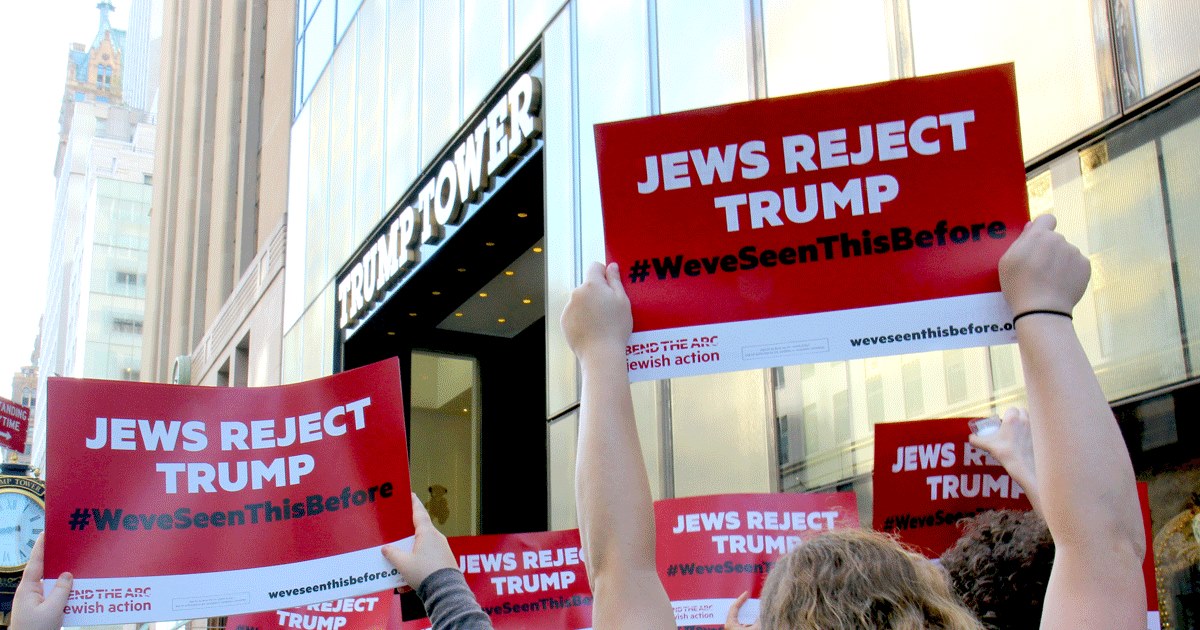
Anti-Semitism Unleashed by Trump Followers Chills Jewish Voters Even for a community grown used to the political fray, the 2016 campaign has been different. Pieties? Out. Passports? In. Paranoia? On its way.


Anti-Semitism Unleashed by Trump Followers Chills Jewish Voters
Even for a community grown used to the political fray, the 2016 campaign has been different. Pieties? Out. Passports? In. Paranoia? On its way.

Jewish Americans have never been ones to sit out an election, whether it comes to voting, political fundraising or dinner table punditry. But even for a community grown used to the political fray, the 2016 campaign was different.

The stakes are so high, the differences so stark, the language so overwrought that Trump vs. Clinton seems to overwhelm everything else.


But there is also a specific Jewish component to this election that some voters are sensing, one that has them reassessing their view of what it is to be Jewish in America.

Rabbi Daniel Bogard, 33, of Cincinnati, said he had never personally encountered anti-Semitism until this election cycle. He has now been called a Christ killer twice on social media – once each from the right and the left, when he was defending Israel.

“There’s been permission that’s been given to say these things we didn’t used to say,” said Bogard, who with his wife, Rabbi Karen Kriger Bogard, was installed recently as an associate rabbi at Adath Israel, a Conservative synagogue.

That has led him to radically alter a view he once held that the established Jewish community was too quick to charge others with anti-Semitism.

“As a rabbi, until a year ago, I would have told you anti-Semitism was absent, it’s been a bludgeon used by institutional Jewish world, we’re too quick to cry wolf, too quick to use it to form identity in our youth,” he said. “I would have said all those things. And now that I have come up against it, it has shaken my understanding.”

Donald Trump, the Republican nominee who has made broadsides against Muslims, Hispanics and other minorities a part of his campaign — recklessly, say his critics; unintentionally, say his defenders — has drawn into the light racists and anti-Semites who once occupied the margins of American life.

In turn, that has coaxed out of the closet an otherness that some Jews, especially millennials, had never sensed or thought they would experience.Image result for #weveseenthisbefore
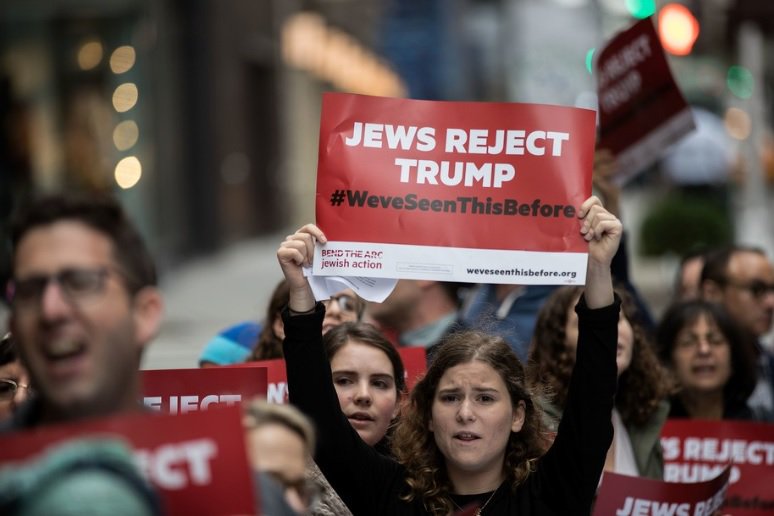
The Anti-Defamation League has warned about anti-Semitic imagery among Trump’s followers throughout the campaign, and implored the candidate to renounce the purveyors, with occasional success. Over the last couple of days, the Trump campaign released a closing television ad about an “international global power structure” that the ADL and other Jewish groups said trafficked in classic anti-Semitic themes.

Jordana Merran, 28, a foreign policy consultant in Washington, D.C., said she had been blithe about warnings from her parents’ generation that Jews could again face the privations of what seemed a distant past.

Merran is a constant presence on social media. Once she reflexively “liked” profile photos of Jewish friends because they conveyed warmth and happiness. Now, some of the same photos have been photoshopped into gas chambers and ovens — a recurring internet meme among far right anti-Semites who declare themselves supporters of Trump — and she is sickened.

“We are still a minority in this country, and that position of comfort and being at home can’t be taken for granted,” she said. “Seeing that vitriol against Jews is so shocking and disheartening. It makes you wonder, ‘Are we lucky today? What does the future hold?’”

What the future holds is not a theoretical question to some voters raised on stories of their parents or grandparents fleeing persecution.

“My sister and her son didn’t have passports, but I pushed her to get them this summer,” said Suzanne Reisman, 40, a New York City-based writer who has been harassed by anti-Semites on Twitter. “My grandparents were Holocaust survivors. I hope it won’t come to it, but if we have to flee, we are ready.”

To be sure, there are plenty of Jews who say this election is not unlike others. Maxim Smyrnyi, responding to a call put out on social media by a JTA reporter asking for comment on how the election had changed people, compared the rise of Trump to the Rev. Jeremiah Wright, the Chicago preacher who once counted President Barack Obama as a congregant. Wright was a fierce critic of Israel who once blamed “them Jews” for driving wedge between him and Obama.

“If Jews survived an actual president whose pastor of 20 years was an anti-Semite, Jeremiah Wright, they can soldier through whoever gets elected this time,” Smyrnyi said on Facebook.

Obama renounced Wright after his anti-Israel statements emerged; Wright’s anti-Semitism was manifested in comments he made after Obama snubbed him.

But there are also Jewish pundits on the political right who are worrying about the darker forces being unleashed by Trump’s intentional or collateral appeal to anti-Semites.

Jews should not “ignore the rekindling of right-wing anti-Semitism simply because its next-of-kin — left-wing anti-Zionism — remains so potent on college campuses and in progressive political circles,” wrote Bret Stephens, the Pulitzer Prize-winning columnist for The Wall Street Journal and a critic of Trump. “The GOP’s conversion to being a powerfully pro-Israel and philo-Semitic party is a relatively recent development. No law dictates that it is destined to be a lasting one.”

For its part, the Trump campaign insists that the campaign is neither anti-Semitic nor trying to appeal to the racist far right, as a top aide said Sunday in response to ADL’s criticism of the “global power structure” ad.

“Mr. Trump’s message and all of the behavior that I have witnessed over the two decades that I have known him have consistently been pro-Jewish and pro-Israel and accusations otherwise are completely off-base,” Jason Greenblatt, the top attorney for the Trump Organization and the co-chair of the campaign’s Israel advisory committee said in a statement Sunday to CBS News. “The suggestion that the ad is anything else is completely false and uncalled for.”

Others note that Trump’s daughter Ivanka and her husband, the real estate developer and key Trump adviser Jared Kushner, are Orthodox Jews.

“My father-in-law is not an anti-Semite,” Kushner wrote earlier this year. “[T]he worst that his detractors can fairly say about him is that he has been careless in retweeting imagery that can be interpreted as offensive.”

Reached for comment by JTA, some rabbis said things were same old, same old.

“I’ve had no surprising or unsettling conversations,” said Rabbi David Kaiman of Congregation B’nai Israel in Gainesville, Florida.

But for others, the election has radically transformed how they see themselves in the American landscape.

“I previously did not think of my Jewishness as a race,” said a 39-year-old woman from the Washington metropolitan area who asked not to be identified because her employer requires her not to be political.

“I didn’t like the ‘race’ characterization for two reasons: one, it smacked of the sort of caliper measuring and feature evaluation that Hitler and the Nazis favored during WWII, and two, I generally feel like race is a social construct that we humans have devised to make it easier to put people into categories and thus order our world,” she said. “But this election has changed that for me. I feel more ‘other’ than I have in the past. I have lain awake at night and considered the fate that befell my grandmother’s brothers and others of my relatives who died in the Holocaust, wondering what it felt like, how soon they realized they were doomed.”

Now this woman is trying to persuade her spouse to move to Israel with their 5-year-old daughter if Trump is elected – an option she had never seriously contemplated.

“I’m not under the impression that we’d get carted off to a camp on Jan. 21,” Inauguration Day, she said. “I think it would be a slow process; we don’t have to make a decision on Nov. 9 lest we be unable to make one later.”

Israel factors into the post-Trump calculus in different ways. Merran, the foreign policy adviser, says that Jewish acquaintances who insist on supporting Trump because he will be “better for Israel” have brought into question her allegiance to the pro-Israel community.

“When I see people in my community say we need to vote a certain way because the interests of the Jewish state are on the line, it makes me question whether we have our priorities in order,” she said.

Some older Jews said they recognized the patterns from events they had seen fresh in their youths.

The tell for Norman Gelman, 87, a retired consultant on public policy who lives in Potomac, Maryland, was that “white supremacists and neo-Nazis quickly recognized [Trump] as their champion. His demeanor and his narcissism quickly reminded me of Mussolini.”

William Berkson, 72, a writer who lives in Reston, Virginia, said that if anything, Trump posed a greater danger than earlier demagogues because he had as a tool the instant delivery guaranteed by social media.

“Today, leaders can have even more of a catalytic effect on followers because of the magnifying power of social approval,” Berkson said. “When a leader says something is OK, millions of followers can reinforce one another with the same message on social media.”

Micah Nathan, 43, a writer who lives in Newton, Massachusetts, said Trump was shocking only because he was saying plainly what Republicans had been insinuating through code for years on topics like immigration, the Muslim community and the threat from globalization.

“Trump didn’t create his base. He gave them a unified voice, minus the softening rules of public discourse,” Nathan said.

In the swing state of Ohio, where both nominees have campaigned in recent days, Bogard said the buzz starts as soon as services end.

“Everything you say in a sermon, whether it’s intended to be political or not, it’s taken to be political,” the rabbi said.

Like the mother in Washington who lays awake at night, Bogard finds his eyes shooting open in the middle of the night, “in a cold sweat because of the election.”


“I talk to a lot of people who have the 4 a.m. election fears,” he said.

How to Follow the Results on Election Day Don't read too much into the early returns

Several people cast their ballots on electronic voting machines on the first day of early voting at the Provo Recreation Center, on October 25, 2016 in Provo, Utah.


When it comes to hour-by-hour and, in some cases, minute-by-minute Election Day horse-race results, many political scientists say you’re better off avoiding it all. Close Twitter. Minimize your browser. Throw your phone in a lake.

That’s partly because while day-of projections, which are based on voter-turnout numbers and historical voting patterns, are good at providing a glimpse into the right now, they often don’t reflect bigger-picture trends. For example, younger voters, who tend to procrastinate on getting to the polls, and blue collar voters, who are less likely to have the kind of job that you can leave for an hour in the middle of the day, won’t always show up in voter-turnout tallies until after 5:30 p.m.

Day-of polls also aren’t good at detecting aberrations in voting patterns. If significant numbers of people who have never voted beforeshow up to the polls, as Donald Trump has promised, or certain demographic groups, like Latinos, end up turning out in record-high numbers, turnout-based models won’t show that.

Another reason to avoid day-of results, some political scientists argue, is that they may have the effect of depressing voter turnout in the evening hours. “It’s not just the presidential race you have to think about,” Elaine Kamarck, a senior fellow in governance studies at the Brookings Institution, told TIME. “It’s the down-ballot races in all the Western states.”

If Democrats in California can see that, say, Hillary Clinton is ahead in early results by a significant margin, Kamarck said, voters in that state may decide to avoid the hassle of going to the polls after work, which could help Republicans in both gubernatorial and statewide races, as well as local contests. Largely in deference to such fears, the biggest news outlets — ABC, CBS, NBC, CNN and Fox, as well as radio stations, newspapers, wire services and websites — redoubled their pledge before Congress to avoid calling a contest until the polls close in that state.

New, public-facing websites like VoteCastr.us promise to disrupt that tradition, which they see as unnecessarily precious in a 24-hour news cycle.

Starting Election Day morning, VoteCastr, in partnership with Slate, will publish up-to-date poll results every three hours throughout the day. Sasha Issenberg, a journalist and partner with VoteCastr, described the traditional news outlets’ “self-imposed gag order” as a disservice to the public interest and argued that that there’s “scant evidence” that calling elections before polls close has affected turnout.

http://www.slate.com/articles/news_and_politics/politics/2016/11/follow_slate_and_votecastr_for_real_time_election_day_turnout_tracking.html VoteCastr ( check it out) 
VoteCastr Welcome to an Unprecedented Election Day Experiment.Want to see who’s winning the presidential race? Follow real-time turnout projections from Slate and VoteCastr.

VoteCastr, which is backed by a bipartisan team of election veterans, including Blaise Hazelwood, former political director of the Republican National Committee, and Ken Strasma, who headed up micro-targeting for Barack Obama in 2008, will collect data from thousands of precincts across 17 battleground states, borrowing a strategy long used by candidates, parties and super PACs.

In an interview with , Strasma was cautiously optimistic about the accuracy of the effort. “Any poll depends on the pollsters’ assumptions of the makeup of the electorate,” he said. “So with VoteCastr, they’re looking at past polling and surveys and then, on Election Day, saying, ‘O.K., based on who we’re actually seeing turn out, we can reasonably expect these people in this precinct to vote in this way.” In 2012, the Obama campaign used virtually the same method to predict that in Hamilton County, Ohio, their candidate would win 56.4% of the early vote. In an article for Slate, Issenberg pointed out that their guess ended up being just two-tenths of a percent away from the final count.

Tim Saler, vice president of the research firm Grassroots Targeting and former deputy campaign manager to Florida Governor Rick Scott, was also encouraging, but reiterated that the real magic was in the modeling. In Colorado in 2012, the Mitt Romney campaign cited public polling showing their candidate doing well among independents, Saler said. But those polls missed the fact that people who were identifying as independent, because that’s the way they thought of themselves, were actually registered Republicans. So on Election Day, Romney did much worse in Colorado than his campaign’s projections showed, Saler told TIME. “You have to avoid falling into the trap of misrepresenting the baseline,” he said.

The take-home message, said Roger Tourangeau, president of the Association for Public Opinion Research, is that while many of these models have become increasingly sophisticated over the past decade, with vastly more public polling and deep historical records on voter behavior, none of it is perfect. The only surefire way to know who won an election is to wait for AP vote tallies, which will come in after polls close or early the next morning, or to count every last vote, including absentee, overseas and preliminary ballots — an impressive logistical endeavor that will be complete by the end of the week.

If you want to avoid that roller-coaster feeling Election Day, wait until the polls close to get excited.

Monday, November 7, 2016

Janet Reno, First Woman to Serve as U.S. Attorney General, 1938 -2016


Janet Reno was sworn in before the Senate Judiciary Committee in March 1993, becoming the first woman to hold the position of United States attorney general. CreditBarry Thumma/Associated Press

Janet Reno, who rose from a rustic life on the edge of the Everglades to become attorney general of the United States — the first woman to hold the job — and whose eight years in that office placed her in the middle of some of the most divisive episodes of the Clinton presidency, died on Monday at age 78.

She died at her home in Miami-Dade County, Fla., from complications of Parkinson’s disease, according to her sister, Margaret Hurchalla. The disease was diagnosed in November 1995, while she was still in office.


Ms. Reno’s tenure as attorney general was bracketed by two explosive events: a deadly federal raid on the compound of a religious cult in Waco, Tex., in 1993, and the seizing in 2000 by federal agents of Elián González, a young Cuban refugee who was at the center of an international custody battle and a political tug of war.


In those moments, and others in between, Ms. Reno was applauded for a straightforward integrity and a willingness to accept responsibility, but she was also fiercely criticized. Republicans accused her of protecting President Bill Clinton and Vice President Al Gore when, in 1997, she refused to allow an independent counsel to investigate allegations of fund-raising improprieties in the White House.

After leaving office, she mounted a surprise though unsuccessful bid in Florida in 2002 to unseat Gov. Jeb Bush, the brother of President George W. Bush, amid the resentment of Cuban-Americans in South Florida over her negotiating for the return of Elián to Cuba.

Ms. Reno was never part of the Clinton inner circle, even though she served in the Clinton cabinet for two terms, longer than any attorney general in the previous 150 years. She was a latecomer to the team, and her political and personal style clashed with the president’s, particularly as she sought to maintain some independence from the White House.

Her relations with the president were further strained by her decision to let an independent inquiry into a failed Clinton land deal in Arkansas, the so-called Whitewater investigation, expand to encompass Mr. Clinton’s sexual relationship with the White House intern Monica Lewinsky, an episode that led to his impeachment.

Mr. Clinton and his allies thought that Ms. Reno was too quick to refer to special counsels in the Lewinsky matter and other cases of suspect administration behavior. The president let her dangle in the public eye for weeks before announcing in December 1996, after his resounding re-election, that she would remain for his second term.


Bill Clinton named Ms. Reno United States attorney general in 1993. She was never part of the Clinton inner circle, however, even though she served in the Clinton cabinet for two terms.CreditRobert Giroux/Agence France-Presse — Getty Images

Ms. Reno was never a natural fit in Washington’s backslapping, highly competitive culture. At weekly news conferences in the barrel-vaulted conference room outside her office in the Justice Department building on Pennsylvania Avenue, she was fond of telling reporters that she would “do the right thing” on legal issues and judge them according to “the law and the facts.”

Imposing at 6-foot-1, awkward in manner and blunt in her probity, she became a regular foil for late-night comics and a running gag on “Saturday Night Live.” But she got the joke, proving it by gamely appearing on the show to lampoon her image.

The comedy could not obscure her law-enforcement accomplishments. Ms. Reno presided over the Justice Department in a time of economic growth, falling crime rates and mounting security threats to the nation by forces both foreign and domestic.

Under Ms. Reno, the agency initiated prosecutions in the 1993 bombing of the World Trade Center and in the 1995 bombing of the Oklahoma City federal building, helping to lay the groundwork for the pursuit of terrorists in the 21st century.

The Reno Justice Department also prosecuted spies like the C.I.A. mole Aldrich H. Ames; it filed an antitrust suit against Microsoft, a milestone in the new-technology era; and it sued the tobacco industry to reclaim federal health care dollars spent on treating illnesses caused by smoking.

Ms. Reno was a strong advocate of guaranteeing federal protection to women seeking abortions and safeguarding abortion clinics that were under threat.

But in some areas she seemed conflicted about the law. She opposed the death penalty, for example, but repeatedly authorized her prosecutors to ask juries to impose it.

When she took office, she endorsed the use of independent counsels to investigate administration figures. But she later testified against renewing the law governing their use, saying it did nothing to take politics out of the inquiries.

Before becoming attorney general, Ms. Reno was the Dade County state attorney for 14 years, a period when the Miami area was growing rapidly and experiencing rising drug-related crime, widening racial divisions, demoralizing police corruption and waves of immigration from Cuba.


Ms. Reno during a news conference at the Justice Department in 1995.CreditPaul Hosefros/The New York Times

Mr. Clinton, committed to naming a woman as attorney general, settled on Ms. Reno after his first choices — the corporate lawyer Zoe Baird and the federal judge Kimba Wood — withdrew their names in the face of criticism after it was revealed that they had employed undocumented immigrants as nannies.


“I’m just delighted to be here, and I’m going to try my level best,” Ms. Reno said at the Rose Garden ceremony at which Mr. Clinton announced her nomination on Feb. 11, 1993.

Two months later, she gained the nation’s full attention in a dramatic televised news conference in which she took full responsibility for a botched federal raid of the Waco compound of an offshoot of the Seventh-day Adventists, the Branch Davidians.

The assault, after a long siege involving close to 900 military and law-enforcement personnel and a dozen tanks, left the compound in flames and the group’s charismatic leader, David Koresh, as well as about 75 others, dead, one-third of whom were children.

Ms. Reno’s candor was viewed as refreshing in a city where blame-shifting is the norm, and it gave her sudden celebrity status in the new administration.

The luster faded quickly. Within weeks, Ms. Reno faced tough questions about the raid and her claim that children were being abused at the compound. She was also faulted for failing to influence an important crime bill. By the end of her first year in office, she was facing mounting scrutiny in the news media.

With Mr. Clinton’s re-election and his decision to keep Ms. Reno at her post, Republicans began questioning her independence when she resisted their calls for a special counsel to look into allegations that Mr. Clinton and Mr. Gore had broken campaign fund-raising laws in 1996.

The clamor, led by the House speaker, Newt Gingrich, and Senator Orrin Hatch of Utah, grew when it was disclosed that Louis J. Freeh, the head of the F.B.I., who had had a tortured relationship with Ms. Reno, also favored a special counsel.

Ms. Reno would not budge, saying her stance had nothing to do with protecting the president. A review of the evidence, she said, convinced her that a special counsel was not warranted.


Ms. Reno testified in Washington in 2004 before the commission investigating the Sept. 11 attacks.CreditDennis Cook/Associated Press

“Let me be absolutely clear,” Ms. Reno told hostile Republican questioners during one of several hearings on Capitol Hill about the call for a special counsel. “I’m not going to violate my oath in this matter because of pressure from any quarter, not from the media, not from Congress, nor from anywhere else.”

Questions about her handling of the Waco raid resurfaced in 1999, when new evidence suggested that the F.B.I. might have started the fire that destroyed the compound.

The revelation further soured her dealings with Mr. Freeh, with whom she had been close early in her tenure, but he let it be known that he favored a special counsel in the fund-raising case and a new inquiry into Waco. She sent marshals to F.B.I. headquarters to seize a tape of communications made the day of the assault.

Her final and perhaps most personal crisis as head of the Justice Department was the case involving Elián González, the 6-year-old Cuban boy who was found floating on an inner tube off the coast of Florida after his mother and 10 others drowned in a failed crossing from Cuba by small boat.

The boy became a unifying figure among Cuban exiles in South Florida, who were determined to see him remain in the United States in defiance of the Cuban leader, Fidel Castro.

Ms. Reno favored returning Elián to his father in Cuba, and she became immersed in negotiations over his fate because of her ties to Miami.

Ms. Reno was on the phone almost up to the moment agents of the Immigration and Naturalization Service burst into the Miami home of Elián’s relatives and took him away at gunpoint. Congressional Republicans and many Cuban exiles were outraged. Some in Miami said Ms. Reno would be in danger if she returned there after her service in Washington.

Early in 2001, however, she did go home, her service finished. She said she was excited about a red pickup truck she had bought.

Janet Reno was born in Miami, on the edge of the Everglades, on July 21, 1938, to Henry Olaf Reno and the former Jane Wood. Her father, born Henry Rasmussen in Denmark, came to the United States in 1913 with his own mother and father, who chose the name Reno off a map, believing it sounded more American.

Ms. Reno during a taping of “The Tonight Show with Jay Leno” in Burbank, Calif., in 2002.CreditRic Francis/Associated Press

Henry Reno was a police reporter in Dade County for more than 40 years. Jane Wood, born in Georgia, was an eccentric naturalist who would have a profound effect on Ms. Reno.

“Outspoken, outrageous, absolutely indifferent to others’ opinions, Janet Reno was truly one of a kind,” Paul Anderson, a former Miami Herald reporter, wrote in his biography of her. It was her mother who had wrestled small alligators, though the stunt was sometimes erroneously ascribed to the attorney general.

Ms. Reno, the eldest of four siblings, was about eight when her parents bought 21 acres bordering the Everglades and moved there. Her mother, who had no construction experience, built the family home. “She dug the foundation with her own hands, with a pick and shovel,” Ms. Reno told senators at her confirmation hearing in 1993.

It was a rustic life; peacocks and other creatures roamed the property, and Janet and her siblings — Robert, Mark and Margaret — cavorted barefoot. But she also glimpsed a more sophisticated world: After junior high school, she traveled to Europe to stay with an uncle, a military judge, as he presided over a spy trial.

Her sister, Ms. Hurchalla, who is known as Maggy, survives her, as do seven nieces and nephews. Her brother Robert, a former columnist for Newsday on Long Island, died in 2012 at 72. Her brother Mark had an adventurer’s life: game warden, boat and oil supply ship captain, alligator wrestler, scuba diver, paratrooper as well as carpenter and bailiff at the Miami-Dade Justice Building. He died in 2014.

After finishing high school in Miami, Ms. Reno attended Cornell University, graduating in 1960 with a degree in chemistry. She won admission to Harvard Law School and graduated in 1963, one of a handful of women in her class of more than 500.

Seeking to practice law in South Florida, Ms. Reno was turned down by one of the state’s best known law firms, Steel, Hector & Davis, and went to work for a smaller firm instead. She became active in local Democratic politics and met a fellow Harvard graduate, Gerald Lewis, a lawyer with electoral aspirations. Ms. Reno helped him win a state House seat in 1966, and the two opened a general practice law firm together.

Ms. Reno entered government service in 1971 as general counsel to the Judiciary Committee of the Florida House of Representatives, where she worked on a difficult overhaul of Florida’s courts. Her work in Tallahassee, the capital, whetted her appetite for public office, and she campaigned for a state legislative seat of her own the next year. She lost in an upset to a Republican candidate helped by the landslide re-election victory of President Richard M. Nixon.

Ms. Reno did not wait long for her next opportunity. The day after her defeat, Richard Gerstein, the state attorney for Dade County, offered her a job on his staff. As she told The Miami Herald, she expressed reservations in her characteristically straightforward manner.


Ms. Reno in her office in 1998. Under her leadership, the agency launched prosecutions in the 1993 bombing of the World Trade Center and in the 1995 bombing of the Oklahoma City federal building, helping to lay the groundwork for the pursuit of terrorists in the 21st century.CreditSusan Walsh/Associated Press

“My father was always convinced you were a crook,” she said she told Mr. Gerstein. “And I’ve always been a critic of yours.”

Mr. Gerstein replied that those were the reasons he wanted to hire her. Within a few years, she was Mr. Gerstein’s chief assistant.

Ms. Reno left the prosecutor’s office in May 1976 to join Steel, Hector & Davis, the firm that had rejected her out of law school. But her tenure there was short-lived.

After Mr. Gerstein announced that he would resign in early 1978, after 21 years in the office, Gov. Reubin Askew appointed her interim state attorney, choosing her from about 50 candidates. She was the first woman to hold the title of state attorney in Florida and one of the few in the nation’s history to be responsible for such a large jurisdiction.

Ms. Reno retained the post through a thicket of drug, murder and corruption cases. In one, she was accused of being anti-police when she prosecuted five Miami officers in the beating death of a black insurance executive after a traffic stop; the officers, she said, had tried to make it look like an accident.

The officers were acquitted — one by the presiding judge in the trial, held in Tampa, and the others by an all-white jury — provoking criticism of her legal strategy and four days of deadly riots in Miami’s predominantly black Liberty City neighborhood.

To quell the furor, Ms. Reno undertook an outreach effort that restored some support among Miami’s black citizens. She remained state attorney through five election campaigns — until February 1993, when the White House called.

Ms. Reno was formally nominated to be attorney general that same month, just a few weeks after the death of her mother, Jane, the guiding influence in her life. She invoked her mother’s memory in her remarks that day at the White House in a Rose Garden ceremony with Mr. Clinton.

“My mother always told me to do my best,” she said, “to think my best and to do right.”

Janet Reno, First Woman to Serve as U.S. Attorney General, 1938 -2016


Janet Reno was sworn in before the Senate Judiciary Committee in March 1993, becoming the first woman to hold the position of United States attorney general. CreditBarry Thumma/Associated Press

Janet Reno, who rose from a rustic life on the edge of the Everglades to become attorney general of the United States — the first woman to hold the job — and whose eight years in that office placed her in the middle of some of the most divisive episodes of the Clinton presidency, died on Monday at age 78.

She died at her home in Miami-Dade County, Fla., from complications of Parkinson’s disease, according to her sister, Margaret Hurchalla. The disease was diagnosed in November 1995, while she was still in office.


Ms. Reno’s tenure as attorney general was bracketed by two explosive events: a deadly federal raid on the compound of a religious cult in Waco, Tex., in 1993, and the seizing in 2000 by federal agents of Elián González, a young Cuban refugee who was at the center of an international custody battle and a political tug of war.


In those moments, and others in between, Ms. Reno was applauded for a straightforward integrity and a willingness to accept responsibility, but she was also fiercely criticized. Republicans accused her of protecting President Bill Clinton and Vice President Al Gore when, in 1997, she refused to allow an independent counsel to investigate allegations of fund-raising improprieties in the White House.

After leaving office, she mounted a surprise though unsuccessful bid in Florida in 2002 to unseat Gov. Jeb Bush, the brother of President George W. Bush, amid the resentment of Cuban-Americans in South Florida over her negotiating for the return of Elián to Cuba.

Ms. Reno was never part of the Clinton inner circle, even though she served in the Clinton cabinet for two terms, longer than any attorney general in the previous 150 years. She was a latecomer to the team, and her political and personal style clashed with the president’s, particularly as she sought to maintain some independence from the White House.

Her relations with the president were further strained by her decision to let an independent inquiry into a failed Clinton land deal in Arkansas, the so-called Whitewater investigation, expand to encompass Mr. Clinton’s sexual relationship with the White House intern Monica Lewinsky, an episode that led to his impeachment.

Mr. Clinton and his allies thought that Ms. Reno was too quick to refer to special counsels in the Lewinsky matter and other cases of suspect administration behavior. The president let her dangle in the public eye for weeks before announcing in December 1996, after his resounding re-election, that she would remain for his second term.


Bill Clinton named Ms. Reno United States attorney general in 1993. She was never part of the Clinton inner circle, however, even though she served in the Clinton cabinet for two terms.CreditRobert Giroux/Agence France-Presse — Getty Images

Ms. Reno was never a natural fit in Washington’s backslapping, highly competitive culture. At weekly news conferences in the barrel-vaulted conference room outside her office in the Justice Department building on Pennsylvania Avenue, she was fond of telling reporters that she would “do the right thing” on legal issues and judge them according to “the law and the facts.”

Imposing at 6-foot-1, awkward in manner and blunt in her probity, she became a regular foil for late-night comics and a running gag on “Saturday Night Live.” But she got the joke, proving it by gamely appearing on the show to lampoon her image.

The comedy could not obscure her law-enforcement accomplishments. Ms. Reno presided over the Justice Department in a time of economic growth, falling crime rates and mounting security threats to the nation by forces both foreign and domestic.

Under Ms. Reno, the agency initiated prosecutions in the 1993 bombing of the World Trade Center and in the 1995 bombing of the Oklahoma City federal building, helping to lay the groundwork for the pursuit of terrorists in the 21st century.

The Reno Justice Department also prosecuted spies like the C.I.A. mole Aldrich H. Ames; it filed an antitrust suit against Microsoft, a milestone in the new-technology era; and it sued the tobacco industry to reclaim federal health care dollars spent on treating illnesses caused by smoking.

Ms. Reno was a strong advocate of guaranteeing federal protection to women seeking abortions and safeguarding abortion clinics that were under threat.

But in some areas she seemed conflicted about the law. She opposed the death penalty, for example, but repeatedly authorized her prosecutors to ask juries to impose it.

When she took office, she endorsed the use of independent counsels to investigate administration figures. But she later testified against renewing the law governing their use, saying it did nothing to take politics out of the inquiries.

Before becoming attorney general, Ms. Reno was the Dade County state attorney for 14 years, a period when the Miami area was growing rapidly and experiencing rising drug-related crime, widening racial divisions, demoralizing police corruption and waves of immigration from Cuba.


Ms. Reno during a news conference at the Justice Department in 1995.CreditPaul Hosefros/The New York Times

Mr. Clinton, committed to naming a woman as attorney general, settled on Ms. Reno after his first choices — the corporate lawyer Zoe Baird and the federal judge Kimba Wood — withdrew their names in the face of criticism after it was revealed that they had employed undocumented immigrants as nannies.

“I’m just delighted to be here, and I’m going to try my level best,” Ms. Reno said at the Rose Garden ceremony at which Mr. Clinton announced her nomination on Feb. 11, 1993.

Two months later, she gained the nation’s full attention in a dramatic televised news conference in which she took full responsibility for a botched federal raid of the Waco compound of an offshoot of the Seventh-day Adventists, the Branch Davidians.

The assault, after a long siege involving close to 900 military and law-enforcement personnel and a dozen tanks, left the compound in flames and the group’s charismatic leader, David Koresh, as well as about 75 others, dead, one-third of whom were children.

Ms. Reno’s candor was viewed as refreshing in a city where blame-shifting is the norm, and it gave her sudden celebrity status in the new administration.

The luster faded quickly. Within weeks, Ms. Reno faced tough questions about the raid and her claim that children were being abused at the compound. She was also faulted for failing to influence an important crime bill. By the end of her first year in office, she was facing mounting scrutiny in the news media.

With Mr. Clinton’s re-election and his decision to keep Ms. Reno at her post, Republicans began questioning her independence when she resisted their calls for a special counsel to look into allegations that Mr. Clinton and Mr. Gore had broken campaign fund-raising laws in 1996.

The clamor, led by the House speaker, Newt Gingrich, and Senator Orrin Hatch of Utah, grew when it was disclosed that Louis J. Freeh, the head of the F.B.I., who had had a tortured relationship with Ms. Reno, also favored a special counsel.

Ms. Reno would not budge, saying her stance had nothing to do with protecting the president. A review of the evidence, she said, convinced her that a special counsel was not warranted.


Ms. Reno testified in Washington in 2004 before the commission investigating the Sept. 11 attacks.CreditDennis Cook/Associated Press

“Let me be absolutely clear,” Ms. Reno told hostile Republican questioners during one of several hearings on Capitol Hill about the call for a special counsel. “I’m not going to violate my oath in this matter because of pressure from any quarter, not from the media, not from Congress, nor from anywhere else.”

Questions about her handling of the Waco raid resurfaced in 1999, when new evidence suggested that the F.B.I. might have started the fire that destroyed the compound.

The revelation further soured her dealings with Mr. Freeh, with whom she had been close early in her tenure, but he let it be known that he favored a special counsel in the fund-raising case and a new inquiry into Waco. She sent marshals to F.B.I. headquarters to seize a tape of communications made the day of the assault.

Her final and perhaps most personal crisis as head of the Justice Department was the case involving Elián González, the 6-year-old Cuban boy who was found floating on an inner tube off the coast of Florida after his mother and 10 others drowned in a failed crossing from Cuba by small boat.

The boy became a unifying figure among Cuban exiles in South Florida, who were determined to see him remain in the United States in defiance of the Cuban leader, Fidel Castro.

Ms. Reno favored returning Elián to his father in Cuba, and she became immersed in negotiations over his fate because of her ties to Miami.

Ms. Reno was on the phone almost up to the moment agents of the Immigration and Naturalization Service burst into the Miami home of Elián’s relatives and took him away at gunpoint. Congressional Republicans and many Cuban exiles were outraged. Some in Miami said Ms. Reno would be in danger if she returned there after her service in Washington.

Early in 2001, however, she did go home, her service finished. She said she was excited about a red pickup truck she had bought.

Janet Reno was born in Miami, on the edge of the Everglades, on July 21, 1938, to Henry Olaf Reno and the former Jane Wood. Her father, born Henry Rasmussen in Denmark, came to the United States in 1913 with his own mother and father, who chose the name Reno off a map, believing it sounded more American.

Ms. Reno during a taping of “The Tonight Show with Jay Leno” in Burbank, Calif., in 2002.CreditRic Francis/Associated Press

Henry Reno was a police reporter in Dade County for more than 40 years. Jane Wood, born in Georgia, was an eccentric naturalist who would have a profound effect on Ms. Reno.

“Outspoken, outrageous, absolutely indifferent to others’ opinions, Janet Reno was truly one of a kind,” Paul Anderson, a former Miami Herald reporter, wrote in his biography of her. It was her mother who had wrestled small alligators, though the stunt was sometimes erroneously ascribed to the attorney general.

Ms. Reno, the eldest of four siblings, was about eight when her parents bought 21 acres bordering the Everglades and moved there. Her mother, who had no construction experience, built the family home. “She dug the foundation with her own hands, with a pick and shovel,” Ms. Reno told senators at her confirmation hearing in 1993.

It was a rustic life; peacocks and other creatures roamed the property, and Janet and her siblings — Robert, Mark and Margaret — cavorted barefoot. But she also glimpsed a more sophisticated world: After junior high school, she traveled to Europe to stay with an uncle, a military judge, as he presided over a spy trial.

Her sister, Ms. Hurchalla, who is known as Maggy, survives her, as do seven nieces and nephews. Her brother Robert, a former columnist for Newsday on Long Island, died in 2012 at 72. Her brother Mark had an adventurer’s life: game warden, boat and oil supply ship captain, alligator wrestler, scuba diver, paratrooper as well as carpenter and bailiff at the Miami-Dade Justice Building. He died in 2014.

After finishing high school in Miami, Ms. Reno attended Cornell University, graduating in 1960 with a degree in chemistry. She won admission to Harvard Law School and graduated in 1963, one of a handful of women in her class of more than 500.

Seeking to practice law in South Florida, Ms. Reno was turned down by one of the state’s best known law firms, Steel, Hector & Davis, and went to work for a smaller firm instead. She became active in local Democratic politics and met a fellow Harvard graduate, Gerald Lewis, a lawyer with electoral aspirations. Ms. Reno helped him win a state House seat in 1966, and the two opened a general practice law firm together.

Ms. Reno entered government service in 1971 as general counsel to the Judiciary Committee of the Florida House of Representatives, where she worked on a difficult overhaul of Florida’s courts. Her work in Tallahassee, the capital, whetted her appetite for public office, and she campaigned for a state legislative seat of her own the next year. She lost in an upset to a Republican candidate helped by the landslide re-election victory of President Richard M. Nixon.

Ms. Reno did not wait long for her next opportunity. The day after her defeat, Richard Gerstein, the state attorney for Dade County, offered her a job on his staff. As she told The Miami Herald, she expressed reservations in her characteristically straightforward manner.


Ms. Reno in her office in 1998. Under her leadership, the agency launched prosecutions in the 1993 bombing of the World Trade Center and in the 1995 bombing of the Oklahoma City federal building, helping to lay the groundwork for the pursuit of terrorists in the 21st century.CreditSusan Walsh/Associated Press

“My father was always convinced you were a crook,” she said she told Mr. Gerstein. “And I’ve always been a critic of yours.”

Mr. Gerstein replied that those were the reasons he wanted to hire her. Within a few years, she was Mr. Gerstein’s chief assistant.

Ms. Reno left the prosecutor’s office in May 1976 to join Steel, Hector & Davis, the firm that had rejected her out of law school. But her tenure there was short-lived.

After Mr. Gerstein announced that he would resign in early 1978, after 21 years in the office, Gov. Reubin Askew appointed her interim state attorney, choosing her from about 50 candidates. She was the first woman to hold the title of state attorney in Florida and one of the few in the nation’s history to be responsible for such a large jurisdiction.

Ms. Reno retained the post through a thicket of drug, murder and corruption cases. In one, she was accused of being anti-police when she prosecuted five Miami officers in the beating death of a black insurance executive after a traffic stop; the officers, she said, had tried to make it look like an accident.

The officers were acquitted — one by the presiding judge in the trial, held in Tampa, and the others by an all-white jury — provoking criticism of her legal strategy and four days of deadly riots in Miami’s predominantly black Liberty City neighborhood.

To quell the furor, Ms. Reno undertook an outreach effort that restored some support among Miami’s black citizens. She remained state attorney through five election campaigns — until February 1993, when the White House called.

Ms. Reno was formally nominated to be attorney general that same month, just a few weeks after the death of her mother, Jane, the guiding influence in her life. She invoked her mother’s memory in her remarks that day at the White House in a Rose Garden ceremony with Mr. Clinton.

“My mother always told me to do my best,” she said, “to think my best and to do right.”

Protocols of the Elders of Zion

Image result for Protocols of the Elders of ZionImage result for Protocols of the Elders of ZionImage result for Protocols of the Elders of Zion
The "Protocols of the Elders of Zion," the most notorious and most successful work of modern anti-Semitism, draws on popular anti-Semitic notions which have their roots in medieval Europe from the time of the Crusades. The libels that the Jews used blood of Christian children for the Feast of Passover, poisoned the wells and spread the plague were pretexts for the wholesale destruction of Jewish communities throughout Europe. Tales were circulated among the masses of secret rabbinical conferences whose aim was to subjugate and exterminate the Christians, and motifs like these are found in early antisemitic literature.
The conceptual inspiration for the Protocols can be traced back to the time of the French Revolution at the end of the 18th century. At that time, a French Jesuit named Abbe Barruel, representing reactionary elements opposed to the revolution, published in 1797 a treatise blaming the Revolution on a secret conspiracy operating through the Order of Freemasons. Barruel's idea was nonsense, since the French nobility at the time was heavily Masonic, but he was influenced by a Scottish mathematician named Robison who was opposed to the Masons. In his treatise, Barruel did not himself blame the Jews, who were emancipated as a result of the Revolution. However, in 1806, Barruel circulated a forged letter, probably sent to him by members of the state police opposed to Napoleon Bonaparte's liberal policy toward the Jews, calling attention to the alleged part of the Jews in the conspiracy he had earlier attributed to the Masons. This myth of an international Jewish conspiracy reappeared later on in 19th century Europe in places such as Germany and Poland.
The direct predecessor of the Protocols can be found in the pamphlet "Dialogues in Hell Between Machiavelli and Montesquieu," published by the non­Jewish French satirist Maurice Joly in 1864. In his "Dialogues," which make no mention of the Jews, Joly attacked the political ambitions of the emperor Napoleon III using the imagery of a diabolical plot in Hell. The "Dialogues" were caught by the French authorities soon after their publication and Joly was tried and sentenced to prison for his pamphlet.
Joly's "Dialogues," while intended as a political satire, soon fell into the hands of a German anti-Semite named Hermann Goedsche writing under the name os Sir John Retcliffe. Goedsche was a postal clerk and a spy for the Prussian secret police. He had been forced to leave the postal work due to his part in forging evidence in the prosecution against the Democratic leader Benedict Waldeck in 1849. Goedsche adapted Joly's "Dialogues" into a mythical tale of a Jewish conspiracy as part of a series of novels entitled "Biarritz," which appeared in 1868. In a chapter called "The Jewish Cemetery in Prague and the Council of Representatives of the Twelve Tribes of Israel," he spins the fantasy of a secret centennial rabbinical conference which meets at midnight and whose purpose is to review the past hundred years and to make plans for the next century.
Goedsche's plagiary of Joly's "Dialogues" soon found its way to Russia. It was translated into Russian in 1872, and a consolidation of the "council of representatives" under the name "Rabbi's Speech" appeared in Russian in 1891. These works no doubt furnished the Russian secret police (Okhrana) with a means with which to strengthen the position of the weak Czar Nicholas II and discredit the reforms of the liberals who sympathized with the Jews. During the Dreyfus case of 1893­1895, agents of the Okhrana in Paris redacted the earlier works of Joly and Goedsche into a new edition which they called the "Protocols of the Elders of Zion." The manuscript of the Protocols was brought to Russia in 1895 and was printed privately in 1897.
The Protocols did not become public until 1905, when Russia's defeat in the Russo-Japanese War was followed by the Revolution in the same year, leading to the promulgation of a constitution and institution of the Duma. In the wake of these events, the reactionary "Union of the Russian Nation" or Black Hundreds organization sought to incite popular feeling against the Jews, who they blamed for the Revolution and the Constitution. To this end they used the Protocols, which was first published in a public edition by the mystic priest Sergius Nilus in 1905. The Protocols were part of a propaganda campaign that accompanied the pogroms of 1905 inspired by the Okhrana. A variant text of the Protocols was published by George Butmi in 1906 and again in 1907. The edition of 1906 was found among the Czar's collection, even though he had already recognized the work as a forgery. In his later editions, Nilus claimed that the Protocols had been read secretly at the First Zionist Congress at Basle in 1897, while Butmi, in his edition, wrote that they had no connection with the new Zionist movement, but, rather, were part of the Masonic conspiracy.
In the civil war following the Bolshevik Revolution of 1917, the reactionary White Armies made extensive use of the Protocols to incite widespread slaughters of Jews. At the same time, Russian emigrants brought the Protocols to western Europe, where the Nilus edition served as the basis for many translations, starting in 1920. Just after its appearance in London in 1920, Lucien Wolf exposed the Protocols as a plagiary of the earlier work of Joly and Goedsche, in a pamphlet of the Jewish Board of Deputies. The following year, in 1921, the story of the forgery was published in a series of articles in the London Times by Philip Grave, the paper's correspondent in Constantinople.
A whole book documenting the forgery was also published in the same year in the United States by Herman Bernstein (The Truth About "The Protocols of Zion." Reprinted with an introduction by Norman Cohn. NY: Ktav Publishing House, 1971). Nevertheless, the Protocols continued to circulate widely. They were even sponsored by Henry Ford in the United States until 1927, and formed an important part of the Nazis' justification of genocide of the Jews in the Holocaust.