Republished with permission by the author Steve Rabinowitz and the Jerusalem Post in which the article appeared .Steve Rabinowitz, a former Bill Clinton White House press aide is president of Bluelight Strategies, a Washington DC communications firm
"The example of Israel and its values was inspiring,” Obama said.

PRIME MINISTER Benjamin Netanyahu stands with President Barack Obama. (photo credit:MARC ISRAEL SELLEM/THE JERUSALEM POST)
As US President Barack Obama stood before the packed synagogue sanctuary, a white kippa comfortably atop his head, he spoke of the impact that images of kibbutzim, Israel’s founders and the 1967 war had on him as he was coming of age.
“To a young man like me, grappling with his own identity, recognizing the scars of race here in this nation, inspired by the Civil Rights struggle, the idea that you could be grounded in your history, as Israel was, but not be trapped by it, to be able to repair the world – that idea was liberating. The example of Israel and its values was inspiring,” Obama said that day, speaking in 2015 at my own synagogue, Adas Israel Congregation in Washington DC, in celebration of Jewish American Heritage Month.
As I sat in the first row with my wife and two sons, I saw this as a seminal moment in the president’s relationship with the Jewish community. Not was this only the fourth time in history that a president of the United States spoke from the stage of an American synagogue, but he also was about to speak to a question that too many Jews had been asking.
 BARACK OBAMA prays at the Western Wall. Credit: Reuters
Seven years into his presidency, Obama was talking “kishkes,” telling the Jewish community that he understood Israel in his gut from the days of his youth. As Matt Nosanchuk, the White House Jewish liaison at the time tells me, he has a “Jewish soul.” Nosanchuk says Obama is “very much in sync with the majority of [the] American-Jewish community – he’s committed to social justice and prioritizes issues like civil rights and equality, and he values intellectual discourse.”
The kishke question shadowed Obama from the early days of his 2008 presidential campaign and continued throughout his presidency. Like many of Obama’s critics in America, some Jews, pointing to any criticism he had of Israel, maintained that he was no friend to Jews or the Jewish state – and that he certainly didn’t feel it in his gut.
Yet Chicago area Jews who had known Obama early in his career had praised him for his Jewish sensibilities early on. Back in 1987, the Jewish Funds for Justice (now known as Bend the Arc) gave a $5,000 grant for a developing communities project directed by then-26-year-old community organizer Barack Obama.
During the 2008 presidential campaign, the late Democratic activist Abner Mikva, a former member of Congress who had been a federal judge and counsel to President Bill Clinton, told the Chicago Jewish News, “I think when this is all over, people are going to say that Barack Obama is the first Jewish president.” (Thanks to Mikva’s quote, “The First Jewish President” became the cover headline for a 2011 article in New York Magazine). In that same CJN article, another Democratic activist, Newton Minow, told CJN that Obama “is very much at home with Jewish people, their values and interests,” while Rabbi Arnold Wolf of KAM Isaiah Israel Congregation in Chicago, of blessed memory, said Obama is “embedded in the Jewish world.”

Barack and Michelle Obama at their final White House Hanukkah ceremony (Dec. 14, 2016)
 Barack Obama. Credit Reuters
Obama’s early “embedded” Jewish world also included longtime Chicago Jewish friends such as David Axelrod, who would manage his first presidential campaign and go on to be a White House senior adviser; Rahm Emanuel, who became his first chief of staff; Susan Sher, who would become Michelle Obama’s first chief of staff; longtime liberal activist Bettylu Saltzman, whose father, Philip Klutznick, was a national Jewish leader; Judd Miner, the civil rights lawyer who gave Obama his first job after law school; and Alan Solow, a former Chicago Jewish Community Relations Council chairman and former chairman of the Conference of Presidents of Major American Jewish Organizations.
Additionally, Obama had close relationships with the Crown family; Penny Pritzker, who would later become secretary of commerce; Eric Lynn, who would later work in the Defense Department; and Dan Shapiro, who Obama would seat on his national security staff before making him ambassador to Israel.
What these Jews had in common was that they were all progressive liberals and staunch Zionists devoted to Israel and its well-being but who also didn’t think it was off limits to criticize Israeli policies, including settlements.
Obama therefore developed an attitude toward Israel that reflected that of his friends: First, just as Jews respond viscerally when Israel is under attack, he doubled down on Israel’s security when it faced dangers. Second, loving Israel sometimes means disagreeing with it, a position that many Jews on the Right seem to reject even when it comes from a fellow Jew.
“In many ways – not in the religious sense – but I would say in the cultural and political sense, the president thinks of himself as sharing the values of his liberal Jewish friends and colleagues. It reflects his thinking on domestic issues. It reflects his thinking on foreign policy, including Israel,” Alan Solow says of his longtime friend.
“Just because I disagree with others on policies doesn’t diminish my love for Israel and the Jewish people, and I think the president would agree with that,” Solow says, noting that Obama repeatedly invited Jewish leaders to meet with him, even when he disagreed with them. “The president has a Talmudic style of thought. He’s very interested in drilling down deeper and deeper into all viewpoints on any given issue.”
Indeed, as president, Obama was open to meeting with Jews from across the political spectrum. I personally saw him meet often with mainstream Jewish communal leaders, but Zach Kelly, the interim White House liaison to the Jewish community in 2013, reminds me of a meeting with Republican Jewish Coalition representatives, with several administration officials giving a presentation on the Iron Dome and other joint US-Israel security efforts. “The tension at the beginning was palpable,” Zach says. But by the time the meeting ended, it never would have been known it was a group of Republicans in the room, he says. Republicans – “gave an ovation.”
Danielle Borrin Hertz, the White House liaison 2009 to 2010, remembers the discussions surrounding Obama’s first meeting in office with Jewish leaders of major Jewish organizations. The big question: Should J Street be invited? The pro-Israel organization was just a year old at the time, and officials wondered, “How do we know if it represents a large swath of the Jewish community?” Hertz recalls.
The ultimate decision was that inviting J Street demonstrated “that this was a White House that had a big table,” she says. The organization “was speaking for thousands on how they view the US-Israel relationship, how they view the Palestinians,” she says in retrospect.
Obama received a lot of criticism for that 2009 invitation, as he did for a remark he made during that meeting in response to a comment from Malcolm Hoenlein, executive vice chairman of the Conference of Presidents, that the peace process was likelier when no “daylight” existed between the United States and Israel. Obama responded that during the eight years of his immediate predecessor George W. Bush’s presidency “there was no space between us and Israel, and what did we get from that? When there is no daylight, Israel just sits on the sidelines, and that erodes our credibility with the Arab states.”
The president, says Hertz, “was making a thoughtful observation but it was taken as the president wanted to distance himself” from Israel. That wasn’t the case, she says, also noting that she never regretted the decision to include J Street in that meeting. Representatives from the group have been included nearly every time since, and rightfully so.
That meeting came just about a month after the president’s June 2009 trip to Cairo, one that drew criticism from some portions of the Jewish community angered that Obama didn’t also visit Israel on that trip (he had visited the Jewish state twice previously, including during the 2008 campaign). Speaking directly to Arabs, the president called for “two states, where Israelis and Palestinians each live in peace and security,” and for Arab nations to “recognize Israel’s right to exist.” Also, in keeping with longstanding US policy, he called for a settlement freeze and, said critics, failed to talk tough on Iran. Some critics claimed the president appeared to embrace the Palestinian understanding of the Israeli-Arab conflict.
In fact, throughout his presidency, some corners of the Jewish community continued to see the president as putting Palestinians’ interests ahead of Israelis’.
But just who were these corners of the Jewish community, tagging Obama as not sufficiently pro-Israel or, worse, anti-Israel or even antisemitic? Are they primarily political conservatives and partisan Republicans? Polls show the few other Jews who feel that way are single-issue voters, voting on Israel above every other issue. The vast majority of Jews prioritize domestic issues over Israel. But the detractors were loud and unending.
Beyond that was the very tense relationship between Obama and Prime Minister Benjamin Netanyahu, intensified by Netanyahu’s 2015 speech to Congress and the Iran nuclear deal, which throughout the Jewish world pitted Jew against Jew, and culminated in the US decision in the waning weeks of the Obama presidency to abstain from, rather than veto, a United Nations Security Council resolution condemning Israel – marking the first and only time in Obama’s eight years in office that the US had allowed a resolution critical of Israel to pass. Secretary of State John Kerry’s major speech a few days later defending the US decision also was widely viewed among large portions of the Jewish community as a lopsided attack on Israel. It was seen by many in our community as perhaps the defining moment in the eight-year relationship between Obama and the Jews.
But nothing could have been further from the truth.
The UN abstention and Kerry’s speech came a mere three months after the US gave Israel a $38 billion, 10-year security assistance Memorandum of Understanding (MoU), signed in September and representing the largest single pledge of military assistance to a foreign country. The MoU came atop record amounts of foreign military financing funds to Israel and unprecedented level of missile defense funding during Obama’s tenure.
“The MoU should be lauded, and celebrated and hugged by the Jewish community,” says Chanan Weissman, the White House liaison to the Jewish community in Obama’s final months. “It’s a pledge to give more military assistance than we have ever given to any one country in history.”
Throughout much of Obama’s administration, though, the personal dislike the president and Netanyahu had for one other overshadowed for some the affinity Obama has for Jews and his robust support for, as Obama and even Netanyahu said on numerous occasions, Israel and the “unshakeable bond” between the two nations.
In his September 2011 speech at the UN General Assembly, Obama noted that “any lasting peace must acknowledge the very real security concerns that Israel faces every single day.” And, in saying that “the Jewish people carry the burden of centuries of exile and persecution, and fresh memories of knowing that six million people were killed simply because of who they are. Those are facts. They cannot be denied,” the president clearly demonstrated that he understands the sweep of Jewish history.
During a major address at the Jerusalem Convention Center in 2013, Obama was wildly applauded when he said, “Those who adhere to the ideology of rejecting Israel’s right to exist, they might as well reject the earth beneath them or the sky above, because Israel is not going anywhere. And today, I want to tell you – particularly the young people – so that there’s no mistake here, so long as there is a United States of America, atem lo levad, you are not alone.”
Rep. Debbie Wasserman Schultz (D-Fla.), the former chairwoman of the Democratic National Committee, remembers feeling “a swell of pride and emotion” accompanying the president on that trip. “Hearing our president profess our friendship and commitment to Israel in Jerusalem was a moment as an American and as a Jew, that I will never forget,” she tells me.
While in Israel, Obama also visited an Iron Dome battery in Tel Aviv, which was supported by Israeli and American funding, viewed the Dead Sea Scrolls at the Israel Museum, laid wreaths at the graves of Zionist visionary Theodor Herzl and former prime minister Yitzhak Rabin and visited the Yad Vashem Holocaust Museum.
Dan Shapiro, the departing US ambassador, tells me that following that trip numerous Israelis told him, “I still disagree with your president on this or that issue, but I can see he is a friend, someone who cares about Israel, and that his intentions and motivations are for our well-being.” And, Shapiro says, “They got him right. That’s exactly who he is. Always has been, always will be, even through later controversies and disagreements.”
Nosanchuk says the notion that just because he recognizes two sides of the conflict that somehow “he’s anti-Israel, that’s ridiculous.”
Ben Rhodes, who served as Obama’s deputy national security adviser for strategic communications, tells me that “through the many twists and turns,” the president “always insisted on having as much contact and consultation as he could with the American-Jewish community. He believed it made our policies better, and that we always had an obligation to hear from different points of view, and to communicate what we were thinking, what we were doing, and why we were doing it.”
Might things have been different if Obama and Netanyahu had the kind of close relationship that the president had with the late Shimon Peres, whose tenure as Israel’s president overlapped Obama’s for several years?
 Barack Obama toats with Shimon Peres. Credit Reuters
Absolutely, says my colleague Aaron Keyak, who was also in Israel during the historic visit, in the audience at the Convention Center. “Seeing the meeting of the minds between President Peres, may he rest in peace, and President Obama when it came to a vision for peace and the expression of their love for the world’s only Jewish state was an incredible moment, and a small glimpse into what could have been,” he recalls.
Returning to Israel for Peres’s funeral, Obama – who had ordered all US federal flags to be flown at half-mast in tribute to the late leader – spoke of the affectionate relationship the two men had shared, “rooted in the fact that I could somehow see myself in his story, and maybe he could see himself in mine. Because for all of our differences, both of us had lived such unlikely lives.” Three years earlier, he became the first president to honor an Israeli head of state, bestowing the Presidential Medal of Freedom on Peres.
 US President Barack Obama paying respects to the late Shimon Peres. Credit: Emil Salman/Pool
And it was Peres who was among the first to honor Obama. The day after Obama became president, Peres sent a letter telling the new president that he was bound to become a good friend of Israel because he shares the Jewish state’s hopes and goals. Peres would in 2013 bestow on Obama the Presidential Medal of Distinction, the first given to a US sitting president.
It’s hard to know just how many times Obama met with representatives of the Jewish community, including at the White House. I suppose somebody knows. A lot. I wasn’t invited even half the time, but one meeting that I did attend included about 25 Jewish community leaders in the Roosevelt Room to discuss his planned trip to Israel. He was especially engaged while discussing how he might best convey to the Israeli people his enthusiasm for Israel and its Jewish history. He also told us that he thought prospects for peace were “bleak,” but added, “That doesn’t mean six or nine or 12 months from now we won’t be in the midst of a policy initiative.” The president said he would urge both sides to avoid unilateral actions that might further damage a process he hoped we would be back on track within a year. Oh, well.
From the beginning of his presidency, Obama made a concerted effort to engage the Jewish community beyond matters involving Israel, Hertz says, ticking off health care, comprehensive changes to immigration policy, the Violence Against Women Act and gun control measures, particularly in the wake of the Sandy Hook, Connecticut, school shooting rampage, as among the policy issues where the White House sought Jewish community input and support. “For us, one of the big missions to make sure we were engaging the Jewish community around a whole host of issues,” she says.
In July 2011, for example, the White House hosted 170 members of the Jewish Social Justice Roundtable, a collaboration of 20 organizations working to elevate the role of social justice in the Jewish community and to affect societal change that cuts across lines of race and faith.
But all too often, it came back to Israel.
Throughout Obama’s eight years in office, the US-Israel relationship had ups and downs, but American Jews continued to support him, with 74% voting for him in 2008 and 69% in 2012, in each case far more than the American vote at large. A look back at his tenure sees numerous “firsts” for a US president, unprecedented support for Israel and close relationships with much of the mainstream Jewish community.
Among his first acts as president was a call, on his first full day in office, to then-prime minister Ehud Olmert, stressing his determination, among other things, to stop Hamas from smuggling arms. In his final year in office came that MoU, which Obama called in a statement “the most recent reflection of my steadfast commitment to the security of the State of Israel.”
Between those two came numerous actions that demonstrated Obama’s commitment to Israel’s safety and security.
In his first speech to the UN General Assembly in September 2009, he said the US was committed to “two states living side by side in peace and security – a Jewish state of Israel, with true security for all Israelis; and a viable, independent Palestinian state.” His voting record on Israel at the UN would remain spotless until last month.
In addition, the Obama administration committed to veto any UN resolution that unilaterally declared a Palestinian state. In a 2011 address to the UN, Obama warned Palestinian Authority President Mahmoud Abbas that, “Ultimately, it is Israelis and Palestinians – not us – who must reach agreement on the issues that divide them.” And in 2015, with leadership from the US, the UN hosted its first conference on antisemitism and later recognized Yom Kippur as an official holiday.
Two months after that first UN speech, Michael Oren, then Israel’s ambassador to the US, told the National Jewish Democratic Council that Israelis had “found that our QME [Qualitative Military Edge] has been eroded” under the previous administration and alerted the new Obama administration that “we have a problem here.” The ambassador continued: “And the Obama administration’s reaction was immediate: we are going to address this issue, we are going to make sure that we maintain your QME.”
As part of ensuring that QME and Israel’s security, the Obama administration okayed the sale of F-35 advanced fighter jets to Israel and authorized $205 million to allow Israel to complete its Iron Dome short-range rocket defense system, a system that Israel credited with stopping numerous rockets that were being fired into Israel by Palestinians in Gaza. The $205m. was above and beyond the $3 billion in foreign military financing that the administration requested for Israel in 2011.
The American Israel Public Affairs Committee was among those praising the appropriation, calling it “a tribute to America’s commitment to Israel’s defense and underscores our fundamental security cooperation with Israel, an island of democracy surrounded by a sea of hostile terrorist and totalitarian threats.”
Obama, who repeatedly called for the creation of a Palestinian state alongside a safe and secure Israel, also gave record support the development of the joint US-Israel missile defense systems David’s Sling, the Arrow II and Arrow III.
Military and security cooperation between the two nations was unprecedented throughout Obama’s tenure. While president George W. Bush had, in 2005, frozen nearly all US-Israeli defense projects and had rejected Israel’s request for bunker-buster bombs, Obama approved the sale. In 2012, the two nations participated in Austere Challenge 12, the largest joint military exercises ever held between Israel and the US.
The strong military cooperation led then-defense minister Ehud Barak to tell the Israel National Defense College in 2012, “The security ties between us and the current administration have never been as high.”
This was only another example of how much more substantial support for Israel – particularly military support – had been under Obama than during his predecessors’ administrations.
“When it comes to the military and defense cooperation and support between the US and Israel, no president has had a stronger record than Obama’s – not George W. Bush, and when it comes to the records of Ronald Reagan or George H.W. Bush, it’s not even in the same ballpark,” says Keyak, a former senior Capitol Hill staffer and Middle East adviser. “There is of course a serious disagreement between Obama and Netanyahu on settlements, as there has been between the US and Israel for decades and under presidents of both parties, which should be a surprise to no one.”
When forest fires raged through parts of Israel in late 2010 – fires that Netanyahu called a “catastrophe the likes of which we have never known” – Obama immediately promised a “full-court press” to help Israel, and sent a technical assistance team as well as fire-retardants and equipment. Jarrod Bernstein, Obama’s third Jewish liaison, tells me it may have been less than a minute from the time that Oren, during that December’s White House Hanukka party, mentioned the fires to Obama and the president turned “to an aide and [said], ‘Get them what they want.’”
In response to fires six years later, the US again sent assistance.
Bernstein says the only other decision he’s aware of that was made nearly as quickly as the aid to fight those 2010 fires was the president’s decision to support a moment of silence at the 2012 Olympics for the 11 Israelis who had been slain at the Olympics 40 years earlier in Munich. “In a matter of an hour, we got the signoffs,” he tells me. The president was aghast that it never previously had been done.
Throughout his presidency, Obama reassured both Israel and the Jewish community that he always had “Israel’s back.” Following a siege of Israel’s embassy in Egypt in 2011, and the successful rescue of Israeli personnel (with the key intervention of the US), Netanyahu thanked the president for his “fateful role” in helping with the evacuation. “He said, ‘I will do all that I can.’ He did that,” Netanyahu said about Obama. “And I think we owe him special thanks.”
Obama also defended Israel on the international stage and led the US in condemning antisemitism, perhaps like no previous president or administration. In 2011, the US pulled out of the UN’s controversial Durban III summit. A State Department letter noted the US “voted against the resolution establishing this event because the Durban process included ugly displays of intolerance and antisemitism.”
“Not only did President Obama speak himself of the highly problematic nature of treating Israel with a double standard or questioning Israel’s right to exist but on his watch the State Department formally issued a working definition of antisemitism including examples of what antisemitism is relative to Israel,” Ira Forman, who was Obama’s special envoy on antisemitism, tells me.
Those examples of antisemitism relative to Israel include the use of “symbols and images associated with classic antisemitism to characterize Israel or Israelis” and blaming “Israel for all inter-religious or political tensions.”
And when the UN held its first session on antisemitism, the president issued a statement noting that “combating antisemitism is an essential responsibility for all of us.”
He also urged other governments to create a position on antisemitism.
During his first year in office, I watched as the president delivered the keynote address for the Holocaust Days of Remembrance ceremony at the US Holocaust Memorial Museum ceremony in the Capitol Rotunda alongside Elie Wiesel. “Today, and every day, we have an opportunity, as well as an obligation, to confront these scourges,” Obama said, “to fight the impulse to turn the channel when we see images that disturb us, or wrap ourselves in the false comfort that others’ sufferings are not our own.”
As he had with Peres, Obama also became close friends with Wiesel. “The president’s friendship with him was genuine,” Hertz says. “They talked about writing a book together.”
Obama was the first president to appoint a special envoy for US Holocaust survivor services to assist victims of Nazi persecution living in the US, and last September, he became the first sitting president to speak at the Israeli Embassy in Washington. In a ceremony there honoring righteous gentiles – including Roddie Edmonds, a POW who facing a German who had ordered the Jews among the American soldiers to identify themselves, told all his men to step forward, saying “We are all Jews here” – Obama stated: “When any Jew anywhere is targeted just for being Jewish, we all have to respond as Roddie Edmonds did – ‘We are all Jews.’”
During that same talk, the president noted that thought when a statue of an antisemitic leader from World War II was planned in Hungary. “We led the charge to convince their government to reverse course. This was not a side note to our relations with Hungary, this was central to maintaining a good relationship with the United States, and we let them know.”
As Forman says, “What other president has stated that maintaining a good bilateral relationship with another country depends on that country pulling back from honoring an antisemite?”
That’s happened only under Obama.
“As far as I can tell no other president has come close to President Obama when it comes to speaking out frequently and forcefully on the evil of antisemitism,” Forman says.
With Israel viewing Iran and its moves toward nuclear arms as an existential threat, Obama in July 2010 signed the Comprehensive Iran Sanctions, Accountability, and Divestment Act, which strengthened existing US sanctions, and made it more difficult for the Iranian government to buy refined petroleum and the materials needed to modernize its oil and gas sector. That same month, under Obama’s leadership, the UN voted to sanction Iran for failing to live up to its obligations under the Nuclear Non-Proliferation Treaty and violating its commitments to the International Atomic Energy Agency.
The Obama administration continued its push to prevent Iran from obtaining nuclear arms, and in 2015 the P5+1 (China, France, Russia, the United Kingdom, the US, plus Germany) and Iran announced the Joint Comprehensive Plan of Action to limit Iran’s nuclear actions.
Wendy Sherman, the undersecretary of state who led the US negotiating team on the accord, tells me that the president, who “believed strongly that if Iran had a nuclear weapon, it would be an unacceptable threat not only to the United States but to Israel and the region,” and his team “consulted Israeli officials and experts at every step of the negotiation.”
With intense pressure and anger from Israel and many quarters of the American-Jewish community, along with many in Congress, opposed to the deal, the Obama administration mounted a full-court press to explain and defend the accord. That included a Jewish Federations of North America (JFNA) and Presidents Conference webcast viewed by many thousands and a reportedly emotional meeting with 22 leaders of Jewish organizations, followed immediately by a smaller meeting with donors and operatives that I attended.
Susan Turnbull, chair of the Jewish Council for Public Affairs and a past chair of Jewish Women International, was at the leadership meeting – one that nearly two hours in had Vice President Joe Biden telling the group, Turnbull says, “We have to let him go; it’s his birthday. Michelle will kill me if you don’t let him go.”
The meeting was a “very tough, very difficult conversation,” she says, with a lot of “harsh back and forth.”
Her organization, JCPA, had not taken a position for or against the accord. She asked the president about what she saw as a contradiction between his talking about “how the US and Israel military were closer than ever,” while Energy Secretary Ernest Muniz had told some Jewish leaders about a “disconnect between Israeli military and the US military because Netanyahu had made it impossible for the military to even discuss implementation of the plan.”
The president told her, she says, that on general activities, day-to-day overarching defense, we were working together, but it was true that the Israeli military was not allowed to talk about how to implement if this gets approved.
Nosanchuk says he didn’t have to do these meetings. “He wanted to.”
My meeting was equally emotional but much more supportive. As he had in the first meeting, Obama quoted the proverb that you must give your enemy a golden bridge on which to depart. But to us he also expressed great frustration that he wasn’t getting recognition for all he felt he had done for Israel – never mind on the other issues the community cared about.
In what was supposed to be a Q&A after his remarks – one that solicited the back-and-forth that Turnbull and others described – my meeting was much more of an offering of what we could each do to help.
One of the first to offer help was philanthropist Haim Saban, who made several very concrete offers. Ironically, my greatest takeaway from the meeting was that I distinctly heard the president warn us that he may not vote as Israel wants in the future at the UN. He said it very matter-of-factly, but I’ve thought about it ever since. And, of course, it was Saban alone in the room that day who would go ballistic on Obama after the UN vote last month.
During that August JFNA and Presidents Conference webcast, the president noted that the bond between the United States and Israel is not political but “grows out of family ties and bonds that stretch back generations and shared values and shared commitments and shared beliefs in democracy.” Taking questions from Jews sent in from around the country and asked by JFNA’s board chair Michael Siegel and Presidents Conference chairman Stephen Greenberg, Obama, sitting with them in the White House Diplomatic Reception Room, said, “The two governments may disagree, but just as disagreements exist in families,” this disagreement “does not affect the core commitments we have to each other.”
Keyak and I had developed the webcast idea, brought it to Nosanchuk and he sold it to the president and his own colleagues. No president previously had interacted with the American-Jewish community the same way.
Within the deal’s first year, Iran had, among other things, filled the core of its Arak reactor with cement, allowed the International Atomic Energy Agency unprecedented access to monitoring and cut down its uranium and heavy-water stockpiles. Say what you want, but it’s worked. “Obama believes as do Israeli experts, that Israel is safer as a result of the deal,” Sherman says.
The Iran debate was a major legitimate tension between the president and the Jewish community, the worst of the eight years – until last month. But even much of that was exaggerated.
To hear his detractors tell it, you would have thought Obama was the worst president for Israel at the UN in recent memory when he arguably may have been the very best. Regan voted for three condemnations and had seven abstentions in the Security Council; George H.W. Bush supported nine condemnations and had two abstentions in just four years. Even my old beloved boss Clinton had one condemnation and two abstentions. But Obama – no votes for condemnations and one abstention in eight years. Once ever. One.
Other events and incidents were cut from whole cloth. In June 2009, Obama was photographed sitting back in the Oval Office talking on the phone with Netanyahu, Obama’s feet on his desk and the soles of his shoes visible. Some Israeli newscasters considered this an insult to Israel.
In March 2010, Netanyahu was again reportedly humiliated as Obama walked out of their White House meeting to have dinner with his family. There was no photo-op from the meeting and it was reported that Netanyahu had to enter through the “back door,” wherever that is. An Israeli newspaper called the meeting “a hazing in stages.” But just two months later, Oren said Obama did not snub Netanyahu during the meeting.
And in May 2011, the president, in a speech at the State Department, said the borders of Israel and “Palestine” should be based on the 1967 lines with mutually agreed land swaps, so that secure and recognized borders are established for both states. The next day in an Oval Office photo-op, Netanyahu spoke at length – some said lectured Obama – on Israeli history and rejected the proposal Obama had suggested the day before as unrealistic.
Obama explained at AIPAC’s Policy Conference the next day – repeated, really – that his call for Israeli-Palestinian negotiations based on the pre-1967 lines did not mean a future Palestinian state would have those exact borders: “By definition, it means that the parties themselves – Israelis and Palestinians – will negotiate a border that is different than the one that existed on June 4, 1967.” Nonetheless, political opponents will spend years mischaracterizing these days’ remarks.
Despite any tensions, perceived or real, one of the hottest tickets in Washington during Obama’s presidency was an invitation to the White House Hanukka party – a tradition George W. Bush had begun, but Obama expanded to afternoon and evening parties in 2013 to accommodate more people. He would hold a record 12 parties. White House liaisons to the Jewish community were bombarded with requests for invitations.
 Candle lighting with President Barack Obama and first lady Michelle Obama at a Hanukka reception held at the White House. Credit: OFFICIAL WHITE HOUSE PHOTO / PETE SOUZA
The White House kitchen was made kosher for each of those parties, and one of the White House’s most popular videos was the one that showed Chabad Rabbi Levi Shemtov overseeing that process.
Each year featured different hanukkiot from throughout the world, and different guests were invited to join the Obamas for the lighting. One year, a child whose father died in the 9/11 attacks lit a hanukkia that had been buried in the rubble of a synagogue during Hurricane Katrina. Another year the White House put out a call for “special and unique menorahs,” receiving 54 within a few days and ultimately using one made in Israel in the 1920s and blending European, Jewish and Arab elements, and another made by a Holocaust survivor in Auschwitz from nails.
The last parties he held featured a hanukkia that Wiesel’s granddaughter, Shira, had made in kindergarten and one that had been hidden during the Holocaust and belonged to Peres’s family. President Reuven Rivlin helped light another year.
Meanwhile, the most popular food at those parties wasn’t the latkes but the kosher lamb chops carved by a White House chef in the State Dining Room under a lone portrait of Abraham Lincoln.
The president not only has a Jewish neshama, (soul) and his own ahavat Yisrael, love of Israel, he all but kept a Jewish home. Or so it seemed to so many of us who kept getting invited to this Jewish holiday gathering or that Jewish event or another Jewish meeting.
For instance, he held the first White House reception for Jewish American Heritage Month, which had been established in 2006, inviting Jewish Supreme Court justices, entertainers, entrepreneurs, lawmakers and rabbinic scholars – and singling out the great baseball player Sandy Koufax. (“He can’t pitch on Yom Kippur; I can’t pitch,” Obama said.)
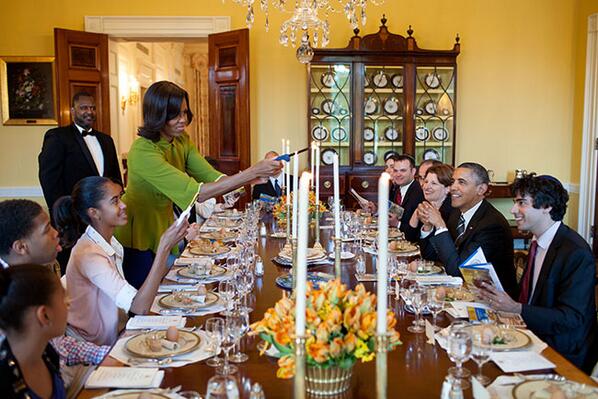
He also was the first president to hold an annual Seder at the White House, with its origins dating to the 2008 campaign when some Jewish staffers, when in Pennsylvania in advance of that state’s primary, they held a Seder. Obama walked into the hotel room, and with some non-Jewish aides, joined the ritual dinner. When the Seder ended with the traditional “Next year in Jerusalem,” Obama added, “Next year in the White House.”
He kept that vow, each year holding a traditional Seder in the White House family dining room – using the ubiquitous Maxwell House Haggada – with family, close friends and people who had worked on that 2008 campaign. Those Seders included a reading of “the Emancipation Proclamation since we were celebrating freedom from slavery,” Sher tells me.
The Seders were amazing events,” Nosanchuk says. “He didn’t do it for show; he didn’t invite big donors, or prominent Jews,” he says. “I’ll bet they’ll continue in some fashion.”
The Seders also demonstrate that “he’s comfortable with Jewish traditions,” Weissman says, telling me the president “engages with the Jewish narrative” and “identifies with the long history of the American-Jewish community.”
This president was also the first to add video messages to yearly holiday greetings, issuing a new and different statement every Rosh Hashana or Yom Kippur, Hanukka, Passover, Jewish American Heritage Month, and Yom Hashoah or International Holocaust Remembrance Day, as well as on nearly every Israeli Independence Day.
Each year, on the eve of Rosh Hashana, Obama hosted a call with hundreds of rabbis from across the continent. The leaders of the four major associations representing Conservative, Orthodox, Reform and Reconstructionist rabbis jointly planned and conducted a High Holy Day call featuring the president’s answers to the most pressing questions of the day. “The environment President Obama created by taking our questions so seriously and openly, deepened the relationships and the dialogue among the major denominations,” Rabbi Julie Schonfeld, executive vice president of the Rabbinical Assembly, tells me. “Ironically, it was he who brought the movements together seven or eight times in preparation for those yearly calls.”
And, in 2015, in recognition of the White House annual Education and Sharing Day, Obama invited a delegation of senior Chabad rabbis to commemorate the anniversary of the late Lubavitcher rebbe’s birth.
Solow calls Obama a “classic Zionist,” and also tells me, “you have to be in active denial to not recognize his level of understanding and commitment.”
He believes Obama will go down in history “as a president who had a close relationship with American Jewry and was an extremely strong supporter of the State of Israel and its people.”
Sher says “the Jewish principle of social justice, or tikkun olam – which has inspired Jewish progressives – was also close to the President of the United States’ heart.”
Speaking at the Union for Reform Judaism biennial conference at National Harbor near the close of 2011, the president said, “When my Jewish friends tell me about their ancestors, I feel a connection. I know what it’s like to think, ‘Only in America is my story even possible.’”
Obama then wove a speech around a d’var Torah, a homily on the Torah portion of the week, one on the Joseph story and the single word Joseph uses when he replies to his father, Jacob. “Hineni – Here I am.” (It’s the same word Abraham uses to reply to God before the binding of Isaac and that Moses uses when God summons him at the burning bush.) “The text is telling us that while Joseph does not know what lies ahead, he is ready to answer the call,” Obama said.
The president’s remarks were made into the reelection campaign’s official Jewish poster. “In this moment, every American, of every faith, every background has the opportunity to stand up and say: HERE I AM. HINENI. Here I am. I am ready to keep alive our country’s promise. I am ready to speak up for our values at home and abroad. I am ready to do what needs to be done. The work may not be finished in a day, in a year, in a term, in a lifetime, but I’m ready to do my part.”
After the speech, Obama went backstage to meet with a dozen or 15 of the most prominent Reform rabbis in the country. “I’m told the definition of the Democratic Party is Reform Judaism without the holidays,” he told the rabbis to laughter. “Well, that makes me a Reform Jew.”
PRIME MINISTER Benjamin Netanyahu stands with President Barack Obama. (photo credit:MARC ISRAEL SELLEM/THE JERUSALEM POST)
As US President Barack Obama stood before the packed synagogue sanctuary, a white kippa comfortably atop his head, he spoke of the impact that images of kibbutzim, Israel’s founders and the 1967 war had on him as he was coming of age.
“To a young man like me, grappling with his own identity, recognizing the scars of race here in this nation, inspired by the Civil Rights struggle, the idea that you could be grounded in your history, as Israel was, but not be trapped by it, to be able to repair the world – that idea was liberating. The example of Israel and its values was inspiring,” Obama said that day, speaking in 2015 at my own synagogue, Adas Israel Congregation in Washington DC, in celebration of Jewish American Heritage Month.
As I sat in the first row with my wife and two sons, I saw this as a seminal moment in the president’s relationship with the Jewish community. Not was this only the fourth time in history that a president of the United States spoke from the stage of an American synagogue, but he also was about to speak to a question that too many Jews had been asking.
BARACK OBAMA prays at the Western Wall. Credit: ReutersSeven years into his presidency, Obama was talking “kishkes,” telling the Jewish community that he understood Israel in his gut from the days of his youth. As Matt Nosanchuk, the White House Jewish liaison at the time tells me, he has a “Jewish soul.” Nosanchuk says Obama is “very much in sync with the majority of [the] American-Jewish community – he’s committed to social justice and prioritizes issues like civil rights and equality, and he values intellectual discourse.”
The kishke question shadowed Obama from the early days of his 2008 presidential campaign and continued throughout his presidency. Like many of Obama’s critics in America, some Jews, pointing to any criticism he had of Israel, maintained that he was no friend to Jews or the Jewish state – and that he certainly didn’t feel it in his gut.
Yet Chicago area Jews who had known Obama early in his career had praised him for his Jewish sensibilities early on. Back in 1987, the Jewish Funds for Justice (now known as Bend the Arc) gave a $5,000 grant for a developing communities project directed by then-26-year-old community organizer Barack Obama.
During the 2008 presidential campaign, the late Democratic activist Abner Mikva, a former member of Congress who had been a federal judge and counsel to President Bill Clinton, told the Chicago Jewish News, “I think when this is all over, people are going to say that Barack Obama is the first Jewish president.” (Thanks to Mikva’s quote, “The First Jewish President” became the cover headline for a 2011 article in New York Magazine). In that same CJN article, another Democratic activist, Newton Minow, told CJN that Obama “is very much at home with Jewish people, their values and interests,” while Rabbi Arnold Wolf of KAM Isaiah Israel Congregation in Chicago, of blessed memory, said Obama is “embedded in the Jewish world.”
Barack and Michelle Obama at their final White House Hanukkah ceremony (Dec. 14, 2016)
Barack Obama. Credit ReutersObama’s early “embedded” Jewish world also included longtime Chicago Jewish friends such as David Axelrod, who would manage his first presidential campaign and go on to be a White House senior adviser; Rahm Emanuel, who became his first chief of staff; Susan Sher, who would become Michelle Obama’s first chief of staff; longtime liberal activist Bettylu Saltzman, whose father, Philip Klutznick, was a national Jewish leader; Judd Miner, the civil rights lawyer who gave Obama his first job after law school; and Alan Solow, a former Chicago Jewish Community Relations Council chairman and former chairman of the Conference of Presidents of Major American Jewish Organizations.
Additionally, Obama had close relationships with the Crown family; Penny Pritzker, who would later become secretary of commerce; Eric Lynn, who would later work in the Defense Department; and Dan Shapiro, who Obama would seat on his national security staff before making him ambassador to Israel.
What these Jews had in common was that they were all progressive liberals and staunch Zionists devoted to Israel and its well-being but who also didn’t think it was off limits to criticize Israeli policies, including settlements.
Obama therefore developed an attitude toward Israel that reflected that of his friends: First, just as Jews respond viscerally when Israel is under attack, he doubled down on Israel’s security when it faced dangers. Second, loving Israel sometimes means disagreeing with it, a position that many Jews on the Right seem to reject even when it comes from a fellow Jew.
“In many ways – not in the religious sense – but I would say in the cultural and political sense, the president thinks of himself as sharing the values of his liberal Jewish friends and colleagues. It reflects his thinking on domestic issues. It reflects his thinking on foreign policy, including Israel,” Alan Solow says of his longtime friend.
“Just because I disagree with others on policies doesn’t diminish my love for Israel and the Jewish people, and I think the president would agree with that,” Solow says, noting that Obama repeatedly invited Jewish leaders to meet with him, even when he disagreed with them. “The president has a Talmudic style of thought. He’s very interested in drilling down deeper and deeper into all viewpoints on any given issue.”
Indeed, as president, Obama was open to meeting with Jews from across the political spectrum. I personally saw him meet often with mainstream Jewish communal leaders, but Zach Kelly, the interim White House liaison to the Jewish community in 2013, reminds me of a meeting with Republican Jewish Coalition representatives, with several administration officials giving a presentation on the Iron Dome and other joint US-Israel security efforts. “The tension at the beginning was palpable,” Zach says. But by the time the meeting ended, it never would have been known it was a group of Republicans in the room, he says. Republicans – “gave an ovation.”
Danielle Borrin Hertz, the White House liaison 2009 to 2010, remembers the discussions surrounding Obama’s first meeting in office with Jewish leaders of major Jewish organizations. The big question: Should J Street be invited? The pro-Israel organization was just a year old at the time, and officials wondered, “How do we know if it represents a large swath of the Jewish community?” Hertz recalls.
The ultimate decision was that inviting J Street demonstrated “that this was a White House that had a big table,” she says. The organization “was speaking for thousands on how they view the US-Israel relationship, how they view the Palestinians,” she says in retrospect.
Obama received a lot of criticism for that 2009 invitation, as he did for a remark he made during that meeting in response to a comment from Malcolm Hoenlein, executive vice chairman of the Conference of Presidents, that the peace process was likelier when no “daylight” existed between the United States and Israel. Obama responded that during the eight years of his immediate predecessor George W. Bush’s presidency “there was no space between us and Israel, and what did we get from that? When there is no daylight, Israel just sits on the sidelines, and that erodes our credibility with the Arab states.”
The president, says Hertz, “was making a thoughtful observation but it was taken as the president wanted to distance himself” from Israel. That wasn’t the case, she says, also noting that she never regretted the decision to include J Street in that meeting. Representatives from the group have been included nearly every time since, and rightfully so.
That meeting came just about a month after the president’s June 2009 trip to Cairo, one that drew criticism from some portions of the Jewish community angered that Obama didn’t also visit Israel on that trip (he had visited the Jewish state twice previously, including during the 2008 campaign). Speaking directly to Arabs, the president called for “two states, where Israelis and Palestinians each live in peace and security,” and for Arab nations to “recognize Israel’s right to exist.” Also, in keeping with longstanding US policy, he called for a settlement freeze and, said critics, failed to talk tough on Iran. Some critics claimed the president appeared to embrace the Palestinian understanding of the Israeli-Arab conflict.
In fact, throughout his presidency, some corners of the Jewish community continued to see the president as putting Palestinians’ interests ahead of Israelis’.
But just who were these corners of the Jewish community, tagging Obama as not sufficiently pro-Israel or, worse, anti-Israel or even antisemitic? Are they primarily political conservatives and partisan Republicans? Polls show the few other Jews who feel that way are single-issue voters, voting on Israel above every other issue. The vast majority of Jews prioritize domestic issues over Israel. But the detractors were loud and unending.
Beyond that was the very tense relationship between Obama and Prime Minister Benjamin Netanyahu, intensified by Netanyahu’s 2015 speech to Congress and the Iran nuclear deal, which throughout the Jewish world pitted Jew against Jew, and culminated in the US decision in the waning weeks of the Obama presidency to abstain from, rather than veto, a United Nations Security Council resolution condemning Israel – marking the first and only time in Obama’s eight years in office that the US had allowed a resolution critical of Israel to pass. Secretary of State John Kerry’s major speech a few days later defending the US decision also was widely viewed among large portions of the Jewish community as a lopsided attack on Israel. It was seen by many in our community as perhaps the defining moment in the eight-year relationship between Obama and the Jews.
But nothing could have been further from the truth.
The UN abstention and Kerry’s speech came a mere three months after the US gave Israel a $38 billion, 10-year security assistance Memorandum of Understanding (MoU), signed in September and representing the largest single pledge of military assistance to a foreign country. The MoU came atop record amounts of foreign military financing funds to Israel and unprecedented level of missile defense funding during Obama’s tenure.
“The MoU should be lauded, and celebrated and hugged by the Jewish community,” says Chanan Weissman, the White House liaison to the Jewish community in Obama’s final months. “It’s a pledge to give more military assistance than we have ever given to any one country in history.”
Throughout much of Obama’s administration, though, the personal dislike the president and Netanyahu had for one other overshadowed for some the affinity Obama has for Jews and his robust support for, as Obama and even Netanyahu said on numerous occasions, Israel and the “unshakeable bond” between the two nations.
In his September 2011 speech at the UN General Assembly, Obama noted that “any lasting peace must acknowledge the very real security concerns that Israel faces every single day.” And, in saying that “the Jewish people carry the burden of centuries of exile and persecution, and fresh memories of knowing that six million people were killed simply because of who they are. Those are facts. They cannot be denied,” the president clearly demonstrated that he understands the sweep of Jewish history.
During a major address at the Jerusalem Convention Center in 2013, Obama was wildly applauded when he said, “Those who adhere to the ideology of rejecting Israel’s right to exist, they might as well reject the earth beneath them or the sky above, because Israel is not going anywhere. And today, I want to tell you – particularly the young people – so that there’s no mistake here, so long as there is a United States of America, atem lo levad, you are not alone.”
Rep. Debbie Wasserman Schultz (D-Fla.), the former chairwoman of the Democratic National Committee, remembers feeling “a swell of pride and emotion” accompanying the president on that trip. “Hearing our president profess our friendship and commitment to Israel in Jerusalem was a moment as an American and as a Jew, that I will never forget,” she tells me.
While in Israel, Obama also visited an Iron Dome battery in Tel Aviv, which was supported by Israeli and American funding, viewed the Dead Sea Scrolls at the Israel Museum, laid wreaths at the graves of Zionist visionary Theodor Herzl and former prime minister Yitzhak Rabin and visited the Yad Vashem Holocaust Museum.
Dan Shapiro, the departing US ambassador, tells me that following that trip numerous Israelis told him, “I still disagree with your president on this or that issue, but I can see he is a friend, someone who cares about Israel, and that his intentions and motivations are for our well-being.” And, Shapiro says, “They got him right. That’s exactly who he is. Always has been, always will be, even through later controversies and disagreements.”
Nosanchuk says the notion that just because he recognizes two sides of the conflict that somehow “he’s anti-Israel, that’s ridiculous.”
Ben Rhodes, who served as Obama’s deputy national security adviser for strategic communications, tells me that “through the many twists and turns,” the president “always insisted on having as much contact and consultation as he could with the American-Jewish community. He believed it made our policies better, and that we always had an obligation to hear from different points of view, and to communicate what we were thinking, what we were doing, and why we were doing it.”
Might things have been different if Obama and Netanyahu had the kind of close relationship that the president had with the late Shimon Peres, whose tenure as Israel’s president overlapped Obama’s for several years?
Barack Obama toats with Shimon Peres. Credit ReutersAbsolutely, says my colleague Aaron Keyak, who was also in Israel during the historic visit, in the audience at the Convention Center. “Seeing the meeting of the minds between President Peres, may he rest in peace, and President Obama when it came to a vision for peace and the expression of their love for the world’s only Jewish state was an incredible moment, and a small glimpse into what could have been,” he recalls.
Returning to Israel for Peres’s funeral, Obama – who had ordered all US federal flags to be flown at half-mast in tribute to the late leader – spoke of the affectionate relationship the two men had shared, “rooted in the fact that I could somehow see myself in his story, and maybe he could see himself in mine. Because for all of our differences, both of us had lived such unlikely lives.” Three years earlier, he became the first president to honor an Israeli head of state, bestowing the Presidential Medal of Freedom on Peres.
US President Barack Obama paying respects to the late Shimon Peres. Credit: Emil Salman/PoolAnd it was Peres who was among the first to honor Obama. The day after Obama became president, Peres sent a letter telling the new president that he was bound to become a good friend of Israel because he shares the Jewish state’s hopes and goals. Peres would in 2013 bestow on Obama the Presidential Medal of Distinction, the first given to a US sitting president.
It’s hard to know just how many times Obama met with representatives of the Jewish community, including at the White House. I suppose somebody knows. A lot. I wasn’t invited even half the time, but one meeting that I did attend included about 25 Jewish community leaders in the Roosevelt Room to discuss his planned trip to Israel. He was especially engaged while discussing how he might best convey to the Israeli people his enthusiasm for Israel and its Jewish history. He also told us that he thought prospects for peace were “bleak,” but added, “That doesn’t mean six or nine or 12 months from now we won’t be in the midst of a policy initiative.” The president said he would urge both sides to avoid unilateral actions that might further damage a process he hoped we would be back on track within a year. Oh, well.
From the beginning of his presidency, Obama made a concerted effort to engage the Jewish community beyond matters involving Israel, Hertz says, ticking off health care, comprehensive changes to immigration policy, the Violence Against Women Act and gun control measures, particularly in the wake of the Sandy Hook, Connecticut, school shooting rampage, as among the policy issues where the White House sought Jewish community input and support. “For us, one of the big missions to make sure we were engaging the Jewish community around a whole host of issues,” she says.
In July 2011, for example, the White House hosted 170 members of the Jewish Social Justice Roundtable, a collaboration of 20 organizations working to elevate the role of social justice in the Jewish community and to affect societal change that cuts across lines of race and faith.
But all too often, it came back to Israel.
Throughout Obama’s eight years in office, the US-Israel relationship had ups and downs, but American Jews continued to support him, with 74% voting for him in 2008 and 69% in 2012, in each case far more than the American vote at large. A look back at his tenure sees numerous “firsts” for a US president, unprecedented support for Israel and close relationships with much of the mainstream Jewish community.
Among his first acts as president was a call, on his first full day in office, to then-prime minister Ehud Olmert, stressing his determination, among other things, to stop Hamas from smuggling arms. In his final year in office came that MoU, which Obama called in a statement “the most recent reflection of my steadfast commitment to the security of the State of Israel.”
Between those two came numerous actions that demonstrated Obama’s commitment to Israel’s safety and security.
In his first speech to the UN General Assembly in September 2009, he said the US was committed to “two states living side by side in peace and security – a Jewish state of Israel, with true security for all Israelis; and a viable, independent Palestinian state.” His voting record on Israel at the UN would remain spotless until last month.
In addition, the Obama administration committed to veto any UN resolution that unilaterally declared a Palestinian state. In a 2011 address to the UN, Obama warned Palestinian Authority President Mahmoud Abbas that, “Ultimately, it is Israelis and Palestinians – not us – who must reach agreement on the issues that divide them.” And in 2015, with leadership from the US, the UN hosted its first conference on antisemitism and later recognized Yom Kippur as an official holiday.
Two months after that first UN speech, Michael Oren, then Israel’s ambassador to the US, told the National Jewish Democratic Council that Israelis had “found that our QME [Qualitative Military Edge] has been eroded” under the previous administration and alerted the new Obama administration that “we have a problem here.” The ambassador continued: “And the Obama administration’s reaction was immediate: we are going to address this issue, we are going to make sure that we maintain your QME.”
As part of ensuring that QME and Israel’s security, the Obama administration okayed the sale of F-35 advanced fighter jets to Israel and authorized $205 million to allow Israel to complete its Iron Dome short-range rocket defense system, a system that Israel credited with stopping numerous rockets that were being fired into Israel by Palestinians in Gaza. The $205m. was above and beyond the $3 billion in foreign military financing that the administration requested for Israel in 2011.
The American Israel Public Affairs Committee was among those praising the appropriation, calling it “a tribute to America’s commitment to Israel’s defense and underscores our fundamental security cooperation with Israel, an island of democracy surrounded by a sea of hostile terrorist and totalitarian threats.”
Obama, who repeatedly called for the creation of a Palestinian state alongside a safe and secure Israel, also gave record support the development of the joint US-Israel missile defense systems David’s Sling, the Arrow II and Arrow III.
Military and security cooperation between the two nations was unprecedented throughout Obama’s tenure. While president George W. Bush had, in 2005, frozen nearly all US-Israeli defense projects and had rejected Israel’s request for bunker-buster bombs, Obama approved the sale. In 2012, the two nations participated in Austere Challenge 12, the largest joint military exercises ever held between Israel and the US.
The strong military cooperation led then-defense minister Ehud Barak to tell the Israel National Defense College in 2012, “The security ties between us and the current administration have never been as high.”
This was only another example of how much more substantial support for Israel – particularly military support – had been under Obama than during his predecessors’ administrations.
“When it comes to the military and defense cooperation and support between the US and Israel, no president has had a stronger record than Obama’s – not George W. Bush, and when it comes to the records of Ronald Reagan or George H.W. Bush, it’s not even in the same ballpark,” says Keyak, a former senior Capitol Hill staffer and Middle East adviser. “There is of course a serious disagreement between Obama and Netanyahu on settlements, as there has been between the US and Israel for decades and under presidents of both parties, which should be a surprise to no one.”
When forest fires raged through parts of Israel in late 2010 – fires that Netanyahu called a “catastrophe the likes of which we have never known” – Obama immediately promised a “full-court press” to help Israel, and sent a technical assistance team as well as fire-retardants and equipment. Jarrod Bernstein, Obama’s third Jewish liaison, tells me it may have been less than a minute from the time that Oren, during that December’s White House Hanukka party, mentioned the fires to Obama and the president turned “to an aide and [said], ‘Get them what they want.’”
In response to fires six years later, the US again sent assistance.
Bernstein says the only other decision he’s aware of that was made nearly as quickly as the aid to fight those 2010 fires was the president’s decision to support a moment of silence at the 2012 Olympics for the 11 Israelis who had been slain at the Olympics 40 years earlier in Munich. “In a matter of an hour, we got the signoffs,” he tells me. The president was aghast that it never previously had been done.
Throughout his presidency, Obama reassured both Israel and the Jewish community that he always had “Israel’s back.” Following a siege of Israel’s embassy in Egypt in 2011, and the successful rescue of Israeli personnel (with the key intervention of the US), Netanyahu thanked the president for his “fateful role” in helping with the evacuation. “He said, ‘I will do all that I can.’ He did that,” Netanyahu said about Obama. “And I think we owe him special thanks.”
Obama also defended Israel on the international stage and led the US in condemning antisemitism, perhaps like no previous president or administration. In 2011, the US pulled out of the UN’s controversial Durban III summit. A State Department letter noted the US “voted against the resolution establishing this event because the Durban process included ugly displays of intolerance and antisemitism.”
“Not only did President Obama speak himself of the highly problematic nature of treating Israel with a double standard or questioning Israel’s right to exist but on his watch the State Department formally issued a working definition of antisemitism including examples of what antisemitism is relative to Israel,” Ira Forman, who was Obama’s special envoy on antisemitism, tells me.
Those examples of antisemitism relative to Israel include the use of “symbols and images associated with classic antisemitism to characterize Israel or Israelis” and blaming “Israel for all inter-religious or political tensions.”
And when the UN held its first session on antisemitism, the president issued a statement noting that “combating antisemitism is an essential responsibility for all of us.”
He also urged other governments to create a position on antisemitism.
During his first year in office, I watched as the president delivered the keynote address for the Holocaust Days of Remembrance ceremony at the US Holocaust Memorial Museum ceremony in the Capitol Rotunda alongside Elie Wiesel. “Today, and every day, we have an opportunity, as well as an obligation, to confront these scourges,” Obama said, “to fight the impulse to turn the channel when we see images that disturb us, or wrap ourselves in the false comfort that others’ sufferings are not our own.”
As he had with Peres, Obama also became close friends with Wiesel. “The president’s friendship with him was genuine,” Hertz says. “They talked about writing a book together.”
Obama was the first president to appoint a special envoy for US Holocaust survivor services to assist victims of Nazi persecution living in the US, and last September, he became the first sitting president to speak at the Israeli Embassy in Washington. In a ceremony there honoring righteous gentiles – including Roddie Edmonds, a POW who facing a German who had ordered the Jews among the American soldiers to identify themselves, told all his men to step forward, saying “We are all Jews here” – Obama stated: “When any Jew anywhere is targeted just for being Jewish, we all have to respond as Roddie Edmonds did – ‘We are all Jews.’”
During that same talk, the president noted that thought when a statue of an antisemitic leader from World War II was planned in Hungary. “We led the charge to convince their government to reverse course. This was not a side note to our relations with Hungary, this was central to maintaining a good relationship with the United States, and we let them know.”
As Forman says, “What other president has stated that maintaining a good bilateral relationship with another country depends on that country pulling back from honoring an antisemite?”
That’s happened only under Obama.
“As far as I can tell no other president has come close to President Obama when it comes to speaking out frequently and forcefully on the evil of antisemitism,” Forman says.
With Israel viewing Iran and its moves toward nuclear arms as an existential threat, Obama in July 2010 signed the Comprehensive Iran Sanctions, Accountability, and Divestment Act, which strengthened existing US sanctions, and made it more difficult for the Iranian government to buy refined petroleum and the materials needed to modernize its oil and gas sector. That same month, under Obama’s leadership, the UN voted to sanction Iran for failing to live up to its obligations under the Nuclear Non-Proliferation Treaty and violating its commitments to the International Atomic Energy Agency.
The Obama administration continued its push to prevent Iran from obtaining nuclear arms, and in 2015 the P5+1 (China, France, Russia, the United Kingdom, the US, plus Germany) and Iran announced the Joint Comprehensive Plan of Action to limit Iran’s nuclear actions.
Wendy Sherman, the undersecretary of state who led the US negotiating team on the accord, tells me that the president, who “believed strongly that if Iran had a nuclear weapon, it would be an unacceptable threat not only to the United States but to Israel and the region,” and his team “consulted Israeli officials and experts at every step of the negotiation.”
With intense pressure and anger from Israel and many quarters of the American-Jewish community, along with many in Congress, opposed to the deal, the Obama administration mounted a full-court press to explain and defend the accord. That included a Jewish Federations of North America (JFNA) and Presidents Conference webcast viewed by many thousands and a reportedly emotional meeting with 22 leaders of Jewish organizations, followed immediately by a smaller meeting with donors and operatives that I attended.
Susan Turnbull, chair of the Jewish Council for Public Affairs and a past chair of Jewish Women International, was at the leadership meeting – one that nearly two hours in had Vice President Joe Biden telling the group, Turnbull says, “We have to let him go; it’s his birthday. Michelle will kill me if you don’t let him go.”
The meeting was a “very tough, very difficult conversation,” she says, with a lot of “harsh back and forth.”
Her organization, JCPA, had not taken a position for or against the accord. She asked the president about what she saw as a contradiction between his talking about “how the US and Israel military were closer than ever,” while Energy Secretary Ernest Muniz had told some Jewish leaders about a “disconnect between Israeli military and the US military because Netanyahu had made it impossible for the military to even discuss implementation of the plan.”
The president told her, she says, that on general activities, day-to-day overarching defense, we were working together, but it was true that the Israeli military was not allowed to talk about how to implement if this gets approved.
Nosanchuk says he didn’t have to do these meetings. “He wanted to.”
My meeting was equally emotional but much more supportive. As he had in the first meeting, Obama quoted the proverb that you must give your enemy a golden bridge on which to depart. But to us he also expressed great frustration that he wasn’t getting recognition for all he felt he had done for Israel – never mind on the other issues the community cared about.
In what was supposed to be a Q&A after his remarks – one that solicited the back-and-forth that Turnbull and others described – my meeting was much more of an offering of what we could each do to help.
One of the first to offer help was philanthropist Haim Saban, who made several very concrete offers. Ironically, my greatest takeaway from the meeting was that I distinctly heard the president warn us that he may not vote as Israel wants in the future at the UN. He said it very matter-of-factly, but I’ve thought about it ever since. And, of course, it was Saban alone in the room that day who would go ballistic on Obama after the UN vote last month.
During that August JFNA and Presidents Conference webcast, the president noted that the bond between the United States and Israel is not political but “grows out of family ties and bonds that stretch back generations and shared values and shared commitments and shared beliefs in democracy.” Taking questions from Jews sent in from around the country and asked by JFNA’s board chair Michael Siegel and Presidents Conference chairman Stephen Greenberg, Obama, sitting with them in the White House Diplomatic Reception Room, said, “The two governments may disagree, but just as disagreements exist in families,” this disagreement “does not affect the core commitments we have to each other.”
Keyak and I had developed the webcast idea, brought it to Nosanchuk and he sold it to the president and his own colleagues. No president previously had interacted with the American-Jewish community the same way.
Within the deal’s first year, Iran had, among other things, filled the core of its Arak reactor with cement, allowed the International Atomic Energy Agency unprecedented access to monitoring and cut down its uranium and heavy-water stockpiles. Say what you want, but it’s worked. “Obama believes as do Israeli experts, that Israel is safer as a result of the deal,” Sherman says.
The Iran debate was a major legitimate tension between the president and the Jewish community, the worst of the eight years – until last month. But even much of that was exaggerated.
To hear his detractors tell it, you would have thought Obama was the worst president for Israel at the UN in recent memory when he arguably may have been the very best. Regan voted for three condemnations and had seven abstentions in the Security Council; George H.W. Bush supported nine condemnations and had two abstentions in just four years. Even my old beloved boss Clinton had one condemnation and two abstentions. But Obama – no votes for condemnations and one abstention in eight years. Once ever. One.
Other events and incidents were cut from whole cloth. In June 2009, Obama was photographed sitting back in the Oval Office talking on the phone with Netanyahu, Obama’s feet on his desk and the soles of his shoes visible. Some Israeli newscasters considered this an insult to Israel.
In March 2010, Netanyahu was again reportedly humiliated as Obama walked out of their White House meeting to have dinner with his family. There was no photo-op from the meeting and it was reported that Netanyahu had to enter through the “back door,” wherever that is. An Israeli newspaper called the meeting “a hazing in stages.” But just two months later, Oren said Obama did not snub Netanyahu during the meeting.
And in May 2011, the president, in a speech at the State Department, said the borders of Israel and “Palestine” should be based on the 1967 lines with mutually agreed land swaps, so that secure and recognized borders are established for both states. The next day in an Oval Office photo-op, Netanyahu spoke at length – some said lectured Obama – on Israeli history and rejected the proposal Obama had suggested the day before as unrealistic.
Obama explained at AIPAC’s Policy Conference the next day – repeated, really – that his call for Israeli-Palestinian negotiations based on the pre-1967 lines did not mean a future Palestinian state would have those exact borders: “By definition, it means that the parties themselves – Israelis and Palestinians – will negotiate a border that is different than the one that existed on June 4, 1967.” Nonetheless, political opponents will spend years mischaracterizing these days’ remarks.
Despite any tensions, perceived or real, one of the hottest tickets in Washington during Obama’s presidency was an invitation to the White House Hanukka party – a tradition George W. Bush had begun, but Obama expanded to afternoon and evening parties in 2013 to accommodate more people. He would hold a record 12 parties. White House liaisons to the Jewish community were bombarded with requests for invitations.
Candle lighting with President Barack Obama and first lady Michelle Obama at a Hanukka reception held at the White House. Credit: OFFICIAL WHITE HOUSE PHOTO / PETE SOUZAThe White House kitchen was made kosher for each of those parties, and one of the White House’s most popular videos was the one that showed Chabad Rabbi Levi Shemtov overseeing that process.
Each year featured different hanukkiot from throughout the world, and different guests were invited to join the Obamas for the lighting. One year, a child whose father died in the 9/11 attacks lit a hanukkia that had been buried in the rubble of a synagogue during Hurricane Katrina. Another year the White House put out a call for “special and unique menorahs,” receiving 54 within a few days and ultimately using one made in Israel in the 1920s and blending European, Jewish and Arab elements, and another made by a Holocaust survivor in Auschwitz from nails.
The last parties he held featured a hanukkia that Wiesel’s granddaughter, Shira, had made in kindergarten and one that had been hidden during the Holocaust and belonged to Peres’s family. President Reuven Rivlin helped light another year.
Meanwhile, the most popular food at those parties wasn’t the latkes but the kosher lamb chops carved by a White House chef in the State Dining Room under a lone portrait of Abraham Lincoln.
The president not only has a Jewish neshama, (soul) and his own ahavat Yisrael, love of Israel, he all but kept a Jewish home. Or so it seemed to so many of us who kept getting invited to this Jewish holiday gathering or that Jewish event or another Jewish meeting.
For instance, he held the first White House reception for Jewish American Heritage Month, which had been established in 2006, inviting Jewish Supreme Court justices, entertainers, entrepreneurs, lawmakers and rabbinic scholars – and singling out the great baseball player Sandy Koufax. (“He can’t pitch on Yom Kippur; I can’t pitch,” Obama said.)
He also was the first president to hold an annual Seder at the White House, with its origins dating to the 2008 campaign when some Jewish staffers, when in Pennsylvania in advance of that state’s primary, they held a Seder. Obama walked into the hotel room, and with some non-Jewish aides, joined the ritual dinner. When the Seder ended with the traditional “Next year in Jerusalem,” Obama added, “Next year in the White House.”
He kept that vow, each year holding a traditional Seder in the White House family dining room – using the ubiquitous Maxwell House Haggada – with family, close friends and people who had worked on that 2008 campaign. Those Seders included a reading of “the Emancipation Proclamation since we were celebrating freedom from slavery,” Sher tells me.
The Seders were amazing events,” Nosanchuk says. “He didn’t do it for show; he didn’t invite big donors, or prominent Jews,” he says. “I’ll bet they’ll continue in some fashion.”
The Seders also demonstrate that “he’s comfortable with Jewish traditions,” Weissman says, telling me the president “engages with the Jewish narrative” and “identifies with the long history of the American-Jewish community.”
This president was also the first to add video messages to yearly holiday greetings, issuing a new and different statement every Rosh Hashana or Yom Kippur, Hanukka, Passover, Jewish American Heritage Month, and Yom Hashoah or International Holocaust Remembrance Day, as well as on nearly every Israeli Independence Day.
Each year, on the eve of Rosh Hashana, Obama hosted a call with hundreds of rabbis from across the continent. The leaders of the four major associations representing Conservative, Orthodox, Reform and Reconstructionist rabbis jointly planned and conducted a High Holy Day call featuring the president’s answers to the most pressing questions of the day. “The environment President Obama created by taking our questions so seriously and openly, deepened the relationships and the dialogue among the major denominations,” Rabbi Julie Schonfeld, executive vice president of the Rabbinical Assembly, tells me. “Ironically, it was he who brought the movements together seven or eight times in preparation for those yearly calls.”
And, in 2015, in recognition of the White House annual Education and Sharing Day, Obama invited a delegation of senior Chabad rabbis to commemorate the anniversary of the late Lubavitcher rebbe’s birth.
Solow calls Obama a “classic Zionist,” and also tells me, “you have to be in active denial to not recognize his level of understanding and commitment.”
He believes Obama will go down in history “as a president who had a close relationship with American Jewry and was an extremely strong supporter of the State of Israel and its people.”
Sher says “the Jewish principle of social justice, or tikkun olam – which has inspired Jewish progressives – was also close to the President of the United States’ heart.”
Speaking at the Union for Reform Judaism biennial conference at National Harbor near the close of 2011, the president said, “When my Jewish friends tell me about their ancestors, I feel a connection. I know what it’s like to think, ‘Only in America is my story even possible.’”
Obama then wove a speech around a d’var Torah, a homily on the Torah portion of the week, one on the Joseph story and the single word Joseph uses when he replies to his father, Jacob. “Hineni – Here I am.” (It’s the same word Abraham uses to reply to God before the binding of Isaac and that Moses uses when God summons him at the burning bush.) “The text is telling us that while Joseph does not know what lies ahead, he is ready to answer the call,” Obama said.
The president’s remarks were made into the reelection campaign’s official Jewish poster. “In this moment, every American, of every faith, every background has the opportunity to stand up and say: HERE I AM. HINENI. Here I am. I am ready to keep alive our country’s promise. I am ready to speak up for our values at home and abroad. I am ready to do what needs to be done. The work may not be finished in a day, in a year, in a term, in a lifetime, but I’m ready to do my part.”
After the speech, Obama went backstage to meet with a dozen or 15 of the most prominent Reform rabbis in the country. “I’m told the definition of the Democratic Party is Reform Judaism without the holidays,” he told the rabbis to laughter. “Well, that makes me a Reform Jew.”

