Showing posts with label #PaxAmericana. Show all posts

Monday, March 27, 2017

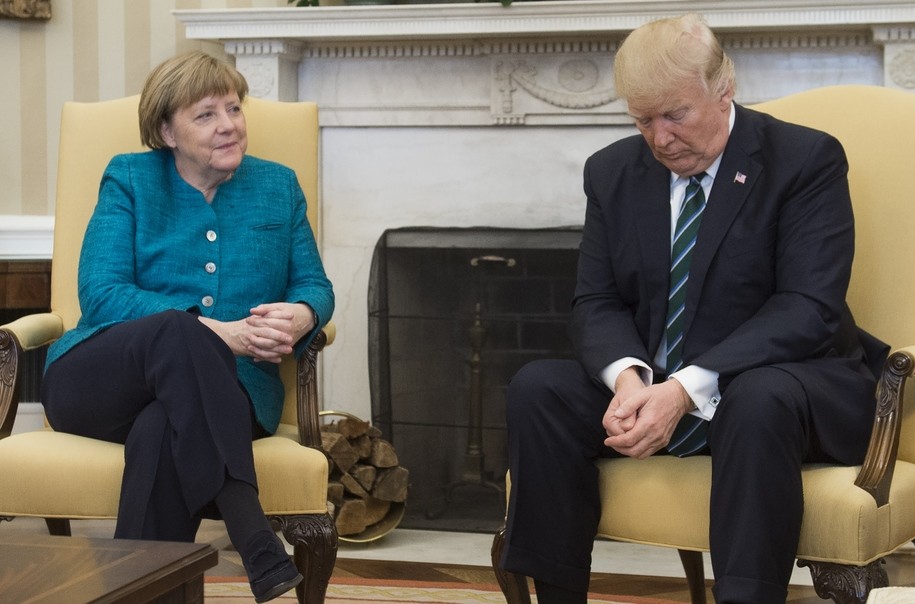
#OyVeyDonaldTrump presented German leader Angela Merkel a printed 'invoice' for what he thinks they owe Nato


The US President is said to have had an “invoice” printed out outlining the sum estimated by his aides as covering Germany’s unpaid contributions for defence. [...]
The current sitting president is an idiot manchild. On a related note: During last weekend's meeting between Idiot Manchild and German leader Angela Merkel, the idiot manchild allegedly handed Merkel a printed "bill" for roughly 370 billion Euros, the amount Donald Trump thinks Germany "owes" Nato.

But the bill has been backdated even further to 2002, the year Mrs Merkel’s predecessor, Gerhard Schröder, pledged to spend more on defence.

Mr Trump reportedly instructed aides to calculate how much German spending fell below two per cent over the past 12 years, then added interest.

That this stunt did not create an immediate international incident is evidence of Merkel's own professionalism and/or evidence that even our international allies do not take Idiot Manchild seriously. Instead, she "ignored the provocation."

Trump's staff—and by this I think we can safely presume Steve Bannon's staff, because there's no way any other members of even this White House could come up with a concept simultaneously so idiot-manchild stupid and so pointlessly insulting—apparently has similar "bills" drawn up for the other Nato members, for presentation when he meets with them as well. This particular bout of idiocy, in other words, is going to continue.

As to what Idiot Manchild and his confederacy of morons expects to accomplish with the move, that's not clear. It is never clear. As with the recent healthcare fiasco of Steve Bannon meeting with Republican lawmakers to demand they just do whatever Steve Bannon wants them to, the strategy seems to be to angrily demand things and then be surprised when the other side, your own allies, tell you to sod off. It may have worked for a crooked New York real estate developer trying to scam subcontractors out of promised wages, but it's not likely to work with The Freaking Chancellor of Germany.

For what it is worth, the White House is now denying that this incident took place. But this White House notoriously lies about everything, all the time, even when it's patently obvious they are lying, so that is worth nothing.

Sunday, March 5, 2017

"....the best protection is not to elect one.".... @realDonaldTrump isn't the most stable GI Joe ( understatement) : How Likely Is an Irrational US Presidential Order to Use Nuclear Weapons?


Image result for donald trump nuclear weapons cartoon


There is no scientifically valid way to predict US presidential irrationality. Nor is there any analytically acceptable way for an American president to foretell the nuclear outcomes of any considered policy decision. There is another, less frequently considered possibility that is just as impossible to predict: that President Trump could refuse to follow through on deterrent threats, thereby allowing assorted Russian aggressions – including those that might involve Israel.

Back in 1976, I was a young professor of political science researching a new book on nuclear strategy and nuclear war. Because I was especially interested in the distant but still conceivable prospect of an irrational American president with nuclear decisional authority, I wrote to General Maxwell Taylor, a former Chairman of the Joint Chiefs of Staff, for some informed clarification. On 14 March 1976, in a handwritten letter to me, General Taylor advised: "....the best protection is not to elect one."

This was not a disingenuous response. On the contrary: it revealed, generically, that the so-called "two-man rule" of redundant nuclear safeguards simply does not apply at the highest level of American political decision-making. However odd or ironic, this utterly unrestricted or ultimate form of presidential authority still obtains today. While it is increasingly under discussion among concerned persons in the just-beginning Trump era, salient apprehensions have generally been expressed surreptitiously, in more-or-less decorous whispers.

It is unlikely that such core apprehensions will remain suppressed, even in the near term. Over the next several months, President Trump could, for example, be severely tested by Pyongyang, and may have to make time-urgent decisions concerning North Korea's expanding nuclearization. How is he likely to respond to such tests?

From a purely analytic or scientific standpoint, there is no reliable way to answer such a vital question. More precisely, to credibly assess whether Mr. Trump can be expected to react rationally or irrationally, we would first have to assume the existence of pertinent and recoverable past experience. This is because all scientifically meaningful assessments of probability need to be based upon a determinable frequency of past events.

This is a requirement for all excursions into probabilistic outcomes, whether in areas of international relations, or in actuarial judgments of individual client life expectancies.

Is it true that there have been no pertinent past events regarding national nuclear decision-making? The only conceivable case, it seems, would be the 1962 Cuban missile crisis. During that uniquely uncertain episode, President John F. Kennedy ordered his "quarantine" of Cuba (a euphemism for "blockade," always a possible casus bellum) with an apparent awareness of the corresponding risks.

According to Theodore Sorensen, his biographer, JFK seemingly believed that even his intentionally softened escalatory response would carry heavy odds of an ensuing nuclear war with the USSR: more precisely, with an expected probability of "between one out of three and even." Although we now know, based upon what we have learned about ascertaining probabilities and the discernible frequency of past events, that any such estimate was necessarily without any scientific foundation, what matters is that at the time, JFK believed in those ominously high odds. Was JFK's "quarantine" a genuine instance of nuclear decisional irrationality, one that turned out well only by happenstance? Could it have ended, as then Secretary of Defense Robert McNamara had feared, in some sort of "Armageddon"? Or was it rather an example of what might today be most aptly termed the "rationality of pretended irrationality?"

The answer is important. If the latter, JFK was playing a more or less carefully calculated strategic game, much like the game of Chicken once played in cars by teenagers. In Chicken, the objective of each player is twofold: not to be a chicken, but also not to be dead. JFK plausibly sought similar objectives, although, of course, at a far wider collective level, and for immeasurably higher stakes.

President Trump's upcoming nuclear-related policy judgments can never be based upon scientifically garnered probabilities, an incapacity that has nothing whatever to do with his own personal strengths or weaknesses. We must further inquire about a related but still discrete presidential decisional problem. This issue references the corollary matter of President Trump being unable to calculate the probable outcomes of any particular nuclear decision that he himself should ultimately make. Again, this expected inability has nothing to do with any personal intellectual deficit on his part; to be sure, the very same analytic problem would confront any American president. It has to do rather with the indisputable absence of any pertinent past events.

Let's assume, for example, that President Trump should seek out an "expert" probability assessment or prediction concerning North Korean escalation to nuclear weapons (in the near term, such an escalation could more or less plausibly affect Japan, US forces in the region, and/or certain targets in Alaska or Hawaii). There would be no relevant history to evaluate. In any such scenario, there would be, by definition, no available opportunity to render a scientifically meaningful assessment of applicable probabilities, or "odds."

On the core issue of prospective presidential irrationality regarding nuclear weapons, it is at least conceivable that such consequential missteps could become less likely over time, on the "common sense" assumption that experience would correlate favorably with prudential caution. But that conclusion would merely offer a "man-in-the-street" explanation. At best, it would represent a naively contrived extrapolation from earlier historical eras – one, moreover, wherein the main argument could only have made sense in the pre-nuclear past.

In any event, during a nuclear crisis involving the US, President Trump would somehow have to strike an optimal balance between the unavoidably competitive search for "escalation dominance," and the corresponding need to avoid being locked into any increasingly desperate sequence of move and countermove. In any such sequence, the inherently self-limiting pattern could lead inexorably to a nuclear exchange or even full-blown war.

Fortuitously, perhaps, President Kennedy revealed in 1962 that strategic risk-taking can be advantageous up to a point – but figuring out exactly where that point should be is by no means an easy task. Indeed, various well-documented histories of the Cuban Missile Crisis all seem to agree that the superpowers came close to a very different, and genuinely calamitous, conclusion. An important lesson to be learned is that a great deal rests on chance when there is a lack of pertinent historical examples.

Nuclear strategy is a game that sane national leaders must learn to play, but never with any reassuringly plausible guarantees of probable outcomes. The only way this can change is if, in the years ahead, examples should begin to accumulate of nuclear escalations and outcomes. Naturally, this is not something one ought to wish for. Instead, it would be better to continue to have to concede our incapacity to reliably "figure the odds" in any nuclear crisis engagement, and also to augment this "concession" with a renewed dedication to stable nuclear deterrence.

We can't yet determine how likely it is that America's new president would ever give an irrational order to use American nuclear weapons, but we can still advise Mr. Trump that unimaginable nuclear dangers lurk not only in sudden "bolt from the blue" enemy attacks, but also in unanticipated and uncontrolled forms of nuclear escalation. As far as pretending irrationality is concerned – a tactic that may or may not have figured in the Cuban Missile Crisis, depending upon one's own interpretation of JFK's 1962 strategic calculations – it could rapidly become a double-edged sword.

One final observation. Expressed worries about an irrational US presidential order to use nuclear weapons notwithstanding, it is increasingly plausible that Mr. Trump could do precisely the opposite. He might steadfastly refuse to make good on a variety of America's core deterrent threats, and/or give the impression of such an intended refusal to one or more prospective aggressors. If, for example, Moscow should believe it can undertake further aggression in Ukraine and Syria with impunity – that is, without any fear of consequential reprisals from Washington – Putin might well decide to proceed.

The consequences of any such Russian calculations in Syria could even impact the safety and security of Israel.

The Author of this blog is Louis René Beres is Emeritus Professor of International Law at Purdue and the author of twelve books and several hundred articles on nuclear strategy and nuclear war. He is a frequent contributor to Harvard National Security Journal (Harvard Law School), The Bulletin of the Atomic Scientists, The Atlantic, The Jerusalem Post, US News & World Report, and Israel Defense. His newest book is Surviving Amid Chaos: Israel's Nuclear Strategy (Rowman & Littlefield, 2016).

Republished with permission of BESA. NESA  Center Perspectives Papers are published through the generosity of the Greg Rosshandler Family

Thursday, March 2, 2017

@realDonaldTrump Versus the European Union #RIPPAxAmericana ? or revived #PaxAmericana like never seen before without the $ cost

Image result for Donald Trump RIP Pax Americana cartoon

Members of the European political and media establishment seemed to be sure that the 45th president of the United States would be Hillary Clinton, or at least they were desperately hoping so. The days after the election one could hear clamor of indignation from top journalists and politicians alike. It almost felt as if the European project had lost shoulder to shoulder with Clinton, now that America, Europe’s most powerful ally, would be ruled by an “inhuman right-wing populist,” an outspoken critic of the European Union, and a sympathizer of the UK Independence Party. And after all he says “America first.” For the European establishment, this is an outrageous position to hold for an American president.
General secretary of the ruling Socialist Party in France, Jean-Christophe Cambadélis, has compared Trump to the Front National’s top candidate Marine Le Pen and noted that the French Left knew full well about the challenges ahead. French prime minister Manuel Valls emphasized that Europe needs to close its ranks, take responsibility and respond to the events on the other side of the Atlantic Ocean, adding that he does not believe in “the triumph of simplicity and demagoguery.”
German minister of foreign affairs Frank-Walter Steinmeier who called Trump a “preacher of hate” during the election campaign stated shortly after the outcome was certain that “American foreign policy will now become less predictable,” but that Germany “should not sit mesmerized like the rabbits before the snake.” Germany “should remain self-confident and needs to preserve its culture of public and political discourse.” But who knows to what kind of cultivated discourse he was actually referring?
Indeed, Donald Trump was compared to Adolf Hitler in German television news at one point in his campaign when he had already far exceeded the expectations of most pundits. But, hardly anyone could imagine him becoming the next US president. On the very evening of November 9 when the unthinkable was taking shape, the consortium of public broadcasters in Germany (ARD) presented a survey according to which only 4 percent of the German electorate would have voted for Trump. One wonders whether this representative survey was conducted exclusively among the employees of the consortium.
When the Austrian presidential candidate and populist Norbert Hofer lost to Alexander Van der Bellen in early December, the EU establishment had its first moment of relief since the Brexit vote in the United Kingdom last June. “Hofer has hoped for the Trump effect in vain” ARD’s news anchor declared somewhat triumphantly at the evening of the election.
However, at the same time the Italian people voted against President Matteo Renzi’s proposal to change the Italian constitution, which led to his resignation and potentially a chance for the Eurosceptic Five Star Movement around comedian Beppe Grillo to form the new national government after early elections. This means that the three largest countries of the Eurozone and the EU (UK excluded), Germany, France and Italy, will hold national elections within the next year. The Italian daily La Stampa wrote that the referendum “tells the same story as Brexit and Trump.”
Hence, it is pretty obvious that almost all political events and ongoing developments in Europe are now interpreted in light of Trump’s victory. There is no question that Trump already has had an impact on European politics regarding strategy and rhetoric.
Looming Economic Realities in Europe
The most important issues, after the currency and debt crisis has mysteriously vanished from the scene for a time, is immigration, the stabilization of the Middle East, and how to react to millions of people coming into Europe.
Trump has such a significance for the political regime of the EU, among other things, because he was elected while openly advocating positions not expected to be capable of winning a majority, either in the US, and most certainly not in Europe. It runs completely against the position that the US government under Bush and Obama has taken, that Clinton sought to continue, and that the political leadership of the EU still wholeheartedly advocates and that is embedded in a broader political program. It is a program that mainstream media is vigorously promoting by emphasizing the benefits of open borders, diversity and multiculturalism, the importance of humanitarian assistance, as well as an official responsibility of the West to improve living conditions in the developing nations of Africa and Asia. That the latter so regularly turns into the very opposite in the form of aggressive military interventions is deliberately hushed up. Trump’s anti-interventionist positions in foreign policy have, against all odds, successfully challenged the globalist line of approach.
After an initial period in which Trump and his supporters were arrogantly ridiculed, a good dose of European superiority complex, vis-à-vis the US, was breaking through, and the general tenor has changed. In an act of self-defense, European political and media elites have desperately tried to make a bogeyman out of Trump and the movement behind him as they saw the broader implications it might have.
Trump was admittedly courting some of the slogans used against him, but most of them are just hysterical exaggerations or allegations. And, while the European establishment claims a position on the moral high-ground, even the most promising aspect of Trump’s advocated isolationism from a humanitarian viewpoint — withdrawal from foreign military interventions — is turned against him. It is argued that Trump will abandon Europe and that European countries will have to substantially increase their own military budgets in the future.
The fact that the aggressive foreign policy of the West under the leadership of the US over the past decades has triggered the destabilization of the Middle East and Northern Africa in the first place, and hence reinforced the immigration crisis that Europe is facing right now, is not critically highlighted at all.
Trump Will Be an Excuse for More Centralization
The EU establishment has obviously itself contributed to the problems it now tries to exploit in order to further centralize the political power structure of Europe. Trump will serve as a scapegoat that left Europe alone in the midst of an international conflict and humanitarian crisis. This narrative was spread before Trump had been in office for a single day, and it will be used as a justification for more intrusive EU policies if the peoples of Europe let it happen. However, chances are that the national governments all over Europe will face ever stronger opposition in the near future, if they are not directly replaced. Unfortunately, these opposition movements are not pushing in the right direction in every respect. But, all our problems will not be solved with next round of national elections anyway. They are much more fundamental and ideological. They are of a long-term nature.

Wednesday, March 1, 2017

Clearly Crafted Tear Jerker : The@realDonalTrump , the President emerges, for a night

After a blustery start to his presidency, Trump delivered a speech to Congress that projected a more optimistic view of America's path forward. But Democrats remain concerned.


On the morning of his debut speech to Congress, Donald Trump awarded himself high marks as president – except on communication.

"In terms of messaging, I would give myself a C or a C+," President Trump told Fox News.

Trump may well revise the grade, after delivering the most polished, optimistic address of his short political career on Tuesday night.

“This speech was a new face on the president that looked very presidential,” Rep. Michael McCaul (R) of Texas, chairman of the Homeland Security Committee, told the Monitor in the Capitol rotunda afterward.

After almost six weeks in office, Trump supporters hope he is hitting his stride and has learned from his early stumbles. The next phase of Trump’s crash course in public service now moves to Congress, where he will embark on the delicate task of trying to pass a budget, and legislation on health care, tax reform, and immigration.

Whether this proves to be the long-awaited pivot toward a more presidential Trump, or a rare night of polished oratory remains to be seen. And while even Democratic lawmakers and commentators agreed that the president showed a new face Tuesday, some offered a caveat: A more effective communicator of an unacceptable agenda makes Trump more dangerous.

Embedded in Trump’s agenda, Democrats warn, is the threat of mass deportations, the gutting of environmental protections, and the loss of health coverage for millions of newly insured low-income Americans.

For now, Trump is apparently allowing himself to linger in this presidential “moment,” and reportedly won’t sign a revised travel ban on Wednesday, as planned. The original order, drafted hastily and now on hold, temporarily barred travel to the US by citizens of seven largely Muslim countries and suspended Syrian refugee resettlement.

Trump did not discuss the travel ban in his speech Tuesday, or his reported willingness to allow millions of otherwise law-abiding illegal immigrants to stay in the US and work – a revival of campaign talk of a compromise on immigration.

'A message of unity and strength'

On its face, the content of Trump’s speech contained many of the touchstones of a typical State of the Union address. He spoke of healing and hope, and called for bipartisanship in the name of common national purpose.

And he began by condemning the recent vandalism and threats against Jewish targets, and the shooting of two Indian men in Kansas last week, following criticism that he was slow to speak out against such attacks.

“I am here tonight to deliver a message of unity and strength,” Trump said.

It was also a message centered on policies that serve his controversial campaign theme of “America first,” including a major increase in defense spending, a pull-back from multilateral trade agreements, the border wall, and tax cuts for corporations and the middle class. He expressed support for NATO, but also signaled a retrenchment of America's role on the global stage.

“My job is not to represent the world,” Trump said. “My job is to represent the United States of America.”

In addition, Trump offered policies that play well across the aisle, such as a call for investment in infrastructure, paid family leave, and guaranteed access to health insurance for those with pre-existing conditions.

The speech won early high marks from the American public, with 7 in 10 Americans who tuned in saying it made them feel more optimistic about the country, according to a CNN poll.

Republicans hopeful, Democrats unmoved

Still, these are early days for the mercurial Trump, and it’s anybody’s guess as to whether he can keep up the more presidential posture he adopted Tuesday night.

All through the campaign, as even supporters and family members urged him to tone down the inflammatory rhetoric, he insisted he could be “presidential.”

But he never quite got there, until now. His convention address came across as dark and dystopic; ditto his short inaugural speech, remembered for the phrase “American carnage.” Now his supporters have a more positive message to point to.

Republican strategist Ford O’Connell points to a particular moment of “optimism and compassion” in Tuesday’s speech: “Everything that is broken in our country can be fixed. Every problem can be solved. And every hurting family can find healing and hope.”

Some Democrats weren’t particularly moved by Trump’s message. Sen. Jeff Merkley (D) of Oregon dismissed his talk of clean air and water as “empty” words. He was also unimpressed by the president’s inclusive language.

“It’s just a rehash of everything we’ve heard before,” said Senator Merkley, one of the chamber’s most liberal members.

Democrats are in the minority on Capitol Hill, and they have pledged to do everything they can to block a Trump agenda that aims to undo key parts of President Obama's legacy. But Republicans are hopeful.

"Trump’s overall goal of the address was to instill in Congress the 'will to govern,' to compromise where possible in an effort to get things done on behalf of the American people," writes Mr. O'Connell in an email. "It's not an easy task in a broken, bipartisan town like Washington, D.C. But on this night, he succeeded."

Sunday, February 19, 2017

#OyVeyDonaldTrump verus Fed Chair Janet Yellen....Interest Rates , Dollar Value and Dodd-Frank Act

Image result for cartoon Yellen vs Trump

On most fronts, the Trump era is off with a bang — both upsetting the status quo, but also offending numerous Austro-libertarian free market principles. Particularly, there is growing tension within the spheres of monetary and regulatory policy. Those who made themselves comfortable in the Obama administration are swiftly being uprooted by a new narrative in the Eccles Building.
The Trumpians — including Treasury Secretary nominee Steven Mnuchin — have been pushing a "too strong dollar" narrative. Trump himself is pushing the same idea:
Mr. Trump said the U.S. dollar was already “too strong” in part because China holds down its currency, the yuan. “Our companies can’t compete with them now because our currency is too strong. And it’s killing us.”
The yuan is “dropping like a rock,” Mr. Trump said, dismissing recent Chinese actions to support it as done simply “because they don’t want us to get angry.”
On the other side, the story at the Fed is that we are now in a rising interest rate environment. Yellen herself is talking up a "strong dollar" policy via both Fed Funds hikes and also addressing the Fed balance sheet
In effect, then, Yellen and Co. are jawboning the dollar upward while those on Team Trump are talking it lower. There's a clear collision here, between the Fed and the White House. This brings us to Yellen's congressional testimony Tuesday and Wednesday of this week. Bloomberg lists a few important topics that will likely be discussed at the hearings: balance sheet plans, the Dodd-Frank Act, and even Yellen's future at the Fed. On each of these, the coming clash between the Trump narrative and the Obama-era cohorts is obvious. 
Yellen will continue to talk about monetary policy "normalization" and she will defend the Dodd-Frank regulations. Meanwhile, Trump will continue to push for a weaker dollar, Dodd-Frank repeal, and a Trump-friendly Fed board. Yellen's term expires next February — which gives her one year to accomplish her goals, assuming the probability that Trump will seek a replacement for her as Fed Chair.
There's a showdown brewing between the current Fed and the Trump administration. To go to even greater lengths to push the dollar down would be to prolong the capital-draining nature of bubble economics; to reverse policy and address the balance sheet or more aggressively pursue higher interest rates would be to prick the bubble.  

Tuesday, February 14, 2017

The 82nd Airbourne Division of #DonaldTrump Fans in Israel. High expectations .... but will he deliver on all his promises in his AIPAC Speech.


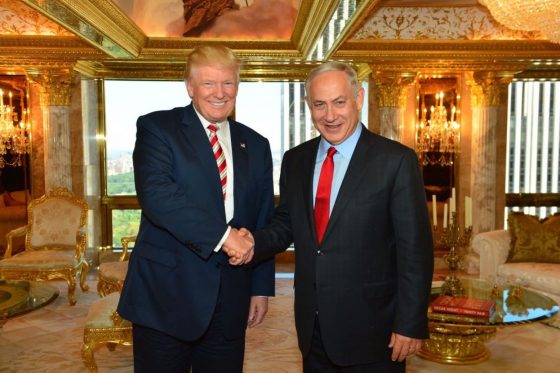
Trump and Netanyahu by National Photo Collection, Government Press Office, Israel
 Israel is a very pro-American country, possibly more so than any other country in the world. As in the past, Israelis followed the US presidential election with great interest, amazed that the American political system had not produced more palatable presidential candidates. After eight years of a frosty relationship with the US Commander in Chief, many Israelis cautiously welcome the advent of Donald Trump.
In a poll taken following Donald Trump’s victory, 83% of Israelis said they consider Trump a pro-Israel leader; by contrast, another poll showed that 63% view Barack Obama as the “worst” US president with regard to Israel in the last 30 years. Indeed, after eight years of tense relations with the Obama administration, most Israelis are relieved to see a friend in the White House. Moreover, on issues that are important to Israel – Iran and the Palestinians – there seems to be a greater convergence of views than before.
Trump’s stance on Iran is particularly important now, as Iran recently held a military exercise to test its missile and radar systems after the Trump administration imposed sanctions on Tehran for a ballistic missile test. When Israeli Prime Minister Benjamin Netanyahu visits Trump in Washington DC this week, it will be worth noting what the leaders say about the Iran nuclear deal and what kind of role the US will play in Israel.
Netanyahu fought tooth and nail against the nuclear agreement negotiated by the Obama administration with Iran. Trump slammed it as “one of the dumbest deals ever.” Senior members of his administration share this view and are apprehensive about Iranian intentions.
Obama gave a high priority to negotiating the Israeli-Palestinian conflict and was obsessed with Jewish settlements in the West Bank. He estranged Israelis by not distinguishing between Israeli building in Jerusalem and in the West Bank. He often dished out “tough love” to Israel, as he called it when addressing a synagogue in Washington, DC.
Trump and his advisors, by contrast, seem more relaxed about the Israeli-Palestinian issue, correctly understanding that it is by no means the most important problem in the chaotic Middle East. Even the White House criticism of new settlement building plans – it called them unhelpful to the peace process, but added that they are not impediments to peace – represents a positive change to many Israelis.
Furthermore, Trump’s promise to move the American embassy in Israel from Tel Aviv to Jerusalem seems more sincere than similar promises made by previous presidential candidates. Throughout his campaign and into the early days of his presidency, Trump has shown that he follows through, and is more concerned with fulfilling his promises than flattering the electorate. Israelis cannot understand why other countries refuse to accept Jerusalem as their capital and to place their embassies in western Jerusalem, which is not, after all, disputed territory. Picking David Friedman – an Orthodox, pro-settlement, Jewish American who owns an apartment in Jerusalem – as ambassador to Israel lends credence to Trump’s promise.
Several of Trump’s positions that draw tremendous criticism at home and abroad are less problematic for Israelis. For example, the idea of building a wall along the US-Mexico border to stop illegal immigration is viewed in Israel as the expression of the sovereign right of any nation to prevent undesirable elements from entering its territory. Israel has built walls and fences to stop the infiltration of terrorists and illegal immigrants from Palestinian territory.
Trump’s diatribes against Muslims are unseemly, but Israelis can understand where he is coming from, since they have been subjected to Muslim terrorism and Arab state aggression for 100 years. The political correctness of the Obama years – when the president refused to acknowledge radical Islam as the source of most of the terrorism in the world – frustrated Israelis.
Thus, Trump’s willingness to speak his mind is appreciated in Israel, even if some of his statements border on the vulgar. It is refreshing to the Israeli ear to hear an American president decline to beat around the bush, but rather to address issues directly, without the constraints of liberal political correctness. This quality has earned Trump some popularity in Israel.
Israelis well know that a portion of the Washington bureaucracy, especially at the Department of State, and some of the media and academic elites are unfriendly to Israel. They welcome a president who dislikes that bureaucracy and is critical of those elites.
We should not forget that since the late 1960s, Israelis have largely preferred Republican presidents. Yitzhak Rabin, who served as Israel’s ambassador to Washington from 1968 to 1973, openly supported the Republican presidential candidate, Richard Nixon. Similarly, Prime Minister Netanyahu made his preference for Mitt Romney over Obama abundantly clear. Unlike many European politicians and American Democrats, Israelis are substantially nationalist and conservative. The conservative Israeli Likud party has won more elections than any other party since 1977.
Israelis followed the decline of American international fortunes during the Obama years with alarm. It frightens them to see America so weakened. Thus, a Trump who wants to make his country great again by increasing defense spending and standing tall against America’s enemies abroad (especially Iran) strikes a responsive chord among Israelis.
Finally, Trump’s family biography endears him to Israelis. His daughter converted to Judaism and belongs to an Orthodox community. Trump has Jewish grandchildren of whom he is proud. His Jewish son-in-law, Jared Kushner, is an important advisor. Living in New York may have sensitized him to the sensibilities of the Jewish community. Moreover, he has always expressed strong support for the Jewish state.
After eight years of the distant President Obama in the White House – a president who used his last days in office to lash out at Israel at the UN – it should not be surprising that Israelis are looking forward, with some trepidation but even more hope, to working with the new American president. While the euphoria displayed by some right-wing circles in Israel is not warranted, an improvement in bilateral relations is a realistic expectation.

#OYVeyDonaldTrump at AIPAC 2016 he acquired the 82nd Airbourne Division of Fans in Israel. High expectations .... but will he deliver on all his promises in his AIPAC Speech.


Israel is a very pro-American country, possibly more so than any other country in the world. As in the past, Israelis followed the US presidential election with great interest, amazed that the American political system had not produced more palatable presidential candidates. After eight years of a frosty relationship with the US Commander in Chief, many Israelis cautiously welcome the advent of Donald Trump.
In a poll taken following Donald Trump’s victory, 83% of Israelis said they consider Trump a pro-Israel leader; by contrast, another poll showed that 63% view Barack Obama as the “worst” US president with regard to Israel in the last 30 years. Indeed, after eight years of tense relations with the Obama administration, most Israelis are relieved to see a friend in the White House. Moreover, on issues that are important to Israel – Iran and the Palestinians – there seems to be a greater convergence of views than before.
Trump’s stance on Iran is particularly important now, as Iran recently held a military exercise to test its missile and radar systems after the Trump administration imposed sanctions on Tehran for a ballistic missile test. When Israeli Prime Minister Benjamin Netanyahu visits Trump in Washington DC this week, it will be worth noting what the leaders say about the Iran nuclear deal and what kind of role the US will play in Israel.
Netanyahu fought tooth and nail against the nuclear agreement negotiated by the Obama administration with Iran. Trump slammed it as “one of the dumbest deals ever.” Senior members of his administration share this view and are apprehensive about Iranian intentions.
Obama gave a high priority to negotiating the Israeli-Palestinian conflict and was obsessed with Jewish settlements in the West Bank. He estranged Israelis by not distinguishing between Israeli building in Jerusalem and in the West Bank. He often dished out “tough love” to Israel, as he called it when addressing a synagogue in Washington, DC.
Trump and his advisors, by contrast, seem more relaxed about the Israeli-Palestinian issue, correctly understanding that it is by no means the most important problem in the chaotic Middle East. Even the White House criticism of new settlement building plans – it called them unhelpful to the peace process, but added that they are not impediments to peace – represents a positive change to many Israelis.
Furthermore, Trump’s promise to move the American embassy in Israel from Tel Aviv to Jerusalem seems more sincere than similar promises made by previous presidential candidates. Throughout his campaign and into the early days of his presidency, Trump has shown that he follows through, and is more concerned with fulfilling his promises than flattering the electorate. Israelis cannot understand why other countries refuse to accept Jerusalem as their capital and to place their embassies in western Jerusalem, which is not, after all, disputed territory. Picking David Friedman – an Orthodox, pro-settlement, Jewish American who owns an apartment in Jerusalem – as ambassador to Israel lends credence to Trump’s promise.
Several of Trump’s positions that draw tremendous criticism at home and abroad are less problematic for Israelis. For example, the idea of building a wall along the US-Mexico border to stop illegal immigration is viewed in Israel as the expression of the sovereign right of any nation to prevent undesirable elements from entering its territory. Israel has built walls and fences to stop the infiltration of terrorists and illegal immigrants from Palestinian territory.
Trump’s diatribes against Muslims are unseemly, but Israelis can understand where he is coming from, since they have been subjected to Muslim terrorism and Arab state aggression for 100 years. The political correctness of the Obama years – when the president refused to acknowledge radical Islam as the source of most of the terrorism in the world – frustrated Israelis.
Thus, Trump’s willingness to speak his mind is appreciated in Israel, even if some of his statements border on the vulgar. It is refreshing to the Israeli ear to hear an American president decline to beat around the bush, but rather to address issues directly, without the constraints of liberal political correctness. This quality has earned Trump some popularity in Israel.
Israelis well know that a portion of the Washington bureaucracy, especially at the Department of State, and some of the media and academic elites are unfriendly to Israel. They welcome a president who dislikes that bureaucracy and is critical of those elites.
We should not forget that since the late 1960s, Israelis have largely preferred Republican presidents. Yitzhak Rabin, who served as Israel’s ambassador to Washington from 1968 to 1973, openly supported the Republican presidential candidate, Richard Nixon. Similarly, Prime Minister Netanyahu made his preference for Mitt Romney over Obama abundantly clear. Unlike many European politicians and American Democrats, Israelis are substantially nationalist and conservative. The conservative Israeli Likud party has won more elections than any other party since 1977.
Israelis followed the decline of American international fortunes during the Obama years with alarm. It frightens them to see America so weakened. Thus, a Trump who wants to make his country great again by increasing defense spending and standing tall against America’s enemies abroad (especially Iran) strikes a responsive chord among Israelis.
Finally, Trump’s family biography endears him to Israelis. His daughter converted to Judaism and belongs to an Orthodox community. Trump has Jewish grandchildren of whom he is proud. His Jewish son-in-law, Jared Kushner, is an important advisor. Living in New York may have sensitized him to the sensibilities of the Jewish community. Moreover, he has always expressed strong support for the Jewish state.
After eight years of the distant President Obama in the White House – a president who used his last days in office to lash out at Israel at the UN – it should not be surprising that Israelis are looking forward, with some trepidation but even more hope, to working with the new American president. While the euphoria displayed by some right-wing circles in Israel is not warranted, an improvement in bilateral relations is a realistic expectation.

Monday, February 13, 2017

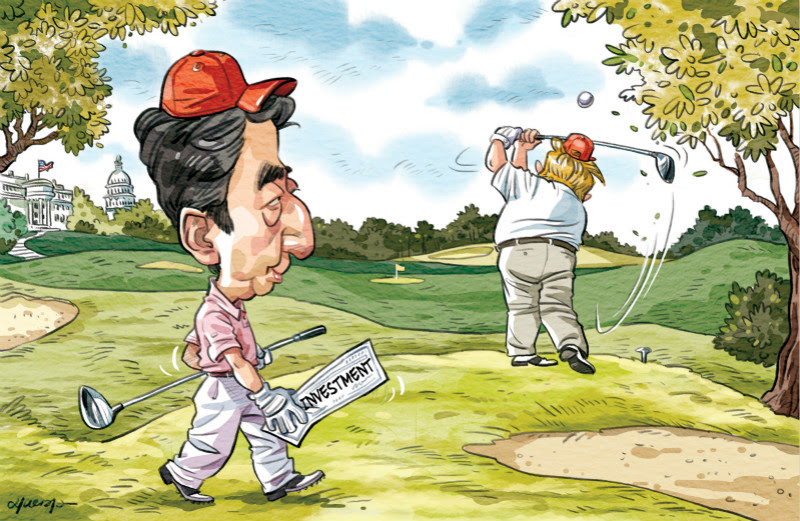
#OyVeyDonaldTrump goes 18 rounds with Japan's Abe


Trump offers insight that Abe would do well to heed

As the first foreign leader to visit Donald Trump when he was US president-elect, and the second to meet him since he entered office, Japanese Prime Minister Shinzo Abe was no doubt confident his exertions had paid off as intended, at least partially.

Especially given the impressive signs of personal rapport between the two leaders, or as Trump described it their "very, very good chemistry", and the coveted US presidential assurance of "unwavering" commitment to the US-Japan alliance.

Everything would therefore seem to be as good as can be for Abe after his meeting with Trump on Friday and Saturday.

Except for the fact his host highlighted a simultaneous willingness to work with China.

The Abe administration has spared no effort to curry international, most noticeably US, support for its attempt to contain what it portrays as a growing threat from China. Disappointed that the Barack Obama administration was not willing to wholeheartedly support his standoff with Beijing, the Japanese leader saw brighter prospects ahead with the Trump administration, given its initial tough rhetoric on China.

But if, as suggested, the phone conversation Trump had with Chinese President Xi Jinping on Thursday was intended as a "balancing" move before his meeting with Abe, Trump’s subsequent confident assertion that he and Xi "are in the process of getting along very well" will not have been music to Abe's ears.

Yet if he can liberate himself from the narrow-minded zero-sum mindset with regard to Beijing, Abe will be able to appreciate and take advantage of the reality of the US president's observation that good China-US relations "will also very much be of a benefit to Japan".

History has put China, Japan and the US in an awkward situation where the past often undermines any hard-earned goodwill. But it is worth bearing in mind that the recent history of their trilateral relationship has not been devoid of bright spots. There was even a long period of quite friendly exchanges between Beijing and Tokyo. And the most important lesson that can be learned from this is not only do Beijing and Tokyo not have to stand against each other, but the three can work together.

The US president has made the insightful judgment that China-US conversations will "work out very well for everybody – China, Japan, the United States, and everybody in the region".

That perception may not be what Abe wants to hear, but it is something that Japan would be wise to lend an ear to.

Tuesday, February 7, 2017

#RIPPaxAmericana Yemen delivers a low blow to #OYVeyDonaldTrump and Withdraws Permission for U.S. Ground missions. To Pax or Not To Pax That is The Question.

Pax Americana[(Latin for "American Peace", modeled after Pax Britannica, Pax Mongolica, and Pax Romana) is a term applied to the concept of relative peace in the Western Hemisphere and later the world as a result of the preponderance of power enjoyed by the Un ited States beginning around the middle of the 20th century and continuing to this day. Although the term finds its primary utility in the latter half of the 20th century, it has been used with different meanings and eras, such as the post-Civil War era in North America, and regionally in the Americas at the start of the 20th century.Pax Americana is primarily used in its modern connotations to refer to the peace among great powers established after the end of World War II in 1945, also called the Long Peace. In this modern sense, it has come to indicate the military and economic position of the United States in relation to other nations. For example, the Marshall Plan, which spent $13 billion to rebuild the economy of Western Europe, has been seen as "the launching of the pax americana."The Latin term derives from Pax Romana of the Roman Empire. The term is most notably associated with Pax Britannica under the British Empire, which served as the global hegemon and constabulary from the late 18th century until the early 20th century. -Wikipedia

Yemen Withdraws Permission for U.S. Antiterror Ground Missions


Sean Spicer, the White House press secretary, at the White House on Tuesday. Mr. Spicer denied reports that the purpose of the attack in Yemen was to capture or kill any specific Qaeda leader.CreditDoug Mills/The New York Times

WASHINGTON — Angry at the civilian casualties incurred last month in the first commando raid authorized by President Trump, Yemen has withdrawn permission for the United States to run Special Operations ground missions against suspected terrorist groups in the country, according to American officials.

Grisly photographs of children apparently killed in the crossfire of a 50-minute firefight during the raid caused outrage in Yemen. A member of the Navy’s SEAL Team 6, Chief Petty Officer William Owens, was also killed in the operation.

While the White House continues to insist that the attack was a “success” — a characterization it repeated on Tuesday — the suspension of commando operations is a setback for Mr. Trump, who has made it clear he plans to take a far more aggressive approach against Islamic militants.

It also calls into question whether the Pentagon will receive permission from the president for far more autonomy in selecting and executing its counterterrorism missions in Yemen, which it sought, unsuccessfully, from President Barack Obama in the last months of his term.

Sean Spicer, the White House press secretary, denied reports that the purpose of the attack was to capture or kill any specific Qaeda leader. “The raid that was conducted in Yemen was an intelligence-gathering raid,” he said. “That’s what it was. It was highly successful. It achieved the purpose it was going to get, save the loss of life that we suffered and the injuries that occurred.”

Neither the White House nor the Yemenis have publicly announced the suspension. Pentagon spokesmen declined to comment, but other military and civilian officials confirmed that Yemen’s reaction had been strong.

It was unclear if Yemen’s decision to halt the ground attacks was also influenced by Mr. Trump’s inclusion of the country on his list of nations from which he wants to temporarily suspend all immigration, an executive order that is now being challenged in the federal courts.

According to American civilian and military officials, the Yemeni ban on operations does not extend to military drone attacks, and does not affect the handful of American military advisers who are providing intelligence support to the Yemenis and forces from the United Arab Emirates.

In 2014, Yemen’s government temporarily halted those drones from flying because of botched operations that also killed civilians. But later they quietly resumed, and in recent years they have been increasing in frequency, a sign of the fact that Al Qaeda in the Arabian Peninsula, or AQAP, is considered one of the world’s most dangerous terrorist groups.

The raid stirred immediate outrage among Yemeni government officials, some of whom accused the Trump administration of not fully consulting with them before the mission. Within 24 hours of the assault on a cluster of houses in a tiny village in mountainous central Yemen, the country’s foreign minister, Abdul Malik Al Mekhlafi, condemned the raid in a post on his official Twitter account as “extrajudicial killings.”

In an interview with Al Jazeera this week, Ahmed Awad bin Mubarak, Yemen’s ambassador to the United States, said that President Abdu Rabbu Mansour Hadi raised concerns about the raid in a meeting with the American ambassador to Yemen in Riyadh on Feb. 2.

“Yemen’s government is a key partner in the war against terrorism,” Mr. Mubarak said in the interview, adding that Yemen’s cooperation should not come “at the expense of the Yemeni citizens and the country’s sovereignty.”

The Pentagon has acknowledged that the raid killed several civilians, including children, and is investigating. The dead include, by the account of relatives, the 8-year-old daughter of Anwar al-Awlaki, the American-born Qaeda leader who was killed in a targeted drone strike in 2011.

In a sign of the contentiousness that public disclosures of the raid have caused, Pentagon officials on Tuesday provided lawmakers on Capitol Hill with a classified briefing on the mission. One participant in that meeting said military officials told them “they got what they wanted,” without offering details. But Senator John McCain of Arizona, chairman of the Armed Services Committee, said afterward that the raid was a failure.

American counterterrorism officials have expressed growing fears about their lack of understanding of Qaeda operations in Yemen since the United States was forced to withdraw the last 125 Special Operations advisers from the country in March 2015 after Houthi rebels ousted the government of President Hadi, the Americans’ main counterterrorism partner.

The Pentagon has tried to start rebuilding its counterterrorism operations in Yemen since then. Last May, American Special Operations forces helped Yemeni and Emirati troops evict Qaeda fighters from the port city of Al Mukalla.

Al Qaeda had used Al Mukalla as a base as the militants stormed through southern Yemen, capitalizing on the power vacuum caused by the country’s 14-month civil war and seizing territory, weapons and money.

The deadly raid last month, launched from an amphibious assault ship off the Yemeni coast, was the first known American-led ground mission in Yemen since December 2014, when members of SEAL Team 6 stormed a village in southern Yemen in an effort to free an American photojournalist held hostage by Al Qaeda. But the raid ended with the kidnappers killing the journalist and a South African held with him.

The United States conducted 38 drone strikes in Yemen last year, up from 23 in 2014, and has already carried out five strikes so far this year, according to the Foundation for Defense of Democracies’ Long War Journal.

In response to the raid, Al Qaeda’s branch in Yemen urged followers last weekend to attack the United States and its allies in the country.

Qasim al-Raymi, the leader of the Qaeda offshoot, likened his fighters to extremists battling American forces in Iraq and Afghanistan, according to a speech translated by SITE Intelligence Group, which tracks extremist activities and messaging.

Specialists in Yemeni culture and politics have cautioned that Al Qaeda would seize on the raid to whip up anti-American feelings and attract more followers.

“The use of U.S. soldiers, high civilian casualties and disregard for local tribal and political dynamics,” the Brussels-based International Crisis Group said in a report released last Thursday, “plays into AQAP’s narrative of defending Muslims against the West and could increase anti-U.S. sentiment and with it AQAP’s pool of recruits.”

Saturday, February 4, 2017

#OyVeyDonaldTrump Terroris unde venis qui operatur in Americam? From Where do The Terrorists who have commits acts in America Come From


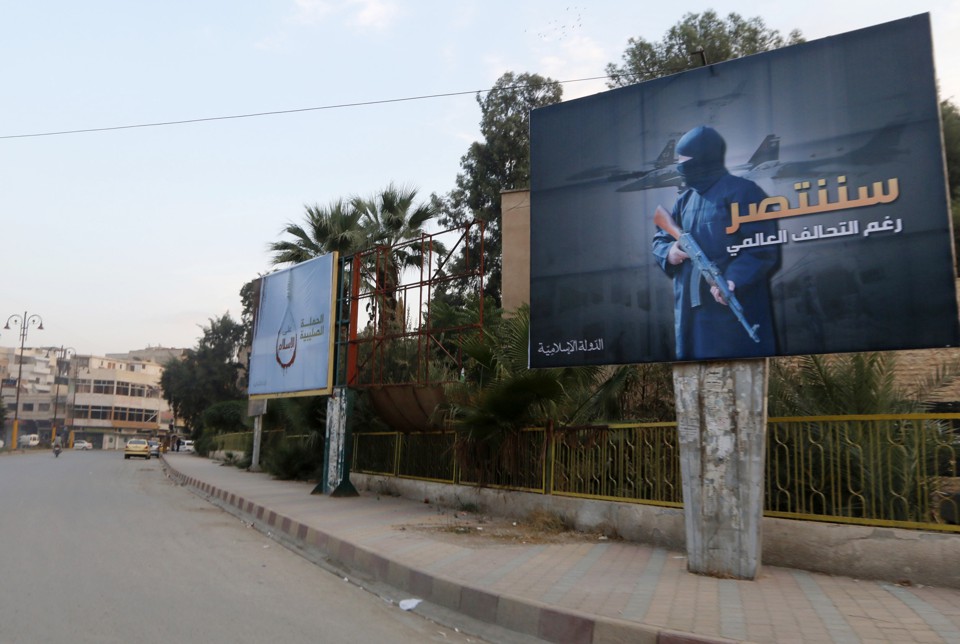
An ISIS billboard in Raqqa, SyriaNour Fourat / Reuters

This weekend, Rudy Giuliani went on Fox News to explain why Donald Trump’s decision to bar Syrian refugees from U.S. shores and suspend visas for citizens of seven Muslim-majority countries did not amount to a Muslim ban. “What we did was, we focused on, instead of religion, danger,” the former New York City mayor said, in reference to the targeted nations: Iran, Iraq, Libya, Somalia, Sudan, Syria, and Yemen. “Which is a factual basis, not a religious basis. … It’s based on places where there are substantial evidence that people are sending terrorists into our country.”

But Trump’s policy does not have the factual basis that Giuliani claims. The data on terrorism in the United States consistently indicates that the threat largely lies elsewhere.

ISIS does control territory in Syria, Iraq, and Libya, while al-Qaeda has a major presence in Yemen and the terrorist group al-Shabab is based in Somalia. The U.S. State Department alleges that the governments of Iran, Sudan, and Syria support international terrorism. The Trump administration also selected these countries because the Obama administration and Congress had previously designated them as places people couldn’t visit if they planned to participate in the U.S. visa-waiver program.

In addition, people from the countries in Trump’s crosshairs have certainly committed acts of terrorism in the United States; a Somali refugee injured several people in an attack at Ohio State University just this fall. Asylum-seekers have also recently been implicated in terrorist plots in Europe.

But after sifting through databases, media reports, court documents, and other sources, Alex Nowrasteh, an immigration expert at the libertarian Cato Institute, has arrived at a striking finding: Nationals of the seven countries singled out by Trump have killed zero people in terrorist attacks on U.S. soil between 1975 and 2015.

Zero.

Six Iranians, six Sudanese, two Somalis, two Iraqis, and one Yemeni have been convicted of attempting or executing terrorist attacks on U.S. soil during that time period, according to Nowrasteh’s research. (Nowrasteh focused on plots against the U.S. homeland, which presumably Trump cares most about, rather than other terrorism-related offenses, like supporting a foreign terrorist group or trying to join a jihadist organization overseas.) Zero Libyans and zero Syrians have been convicted of doing the same. “Foreign-born terrorism is a hazard,” Nowrasteh argues, “but it is manageable given the huge economic benefits of immigration and the small costs of terrorism.”

As for refugees, Nowrasteh writes, Trump’s action “is a response to a phantom menace.” Over the last four decades, 20 out of 3.25 million refugees welcomed to the United States have been convicted of attempting or committing terrorism on U.S. soil, and only three Americans have been killed in attacks committed by refugees—all by Cuban refugees in the 1970s.

Zero Americans have been killed by Syrian refugees in a terrorist attack in the United States.

Between 1975 and 2015, the “annual chance of being murdered by somebody other than a foreign-born terrorist was 252.9 times greater than the chance of dying in a terrorist attack committed by a foreign-born terrorist,” according to Nowrasteh.

Nowrasteh has listed foreign-born individuals who committed or were convicted of attempting to commit a terrorist attack on U.S. soil by their country of origin and the number of people they killed. As in any exercise like this, the statistics are rough and directional rather than precise. For example, the San Bernardino attacker Tashfeen Malik, who was born in Pakistan but lived in Saudi Arabia most of her life, is counted as originating from Saudi Arabia. In the case of attacks perpetrated by multiple terrorists, like 9/11, each terrorist is assigned an equal number of victims.

Still, it’s worth noting that the countries at the top of the list, including Saudi Arabia and Egypt, are not included in Trump’s ban. I’ve bolded the countries included in Trump’s executive order.

The 9/11 attacks were carried out by 19 men—from Saudi Arabia (15), the United Arab Emirates (2), Egypt (1), and Lebanon (1). The incident remains influential in how Americans think about the nature of terrorism; Trump’s executive order cites 9/11 as a prime example of the U.S. visa process catastrophically breaking down. But it’s misleading as a guide to where today’s terrorists come from.

Nowrasteh found that foreign-born terrorists who entered the country, either as immigrants or tourists, were involved in 3,024 of the 3,432 murders caused by terrorists on U.S. soil from 1975 through 2015. But 2,983 of those murders came on 9/11 alone.Alex Nowrasteh / Cato Institute

The stereotype of the foreign terrorist infiltrator is outdated, according to the New America think tank. The organization has compiled its own data on patterns of terrorism in the United States, which unlike Cato’s focuses on jihadist terrorism in the country following 9/11. The dataset includes people charged with terrorism-related crimes, not just those convicted, as well as U.S. citizens and residents rather than solely foreigners.

“[E]very jihadist who conducted a lethal attack inside the United States since 9/11 was a citizen or legal resident,” New America reports. During that time period, more than 80 percent of individuals who were charged with or died engaging in jihadist terrorism or related activities inside the United States have been U.S. citizens or permanent residents (the tally also includes Americans accused of engaging in such activity abroad). Many have been second-generation immigrants: The Orlando nightclub attacker, for instance, was a U.S. citizen and son of Afghan immigrants. One of the San Bernardino shooters was a U.S. citizen and son of Pakistani immigrants; the other, Tashfeen Malik, was a Pakistani national and conditional U.S. permanent resident who came to the United States on a fiancee visa.

New America

As Jane Holl Lute, the former deputy secretary of the U.S. Department of Homeland Security, said at the Aspen Ideas Festival last year, “What’s been our theory of the case for 12 or 15 years following 9/11? Our theory of the case is the bad guys are out there, trying to come here. … What if [the bad guys are] already here?”

The 9/11 attackers entered the United States using various types of visas. But between then and 2015, “among attackers claiming or appearing to be motivated by extremist Islam, only one would have needed a visa to enter the United States at the time of the attack,” according to yet another tally, by The New York Times. Half of the prominent jihadist attacks analyzed by the Times were carried out by men born in the United States. “Security experts argue that the risks of routine travel—including the U.S. visa waiver program, which allows citizens of Britain, France, Belgium and 35 other countries to enter the United States without a visa for stays of up to 90 days—are greater than the threat of foreign terrorists coming through the refugee program,” the paper added.

Trump is understandably focused on the threat from ISIS. But here, too, the statistics don’t align with Trump policy. Since 2014, the majority of individuals charged in the United States with ISIS-related offenses have been U.S. citizens (58 percent) or permanent residents (6 percent), according to George Washington University’s Program on Extremism. Additionally, more ISIS fighters in Iraq and Syria appear to come from Saudi Arabia, Tunisia, Morocco, Turkey, Russia, Egypt, and China than any countries included in Trump’s ban.

One could argue that America hasn’t experienced high levels of terrorism by foreign-born individuals precisely because, well before Trump, the U.S. government was limiting immigration from countries afflicted by terrorism, and subjecting the modest number of refugees it accepted to more rigorous vetting than any other type of traveler to the United States. As my colleague Graeme Wood has written, “If the Islamic State intends to kill Americans by sending an Iraqi or Syrian to get a visa, they are doing it the hard way. Most of the attackers will blow themselves up out of frustration with the American immigration bureaucracy before they can ever reach American shores to blow themselves up near their intended targets.”

But even if that’s the case, it still doesn’t explain why the Trump administration would suddenly block all refugees and citizens of entire countries, as if it were confronting Syrian refugees and Iraqi immigrants pouring across America’s borders to commit terrorism. Like his border wall, which will be erected to stop a mass Mexican migration that no longer exists, Trump’s immigration ban is a solution that misdiagnoses the actual problem.

As Nowrasteh notes, future terrorists could very well come from different countries than terrorists have in the past. Judged by the evidence to date, however, Trump’s ban “will likely stop few terrorists, prevent zero deaths, and slightly reduce immigration and tourism. All minor economic pain, no gain.”