Showing posts with label Stepehen Darori. Show all posts

Tuesday, February 14, 2017

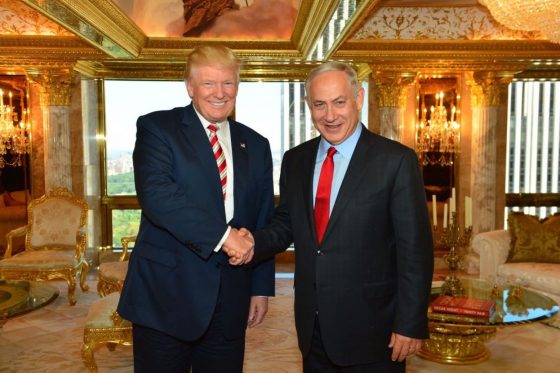
#OYVeyDonaldTrump at AIPAC 2016 he acquired the 82nd Airbourne Division of Fans in Israel. High expectations .... but will he deliver on all his promises in his AIPAC Speech.


Israel is a very pro-American country, possibly more so than any other country in the world. As in the past, Israelis followed the US presidential election with great interest, amazed that the American political system had not produced more palatable presidential candidates. After eight years of a frosty relationship with the US Commander in Chief, many Israelis cautiously welcome the advent of Donald Trump.
In a poll taken following Donald Trump’s victory, 83% of Israelis said they consider Trump a pro-Israel leader; by contrast, another poll showed that 63% view Barack Obama as the “worst” US president with regard to Israel in the last 30 years. Indeed, after eight years of tense relations with the Obama administration, most Israelis are relieved to see a friend in the White House. Moreover, on issues that are important to Israel – Iran and the Palestinians – there seems to be a greater convergence of views than before.
Trump’s stance on Iran is particularly important now, as Iran recently held a military exercise to test its missile and radar systems after the Trump administration imposed sanctions on Tehran for a ballistic missile test. When Israeli Prime Minister Benjamin Netanyahu visits Trump in Washington DC this week, it will be worth noting what the leaders say about the Iran nuclear deal and what kind of role the US will play in Israel.
Netanyahu fought tooth and nail against the nuclear agreement negotiated by the Obama administration with Iran. Trump slammed it as “one of the dumbest deals ever.” Senior members of his administration share this view and are apprehensive about Iranian intentions.
Obama gave a high priority to negotiating the Israeli-Palestinian conflict and was obsessed with Jewish settlements in the West Bank. He estranged Israelis by not distinguishing between Israeli building in Jerusalem and in the West Bank. He often dished out “tough love” to Israel, as he called it when addressing a synagogue in Washington, DC.
Trump and his advisors, by contrast, seem more relaxed about the Israeli-Palestinian issue, correctly understanding that it is by no means the most important problem in the chaotic Middle East. Even the White House criticism of new settlement building plans – it called them unhelpful to the peace process, but added that they are not impediments to peace – represents a positive change to many Israelis.
Furthermore, Trump’s promise to move the American embassy in Israel from Tel Aviv to Jerusalem seems more sincere than similar promises made by previous presidential candidates. Throughout his campaign and into the early days of his presidency, Trump has shown that he follows through, and is more concerned with fulfilling his promises than flattering the electorate. Israelis cannot understand why other countries refuse to accept Jerusalem as their capital and to place their embassies in western Jerusalem, which is not, after all, disputed territory. Picking David Friedman – an Orthodox, pro-settlement, Jewish American who owns an apartment in Jerusalem – as ambassador to Israel lends credence to Trump’s promise.
Several of Trump’s positions that draw tremendous criticism at home and abroad are less problematic for Israelis. For example, the idea of building a wall along the US-Mexico border to stop illegal immigration is viewed in Israel as the expression of the sovereign right of any nation to prevent undesirable elements from entering its territory. Israel has built walls and fences to stop the infiltration of terrorists and illegal immigrants from Palestinian territory.
Trump’s diatribes against Muslims are unseemly, but Israelis can understand where he is coming from, since they have been subjected to Muslim terrorism and Arab state aggression for 100 years. The political correctness of the Obama years – when the president refused to acknowledge radical Islam as the source of most of the terrorism in the world – frustrated Israelis.
Thus, Trump’s willingness to speak his mind is appreciated in Israel, even if some of his statements border on the vulgar. It is refreshing to the Israeli ear to hear an American president decline to beat around the bush, but rather to address issues directly, without the constraints of liberal political correctness. This quality has earned Trump some popularity in Israel.
Israelis well know that a portion of the Washington bureaucracy, especially at the Department of State, and some of the media and academic elites are unfriendly to Israel. They welcome a president who dislikes that bureaucracy and is critical of those elites.
We should not forget that since the late 1960s, Israelis have largely preferred Republican presidents. Yitzhak Rabin, who served as Israel’s ambassador to Washington from 1968 to 1973, openly supported the Republican presidential candidate, Richard Nixon. Similarly, Prime Minister Netanyahu made his preference for Mitt Romney over Obama abundantly clear. Unlike many European politicians and American Democrats, Israelis are substantially nationalist and conservative. The conservative Israeli Likud party has won more elections than any other party since 1977.
Israelis followed the decline of American international fortunes during the Obama years with alarm. It frightens them to see America so weakened. Thus, a Trump who wants to make his country great again by increasing defense spending and standing tall against America’s enemies abroad (especially Iran) strikes a responsive chord among Israelis.
Finally, Trump’s family biography endears him to Israelis. His daughter converted to Judaism and belongs to an Orthodox community. Trump has Jewish grandchildren of whom he is proud. His Jewish son-in-law, Jared Kushner, is an important advisor. Living in New York may have sensitized him to the sensibilities of the Jewish community. Moreover, he has always expressed strong support for the Jewish state.
After eight years of the distant President Obama in the White House – a president who used his last days in office to lash out at Israel at the UN – it should not be surprising that Israelis are looking forward, with some trepidation but even more hope, to working with the new American president. While the euphoria displayed by some right-wing circles in Israel is not warranted, an improvement in bilateral relations is a realistic expectation.

Saturday, February 11, 2017

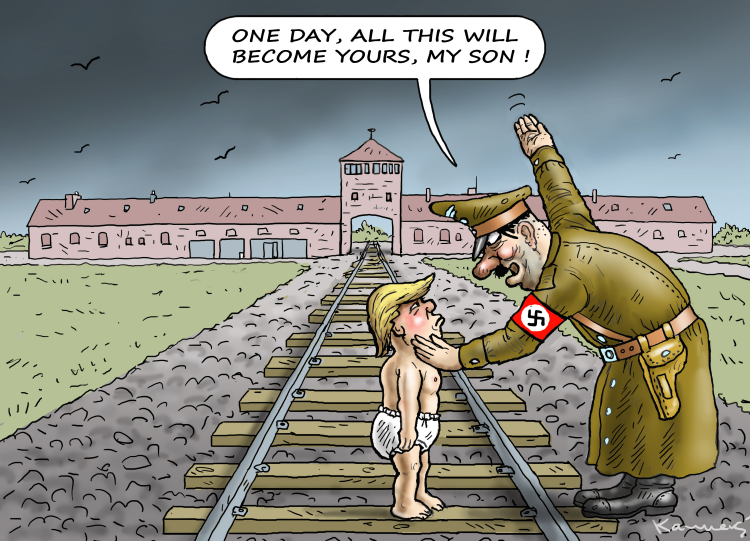
Did #OyVeyDonaldTrump's White House Mean to wink at Holocaust Denier? Holocaust Deniers are synonymous with both the positions of the KKK and Alt Right that both endorsed and actively campained to get him elected.

Image result for Trump's White House Nazi cartoon


The White House 's troubling statement for International Holocaust Day flirts with "softcore" Holocaust denialism.

Statement by the President on International Holocaust Remembrance Day
“It is with a heavy heart and somber mind that we remember and honor the victims, survivors, heroes of the Holocaust. It is impossible to fully fathom the depravity and horror inflicted on innocent people by Nazi terror.
“Yet, we know that in the darkest hours of humanity, light shines the brightest.‎ As we remember those who died, we are deeply grateful to those who risked their lives to save the innocent.
“In the name of the perished, I pledge to do everything in my power throughout my Presidency, and my life, to ensure that the forces of evil never again defeat the powers of good. Together, we will make love and tolerance prevalent throughout the world.”

President Donald Trump has barely been in office for a week and already he’s being accused, by prominent and credible people, of aiding and abetting Holocaust denial. Both Sen. Tim Kaine, D-Va., and conservative commentator John Podhoretz have gone public with such criticisms.

This outcry resulted from the White House statement on Holocaust Remembrance Day, which omitted any mention that the Holocaust was an effort to get rid of the Jewish population of Europe. All previous presidents had made mention of the fact that while many non-Jewish people were killed in Nazi Germany’s concentration camps, the machinery of the Holocaust was created and effectively used to kill more than 60 percent of Europe’s Jewish population.

This omission is especially troubling in light of the fact that Holocaust denialism — which is about either outright denying or aggressively downplaying the Jewish genocide at the hands of the Nazis — is a common feature of the specific variety of white nationalism that is being mainstreamed through Trump and his “alt-right” advisers, including former Breitbart head Steve Bannon. The fact that Trump’s Holocaust statement was issued at almost the same time as his ban on refugees and immigrants from certain countries, which reminded many of the efforts to turn away Jewish refugees during World War II, did not help matters.

In addition, Trump is known to be fond of conspiracy theories, including overtly racist ones like the “birtherism” he used to plague Barack Obama. Holocaust denial is the granddaddy of conspiracy theories, and many of the common tropes and strategies used by a wide range of conspiracy-mongers can be traced back to efforts to deny or explain away the Nazi campaign to murder Jews.

“The fact of the matter is that the Holocaust, as defined by historians, is not ‘all the bad things the Nazis did,'” explained historian Deborah Lipstadt over the phone. “The Nazis did lots and lots of bad things. But the Holocaust is the attempt to annihilate European Jewry.”

In 1993, Lipstadt wrote an important expose on Holocaust denialism, titled “Denying the Holocaust: The Growing Assault on Truth and Memory.” She was then sued in a British court by conspiracy theorist David Irving, because she correctly characterized many of Irving’s public statements as Holocaust denial. Lipstadt won the suit.

That famous court case was recently depicted in the feature film “Denial,” released last fall, in which Rachel Weisz plays Lipstadt.

In our conversation, Lipstadt laid out her theory that there are two kinds of Holocaust denial: “hardcore” and “softcore.”

“Hardcore denial,” she explained, is when someone seeks to deny the very existence of Nazi gas chambers, “deny Hitler wanted to kill the Jews [and] deny the facts of the Holocaust.”

Softcore denial, however, is subtler. That is less a matter of “denying the Holocaust outright” so much as “de-Judaizing it” or otherwise trying to downplay the historical importance of Hitler’s efforts to commit genocide against the Jews.

As Mark Hoofnagle of Denialism Blog, which tracks and exposes conspiracy theories, explained, softcore denialism has developed as a way for denialists to communicate their ideas while maintaining a veneer of plausible deniability.

Such softcore “deniers have become more subtle in the decades since Paul Rassinier outright denied [the Holocaust’s] existence in the aftermath of WWII,” Hoofnagle writes. They often rely instead on “minimization and distraction” to push the notion that while the Holocaust was a tragic event, it was not a large-scale genocide against the Jewish people.

This form of denial is similar, in this limited sense, to climate-change denialism. In some circumstances, denialists will flat out suggest that climate change is a hoax. In more mainstream arenas, they will soften their rhetoric, claiming instead to be unsure whether climate change is real, or admitting that it’s happening while expressing skepticism that humans are causing it.

It is worth noting that Trump himself has this habit, sometimes calling climate change a hoax and sometimes softening his rhetoric to suggest he’s just uncertain about the science. Is the analogy the same for the Holocaust, #OyVeyDonaldTrump ? #AmericaHangsItsHeadinShame.  

Thursday, January 26, 2017

#OyVeyDonaldTrump becomes schmoozer-in-chief


Donald Trump has emerged from his earliest days in the White House with a new title: schmoozer-in-chief.

Trump, a Washington outsider, is hoping to build the kinds of relationships that can lead to cooperation with Republicans and Democrats that would advance his agenda.

Lawmakers who felt shunned at worst or tolerated at best by former President Barack Obama are hopeful for the change.

“We're a couple days in but it's going to be way better than what we've had during the last eight years," Rep. Adam Kinzinger (R-Ill.) said in an interview. “He's a builder and he wants to bring people together.”

Trump so far has appeared to relish joking around with lawmakers at informal and formal events, and he’ll take his effort on the road Thursday, when he will speak about his agenda in front of House and Senate Republicans’ joint retreat in Philadelphia.

But it's unclear how far the new president’s charm offensive will get him.

Trump's lack of impulse control and tendency to speak his mind has already gotten himself into hot water with the lawmakers he needs to woo.

That paradox was on full display on Monday afternoon, when Trump lavished congressional leaders who met with him at the White House with an assortment of fancy appetizers and drinks.

As the leaders munched on a mix of shrimp, crab, meatballs and other snacks in the State Dining Room, Trump repeated his baseless claim he lost the popular vote because millions of people illegally cast ballots for Democratic nominee Hillary Clinton.

The assertion prompted a mix of anger and pity from Democrats. “I felt sorry for him,” said House Minority Nancy Pelosi (D-Calif.), who was in the room.

It frustrated Republicans, who worry Trump’s continued focus on the election could hamper their efforts to get on the same page on policy areas like healthcare reform, trade and immigration.

Trump on Wednesday expressed annoyance the conversation was leaked, a common Washington occurrence, and downplayed the degree to which it consumed the reception.

“It was so misrepresented,” he told ABC News. “That was supposed to be a confidential meeting … the conversation lasted for about a minute.”

Trump is also not invited to Democrats' upcoming congressional retreat in Baltimore, breaking with past practice, a sign partisan tensions aren't going away.

Despite the rocky start, Trump does not plan to shut himself in.

He plans to extend White House invitations to the Congressional Hispanic Caucus and Congressional Black Caucus, which include some of his most vocal opponents, spokesman Sean Spicer said Monday.

“I think that you're gonna to see a lot more of that, a listening president who's engaged,” said Spicer. “That's who he is. That's what he did during the transition. And I think that's he's gonna do going forward.”

At Monday’s event with congressional leaders, Trump, a teetotaler, even had alcoholic beverages on hand to loosen the mood.

Sen. John Cornyn (R-Texas) admitted that was pushing the envelope a little too far with the usually buttoned-down leaders. “We were all drinking Diet Cokes,” he said.

Trump has tapped Vice President Mike Pence, whose six terms in the House included a stint in leadership, as his point man on Capitol Hill.

Pence on Tuesday attended the Senate Republicans’ weekly conference lunch and said he would drop by regularly. The vice president is also accompanying Trump in Philadelphia.

White House chief of staff Reince Priebus, who developed close ties with GOP leaders as party chairman; and deputy chief of staff for operations Rick Dearborn, a longtime chief of staff to Trump’s attorney general pick Sen. Jeff Sessions (R-Ala.), are also said to be involved in congressional outreach.

While Trump is still getting to know many key players at the Capitol, he has been especially chummy with Senate Minority Leader Charles Schumer (D-N.Y.), who has known the president for three decades.

He and Schumer spent a good chunk of time swapping stories and memories at the Monday meeting, including a 2008 fundraiser for the Democratic Senatorial Campaign Committee at his Mar-a-Lago club in Florida.

“I asked the president, how long have you and Chuck Schumer known each other. He said, ‘Chuck’s been coming around for 35 years or so.’ I think they know each other better than anybody else in the room,’” Cornyn said.

That Trump and Schumer come from the same place and share a history wasn’t lost on the top Senate Republican.

“I enjoyed the president and Sen. Schumer talking about all the people they knew in New York,” Senate Majority Leader Mitch McConnell (R-Ky.) said afterward.

Schumer, who is facing tremendous pressure from the left not to compromise with Trump, has said he won’t be taken in by the charm offensive.

“The president tried to flatter me [like] I'm his good friend,” he told reporters this week. “Then, he started calling names. None of them affect me. The bottom line is values, our values, as Democrats and Americans will affect whether I work with him or oppose him, plain and simple."

Trump’s developed his taste for socializing during his decades as a New York real estate developer and reality TV star.

In his book "Trump and Me," writer Mark Singer marveled at how the businessman worked a room full of dignitaries at the 1997 grand opening of the Trump International Hotel and Tower in Manhattan.

“A backlap and a wink, a finger on the lapels, no more than a minute with anyone who wasn’t a police commissioner, a district attorney or a mayoral candidate,” he wrote.

But then the author noticed Trump stop and thank the parking attendants before leaving. “A quintessential Trumpian gesture that explains his popularity among people who barely dare to dream of living in one of his creations,” he wrote.

Obama was perceived to be more cerebral and aloof, preferring to spend time with first lady Michelle Obama, his two daughters and team of close advisers.

Trump, on the other hand, is living in the White House without his wife and young son, who are in New York while he finishes the school year.

Obama wooed lawmakers early on, hosting a cocktail reception at the White House on eight days after his inauguration to lobby them on his stimulus plan. Days later he invited Republicans and Democrats for a Super Bowl party.

But the schmoozing let up — he rarely had lawmakers fly with him on Air Force One or play golf with them — and Obama soon earned a distant reputation.

In a 2012 interview with CNN, Obama denied he avoided socializing with members out of spite.

“Sometimes Michelle and I not doing the circuit and going out to dinners with folks is perceived as us being cool,” he said.” It actually really has more to do with us being parents.”