Showing posts with label Iranian Nuclear Deal. Show all posts

Tuesday, February 14, 2017

#OYVeyDonaldTrump at AIPAC 2016 he acquired the 82nd Airbourne Division of Fans in Israel. High expectations .... but will he deliver on all his promises in his AIPAC Speech.


Israel is a very pro-American country, possibly more so than any other country in the world. As in the past, Israelis followed the US presidential election with great interest, amazed that the American political system had not produced more palatable presidential candidates. After eight years of a frosty relationship with the US Commander in Chief, many Israelis cautiously welcome the advent of Donald Trump.
In a poll taken following Donald Trump’s victory, 83% of Israelis said they consider Trump a pro-Israel leader; by contrast, another poll showed that 63% view Barack Obama as the “worst” US president with regard to Israel in the last 30 years. Indeed, after eight years of tense relations with the Obama administration, most Israelis are relieved to see a friend in the White House. Moreover, on issues that are important to Israel – Iran and the Palestinians – there seems to be a greater convergence of views than before.
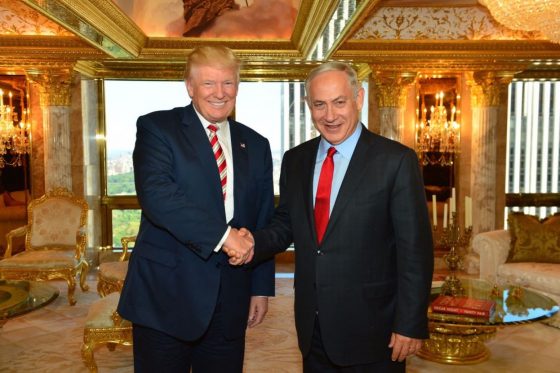
Trump’s stance on Iran is particularly important now, as Iran recently held a military exercise to test its missile and radar systems after the Trump administration imposed sanctions on Tehran for a ballistic missile test. When Israeli Prime Minister Benjamin Netanyahu visits Trump in Washington DC this week, it will be worth noting what the leaders say about the Iran nuclear deal and what kind of role the US will play in Israel.
Netanyahu fought tooth and nail against the nuclear agreement negotiated by the Obama administration with Iran. Trump slammed it as “one of the dumbest deals ever.” Senior members of his administration share this view and are apprehensive about Iranian intentions.
Obama gave a high priority to negotiating the Israeli-Palestinian conflict and was obsessed with Jewish settlements in the West Bank. He estranged Israelis by not distinguishing between Israeli building in Jerusalem and in the West Bank. He often dished out “tough love” to Israel, as he called it when addressing a synagogue in Washington, DC.
Trump and his advisors, by contrast, seem more relaxed about the Israeli-Palestinian issue, correctly understanding that it is by no means the most important problem in the chaotic Middle East. Even the White House criticism of new settlement building plans – it called them unhelpful to the peace process, but added that they are not impediments to peace – represents a positive change to many Israelis.
Furthermore, Trump’s promise to move the American embassy in Israel from Tel Aviv to Jerusalem seems more sincere than similar promises made by previous presidential candidates. Throughout his campaign and into the early days of his presidency, Trump has shown that he follows through, and is more concerned with fulfilling his promises than flattering the electorate. Israelis cannot understand why other countries refuse to accept Jerusalem as their capital and to place their embassies in western Jerusalem, which is not, after all, disputed territory. Picking David Friedman – an Orthodox, pro-settlement, Jewish American who owns an apartment in Jerusalem – as ambassador to Israel lends credence to Trump’s promise.
Several of Trump’s positions that draw tremendous criticism at home and abroad are less problematic for Israelis. For example, the idea of building a wall along the US-Mexico border to stop illegal immigration is viewed in Israel as the expression of the sovereign right of any nation to prevent undesirable elements from entering its territory. Israel has built walls and fences to stop the infiltration of terrorists and illegal immigrants from Palestinian territory.
Trump’s diatribes against Muslims are unseemly, but Israelis can understand where he is coming from, since they have been subjected to Muslim terrorism and Arab state aggression for 100 years. The political correctness of the Obama years – when the president refused to acknowledge radical Islam as the source of most of the terrorism in the world – frustrated Israelis.
Thus, Trump’s willingness to speak his mind is appreciated in Israel, even if some of his statements border on the vulgar. It is refreshing to the Israeli ear to hear an American president decline to beat around the bush, but rather to address issues directly, without the constraints of liberal political correctness. This quality has earned Trump some popularity in Israel.
Israelis well know that a portion of the Washington bureaucracy, especially at the Department of State, and some of the media and academic elites are unfriendly to Israel. They welcome a president who dislikes that bureaucracy and is critical of those elites.
We should not forget that since the late 1960s, Israelis have largely preferred Republican presidents. Yitzhak Rabin, who served as Israel’s ambassador to Washington from 1968 to 1973, openly supported the Republican presidential candidate, Richard Nixon. Similarly, Prime Minister Netanyahu made his preference for Mitt Romney over Obama abundantly clear. Unlike many European politicians and American Democrats, Israelis are substantially nationalist and conservative. The conservative Israeli Likud party has won more elections than any other party since 1977.
Israelis followed the decline of American international fortunes during the Obama years with alarm. It frightens them to see America so weakened. Thus, a Trump who wants to make his country great again by increasing defense spending and standing tall against America’s enemies abroad (especially Iran) strikes a responsive chord among Israelis.
Finally, Trump’s family biography endears him to Israelis. His daughter converted to Judaism and belongs to an Orthodox community. Trump has Jewish grandchildren of whom he is proud. His Jewish son-in-law, Jared Kushner, is an important advisor. Living in New York may have sensitized him to the sensibilities of the Jewish community. Moreover, he has always expressed strong support for the Jewish state.
After eight years of the distant President Obama in the White House – a president who used his last days in office to lash out at Israel at the UN – it should not be surprising that Israelis are looking forward, with some trepidation but even more hope, to working with the new American president. While the euphoria displayed by some right-wing circles in Israel is not warranted, an improvement in bilateral relations is a realistic expectation.

Friday, November 11, 2016

#RIPUSA, Trump backtracks out of his commitments to Israel and Zion #AmericaHansItsHeadInShame,#ImpeachHimNow


Adviser says Trump won’t rip up Iran deal, signals he may not move embassy
Appearing to walk back statements made by president-elect and other advisers, Walid Phares says nuclear pact will be ‘renegotiated,’ US mission will only be moved to Jerusalem under ‘consensus,’ brokering Israeli-Palestinian peace deal will be top priority


US President-elect Donald Trump gives the thumbs up after a meeting with Senate Majority Leader Mitch McConnell, right, at the Capitol in Washington, DC, on November 10, 2016.


A senior adviser to President-elect Donald Trump said the new US leader will “review” the Iran nuclear agreement, but will stop short of ripping up the landmark international pact. Trump and  the senior advisors forget that the agreement was negotiated not exclusively by the US  but rather by the P5+1  and European Union . The five permanent members of the Security Council Russia, China, Great Britain, France and the US. The Iranian Nuclear Deal is not the US's to tear up.

Walid Phares, one of Trump’s top foreign policy advisers, also signaled that Trump might not move the US Embassy to Jerusalem immediately and indicated he would make negotiating an Israeli-Palestinian peace deal a priority right off the bat.Other key Trump advisors have signalled that a solution to the Palestinian - Israeli quagmire is not on the short list of priorities

The comments appeared to represent a break with some comments made by other Trump advisers and the president-elect himself, and highlighted persisting confusion over what the contours of a Trump administration’s foreign policy may look like.

Speaking to BBC Radio on Thursday, Phares said the nuclear deal, which Trump has railed against and vowed to dismantle, would instead be renegotiated with Tehran.

“Ripping up is maybe a too strong of word, he’s gonna take that agreement, it’s been done before in international context, and then review it,” he said, according to a CNN recording of the interview.

“He will take the agreement, review it, send it to Congress, demand from the Iranians to restore a few issues or change a few issues, and there will be a discussion,” Phares added. “It could be a tense discussion but the agreement as is right now — $750 billion to the Iranian regime without receiving much in return and increasing intervention in four countries — that is not going to be accepted by the Trump administration.”

During the election campaign, Trump described the nuclear deal as “disastrous” and said it would be his “number one priority” to dismantle it.

Yet he also sowed confusion when he said he would demand greater oversight over the deal and enforce it, at a speech to the pro-Israel lobby group AIPAC in March. In that same speech, he also said he would dismantle the deal.


Donald Trump speaking at the American Israel Public Affairs Committee (AIPAC) 2016 Policy Conference at the Verizon Center in Washington, DC, March 21, 2016. (Saul Loeb/AFP/Getty Images via JTA)

“We must enforce the terms of the previous deal to hold Iran totally accountable. And we will enforce it like you’ve never seen a contract enforced before, folks, believe me,” he said then.

On Thursday, State Department spokesman Mark Toner warned that nothing was stopping Trump from tearing up the agreement, rebuffing comments from Iranian President Hassan Rouhani that the pact was enshrined by the United Nations Security Council and could therefore not be canceled by one party.

The agreement, reached in July 2014 to thwart suspected work toward an atomic weapon, requires Iran to curb its nuclear enrichment activities in exchange for sanctions relief.

Israel was and remains the world’s leading critic of the deal, calling it a “historic mistake” and arguing that it falls woefully short of preventing Tehran from obtaining nuclear weapons.

Toner said if Trump pulls out of the agreement, it could fall apart and lead to Iran restarting work toward a bomb.

It’s not clear if Iran, which remains deeply distrustful of the United States and has complained of receiving a raw deal under the nuclear pact, would be open to renegotiating the agreement, the hard-fought result of years of intensive diplomatic activity.
Will move embassy ‘under consensus’

Phares also told the BBC that while Trump was committed to moving the US Embassy from Tel Aviv to Jerusalem, as other presidential candidates have vowed, he would not do so unilaterally.

“Many presidents of the United States have committed to do that, and he said as well that he will do that, but he will do it under consensus,” Phares said.


Walid Phares (courtesy)

Phares did not elaborate on what consensus would be sought for such a move, which would break with decades of precedent and put Washington at odds with nearly all United Nations member states.

A number of Israeli politicians, including Jerusalem Mayor Nir Barkat, have seized on Trump’s victory by asking him to make good on his promises to recognize Jerusalem as Israel’s undivided capital and move the embassy there, breaking with long-standing US policy to await a final status agreement on the city.

During the campaign, Trump called Jerusalem “the eternal capital” of Israel and said he was “100 percent for” moving the embassy there.

Earlier Thursday, Trump Israel adviser Jason Dov Greenblatt told Israel’s Army Radio that the president-elect would make good on his promise.

“I think if he said it, he’s going to do it,” Greenblatt said. “He is different for Israel than any recent president there has been, and I think he’s a man who keeps his word. He recognizes the historical significance of the Jewish people to Jerusalem, unlike, say, UNESCO.”


The US Embassy in Tel Aviv. (CC-BY Krokodyl, Wikimedia Commons)

Congress passed a law in 1995 mandating the move of the embassy to Jerusalem, but allowed the president a waiver. Each president since then has routinely exercised the waiver, citing the national security interests of the United States, despite repeated campaign promises.

Phares also indicated efforts for an Israeli-Palestinian peace deal would be a top agenda item for Trump, casting doubt on a claim by Greenblatt that Trump would not necessarily prioritize trying to push the Israelis and Palestinians into peace negotiations.


“He is ready and he will immediately move to try and solve the problem between Palestinian and Israelis,” Phares said. “He told me personally that, as the author of ‘The Art of the Deal,’ it’s not going to be impossible for him to broker a deal between the Israelis and Palestinians. At least he’s going to go in that direction and not waste eight years — four years for now — not doing something for the Palestinians and Israelis.”


Jason Dov Greenblatt, Donald Trump’s top real estate lawyer and an Orthodox Jew, is one of three members on the Republican nominee’s Israel Advisory Committee. (JTA/Uriel Heilman)

On Wednesday, Greenblatt told The Times of Israel that Trump would only prioritize solving the conflict if that’s what the sides wanted him to do.

“He will make it a priority if the Israelis and Palestinians want to make it a priority,” Greenblatt said. “He’s not going to force peace upon them, it will have to come from them.”

The gap in signals coming out of Trump’s camp is consistent with frustration some have pointed to in trying to demystify what Trump’s foreign policy will be.

In comments published in German weekly Der Spiegel Thursday, Germany Foreign Minister Frank-Walter Steinmeier said it was urgent for the incoming US administration to set out its positions quickly since “very many questions are open” on its foreign policy.

Steinmeier said he had spoken several times with former US Secretary of State Henry Kissinger about what President-elect Donald Trump’s foreign policies might look like. But Steinmeier said even Kissinger had no insights to offer.

“Many have already tried to read a foreign policy doctrine, or at least clear and coherent positions, out of Donald Trump’s comments. Without much success,” Steinmeier said.

In Israel, the Yedioth Ahronoth newspaper reported Thursday that Israeli officials were viewing Trump as “a puzzle,” without a clear sense of whether he will match his words with actions or how he will manage ties with Jerusalem.

Others close to the Israeli government, though, said the new US president will fall closer in line with their views than the current administration.

Tzachi Hanegbi, a minister-without-portfolio who is a close confidant of Prime Minister Benjamin Netanyahu, said Thursday that the Iran nuclear deal and construction over the Green Line — the two most contentious topics between the Obama administration and Netanyahu — will no longer be a source of tension between Israel and the United States under a Trump presidency.

“On both of these issues, our view was much different than Obama’s, while it is likely much more similar to that of Trump,” Hanegbi told Army Radio.