 Illustrations by Tom Bachtell
On April 29th, Donald Trump will have occupied the Oval Office for a hundred days. For most people, the luxury of living in a relatively stable democracy is the luxury of not following politics with a nerve-racked constancy. Trump does not afford this. His Presidency has become the demoralizing daily obsession of anyone concerned with global security, the vitality of the natural world, the national health, constitutionalism, civil rights, criminal justice, a free press, science, public education, and the distinction between fact and its opposite. The hundred-day marker is never an entirely reliable indicator of a four-year term, but it’s worth remembering that Franklin Roosevelt and Barack Obama were among those who came to office at a moment of national crisis and had the discipline, the preparation, and the rigor to set an entirely new course. Impulsive, egocentric, and mendacious, Trump has, in the same span, set fire to the integrity of his office.
Trump has never gone out of his way to conceal the essence of his relationship to the truth and how he chooses to navigate the world. In 1980, when he was about to announce plans to build Trump Tower, a fifty-eight-story edifice on Fifth Avenue and Fifty-sixth Street, he coached his architect before meeting with a group of reporters. “Give them the old Trump bullshit,” he said. “Tell them it’s going to be a million square feet, sixty-eight stories.”
This is the brand that Trump has created for himself—that of an unprincipled, cocky, value-free con who will insult, stiff, or betray anyone to achieve his gaudiest purposes. “I am what I am,” he has said. But what was once a parochial amusement is now a national and global peril. Trump flouts truth and liberal values so brazenly that he undermines the country he has been elected to serve and the stability he is pledged to insure. His bluster creates a generalized anxiety such that the President of the United States can appear to be scarcely more reliable than any of the world’s autocrats. When Kim In-ryong, a representative of North Korea’s radical regime, warns that Trump and his tweets of provocation are creating “a dangerous situation in which a thermonuclear war may break out at any moment,” does one man sound more immediately rational than the other? When Trump rushes to congratulate Recep Tayyip Erdoğan for passing a referendum that bolsters autocratic rule in Turkey—or when a sullen and insulting meeting with Angela Merkel is followed by a swoon session with Abdel Fattah El-Sisi, the military dictator of Egypt—how are the supporters of liberal and democratic values throughout Europe meant to react to American leadership?
Trump appears to strut through the world forever studying his own image. He thinks out loud, and is incapable of reflection. He is unserious, unfocussed, and, at times, it seems, unhinged. Journalists are invited to the Oval Office to ask about infrastructure; he turns the subject to how Bill O’Reilly, late of Fox News, is a “good person,” blameless, like him, in matters of sexual harassment. A reporter asks about the missile attack on Syria; he feeds her a self-satisfied description of how he informed his Chinese guests at Mar-a-Lago of the strike over “the most beautiful piece of chocolate cake that you’ve ever seen.”
Little about this Presidency remains a secret for long. The reporters who cover the White House say that, despite their persistent concerns about Trump’s attempts to marginalize the media, they are flooded with information. Everyone leaks on everyone else. Rather than demand discipline around him, Trump sits back and watches the results on cable news. His Administration is not so much a team of rivals as it is a new form of reality entertainment: “The Circular Firing Squad.”
This Presidency is so dispiriting that, at the first glimmer of relative ordinariness, Trump is graded on a curve. When he restrains himself from trolling Kim Jong-un about the failure of a North Korean missile test, he is credited with the strategic self-possession of a Dean Acheson. The urge to normalize Trump’s adolescent outbursts, his flagrant incompetence and dishonesty—to wish it all away, if only for a news cycle or two—is connected to the fear of what fresh hell might come next. Every day brings another outrage or embarrassment: the dressing down of the Australian Prime Minister or a shoutout for the “amazing job” that Frederick Douglass is doing. One day nato is “obsolete”; the next it is “no longer obsolete.” The Chinese are “grand champions” of currency manipulation; then they are not. When Julian Assange is benefitting Trump’s campaign, it’s “I love WikiLeaks!”; now, with the Presidency won, the Justice Department is preparing criminal charges against him. News of Trump’s casual reversals of policy comes with such alarming regularity that the impulse to locate a patch of firm ground is understandable. It’s soothing. But it’s untenable.
There is frustration all around. During his first hundred days in office, Trump has not done away with populist rhetoric, but he has acted almost entirely as a plutocrat. His Cabinet and his cast of advisers are stocked with multimillionaires and billionaires. His positions on health care, tax reform, and financial regulation are of greatest appeal to the super-wealthy. How he intends to improve the situation of the middle class remains obscure. A report in Politico described thirty staffers holed up in a conference room in the Eisenhower Executive Office Building, attempting a “rebranding” of this first chapter of the Trump Administration. The aides furiously assembled “lists of early successes” on whiteboards.
One success they can name is the appointment of Neil Gorsuch to the Supreme Court, although Democrats rightly judge that his seat was stolen from Obama’s nominee, Merrick Garland. The first hundred days are marked most indelibly by Trump’s attempted ban of travellers from six Muslim countries, which failed in the courts, and the effort to “repeal and replace” the Affordable Care Act, which imploded in the House of Representatives. The list of domestic initiatives is largely confined to reversals of achievements of the Obama era. Trump has proposed an expansion of the prison at Guantánamo and ordered the easing of Dodd-Frank financial regulations. He has reversed plans to save wetlands and protect waterways from coal waste; he has reversed executive orders that banned gun sales to the mentally ill and that protected L.G.B.T. federal employees from discrimination; his Vice-President voted in a Senate tiebreaker to allow states to defund Planned Parenthood clinics. Trump, because of the lavish travel habits of his family, is shaping up to be the most expensive executive in history to guard. At the same time, his budget proposals would, if passed in Congress, cut the funding of after-school programs, rental-assistance programs, the Community Development Block Grant program, legal assistance for the poor, the National Endowment for the Arts, and the National Endowment for the Humanities. Scorekeepers will credit these as promises kept. Guardians of democratic values and the environment, champions of economic opportunity and the national well-being will view them as an ever-growing damage report.
“There’s a slight madness to thinking you should be the leader of the free world,” Obama admitted before he went ahead and ran for President. But even after Richard Nixon’s anti-Semitic rants and Ronald Reagan’s astrology-influenced daily schedule, we are at a new level of strangeness with Donald Trump—something that his biography had always suggested.
Trump emerged from neither a log cabin nor the contemporary meritocracy. He inherited his father’s outer-borough real-estate empire—a considerable enterprise distinguished by racist federal-housing violations—and brought it to Manhattan. He entered a world of contractors, casino operators, Roy Cohn, professional-wrestling stars, Rupert Murdoch, multiple bankruptcies, tabloid divorces, Mar-a-Lago golf tournaments, and reality television. He had no real civic presence in New York. A wealthy man, he gave almost nothing to charity. He cultivated a kind of louche glamour. At Studio 54, he said, “I would watch supermodels getting screwed . . . on a bench in the middle of the room.” He had no close friends. Mainly, he preferred to work, play golf, and spend long hours at home watching TV. His misogyny and his low character were always manifest. Displeased with a harmless Palm Beach society journalist named Shannon Donnelly, he told her in a letter that if she adhered to his standards of discretion, “I will promise not to show you as the crude, fat and obnoxious slob which everyone knows you are.” Insofar as he had political opinions, they were inconsistent and mainly another form of performance art, part of his talk-show patter. His contributions to political campaigns were unrelated to conviction; he gave solely to curry favor with those who could do his business some good. He believed in nothing.
By the mid-nineties, Trump’s investment prospects had foundered. Banks cut him off. He turned to increasingly dubious sources of credit and branding opportunities at home and abroad. A typical deal, involving a hotel in Baku, Azerbaijan (described at length in these pages by Adam Davidson), included as partners an Azerbaijani family distinguished for its outsized corruption and for its connections to some Iranian brothers who worked as a profit front for the Iranian Revolutionary Guard. There is little mystery as to why Trump has broken with custom and refuses to release his tax returns. A record of his colossal tax breaks, associations, deals, and net worth resides in those forms. It may turn out that deals like the one in Baku will haunt his Presidency no less than his grotesque conflicts of interest or any of the possible connections to Russia now being investigated by the F.B.I. and congressional committees will.
As Trump struggled in business, he made a deal with NBC to star in “The Apprentice,” which, for fourteen seasons, featured him in a role of corporate dominance. It was there that he honed his peculiar showmanship and connected to a mass audience well beyond New York City, perfecting the persona that became the core of his Presidential campaign: the billionaire populist. That role is not unknown in American history: in the eighteen-seventies, wealthy leaders of the Redeemer movement, a southern faction of the Bourbon Democrats linked to the Ku Klux Klan and other white paramilitary groups, set out to defund public schools, shrink government, lower taxes for land owners, and undercut the rise of a generation of black politicians.
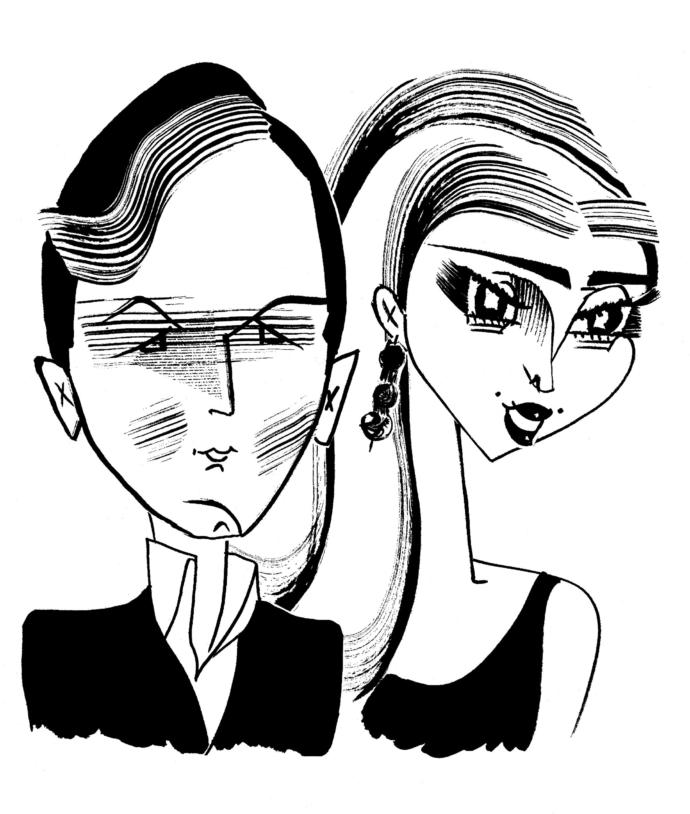
Jared Kushner and Ivanka Trump
And yet Trump has discovered that it’s far more difficult to manage the realities of national politics than the set of “The Apprentice.” In the transitional period between Election Day and the Inauguration, Obama’s aides were told that Trump, who has the attention span of a hummingbird, would not read reports of any depth; he prefers one- or two-page summaries, pictures, and graphics. Obama met with Trump once and talked with him on the telephone roughly ten times. The discussions did little to change Obama’s mind that Trump was “uniquely unqualified” to be President. His grasp of issues was rudimentary, at best. After listening to Obama describe the framework of the nuclear agreement with Iran—a deal that Trump had previously assessed as “terrible” and vowed to dismantle—he conceded that maybe it made sense after all. In one of the many books published under his name, “Trump: Think Like a Billionaire,” he said, “The day I realized it can be smart to be shallow was, for me, a deep experience.”
On Inauguration Day, at the Capitol, Trump no longer affected any awe of the task before him or respect for his predecessors. He furiously rebuked the elected officials seated behind him and the international order that they served. Using the language of populist demagogues, from Huey Long to George Wallace to Silvio Berlusconi, the new President implied that he, the Leader, was in perfect communion with the People, and that together they would repair the landscape of “American carnage” and return it to its prelapsarian state of grace. In this union, it seemed, there was no place for the majority of the electorate, which had voted for Hillary Clinton. African-Americans, Muslim Americans, Latinos, immigrants—it was hard to tell if Trump counted them as the People, too. More likely, they remained the objects of anxiety, fear, and disdain that they had been during the campaign. As George W. Bush was leaving the grandstand, according to New York, he was heard to say, “That was some weird shit.”
By all accounts, the West Wing has become a battlefield of opposing factions. The most influential of them is also the only one with a guarantee of permanence—the Family, particularly Trump’s daughter Ivanka and his son-in-law, Jared Kushner. (His sons Eric and Donald, Jr., have remained in New York to run the family business. Despite the responsibility to put country before personal profit, the President refuses to divest from the business.) Kushner has no relevant experience in foreign or domestic policy, but he has been tasked with forging a peace between the Israelis and the Palestinians, steering U.S. relations with China and Mexico, reorganizing the federal government, and helping to lead the fight against the epidemic of opioid use. It is hard to know if Kushner, as an executive, is in charge of everything or of nothing at all. But, as a counsellor, he clearly is powerful enough to whisper in his father-in-law’s ear and diminish the prospects of rival counsellors, including those of the Administration’s most lurid white nationalist, Steve Bannon. Ivanka Trump’s duties are gauzier than her husband’s, but they seem to relate to getting her father to go easier on L.G.B.T. and women’s-rights issues and calming his temper.
The way that Trump has established his family members in positions of power and profit is redolent of tin-pot dictatorships. He may waver on matters of ideology, but his commitment to the family firm is unshakable and resists ethical norms. The conflicts and the privileges are shameless, the potential revenues unthinkable. On the day that the Trump family hosted Xi Jinping in Palm Beach, the Chinese government extended trademarks to Ivanka’s businesses so that she could sell her shoes and handbags to the vast market from Harbin to Guangzhou.
Trump is wary of expertise. During the campaign, he expressed his distrust of scientists, military strategists, university professors, diplomats, and intelligence officers. He filled the executive branch accordingly, appointing a climate-change denier as the head of the Environmental Protection Agency; a Secretary of Education who, during her confirmation hearing, displayed stunning ignorance of public education; an Energy Secretary who previously called for closing the Department of Energy; a United Nations Ambassador whose international experience is limited to trade missions for the state of South Carolina; and a national-security adviser who trafficked in Islamophobic conspiracy theories until, three weeks into the job, he was forced to resign because he lied to Vice-President Pence about his ties to the Russian government.
Trump has left open hundreds of important positions in government, largely because he sees no value in them. “A lot of those jobs, I don’t want to appoint, because they’re unnecessary to have,” he has said. “I say, ‘What do all these people do?’ You don’t need all those jobs.” Among the many federal bureaucracies that are now languishing with countless empty offices are the Departments of State, Treasury, Commerce, Health and Human Services, Homeland Security, and Defense. A recent article in The Atlantic described the State Department as “adrift and listless,” with officials unsure of their duties, hanging around the cafeteria gossiping, and leaving work early.

And yet Trump has discovered that it’s far more difficult to manage the realities of national politics than the set of “The Apprentice.” In the transitional period between Election Day and the Inauguration, Obama’s aides were told that Trump, who has the attention span of a hummingbird, would not read reports of any depth; he prefers one- or two-page summaries, pictures, and graphics. Obama met with Trump once and talked with him on the telephone roughly ten times. The discussions did little to change Obama’s mind that Trump was “uniquely unqualified” to be President. His grasp of issues was rudimentary, at best. After listening to Obama describe the framework of the nuclear agreement with Iran—a deal that Trump had previously assessed as “terrible” and vowed to dismantle—he conceded that maybe it made sense after all. In one of the many books published under his name, “Trump: Think Like a Billionaire,” he said, “The day I realized it can be smart to be shallow was, for me, a deep experience.”
On Inauguration Day, at the Capitol, Trump no longer affected any awe of the task before him or respect for his predecessors. He furiously rebuked the elected officials seated behind him and the international order that they served. Using the language of populist demagogues, from Huey Long to George Wallace to Silvio Berlusconi, the new President implied that he, the Leader, was in perfect communion with the People, and that together they would repair the landscape of “American carnage” and return it to its prelapsarian state of grace. In this union, it seemed, there was no place for the majority of the electorate, which had voted for Hillary Clinton. African-Americans, Muslim Americans, Latinos, immigrants—it was hard to tell if Trump counted them as the People, too. More likely, they remained the objects of anxiety, fear, and disdain that they had been during the campaign. As George W. Bush was leaving the grandstand, according to New York, he was heard to say, “That was some weird shit.”
By all accounts, the West Wing has become a battlefield of opposing factions. The most influential of them is also the only one with a guarantee of permanence—the Family, particularly Trump’s daughter Ivanka and his son-in-law, Jared Kushner. (His sons Eric and Donald, Jr., have remained in New York to run the family business. Despite the responsibility to put country before personal profit, the President refuses to divest from the business.) Kushner has no relevant experience in foreign or domestic policy, but he has been tasked with forging a peace between the Israelis and the Palestinians, steering U.S. relations with China and Mexico, reorganizing the federal government, and helping to lead the fight against the epidemic of opioid use. It is hard to know if Kushner, as an executive, is in charge of everything or of nothing at all. But, as a counsellor, he clearly is powerful enough to whisper in his father-in-law’s ear and diminish the prospects of rival counsellors, including those of the Administration’s most lurid white nationalist, Steve Bannon. Ivanka Trump’s duties are gauzier than her husband’s, but they seem to relate to getting her father to go easier on L.G.B.T. and women’s-rights issues and calming his temper.
The way that Trump has established his family members in positions of power and profit is redolent of tin-pot dictatorships. He may waver on matters of ideology, but his commitment to the family firm is unshakable and resists ethical norms. The conflicts and the privileges are shameless, the potential revenues unthinkable. On the day that the Trump family hosted Xi Jinping in Palm Beach, the Chinese government extended trademarks to Ivanka’s businesses so that she could sell her shoes and handbags to the vast market from Harbin to Guangzhou.
Trump is wary of expertise. During the campaign, he expressed his distrust of scientists, military strategists, university professors, diplomats, and intelligence officers. He filled the executive branch accordingly, appointing a climate-change denier as the head of the Environmental Protection Agency; a Secretary of Education who, during her confirmation hearing, displayed stunning ignorance of public education; an Energy Secretary who previously called for closing the Department of Energy; a United Nations Ambassador whose international experience is limited to trade missions for the state of South Carolina; and a national-security adviser who trafficked in Islamophobic conspiracy theories until, three weeks into the job, he was forced to resign because he lied to Vice-President Pence about his ties to the Russian government.
Trump has left open hundreds of important positions in government, largely because he sees no value in them. “A lot of those jobs, I don’t want to appoint, because they’re unnecessary to have,” he has said. “I say, ‘What do all these people do?’ You don’t need all those jobs.” Among the many federal bureaucracies that are now languishing with countless empty offices are the Departments of State, Treasury, Commerce, Health and Human Services, Homeland Security, and Defense. A recent article in The Atlantic described the State Department as “adrift and listless,” with officials unsure of their duties, hanging around the cafeteria gossiping, and leaving work early.
Vladimir Putin and Recep Tayyip Erdoğan
Trump seems to believe that foreign affairs require only modest depths of thought. It’s the generals who are the authoritative voices in his Administration. To a President whose idea of a strategic move is to “bomb the shit out of” isis, they are the ones who have to make the case for international law, the efficacy of nato, the immorality of torture, and the inadvisability of using the rhetoric of “radical Islamic terrorism.” At the same time, the pace of bombing in Syria, Iraq, Afghanistan, and Yemen appears to have increased; tensions with Iran, Russia, and North Korea have intensified. Trump, an erratic and impulsive spokesman for his own policy, needs competent civilian advisers, if only as a counterweight to the military point of view and his own self-admiring caprices. When conservative columnists write about Trump and fondly recall Richard Nixon’s “madman theory” of international relations—a calculated unpredictability directed at the North Vietnamese—they tend to leave out that it did not work. The war in Southeast Asia went on for years after Nixon’s brinksmanship.
The Trump Presidency represents a rebellion against liberalism itself—an angry assault on the advances of groups of people who have experienced profound, if fitful, empowerment over the past half century. There is nothing about Trump’s public pronouncements that indicates that he has welcomed these moral advances; his language, his tone, his personal behavior, and his policies all suggest, and foster, a politics of resentment. It is the Other—the ethnic minority, the immigrant—who has closed your factory, taken your job, threatened your safety.
The Trumpian rebellion against liberal democracy is not a local event; it is part of a disturbing global trend. When the Berlin Wall fell, in 1989, and the Soviet Union dissolved, two years later, the democratic movement grew and liberalism advanced, and not only in Eastern and Central Europe. During the course of thirty years, the number of democracies in the world expanded from thirty to roughly a hundred. But, since 2000, nation-states of major consequence—Russia, Hungary, Thailand, and the Philippines among them—have gone in the opposite, authoritarian direction. India, Indonesia, and Great Britain have become more nationalistic. The Arab Spring failed nearly everywhere. The prestige and the efficacy of democracy itself is in question. The Chinese Communist Party, which crushed a pro-democracy movement on Tiananmen Square, in 1989, then set out to make the case that it could achieve enormous economic growth while ignoring the demand for human rights and political liberties. In Russia, Vladimir Putin has suppressed political competition, a nascent independent media, and any hope for an independent judiciary or legislature while managing to convince millions of his countrymen that the United States is hypocritical and immoral, no more democratic than any other country. In Turkey, Erdoğan has jailed tens of thousands of political opponents, muzzled the press, and narrowly won a referendum providing him with nearly dictatorial powers. Western Europe is also in question. In France, Marine Le Pen, the leader of the National Front, is polling credibly in a Presidential campaign guided by two of her longtime associates and fascist sympathizers, Frédéric Chatillon and Axel Loustau.
The stakes of this anti-democratic wave cannot be overestimated. Nor can it be ignored to what degree authoritarian states have been able to point out the failures of the West—including the wars in Vietnam, Iraq, and Libya—and use them to diminish the moral prestige of democracy itself. As Edward Luce writes, in “The Retreat of Western Liberalism,” “What we do not yet know is whether the world’s democratic recession will turn into a global depression.”
If we were ever naïve enough to believe that progress in political life is inevitable, we are experiencing the contradiction. Freedom House, a nongovernmental organization that researches global trends in political liberty, has identified an eleven-year decline in democracies around the globe and now issues a list of “countries to watch.” These are nations that “may be approaching important turning points in their democratic trajectory.” The ones that most concern Freedom House include South Africa, Iraq, Kyrgyzstan, Ecuador, Zimbabwe, and, the largest of them, the United States. The reason the group includes the U.S. is Trump’s “unorthodox” Presidential campaign and his “approach to civil liberties and the role of the United States in the world.”
In 1814, John Adams evoked the Aristotelian notion that democracy will inevitably lapse into anarchy. “Remember, democracy never lasts long,” he wrote to John Taylor, a former U.S. senator from Virginia, in 1814. “It soon wastes, exhausts, and murders itself. There never was a democracy that did not commit suicide.” As President, Donald Trump, with his nativist and purely transactional view of politics, threatens to be democracy’s most reckless caretaker, and a fulfillment of Adams’s dark prophecy.
Pushing back against Trumpism will not be easy. Even if the President drops some of his most brutal promises, even if he throws his smartphone into the Potomac, and ceases to titillate his base with racist dog-whistling and to provoke his enemies with a rhetoric of heedless bravado, he still commands a Republican Congress, and he is still going to score some distressing political victories. He is certainly not finished with his efforts to repeal Obamacare in a way that would deprive millions of people of their health insurance; he is certainly not going to relax his effort to enact hard-line immigration restrictions; he is certainly not through trying to dismantle legislative and international efforts to rescue an environment that is already suffering the grievous effects of climate change.
“Can you ask them to do a little dance?”
Trump forces us to recognize the fragility of precious things. Yet there are signs that Adams and the doomsayers of democratic values will be proved wrong. Hope can be found in the extraordinary crowds at the many women’s marches across the country on the day after the Inauguration; in the recent marches in support of science and a more compassionate, reasonable immigration policy; in the earnest work of the courts that have blocked the “Muslim ban” and of various senators and House members in both parties who, unlike Mitch McConnell and Paul Ryan, have refused to put cynicism and expedience before integrity; in the exemplary investigative journalism being done by traditional and new media outlets; in the performance of anti-Trump candidates in recent congressional races in Kansas and Georgia.
The opposition to Trump also has to give deeper thought to why a demagogue with such modest and eccentric experience could speak with such immediacy to tens of millions of voters anxious about their lives and their prospects, while the Democratic nominee could not. The intellectual and political task ahead is at once to resist the ugliest manifestations of the new right-wing populism—the fears it plays on, the divisions it engenders—and to confront the consequences of globalism, technology, and cultural change. Politicians and citizens who intend to defeat the forces of reaction, of Trumpism, need to confront questions of jobs lost to automation and offshoring head on. Unemployment is at five per cent, but that does not provide an accurate picture of an endangered middle and working class.
The political math is clarifying: four hundred and eighty-nine of the wealthiest counties in the country voted for Clinton; the remaining two thousand six hundred and twenty-three counties, largely made up of small towns, suburbs, and rural areas, voted for Trump. Slightly fewer than fifty-five per cent of all voting-age adults bestirred themselves to go to the polls. That statistic is at least as painful to process as the Comey letter, the Russian hack of the D.N.C., the strategic failures of the Clinton campaign, and the over-all darkness of the Trump campaign. It’s a statistic about passivity, which is just what a democracy in the era of Trump can no longer afford.
There is still time for younger politicians to gather themselves for the 2018 midterms and the 2020 Presidential race. One well-established figure, Senator Elizabeth Warren, of Massachusetts, just published “This Fight Is Our Fight,” a book on the decline of middle-class prospects and conservative ideology since the Reagan era. It’s the sort of manifesto, like “The Audacity of Hope,” that frequently augurs higher political ambition. Warren came by our offices last week for an hour-long interview, and, while she made the ritual demurrals about a run for the Presidency, she spoke with a combative focus on precisely the issues that Clinton ceded to Trump in the 2016 race. Warren will be sixty-nine when it comes time to make a decision, but it would be foolish to think that she is not among those who are testing the waters.
The clownish veneer of Trumpism conceals its true danger. Trump’s way of lying is not a joke; it is a strategy, a way of clouding our capacity to think, to live in a realm of truth. It is said that each epoch dreams the one to follow. The task now is not merely to recognize this Presidency for the emergency it is, and to resist its assault on the principles of reality and the values of liberal democracy, but to devise a future, to debate, to hear one another, to organize, to preserve and revive precious things
Trump seems to believe that foreign affairs require only modest depths of thought. It’s the generals who are the authoritative voices in his Administration. To a President whose idea of a strategic move is to “bomb the shit out of” isis, they are the ones who have to make the case for international law, the efficacy of nato, the immorality of torture, and the inadvisability of using the rhetoric of “radical Islamic terrorism.” At the same time, the pace of bombing in Syria, Iraq, Afghanistan, and Yemen appears to have increased; tensions with Iran, Russia, and North Korea have intensified. Trump, an erratic and impulsive spokesman for his own policy, needs competent civilian advisers, if only as a counterweight to the military point of view and his own self-admiring caprices. When conservative columnists write about Trump and fondly recall Richard Nixon’s “madman theory” of international relations—a calculated unpredictability directed at the North Vietnamese—they tend to leave out that it did not work. The war in Southeast Asia went on for years after Nixon’s brinksmanship.
The Trump Presidency represents a rebellion against liberalism itself—an angry assault on the advances of groups of people who have experienced profound, if fitful, empowerment over the past half century. There is nothing about Trump’s public pronouncements that indicates that he has welcomed these moral advances; his language, his tone, his personal behavior, and his policies all suggest, and foster, a politics of resentment. It is the Other—the ethnic minority, the immigrant—who has closed your factory, taken your job, threatened your safety.
The Trumpian rebellion against liberal democracy is not a local event; it is part of a disturbing global trend. When the Berlin Wall fell, in 1989, and the Soviet Union dissolved, two years later, the democratic movement grew and liberalism advanced, and not only in Eastern and Central Europe. During the course of thirty years, the number of democracies in the world expanded from thirty to roughly a hundred. But, since 2000, nation-states of major consequence—Russia, Hungary, Thailand, and the Philippines among them—have gone in the opposite, authoritarian direction. India, Indonesia, and Great Britain have become more nationalistic. The Arab Spring failed nearly everywhere. The prestige and the efficacy of democracy itself is in question. The Chinese Communist Party, which crushed a pro-democracy movement on Tiananmen Square, in 1989, then set out to make the case that it could achieve enormous economic growth while ignoring the demand for human rights and political liberties. In Russia, Vladimir Putin has suppressed political competition, a nascent independent media, and any hope for an independent judiciary or legislature while managing to convince millions of his countrymen that the United States is hypocritical and immoral, no more democratic than any other country. In Turkey, Erdoğan has jailed tens of thousands of political opponents, muzzled the press, and narrowly won a referendum providing him with nearly dictatorial powers. Western Europe is also in question. In France, Marine Le Pen, the leader of the National Front, is polling credibly in a Presidential campaign guided by two of her longtime associates and fascist sympathizers, Frédéric Chatillon and Axel Loustau.
The stakes of this anti-democratic wave cannot be overestimated. Nor can it be ignored to what degree authoritarian states have been able to point out the failures of the West—including the wars in Vietnam, Iraq, and Libya—and use them to diminish the moral prestige of democracy itself. As Edward Luce writes, in “The Retreat of Western Liberalism,” “What we do not yet know is whether the world’s democratic recession will turn into a global depression.”
If we were ever naïve enough to believe that progress in political life is inevitable, we are experiencing the contradiction. Freedom House, a nongovernmental organization that researches global trends in political liberty, has identified an eleven-year decline in democracies around the globe and now issues a list of “countries to watch.” These are nations that “may be approaching important turning points in their democratic trajectory.” The ones that most concern Freedom House include South Africa, Iraq, Kyrgyzstan, Ecuador, Zimbabwe, and, the largest of them, the United States. The reason the group includes the U.S. is Trump’s “unorthodox” Presidential campaign and his “approach to civil liberties and the role of the United States in the world.”
In 1814, John Adams evoked the Aristotelian notion that democracy will inevitably lapse into anarchy. “Remember, democracy never lasts long,” he wrote to John Taylor, a former U.S. senator from Virginia, in 1814. “It soon wastes, exhausts, and murders itself. There never was a democracy that did not commit suicide.” As President, Donald Trump, with his nativist and purely transactional view of politics, threatens to be democracy’s most reckless caretaker, and a fulfillment of Adams’s dark prophecy.
Pushing back against Trumpism will not be easy. Even if the President drops some of his most brutal promises, even if he throws his smartphone into the Potomac, and ceases to titillate his base with racist dog-whistling and to provoke his enemies with a rhetoric of heedless bravado, he still commands a Republican Congress, and he is still going to score some distressing political victories. He is certainly not finished with his efforts to repeal Obamacare in a way that would deprive millions of people of their health insurance; he is certainly not going to relax his effort to enact hard-line immigration restrictions; he is certainly not through trying to dismantle legislative and international efforts to rescue an environment that is already suffering the grievous effects of climate change.
“Can you ask them to do a little dance?”
Trump forces us to recognize the fragility of precious things. Yet there are signs that Adams and the doomsayers of democratic values will be proved wrong. Hope can be found in the extraordinary crowds at the many women’s marches across the country on the day after the Inauguration; in the recent marches in support of science and a more compassionate, reasonable immigration policy; in the earnest work of the courts that have blocked the “Muslim ban” and of various senators and House members in both parties who, unlike Mitch McConnell and Paul Ryan, have refused to put cynicism and expedience before integrity; in the exemplary investigative journalism being done by traditional and new media outlets; in the performance of anti-Trump candidates in recent congressional races in Kansas and Georgia.
The opposition to Trump also has to give deeper thought to why a demagogue with such modest and eccentric experience could speak with such immediacy to tens of millions of voters anxious about their lives and their prospects, while the Democratic nominee could not. The intellectual and political task ahead is at once to resist the ugliest manifestations of the new right-wing populism—the fears it plays on, the divisions it engenders—and to confront the consequences of globalism, technology, and cultural change. Politicians and citizens who intend to defeat the forces of reaction, of Trumpism, need to confront questions of jobs lost to automation and offshoring head on. Unemployment is at five per cent, but that does not provide an accurate picture of an endangered middle and working class.
The political math is clarifying: four hundred and eighty-nine of the wealthiest counties in the country voted for Clinton; the remaining two thousand six hundred and twenty-three counties, largely made up of small towns, suburbs, and rural areas, voted for Trump. Slightly fewer than fifty-five per cent of all voting-age adults bestirred themselves to go to the polls. That statistic is at least as painful to process as the Comey letter, the Russian hack of the D.N.C., the strategic failures of the Clinton campaign, and the over-all darkness of the Trump campaign. It’s a statistic about passivity, which is just what a democracy in the era of Trump can no longer afford.
There is still time for younger politicians to gather themselves for the 2018 midterms and the 2020 Presidential race. One well-established figure, Senator Elizabeth Warren, of Massachusetts, just published “This Fight Is Our Fight,” a book on the decline of middle-class prospects and conservative ideology since the Reagan era. It’s the sort of manifesto, like “The Audacity of Hope,” that frequently augurs higher political ambition. Warren came by our offices last week for an hour-long interview, and, while she made the ritual demurrals about a run for the Presidency, she spoke with a combative focus on precisely the issues that Clinton ceded to Trump in the 2016 race. Warren will be sixty-nine when it comes time to make a decision, but it would be foolish to think that she is not among those who are testing the waters.
The clownish veneer of Trumpism conceals its true danger. Trump’s way of lying is not a joke; it is a strategy, a way of clouding our capacity to think, to live in a realm of truth. It is said that each epoch dreams the one to follow. The task now is not merely to recognize this Presidency for the emergency it is, and to resist its assault on the principles of reality and the values of liberal democracy, but to devise a future, to debate, to hear one another, to organize, to preserve and revive precious things


