Showing posts with label @stephendarori. Show all posts

Saturday, February 24, 2018

1974 in Israel

Incumbents
Prime Minister of Israel – Golda Meir (Alignment) until 3 June, Yitzhak Rabin (Alignment)
President of Israel – Ephraim Katzir
Chief of General Staff - David Elazar until 3 April, Mordechai Gur
Government of Israel - 15th Government of Israel until 10 March, 16th Government of Israel until 3 June, 17th Government of Israel

Events

18 January – Israel and Egypt sign an agreement on disengagement following the Yom Kippur War.
1 February – Lillehammer affair: Five Israeli Mossad agents are sentenced in Norway to prison terms for the assassination of Ahmed Bouchiki. The prison terms range from two and a half to five years, although all the agents are eventually released within 22 months and deported back to Israel.
5 March – Israel completes its pullback from the west side of the Suez Canal to the east side of the canal, as agreed upon in the Agreement on Disengagement.

Image result for Yom Kippur disengagement agreement

Ariel Sharon ( center with the bandage)   wih Moshe Dayan at kilometer 47 ( the closest the IDF came to Cairo) . The disengagement Agreement was signed at kilometer 101

10 March – Golda Meir presents her third government to the Knesset.
1 April – The Agranat Commission publishes its interim report, which calls for the dismissal of the IDF's Chief of Staff Dado Elazar, director of the Israeli Military Intelligence Directorate Eli Zeira and the Chief of the Israeli Southern Command Shmuel Gonen. The interim report states that they were responsible for failure in preparing the army for war, and for the operational and intelligence failures which occurred prior to the Yom Kippur War, which resulted in severe consequences of the war. Nevertheless, the Agranat Commission refuses to give an opinion on the responsibility of the political leadership, Prime Minister Golda Meir and the Minister of Defence Moshe Dayan arguing that this is beyond its scope.
11 April – Golda Meir resigns from premiership
15 April – Mordechai Gur is appointed as the tenth Chief of Staff of the Israel Defense Forces.
19 April – Mahanayim disaster: Eight Israeli soldiers are killed as a result of a collision between two helicopters over the Mahanayim Airfield.
31 May – Israel and Syria sign an agreement on disengagement following the Yom Kippur War.
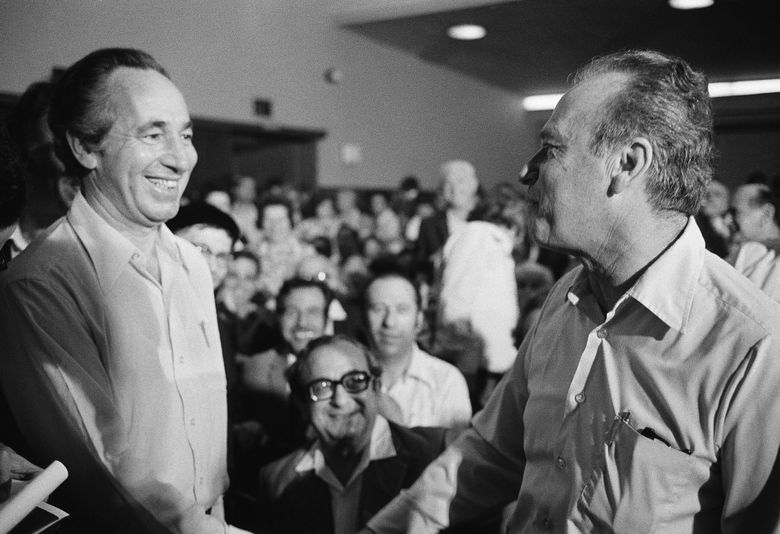
Image result for Yitzhak Rabin's first cabinet 1974

Rabin defeats Shimon Peres to become head of the Labour Party per se the Labour Candidate to follow Golda Meir ( Yitzchak Lavon  in the background a future President of Israel) 

3 June – Yitzhak Rabin presents his cabinet for a Knesset "Vote of Confidence". The 17th Government is approved that day and the members are sworn in.
Israeli–Palestinian conflict[edit]

The most prominent events related to the Israeli–Palestinian conflict which occurred during 1974 include:

Notable Palestinian militant operations against Israeli targets

The most prominent Palestinian Arab terror attacks committed against Israelis during 1974 include:
11 April – Kiryat Shmona massacre: Three members of the PFLP-GC cross the Israeli border from Lebanon, enter an apartment building in the town of Kiryat Shmona and kill all eighteen residents there, half of whom are children.
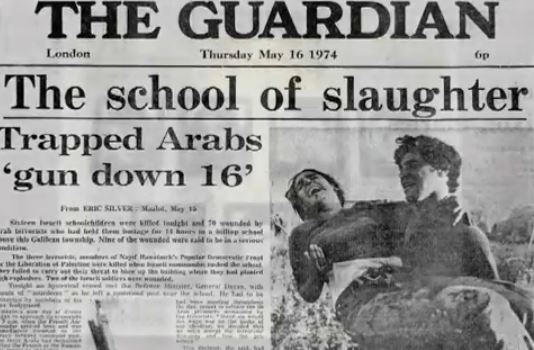
Image result for Ma'alot Massacre

Shmuel Levy ,a Sayeret Matkal  rescuer caring his wound sister  Yael out of the Maalot School

15 May – Ma'alot massacre: Palestinian militants of the Democratic Front for the Liberation of Palestine cross the Israeli border from Lebanon. They attack a van killing two Israeli Arab women, they enter an apartment building in the town of Ma'alot and kill a couple and their 4-year-old son. After that the militant squad take over a local school and hold at 105 students and 10 teachers hostage. The hostage-takers demanded the release of 23 Palestinian militants from Israeli prisons, or they would kill the students. On the second day of the standoff, a unit of the elite Golani Brigade stormed the building. During the takeover the hostage-takers detonated their grenades and shot the children. Ultimately, 25 hostages were killed, including 22 children; 68 more were injured.[2][3]
24–25 June – 1974 Nahariya attack: three Palestinian militant squad infiltrated the coastal city of Nahariya in Israel by sea from Lebanon. During the attack three civilians and one Israeli soldier were killed.
8 September – TWA jet with 88 passengers traveling from Tel Aviv to Athens crashed into the Ionian Sea after PFLP militants detonated a bomb hidden in the baggage compartment, killing all the 79 passengers and 9 crew members on board.
19 November – 1974 Beit She'an attack: a raid by a squad of Palestinian militants, belonging to the Democratic Front for the Liberation of Palestine militant organization, on the Israeli city of Beit She'an. Four civilians were killed during the event and more than 20 civilians were injured.

Thursday, February 22, 2018

Halacha ,the 2nd Amendment .and the restriction of access ..

Image result for Gun Control in Halachah
Gun Control in Halachah

If you drive around different parts of the US long enough, you are likely to encounter two bumper stickers asserting two contradictory ideas. One states, “The only thing that stops a bad guy with a gun is a good guy with a gun.” The other states, “More guns, more death.” Those who support stricter gun control measures believe that gun control reduces violent crime by taking guns away from criminals. Those who are opposed to stricter gun control measures believe that gun control increases crime by disarming the “good guys” who deter criminals from committing violent crimes. Each side of the debate has statistics to support its side of the argument. There are studies that “prove” that areas with looser gun restrictions have less crime.1 There are also studies that “prove” that areas with greater availability of guns have a higher rate of violent crimes.2

As intellectually honest people, we strive to gather the facts before making decisions about controversial topics. Yet the conflicting studies in the area of gun control should not deter us. One possible resolution to this conflict is that there is no one-size-fits-all approach to the way people behave with guns. Sometimes guns will be used to commit violent crimes and sometimes they will be used to protect people. How then, does one come to a decision? In Talmudic times, the rabbis struggled with similar issues. Perhaps we can glean some lessons about gun control from the Talmud and its commentaries.

WEAPONS IN THE TALMUD
The Gemara (Avodah Zarah 15b-16a) has a lengthy discussion about laws relating to selling weapons and their accessories. The discussion involves a number of points. 1) The Gemara quotes a beraita that one may not sell weapons or their accessories (holsters, et cetera) to a non-Jew or a kuti. (A kuti, for these purposes, represents anyone who we suspect may sell the weapons to non-Jews.) One may not sharpen non-Jews’ weapons nor sell them handcuffs or similar tools. The Gemara explains that the reason for the prohibition is because non-Jews are prone to use these weapons or tools for murder, an observation that was true at the time. 2) The Gemara further states that just as it is prohibited to sell weapons to a non-Jew, it is also prohibited to sell them to a Jewish bandit. The Gemara adds that this certainly applies to a bandit who might murder, but it also applies to a mashmuta (Jewish bandit who has no history of violence). 3) The Gemara then quotes a dispute about whether one may sell shields to non-Jews. The dispute centers around one question: will the shields be used as weapons to attack others or for self-defense? 4) The Gemara further states that one may not sell iron to non-Jews because they might use it to make weapons. The Gemara notes that while one can convert any tool into a weapon, this rule relates to a type of iron primarily used for weaponry. 5) The Gemara goes on to justify selling iron to the Persians because they protected the Jews at the time. The Gemara seems to be permitting the sale of a specific type of iron. Yet many Rishonim extend the prohibition to ban the selling of all types of weaponry to non-Jews.


What is the nature of the prohibition against selling weapons? Is it based on public policy considerations (i.e., the safety of the public) or is it based on pre-established halachic principles? This seems to be the subject of a dispute among the Rishonim. Rabbi Yosef ibn Chabib, Nimukei Yosef (Avodah Zarah 16a), writes that the prohibition is based on a concern that it will lead to murder. Ritva (Avodah Zarah 16a) writes explicitly that it is based on the concept of lifnei iver, the prohibition against enabling someone else to commit a transgression. By providing weapons to someone who might use them for crime, one is enabling the purchaser to violate a transgression. Rambam codifies these laws in Hilchot Avodat Kochavim as well as in Hilchot Rotzei’ach. In Hilchot Avodat Kochavim, Rambam emphasizes that we don’t provide people with tools that can harm society, while he downplays lifnei iver. In Hilchot Rotzei’ach, Rambam connects these laws with the concept of lifnei iver. Thus, for Rambam both the societal concerns and the issur of lifnei iver play a role in the prohibition against selling weapons.

If the basis for prohibiting the sale of weapons is solely the concept of lifnei iver, then perhaps it is permissible to sell weapons to someone who has another means of acquiring them.3 If the prohibition is based on the harm weapons do to society, then the prohibition would still apply even if the purchaser has other means of acquiring the weapons.

GUNS FOR PROTECTION
The most significant practical difference between these approaches emerges in explaining why the Gemara permits selling weapons to the Persians. According toNimukei Yosef (op. cit.), selling weapons to those who protect us will certainly (vaday)provide an added measure of security, while the concern that they might use the weapons for murder is only speculative (safek). Rabbeinu Nissim (Avodah Zarah 5a) follows a similar approach and writes that one must analyze whether selling the weapons will prove to be more protective or more harmful. In Talmudic times, selling weapons to the Persians provided greater security overall.

Applying Nimukei Yosef’s analysis to modern times would require knowledge of whether less restrictive gun control laws are inherently protective or not. As we noted earlier, there is no clear consensus on whether this is true or not. Do gun control laws contribute to public safety (pikuach nefesh d’rabim) or detract from it? Ritva (op. cit.) writes that the Gemara permits selling weapons to the Persians because there is nolifnei iver in this situation. Perhaps what he means is that lifnei iver only applies when one knows that the weapon is going to be used for harm. If one sells to people who are trying to protect themselves or who serve to protect, one can assume that the weapon will be used for good, similar to the permissibility of selling ordinary tools to someone. We are not concerned that they may be converted into a weapon. Advocates for looser gun control restrictions might use this comment to support their argument and claim thatlifnei iver doesn’t apply because normally guns are sold for protective or neutral purposes.

Opponents might counter that argument and claim that this is only true if we properly evaluate the purchase and perform a proper background check on the purchaser. Rambam, both in Hilchot Avodat Kochavim and in Hilchot Rotzeiach, seems to limit the permissibility of selling weapons to (Persian) military and law enforcement personnel. Rambam seems to not permit selling weapons to civilians even if their stated goal is to protect themselves or to provide protection to society.

BACKGROUND CHECKS IN HALACHAH
Some advocates for stricter gun control laws are asking for enhanced criminal background checks as well as psychological evaluations of those purchasing weapons. Interestingly, support for this can be found in a Talmudic discussion. As noted earlier, the Talmud prohibits selling a weapon to a mashmuta—a Jewish bandit who has no history of violence but may use the weapon to escape capture. Rashi (Avodah Zarah 15b, s.v.L’Olam) notes that even if one is certain that the bandit won’t use the weapon to kill someone, he may use it to threaten someone and commit a crime (steal, et cetera). Thus, selling weapons to a bandit could make one guilty as an accessory to a crime. Rabbeinu Nissim (Avodah Zarah 5a), however, has a different explanation. He suggests that even if the bandit does not have a violent past, he will eventually be in a situation where he will use the weapon to avoid being captured. According to Rabbeinu Nissim, we are not only prohibited from selling weapons to people who are actually prone to commit murder, we may not sell weapons to those who have a greater than average propensity to use the weapon in a destructive manner. As such, perhaps one should not sell a weapon to someone who has a criminal past or a psychological proclivity towards violence.4

The entire Talmudic discussion takes place against the backdrop of a barbaric society. In Talmudic times, Jews lived in a society where Jewish blood was routinely spilled in vain and there was good reason to suspect that any non-Jew might commit an act of violence against a Jew. There are a number of other laws in the Talmud that are based the same premise. Rabbi Yair Bachrach (Chavot Yair no. 66) and Rabbi Avraham Danzig (Chayei Adam 12:42) write that nowadays, we live in civilized societies and we don’t have to suspect that any non-Jew will attempt to murder us.5

Does this mean that in today’s times, we can ignore the entire Talmudic discussion? If we apply Rabbeinu Nissim’s argument here, we can suggest that even though we need not be suspicious of the average citizen, we have the right to suspect that there are people in the general population who should not own guns and as such, we can take protective measures to ensure that guns don’t come into their hands.

NO RIGHT TO BEAR ARMS
As a concluding point, there is an important distinction between Jewish law and US law with regard to gun ownership. Whereas US law—as per District of Columbia v. Heller (2008)—guarantees each individual a right to bear arms, Jewish law does not. Jewish law does not guarantee anyone’s right to bear arms and such a right plays no role in the Talmudic discussion. Jewish law is primarily interested in preserving society and ensuring that public policy keeps people safe. US lawmakers are also interested in protecting its citizens, but must do so within the confines of the Second Amendment right to bear arms.6

At the same time, Jewish law does value the importance of providing weapons to those who serve to protect us and by extension, those who are interested in protecting themselves, whether it was the Persians of Talmudic times or the security officers of today’s times, despite the possibility that those very weapons may be used to harm us. Jewish law recognizes that weapons control is complex and that a key determinant in whether to provide weapons to someone is whether doing so is more protective than it is dangerous. In Jewish law, knowledge is our friend and the more we know about the effects of gun control laws on public safety and about the specific individuals who are interested in purchasing guns, the better equipped we are to address this complexity.

Notes
1. See Carlisle E. Moody and Thomas B. Marvell, “The Debate on Right-to-Carry Concealed Weapons Laws,” Working Papers 71 (2008), Department of Economics, College of William and Mary, available at http://economics.wm.edu/wp/cwm_wp71.pdf.

2. See Lisa M. Hepburn and David Hemenway, “Firearm Availability and Homicide: A Review of the Literature,” Aggression and Violent Behavior (2004) 9: 417-440, abstract available at https://www.ncjrs.gov/App/publications/Abstract.aspx?id=206421.

3. The Gemara (Avodah Zarah 6b) states that the Biblical prohibition of lifnei iver is only violated if one provides the prohibited item and the recipient has no other reasonable means of attaining the item. If he has other means of attaining the item, there is no Biblical violation of lifnei iver. Rabbi Moshe Sternbuch (Da’at U’Machshavah 9:8) notes that this rule may not apply in the case of selling weapons. Even if the rabbis based the prohibition against selling weapons on lifnei iver, the parameters of the rule may not follow the same exact parameters as lifnei iver.

4. Even according to Rabbeinu Nissim’s interpretation, the prohibition only applies to selling to a known bandit. Requiring a criminal background check would mean checking every individual to make sure that a gun isn’t sold to the few people who are criminals. Nevertheless, when the likelihood of violating a prohibition is small but significant (miut hamatzui), Jewish law generally requires one to investigate the matter if the facts can be determined with relative ease (see Tosafot, Avodah Zarah 40b, s.v. Kol based on the Gemara, Yevamot 121a, Shulchan Aruch, Yoreh De’ah 1:1 and Beiur HaGra ad loc.). When the matter can potentially lead to a life-threatening situation, the threshold for statistically significant risk is even lower. Given that performing criminal background checks can be done with relative ease, one should screen all customers to ensure that they aren’t established criminals.

5. The comments of Rabbi Bachrach and Rabbi Danzig were not said with regard to the prohibition against selling weapons to non-Jews.

6. It is also noteworthy that the debate about gun control in the US focuses on possession rather than sale. If an individual purchases a gun illegally or produces it on his own, he is still in violation of the law. While the Talmudic discussion addresses the provider and not the purchaser, the values that can be extrapolated from the discussion provide guidance as to who should own a gun.

Thursday, February 15, 2018

Israeli-Syrian-Iranian Confrontation and Kremlin's Reaction

Image result for February 11, 2018, Israel conducted multiple airstrikes on Syrian-Iranian targets
 
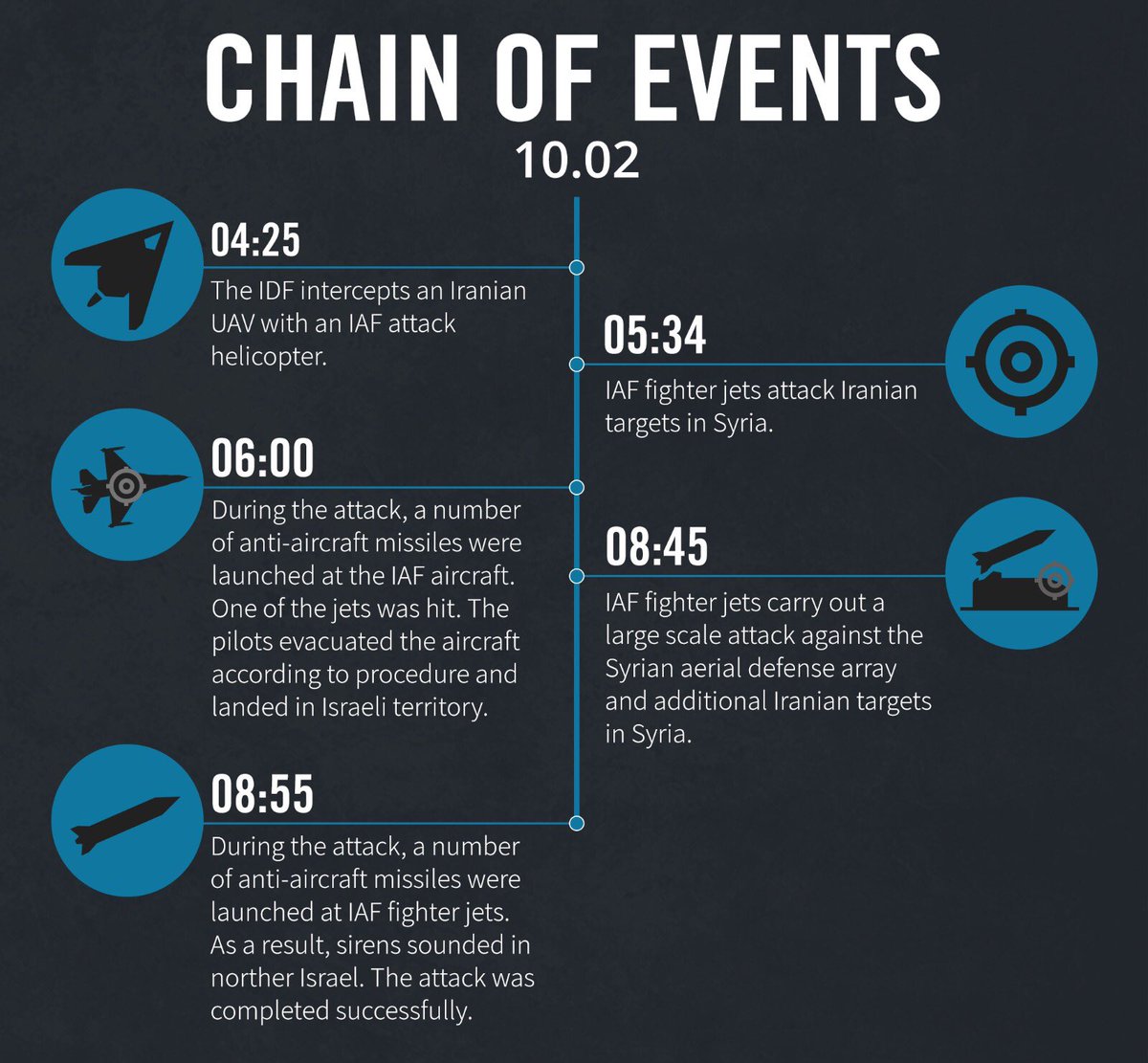
On February 11, 2018, Israel conducted multiple airstrikes on Syrian-Iranian targets in Syria in response to the downing of an Israeli F-16 in Israeli territory following infiltration by an Iranian drone. Moscow’s mild reaction to these events reflects its desire to maintain cooperation with both Tehran and Jerusalem.

Russian politicians have been surprisingly mute on the Israeli airstrikes in Syria that took place on February 11. Nothing notable has been said beyond an official statement from the Russian Foreign Ministry urging all sides to show restraint and avoid actions that could lead to further complications.

The quiet reflects the Kremlin’s tough position. Moscow has been cooperating closely with both Israel and Iran of late, hence is in no position to unequivocally take sides. As Irina Zvyagelskaya, member of the Institute of Oriental Studies of the Russian Academy of Sciences, put it, “The situation for Russia is difficult as our country has good relations with Iran and Israel, which share deep differences.”

Other political commentators say that nothing new has in fact occurred, as Israel has always vowed to destroy military buildups near its borders. The action was entirely foreseeable, they argue, in view of Israeli PM Netanyahu’s comments during his visit to Moscow in late January.

At the same time, many Russians are wondering to what extent the Kremlin will allow Israel to continue to carry out preventive strikes on Syrian soil. The incident suggested that an Israeli-Syrian military engagement could evolve into a serious situation that could spin out of Russian control. This is worrisome to the Russians, as they are keen to keep the balance in Syria.

On a broader level, the latest incident shows how ineffective Russian efforts have become to maintain a dominant position on the Syrian battlefield. The Turkish operation in Afrin, in the north of the country, made clear that Moscow is unable to forestall the growth of Ankara’s influence. Iranian proxy forces are now close to the Israeli border, and Russia failed to accomplish anything significant in this respect at the Sochi Conference in late January.

Comments in the Russian media hint that, strategically speaking, Russia does not want Israel – a powerful player – to enter the already overcrowded Syrian battlefield. This is particularly true as Moscow is working right now on solidifying its positions following important military victories. Deep Israeli involvement could unravel Russia’s dominant role in Syria.

At the same time, suggestions in the Russian media over the past few days point to an interesting scenario in which the Israeli involvement in Syria forces Russia to more openly declare a pro-Iranian strategy. Up to this point, Moscow has consistently tried – at least officially – to cooperate with both countries.

Alternatively, some Russian pundits surmise that because Moscow has been concerned that its major ally, Iran, might try to seize the strategic opportunity through its proxies and increase its clout in Syria, the Kremlin might welcome – if not Israel’s total engagement in Syria – at least some actions that limit Tehran’s power.

At a January 30 meeting with Russian President Putin in Moscow, just days before the incident, Netanyahu said, “[t]he most important thing I think is to make sure that we understand each other and that we don’t shoot down each other’s planes.” Indeed, over the past two days, some Russian analysts have raised the idea that the Israeli involvement in the Syrian conflict will be confined solely to maintaining its own security along the borders. Overall, the tone of the Russian media towards Israel’s actions has been neutral, while remaining studiously noncommittal about those of Iran.

Considering Israel’s security imperatives, it is arguable that the Israeli intervention was expected. Tehran is gaining the most from the Syrian chaos. It is likely that Israel will have to respond again, even if the Golan Heights are not directly threatened. As there are no other official statements from Russian officials, nor direct government leaks in leading Russian dailies such as Kommersant, Izvestia and others, Moscow’s position will be important to watch. Like most players in Syria, the Russians would not welcome additional actors in the country. However, the Kremlin will not be able to forestall further possible Israeli involvement in Syria.

Saturday, February 3, 2018

Settler colonialism of Palestine . Who was here first?


The entrance of Caliph Umar (581-644) into Jerusalem, 19th century colored engraving, via Wikipedia

 The concept of “settler colonialism” has been applied with almost unique vehemence against Israel. But the fact that Jews are the indigenous population of the Southern Levant can be proved with ease. In contrast, historical and genealogical evidence shows Palestinians descend primarily from three primary groups: Muslim invaders, Arab immigrants, and local converts to Islam. The Muslim conquest of Byzantine Palestine in the 7th century CE is a textbook example of settler-colonialism, as is subsequent immigration, particularly during the 19th and 20th centuries under the Ottoman and British Empires. The application of the concept to Jews and Zionism by Palestinians is both ironic and unhelpful.

One of the mainstays of the modern university is the idea of settler-colonialism. This argues that certain societies are birthed by settlers implanted in a foreign territory, either directly by or with the consent of an imperial power. These colonists then dominate and eradicate the indigenous population. They develop bellicose cultures that eliminate the natives from historical, literary, and other narratives. Primary examples often cited are the US, Canada, Australia and New Zealand, South Africa and Rhodesia, and Israel.

The settler-colonial argument against Israel posits that Zionism was an imperial tool of Britain (or, alternatively, that Zionism manipulated the British Empire); that Jews represent an alien population implanted into Palestine to usurp the land and displace the people; and that Israel has subjected Palestinians to “genocide,” real, figurative, and cultural.

According to this argument, Israel’s “settler colonialism” is a “structure, not an event,” and is accompanied by a “legacy of foundational violence” that extends back to the First Zionist Congress in 1897 or even before. With Zionism thus imbued with two forms of ineradicable original sin, violent opposition to Israel is legitimized and any forms of compromise, even negotiation, are “misguided and disingenuous because ‘dialogue’ does not tackle the asymmetrical status quo.”

But Middle Eastern history is not amenable to these formulations. Among the many concepts abused and perverted by the Palestinians, accusations of Israeli “genocide” rank the highest for blatant audacity, and for twinned calumny and odiousness. The settler-colonial idea deserves attention for three reasons: its comparatively recent adoption by Palestinians and their advocates; its broader currency in the academy; and its obvious and ironic falsity.

The idea of Jews as “settler-colonialists” is easily disproved. A wealth of evidence demonstrates that Jews are the indigenous population of the Southern Levant; historical and now genetic documentation places Jews there over 2,000 years ago, and there is indisputable evidence of continual residence of Jews in the region. Data showing the cultural and genetic continuity of local and global Jewish communities is equally ample. The evidence was so copious and so incontrovertible, even to historians of antiquity and writers of religious texts, some of whom were Judeophobes, that disconnecting Jews from the Southern Levant was simply not conceived of. Jews are the indigenous population.

As for imperial support, the Zionist movement began during the Ottoman Empire, which was at best diffident towards Jews and uncomfortable with the idea of Jewish sovereignty. For its part, the British Empire initially offered support in the form of the Balfour Declaration, but during its Mandatory rule (1920-48) support for Zionism vacillated. The construction of infrastructure aided the Yishuv immensely, but political support for Jewish immigration and development, as stipulated by the League of Nations mandate, waxed and waned until, as is well known, it was withdrawn on the eve of World War II. This is hardly “settler-colonialism.”

Ironically, the same cannot be said for the Palestinian Arabs. A recent analysis by Pinhas Inbari reviewed the history of Palestine (derived from the Roman term Palaestina, applied in 135 CE as a punishment to a Jewish revolt). Most notably, he examines the origin traditions of Palestinian tribes, which continue even today to see themselves as immigrants from other countries. Inbari’s review, along with many additional sources of information he did not address, demonstrates that modern Palestinians are, in fact, derived from two primary streams: converts from indigenous pre-modern Jews and Christians who submitted to Islam, and Arab tribes originating across the Middle East who migrated to the Southern Levant between late antiquity and the 1940s. The best documented episodes were the Islamic conquests of the 7th century and its aftermath, and the periods of the late Ottoman Empire and the British Mandate.

Even notable examples like Palestinian negotiator Saeb Erekat, who ludicrously claimed that “I am the proud son of the Canaanites who were there 5,500 years before Joshua bin Nun burned down the town of Jericho,” traces his real family lineage to the Huwaitat tribe, which migrated from Arabia to Jordan. The rare admission by Hamas minister Fathi Ḥammad that “half the Palestinians are Egyptians and the other half are Saudis” is more honest.

Echoing Inbari, it is not to be argued here that “there are no Palestinians” who thus do not deserve political rights, including self-rule and a state. To do so would be both logically and morally wrong. Palestinians have the right to define themselves as they see fit, and they must be negotiated with in good faith by Israelis. What Palestinians cannot claim, however, is that they are Palestine’s indigenous population and the Jews are settler-colonialists.

Palestinian genealogies that show their own tribes originating outside the Southern Levant are prima facie evidence of Arab settler-colonialism. And while narratives of the Arab conquests of Byzantine Palestine and North Africa cannot be taken at face value, they are pure ideological expressions of settler-colonialism. In 634-37 CE, Muslim armies commanded by the Caliph Umar conquered the entirety of the Levant before invading Armenia and Anatolia in 638 and Cyprus in 639.

The subsequent Islamization and Arabization of the Levant was a long and complex imperial process that entailed reorganizing the region into administrative provinces, instituting new social categories for the purposes of taxation and control, implanting settlers and reapportioning lands as estates, and encouraging conversion to Islam. Over the centuries, other settlers migrated and were intentionally implanted, including, in the 19th century alone, Egyptians fleeing from and imported by Muhammad Ali from the late 1820s to the 1840s, as well as Chechens, Circassians, and Turkmen relocated by the Ottoman Empire in the 1860s after its wars with Russia. Tribes of Bedouins, Algerians, Yemenis, and many others also immigrated during that century.

As for modern immigration, Inbari could well have pointed to the well-documented increases in Palestinian census numbers from 1922 to 1931, produced by illegal immigration spurred by the development of the region’s infrastructure and economy. One estimate sees some 37% of the increase in Palestinian population between 1922 and 1931, over 60,000 persons, having been the result of illegal immigration. Another study found that from 1932 to 1946, another 60,000 illegal male immigrants entered the country, with uncounted females imported as brides. These were in addition to the great influx of Arab workers from 1940 to 1945 in connection with the war effort.

To reiterate, these arguments do not devolve to arguing “a land without a people for a people without a land,” or that Ottoman Palestine was “empty” when the Zionist movement began. It was indeed populated, albeit unevenly, but those populations had immigrated into the land over the previous centuries, a process that accelerated precisely because of the Zionist movement and the British Mandate. Palestinian settler-colonialism took place, ironically, under the aegis of both a Muslim and a Christian empire.

Finally, there is the matter of a separate Palestinian ethno-national consciousness and its relationship to settler-colonialism. Claims to find a separate Palestinian ethnic identity as far back as the 17th century are unpersuasive. Instead, the idea developed as an elite concept in the years immediately before and especially after World War I, vying with far deeper and more resilient tribal and religious identities. The nationalization of the masses occurred gradually over the next few decades, propelled in part by tragedies largely foisted on them by their leaders, notably the “Arab Revolt” of 1936-39, the rejection of partition in 1947, the Israeli War of Independence of 1948-49, and the subsequent, rather local, dispersal of refugees into the 1950s. Palestinian nationalism and identity are largely reactive and secondary, pointing to the fact that settler-colonial identity was primarily tribal and religious, the latter imperial by definition.

During the 19th and 20th centuries, a mythology of the “timeless” Palestinians took root. During the earlier period, this was a European Orientalist trope: the Palestinians as living “fossils” who reflected the lifeways of the Bible. It was later adopted for strategic reasons by the Palestinians themselves as a political and cultural retort to the Zionist return to the land. That usage was perhaps understandable, if ironic; but it reaches a reductio ad absurdum in Erekat’s claim to have had Upper Paleolithic ancestors.

It is, then, the Palestinians who are the settler-colonialists, not the Jews or even the Zionists. Does this realization change anything? Does removing a term from the rejectionist toolbox bring the cause of negotiation and peace any closer? This seems unlikely. But in the longer term, facing certain truths will be necessary for Palestinians and Israelis alike. One is that rejection of Israel, at its core, is not a function of Palestinian nationalism and local identity but Islamic religious opposition to Jewish autonomy and sovereignty. Another is that tendentious categories like “settler-colonialism,” which ironically undermine Palestinian claims to indigenous status, should be dispensed with in favor of honest appraisals of history.

Monday, December 4, 2017

What to Expect when working with Israelis

Image result for TEl Aviv Skyline

Whether you're American, German, Asian or Australian, coming to Israel to work with Israelis will be a unique experience. In order to enjoy your stay, keep focused and not be offended (or offend) in this high pace, energetic and complex culture - you should come prepared.

Business culture in Israel is far more casual and informal than what you are probably used to. Israelis are straightforward, assertive and persistent people. Business is fast-paced and often conducted with a sense of urgency. At the same time, personal connections are of the highest importance as colleagues and business partners make an effort to get to know each other, socialize and have coffee together.

"Israeli society is a poly-chronic culture (relationship-oriented), in contrast to American, British or German cultures which are mono-chronic (rule-oriented). In Israel's relationship-oriented culture, open feelings and warm, honest emotions are primary, while efficiency, planning and objective facts may be secondary." *

Here are some points to take into consideration upon embarking on your next Business adventure to Israel:

1. Communication : Interaction among colleagues is very direct, spontaneous, open and almost family-like. If you are used to formality and to speaking about issues indirectly, avoiding being too honest or using a lot of understatements, you may find that your Israeli colleagues are unsure and even confused as to your true intentions. Israelis appreciate honesty and clarity and will expect you to do the same.They do not deal well with vagueness or subtlety and often interpret them as dishonesty, which will make it much harder to gain their trust.That's why Israelis may often come across as blunt, aggressive or even rude, but be assured- this is not at all the case!

2. Work Situations: At work, Israelis will usually opt to resolve differences through direct communications, face to face, which may include the use of confrontation, speaking loudly and straightforward criticism. Hand gestures and facial expressions are common.Verbal communication is used to express feelings, thoughts, ideas but also to maintain a working relationship that deals with problems quickly and efficiently. You may often find that after such an encounter, both sides resume their former relationship almost immediately and feel satisfied and ready to move on with the job at hand.

3. Working style: Israelis value quick action to resolve problems, and tend to choose improvisation over careful planning and over detailed working schedules. Plans can change at the last minute to be made more efficient and suit the specific situation. They will always prefer to take initiative over waiting through a long process of bureaucracy which is widely interpreted as a waste of valuable time. Flexibility, innovation, taking initiative and adaptability are highly respected traits as well as the ability to work in a team and communicate openly with your co workers.

4. Punctuality and keeping time: Israelis usually have a more flexible view of time, which subsequently leads to a decreased use of time-tables and agendas as well as imprecise starting and ending times for meetings. Although time tables are made and schedules are part of every project, in reality everyone seems to be running a little late. Meeting a deadline is well appreciated but somehow everyone expects it to be moved a bit before the project ends. Another time-related issue in Israeli meetings is the typical lack of agenda. In some cultures, an agenda might be circulated before the meeting, and it will be closely followed as the meeting progresses. In most Israeli work environments this will not be the case.This however, will actually have very little or no effect at all on the content or efficiency of the meeting which usually results in getting things done, having decisions made and bringing closure to unresolved issues.

" This might be perceived by other cultures as easy-going and relaxed, or alternatively inefficient and inaccurate." **


5. Hierarchy at the work place: Israelis interact very openly across organizational hierarchies, and do not attribute significance to various types of authority in the company **. The atmosphere in most companies is very professional, yet pleasant and friendly at an interpersonal level. The rigid hierarchy you may be accustomed to isn't the norm in Israel. As in every company, there is a hierarchical management structure, but even a new employee can freely communicate with any rank of management, as long as the matter is presented in a professional manner or if help or support are needed in a certain area. Depending on their importance, decisions are made during either staff or work team meetings. Everyone has the right to express their feelings and opinions about the topic in question as meetings usually take the form of open discussions. If the supervisor is present, people may spontaneously suggest ideas, give their opinions or even complain. Unofficial communication is vastly encouraged. There's no over use of bureaucracy and the employee doesn't have to go through a chain of command to speak with someone.

I would like to conclude by sharing a quote:
"Israel is very "civilized" within the framework of a struggling and pressurized Middle Eastern nation that strives very hard to be "Western."
Israelis have perceptions of time, space and values that are completely different from those of North Americans. Israelis see Americans as artificial and square, when they are actually just showing respect. Americans think Israelis are arrogant, rude and pushy, when in reality they are being direct and honest. Israel is a very small country whose population is one big family. In a family people can be as direct and honest as they want. But now that family members are selling their goods and services outside the clan, Israelis are adapting."

Saturday, June 3, 2017

Zions Dawn Arises Again by the Bard of Bat Yam , Poet Laureate of Zion

Image may contain: ocean, sky, beach, outdoor, nature and waterImage may contain: ocean, sky, outdoor, water and natureImage may contain: people sitting, sky and outdoorImage may contain: ocean, sky, beach, cloud, outdoor, nature and waterImage may contain: sky and outdoorImage may contain: sky, cloud and outdoor

Zion's Dawn Arises Again
Light peaks through the sky cracks.
Dawn along the Mediterranean paradise once more,
I lift my head, light rays softly caressing me.
Pleased that for a new day has begun,
but the soft graze of light on my cheeks nudge me forward.
Along southwards the desolate white umbrelled Bat Yam Beach


Thursday, June 1, 2017

#AmericaHangsItsHeadInShame Again ....Merrry de la Grey Oysmutshen ( tied, rundown and hot) already ... it is going to be scorcher humid day in Zion .... the first of many a reminder that #OyVeyDonaldTrump 's backing out of the Paris Accord top everything really stupid, insane and dangerous the shmuckface has done today ..... Time that he joined God, the Angel Gabrial and my late parents in their 24/ 7 calooky / rummie / bridge game and hey if Mike Pence joined him there , the order of succession would be 1. Speaker of the House of Representatives Paul Ryan (R) 2 President pro tempore of the Senate Orrin Hatch (R) 3 Secretary of State Rex Tillerson

Image may contain: cat and tableImage may contain: people sitting and indoor

Merrry de la Grey Oysmutshen ( tied, rundown and hot) already ... it is going to be scorcher humid day in Zion .... the first of many a reminder that #OyVeyDonaldTrump 's backing out of the Paris Accord top everything really stupid, insane and dangerous the shmuckface has done today ..... Time that he joined God, the Angel Gabrial and my late parents in their 24/ 7 calooky / rummie / bridge game and hey if Mike Pence joined him there , the order of succession would be 
  1.  Speaker of the House of Representatives Paul Ryan (R)
  2.  President pro tempore of the Senate Orrin Hatch (R)
  3.  Secretary of State Rex Tillerson

Sunday, May 28, 2017

Eight Embarrassing Things #OyVeyDonaldTrump did on his European Tour

  :

We have to let this guy go out and humiliate the U.S. over and over?

For nine days, Donald Trump has been traveling across the Middle East and Europe, bringing every terrible stereotype about “ugly Americans” to vivid life. He labeled Germany (where he doesn’t have business interests) “very bad” after saying nary a critical word in Saudi Arabia (where he does have business interests). He chastised our partners in NATO while revealing he doesn’t actually understand how it all works. He literally threw his weight around like an attention-starved problem child, and he broadcast his every move to the world via his cellphone, which would be a security risk if we had a president anyone wanted to kidnap.
Mostly—when he wasn’t trading arms for political and personal gain—Trump acted like an embarrassing boor. He can’t help proving that he and his followers are the punchlines to a joke the rest of the world is laughing at.
Here are eight examples.
1. Lied to the new French president about supporting him in the election even though it’s really easy to find out he didn’t.
“You were my guy," Trump reportedly said to newly elected French president Emmanuel Macron, a quote that suggests the president doesn’t know many of us have eyes and ears and internets that prove he’s lying. For someone so practiced at lying, the president remains terrible at it.
While Trump never explicitly endorsed noted Islamophobe, Holocaust revisionist and French National Front leader Marine Le Pen, he gushed over her racist bonafides during the French election. "She's the strongest on borders, and she's the strongest on what's been going on in France," he said in an April interview with the Associated Press. "Whoever is the toughest on radical Islamic terrorism, and whoever is the toughest at the borders, will do well in the election."
On April 21, a couple days shy of the first round of voting, and 24 hours after the shooting of a police officer on the Champs-Élysées, Trump tweeted, “Another terrorist attack in Paris. The people of France will not take much more of this. Will have a big effect on presidential election!”
2. Tried to pull that weird, aggressive handshake move with Macron and failed.
Probably because of his insecurity about his wittle Vulgarian fingers, Trump turns every handshake into a textbook display of macho posturing and heterosexual male insecurity. It’s happened enough times now that word has gotten around, and Macron had reportedly been forewarned by French ambassador Gérard Araud. The result, as you can see in a video below, was that Macron was fully ready for a hands-only cagematch and Trump found himself out-muscled by his French counterpart. Quelle tristesse!
3. Tried the handshake thing again with Macron. Failed again.
Arriving at NATO headquarters, Macron doubled down, and then tripled down on his Trump diss. First, as Macron walked toward Trump in a cluster of world leaders, he did a super conspicuous dodge of the U.S. president and instead veered toward German chancellor Angela Merkel and also anyone not named Donald Trump. Only after Macron ran out of ways to avoid Trump did he finally take Trump’s extended hand, but immediately turned the American president’s yank-and-pull tactic against him. Watching the video, below, you can almost hear every single person thinking, is this guy for real?
4. Asked Macron for his private cellphone number.
Of course, it makes sense that Trump would develop a new respect, and probably a reverence for anyone who beats him in a pissing match. After repeatedly witnessing Macron’s feats of strength, Trump turned fanboy and decided he wanted Macron for a new best friend. "Do you want my cell phone [number] so we can speak directly to each other?" Trump reportedly asked the big, strong Frenchman.
5. Physically pushed Montenegro’s leader out of his way.
Trump wanted to be in the front row when pictures were taken so he pushed his way to the front of the crowd of assembled leaders. That included shoving Montenegro Prime Minister DuÅ¡ko Marković to one side. A lot was written about Trump’s offensive behavior, but CNN pointed out a mostly overlooked bit about NATO, Montenegro and Trump’s idol, Vladimir Putin:
This was Markovic's and Montenegro's first NATO summit. The tiny Balkan country has just been accepted into the alliance, much to Moscow's chagrin. How much chagrin? Authorities in Montenegro say they stopped a Russian-backed plot to kill Markovic's predecessor, which was aimed at preventing Montenegro from joining NATO. They have arrested 14 people, including two Russians. (Russia denies involvement.) The plot, prosecutors say, sought to install a new government loyal to Russia and opposed to Montenegro's efforts to grow closer to the West and to NATO. The plot failed, and now Montenegro is becoming NATO's 29th member.
Watch how, after bullying his way to the front, cocky Trump tugs on his suit jacket with smug satisfaction. Because he is the absolute worst.
6. Made a NATO speech that gave world leaders a good, derisive laugh.
“NATO members must finally contribute their fair share and meet their financial obligations,” Trump said in a lecture he delivered at NATO headquarters. “But 23 of the 28 member nations are still not paying what they should be paying, and what they are supposed to be paying, for their defense. This is not fair to the people and taxpayers of the United States.”
Trump seems to think NATO is like a social club, with member nations paying dues into some central kitty. It isn’t. A 2014 agreement established that member countries should be spending 2 percent of their GDP on their own military defense. Those countries have until 2024 to hit that goal. Trump is trying to be the world’s policeman on a policy that’s neither set in stone nor even a concern for another seven years. It’s also rich coming from someone whose most noted business practice is refusal to pay his debts.
The speech went over like a lead balloon with assembled world leaders, who smirked, snickered and whispered to each other as Trump spoke. In the video below, Luxembourg’s Xavier Bettel and France’s Macron seem to share a giggle at Trump’s expense.
“And I never asked once what the new NATO headquarters cost,” Trump added. “I refuse to do that.”
Here’s Angela Merkel looking rightly annoyed.
You can see the stifled giggles on the faces of Estonian prime minister Jüri Ratas, Croatian president Kolinda Grabar-Kitarovic, Lithuanian president Dalia Grybauskaite, German chancellor Angela Merkel, and French president Emmanuel Macron.
7. Riding in his golf cart while everyone else walks in Italy,
A summation of Trump’s afternoon on Saturday, from the Times of London:
The distance between Donald Trump and his G7 partners was spelled out dramatically today when Theresa May and the leaders of Italy, France, Germany, Japan and Canada strolled the streets of Taormina, Sicily — while he followed in a golf cart.
The six are planning to put pressure on Mr. Trump over his opposition to free trade and efforts to combat climate change. They walked the 700 yards from the traditional G7 group photo, taken at a Greek amphitheatre, to a piazza in the hilltop town, but Mr. Trump stayed behind until he could take a seat in the electric vehicle.
He had been the last to arrive for the photo, keeping the others waiting at the amphitheatre…
"She doesn't have the stamina,” Trump, probably on the verge of being winded, said of Hillary Clinton last year. “I said she doesn't have the stamina, and I don't believe she does have the stamina."
8. Complained that he hasn’t been given carte blanche to make a fast buck in Europe.
“Every time we talk about a country, he remembered the things he had done. Scotland? He said he had opened a club. Ireland? He said it took him two and a half years to get a license and that did not give him a very good image of the European Union,” according to a source who spoke with Belgian outlet Le Soir. “One feels that he wants a system where everything can be realized very quickly and without formalities.”

Saturday, May 27, 2017

Was #OyVeyDonaldTrump in Israel when he visited Jerusalem.: Take Jerusalem out of the equation and the only place you can say Trump visited in Israel is Ben-Gurion Airport.


US President Donald Trump places a note in the stones of the Western Wall, Judaisms holiest prayer site, in Jerusalems Old City May 22, 2017..

Of course, US President Donald Trump was in Israel — everyone saw him.

But his sole stop was Jerusalem, a city where Israeli sovereignty is contested. For two days US and Israeli flags might have fluttered together, but can the White House say he was definitely in Israel without making a larger policy question?

A close inspection of the White House's word selection suggests it did everything possible to avoid putting policy to the test. On the surface of it, Trump did what millions of tourists do: visited Yad Vashem, the Western Wall, the Church of the Holy Sepulchre and the Israel Museum. He used the Hebrew word “Shalom” and at times even wore a black kippah.

As US president he did some unique things compared to the standard visitor, like landing a helicopter in a supermarket parking lot, shutting down city traffic, and meeting with Prime Minister Benjamin Netanyahu and President Reuven Rivlin.

Upon arriving at the Israeli president’s residence in Jerusalem, Trump said the most simple of statements, placing himself and the city he stood in geographically within Israel.

Not that Israelis in the room had any doubts on that score.

“Thank you and shalom. I am honored to be in the great State of Israel,” Trump told Rivlin.

Similarly, information on the White House website regarding Trump’s visit to Jerusalem and the Western Wall was placed in the section about the President’s Israel leg of his eight-day international trip.

In fact, take Jerusalem out of the equation and the only thing that could truly be said about the visit is that Trump landed and departed from Ben-Gurion International Airport outside of Tel Aviv.

Anything else would be a question mark, but one that was perpetually raised by the White House staff and US officials. With small tiny diplomatic subtleties, they tried to divorce Trump’s visit from official recognition of Jerusalem as Israel’s capital, or even part of Israel at all.

Turns out it is not so simple to exclude Jerusalem from Israel, certainly not without raising some eyebrows.

Rivlin’s home was the last time Trump said he was in Israel, during his time in Jerusalem.

Even in his popular speech at the Israel Museum on Tuesday, he spoke of the State of Israel and the Israeli people. But when placing himself geographically, Trump said he was in Jerusalem or in the ancient land or the holy land.

On Monday White House Live, which provided video feeds of his trip, posted the words “Jerusalem, Israel” as it advertised the meeting between Trump and Netanyahu, but erased the word Israel the next day, leaving only the word Jerusalem to describe where Trump was.

The text of Trump’s remarks also bore the sole word Jerusalem, without mentioning the country. Similarly, only Jerusalem was listed by the White House as the location for Trump's Israel Museum speech.

The simple linguistic shift was reminiscent of a White House decision to cross out the world Israel as the location of former US president Barack Obama’s Jerusalem speech at Mt. Herzl military cemetery during the funeral for former Israeli president Shimon Peres in 2016.

Before Trump's arrival, the White House on Friday created a video called Potus Abroad which it placed on its YouTube Channel. The video included a a map of Trump’s trip that excluded areas of the country over the pre-1967 lines, including east Jerusalem. It did, however, list the Israel Museum and Yad Vashem as belonging in Israel.

By Wednesday, that video appeared to have been removed from the White House’s YouTube channel.

Earlier in the week US officials in Jerusalem who were planning the visit made comments to their Israeli counterparts, indicating that the Western Wall, which is over the pre-1967 lines, was not under Israeli sovereignty.

When asked about the incident ,White House Press Secretary Sean Spicer said that the Western Wall was in Jerusalem, but would not state that it was in Israel. When speaking with reporters in Washington last week National Security Advisor H. R. McMaster twice refused to answer the question of whether the Western Wall was in Israel. He did state, however, that no Israeli officials would accompany Trump to the Western Wall. Instead Western Wall Rabbi Shmuel Rabinowitz prayed with Trump at the ancient Biblical site.

Congress has recognized that Jerusalem is Israel’s united capital since 1995. But the White House and the State Department have differed offering de-facto recognition to west Jerusalem as part of the Jewish state and a de-facto rejection of Israeli sovereignty in east Jerusalem.

The White House and the US State Department have traditionally preferred to see the issue of Jerusalem settled as part of a final-status negotiation for a two-state solution with the Palestinians.

Trump led Israelis to believe that he would fall in line with Congress, particularly since during his campaign he promised to comply with a 1995 congressional mandate to relocate the US embassy to Jerusalem. His predecessors waived that mandate twice a year and Trump is expected to do the same when the deadline arrives.

Should he decide not to keep to his pledge he has to sign a waiver by June 1. Failure to do so would allow the embassy to be moved and end much of the debate about US policy with regard to Jerusalem.

Some Israeli politicians have felt that Trump’s visit to Jerusalem is a sign of obvious recognition of Israeli sovereignty over the city, including the Old City.

At the museum speech, a US official echoed Spicer in stressing to The Jerusalem Post that the Western Wall is in Jerusalem.

But as to whether the US considers Jerusalem to be in Israel, whether in the eastern or western part of the city, that question remains unanswered, even after Trump’s ceremonial visit.

Donald the Menace with Apologies to Dennis Oy Vey Oy Vey Oy Vey . #OyVeyDonaldTrump's disregard of facts, figures and reality are becoming a menace .


'Bad Germans' And Other Trump Blunders
Trump's Brussels trip displayed a now familiar disregard for the facts.


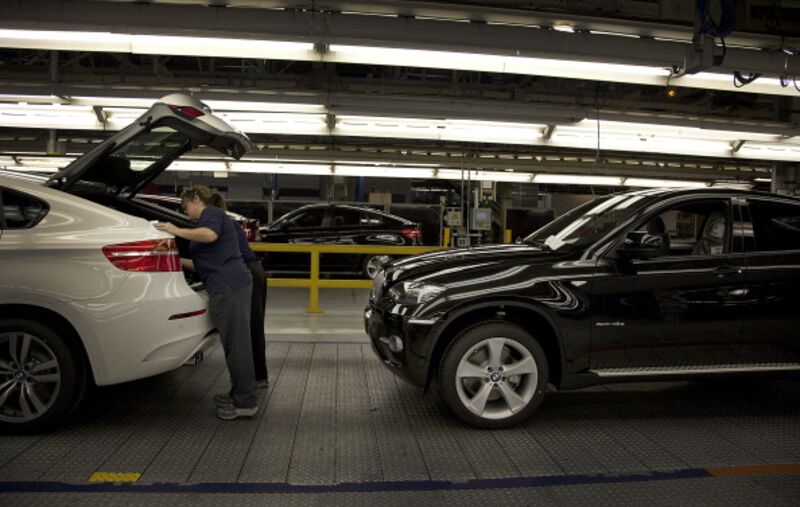
Made in the U.S.A. Photogaper: Ariana Lindquist/Bloomberg


During his first foreign trip since he was elected, President Donald Trump didn't look too out of place in Saudi Arabia or even in the Vatican. In Brussels, however, he was a befuddled elephant in a china shop, doing his best to convince European leaders that the U.S. was clueless on key cooperation issues.

It was bad enough that he shoved aside Montenegro Prime Minister Dusko Markovic to be in the front row during a North Atlantic Treaty Organization photo opportunity; Markovic, whose country has just been welcomed into NATO, graciously said that the U.S. president belonged out front. It was awful enough that he used a memorial opening ceremony to make a politically contentious speech in which he railed against NATO members' low defense spending and, unlike any of his predecessors, avoided explicitly affirming NATO's pledge of mutual defense -- the very Article 5 of the treaty that the memorial was supposed to commemorate.

One would expect a novice political leader in his first six months since being elected to climb a steep learning curve; instead Trump appeared to demonstrate a persistent unwillingness to learn. Despite having been told repeatedly that NATO member states had pledged to spend 2 percent of economic output on defense individually, not to pay that amount into some common pool, Trump repeated the canard that under-spenders "owe massive amounts of money from past years and not paying in those past years." There appears to be no way to explain to him that no NATO member is in arrears to the military bloc's budget.

"I never once asked what the new NATO headquarters cost," Trump said. "I refuse to do that." The number is published on NATO's website: 1.12 billion euros ($1.26 billion), an amount comparable with NATO's common budget for 2017 (1.5 billion euros) but contributed separately by the member states in proportion to the size of their economies. Besides, each country paid for the offices to be occupied by its mission.

At the meeting with top EU officials, Trump tore into Germany's trade surplus, showing a similar disregard for facts. "The Germans are bad, very bad," he said, according to Der Spiegel. "Look at the millions of cars they sell in the U.S. Horrible. We're going to stop that."

German carmakers don't sell millions of cars in the U.S. Last year, the total unit sales of Volkswagen, BMW and Daimler reached 1.3 million (not counting Lamborghinis). At the same time, the German companies produce about a million vehicles in the U.S. For example, BMW made 32,659 sports utility vehicles in Spartanburg, South Carolina, in April 2017; it churns out 1,400 a day, most of them for export. The relatively few BMW X5s on German roads are made in Spartanburg, too: It makes sense for BMW to make the large cars closer to their main market.

Daimler made a total of 300,000 Mercedes cars in Tuscaloosa, Alabama, in 2016. The plant is the state's biggest exporter. VW's Chattanooga, Tennessee, operation has a 150,000-vehicle production capacity and also is export-oriented.

The U.S. does have an auto trade deficit with Germany. According to the U.S. Census Bureau, it exported $2 billion worth of cars, trucks, buses and parts to Germany (including those BMW X5s) in the first three months of 2017, and imported $7 billion worth. But it's with Mexico and Japan that the U.S. has the biggest vehicle trade shortfalls.

If Trump is intent on making sure Americans buy more U.S.-made cars, he should be the biggest lobbyist for German car manufacturers. They bring jobs to the U.S. and work to reduce the country's trade deficit. The stocks of all three major carmakers fell following Trump's remark -- but the drops weren't dramatic. Investors may be betting that someone will give Trump better information and he'll change his tune. As his NATO "debts" comments show, that is unlikely.

Trump refuses to understand things that go against his deep convictions. He wants to tailor reality to them, which may mean he'll actually try to impose punitive taxes on German-made vehicles. That may bring the price of a Mini, not made in the U.S., close to that of an SUV made by BMW, playing havoc with the firm's North American sales structure -- but the German Big Three will, of course, adapt to it, just as VW has absorbed the enormous costs of the U.S.-generated diesel scandal.

European NATO members, too, need to adapt. That will mean grim patience for the next few years, but also stepped-up at European military cooperation outside NATO.


Europe reluctantly rolled out the red carpet for Trump for his Brussels visit. He would have acquitted himself better had he roller-bladed down it in his birthday suit. Europeans will be watching keenly for what comes next, fearing that the Trump presidency is becoming a menace to European trade and security interests. Maybe that threat will produce the cooperation from each other that is sorely lacking from Washington.

This column does not necessarily reflect the opinion of the editorial board or Bloomberg LP and its owners.

Hillary Clinton Is Furious. And Resigned. And Funny. And Worried.

Republished from New York Magazine with permission of the author Rebecca Taister and NY Magazine


The surreal post-election life of the woman who would have been president.


Photographs by Lynsey Addario

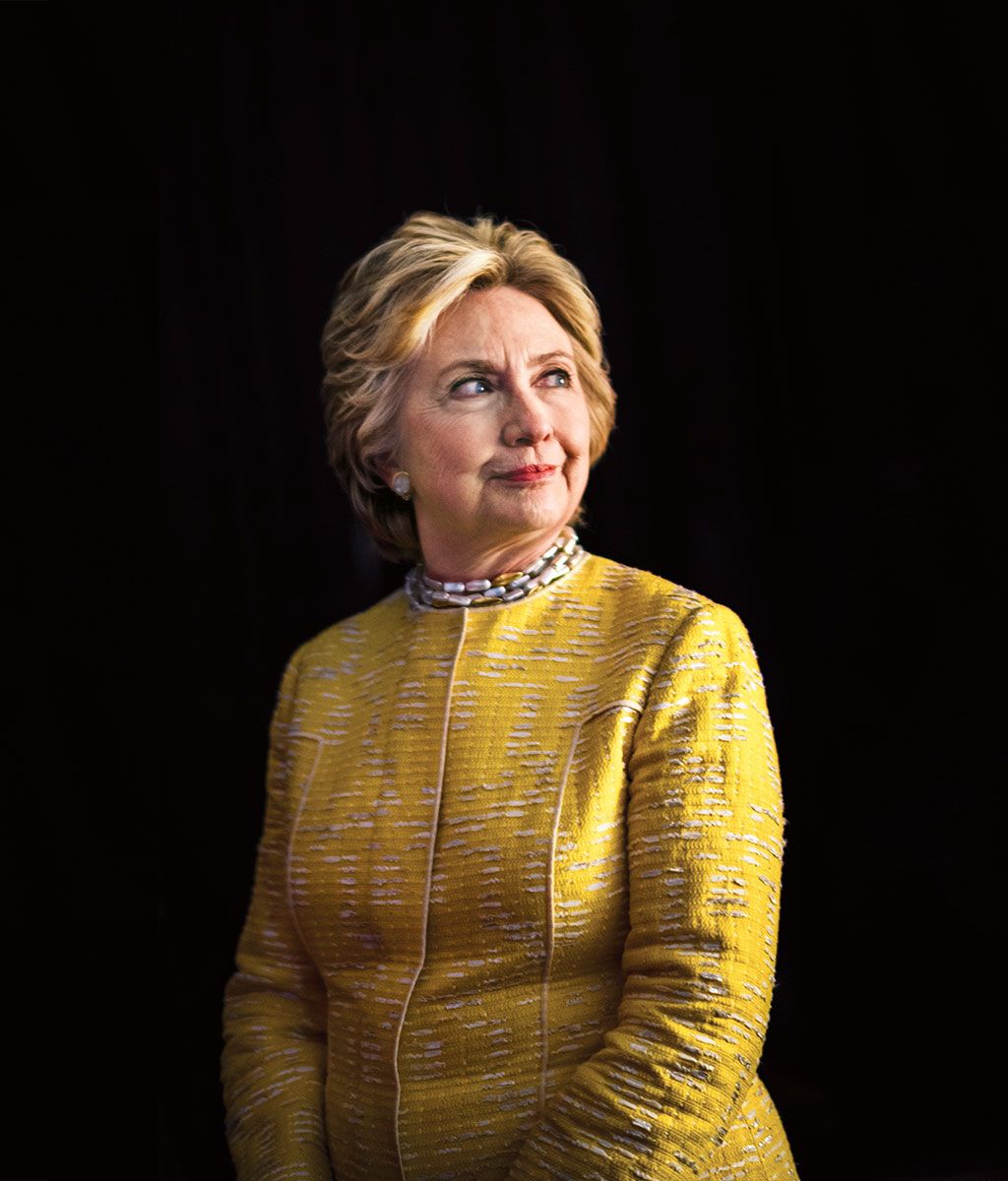
Hillary backstage at a speech in May.


When I walk into the Chappaqua dining room in which Hillary Clinton is spending her days working on her new book, I am greeted by a vision from the past. Wearing no makeup and giant Coke-bottle glasses, dressed in a gray mock-turtleneck and black zip sweatshirt, Hillary looks less Clinton and more Rodham than I have ever seen her outside of college photographs. It’s the glasses, probably, that work to make her face look rounder, or maybe just the bareness of her skin. She looks not like the woman who’s familiar from television, from newspapers, from America of the past 25 years, but like the 69-year-old version of the young woman who came to the national stage with a wackadoodle Wellesley commencement speech in 1969. With no more races to run and no more voters to woo with fancy hair, Clinton appears now as she might have if she’d aged in nature and not in the crucible of American politics. Still, this is not Hillary of the woods. She is reemerging, giving speeches and interviews. It’s clear that she is making an active choice to remain a public figure.

It’s the day after Donald Trump has fired FBI director James Comey, the man who many — including Clinton — believe is responsible for the fact that she is spending this Wednesday in May working at a dining-room table in Chappaqua and not in the Oval Office. Clinton checks with her communications director, Nick Merrill, about what’s happened in the past hour — she’s been exercising — and listens to the barrage of updates, nodding like a person whose job requires her to be up-to-date on what’s happening, even though it does not.

“I am less surprised than I am worried,” she says of the Comey firing. “Not that he shouldn’t have been disciplined. And certainly the Trump campaign relished everything that was done to me in July and then particularly in October.” But “having said that, I think what’s going on now is an effort to derail and bury the Russia inquiry, and I think that’s terrible for our country.”

It will be days before newspapers report that Trump asked Comey to move away from the Russia investigation prior to firing him, but the implications are already clear. History, says Clinton, “will judge whoever’s in Congress now as to how they respond to what was an attack on our country. It wasn’t the kind of horrible, physical attack we saw on 9/11 or Pearl Harbor, but it was an attack by an aggressive adversary who had been probing for many years to figure out how to undermine our democracy, influence our politics, even our elections.” Her hope, in the wake of Comey’s dismissal, is that “this abrupt and distressing action will raise enough questions in the minds of Republicans for them to conclude that it is worthy of careful attention, because left unchecked … this will not just bite Democrats, or me; this will undermine our electoral system.”


Talking about Comey, even the day after his firing, is a risky thing for Clinton to do. The last time she did it was in a conversation a week earlier with CNN journalist Christiane Amanpour at a Manhattan lunchtime gala for Women for Women International. Amanpour had asked Clinton about why she thought she had lost the election. “I take absolute personal responsibility,” Clinton replied. “I was the candidate, I was the person who was on the ballot. I am very aware of the challenges, the problems, the shortfalls that we had.” But she had also talked about other factors she believes contributed, citing FiveThirtyEight’s Nate Silver’s research on the impact of Comey’s October 28 letter. “If the election had been on October 27,” she said, “I’d be your president.”

After the exchange, Clinton and her aides had appeared upbeat. The crowd had been enthusiastic, and there was a sense that Clinton had done something that she has long found difficult in public: She had been herself — brassy, frank, funny, and pissed. But on cable news and social media, another reaction was taking shape. The New York Times’ Glenn Thrush, who has reported on Clinton for years, tweeted “mea culpa-not so much,” suggesting that the former candidate “blames everyone but self.” Obama-campaign strategist turned pundit David Axelrod gave an interview claiming that while Clinton “said the words ‘I’m responsible’ … everything else suggested that she really doesn’t feel that way.” Joe Scarborough called her comments “pathetic”; David Gregory suggested she was not “taking real responsibility for the fact that she was not what the country wanted.” And in the Daily News, Gersh Kuntzman delivered a column that began, “Hey, Hillary Clinton, shut the f— up and go away already.”

Later, Amanpour would tell me how surprised she was by the negative reaction. “The idea that she shouldn’t mention the Comey letter when the entire nation and the most respected statisticians are considering its impact is so strange,” she said. “If she were a man, would she be allowed to mention it? As a woman, I am offended by the double standards applied here. Everyone shrieks that Hillary was a bad candidate, but was Trump a good candidate?”


In the natural biorhythms of popular response to Hillary Clinton, which have been trackable for more than two decades, this is the period during which even her detractors would usually be starting to feel rugged admiration for her. Clinton has typically been most loathed when she is running for office, and most beloved after she has lost but is soldiering on, especially if the loss was sufficiently humiliating. But it’s been six months since the cataclysm of November 8, and feelings about her remain fiercely divided. Social media is awash with Hillary fans who imagine alternative universes in which she’s the president, and Etsy booms with crafts made from the words of her concession speech; yet many of her critics — even those who voted for her — are determined that Clinton bear the mantle of worst politician who ever lived, their evidence being that she lost to … the worst politician who ever lived.

The unusually prolonged pummeling is partly because Clinton’s Election Day loss was not just hers but the nation’s; her defeat this time left us not with an Obama presidency but with an out-of-control administration led by a man so inept — and so reviled — that even (some) Republicans are voicing concerns. The nation is grasping for a way to understand how we got here, and blaming Clinton wholly and neatly takes the heat off everyone else who contributed: from the critics who derided her supporters as empty-headed shills to those supporters who were cowed into secret Facebook groups; from the journalists who treated Trump as a ratings-pumping sideshow and Clinton as the suspiciously presumptive president to all of us who permitted cheerful stories about America’s progress on gender and race to blot out the real and lingering inequities in this country.

The anger at Clinton from some quarters — in tandem with the beatification of her from others — reminds us just how much this election tapped into unresolved and still largely unexplored issues around women and power. In the aftermath, the media has performed endless autopsies. We have talked about Wisconsin, about Comey, about Russia, about faulty messaging and her campaign’s internal conflicts. We have fought over unanswerable questions, like whether Sanders would have won and whether Clinton was particularly mismatched to this political moment, and about badly framed conflicts between identity politics and economic issues. But postmortems offering rational explanations for how a pussy-grabbing goblin managed to gain the White House over an experienced woman have mostly glossed over one of the well-worn dynamics in play: A competent woman losing a job to an incompetent man is not an anomalous Election Day surprise; it is Tuesday in America.

To acknowledge the role sexism played in 2016 is not to make excuses for the very real failings of Clinton and her campaign; it is to try to paint a more complete picture. “I think a lot of people didn’t believe those of us who were yelling that it was hard to elect a woman president,” says Jess McIntosh, a Democratic strategist who was the director of communications outreach for the Clinton campaign. “The fact that that woman lost to the least qualified human being on the planet really kind of drove it home.” At a visceral level, the revelation of sexism’s lingering power is why 3 million women marched in protest on the day after Trump’s inauguration and why more than 13,000 women have expressed interest in running for office since the election.

In some ways, Clinton herself is one of these awakened women; she is much more comfortable talking about gender in the aftermath of her historic run than she ever was during it. Recently, she has even declared herself a member of “the resistance.” “There’s always been this rearguard movement against expanding the circle of opportunity,” she says. “And I believe that a lot of what’s happening now is a resurgence of the anxiety, the fear, the bias that still affects people who are worried that change is coming even faster, that it will have even more consequences.” The unwillingness to acknowledge this backlash, says Clinton, is “part of the reason we are, if not going backward, certainly stalled.”
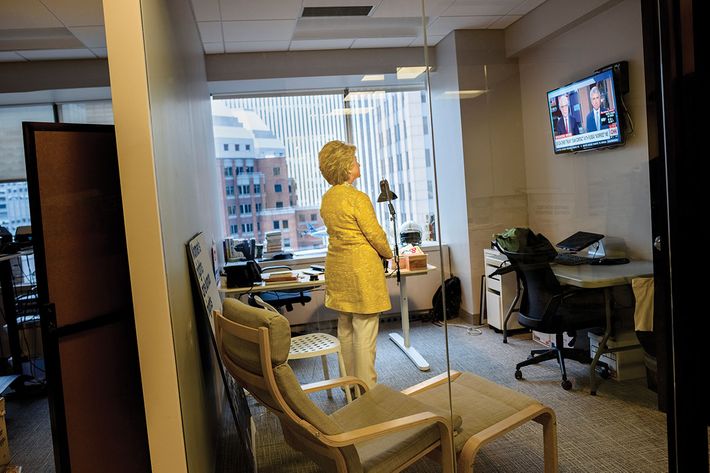
Watching CNN’s coverage of the Russia investigations on May 23. Photo: Lynsey Addario/New York Magazine
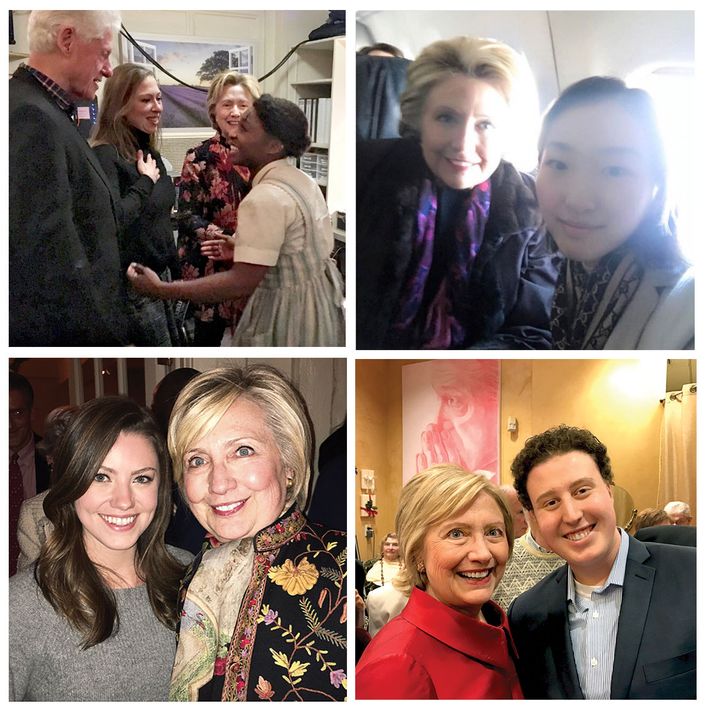
One evening in April, about a dozen Clinton-campaign alums gathered at Cipriani Wall Street to watch their former boss give a speech at a benefit for New York’s LGBT Community Center. It was a mix of senior and junior staffers — Robby Mook and Jake Sullivan and former finance director Dennis Cheng, plus speechwriters Megan Rooney and Lauren Peterson, chief product officer Osi Imeokparia, Liz Zaretsky and Teddy Goff from the digital team, and Aditi Hardikar, Carl Gray, and Anthony Mercurio from finance. Partway through the lengthy dinner leading to Clinton’s speech, Nick Merrill and Huma Abedin arrived and a signal went up; the staff had been summoned backstage to say hello to the woman whom a few of them hadn’t seen since the election. Ushered into a small room, they clapped as Clinton walked in, then there was a noisy round of handshaking, hugging, and group-picture-taking. When they headed back to their banquet tables to settle in for her speech, two of the men were wiping tears from their eyes.

Mercurio told me that it’d been a terrible week for ex-staffers. Two days earlier, campaign reporters Amie Parnes and Jonathan Allen had publishedShattered, a book diagnosing the campaign’s failures as the result of catastrophic internal dissent. Many who were interviewed for this story agreed with portions of the reporting in Shattered — that Clinton listened to too many competing voices, often to the point of inaction; that there were arguments about messaging and resources that turned out to be retrospectively haunting; that the ground game was faulty in some states. What they disagreed with was that any of these problems was unique to their campaign, or that their team was anything other than close and united in their efforts to elect Hillary Clinton. “There was this inference that we were a bunch of mercenaries working for a soulless, distant candidate for whom we felt no genuine affection,” McIntosh would tell me later. “That assertion — that we could not and did not like her — did more to doom us than any internal dissent ever did.”


After Clinton gave her speech, some of the staffers packed into a van and hitched a ride to Chappaqua, where they would spend the night before a day of working on the book. The rest, including Mook and Cheng, headed for a bar, where they drank and laughed and looked at their phones, a habit that has been hard to break. Few at the bar were still on Clinton’s payroll, but they all seemed devoted to her, and to each other — veterans of a losing battle. “We were really good and humane to each other,” says Rooney. “And we really loved her. We still do.”

Affection for her campaign staff is one reason Clinton claims she will not point fingers at her own team in assessing her loss. “I will never say anything other than positive things about my campaign,” she tells me in Chappaqua. “Because I love the people that led it, worked in it.”

Besides, she argues, “what I was doing was working. I would have won had I not been subjected to the unprecedented attacks by Comey and the Russians, aided and abetted by the suppression of the vote, particularly in Wisconsin.” She agrees that there are lessons to be learned from her campaign, just not the same ones her critics would cite. “Whoever comes next, this is not going to end. Republicans learned that if you suppress votes you win … So take me out of the equation as a candidate. You know, I’m not running for anything. Put me into the equation as somebody who has lived the lessons that people who care about this country should probably pay attention to.”

Piecing together what happened, with six months of perspective, Clinton says she thinks she “underestimated WikiLeaks and the impact that had, because I thought it was so silly.” Those hacked emails, dripped out over weeks, says Clinton, “were innocuous, boring, inconsequential. And each one was played like it was some breathless flash. And so you got Trump, in the last month of the campaign, talking about WikiLeaks something like 164 times; you’ve got all his minions out there, you’ve got the right-wing media just blowing it up. You’ve got Google searches off the charts.”

Clinton has been looking at where some of the Google searches for WikiLeaks were coming from. “They were from a lot of places where people were trying to make up their minds,” she says. “Like, ‘Oh my God, I kinda like her, I don’t like him, but she might go to jail. And then what about all this other stuff?’ It was just such a dump of cognitive dissonance …” Clinton trails off and then smiles and nods to herself. “I have a lot of sympathy for voters in a lot of places I didn’t win,” she says. “Because I can see how hard it was.”

The press, she believes, didn’t make it any easier. “Look, we have an advocacy press on the right that has done a really good job for the last 25 years,” she says. “They have a mission. They use the rights given to them under the First Amendment to advocate a set of policies that are in their interests, their commercial, corporate, religious interests. Because the advocacy media occupies the right, and the center needs to be focused on providing as accurate information as possible. Not both-sides-ism and not false equivalency.”

The impulse toward false equivalency is only getting worse, in her opinion. “The cable networks seem to me to be folding into a posture of, ‘Oh, we want to try to get some of those people on the right, so maybe we better be more, quote, evenhanded.’ ” When I mention MSNBC’s hiring of conservatives including George Will, and the New York Times’ new climate-change-skeptic opinion columnist, Bret Stephens, her brow furrows. “Why … would … you … do … that?” she says. “Sixty-six million people voted for me, plus, you know, the crazy third-party people. So there’s a lot of people who would actually appreciate stronger arguments on behalf of the most existential challenges facing our country and the world, climate change being one of them! It’s clearly a commercial decision. But I don’t think it will work. I mean, they’re laughing on the right at these puny efforts to try to appease people on the right.”

To be sure, Trump got plenty of negative coverage in the press as well, but, during the campaign at least, the negative stories didn’t seem to stick to him with the same adhesion. And even now, as investigations of his administration’s connections to Russia splash across front pages, the Timeshas launched a new feature, a weekly call to readers to “Say something nice” about him. I ask Clinton if she’s seen it. “I did!” she says with a wide smile, taking a beat. “I never saw them do that for me.”


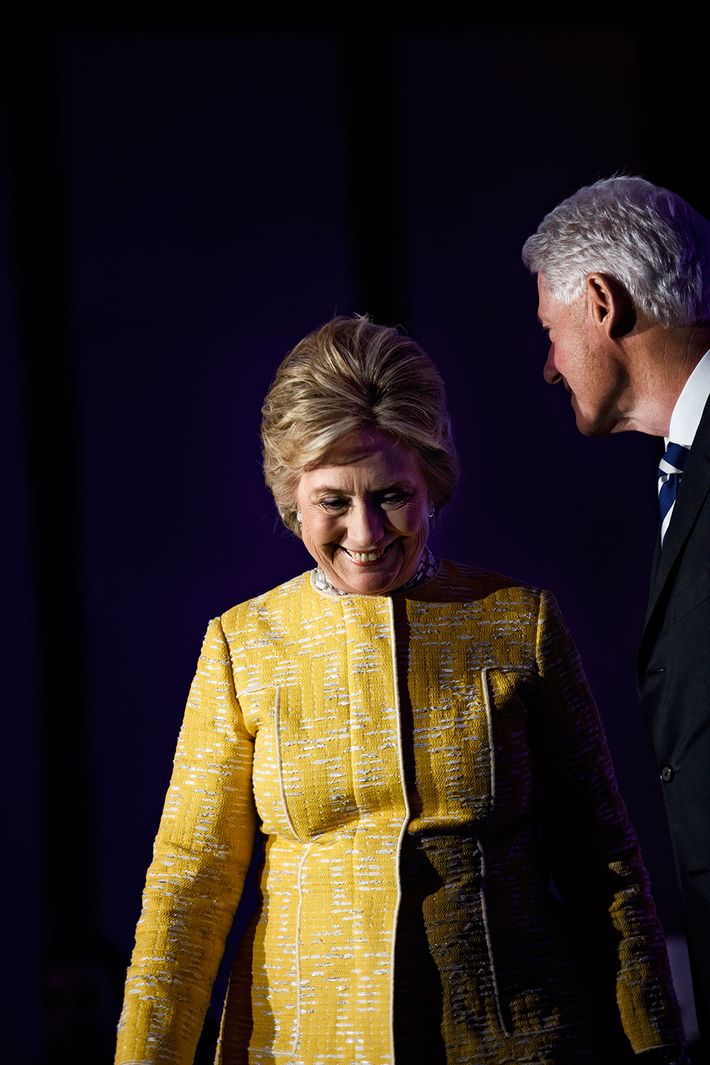
Onstage with Bill at a speech in May. Photo: Lynsey Addario/New York Magazine
By Election Night, Clinton says, she knew it was going to be close but thought she would be able to “gut it out.” “I was as surprised as anybody when I started getting returns. Because that’s not what anybody — with a couple of outliers — saw in the data. And the feel was good! We had good crowds, we had lots of energy and enthusiasm, and I thought we were going to pull it off. And so did the other side, by the way. They did not believe they were going to win.”

As staffers and friends began to melt down with shock and grief, Clinton, by all accounts, remained preternaturally calm. One staffer speculated that she was able to do so because she is a person who often expects the worst and does not trust the best: “It was an example of reality rising to meet her expectations.”

“I remember having conversations with her which were gut-wrenching to me,” says Mook of that night. “Saying to her, ‘The math isn’t there. It doesn’t look like we can win.’ She was so stoic about it. She immediately went into the mode of thinking, Okay, what do we do next?”

Speechwriters Dan Schwerin and Megan Rooney realized that they were going to have to produce a concession speech. Rooney had drafted one and stuck it in a drawer. As the evening wore on, they started working on it. By the time the results were certain, Clinton and her advisers felt that it was too late to make a speech; she wanted to consider carefully what she had to say, and went back and forth with her team about the stance to take toward Trump. When Schwerin and Rooney came to her suite at the Peninsula Hotel the next morning to go over the draft, Clinton was sitting in her bathrobe at the table. She had slept only briefly, but she was clear: She wanted to take a slightly more aggressive approach, focusing on the protection of democratic norms, and she wanted to emphasize the message to young girls, the passage that would become the heart of her speech. As the pair of writers left her room and walked down the hall, Rooney turned to Schwerin and said, “That’s a president.” Schwerin remembers: “Because here, in this incredibly difficult moment, she was thinking calmly and rationally about what the country needs to hear.” Schwerin said that until then he had held it together. “But I kind of lost it then.”

“I think she has never gotten enough credit for how definitive and clear that speech was, what a smooth transfer of power she was facilitating,” says Mook. “It was so close, there were so many allegations, particularly about irregularities, and she never wavered on the idea that she had to definitively concede and make sure there was a smooth transition of power.”

To hear Clinton tell it, focusing on the immediate tasks was what saved her. “This was a crushing, devastating blow,” she says now. “I just thought we had to get through this with a level of dignity and integrity, and there’d be plenty of time to try to figure out what went wrong and what we could have done differently, but for that moment we just had to stick to the ritualistic process: Okay, when I was sure, I have to call Trump. I want to call Obama. And then I have to figure out what I’m gonna do the next day … I had to get through that before I could go, ‘What the hell just happened?’ and be angry and upset. And be disappointed and feel I let people down and feel everything that I felt.”

She was still in the ritualistic-process mode when she attended Trump’s inauguration. People close to her told me that she’d had doubts about being able to make it through without visibly losing control. “Oh,” says Clinton, “it was hard. It was really … difficult.” But “at the time, we hoped that there would be a different agenda for governing than there had been for running.”

Of course, it quickly became clear from Trump’s speech that there would be no change in strategy. A look of disgust crosses Clinton’s face as she recalls it. “It was a really painful cry to his hard-core supporters that he wasn’t changing,” she says. “The ‘carnage’ in our country? It was a very disturbing moment. I caught Michelle Obama’s eye, like, What is going on here? I was sitting next to George and Laura Bush, and we have our political differences, but this was beyond any experience any of us had ever had.”

I ask her about the report that Bush had said of the speech, “That was some weird shit,” and her eyes light up. “Put it in your article,” she says. “They tried to walk back from it, but …” Did she hear it herself? I ask. She raises her eyebrows and grins.

Remembering Election Night and the inauguration, I can’t help but think that Clinton’s ability to set aside her own feelings might be useful but perhaps not entirely healthy. I ask her if she’s ever been in therapy, and she shakes her head. “Unh-uh. No. I have not.” When I express surprise, she allows, “Well, we had some marital counseling in the late ’90s, around our very difficult time, but that’s all.”

She shrugs. “That’s not how I roll. I’m all for it for anybody who’s at all interested in it. It’s just not how I deal with stuff.”
Sorting through mail from her supporters. Photo: Lynsey Addario/New York Magazine

When she entered the 2016 race, Clinton says, she had hoped that “a lot of the rawness of being a woman competing for the presidency would have dissipated” in the eight years since she had last run. What she found was that indeed, “a lot of the explicit stuff” — the nutcrackers, the television pundits who compared her to their carping ex-wives, the opponents who made fun of her outfits during debates — “had somewhat diminished, but a lot of implicit [bias] was just raging below the surface.” For Clinton, the online commentary, the more subtle but also more intimate social-media disparagement, offered “the revelation that there were still very deep, raw feelings about gender that had not been resolved.”

Early in the campaign, Clinton spoke to historians, psychologists, and others who’d examined gender bias about what she should expect. “They were very clear that this was going to be an uphill battle,” she says. Particularly dire were the warnings from Sheryl Sandberg, the Facebook COO whose 2013 book Lean In had become a flash point in discussions around feminism, class, capitalism, and the roadblocks that remain for ambitious women. “The takeaway from Lean In,” says Clinton, “is that there is a stark difference between men and women when it comes to success and likability. So the more successful a man is, the more likable he is. The more successful a woman is, the less likable she is. And it’s across every sector of society.”

Sandberg predicted to Clinton that her reception during the campaign would be very different from the 69 percent approval rating she’d gained as secretary of State. “Sheryl was right-on,” says Clinton. “Once I moved from serving someone — a man, the president — to seeking that job on my own, I was once again vulnerable to the barrage of innuendo and negativity and attacks that come with the territory of a woman who is striving to go further.” So how did knowing that ambition is negatively correlated with likability for women affect Clinton’s approach in seeking the most powerful office in the land?

“Well, this is the joke,” she says. “You gotta be authentic! So you go out and try to be as effective as you can in presenting yourself and demonstrating the qualifications you have for the job, but you’re always walking a line about what will find approval from the general population and what won’t. It’s trial and error.”

Her team recalled the persistent feeling of being in uncharted territory. As McIntosh says, “Should she have showed more emotion? I don’t know. We don’t know whether women who show less emotion get to be the president. Should she have been less hawkish? I don’t know. We don’t know if we can elect a pacifist woman president. We can’t point to where she diverges from a path that other women have taken because she was charting that path, and that might fuck with your analytics a bit, as it turns out.”

The campaign was sometimes frustrated by the fact that Clinton couldn’t play the same game as her opponents. “Bernie Sanders and Donald Trump both excelled at channeling people’s anger,” says Schwerin. “And there was a way in which this anger was read as authentic. But there’s a reason why male candidates can shout and are called passionate, and if a woman candidate raises her voice to whip up a crowd, she’s screeching and yelling.” Clinton understood this, says Schwerin. “So she’s controlled. She doesn’t rant and rave, she’s careful. And then that’s read as inauthentic; it means that she doesn’t understand how upset people are, or the pain people are in, because she’s not angry in the way those guys are angry. So she must be okay with the status quo because she’s not angry.”

Clinton says the second debate with Trump, during which he loomed menacingly behind her, was one of the hardest situations of the whole campaign. “Because what he was doing was so … uh …” — she pauses to search for words — “so personally invasive: following me, eyeing me.”

She considered confronting him, turning around and saying, “Get away from me!” But she figured that would just give him what he wanted. “I saw him destroy all of his Republican opposition who eventually tried to confront him on a debate stage, and he reacted with such contempt. He will gain points, and I will lose points.” Acknowledging how tight her grip on the microphone was during that debate, Clinton says, “Think of all the times where you are either mentally or physically gripping yourself, [willing yourself] not to respond, not to lash out, not to display the anger that you feel, because you know it will redound to your detriment. So you swallow it. You try to be honest with yourself, to know you’re feeling it but then say, ‘Okay, I’ve got a goal here and I’m not going to get knocked off-balance.’ ” Clinton maintained control. “So I ended up with another ‘win,’ ” she says. “But I also ended up with him really satisfying a lot of his potential voters. One of these guys, I can’t remember who” — it was Nigel Farage — “said, said, ‘Oh, he was the alpha male! He was the big gorilla in the …’ — whatever they call gorilla groups! I think that for people already committed to him, they loved it.”

But was she right that she couldn’t have expressed her anger in that debate? There are plenty of people who yearned for Clinton to get mad; during the campaign, an imagined litany of Clinton’s fury titled “Let Me Remind You Fuckers Who I Am” went viral. “Oh, I am [pissed],” she says. But as a woman in public life, “you can’t be angry for yourself. You just can’t. You can be indignant, you can be annoyed, you can be frustrated, but you can’t be angry … I don’t think anger’s a strategy.”

You mean it’s not a strategy for you, I clarify. “For me, yeah.” She pauses. “But I don’t think it’s a good strategy for most people.”

But this was an election that was, in many ways, about anger. And Trump and Sanders capitalized on that.

“Yes.” Clinton nods. “And I beat both of them.”
Selfies with Hillary, clockwise from top-left: Social-media posts after the election: backstage with Cynthia Erivo at The Color Purple; on a plane; at ICD Contemporary Jewelry in Chappaqua; and at Chappaqua’s Kittle House.
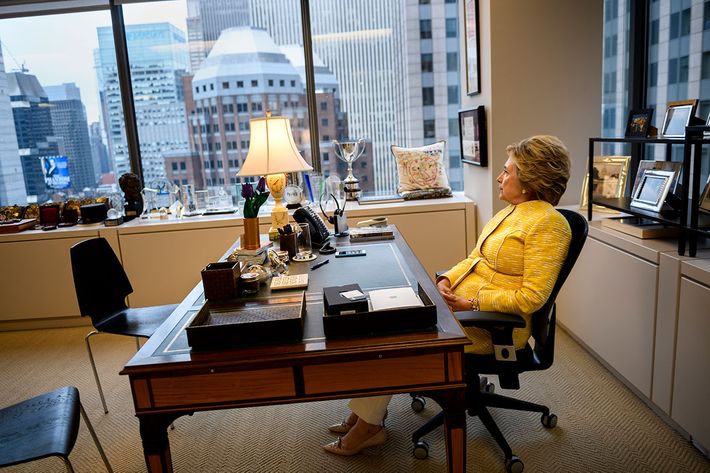

Thirty-six hours after her interview with Amanpour and the opprobrium that followed, a steamrollered Clinton walked into a downtown event space for the Ms. Foundation’s Gloria Awards, looking like Charlie Brown having just had the football yanked away again: Gone was the loose, open Clinton, back was the tight, fake distance and distrust.

Clinton dutifully did a photo line with Gloria Steinem and the co-chairs of the Women’s March, some of whom have been her fierce critics, and was then mobbed by a group of former staffers. “It’s a reunion!” she bellowed gamely as this evening’s group — including her former director of engagement De’Ara Balenger, former deputy national political director Brynne Craig, and former digital-outreach chair Zerlina Maxwell — piled on. But Clinton looked strained, tired, as she moved away from them to go over speech logistics.

As the young women from her campaign formed a knot and began a heated conversation about the blowback Clinton had received over the past few days, their former boss started to edge closer to where they were standing, her ear turned slightly to their exchange. The conversation got more boisterous and more profane, and Clinton got closer. As the group remarked on the way Clinton’s critics had whipped each other into a frenzy, she could no longer help herself. “Well of course they did,” she chimed in. “They’re boys.”

The conversation continued, its subject now present and nodding along. Clinton asked if the group had heard that searches for the word misogyny rose by 10,000 percent after Amanpour used the word. Can you believe that six months after this election, people still didn’t know what misogyny means? I asked in reply. A smile barely flickered around Clinton’s lips before she deadpanned: “Why, yes. I guess I can believe that.”

Clinton has a complicated relationship with feminism, and with women more broadly. While Clinton won black, Latina, and Asian women by huge margins, 53 percent of white women preferred the candidate who called women pigs and dogs to the one from their own demographic. Of course, no Democrat since Bill Clinton has won white women, and Hillary did better with them than Obama did in 2012. But the reminder of this old dynamic — that male power over a majority population, women, would not be possible without the willing support of members of that majority — came as a nasty surprise to some on the campaign.

“The thing that stood out to me the most,” says Mook, “is when we would hear women say, ‘Do we really want a woman president?’ And we would find that women were much more ready to say that than men, and that really surprised me because I guess it just never occurred to me that anyone would want to disqualify themselves.”

The campaign was determined to be better at emphasizing the historic nature of Clinton’s run than it had been in 2008, when strategist Mark Penn had advised Clinton to run like a man, but striking the right note about women — to women — remained tricky. Early conversations with persuadable women voters showed that they would balk at framing Clinton’s candidacy as historic, citing fears that such an argument would alienate men.

Then again, after Trump accused Clinton of “playing the woman card,” the campaign produced actual wallet-size “Woman Cards” that could be purchased for a dollar and proved to be its greatest merchandising and PR success.

Though you might not know it from the media coverage, there were many, many women who not only voted for Clinton but were excited about it. “Look at all of the deep dives into who exactly Trump voters were, what motivated them, where they had been let down, what they believed,” says McIntosh. “Look at the coverage of Bernie Sanders’s supporters: Who’s filling the stadium, what gender and age and race were they? Those stories did not exist about enthusiastic Hillary voters even though there were more enthusiastic Hillary voters than for the other candidates. That lack of validation made it easier for the brutal response women experienced when they said they liked her.”

The brutal response McIntosh is referring to was the way in which expressions of unreserved support for Clinton were often met with accusations of featherbrained fangirl-dom, or vagina-voting. This dynamic led plenty of supporters to shut up about their enthusiasms or to take them underground, to their online clubs. There was “no reason for people to believe that there were actually millions of people who genuinely adored her,” says McIntosh. Another story that never really landed: “The majority of our donors were women,” says Mini Timmaraju, Clinton’s former director of the women’s vote. “That’s never happened before in a presidential campaign.”

More than one male staffer spoke of a dark joke from the campaign, one that reflected their awareness of how little credit was given to Clinton and the women who worked for and supported her. The joke was that if Clinton won, the story would be about how the brilliant men running her campaign had managed to drag her limp body over the finish line.
Hillary in her Midtown office. Photo: Lynsey Addario/New York Magazine
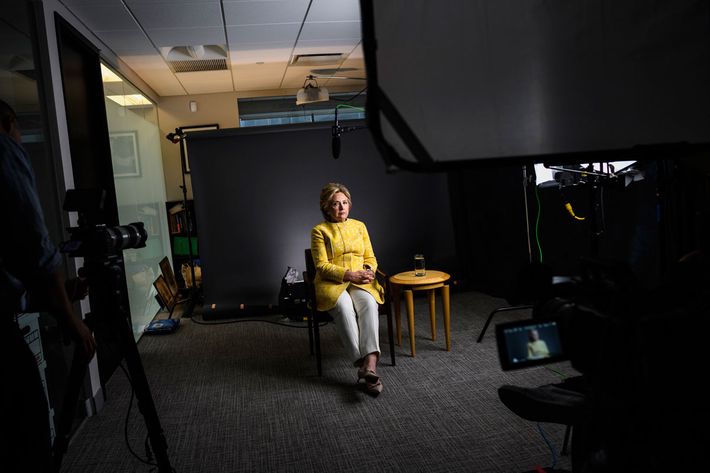
In mid-April, Clinton was in a classroom at La Guardia Community College, waiting for Andrew Cuomo, who was about to sign into law his college-affordability legislation. She was fretting about everyone’s wardrobe — she said she’d just moved her winter clothes out of her closets but was still struggling with layering — and admiring the reversible pantsuit that Huma Abedin was wearing, urging her to show off the seams and details. It’s made by a company founded by two young women who were supporters, and Clinton was hawking for them like a garment-industry old-timer: “They make them all in New York, and they’re not unreasonably priced!” she said. “I just want to support more of these young-women-owned businesses, and I think it’s so sweet that they are making pantsuits!”

Clinton’s focus on seasonal wardrobe choices and cleaning out her closet was evidence of how odd her life is now. For the first time in a long time, she does not have a crowded schedule of events; some weeks include multiple commitments and writing time, but there have been comparatively vast stretches during which there has been very little to do.

The slow pace was especially uncanny in the early weeks of the Trump administration, when the new president was issuing one executive order after another while Clinton and her staff could only watch in paralyzed horror. “It was like the inverse of Veep,” Merrill says. “Instead of an unqualified person being thrust into a position of huge responsibility, there was a hugely overqualified person with no responsibilities.”

Yes, she did a lot of walking in the woods and around Chappaqua. And yes, she caught up on her sleep — she speaks often these days of the benefits of rest and good food and being outdoors. She answered mail and had scores of off-the-record exit-interview meetings, and she and Bill saw most of the shows currently on Broadway. They have dinners together and spend time with their grandchildren, whose jungle gym is right outside the window where Hillary works. Bill has recently re-immersed himself in the Clinton Foundation, but Hillary is not involved in its day-to-day operations, instead focusing on her writing and speaking engagements. On trips to Texas and to Wellesley, and in the comfortable Times Square office she has kept since 2013, she is accompanied by those staffers who’ve stayed on: Merrill and Abedin; two young assistants, Opal Vadhan and Grady Keefe; and Robert Russo, who works on her correspondence.

Simon & Schuster plans to publish Clinton’s book on a rushed schedule in the fall. Billed as a collection of essays riffing on her favorite quotations, it’s a project that sounded anodyne from the press release. But Clinton’s drive to get some of her thoughts on the election out of her head, along with the urging of friends that she should let rip, has led her to work toward a fuller chronicle. She has called the process, which is taking up most of her time these days, “excruciating.”

Clinton and her team understand that she will be excoriated for whatever she writes. “There’s never going to be enough self-blame for the people who demand it,” says Schwerin of the book. The appetite for the abasement of Hillary Clinton has long been insatiable. Over the course of 25 years, stories about whether Clinton should apologize, about how she apologized, or about her unwillingness to apologize — for everything from dissing Tammy Wynette to voting for the Iraq War — have been frequent and fetishistic. In November, Clinton became the first person to lose a presidential race to say “I’m sorry” for the loss in her concession speech. A press release for a new collection of her emails and speeches to Goldman Sachs, entitled How I Lost and with a foreword by Julian Assange, reads as an apology from Clinton for being “incapable of beating even a sexist dumbass,” as if sexist dumbasses were easy to defeat in America.

When I ask Clinton about the eagerness to blame her and her alone for the election result, she gets impatient. “Oh, I don’t know, you’d have to talk to a psychologist about it. There’s always, what’s that word … Schadenfreude — ‘cut her down to size,’ ‘too big for her own britches’ — I get all that. But I don’t see this being done to other people who run, particularly men. So I’m not going to engage in it. I take responsibility, I admit that I’m not a perfect candidate — and don’t know anybody who was — but at the end of the day we did a lot of things right and we weathered enormous headwinds and we were on our way to winning. So that is never going to satisfy my detractors. And you know, that’s their problem.”

There’s a lot of gallows humor around Clinton these days. Waiting for Cuomo at La Guardia, she was talking about what it’d been like looking back on all the editorial endorsements she got during the campaign, some from even conservative papers. “I want to be buried with my editorial endorsements,” she said with a laugh. “I want an open casket and they can all be piled on top of me. You won’t even be able to see my body.” Abedin and Merrill joined in. “I can’t seem to get a last look at Hillary, but here’s the Cleveland Plain Dealer!” shouted Merrill, imagining the funeral.

The joke was cut short when Cuomo walked into the room. Suddenly, Clinton’s wryness was gone and she was high-pitched and effusive. They talked about Easter, about how she’d like to fill some of those plastic eggs for the kids but Chelsea told her that Charlotte can’t yet eat jelly beans. Cuomo suggested doing “those marshmallow things instead.” It was all very ordinary and small-talk-y until you remembered that Donald Trump is president and Hillary Clinton is discussing the merits of Peeps versus jelly beans.

When the event was over, as Clinton was leaving La Guardia, an office full of women started shrieking from behind a door that had been closed by security. Clinton paused, then opened the door to let them in. “Oh my God, she opened the door herself,” one of them screamed as they huddled around her, taking selfies and shouting, “Don’t give up, Hillary!” After Clinton left, one of the women shouted across the office, “I want her to run again!” But when I asked her name, she looked stricken. “I just hope she keeps speaking out,” she said and turned away.
Hillary during a video taping at her Midtown office. Photo: Lynsey Addario/New York Magazine

Almost everywhere Clinton goes, it seems, someone starts crying. It’s not just friends and staffers. And though it was more intense in the weeks immediately following the election, it hasn’t entirely let up. At restaurants, in grocery stores, on planes, and in the woods, there are lines of people wanting selfies, hugs, comfort.

“It’s been unlike anything I’ve ever seen,” she says. “I mean, it doesn’t end. Every time I’m in public. I was having lunch with Shonda Rhimes last week and a woman stopped at the table — well-dressed, probably in her 40s or 50s — and she said, ‘I just can’t leave this restaurant without telling you I’m just so devastated,’ and she just started to cry. I was on the other side of the table, or I would have done what I have done countless times since the election, which is just put my arms around her. Because people are so profoundly hurt. And it is, yes, predominantly women. But men say it in a different way. Men are, ‘I voted for you and I don’t know what the hell happened.’ But for women who supported me or who feel bad that they didn’t, not because they voted for somebody else but because they didn’t vote …”

This is the dynamic that is perhaps the most intense for Clinton. “Not so much anymore, but in the immediate aftermath, from after the election to probably the first of the year,” she says, “I had people literally seeking absolution.”

I look at her, surprised. “Oh, yeah,” she says, nodding. “ ‘I’m so sorry I didn’t vote. I didn’t think you needed me.’ I don’t know how we’ll ever calculate how many people thought it was in the bag, because the percentages kept being thrown at people — ‘Oh, she has an 88 percent chance to win!’ I never bought any of that, but lots of people did.”

In particular, Clinton recalls one night at the theater. “It was intermission, and a woman came over holding the hand of a young woman. She literally dragged her daughter over to see me. And she said, ‘My daughter has something to tell you … Tell her.’ And this girl says to me, ‘I am really sorry; I didn’t think you needed my vote and I didn’t vote.’ And her mother says [yelling], ‘Yes, she didn’t vote! You didn’t vote! You’re part of the problem!’ I said, ‘Okay, well, next time I hope you’ll vote.’ And she said, ‘But I marched!’ ” Here Clinton smiles. “And I said, ‘I’m really glad you marched. I’m so glad you marched.’ ”

There is twisted irony in the fact that the millions of women who poured onto the streets in January would have changed the outcome of the election had they come together before November, yet the march never would have happened had Hillary Clinton not lost the presidency. This is often the backtracking path of progress for the women’s movement in this country. Recall Anita Hill’s claims of sexual harassment by Supreme Court nominee Clarence Thomas in 1991; women suffered a material loss with long-lasting consequences when Thomas was confirmed in spite of Hill’s testimony. (Thomas’s part in gutting the Voting Rights Act was likely a contributing factor to Clinton’s 2016 loss.) But the fury that Hill’s treatment provoked in women proved catalytic. In 1992, a record number of women ran and were elected to Congress, and EMILY’S List blossomed into one of Washington’s most powerful political institutions.

Similarly, since the election, the outcry, the march, the organizing, the resistance “has been really powerful,” says Clinton. She is hoping to build on the momentum with her new 501(c)4, Onward Together, which is supposed to direct the fire hose of fund-raising dollars that powered her campaign to grassroots groups working to oppose the Trump administration. One of those groups is Emerge America, which trains female candidates to run for office. Another is Run for Something, a group designed to draw young people into politics; its 27-year-old co-founder Amanda Litman worked on Clinton’s digital team. “It has to be sustained,” says Clinton. “And here is my big worry. The other side is sustained by greed and hate and power and ideology, and they never quit. They get up every day looking to take advantage and drive their agenda forward.”

Having been on the receiving end of the right’s anger for decades, Clinton knows from relentless hate. They still chant “Lock her up” at Trump rallies, just as they did at the New York Stock Exchange as she gave her concession speech. “You know, these guys on the other side are not just interested in my losing, they want to keep coming after me. I mean, think about that for a minute. What are they so afraid of? Me, to some extent. Because I don’t die, despite their best efforts. But what [really drives them] is what I represent.”

Clinton knows that had she won, she would have governed in a time of deep anti-feminist backlash. “You know what?” she says. “I would have loved to have had that problem. Look, I know what’s out there. I have lived it. I have come of age at a time when expectations and norms and institutions changed for women.” Clinton understands that for many in America, she embodies those changes and has spent her career absorbing the anxiety they provoke. “Part of what my opponent did, which was brilliant,” she says, “was blow the top off: You can say whatever you want about anybody else, and I’ll tell you who to be against. I’ll tell you who you should be resentful of.” The stories her campaign tried to tell, she says, “were boring in comparison to the energy behind malicious nostalgia.”

Clinton is no longer trying to win Ohio (which is a good thing, because she lost it by eight points), but she still is trying to figure out how to tell those Democratic stories. “Forget the detractors, forget the kibitzers, forget the nasty guys and women,” she says of what the left must do to move forward. “And figure out how we communicate with people who feel what we’ve been talking about, who know there’s something much bigger than me and my campaign. The values that 66 million people voted for are worth fighting for.” But she acknowledges that the message is more difficult than ever to get across: “We’re up against suppression, we’re up against an even greater domination of the media by the right. We are up against the propaganda machine. I mean, they have a reelect campaign already started! They have raised millions of dollars. They know that they’re in a fight.”

Tapping into a comparably powerful energy is one of the challenges ahead for the left, says Clinton. “We just have a different set of values. Part of our challenge is to recognize that, honor that, but keep people focused on the fact that we are in a fight for the future. We can’t be them, and we have got to be better at being us.”

On a cool May morning, Clinton returned to Wellesley to give another commencement speech. It was 48 years since the address that introduced America to the woman who would eventually come within 78,000 votes of the presidency, and it was just over six months since the speech in which she conceded that her dream of being the first female president would never be fulfilled. It was clearly an emotional experience for Clinton. When her voice got scratchy and she asked for a lozenge, she joked, “We’ll blame allergies instead of emotion.”

She acknowledged to all the younger versions of herself in the crowd that “things didn’t go exactly the way I planned,” just as things may not go as they plan, either. “But you know what? I’m doing okay … Long walks in the woods. Organizing my closets. I won’t lie: Chardonnay helped a little, too.”

But as much as she joked about her loss, it was not a speech of retreat. Here on her home turf, Clinton was much more fiery than she had been during and right after the campaign, drawing sharp comparisons between the era in which she was at Wellesley and now, noting that back then “we were furious about the past presidential election of a man whose presidency would eventually end in disgrace with his impeachment for obstruction of justice after firing the person running the investigation into him at the Department of Justice.”

She reiterated the message to young women in her concession speech: “You are valuable and powerful and deserving of every chance and opportunity in the world. Our future depends on you believing that,” she said. “Don’t be afraid of your ambition, your dreams, or even your anger. Those are powerful forces. … Be bold, try, fail, try again, and lean on each other, hold on to your values. Never give up.”

*This article appears in the May 29, 2017, issue of New York Magazine.