Showing posts with label . #stephendrus. Show all posts

Thursday, September 6, 2018

The New York Times Anonymous Editorial Op-Ed 5th September 2018 #OyVeyDonaldTrump

Image result for Cartoon / Graphic Images Chaos in the Donald Trump White House


I Am Part of the Resistance Inside the Trump Administration

I work for the president but like-minded colleagues and I have vowed to thwart parts of his agenda and his worst inclinations.
Sept. 5, 2018


The Times today is taking the rare step of publishing an anonymous Op-Ed essay. We have done so at the request of the author, a senior official in the Trump administration whose identity is known to us and whose job would be jeopardized by its disclosure. We believe publishing this essay anonymously is the only way to deliver an important perspective to our readers. We invite you to submit a question about the essay or our vetting process here.

President Trump is facing a test to his presidency unlike any faced by a modern American leader.

It’s not just that the special counsel looms large. Or that the country is bitterly divided over Mr. Trump’s leadership. Or even that his party might well lose the House to an opposition hellbent on his downfall.

The dilemma — which he does not fully grasp — is that many of the senior officials in his own administration are working diligently from within to frustrate parts of his agenda and his worst inclinations.

I would know. I am one of them.

To be clear, ours is not the popular “resistance” of the left. We want the administration to succeed and think that many of its policies have already made America safer and more prosperous.

But we believe our first duty is to this country, and the president continues to act in a manner that is detrimental to the health of our republic.

Image result for Cartoon / Graphic Images Chaos in the Donald Trump White House
That is why many Trump appointees have vowed to do what we can to preserve our democratic institutions while thwarting Mr. Trump’s more misguided impulses until he is out of office.

The root of the problem is the president’s amorality. Anyone who works with him knows he is not moored to any discernible first principles that guide his decision making.

Although he was elected as a Republican, the president shows little affinity for ideals long espoused by conservatives: free minds, free markets and free people. At best, he has invoked these ideals in scripted settings. At worst, he has attacked them outright.

In addition to his mass-marketing of the notion that the press is the “enemy of the people,” President Trump’s impulses are generally anti-trade and anti-democratic.

Don’t get me wrong. There are bright spots that the near-ceaseless negative coverage of the administration fails to capture: effective deregulation, historic tax reform, a more robust military and more.

But these successes have come despite — not because of — the president’s leadership style, which is impetuous, adversarial, petty and ineffective.

From the White House to executive branch departments and agencies, senior officials will privately admit their daily disbelief at the commander in chief’s comments and actions. Most are working to insulate their operations from his whims.

Meetings with him veer off topic and off the rails, he engages in repetitive rants, and his impulsiveness results in half-baked, ill-informed and occasionally reckless decisions that have to be walked back.

“There is literally no telling whether he might change his mind from one minute to the next,” a top official complained to me recently, exasperated by an Oval Office meeting at which the president flip-flopped on a major policy decision he’d made only a week earlier.

The erratic behavior would be more concerning if it weren’t for unsung heroes in and around the White House. Some of his aides have been cast as villains by the media. But in private, they have gone to great lengths to keep bad decisions contained to the West Wing, though they are clearly not always successful.

It may be cold comfort in this chaotic era, but Americans should know that there are adults in the room. We fully recognize what is happening. And we are trying to do what’s right even when Donald Trump won’t.

The result is a two-track presidency.

Take foreign policy: In public and in private, President Trump shows a preference for autocrats and dictators, such as President Vladimir Putin of Russia and North Korea’s leader, Kim Jong-un, and displays little genuine appreciation for the ties that bind us to allied, like-minded nations.

Astute observers have noted, though, that the rest of the administration is operating on another track, one where countries like Russia are called out for meddling and punished accordingly, and where allies around the world are engaged as peers rather than ridiculed as rivals.

On Russia, for instance, the president was reluctant to expel so many of Mr. Putin’s spies as punishment for the poisoning of a former Russian spy in Britain. He complained for weeks about senior staff members letting him get boxed into further confrontation with Russia, and he expressed frustration that the United States continued to impose sanctions on the country for its malign behavior. But his national security team knew better — such actions had to be taken, to hold Moscow accountable.

This isn’t the work of the so-called deep state. It’s the work of the steady state.

Given the instability many witnessed, there were early whispers within the cabinet of invoking the 25th Amendment, which would start a complex process for removing the president. But no one wanted to precipitate a constitutional crisis. So we will do what we can to steer the administration in the right direction until — one way or another — it’s over.

The bigger concern is not what Mr. Trump has done to the presidency but rather what we as a nation have allowed him to do to us. We have sunk low with him and allowed our discourse to be stripped of civility.

Senator John McCain put it best in his farewell letter. All Americans should heed his words and break free of the tribalism trap, with the high aim of uniting through our shared values and love of this great nation.

We may no longer have Senator McCain. But we will always have his example — a lodestar for restoring honor to public life and our national dialogue. Mr. Trump may fear such honorable men, but we should revere them.

There is a quiet resistance within the administration of people choosing to put country first. But the real difference will be made by everyday citizens rising above politics, reaching across the aisle and resolving to shed the labels in favor of a single one: Americans.

The writer is a senior official in the Trump administration.

Saturday, August 18, 2018

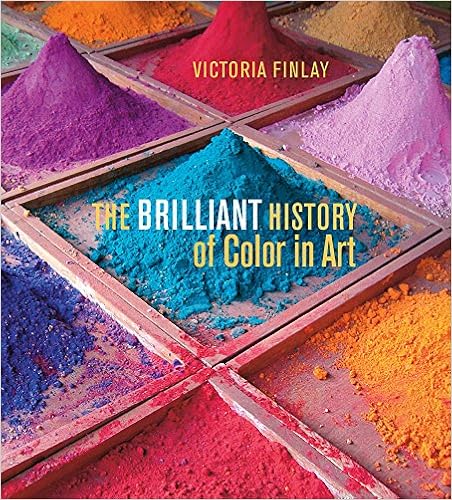
The Brilliant History of Color in Art Hardcover – November 1, 2014 by Victoria Finlay( J. Paul Getty Museum)


Who knew that colors have such fascinating stories to tell? Finlay does a wonderful job of describing, in clear, accessible, witty language, how artists around the world, from prehistoric times to the present, have used natural materials, including charcoal, soot, plants, insects, shells, and gems and minerals, to produce magnificent paint and ink colors that continue to dazzle. Today, though, synthetic paints and even computers produce an astonishing range of hues. Browsers and cover-to-cover readers will find some tantalizing information here. For example, Vincent van Gogh once ate his toxic chromium yellow paint; Santa Claus wasn't always clothed in red; thanks to Isaac Newton, there are seven colors in the rainbow; human and animal body wastes were once essential ingredients in color production; and some commonplace colors were created by sheer accident. The handsomely designed book includes 166 excellent reproductions of artworks, many from the collections of Los Angeles's J. Paul Getty Museum. It is filled with illuminating captions and sidebars; reproductions have been perfectly chosen and placed to illustrate the author's narratives; and a "brilliant history of color" is a compelling, readable account of humankind's yearning to express itself beautifully since the beginning of time. An illustration list and lengthy index are included. Recommended for large public library collections and for school libraries; useful in art classes, particularly in units on art history/appreciation, drawing, and painting

The history of art is inseparable from the history of color. And what a fascinating story they tell together: one that brims with an all-star cast of characters, eye-opening details, and unexpected detours through the annals of human civilization and scientific discovery.

Enter critically acclaimed writer and popular journalist Victoria Finlay, who here takes readers across the globe and over the centuries on an unforgettable tour through the brilliant history of color in art. Written for newcomers to the subject and aspiring young artists alike, Finlay’s quest to uncover the origins and science of color will beguile readers of all ages with its warm and conversational style. Her rich narrative is illustrated in full color throughout with 166 major works of art―most from the collections of the J. Paul Getty Museum.

Readers of this book will revel in a treasure trove of fun-filled facts and anecdotes. Were it not for Cleopatra, for instance, purple might not have become the royal color of the Western world. Without Napoleon, the black graphite pencil might never have found its way into the hands of Cézanne. Without mango-eating cows, the sunsets of Turner might have lost their shimmering glow. And were it not for the pigment cobalt blue, the halls of museums worldwide might still be filled with forged Vermeers.


Red ocher, green earth, Indian yellow, lead white―no pigment from the artist’s broad and diverse palette escapes Finlay’s shrewd eye in this breathtaking exploration.

Thursday, August 16, 2018

Jewish Henna Ceremony in Israel

Image result for Jewish Henna Ceremony

Henna appears in the Bible, as well as in other Semitic texts of the ancient Near East, and we know that henna was grown and used in the Land of Israel during the Hellenistic period. The earliest explicit records of Jewish henna ceremonies appear in the medieval Mediterranean. Henna use, both for everyday adornment and for ritual purposes, quickly spread throughout the Diaspora and was an established custom among the Jews of Morocco and other North Africancommunities, the Levant and Mediterranean basin, the Arabian Peninsula, and Western, Central and Southern Asia. Henna was used by some Jewish communities as part of everyday female adornment, dyeing hands, feet, nails, and hair. Some communities also used henna as part of ritual celebrations and holidays. The most significant use of henna in Jewish communities, however, is as part of a pre-wedding ceremony. These communities include Jewish communities sometimes called Sephardi ['Spaniards', i.e. descended from Spanish Jews expelled in the 15th century], or Mizrahi ['Orientals'], as well as others.

In these communities, henna was a crucial aspect of the preparations for a Jewish wedding, and often defined the structure of the wedding festivities, from the beginning (marked by the sending of henna from the groom to the bride) through the climax (the main henna ceremony itself) to the end (when the last remnants of henna wore off the skin). Furthermore, henna was used to mark the actors in a variety of other lifecycle events and passage rituals, such as birth, weaning, entering the school system, puberty, and coming out of mourning. It was also used at holiday celebrations and other happy occasions. The symbolism of henna in these Jewish communities was highly polysemous, but it is clear that it had three overarching functions: first, the henna’s staining of skin was seen as beautifying, both as daily adornment and for weddings; second, the materiality of henna was thought as protective, especially of actors at the center of a passage ritual; third, henna was seen as an aid in transforming and guiding the actors into the structure of their new social roles.

Henna in Israel

After the establishment of the State of Israel in 1948, the Jewish communities of North Africa, the Levant and Mediterranean basin, and Western, Central and Southern Asia underwent a massive and sudden displacement beginning almost immediately. Within 10 years, the vast majority of these communities had left their homes and been relocated, either to Israel or to Europe and the Americas. 


In Israel, the majority of the rituals and traditions surrounding the henna ceremony were initially abandoned upon arrival for a variety of reasons: socioeconomic circumstances made it uncomfortable to celebrate loudly and publicly for extended periods of time; the disorientation and confusion of integration into Israeli society had broken up communities and disrupted the traditional ritual sequence of events; and the negative stigma attached to markers of Diaspora identity, and Arabness in particular, discouraged immigrants from engaging in what had previously been activities and symbols with high social prestige and value.

It was not until the late 70s, when young non-Ashkenazi Israelis had become increasingly dissatisfied with their marginalization in the public sphere, and they began to vocally demand recognition as legitimate members of Israeli society, that previously-neglected cultural celebrations began to experience a revival: the Moroccan mimuna or the Kurdish saharane holidays, the new emergent style of modern ‘Mizrahi music’, and of course, the henna ceremony.

Today, the revived henna ceremony is very different than its historical predecessors. One of the main changes to the henna ceremony has been in its length and timing. While in the Diaspora, the pre-wedding festivities often lasted a week or more, in Israel they were severely compressed due to constraints of money and time. The application of henna to the bride, whether done over a period of three days, as in Yemen, or whether done multiple times over a two-week period, as in Morocco, was reduced to a single evening. The timing of the henna ceremony was moved from the night before the wedding, or a few days before the wedding, to the week before the wedding or even earlier. Furthermore, where formerly the groom may have been hennaed in a separate ceremony in a separate location, in Israel the two ceremonies were joined, so that the groom sits next to the bride and is hennaed witsth her. Another change was the rapid disappearance of the artistic patterns with which the henna was applied. It appears that the henna patterns practiced by Jewish communities in the Diaspora were almost immediately abandoned upon arrival in Israel. Today, even the memories of these patterns are rapidly disappearing.

Henna ceremonies in Israel today serve to reinforce a pan-ethnic unity, and often an even broader ‘pan-Mizrahi’ unity. The henna ceremonies of the Moroccan Jews and Yemenite Jews became the dominant models, while the henna ceremonies of other non-Ashkenazi communities were either abandoned or subsumed into one of the dominant models (usually Moroccan). Regional differences in the performance of the ceremony were abandoned, and one generic “Moroccan” or “Yemenite” ceremony was formed (it was usually a modification of the customs of the capital, or largest city, that prevailed). For example, one of the most significant and visible manifestations of this is in the clothing worn at the henna ceremony: among Yemenite Jews today, the henna ceremony features the Sana’i headdress, the tishbuk lulu, while similarly among Moroccan Jews the contemporary ceremony generally uses the urban grand dress, the keswa lkbira.

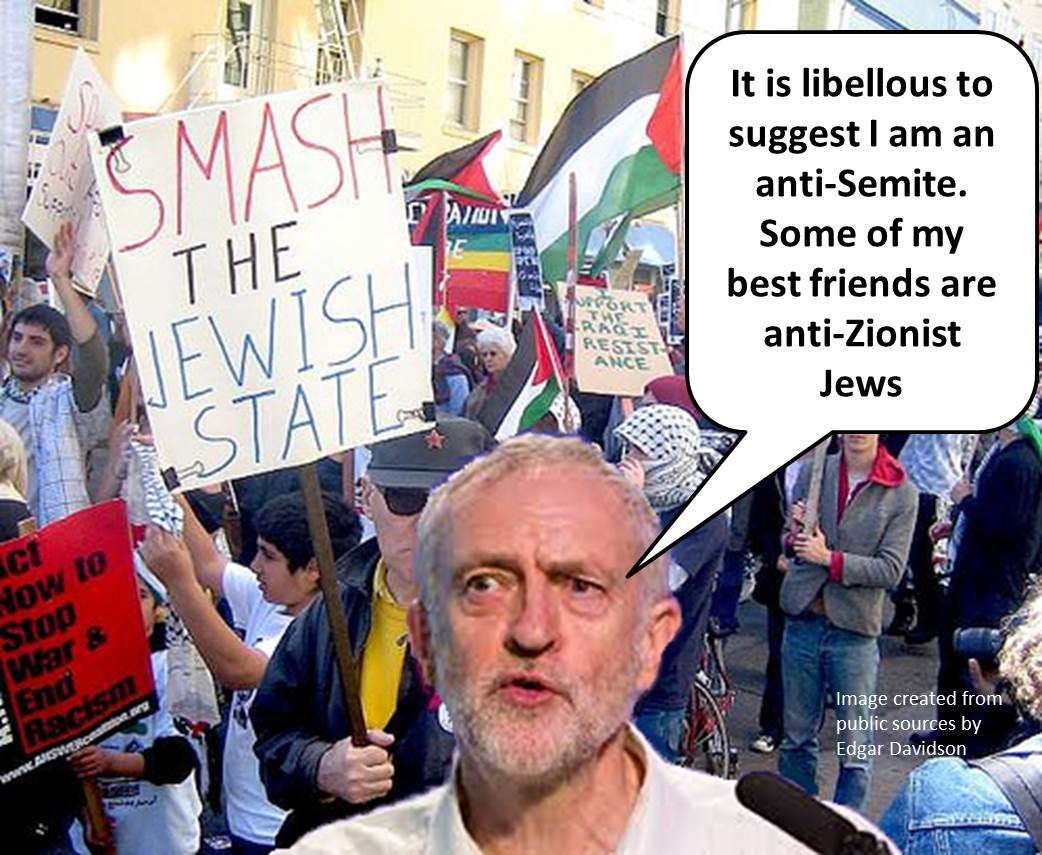
Corbyn’s Disturbing Actions Against Israel and the Jews ( do share), #stephendarori, #BardOfBatYam,#PoetLaureateOfZion

Image result for Corbyn anti semitism anti israel prohamas n


BESA Center Perspectives Paper No. 923, August 16, 2018 by Dr. Manfred Gerstenfeld  Republished  ( Do read it and share) 

EXECUTIVE SUMMARY: British Labour leader Jeremy Corbyn has defined himself as a “friend” and “brother” of genocidal terrorists, and he supports and mixes with Holocaust distorters. Corbyn is an extreme anti-Israel inciter and anti-Semite who has used Iranian media for that purpose.

There is now so much information about the misdemeanors of British Labour leader Jeremy Corbyn against Jews and Israel that his wrongdoings can be classified into sub-categories.

The first category is his support for genocidal terrorists. Corbyn welcomed representatives of Hezbollah and Hamas at the British parliament in 2009 and called them his “friends.” It took him until 2016, when he was challenged in the House of Commons by Conservative Prime Minister David Cameron, to renounce his words.

In 2012, on Iranian Press TV, Corbyn praised Israel’s release of 1,000 Hamas prisoners – terrorists who had killed 600 people between them – and referred to the terrorists as “brothers.” In November 2012, he hosted a meeting in Parliament with Musa Abu Maria, a member of the banned terrorist group, Palestinian Islamic Jihad. He has also shared a platform with the Black September terrorist and hijacker Leila Khaled.

Image result for Corbyn with arab terrorism

In August 2018, the Daily Mail disclosed that four years earlier, in Tunisia, Corbyn had stood with a wreath in his hand next to a memorial plaque commemorating the graves of members of the Palestinian Black September movement. This is the terrorist organization that perpetrated the murder of 11 Israeli athletes at the 1972 Munich Olympics.

The Telegraph has reported that one of the three main donors to Corbyn’s leadership campaign was Ibrahim Hamami, who supports stabbing Jews in Israel. He is a general practitioner living in London and founder of the pro-Hamas group, the Palestinian Affairs Center. Hamami has also been a columnist at an official Hamas newspaper.

Hamami helped organize the visit to Britain of Raed Saleh, who has described Jews as “bacteria” and “monkeys.” Saleh has also promoted the blood libel, claiming that Jews use the blood of gentile children to bake their bread. Corbyn has shared public platforms with Hamami, who acted as Saleh’s spokesman during the visit.

When Saleh was jailed in Britain, Corbyn called him “a very honored citizen who represents his people extremely well” and said he “looked forward to giving [him] tea on the [House of Commons] terrace.” Soon after his election as Labour leader in 2005, Corbyn hired journalist Seamus Milne, who had praised Hamas for its spirit of resistance, as his communications director.

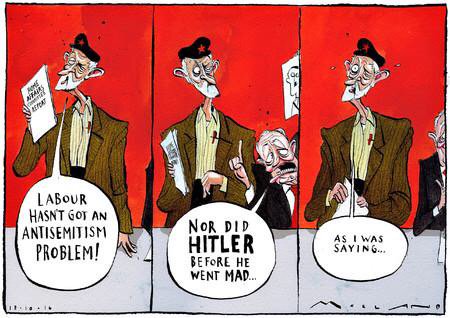
Image result for Corbyn antisemitism cartoons

A second category of misdemeanor is Corbyn’s relationship with Holocaust distorters. He has participated annually in gatherings of a charity led by Holocaust denier Paul Eisen and has given it a donation. More recently, it became known that in 2010, on Holocaust Memorial Day, Corbyn held a meeting in Parliament at which the Netherlands’ best known Jewish anti-Semite, Hajo Meyer, compared Israel to the Nazis. (Meyer has done this frequently, including in Germany.) A Holocaust survivor claims that Corbyn told a policeman which protesters he wanted removed from that meeting. Only now, eight years later, has Corbyn apologized for attending.

Both Corbyn and Labour Shadow Chancellor of the Exchequer John McDonnell signed a parliamentary motion proposing that Holocaust Memorial Day be renamed Genocide Memorial Day. In 2012, McDonnell accused Israel of attempting to commit genocide against the Palestinians.

A third category of Corbyn’s wrongdoings concerns extreme anti-Israel incitement. Substantial information about this is scattered throughout Dave Rich’s 2016 book, The Left’s Jewish Problem. For example, Corbyn chaired a conference that included talks on apartheid in Israel, Western imperialism, and anti-Arab racism. Rich also writes that throughout the 1980s, Corbyn sponsored and supported the Labour Movement Campaign for Palestine (LMCP). This group wanted to “eradicate Zionism while it supported a democratic secular state in place of Israel.”

In 2011, Corbyn presented his opinion on the BBC on a state-funded Iranian TV program. He said about the British broadcaster that “there is a bias toward saying that Israel is a democracy in the Middle East, Israel has a right to exist, Israel has its security concerns.”

In 2012 Corbyn promoted a conspiracy theory about Israel on an Iranian channel,  suggesting that it was in “Israel’s interest to kill Egyptians in an attack by Islamic Jihadists.” He also said, “I suspect the hand of Israel in this whole process of destabilization.”

In 2018, Corbyn attended a Passover seder with members of the small Jewdas Group, a radical anti-Zionist Jewish organization that has called Israel a “steaming pile of sewage which needs to be properly disposed of.” In August 2018, information about a video was disclosed that shows Corbyn making a speech in 2013 for the Palestinian Return Center in which he draws comparisons between the actions of the Israeli government and Nazism.

This year, Jonathan Arkush, the outgoing president of the British Jewish umbrella organization the Board of Deputies, noted that Corbyn had been chairman of Stop the War, an organization that is “responsible for some of the worst anti-Israel discourse.” Arkush added that Corbyn has anti-Semitic views and was making Jews question their place in Britain.

A fourth category of Corbyn’s wrongdoing concerns anti-Semitism. In 2012, he endorsed an anti-Semitic mural on Facebook. He did not apologize for this until six years later. He was also a member of various Facebook groups where anti-Semitic material was posted.

Corbyn is not the only member of his family who is highly problematic as far as anti-Semitism is concerned. His brother Piers tweeted that the “Jewish conspiracy will force Trump into war just like they did to Hitler.” The Daily Mail discovered a Nazi cartoon on his youngest son Tommy’s Facebook page. He, too, was a member of several anti-Semitic Facebook groups.

If only previous Labour leaders and their staffs had been more alert, Corbyn would have been expelled from the party years ago. Corbyn’s predecessor as Labour leader, Ed Miliband, is the main culprit behind this failure. A mainstream party should not have self-defined “friends” and “brothers” of terrorists in its ranks. The same is true for those who support Holocaust distorters. Corbyn belongs in both categories.

Saturday, July 28, 2018

Israel's new Nation State Law reminiscent of Aprtheid Laws ( Section 10 of the Urban Areas Act) sets legal parameters for Judification of Zion ( Israel , the Shomron and Yehuda) often refered to as " Historic Palestine" (if Palestine existed ever or not)


Before being allowed to immigrate to Israel in 1986, I was repeatedly detained with out trial ( and never charged) for anti Apartheid activities in  South Africa. As soon as I step off the plane at Ben Gurion on a miserable wet morning on January 21st after been chained naked to a chair for much of the previous 3 months in a dimly lit damp cockroach invested BOSS (Bureau of State Security cel)l , I resolved my conflict " Human Right" versus " State Security" and have always placed Israel's State Security first and formost . I have always voted for the Likud and even served as a Likud Central Committee Member for  10 years..... and now Israel's New State Law throws me into a huge quandry. .... however way you look at it and especially section 7b it is too reminenced of Section 10 of the Urban Areas Act ( The Native Laws Amendment Act of South Africa. The Native Laws Amendment Act, 1952 (Act No. 54 of 1952, subsequently renamed the Bantu Laws Amendment Act, 1952 and the Black Laws Amendment Act, 1952 and commonly referred to as the Urban Areas Act), formed part of the very apartheid system of racial segregation in South Africa. It amended section 10 of the Group Areas Act. It limited the category of blacks who had the right to permanent residence in urban areas. While Section 10 had granted permanent residence to blacks who had been born in a town and had lived there continuously for more than 15 years, or who had been employed there continuously for at least 15 years, or who had worked continuously for the same employer for more than 10 years. Non-whites living in urban areas who did not meet these criteria faced forcible removal.

Israel's Basic Law reserves national self-determination exclusively for Jewish people and makes discriminatory immigration and housing national values. Yet, what is omitted – especially the lack of geographic boundaries – is at least as relevant as what is admitted: when situating the newly adopted Basic Law within existing and proposed Israeli legislation, practice and policy, what emerges is the consecration of a vision for an exclusively Jewish state in all of historic Palestine.
From the very beginning, as negotiations were taking place between white, European elites to give away Palestine, the benefactors of the to-be stolen land were adamantly opposed to a discussion of borders. Even after Zionist colonizers declared victory following the initial conquest of the majority of Palestinian land in 1948, their leadership refused to acknowledge the boundaries of their new State of Israel. Pinhas Rosen, who would become Israel’s first Minister of Justice, was overruled when he suggested to David Ben-Gurion that the state demarcate its borders in its 1948 Declaration of Independence:
Rosen: “There’s the question of the borders, and it cannot be ignored.”
Ben-Gurion: “Anything is possible. If we decide here that there’s to be no mention of borders, then we won’t mention them. Nothing is a priori.”
Rosen: “It’s not a priori, but it is a legal issue.”
Ben-Gurion: “The law is whatever people determine it to be.”[1]
Indeed, the law is not an instrument of justice, but rather a tool used by the powerful to serve their interests. Ben-Gurion was, as colonizers have often been, refreshingly honest. And while the intervening years of Israeli politics have been marked by brilliantly executed window dressing, the Israeli Knesset just pulled back the curtain and returned Israel to its roots. The text of the law is explicit, and what is unsaid is also revealing: No mention of Palestine, Palestinian history, Palestinians, or Arabs; no mention of equality, democracy, or human rights for all; and significantly, no mention of borders.
While the absence of borders might seem to suggest that the expansionist ambition of the early Zionists is still unrealized, the demarcation is actually omitted because there is no longer a need to articulate where the sovereign State of Israel ends. The facts on the ground and supporting legislation speak for themselves. The opening article of the Basic Law does nod to the imaginary two-state solution by purporting to make a distinction between Eretz Israel (the Land of Israel or historic Palestine) and the State of Israel (presumably land within the 1967 “Green Line” and any already-annexed Palestinian land such as East Jerusalem). However, the law itself blurs the line. For instance, Article 3 declares “a greater, united Jerusalem” to be the capital of Israel, reaffirming the illegal annexation of East Jerusalem. And Article 7 casually endorses “Judaization” or the promotion of Jewish-only settlement. Supporters of the law have rushed to interpret Article 7 as applying only to areas within the Green Line, though nothing within the law itself or in the policy of any Israeli government would suggest any such limitation. And reading the new Basic Law together with the over twenty “Annexation Laws” proposed in the Knesset over the last three years uncovers the legal scaffolding for the complete colonization of historic Palestine already in place.
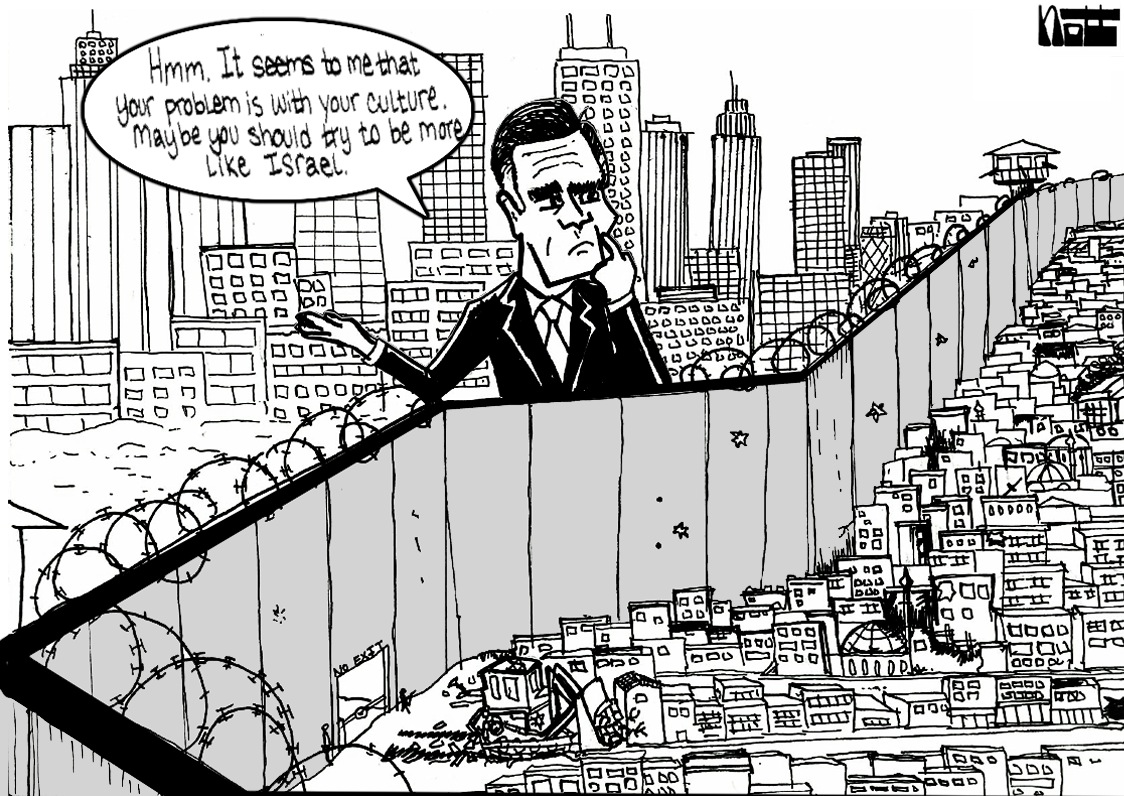
Image result for Cartoon Israel And Apartheid
These Annexation Laws are at various stages of the legislative process but all create the conditions for the de facto confiscation of private Palestinian land in the occupied West Bank through the application of Israeli domestic law to areas in and around the illegal Israeli settlements. The same method was used to illegally annex East Jerusalem and the Syrian Golan Heights to Israel in 1967. In its response to a Supreme Court petition by Adalah regarding the “Settlements Regularization Law” – the most egregious of these Annexation Laws – the Israeli government stated plainly: Jewish settlement in the West Bank fulfills the values of Zionism; and the Israeli Knesset, which is not subject to international law, is the source of authority in the occupied Palestinian territory. Before its Supreme Court, the Israeli government defined itself as the sovereign in the West Bank settlements, meaning there is only one legal regime operating on both sides of the Green Line – throughout Eretz Israel. And last week, the Knesset enshrined Jewish supremacy as the absolute constitutional value of this legal regime, while also definitively eliminating the possibility of Palestinian self-determination anywhere in that entire geographic space, from the Jordan River to the Mediterranean Sea.
The new Basic Law therefore signals the end of any prospective Palestinian national project, as long as this new era of bald-faced, legalized racism lasts. This law thus has severe consequences for Palestinians and other non-Jewish citizens or residents currently under Israeli control. With Judaization as a national value, the Israeli government could justify the forcible transfer of populations, and with discrimination enshrined, non-Jewish people have limited ways of challenging unequal access to land, housing, or state resources.

Related image
Codifying the myth of human hierarchy is deadly – when states elevate one group of people as more valuable, others are dehumanized and their very lives are threatened. At the same time, by explicitly (re)stating and constitutionalizing this myth, the Israeli Knesset has also clarified the root of the problem. And when the root of the problem is understood, so too is the solution. The alternative to this colonial, supremacist present is a decolonized future of equal rights for all. While settler-colonialism is a zero-sum game, decolonization is not. Supremacy insists that only one group of people deserve freedom; equality means we all do.
[1] Tom Segev. 1949, The First Israelis. Picador: 1988. p. xviii

Wednesday, July 25, 2018

The End of Democracy in the Jewish State of Zion , by the Bard of Bat Yam, Poet Laureate of Zion , Stephen Darori

Image result for ‫חוק לאום הפגנות‬‎

Since its founding in 1948, Israel has grappled with the conundrum of being both a Jewish nation-state and a democracy. Is it even possible?

The Nation-State Law surely created varied reactions since last week. Turkish President Tayyip Erdogan led the pack, calling Israel “the most Zionist, fascist and racist country in the world.”

“The Jewish Nation-State Law... legitimizes all unlawful actions and oppression. There is no difference between Hitler’s Aryan race obsession and Israel’s mentality.

Hitler’s spirit has re-emerged among administrators in Israel,” said Erdogan, who has not been exemplary in dealing with the Kurdish minority in his country.

Of course, that hyperbole goes way overboard in describing the effects of the law on Israel, but closer to home, there has also been more nuanced, but still barbed criticism. Ayman Odeh, chairman of the Joint List, said Israel “passed a law of Jewish supremacy and told us [Israel’s Arab citizens] that we will always be second-class citizens.”

Officially called the “Basic Law: Israel as the Nation State of the Jewish People,” the legislation – which was passed by a vote of 62-55 – states that “Israel is the historic homeland of the Jewish people, and they have an exclusive right to national self-determination in it.”

It puts on paper some of the defining characterizations of Israel that have been part of the country’s fabric since 1948, many of which are already parts of laws that codify and express Israel’s Jewish identity. For example, the Law of Return, passed in 1950, automatically grants citizenship to any Jew immigrating to Israel.

But the law goes beyond previous declarations of Israel as a Jewish state by further marginalizing its minority citizens in stating that the state’s language is Hebrew and relegating Arabic – the language of 20% of the population – to “special status in the state.”

Another clause says, “The state views the development of Jewish settlement as a national value and will act to encourage and promote its establishment and consolidation,” wording that can be construed as supporting Jewish-only communities.

Kulanu MK Akram Hasson and other top Druze officials filed a petition on Sunday asking the High Court of Justice to strike down all or part of the law as unconstitutional.

Hasson said the law transforms the country’s Druze population and other minorities, including Arabs, into second-class citizens. The petition called the law “a terrible blow to the Druze sector, a terrible blow to democracy and a terrible blow to Zionism.

The Jewish Nation-State Law disproportionately and unreasonably harms [all minorities, turning them] into exiled people in their own homeland.”

As Prof. Dov Waxman of Northeastern University wrote, Israel has never been a truly liberal democracy that treats all its citizens equally regardless of their ethnicity or religion. “Instead, from the outset it has been an ‘ethnic democracy’ or ‘ethnocracy’ as scholars have labeled it, serving Jews first and foremost. While Arab living standards have certainly risen over the years, Israel has never fully lived up to the promise contained in its Declaration of Independence to ‘foster the development of the country for the benefit of all its inhabitants,’ and ‘ensure complete equality of social and political rights to all its inhabitants irrespective of religion, race or sex,’” wrote Waxman.

Since its founding in 1948, Israel has grappled with the conundrum of being both a Jewish nation-state and a democracy. Is it even possible? Those tenets in the new law include many of the values that probably many people reading this right now share and weighed when deciding to pick up their lives and move to Israel – the symbols of the country like the flag, Hatikva, Jerusalem as the eternal capital of the Jewish people, and the Hebrew calendar as the guideline for the rhythm of the country.

But they were already well in place. Did we really need a new law that states the obvious, but also further erodes any sense of Israel’s minorities of belonging to the country? As we wrote last week when the bill passed, we agree with Likud MK Bennie Begin, who before abstaining on the vote for law, said it should have stated clearly that Israel, as a Jewish and democratic state, is committed to safeguarding the rights of its minorities. After all, isn’t that what being a Jewish state is all about?

Wednesday, July 18, 2018

#OyVeyDonaldTrump ..The return of the Bioviator by the Bard of Bat Yam, Poet Laureate Of Zion Stephen Darori

Image result for Donald Trump pompous  delux cartoons
Bloviator
1. A public figure, such as a politician or an actor, who makes outlandish, strident statements on issues, thinking that the average man will care about their opinions.
2. Someone who pontificates about issues of which they are uninformed, yet pretend to be expert.
3. Pompous blowhard, using their celebrity to speak about topics on which they are totally unqualified.

As Donald Trump surges, so does "bloviate." "The bloviating billionaire" — it's clearly an alliteration whose time has come. But there's hardly a candidate or commentator who hasn't been labeled with the word. Thirty years ago it was dated slang; now it's seen as the prevailing vice of our public discourse.

"Bloviate" has risen and fallen in American life. It was coined in the 1840s from "blow," a facetious pseudo-Latinism mocking the inflated oratory of an era when, as Tocqueville observed, Americans couldn't take to the stump without "venting their pomposity from one end of a harangue to the other."

That bloated style had its last champion in the 1920s in the affable person of Warren Gamaliel Harding. Harding was blessed with strong pipes and a fine head of white hair. He prided himself on his gift for bloviating, which he defined as "speaking as long as the occasion warrants and saying nothing." His sonorous platitudes aroused the contempt of H.L. Mencken, who wrote that Harding's English was a "loud burble of words" fit only for morons and small-town yokels: "It reminds me of stale bean soup, of college yells, of dogs barking idiotically through endless nights. It is so bad that a sort of grandeur creeps into it."

Those stump-speech declamations soon fell victim to radio and the modern fashion for naturalness and informality, taking "bloviate" along with it. By the 1970s, the word was moribund. It was arguably saved from extinction only by the timely interventions of language columnist William Safire, who offered it as a replacement for phrases such as "empty rhetoric."

Then, in the late 1990s, "bloviate" began a dramatic comeback, most likely in response to the sheer pervasiveness of political yammer. Between 24/7 talk radio, cable news, social media, blogs and websites, we're exposed to more raucous voices in a single week than anyone in the age of Harding could experience in an entire lifetime.

So "bloviate" was summoned back to life, but in a new guise. Its jocular origins are forgotten; you sometimes see Safire credited with inventing it. And it no longer implies pomposity or even long-windedness — people complain about all the bloviating on Twitter. (Harding couldn't even have said "Ahem!" in 140 characters.) Sometimes it's just a way of dismissing whole networks and sectors as not worth listening to.

There's no "correct" way to use "bloviate" — it was never a real word to begin with. But I like to reserve it for the fondness for bombast that runs deep in the American spirit. The classic bloviator is someone so besotted with the majesty of the language that comes out of his or her mouth that it takes on a life of its own. In that sense, bloviating is a kind of backhanded tribute to language.

It's an occupational hazard that many people who live by words are susceptible to. Think of Norman Mailer and Allen Ginsberg, or of William F. Buckley and Gore Vidal, whose sesquipedalian 1968 debate confrontations are on exhibit in the new documentary "Best of Enemies." Or David Foster Wallace or Christopher Hitchens — the woods are full of fine writers whose need to say things grandly sometimes comes at the cost of saying them well.

The most artful bloviators are self-aware enough to own it. Buckley tossed off esoteric words like "albescent" and "catechize" with pointed nonchalance, as if to suggest that that's how he'd talk if you woke him in the middle of the night. Bill O'Reilly wants you to draw the opposite conclusion. He calls himself a bloviator, as Harding did, but rarely uses an SAT word without disavowing it at the same time. "You're casting aspersions," he tells Jon Stewart, then adds "big word." He over-enunciates fancy words like "opine" and "bloviate" itself, with the implication that there would be something genuinely pretentious about saying them straight.

O'Reilly is typical of the modern political bloviators so carried away with their words that they imagine others must be too. Their ranks are thinner than people make them out to be: O'Reilly but not Sean Hannity, Chris Matthews but not Rachel Maddow, Ted Cruz but not Chris Christie, Michael Moore but not Bernie Sanders, "Colbert" but not Colbert.

That's not to let the others off the hook. The American lexicon is rich with names for hooey and its purveyors: There are "blowhards" and "windbags," there is "ballyhoo," "bluster" and "bunkum," not to mention a less decorous word for nonsense that also begins with a B.

That leaves no shortage of alliterative epithets for Trump: the blustering billionaire, the gassy gazillionaire, the preening plutocrat. (Safire might have said Trump calls for a revival of Mark Twain's favorite, "blatherskite," for a "blustering noisy talkative fellow.")

But if Trump is a bloviator, he's one who regards words with something between indifference and disdain. He'd never overreach for a fancy word and come up with something like George W. Bush's "Grecians" or Sarah Palin's "refudiate." He's utterly unself-conscious about his language, and if he has any self-awareness about it, he does a good job of hiding it. The broken sentences, repetitions, false starts and digressions, the banal superlatives and insults —Tremendous! Fabulous! Moron! Loser! — Trump may be sui generis as a candidate, but his language is the culmination of a fixation with the "natural" that has shaped public discourse over the last century. It's not really public speaking, just a simulation of street-corner schmoozing, which is one reason so many people find Trump "real," "authentic" and even "just like us."

And yet. The bloviator's first object is to dazzle himself with his own words, and Trump's are exactly the simple ones that he wants to hear, particularly when the conversation turns to his favorite subject: "I'm really rich." "I'm a really smart guy."

I think of what the psychologist B.F. Skinner said: The reason we boast is to hear someone saying nice things about us.

Thursday, June 28, 2018

The Two State Fantasy versus The New State Solution

For decades the world has subscribed to the notion that the two-state solution presents the most viable road to resolving the Israeli-Palestinian conflict; it is time that other ideas be allowed to enter the public discourse.

As with all incoming administrations, a Trump presidency ushers in the opportunity to review, retain, or revise the terms of long-standing policies, including those relating to the Middle East.

The ‘two state solution’, as broadly defined, is a policy that must be reviewed and revised. No proposed solution to the conflict need be perfect; all must be possible, however. The two-state solution is neither. The insipid one state solution is even less so.

Both ideas have gained too much traction. Neither is understood by the vast majority of those by whom they are championed. The saving grace of these notions seems primarily to be their alliterative, easily retained titles.

A further state for the Palestinian Arabs can be established. That state must be viable though. It must augur in a future of promise, security, liberty, sovereignty, self determination and opportunity for its inhabitants. Citizens of this Palestinian state must be granted every possible chance to positively thrive. It must be a state whose people not only dare to dream, but who actually realize the dreams they conceive.

This state must not come into being at the expense of Israel either now or in the future. Neither Israel the people, nor Israel the country must be existentially compromised in order to facilitate its creation.


Israel and Egypt from space at night (Photo: NASA)

Any solution must be characterized by the reconciliation of practicability, possibility and imagination.

With the above in mind, I introduce what I term THE NEW STATE SOLUTION.

ON CONTIGUITY

The least practical aspect of the two-state scenario results from the geographical positioning of the Gaza Strip in relation to Judea and Samaria (West Bank).

Unlike in other proposals, The New State Solution would front-load this most intractable geographical challenge rather than defer it to a nebulous ‘future date.’

The New State Solution would thus be anchored first and foremost in the Gaza Strip, with territorial expansion into a section of the Sinai Peninsula. This state could be larger than anything that could be accommodated by the minute area of Judea and Samaria, thus granting geographical viability. It also redefines the Gaza Strip as a central part of the solution, rather than an insurmountable problem.

ON THE ARAB STATES

The boundaries of the New State would be brokered and ratified by several other parties beside Israel; most notably Egypt. Egypt is a prime mover within the Arab world. Having their imprimatur would grant legitimacy among several Arab nations and non-western nations. Egypt also has a history of going alone in the Arab world where necessary, so long as its own best interests are assured.

ON FRATERNAL RELATIONS

The New State would enjoy clearly defined, secured borders. Good fences make good neighbors. To the south, Egypt would positively amend the current arrangements it has with the Gaza strip in line with the contours of The New State and the opportunities that spring forth. To the north, Israel would extend its arm even further and open its hand even wider to partner with its new, peace-seeking neighbor.

The New State would have cultural affinity with its Egyptian neighbors and there is far closer cultural familiarity between Israelis and Palestinian Arabs than many fully appreciate. That affinity could be built upon and expanded, creating triangulated, regional cooperation.

ON DOMESTIC SECURITY AND DEMILITARIZATION

There would be no IDF presence within the borders of the New State. None. Independent states do not want foreign troops within their land. The New State would thus be both demilitarized and have a highly effective security apparatus. Contrary to the perception of many, demilitarization does not mean no weapons. Nor does it mean no security. It means no military. For example, The New State would have APC’s but not tanks. It would have light air ordinance such as helicopters but no fighter jets. It would have speed boats and patrol boats, but no battleships or submarines. It would have a police force but not an army. The security and police forces of the state would maintain superior fire power and logistical capabilities. These are the same tools by which democratic states maintain daily, domestic security after all.


Gaza Strip (Photo: Southern Network)

ON PREVENTING ENDOGENOUS SPILLOVER AND INFILTRATION

Any Palestinian Arab state established in Judea and Samaria requires that both Israel and Jordan stand fast as military guarantors. No state in the region enjoys absolute, total security but Israel is a comparative super power in the Middle East. The long term security of Jordan is far more precarious. The establishment of a Palestinian Arab state in Judea and Samaria means that in the event of a collapsing or collapsed Jordan, an unimpeded corridor of potentially pernicious states would be established to Israel’s east, extending from Afghanistan and Pakistan, into Iran, through Iraq, via Jordan, across Judea and Samaria, and onto what would be the divided city of Jerusalem in the two state formula.

Israel would stand alone as the final bulwark against such threats. Advocates of the two state solution must not shut their eyes to this very stark possibility.

The New State Solution offers far more reasoned security guarantees. To the south, south-west and south-east of the New State, the Egyptian military would be present only on the Egyptian side of the shared border. Israel would maintain its security presence on the border with the New State on the Israeli side only.

Israeli and Egyptian forces manning the borders would not only offer reassurance to their own countries, but also to the New State. Both would closely assist and cooperate so as to prevent spillover beyond, and unwanted infiltration within, the borders of The New State.

ON COMMERCE


A state established in Judea and Samaria will be close to landlocked with very few natural resources. That may beget a culture of tremendous entrepreneurialism among its citizens, but it may not. It may beget despair. Nobody can be certain. A failing economy will yield only a failed or client state and will be a manifestation of a problem unresolved.

By contrast, The New State Solution, established as proposed, offers miles of beautiful, Mediterranean coastline.

With a shoreline no less inviting than that of Tel-Aviv, The New State would boast rich opportunity for trade, commerce, tourism, hotels, resorts, casinos (on or off-shore), import, export and both an open, commercial air-port and an open commercial sea-port. Both would be toward the western most section of the country. Favorable security coordination would be agreed between Israel, Egypt and The New State.Massive economic investment within The New State would come from all international parties who have pledged their commitment to resolving the conflict. Actors would include the United States, the E.U., Great Britain and both Israel and Egypt; at a minimum.

ON DEMOGRAPHICS

Financial and commercial assistance would be granted to any residents of Judea and Samaria wishing to relocate to The New State.

Consider that today, as in the past, Jews immigrate to Israel with the belief that a better life awaits them here. Their reasons for doing so are varied. Significantly, however, Jews come to Israel voluntarily. They are neither forcibly transferred into Israel as individuals, nor as whole communities.

So too should it be for the Palestinian Arabs of Judea and Samaria.

Like many in the Jewish Diaspora, some will wish to remain where they currently reside. Others will sense and seize upon the gleaming opportunity offered by The New State.

The Palestinian Arabs are no more monolithic than are the Jewish People. Some may wish to constitute their futures in Judea and Samaria, others will prefer the option of opening a hotel along the shores of their own state or the prospect of building a home overlooking the Mediterranean, or they will move seeking employment and the opportunity to build up a state in which they have agency. They ought to be allowed to choose.

Successful repatriation to The New State would significantly further reduce Israel’s demographic considerations regarding Judea and Samaria while those residents already in the Gaza Strip would be part of The New State, resolving that demographic concern.

For those not wishing to relocate from Judea and Samaria, the more favorable demographic realities enjoyed by Israel would engender the confidence needed to annex Judea and Samaria with full and equal rights being extended to all, regardless of race, religion or creed. This would take place only once a 50% immigration threshold to The New State is achieved.

Israel would continue the policy of the right of return and would control immigration policy within Israel. It would thus maintain its democratic and Jewish character by far more than the two-thirds majority advocated by some proponents of the one state solution.

Those Palestinian Arabs claiming citizenship overseas would have an open channel to immigration into The New State, with The New State affixing immigration policy for itself.

ON GOVERNANCE AND GOVERNMENT


Any future massive attack launched against the State of Israel from the Gaza Strip should serve as a prelude for the total and final toppling and dismantling of Hamas and their oppressive regime. The destruction of Hamas should be undertaken with the aim of facilitating and incubating the legitimate emergence of a new, pragmatic, though not necessarily westernized, government that will administer a free, viable, secure, burgeoning New State that is secured, supported and championed by Israel, Egypt and the international community.

The first footstep into Gaza by IDF soldiers as part of the next defensive operation in response to rocket or tunnel attacks should set in motion The New State Solution as strategy. The diplomatic groundwork should begin immediately however, in advance of any unwanted, but likely, future conflict.

THE CASE FOR THE NEW STATE SOLUTION

In December, 2015, Secretary of State John Kerry stated:

"The United States is deeply committed to securing Israel's future as a Jewish and Democratic state. We are also committed to an independent, viable Palestinian state, where Palestinians live with freedom and dignity. The only way to achieve that is through a negotiated solution that creates two states for two peoples living side by side in peace and security."The New State Solution adheres precisely to Kerry’s own spoken definition of the sole way forward, though not to his vision.

It offers a negotiated solution resulting in two states for two peoples living side by side in peace and security. The definition endures therefore. It is the vision that must change.

For too long, calls have come for a two state solution incorporating Judea and Samaria as the basis of a Palestinian state. At its core, such a plan requires the mass, likely enforced displacement of at least many tens of thousands of Jewish people in order to build a home for another people. Past experience within Israel does not bode well for any such notion, nor should it. I do not want to see the people of Israel go through such a process. I do not wish to see the Palestinian Arabs go through such a process. There should be no forced transfers of populations.


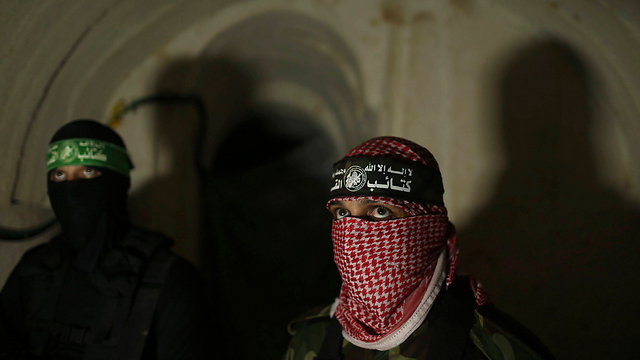
Hamas terrorists inside their attack tunnels (Photo: Reuters)

Politicians and communal figureheads frequently declare that the two-state solution is the ‘only solution.’ This tone of finality is both inaccurate and unhelpful. It places far too much faith in a plan that is demonstrably flawed and it blunts legitimate discussion and debate about alternatives.

There are alternative solutions to every problem – including to this problem. I am presenting my plan as one such alternative. It can be refined; but it is an alternative.

When assessing opportunities for peace, it is my hope that President-elect Trump brings with him a new attitude, where Presidents turn their gaze away from Israel’s east, and affix it instead upon Israel’s west when reviewing the peace process.

He, Israel’s Prime Minister and the President of Egypt could yet realize a new, fresh and viable vision by so doing.

I hear Mr. Trump has an eye for the development of gleaming, shining and bold new projects. This would be the boldest of all.


The two-state solution is defunct. Long live the New State Solution.

Wednesday, June 13, 2018

Bird's Eye View of Jeremy Corbyn and Uk Labour Party antiSemitism

Image result for Jeremy Corbyn anti israel and antisemitism

An analysis of the British Labour party under the chairmanship of Jeremy Corbyn provides a panoramic view of many aspects of socialist anti-Jewish hate-mongering. The most extreme comments come disproportionately from Muslims, a subject that is taboo for the British media. The incitement is accompanied by a whitewashing of the party’s anti-Semitism problem, a whitewashing that is supported by a great majority of its members. The ongoing hate-mongering in the party has led to some unprecedented reactions by the British Jewish leadership.

In the past decades, Western European social democrat politicians and parties have been among the most extreme inciters against Israel. In several cases, there have also been expressions of anti-Semitism. Leading socialist politicians, including the late Swedish Socialist Prime Minister Olof Palme and the late Greek Socialist Prime Minister Andreas Papandreou, have accused Israel of Nazi practices.

Only in the past two years, however, has a European socialist party – the British Labour Party – been exposed for widespread and extreme anti-Jewish incitement. Classic anti-Semitic as well as anti-Israel remarks by elected representatives have been published on a more or less ongoing basis. An analysis of the British Labour party provides a panoramic view of many aspects of socialist anti-Jewish hate-mongering.

In September 2015, extreme leftist Jeremy Corbyn became the party leader. A few months later, the first accusations about anti-Semitism concerning the Oxford University Labour Club became widely known. The party’s National Executive Committee chose to reveal only a limited summary of the findings exposed by Labour peer Lady Royall. Several months later the entire report was leaked to the press.

As the “anti-Semitism in Labour” issue started to interest the British media, it slowly became clear that extreme anti-Semitic expressions had been present in the party prior to Corbyn’s appointment. In 2014, for example, under previous Labour leader Ed Miliband, Naz Shah proposed – before she was elected MP in Bradford – that Israel should be relocated to the US. At that time, apparently no one was interested in publicizing this statement.

Among the expressions of anti-Semitic hate uttered by elected representatives, a disproportionate number has come from Muslims. This was the case during Miliband’s leadership and continues under Corbyn. Despite hundreds of articles on anti-Semitism in Labour, the specifically Muslim aspects remain taboo in the British media.

Miliband steered the party towards a proposal of recognition of a Palestinian state. This was possibly done to gain the support of Muslims during the May 2015 elections, as an estimated 4.5% of the British population are Muslim.

Image result for Jeremy Corbyn anti israel and antisemitism

Corbyn mixes with anti-Semites. He has donated money to, and attended gatherings of, a charity headed by Holocaust denier Paul Eisen. He has referred to the genocide-promoting Hamas and Hezbollah terrorist organizations as his friends. When he came to power he promoted anti-Semites, including Ken Livingstone, to senior positions. Livingstone, the former mayor of London, was later suspended after his repeated claims that Hitler had supported Zionism in the 1930s. Livingstone resigned from the party in 2018.

It is not easy to identify which of Corbyn’s acts fall squarely within the International Holocaust Remembrance Association’s definition of anti-Semitism, which was adopted by the UK government. In May 2018, Jonathan Arkush, outgoing President of the Board of Deputies, the umbrella organization of British Jewry, claimed that Corbyn held anti-Semitic views. He noted that the Labour leader had been chairman of the Stop the War organization, which is known for some of the worst anti-Israel discourse.

When media pressure concerning anti-Semitism in Labour became an issue, Corbyn appointed human rights activist Shami Chakrabarti in April 2016 to investigate the accusations. Her report was poorly written and unprofessional. Shortly afterwards, Corbyn proposed Chakrabarti for a peerage, which resulted in her becoming a baroness. Corbyn also appointed her the party’s Shadow Attorney General for England and Wales. Little has been heard from this supposed expert about ongoing Labour anti-Semitism.

It is by now abundantly clear that Corbyn has little desire to confront anti-Semitism in his party other than through general statements. As a result, the whitewashing of anti-Semitism in Labour has become a significant problem. In March 2018, a poll of paying Labour members found that 47% said anti-Semitism is a problem, but the extent of the problem is being exaggerated “to damage Labour and Jeremy Corbyn or to stifle criticism of Israel.” A further 30% said anti-Semitism is not a serious issue. Sixty-one percent thought Corbyn is handling the anti-Semitism claims well. Only 33% thought he is handling them badly.

The confrontation with anti-Semitism in one of the country’s two major parties has had an important impact on members of the Jewish community. Many of them no longer vote for Labour, and some have stopped donating. An unprecedented demonstration of the Jewish community against anti-Semitism in Labour took place in London outside a Parliamentary Labour Party (PLP) meeting. In a letter to the chair of the PLP, the Board of Deputies wrote: “Again and again, Jeremy Corbyn has sided with anti-Semites rather than Jews.”

In Parliament, several Jewish and pro-Jewish Labour MPs have reported that they have been subjected to tremendous harassment. Labour’s attempt to conquer the London constituency of Barnet – the most Jewish borough in the UK – failed in the May 2018 local elections.

The modest increase in Labour seats nationwide during those elections disappointed the party’s expectations and was seen as partly due to the anti-Semitism debate. Arkush went farthest, stating that Corbyn’s views could drive Jews to leave Britain if he were to become prime minister. He was one of the Jewish leaders who met Corbyn in April 2018, a meeting those leaders found disappointing.

Small groups on the Jewish left are enthusiastic supporters of Corbyn. He continues to provoke, and attended a Passover seder at Jewdas – a radical anti-Zionist Jewish organization that has called Israel a “steaming pile of sewage which needs to be properly disposed of.”

In March 2018, Corbyn said that since he became party chairman, there have been 300 complaints about anti-Semitism. He said that of those accused, 150 people have either been expelled or resigned, and added that the backlog of complaints is 60 cases. However, the Daily Mail reported a backlog of 74 cases and said MP John Mann claims to be aware of another 130 complaints. One source in Labour told the paper: “Many of these cases include the most shocking and blatant anti-Semitism that would make even a committed Nazi blush.”

The disappointing local election results may have been the impetus for Labour’s announcement that it will speed up dealing with the complaints with the intention of clearing the backlog by the end of July. In view of the party’s checkered past under Corbyn, we will have to wait and see whether this promise will be fulfilled.