Showing posts with label @BardofBatYam. Show all posts

Wednesday, July 25, 2018

The End of Democracy in the Jewish State of Zion , by the Bard of Bat Yam, Poet Laureate of Zion , Stephen Darori

Image result for ‫חוק לאום הפגנות‬‎

Since its founding in 1948, Israel has grappled with the conundrum of being both a Jewish nation-state and a democracy. Is it even possible?

The Nation-State Law surely created varied reactions since last week. Turkish President Tayyip Erdogan led the pack, calling Israel “the most Zionist, fascist and racist country in the world.”

“The Jewish Nation-State Law... legitimizes all unlawful actions and oppression. There is no difference between Hitler’s Aryan race obsession and Israel’s mentality.

Hitler’s spirit has re-emerged among administrators in Israel,” said Erdogan, who has not been exemplary in dealing with the Kurdish minority in his country.

Of course, that hyperbole goes way overboard in describing the effects of the law on Israel, but closer to home, there has also been more nuanced, but still barbed criticism. Ayman Odeh, chairman of the Joint List, said Israel “passed a law of Jewish supremacy and told us [Israel’s Arab citizens] that we will always be second-class citizens.”

Officially called the “Basic Law: Israel as the Nation State of the Jewish People,” the legislation – which was passed by a vote of 62-55 – states that “Israel is the historic homeland of the Jewish people, and they have an exclusive right to national self-determination in it.”

It puts on paper some of the defining characterizations of Israel that have been part of the country’s fabric since 1948, many of which are already parts of laws that codify and express Israel’s Jewish identity. For example, the Law of Return, passed in 1950, automatically grants citizenship to any Jew immigrating to Israel.

But the law goes beyond previous declarations of Israel as a Jewish state by further marginalizing its minority citizens in stating that the state’s language is Hebrew and relegating Arabic – the language of 20% of the population – to “special status in the state.”

Another clause says, “The state views the development of Jewish settlement as a national value and will act to encourage and promote its establishment and consolidation,” wording that can be construed as supporting Jewish-only communities.

Kulanu MK Akram Hasson and other top Druze officials filed a petition on Sunday asking the High Court of Justice to strike down all or part of the law as unconstitutional.

Hasson said the law transforms the country’s Druze population and other minorities, including Arabs, into second-class citizens. The petition called the law “a terrible blow to the Druze sector, a terrible blow to democracy and a terrible blow to Zionism.

The Jewish Nation-State Law disproportionately and unreasonably harms [all minorities, turning them] into exiled people in their own homeland.”

As Prof. Dov Waxman of Northeastern University wrote, Israel has never been a truly liberal democracy that treats all its citizens equally regardless of their ethnicity or religion. “Instead, from the outset it has been an ‘ethnic democracy’ or ‘ethnocracy’ as scholars have labeled it, serving Jews first and foremost. While Arab living standards have certainly risen over the years, Israel has never fully lived up to the promise contained in its Declaration of Independence to ‘foster the development of the country for the benefit of all its inhabitants,’ and ‘ensure complete equality of social and political rights to all its inhabitants irrespective of religion, race or sex,’” wrote Waxman.

Since its founding in 1948, Israel has grappled with the conundrum of being both a Jewish nation-state and a democracy. Is it even possible? Those tenets in the new law include many of the values that probably many people reading this right now share and weighed when deciding to pick up their lives and move to Israel – the symbols of the country like the flag, Hatikva, Jerusalem as the eternal capital of the Jewish people, and the Hebrew calendar as the guideline for the rhythm of the country.

But they were already well in place. Did we really need a new law that states the obvious, but also further erodes any sense of Israel’s minorities of belonging to the country? As we wrote last week when the bill passed, we agree with Likud MK Bennie Begin, who before abstaining on the vote for law, said it should have stated clearly that Israel, as a Jewish and democratic state, is committed to safeguarding the rights of its minorities. After all, isn’t that what being a Jewish state is all about?

Friday, May 4, 2018

Israel Goes to War. Whose makes that decision. PM or DM ?, by Stephen Darori, The Bard Of Bat Yam, Poet Laureate of Zion


The Knesset has recently amended the “Basic Law: The Government,” with respect to "authority to declare war or conduct a significant military operation." Under the previous legislation, this authority was given to the government, but the new law grants the authority to the Ministerial Committee for National Security (the Security Cabinet). However, the final version of the new law goes even further, and concludes: "Under extreme circumstances and for reasons that will be noted…the prime minister and the minister of defense are authorized to make the decision in a more restricted legal quorum." Such a law has almost no equivalent in Western democracies. It lacks the checks and balances essential to a democratic regime and is bound to undermine the principle that war is an act requiring maximum domestic and international legitimacy. Yet in view of the new legislation, the Security Cabinet's work should be improved so that it will be fully familiar with the strategic matters on the agenda. In addition, both for the sake of checks and balances and the prevention of an overconcentration of authority in the hands of individuals and so that more than two elected representatives of the people bear responsibility for cardinal policy measure such as war and peace, at least the entire Security Cabinet should participate in the decision. The tactical decisions can and should be made in restricted forums, but it is best for such a momentous decision as a declaration of war to be taken in a broad forum that bears the burden of the responsibility.
In view of the escalation both in rhetoric and on the ground in Israel's northern and southern conflict areas, the question of who in Israel has the authority to declare war should be considered. The Knesset has recently amended the “Basic Law: The Government,” with respect to "authority to declare war or conduct a significant military operation." It is doubtful whether legislation was needed to change this authority. Under the previous legislation, this authority was given to the government, but the new law grants the authority to the Ministerial Committee for National Security (the Security Cabinet). However, the final version of the law goes even further, and concludes: "Under extreme circumstances and for reasons that will be noted…the prime minister and the minister of defense are authorized to make the decision in a more restricted legal quorum." Such a law has almost no equivalent in Western democracies. It lacks the checks and balances essential to a democratic regime and is bound to undermine the principle that war is an act requiring maximum domestic and international legitimacy.

The reasons for restricting the forum that decides on whether to declare war focus on streamlining the decision-making process and preserving its secrecy. Judge (ret.) Eliyahu Winograd, who chaired the 2006 Commission of Inquiry into the Events of Military Engagement in Lebanon, expressed his opinion about the Israeli government's decision making process as follows: "Almost none of the conclusions of the final report of the Commission of Inquiry into the Events of Military Engagement in Lebanon were implemented by the government…the recommendations of the final report were not implemented, and lessons were not drawn." In his report on Operation Protective Edge (2014), the State Comptroller, considering the government's decision making processes about the Gaza Strip before and early in the operation, stated, "The cabinet's authorities, including the question of which issues fall under its purview, are not anchored in writing….Cabinet ministers do not know whether the cabinet is a decision-making body or an advisory one….In addition to failure to anchor the cabinet's authority, there is also no norm establishing the duty to provide the cabinet with information…[although] this information was essential for decision-making."

In December 2017, the Ministerial Commission on Legislation approved a bill sponsored by Minister of Justice Ayelet Shaked authorizing the government to delegate its authority to the Security Cabinet, which would then be able to decide on a military operation likely to lead to escalation and then to war. The bill addressed two aspects: the nature of military action in our time and the government's mode of operation. The bill was based on a report by a committee headed by former National Security Council head Maj. Gen. (ret.) Yaakov Amidror, which included recommendations on the declaration of war. The reasons given for the bill stated that there was a lack of clarity concerning the government's authority, since Section 40(A) of the “Basic Law: The Government” states, "The state may only begin a war pursuant to a Government decision," while Section 40(B) of the same law states, "Nothing in the provisions of this section will prevent the adoption of military actions necessary for the defense of the state and public security." The committee believed that it is best that the government authorize the Security Cabinet in order to streamline the decision making processes and maintain secrecy before the campaign.

Since the First Lebanon War (1982), there were very few cases in which the Israeli government made orderly decisions out of a clear understanding that a large scale military conflict or potential for such a conflict was at stake. One example of such a decision is Operation Defensive Shield (2002), in which the government headed by Ariel Sharon ordered the IDF to retake control of the Palestinian cities in the West Bank. Another example is the decision by the government headed by Ehud Olmert to destroy the nuclear reactor in Syria (2007), which involved the possibility of escalation into a full scale military campaign. At the same time, in two events that did escalate into a large scale operation or a war, the Second Lebanon War (2006) and Operation Protective Edge, events unfolded like a snowball, and the government or the Security Cabinet approved measures incrementally, without officially declaring a major campaign until very advanced stages. The dynamic nature of the campaigns in recent decades has usually dictated policy through a series of tactical, rolling, and successive decisions that in retrospect generated a decision to go to war.

In the United States, the Congress is responsible for declarations of war, as Article 1, Section 8 of the Constitution states explicitly that it possesses the sole power "to declare war" and to make rules concerning captures on land and water. Legitimization by the people's representatives as a reflection of the entire people is required for such a critical act in the life of the nation. This does not mean that the American president, the commander in chief of the army, lacks extensive power to use force. The Vietnam War, for example, was the result of a presidential decision by Lyndon Johnson, who relied on a resolution of the Congress following the Gulf of Tonkin incident in 1964. This resolution authorized him to use military force, but did not constitute an official declaration of war.

A similar case occurred in Israel in 2006. The government approved Operation Density, an attack by the Israeli air force against Hezbollah's batteries of long range rockets, without understanding where this was liable to lead. According to then-Deputy IDF Chief of Staff Maj. Gen. (res.) Moshe Kaplinsky, in the Second Lebanon War, "the first point in which we erred or failed as commanders was our inability to change the approach or the general mindset… the confrontation with Hezbollah was not a direct continuation of the ongoing operations we had carried out for the last six years in Judea and Samaria but was, rather, a war." When the government voted a year later on the attack against the Syrian nuclear reactor, it had already learned from experience, and took the trouble in a series of discussions to consider the consequences in depth.

Is legislation the proper way of changing the delegation of authority? Not necessarily, first because official declarations of war are becoming rarer, while events that escalate into a conflict have become more common. Second, the previous law allowed a decision to be taken on an essential military operation even without a decision by the entire government, and the Security Cabinet was authorized to make decisions on operations similar in character to those conducted by Israel in the Gaza Strip in the past decade. At the same time, because of the overall responsibility and the exercise of judgment required, especially when a large scale security event liable to spiral out of control and extend beyond the boundaries of the sector is involved, the decision should be brought before the entire government in a plenary session. Considerations of efficiency, rapidity of response, and even secrecy should not exclude in-depth judgment, an analysis of the information and the alternatives, acquisition of internal and external legitimacy, and the opportunity to consult with everyone who bears responsibility: the elected public officials serving as government ministers and of course the officeholders in the defense and political establishment.

It appears that the main power of the new law will lie in strengthening the element of accountability among the ministers in the Security Cabinet, because it clearly regulates its status as an entity with the authority to make decisions and carry them out – a kind of mini-government in an emergency. Once its legal status and authority is established, the ministers who are members can no longer argue that they did not know and were not informed, as occurred in the past, for example in the case of the terror tunnel threat in Operation Protective Edge. The law gives the Security Cabinet a great deal of authority, but in practice, almost no issue is put to a vote in the Security Cabinet in opposition to the prime minister's view. When the authority to decide is in the hands of two people (and one person if the prime minister is also the minister of defense, as was the case with David Ben Gurion, Levi Eshkol, Yitzhak Rabin, and Ehud Barak, for example), a decision is unlikely to be taken without the support of the heads of the security branches, as is proven by the history of the decision not taken (2010-2012) to attack in Iran.

In view of the new legislation, the Security Cabinet's work should be improved so that it will be fully familiar with the strategic matters on the agenda, instead of coming to a discussion of these issues like a fireman putting out fires. In addition, both for the sake of checks and balances and the prevention of an overconcentration of authority in the hands of individuals and so that more than two elected representatives of the people bear responsibility for cardinal policy measure such as war and peace, at least the entire Security Cabinet should participate in the decision. The tactical decisions can and should be made in restricted forums, but it is best for such a momentous decision as a declaration of war to be taken in a broad forum that bears the burden of the responsibility.

With the delegation of responsibility for such a fateful decision from the government to the Security Cabinet, let alone to only two senior government members, note should be taken of the sharp comment by the State Comptroller in his report on Operation Protective Edge: "Dismissing diplomatic alternatives without presenting them to the cabinet first prevented the ministers from properly discussing the advantages or risks involved in those alternatives." Everything that applies to the necessary assessment of the situation in the security sphere with respect to a military conflict also applies in the political and diplomatic sphere – including, for example, peace processes.

Saturday, April 21, 2018

Russian Deterrence influenced Minimal strike on Assad's Chemical Weapons Facilities


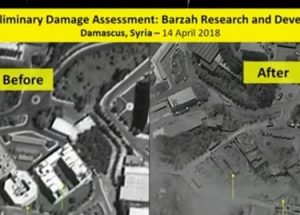
US airstrike on Syria before and after, screenshot from YouTube video

 While the purpose of the US strikes was to target Syria’s chemical-weapons capabilities, the relatively modest scale of the strikes are an indication of Russia’s ability to cause Western powers to limit their actions.

The recent US missile strikes on three chemical-weapons sites in Syria represent relatively small-scale action against Syrian President Bashar Assad and underline the extent of Russia’s deterrent posture.

The purpose of the strike was to damage Syria’s chemical-weapons program and to deter the murderous regime in Damascus from unleashing further chemical weapons on the civilian population. Yet in actuality, the strikes are more of an indication of Russia’s success at causing Western powers to limit their actions and opt for extreme caution in their response to Assad’s crimes against humanity.

Russian officials made explicit threats to shoot down US missiles prior to the strike and even to target the missile-launchers. These threats are part of a wider Russian posture aimed at showing the entire world – and the Middle East in particular – that Russia stands by the Assad regime no matter what horrors it unleashes.

Russia’s actions are guided by a cold, hard logic. By standing firm alongside its Syrian client, it is broadcasting the message that any Middle Eastern actor who partners with Russia will gain the essentially unconditional backing of a major power. Between the lines, the Russian message seems to be, “How can you trust the fickle West and the US, which abandon allies or leave them to fight alone? Join our sphere of influence and you will receive real backing.”

This kind of posturing is part of Moscow’s attempt to rebuild its global empire and boost the value of its currency as a superpower ally. There will likely be regional actors who will pay attention to this message.

As for the strikes themselves, they will probably have minimal, if any, impact on overall events in Syria.

The reason the Assad regime uses chemical weapons is because it is engaged in a war against Syria’s Sunni Muslim population, and it is attempting to ethnically cleanse whole areas of communities deemed a threat by the regime.

The Assad regime makes no distinction whatsoever between armed combatants and innocent civilians living in the areas from which the rebels operate, viewing them all as threats to its existence. This is why it repeatedly uses chemical weapons on entire neighborhoods, as well as conventional weapons, committing mass murder and trying to get the rest of the population to flee – preferably, from Assad’s perspective, out of the country.

Already, the Syrian refugee exodus is the worst since WWII. Out of an original population of 22 million people, more than half have left their homes. Of those, half are internally displaced, and around half have left Syria’s borders. The majority of these refugees are Sunni.

The Assad regime is from the minority Alawite sect, an offshoot of Shiite Islam, and the fact that millions of Sunnis are fleeing the country suits it just fine. This strategic shift in the country’s sectarian balance serves Assad’s long-term goal of strengthening its rule. It will continue to work towards this goal by terrorizing and butchering the Sunni population, and by dwindling its numbers by forcing people to leave Syria.

As a result, Europe should expect further waves of Sunni Syrian refugees.

The Assad regime has the backing not only of Moscow, but also of a regional and radical Shiite power: Iran. An array of Iranian-led Shiite armed forces are deployed across Syria, where they oversee the brutal campaign against Syria’s Sunnis.

Striking three chemical-weapons targets in Syria will not change this.

The Iranian-Israeli front

Meanwhile, Syria is also becoming an active combat arena between Iran and Israel. This front is growing more explosive and tense with time. Iran is trying to convert its military assets in Syria into bases of attack against Israel. Jerusalem is showing resolute determination to stop this from happening.

The Israel Defense Forces recently announced that an Iranian drone that flew into Israeli airspace in February and was shot down by the Israeli Air Force was armed with an explosive and was on its way to conduct an attack inside Israel.

This represents the first known time that Iran has attempted a direct armed strike on Israel from Syria, rather than its traditional attempts at organizing attacks via proxy.

The recent reported Israeli airstrike on an Iranian-run military base in central Syria, which purportedly was used by the Iranians to operate drones and threaten Israel, appears to represent Israeli self-defense. The goal is to stop Iran from turning Syria into a forward base of aggression.

In the aftermath of the strike, Iranian officials have been issuing threats of retaliation against the Jewish state.

Israeli defense officials have reportedly responded by saying that if Iran makes good on its threat, the whole of the Assad regime could be destroyed in the subsequent Israeli response.

These events represent a high-stakes struggle between Tehran and Jerusalem, with Iran pushing and testing Israel’s red lines and Israel enforcing them consistently. If Iran pushes too far and disregards Israel’s warnings, this low-profile war could turn into a major regional conflict.

Friday, March 2, 2018

THE KUSHNER FAMILY PASSOVER HAGGADAH

Image result for THE KUSHNER FAMILY PASSOVER HAGGADAH

THE KUSHNER FAMILY PASSOVER HAGGADAH

INTRODUCTION

Welcome to our Passover Seder! The history of the Jewish people reaches back nearly 4,000 years. We began as slaves in the land of Egypt but today we are free. As we recline in the luxury of freedom in our new Kalorama mansion, let us not forget our white Christian brothers and sisters yearning for release from bondage. We remember the baker forced to bake for every wedding and the ovum oppressed by its mother’s womb. May this Seder inspire us to light the torch of liberty and burn anyone who stands in our way. Thus we begin with the lighting of the candles.

KIDDUSH BLESSING OVER THE WINE

Next, we recite the blessing over the wine, given to us from Eric Trump Winery, the largest winery on the East Coast. This wine symbolizes the sweetness of a wealthy father and the joy we feel when we are all together, with the exception of Melania who prefers to stay in New York. Amen.

PARSLEY

The parsley on our Seder plate reminds us of spring and the earth’s natural bounty, which does not need cumbersome government regulations. We dip the parsley into salt water representing the bitterness of liberal tears. Then eat.

MATZAH

This is the bread of affliction. It is the simple bread our ancestors ate in the land of Egypt, Brooklyn, and New Jersey before reaching the Promised Land of Washington D.C. Our ancestors overcame great suffering in their journey to freedom without any government assistance. To those who are hungry and in need, we offer our prayers and hope, which is enough — Dayenu!

THE FOUR QUESTIONS

We’re not answering any questions today. No questions.

THE FOUR CHILDREN

The Torah instructs us to teach our children the story of Passover. The sages tell us there are four types of children:
The Wise Child — He understands what’s going on but is unable to convince others.
The Wicked Child — He understands what’s going on but goes along with it because it enriches him.
The Simple Child — He hasn’t a clue what’s going on but stupidly trusts Steve Bannon will figure it out.
The Child Unable to Ask — This kid is so shell-shocked by what’s happening that he turns mute like in the movie Tommy.

MIRIAM’S CUP

A cup of water is placed on the table to honor the prophet Miriam. Legend says God sustained the Jews as they wandered the desert with a steady stream of water coming out of Miriam’s wherever. We embrace this new Passover tradition as passionate advocates for the empowerment of women as symbolized by our “Make Women Great Again” luxury candle, available for sale at ivankatrump.com. This candle combines notes of peony, sandalwood, and conflicts of interest.

THE PASSOVER STORY

Now it is time to retell the story of Passover: A Pharaoh came to power in Egypt who feared the Jews because they wore strange head coverings. He didn’t believe the Jews were loyal to Egypt and loyalty was extremely important to Pharaoh, more than spelling, honesty, or the Constitution.

Pharaoh enslaved the Jews and forced them to make bricks for his tacky buildings with his name written on them in giant hieroglyphs. Then he issued a “Pharaoh-Order” mandating every Jewish male newborn was a security risk and must be drowned in the Nile, Pharaoh’s way of keeping “bad dudes” out of Egypt.

One Jewish mother resisted. She placed her baby in a tiny boat made of ancient Planned Parenthood signs, remnants of a bygone era, and set him afloat in the Nile, hoping he’d be saved. An undercover CIA operative posing as Pharaoh’s daughter found the baby, named him Moses, and raised him as her own.
Eventually, Moses learned of his true family’s identity and tried to help the Jews. (Family must always remain loyal—through felony convictions, product boycotts or impeachment.) Moses started @RoguePALACEfamily to spread hope, but failed to get Pharaoh to pivot on the Jewish labor issue. That’s when God had to step in and visited ten terrible plagues upon 

Egypt. They were:
  • Gender Neutral Bathrooms
  • Tuition-Free Public College
  • Paid Family Leave
  • Sensible Gun Control
  • $15.00 Federal Minimum Wage
  • Internet Privacy
  • Carbon Tax
  • Dodd-Frank
  • Campaign Finance Reform
  • Universal Health Care

Egyptians suffered greatly during these plagues. Everyone was getting the same opportunities. Pharaoh couldn’t handle it. After each plague, Pharaoh agreed to let the Jews go. But once the plague disappeared he’d tweet:

“FAKE NEWS got it wrong again — Jews know they r better off w/me than Moses. LOSER!!”

Curiously the tweets always happened on Shabbat. But amid great sorrow over the final plague of universal health care, Pharaoh relented. The Jews fled quickly into the desert without allowing their dough to rise and were stuck with a dry, tasteless, constipation-invoking bread substitute instead — the first matzah.

EXPLANATION OF PASSOVER SYMBOLS
SHANK BONE

The shank bone represents the sacrificial lamb Jews slaughtered the night they left Egypt. This Passover we engrave the shank bone with “Elizabeth Warren 2020.”

BITTER HERBS

These herbs remind us of the unfathomable bitterness of white working class America who threw a Hail Mary into our system of government in a last-ditch effort to bring back jobs in coal, steel, and VCR repair.

CHAROSET

A yummy salad of apple, nuts and cinnamon which shows off Ivanka’s cooking skills and her relatable desire to be a sweet and caring mother to her children. #familytime

ROASTED EGG

This egg is a symbol of rebirth and new opportunities for revenge on those who have betrayed us.

WELCOMING ELIJAH

We set aside a special cup of wine for the prophet Elijah. Legend says Elijah will return to earth to lead the way for peace. Unfortunately, we are unable to open our door to welcome Elijah as tradition dictates due to the protesting crowds outside.

CONCLUSION

As we conclude our Seder we give thanks to the Lord, our God, and ask for his greatest blessing of peace but take nothing off the table.

This year we are here; next year in Moscow!

Saturday, February 24, 2018

1974 ...The Oscars: What was showing in Cinemas ( that were worth seeing)

Related image
The 46th Academy Awards were presented on April 2, 1974, at the Dorothy Chandler Pavilion in Los Angeles. The ceremonies were presided over by Burt ReynoldsDiana RossJohn Huston and David Niven.

The Sting won 7 awards, including Best Picture and Best Director for George Roy HillThe Exorcist and The Way We Were were the only other films to win multiple awards.

Winners


Jack Lemmon, Best Actor winner


Glenda Jackson, Best Actress winner


John Houseman, Best Supporting Actor winner


Tatum O'Neal, Best Supporting Actress winner

Winners are listed first, highlighted in boldface and indicated with a double dagger (double-dagger).
Best PictureBest Director
Best ActorBest Actress
Best Supporting ActorBest Supporting Actress
Best Story and Screenplay Based on Factual Material or Material Not Previously Produced or PublishedBest Screenplay Based on Material from Another Medium
Best Documentary FeatureBest Documentary Short Subject
Best Live Action Short SubjectBest Animated Short Subject
Best Original Dramatic ScoreBest Original Song Score and/or Adaptation Score
Best SongBest Sound
Best Foreign Language FilmBest Costume Design
Best Art DirectionBest Cinematography
Best Film Editing

Streaking incident

The 46th Academy Awards ceremony is perhaps best remembered as the ceremony in which a streaker named Robert Opel ran across the stage naked while flashing a peace sign with his hand. In response, host David Niven jokingly quipped, "The only laugh that man will ever get in his life is by stripping off and showing his shortcomings."In 2001, this incident was voted[citation needed] as the most memorable Oscar moment in history, coming in first over Marlon Brando's 1972 boycott of the 45th Academy Awards, in which he nominated Sacheen Littlefeather to explain why he would not be coming to collect his Oscar for The Godfather.

Other notable events

  • First-time nominee George Lucas made his debut at the Academy Awards with his nostalgic teen drama American Graffiti. It was nominated for Best Picture (Francis Ford Coppola and Gary Kurtz), Director & Story and Screenplay Based on Factual Material or Material Not Previously Produced or Published (Lucas), Editor (Marcia Lucas) and Candy Clark for Best Supporting Actress.
  • Jack Lemmon won his second career Oscar that night; his first was for 1955's Mister Roberts. As he accepted the award, he announced that "In recent years, especially, there has been a great deal of criticism about this award. And probably, a great deal of that criticism is very justified; I would just like to say that, whether it is justified or not, I think it is one hell of a honor and I am thrilled, and I thank you all, very, very much."
  • Katharine Hepburn made her first and only appearance at the ceremony to present The Irving G. Thalberg Memorial Award to her longtime friend Lawrence Weingarten. Whenever she won an Oscar, she always had either the presenter or another person associated with her film accept it on her behalf. Upon taking the stage, she received a standing ovation, to which she replied "I'm living proof that a person can wait forty-one years to be unselfish."
  • Coincidentally, Debbie ReynoldsElizabeth Taylor and Connie Stevens, who were all ex-wives of Eddie Fisher's, each appeared in some form.
  • This was Susan Hayward's last public appearance before she died of brain cancer in 1975.
  • At 10 years, 148 days of age, Tatum O'Neal won Best Supporting Actress for her role in Paper Moon. She became the youngest winner of an Oscar, a feat unmatched to this day.
  • During the ceremony, the whole in memoriam tribute was for legendary producer Samuel Goldwyn, who had died at age 94, three months prior to the event. He is the only person to have an Academy Awards ceremony dedicated solely to him.
  • Longtime film veteran/comedian Groucho Marx was presented with an Honorary Academy Award for his contributions to the cinema.
  • Julia Phillips became the first female producer to win for Best Picture.
  • With Tatum O'Neal being 10 years old and John Houseman being 71 years old, this was the biggest age gap ever for 2 acting wins.

Multiple nominations and awards