Showing posts with label #israelbookreview. Show all posts

Saturday, May 27, 2017

Was #OyVeyDonaldTrump in Israel when he visited Jerusalem.: Take Jerusalem out of the equation and the only place you can say Trump visited in Israel is Ben-Gurion Airport.


US President Donald Trump places a note in the stones of the Western Wall, Judaisms holiest prayer site, in Jerusalems Old City May 22, 2017..

Of course, US President Donald Trump was in Israel — everyone saw him.

But his sole stop was Jerusalem, a city where Israeli sovereignty is contested. For two days US and Israeli flags might have fluttered together, but can the White House say he was definitely in Israel without making a larger policy question?

A close inspection of the White House's word selection suggests it did everything possible to avoid putting policy to the test. On the surface of it, Trump did what millions of tourists do: visited Yad Vashem, the Western Wall, the Church of the Holy Sepulchre and the Israel Museum. He used the Hebrew word “Shalom” and at times even wore a black kippah.

As US president he did some unique things compared to the standard visitor, like landing a helicopter in a supermarket parking lot, shutting down city traffic, and meeting with Prime Minister Benjamin Netanyahu and President Reuven Rivlin.

Upon arriving at the Israeli president’s residence in Jerusalem, Trump said the most simple of statements, placing himself and the city he stood in geographically within Israel.

Not that Israelis in the room had any doubts on that score.

“Thank you and shalom. I am honored to be in the great State of Israel,” Trump told Rivlin.

Similarly, information on the White House website regarding Trump’s visit to Jerusalem and the Western Wall was placed in the section about the President’s Israel leg of his eight-day international trip.

In fact, take Jerusalem out of the equation and the only thing that could truly be said about the visit is that Trump landed and departed from Ben-Gurion International Airport outside of Tel Aviv.

Anything else would be a question mark, but one that was perpetually raised by the White House staff and US officials. With small tiny diplomatic subtleties, they tried to divorce Trump’s visit from official recognition of Jerusalem as Israel’s capital, or even part of Israel at all.

Turns out it is not so simple to exclude Jerusalem from Israel, certainly not without raising some eyebrows.

Rivlin’s home was the last time Trump said he was in Israel, during his time in Jerusalem.

Even in his popular speech at the Israel Museum on Tuesday, he spoke of the State of Israel and the Israeli people. But when placing himself geographically, Trump said he was in Jerusalem or in the ancient land or the holy land.

On Monday White House Live, which provided video feeds of his trip, posted the words “Jerusalem, Israel” as it advertised the meeting between Trump and Netanyahu, but erased the word Israel the next day, leaving only the word Jerusalem to describe where Trump was.

The text of Trump’s remarks also bore the sole word Jerusalem, without mentioning the country. Similarly, only Jerusalem was listed by the White House as the location for Trump's Israel Museum speech.

The simple linguistic shift was reminiscent of a White House decision to cross out the world Israel as the location of former US president Barack Obama’s Jerusalem speech at Mt. Herzl military cemetery during the funeral for former Israeli president Shimon Peres in 2016.

Before Trump's arrival, the White House on Friday created a video called Potus Abroad which it placed on its YouTube Channel. The video included a a map of Trump’s trip that excluded areas of the country over the pre-1967 lines, including east Jerusalem. It did, however, list the Israel Museum and Yad Vashem as belonging in Israel.

By Wednesday, that video appeared to have been removed from the White House’s YouTube channel.

Earlier in the week US officials in Jerusalem who were planning the visit made comments to their Israeli counterparts, indicating that the Western Wall, which is over the pre-1967 lines, was not under Israeli sovereignty.

When asked about the incident ,White House Press Secretary Sean Spicer said that the Western Wall was in Jerusalem, but would not state that it was in Israel. When speaking with reporters in Washington last week National Security Advisor H. R. McMaster twice refused to answer the question of whether the Western Wall was in Israel. He did state, however, that no Israeli officials would accompany Trump to the Western Wall. Instead Western Wall Rabbi Shmuel Rabinowitz prayed with Trump at the ancient Biblical site.

Congress has recognized that Jerusalem is Israel’s united capital since 1995. But the White House and the State Department have differed offering de-facto recognition to west Jerusalem as part of the Jewish state and a de-facto rejection of Israeli sovereignty in east Jerusalem.

The White House and the US State Department have traditionally preferred to see the issue of Jerusalem settled as part of a final-status negotiation for a two-state solution with the Palestinians.

Trump led Israelis to believe that he would fall in line with Congress, particularly since during his campaign he promised to comply with a 1995 congressional mandate to relocate the US embassy to Jerusalem. His predecessors waived that mandate twice a year and Trump is expected to do the same when the deadline arrives.

Should he decide not to keep to his pledge he has to sign a waiver by June 1. Failure to do so would allow the embassy to be moved and end much of the debate about US policy with regard to Jerusalem.

Some Israeli politicians have felt that Trump’s visit to Jerusalem is a sign of obvious recognition of Israeli sovereignty over the city, including the Old City.

At the museum speech, a US official echoed Spicer in stressing to The Jerusalem Post that the Western Wall is in Jerusalem.

But as to whether the US considers Jerusalem to be in Israel, whether in the eastern or western part of the city, that question remains unanswered, even after Trump’s ceremonial visit.

Friday, May 12, 2017

Stephen Colbert Moderates An All-Trump Debate: #OyVeyDonaldTrump versus Donald Trump. Absolutely no one can save #OyVeyDonaldTrump from himself #ImpeachTrumpNow


No one in the White House is able to tell the 70-year-old newbie president how to behave
The staff is forced to explain the unexplainable.

So maybe a few times in your life you have screamed at the television set. And then what? You flip the channel, and get on with your life.


Ah, unless you're the current President of the United States. Because he probably watches way more TV than you do, and when he sees something he doesn't like, he doesn't flip. He stews. He calls his friends and complains. He tweets.


And then he acts, because he can.
According to a source with knowledge, Trump told friends he was increasingly concerned that FBI Director James Comey had grown "out of control" and was "pursuing his own agenda." Comey's testimony last week, this source says, "pushed him to the edge."
So he acted out, and decided to fire Comey, in a childish, impetuous -- and dangerous -- manner. Then he looked for a rationale, and found it in a memo written by Rod Rosenstein, deputy attorney general.


The White House used that cover story; so did the vice president. But now Trump has blown up that explanation by telling NBC that he would have fired Comey no matter what Justice officials had recommended. (Did Trump lie to Pence like Mike Flynn did? Just asking.)


And all credibility is lost.


Apparently, no one is able to tell the 70-year-old newbie how to behave. That firing the current FBI director in the middle of the Russia investigation -- no matter how tarnished his reputation -- is a bad idea. No one can tell him that, no matter how furious he is about an investigation that is growing and requiring more resources, trying to kill it by striking at the FBI director is a very, very bad idea. And that it might be interpreted as obstruction of justice.
But none of this matters to Trump. It never has. As Louise Sunshine, a former Trump organization employee told me months ago, Trump had always lobbed grenades -- and then walked away.


"Nobody ever knew when he walked in a meeting what he was going to say or do because he didn't," she said. "Donald has always managed to walk into a meeting and say something that nobody else expected him ever to say, upend the entire meeting, leave everybody agog, and control every situation that way, so by the time he leaves the room, he has the store, he owns the store."


But this isn't Trump's store anymore.


Trump has clearly learned little in office. He still throws tantrums, and his staff is sent to clean up the mess.


The pattern was set on the first full day in office.


That's when Trump fumed about the pictures about crowd size at his inauguration, and sent his press secretary Sean Spicer, out there to rationalize his obsession.
Then came the president's ridiculous assertion that there were 3 million illegal votes cast in the election -- and that's why he lost the popular vote.


That's when Spicer came out to try and explain the unexplainable. The solution -- just set up a presidential commission to examine the fiction, which the White House finally announced Thursday.


Then came the president's impulsive tweet-storm early on Saturday morning, March 4, when he accused his predecessor of having him wiretapped. Never mind that he was accusing Barack Obama of a felony, or that it wasn't true. He did it, anyway.


So then, once again, came the shovel brigade. Because to balk, even a bit, would be seen as disloyal to Trump --and that is not allowed. Ever.


Only this time it was really hard to figure out how to explain the unexplainable. And so a plan was hatched: call for congressional investigations. And stop talking about Russia hacks and potential Russian collusion with the campaign, but focus instead on investigating leaks that cast a negative light on Trump and his people.

You get the idea. The President tweets nonsense, and the staff scrambles to make it sensible. Even if the emperor has no clothes, you can't tell him.


So it was with the firing of James Comey.


The President decides he wants to fire Comey, and the staff is tasked to come up with a rationale. But it was very hard this time -- absurd on its face. After he praised Comey in late October on the campaign trail and last week his spokesman declared confidence in the FBI director, are we to suddenly believe that the president really thought Comey was unfair to Hillary? Really? As one source close to the president tells me, his real concern was that if Comey had treated Clinton so badly, he would do the same to Donald Trump.


Oh, and as he told NBC, Comey was a "showboat" and a "grandstander." It was a telling insult; in Trump's galaxy, there can be no star brighter than Trump.


One requirement of the presidency is to believe that your job is about something greater than yourself -- your country.


But first you have to believe there is something greater than yourself.

Thursday, May 11, 2017

The Enemy Within: A Tale of Muslim Britain. Sayeeda Warsi. (Allen Lane). 2017.


The Enemy Within: A Tale of Muslim Britain. Sayeeda Warsi. Allen Lane. 2017.


Sayeeda Warsi is a daughter of Pakistani immigrants. Yorkshire born and raised, an accomplished lawyer and member of the Conservative Party, she unsuccessfully sought election as an MP in 2005. Defeated but not outdone, David Cameron elevated her to a life peerage as Baroness Warsi of Dewsbury. Warsi was subsequently appointed to the Cabinet between 2010-12, entering as the first ever Muslim woman to hold such a position.

In her brief but eventful political life, Warsi achieved recognition, success and notoriety, receiving her fair share of supporters and loyalty from dedicated civil servants, but also a number of detractors from within ‘British Islam’ itself to the right-wing elements of her own party. She is now getting a very different kind of attention for her first book, The Enemy Within: A Tale of Muslim Britain, which is part memoir, part social analysis and part political commentary.

Shortly after her superb takedown of the Cambridge-educated, former BNP leader Nick Griffin on BBC’s Question Time in 2009, I left for Turkey in 2010, returning in 2016 to a very different Britain from the one I left. Warsi’s now infamous speech in 2011 observing how Islamophobia has ‘passed the dinner-table test’, as well as her resignation over the bombing of Gaza in 2014 triggered by the deafening silence of her party’s leadership, were half-forgotten events by then.

Since 9/11 and the global economic meltdown in 2008, societies everywhere have transformed, and politics has changed. Islamic State-inspired or planned attacks on Western Europe have created fear and alarm, with Brexit and Donald Trump casting dark shadows over matters of diversity, difference and the reasons given for divisions. An ever-growing Islamophobia makes the task of positive change an ever-greater challenge.
Image Credit: Baroness Sayeeda Warsi (Global Panorama CC BY 2.0)

The Enemy Within chronicles Warsi’s memories of life as a young Muslim woman growing up in a South Asian household. She discusses the importance of her family values: notions of hard work, respect for others and their differences and, importantly, fully supporting women as much as men, a perennial struggle facing many. The growing status of the family was achieved through self-employment and eventual financial success. It motivated her desire to become a confident and self-assured woman working in high politics in later life. Her path to political power, however, was not easy, laced as it was with many obstacles along the way.

The opening sections of the book explore what it means to be a British Muslim. Warsi reflects on her experience growing up in Yorkshire while facing the challenges of deindustrialisation also affecting other parts of the North and the Midlands from the 1960s to the 1980s. Warsi describes herself as the daughter of a poor father; however, she grew up not at the heart of her community but at the margins: close enough not to be seen to be apart, but far away enough not to be absorbed by the pervading culture. A strategic rational action defined her middle path, one that has navigated the often frozen-in-time heritage bubble existence of many South Asian Muslims in the North and the Midlands and the need to uphold a pro-integration Islamic outlook on life and society, inspired by Sufi leanings derived from the Barelwi School of Sunni Islam.

The book moves into a wider social and political commentary, with themes of terrorism and Islamophobia most occupying her thoughts. Warsi cogently explains why the UK government has failed to understand terrorist violence and how to adequately deal with the problem. In reality, such violence does not occur in a vacuum. It is often a response to dehumanisation, suppression and subjugation. Policymakers, however, are quick to disregard the importance of inequality, racism, discrimination, stereotyping and the demonising of Islam in normalising anti-Muslim sentiment. Crucially, this Islamophobia drives both violent Islamism and far-right extremism. Warsi also outlines the waves of populism that are sweeping Britain, and how after Brexit and the election of Trump as US President, these challenges will only intensify.

Her perspectives on the 7/7 bombings and what ultimately became known as the UK ‘Prevent’ strategy should be read widely. Warsi fundamentally disagrees that Prevent offers any real value. Rather, for her, it places communities under the watchful eye of the intelligence, policing and security services, securitising differences by treating not just would-be terrorists, however defined, but Muslims as a whole as a threat to ‘shared values’, regarded as the precursor to violent extremism. This conveyor belt theory is thoroughly discredited by leading thinkers but remains a popular theme in the minds of many policymakers and professionals.
Image Credit: Baroness Warsi and Professor Ekmeleddin İhsanoğlu, The Secretary General of the Organisation of the Islamic Conference (now Cooperation) at Lancaster House, 2010 (Foreign and Commonwealth Office CC BY 2.0)

For Warsi, the solution to the malaise facing British Muslims is political action leading to political change. This includes Muslims coming together to eliminate the differences that have been exploited by the UK government, forcing Muslims to play against each other in the ‘Muslim industry’. The process, perpetuated by New Labour until 2010, allowed these ‘approved Muslims’ to be incorporated or abandoned by the state at will. Warsi fervently notes that the lack of a Muslim political middle path allows extreme voices to get into power. These actors speak loudest and with the greatest passion as mainstream politicians dodge people’s foremost concerns, attempting to appease them with half-truths about the state of the nation or its identity on the global stage.

Warsi reflects on a conversation with her long-time mentor, Eric Pickles, who stated that ‘the state is not going to do anything for Muslims. Stop demanding things from it.’ Her response is to articulate the need for a British Muslim space that is organic, self-determined and wholly owned by Muslims, not for themselves but for society as a whole, knowing that the category of ‘Britishness’ is itself under severe scrutiny. There is a risk, however, that the search for an ‘English Islam’ as the new moniker that defines the space of British Islam is at odds with Englishness defined as a racial and ethnic category rather than a civil one, as is the case of a Scottish Islam, which is very much part of Scottish national identity. Muslims across Britain need to make strategic alliances with each other. If they refuse to think independently of government, Muslims will continue to suffer. Certainly, as Warsi confesses, for all the talk on the misguided activities of New Labour in the recent past, there is little or no will on the part of the present government when it comes to the Muslim space today, save for more of the status quo.

The alternative to this is not disengagement but greater engagement. Muslims must prove themselves as worthy citizens, she attests, separating questions of political and cultural engagement from the idea that conservatism among Muslims leads to terrorism per se. It is a clear statement on conservative Islam. While needing ongoing adaptation, it is not the reason for violent extremism. While I fully agree with this position, there is a risk that waiting for Muslims to iron out their differences ignores the opportunity to utilise the process of becoming itself as an important element in the progress needed for positive change. Moreover, British Islam does not need British Muslims to singularly espouse or uphold an advanced notion on citizenship. Often small but necessary wins are required to achieve desired outcomes.
Image Credit: Former Foreign Office Senior Minister of State, Baroness Warsi meeting with Amnesty youth activists who handed over a petition on Afghan women’s rights in London, 24 July 2013 (Foreign and Commonwealth Office CC BY 2.0)

The Enemy Within is a preeminent political account of the British Muslim experience, focusing on the most pressing concerns facing communities: namely, the twin evils of terrorism and Islamophobia. Warsi’s analysis of the problems facing British Muslims today is frank, and at times quite witty, as she pokes fun at the absurdity of the men around her. It is also a brave book, written by a woman, a northerner and a Muslim. Warsi went to the top of politics and fought for her stated aims as a Conservative, but also as a proud British Muslim. She rose to the position in spite of the wider problems of the Conservative-dominated Coalition. Her achievements are remarkable, making hers a special story. She witnessed it all, amassing a penetrating sense of the social problems, but could she have done more?

Warsi concludes that in spite of all that is good and right about diversity in Britain, British racism is resistant. Indeed, it continues to reinvent itself, with all the focus now on ‘the Muslim’, who represents a colour, culture and creed seen as problematic for the state, homogenising a vast people and a global faith community, reducing it to all that is loathed about the self but projected on to this predefined other. British racism is, ultimately, ubiquitous and omnipotent. In the end, this is the issue, is it not? Warsi contends that resistance is not futile. Neither is political action. She does concede, however, that the challenges grow faster than the opportunities.

All memoirs contain or exclude aspects that enhance the status of the writer. Warsi, like most other politicians and autobiographers, invariably suffers from this. Her perceptiveness with regards to being British and Muslim, the depth of Islamophobia and the ineffectiveness with which terrorism is dealt with by wrongly focusing on ideology as the only precursor to violent Islamist extremism, however, reveals a book containing detailed insights and critical reflections, all combined with oodles of chutzpah. That the book is a feminist tract is also clear from Warsi’s position as a working-class Muslim woman not only struggling to fight racism, but, crucially, sexism too.

The Enemy Within is a delightful, detailed deep dive into the personal and political world of the woman behind the public face and the TV slots. No matter what commentators and policymakers think of the recent Conservative Party antics, Warsi is the most successful Muslim woman in British political history. Make of that what you will.

Friday, March 24, 2017

RIGHTFUL HERITAGE: Franklin D. Roosevelt and the Land of America By Douglas Brinkley, Harper, 744 pp, illustrated, $35


Roosevelt stops at Artists' point in Yellowstone National Park.

Biographers of presidents, in days gone by, attempted to tell their subject’s entire life, often in multivolumes. Robert Caro’s “The Years of Lyndon Johnson,’’ for example, is a superlative account in four books with a concluding fifth planned — but it is an exception to the rule. Nowadays publishers want shorter works, for shorter attention spans.

Authors, pushing back, are increasingly opting for what is called “partial biography” — a single significant volume focusing on a particular aspect, angle, or period of the subject’s life. Douglas Brinkley’s “Rightful Heritage: Franklin D. Roosevelt and the Land of America’’ belongs to this new strain — and illustrates just how potent it can be, both as biography and history. For not 999 out of 1,000 Americans, I would wager, is aware just how much we owe FDR for his crusading efforts to save and improve America’s forests, trails, parks, refuges, and natural habitats. Think 3 billion trees planted, crucial landscapes saved, from the Okefnokee Swamp to the Olympic Mountains — and more acreage conserved (118 million) than the size of California!

FDR’s four lifelong passions were ornithology, stamps, sailing — and silviculture, or tree management. Already as governor of New York he had begun to promote conservation, but it was the Great Depression that, ironically, gave him the chance to put his vision of sustainable land use into effect on a national scale.

As Brinkley makes wonderfully clear, Roosevelt was not merely the inheritor of his uncle Teddy’s passion for wilderness, hiking, and matchless vistas; he was among the first national leaders to see from the start that forestation meant water and soil stabilization, in good times and bad.

“Rightful Heritage’’ is broken into four sections: the first takes readers from FDR’s birth to his ascension to the presidency, and the other three chronicle his efforts while in office. At more than 700 pages it is a long book yet its very size reflects both how much conservation was a part of his life and the breadth of his achievements — especially given the myriad simultaneous problems he faced, nationally and internationally.

Growing up in the Hudson Valley Roosevelt had learned at an early age how to manage land; thus, when his father died while FDR was at Harvard, his mother Sara gave him responsibility for the farm and 600 acres of land around the family home in Hyde Park. It was the beginning of FDR’s lifelong obsession with trees and the importance of trees to the environment.

FDR’s greatest contribution to the preservation and management of American nature came during the New Deal: His “Tree Army,” or Civilian Conservation Corps (CCC), not only planted billions of trees but built many thousands of recreational facilities, from roads to trails and cabins, and helped so many young people (over 3 million) without means get through the Depression positively.

Until you read the book it’s difficult to comprehend just how skillfully, and with what narrative brio, Brinkley manages to tell this story of one man’s single-minded odyssey, aided and abetted by men like Harold Ickes and FDR’s uncle Frederic Delano.

Perhaps he is a little quick to absolve FDR from the ecological downsides of some of his schemes. He acknowledges, for example, that, thanks to “fertilizers, industrial sludge, dredging, chemicals, and sewage” the waterways of the Deep South were, “ecologically speaking, made worse by the New Deal,” yet quickly passes on to more forestry. But Brinkley’s admiration for the leader’s devotion to the land is clearly sincere, and FDR’s story is surely a unique and hitherto neglected one, fully deserving of such a big canvas. Right up to the end, Roosevelt, despite his paralyzed lower limbs, was looking outward and onward — ultimately dreaming of global conservation policies, not just domestic, as he steered the United Nations into existence in 1945.

To me the most moving moment of “Rightful Heritage’’ comes, however, when Roosevelt flies to Tehran in late November 1943 to meet Stalin for the first time. Embroiled in a global conflict, his health compromised, the 61-year-old was, Brinkley recounts, still “appalled by the ecological abuse” he saw from the sky. “Of course,” FDR wrote the young shah, who had hosted the summit, “I do not pretend to know Iran well on account of the shortness of my visit, but may I write to you about one of the impressions I received on my air trip to Tehran? It relates to the lack of trees on the mountain slopes and the general aridity of the country which lies above the plains. All my life I have been very much interested in reforestation and the increase of water supply that goes with it.”

What a president! What a book!


Monday, March 6, 2017

Sniveling idiots: The media, a teleprompter, and the toxic bigotry of sycophantic desperation


It’s not my habit to write about blogging process for a Sunday post. But this is the disastrous Trump era, however long it lasts. And in the disastrous Trump era, news moves at such a pace that what is a big story mid-week is likely to be overtaken by an even bigger story by the end of the week. Even as I write these lines, I wonder if the new big news will be overtaken by even bigger news tomorrow or the next day.
But this post isn’t really about Trump. It’s about the media that are so responsible for the disaster that is Trump. As I wrote last summer, when so much that is not and must never be accepted as normal came to be the lived reality: If fascism ever does come to America, the media will be goose stepping right in line.
There are many independent reasons why the popular vote loser Trump sits in the Oval Office. There are many independent factors without any one of which Hillary Clinton would be president. These include the Clinton campaign's failure to lock down its firewall states; the Russian government's manipulations, investigations of which Republicans on all levels are with clear intent assiduously and cynically obstructing; and of course the unprecedented and unethical interference of the New York FBI office and FBI director James Comey, which also may never be fully investigated.
But another factor that by itself made possible Trump's historically narrow Electoral College victory was the incompetence and at times complicity of the major media. They made Trump possible, and despite his unprecedented hostility toward them, they continue to enable him. It would be embarrassing for them, if they hadn't long ago proven they are beyond embarrassing. It is, however, dangerous.
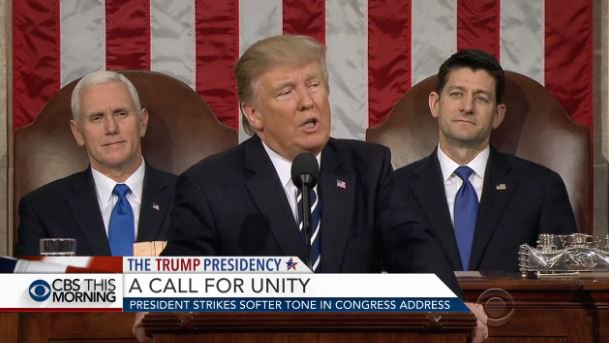
The depth of the media's sycophantic depravity with Trump is exemplified by the image at the top of this post.
The inexplicable prominence of Chris Cillizza as Washington Post analyst is exemplified by his pathological obsession with Clinton's emails last year, and he continues to prove he hasn't grown or learned a thing since. In this case, he does acknowledge Trump's disassociation with facts, as highlighted in the Post’s adjoining article, but that doesn't prevent him from writing:
he can be, dare I say it, presidential when the moment demands it.
And:
He's not going anywhere, folks. And that speech suggests he might have more upside than almost anyone thought.
Specifically, Cillizza points to these as among Trump's supposed highlights:
Trump hit a few very nice notes: His condemnation of threats against Jewish community centers at the start of the speech was a very nice grace note, and his honoring of the widow of the Navy SEAL killed in the recent Yemen raid was a remarkably powerful moment.
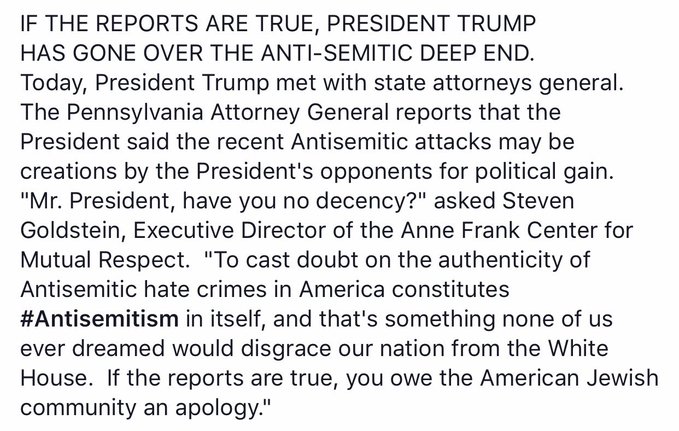
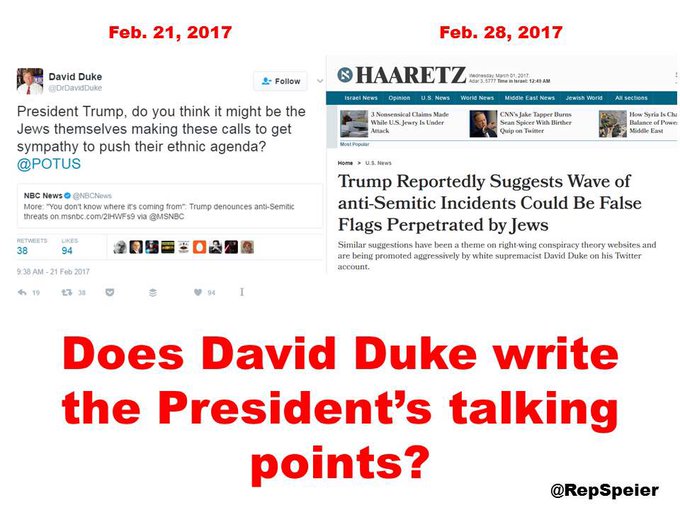
And never mind that earlier on the same day, in an unscripted and unteleprompted meeting Trump bizarrely and ominously suggested that those threats against Jewish community centers may be a false flag operation designed to make him look bad.
View image on Twitter
Does @DrDavidDuke write @POTUS ’s talking points? #25thAmendment
just hours ago he suggested the anti-Semitic attacks were a Jewish false flag—he was the President of the United States in that moment, too
My Jewish high school got a bomb threat today but thankfully the police were able to assure everyone that Ivanka is a Jew
And never mind that the Navy SEAL was killed in a failed operation that also has yet to be fully investigated, but that Trump on the same day as his speech blamed on the military and the Obama administration. But Trump read words, and to Cillizza's ilk that was the big pivotal moment they've been so desperately waiting for. More intelligent and principled observers from across the political spectrum—including military veterans and military analysts—had a different reaction.
Photo published for Donald Trump Blames SEAL's Death On Military: 'They Lost Ryan'

Donald Trump Blames SEAL's Death On Military: 'They Lost Ryan'

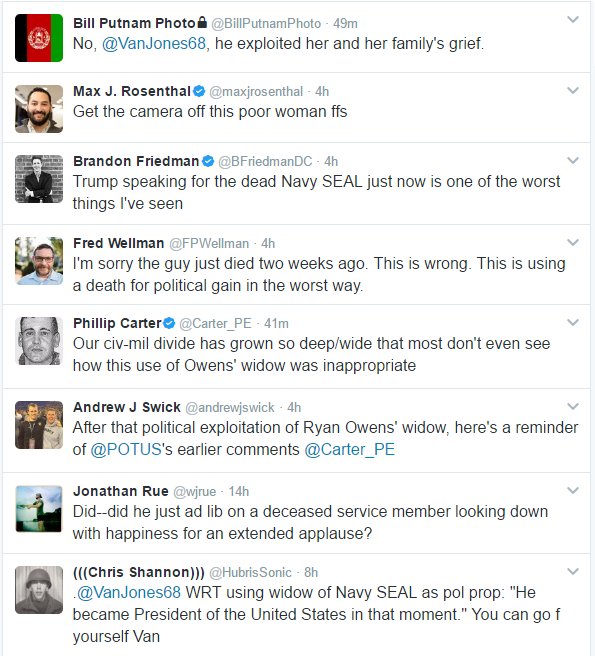
If watching POTUS publicly exploit S/Chief Owens' grieving widow didn't make your skin crawl, I worry about you -- as an American & a human.
So "the generals" got S/Chief Owens killed, but let's spotlight his widow on live TV.


Has Stockholm Syndrome overtaken the whole country?
Hi I'm a real journalist and a Marine's wife. Ask me anything about honoring sacrifice without scoring cheap political points. https://twitter.com/proudmoma98/status/837179670877601794 …
View image on TwitterView image on Twitter
Media people in my feed (left) viewed Trump's Navy SEAL moment last night very differently from the veterans (right). A story in two images:
Trump sent a soldier off to die in a half-baked raid and then used his grieving widow as a prop. I'm still processing this.
Did...did Trump just say a slain Navy SEAL is looking down happily from heaven because his mention broke an applause record?
But Cillizza was not alone. The punditocracy was beside itself lauding Trump's apparently remarkable ability to read words off a teleprompter, and they found Trump's staged and calculated honoring of the Navy SEAL's courageous widow transformationally presidential. This despite the lingering questions around the political circumstances of his having been killed; the administration's repeated lies about those circumstances; the report just a day earlier (and confirmed a day later) that the mission itself produced no significant intelligence; Trump’s own questionable behavior that horrible night; and the civilian women and children who also were killed that horrific night.
This ain't about saving time. It's a dangerous desire to pass the buck. Let me lay this out in a few tweets. http://www.thedailybeast.com/articles/2017/03/01/generals-may-launch-new-isis-raids-without-trump-s-ok.html?via=desktop&source=twitter …
Photo published for Generals May Launch New ISIS Raids Without Trump’s OK

Generals May Launch New ISIS Raids Without Trump’s OK

At best, call the media's reaction to Trump the toxic bigotry of no expectations. They’re desperate to believe he can be what he’s spent decades proving he never will be. A more realistic assessment of the media would be to wonder how they'll get Trump's boot polish off their tongues. Do they understand that the public's reaction was far less impressed, with both the size of the audience and the approval rating being significantly less than for the first joint speeches of Barack Obama and even the Lesser Bush?
View image on Twitter
43.4 million watched. Down from 52M for Obama's 2009 speech. #trumpaddress http://adweek.it/2lshHqB
Better yet: Total U.S. Population is up about 6% since 2009 (324M vs. 306M).https://www.census.gov/popclock/  https://twitter.com/TurkanaDK/status/837028551228444672 …
"Very positive" reaction to equivalent speech, per CNN/ORC


Bush 2001: 66%
Obama 2009: 68%


Trump 2017: 57%


Photo published for 7-in-10 speech-watchers say Trump boosted optimism

7-in-10 speech-watchers say Trump boosted optimism

NBC's Jacob Rascon just spent morning in TX interviewing dozens of people to gauge reaction to President Trump's speech. 90% hadn't seen it
The deferential desperation by so many in the media is even more proof of the totality of their degradation. It hasn’t been even a week since their colleagues were shut out of a White House press office gaggle, while Trump himself was doubling down on his dangerous authoritarian labeling of the media as enemies of the American people, before taking it to the next level and declaring the intentions of the New York Times are evil. But nothing Trump says or does prevents large segments of the major media and their punditocracy from throwing themselves at his feet like the timid toadies they are.
They made his ascension possible in the first place by lavishing him with billions of dollars of free coverage. They openly touted the profits he made them. He plays them for the fools they are, and they continue to grovel and do his bidding. If he now reversed course and decided to attend their annual exercise in self-congratulation know as the White House Correspondents’ Dinner, they’d probably strew rose petals before him.
But some did pay attention to the substance behind the gloss, and some of those paying attention are among the professional media, although lacking requisite obsequy is not likely to land them on television.
Oh shit. The office of “Victims Of Immigrant Crime Engagement.” This is exactly how it starts. #jointsession
View image on Twitter
FACT CHECK: Trump touts clean air and water while trying to kill air, water rules http://politi.co/2lUnUO7
Words NOT in Trump's speech: ***PLANNED PARENTHOOD*** or ***ABORTION***
Word NOT in Trump's speech: ***GUNS***
Word NOT in Trump's speech: ***CLIMATE***
Trump emphasizes threat of jihadi terrorism. It's real, killing 123 Americans since 9/11. In that period, guns have killed 450,000.
And there were many who were unimpressed with the media’s breathless fawning.
The television commentary was even more embarrassing than usual. And it is usually pretty cringeworthy https://twitter.com/jonfavs/status/836954635344621569 …
Pundit: “Doubts about Donald Trump have been quelled now that he has delivered an hour-long speech without jamming a pen into anyone’s eye."
I will ask this all day long: why was his tone more important than his lies and falsehoods? https://twitter.com/katyturnbc/status/836925827191275523 …
For any other president this would be a boring, laundry list speech. For Trump - amazing, responsible, detailed, uniting, presidential!
He put in his thumb,
And pulled out a plum,
I'll never understand why the media tries so hard to find the good in Trump after they tried so hard to find the bad in Hillary.
I'm so sick of folks grading Trump on a curve. If he's merely competent at reading a speech they want to give him a Medal of Honor. NOT ME!…
Last night was good evidence that if Trump was not a complete fuck up, he could keep horrible policies and be adored by pundits.
Things we're calling "presidential"


telling egregious lies that've been debunked


vilifying immigrants as criminals


reading from prompter
Senior White House official just described Trump's speech to me as "nationalism with an indoor voice"
"Indoor voice" is a phrase we use for toddlers, not presidents. So... please proceed.
View image on Twitter
What folks look like trying to explain why they think Trump reading a TelePrompter makes him more Presidential.
We  may yet get through this without suffering too much damage to too many people, but any damage to any people makes those responsible beyond excuse. And the media types who fawned and slobbered over Trump’s speech are as responsible as those who helped usher Trump into the White House in the first place. It didn’t take even 24 hours for their idiocy to be exposed for what it was. Not that they will learn. But they can at least take comfort in knowing their insular little club wasn’t alone in lauding Trump’s speech.  
The KKK loved Trump's speech.