Showing posts with label . Stephen Drus. Show all posts

Friday, October 5, 2018

Grilled Parley Lemon Chicken Kebab Skewers, a recipe from The Bard Of Bat Yam, Poet Laureate Of Zion


Lemon is my all-time favorite ingredient, and lately I've been on a bit of a parsley kick. Since lemon and parsley marry so well, these chicken kebab skewers are fragrant, herbaceous, fresh, and flavorful.

For best flavor, it's important to use fresh lemon, fresh parsley, and fresh garlic. Bottled lemon juice won't cut it.


You can cook these on an outdoor grill, indoor grill pan, or even just in the oven. I've given directions for all.

Ingredients
2 lb. chicken breast, cubed
2½ cups flat-leaf parsley (approximately 25 grams)
⅓ cup fresh lemon juice
6 tbsp. olive oil
3 large garlic cloves, crushed
2 tbsp. honey
zest of 2 lemons
2 tsp. kosher salt

Directions

  1. Cut the chicken into cubes and place in a bowl or container.
  2. Blitz the rest of the ingredients together in a blender or food processor. Pour over the chicken. Mix so that the marinade reaches all the chicken.
  3. Marinate the chicken for a few hours, or overnight.
  4. Thread the chicken onto wooden skewers. Optional: intersperse the chicken with chunks of onion or other vegetables. I used onion.
  5. Cook skewers on the barbecue until chicken is cooked through but tender.
  6. To cook indoors, pre-heat the oven to 500°F. Heat a grill pan over high heat for 4-5 minutes. Place the chicken skewers on the pan and grill for 2-3 minutes, then flip and grill for another 2 minutes. Transfer pan to the oven and cook for another 5 minutes. If you don't have a grill pan, you can still make these. Place the chicken skewers on a real baking sheet and bake at 500°F for 10-12 minutes.

Yields: 10 kebabs

Thursday, September 6, 2018

The New York Times Anonymous Editorial Op-Ed 5th September 2018 #OyVeyDonaldTrump

Image result for Cartoon / Graphic Images Chaos in the Donald Trump White House


I Am Part of the Resistance Inside the Trump Administration

I work for the president but like-minded colleagues and I have vowed to thwart parts of his agenda and his worst inclinations.
Sept. 5, 2018


The Times today is taking the rare step of publishing an anonymous Op-Ed essay. We have done so at the request of the author, a senior official in the Trump administration whose identity is known to us and whose job would be jeopardized by its disclosure. We believe publishing this essay anonymously is the only way to deliver an important perspective to our readers. We invite you to submit a question about the essay or our vetting process here.

President Trump is facing a test to his presidency unlike any faced by a modern American leader.

It’s not just that the special counsel looms large. Or that the country is bitterly divided over Mr. Trump’s leadership. Or even that his party might well lose the House to an opposition hellbent on his downfall.

The dilemma — which he does not fully grasp — is that many of the senior officials in his own administration are working diligently from within to frustrate parts of his agenda and his worst inclinations.

I would know. I am one of them.

To be clear, ours is not the popular “resistance” of the left. We want the administration to succeed and think that many of its policies have already made America safer and more prosperous.

But we believe our first duty is to this country, and the president continues to act in a manner that is detrimental to the health of our republic.

Image result for Cartoon / Graphic Images Chaos in the Donald Trump White House
That is why many Trump appointees have vowed to do what we can to preserve our democratic institutions while thwarting Mr. Trump’s more misguided impulses until he is out of office.

The root of the problem is the president’s amorality. Anyone who works with him knows he is not moored to any discernible first principles that guide his decision making.

Although he was elected as a Republican, the president shows little affinity for ideals long espoused by conservatives: free minds, free markets and free people. At best, he has invoked these ideals in scripted settings. At worst, he has attacked them outright.

In addition to his mass-marketing of the notion that the press is the “enemy of the people,” President Trump’s impulses are generally anti-trade and anti-democratic.

Don’t get me wrong. There are bright spots that the near-ceaseless negative coverage of the administration fails to capture: effective deregulation, historic tax reform, a more robust military and more.

But these successes have come despite — not because of — the president’s leadership style, which is impetuous, adversarial, petty and ineffective.

From the White House to executive branch departments and agencies, senior officials will privately admit their daily disbelief at the commander in chief’s comments and actions. Most are working to insulate their operations from his whims.

Meetings with him veer off topic and off the rails, he engages in repetitive rants, and his impulsiveness results in half-baked, ill-informed and occasionally reckless decisions that have to be walked back.

“There is literally no telling whether he might change his mind from one minute to the next,” a top official complained to me recently, exasperated by an Oval Office meeting at which the president flip-flopped on a major policy decision he’d made only a week earlier.

The erratic behavior would be more concerning if it weren’t for unsung heroes in and around the White House. Some of his aides have been cast as villains by the media. But in private, they have gone to great lengths to keep bad decisions contained to the West Wing, though they are clearly not always successful.

It may be cold comfort in this chaotic era, but Americans should know that there are adults in the room. We fully recognize what is happening. And we are trying to do what’s right even when Donald Trump won’t.

The result is a two-track presidency.

Take foreign policy: In public and in private, President Trump shows a preference for autocrats and dictators, such as President Vladimir Putin of Russia and North Korea’s leader, Kim Jong-un, and displays little genuine appreciation for the ties that bind us to allied, like-minded nations.

Astute observers have noted, though, that the rest of the administration is operating on another track, one where countries like Russia are called out for meddling and punished accordingly, and where allies around the world are engaged as peers rather than ridiculed as rivals.

On Russia, for instance, the president was reluctant to expel so many of Mr. Putin’s spies as punishment for the poisoning of a former Russian spy in Britain. He complained for weeks about senior staff members letting him get boxed into further confrontation with Russia, and he expressed frustration that the United States continued to impose sanctions on the country for its malign behavior. But his national security team knew better — such actions had to be taken, to hold Moscow accountable.

This isn’t the work of the so-called deep state. It’s the work of the steady state.

Given the instability many witnessed, there were early whispers within the cabinet of invoking the 25th Amendment, which would start a complex process for removing the president. But no one wanted to precipitate a constitutional crisis. So we will do what we can to steer the administration in the right direction until — one way or another — it’s over.

The bigger concern is not what Mr. Trump has done to the presidency but rather what we as a nation have allowed him to do to us. We have sunk low with him and allowed our discourse to be stripped of civility.

Senator John McCain put it best in his farewell letter. All Americans should heed his words and break free of the tribalism trap, with the high aim of uniting through our shared values and love of this great nation.

We may no longer have Senator McCain. But we will always have his example — a lodestar for restoring honor to public life and our national dialogue. Mr. Trump may fear such honorable men, but we should revere them.

There is a quiet resistance within the administration of people choosing to put country first. But the real difference will be made by everyday citizens rising above politics, reaching across the aisle and resolving to shed the labels in favor of a single one: Americans.

The writer is a senior official in the Trump administration.

Wednesday, July 25, 2018

The End of Democracy in the Jewish State of Zion , by the Bard of Bat Yam, Poet Laureate of Zion , Stephen Darori

Image result for ‫חוק לאום הפגנות‬‎

Since its founding in 1948, Israel has grappled with the conundrum of being both a Jewish nation-state and a democracy. Is it even possible?

The Nation-State Law surely created varied reactions since last week. Turkish President Tayyip Erdogan led the pack, calling Israel “the most Zionist, fascist and racist country in the world.”

“The Jewish Nation-State Law... legitimizes all unlawful actions and oppression. There is no difference between Hitler’s Aryan race obsession and Israel’s mentality.

Hitler’s spirit has re-emerged among administrators in Israel,” said Erdogan, who has not been exemplary in dealing with the Kurdish minority in his country.

Of course, that hyperbole goes way overboard in describing the effects of the law on Israel, but closer to home, there has also been more nuanced, but still barbed criticism. Ayman Odeh, chairman of the Joint List, said Israel “passed a law of Jewish supremacy and told us [Israel’s Arab citizens] that we will always be second-class citizens.”

Officially called the “Basic Law: Israel as the Nation State of the Jewish People,” the legislation – which was passed by a vote of 62-55 – states that “Israel is the historic homeland of the Jewish people, and they have an exclusive right to national self-determination in it.”

It puts on paper some of the defining characterizations of Israel that have been part of the country’s fabric since 1948, many of which are already parts of laws that codify and express Israel’s Jewish identity. For example, the Law of Return, passed in 1950, automatically grants citizenship to any Jew immigrating to Israel.

But the law goes beyond previous declarations of Israel as a Jewish state by further marginalizing its minority citizens in stating that the state’s language is Hebrew and relegating Arabic – the language of 20% of the population – to “special status in the state.”

Another clause says, “The state views the development of Jewish settlement as a national value and will act to encourage and promote its establishment and consolidation,” wording that can be construed as supporting Jewish-only communities.

Kulanu MK Akram Hasson and other top Druze officials filed a petition on Sunday asking the High Court of Justice to strike down all or part of the law as unconstitutional.

Hasson said the law transforms the country’s Druze population and other minorities, including Arabs, into second-class citizens. The petition called the law “a terrible blow to the Druze sector, a terrible blow to democracy and a terrible blow to Zionism.

The Jewish Nation-State Law disproportionately and unreasonably harms [all minorities, turning them] into exiled people in their own homeland.”

As Prof. Dov Waxman of Northeastern University wrote, Israel has never been a truly liberal democracy that treats all its citizens equally regardless of their ethnicity or religion. “Instead, from the outset it has been an ‘ethnic democracy’ or ‘ethnocracy’ as scholars have labeled it, serving Jews first and foremost. While Arab living standards have certainly risen over the years, Israel has never fully lived up to the promise contained in its Declaration of Independence to ‘foster the development of the country for the benefit of all its inhabitants,’ and ‘ensure complete equality of social and political rights to all its inhabitants irrespective of religion, race or sex,’” wrote Waxman.

Since its founding in 1948, Israel has grappled with the conundrum of being both a Jewish nation-state and a democracy. Is it even possible? Those tenets in the new law include many of the values that probably many people reading this right now share and weighed when deciding to pick up their lives and move to Israel – the symbols of the country like the flag, Hatikva, Jerusalem as the eternal capital of the Jewish people, and the Hebrew calendar as the guideline for the rhythm of the country.

But they were already well in place. Did we really need a new law that states the obvious, but also further erodes any sense of Israel’s minorities of belonging to the country? As we wrote last week when the bill passed, we agree with Likud MK Bennie Begin, who before abstaining on the vote for law, said it should have stated clearly that Israel, as a Jewish and democratic state, is committed to safeguarding the rights of its minorities. After all, isn’t that what being a Jewish state is all about?

Wednesday, July 18, 2018

#OyVeyDonaldTrump ..The return of the Bioviator by the Bard of Bat Yam, Poet Laureate Of Zion Stephen Darori

Image result for Donald Trump pompous  delux cartoons
Bloviator
1. A public figure, such as a politician or an actor, who makes outlandish, strident statements on issues, thinking that the average man will care about their opinions.
2. Someone who pontificates about issues of which they are uninformed, yet pretend to be expert.
3. Pompous blowhard, using their celebrity to speak about topics on which they are totally unqualified.

As Donald Trump surges, so does "bloviate." "The bloviating billionaire" — it's clearly an alliteration whose time has come. But there's hardly a candidate or commentator who hasn't been labeled with the word. Thirty years ago it was dated slang; now it's seen as the prevailing vice of our public discourse.

"Bloviate" has risen and fallen in American life. It was coined in the 1840s from "blow," a facetious pseudo-Latinism mocking the inflated oratory of an era when, as Tocqueville observed, Americans couldn't take to the stump without "venting their pomposity from one end of a harangue to the other."

That bloated style had its last champion in the 1920s in the affable person of Warren Gamaliel Harding. Harding was blessed with strong pipes and a fine head of white hair. He prided himself on his gift for bloviating, which he defined as "speaking as long as the occasion warrants and saying nothing." His sonorous platitudes aroused the contempt of H.L. Mencken, who wrote that Harding's English was a "loud burble of words" fit only for morons and small-town yokels: "It reminds me of stale bean soup, of college yells, of dogs barking idiotically through endless nights. It is so bad that a sort of grandeur creeps into it."

Those stump-speech declamations soon fell victim to radio and the modern fashion for naturalness and informality, taking "bloviate" along with it. By the 1970s, the word was moribund. It was arguably saved from extinction only by the timely interventions of language columnist William Safire, who offered it as a replacement for phrases such as "empty rhetoric."

Then, in the late 1990s, "bloviate" began a dramatic comeback, most likely in response to the sheer pervasiveness of political yammer. Between 24/7 talk radio, cable news, social media, blogs and websites, we're exposed to more raucous voices in a single week than anyone in the age of Harding could experience in an entire lifetime.

So "bloviate" was summoned back to life, but in a new guise. Its jocular origins are forgotten; you sometimes see Safire credited with inventing it. And it no longer implies pomposity or even long-windedness — people complain about all the bloviating on Twitter. (Harding couldn't even have said "Ahem!" in 140 characters.) Sometimes it's just a way of dismissing whole networks and sectors as not worth listening to.

There's no "correct" way to use "bloviate" — it was never a real word to begin with. But I like to reserve it for the fondness for bombast that runs deep in the American spirit. The classic bloviator is someone so besotted with the majesty of the language that comes out of his or her mouth that it takes on a life of its own. In that sense, bloviating is a kind of backhanded tribute to language.

It's an occupational hazard that many people who live by words are susceptible to. Think of Norman Mailer and Allen Ginsberg, or of William F. Buckley and Gore Vidal, whose sesquipedalian 1968 debate confrontations are on exhibit in the new documentary "Best of Enemies." Or David Foster Wallace or Christopher Hitchens — the woods are full of fine writers whose need to say things grandly sometimes comes at the cost of saying them well.

The most artful bloviators are self-aware enough to own it. Buckley tossed off esoteric words like "albescent" and "catechize" with pointed nonchalance, as if to suggest that that's how he'd talk if you woke him in the middle of the night. Bill O'Reilly wants you to draw the opposite conclusion. He calls himself a bloviator, as Harding did, but rarely uses an SAT word without disavowing it at the same time. "You're casting aspersions," he tells Jon Stewart, then adds "big word." He over-enunciates fancy words like "opine" and "bloviate" itself, with the implication that there would be something genuinely pretentious about saying them straight.

O'Reilly is typical of the modern political bloviators so carried away with their words that they imagine others must be too. Their ranks are thinner than people make them out to be: O'Reilly but not Sean Hannity, Chris Matthews but not Rachel Maddow, Ted Cruz but not Chris Christie, Michael Moore but not Bernie Sanders, "Colbert" but not Colbert.

That's not to let the others off the hook. The American lexicon is rich with names for hooey and its purveyors: There are "blowhards" and "windbags," there is "ballyhoo," "bluster" and "bunkum," not to mention a less decorous word for nonsense that also begins with a B.

That leaves no shortage of alliterative epithets for Trump: the blustering billionaire, the gassy gazillionaire, the preening plutocrat. (Safire might have said Trump calls for a revival of Mark Twain's favorite, "blatherskite," for a "blustering noisy talkative fellow.")

But if Trump is a bloviator, he's one who regards words with something between indifference and disdain. He'd never overreach for a fancy word and come up with something like George W. Bush's "Grecians" or Sarah Palin's "refudiate." He's utterly unself-conscious about his language, and if he has any self-awareness about it, he does a good job of hiding it. The broken sentences, repetitions, false starts and digressions, the banal superlatives and insults —Tremendous! Fabulous! Moron! Loser! — Trump may be sui generis as a candidate, but his language is the culmination of a fixation with the "natural" that has shaped public discourse over the last century. It's not really public speaking, just a simulation of street-corner schmoozing, which is one reason so many people find Trump "real," "authentic" and even "just like us."

And yet. The bloviator's first object is to dazzle himself with his own words, and Trump's are exactly the simple ones that he wants to hear, particularly when the conversation turns to his favorite subject: "I'm really rich." "I'm a really smart guy."

I think of what the psychologist B.F. Skinner said: The reason we boast is to hear someone saying nice things about us.

Thursday, June 28, 2018

The Two State Fantasy versus The New State Solution

For decades the world has subscribed to the notion that the two-state solution presents the most viable road to resolving the Israeli-Palestinian conflict; it is time that other ideas be allowed to enter the public discourse.

As with all incoming administrations, a Trump presidency ushers in the opportunity to review, retain, or revise the terms of long-standing policies, including those relating to the Middle East.

The ‘two state solution’, as broadly defined, is a policy that must be reviewed and revised. No proposed solution to the conflict need be perfect; all must be possible, however. The two-state solution is neither. The insipid one state solution is even less so.

Both ideas have gained too much traction. Neither is understood by the vast majority of those by whom they are championed. The saving grace of these notions seems primarily to be their alliterative, easily retained titles.

A further state for the Palestinian Arabs can be established. That state must be viable though. It must augur in a future of promise, security, liberty, sovereignty, self determination and opportunity for its inhabitants. Citizens of this Palestinian state must be granted every possible chance to positively thrive. It must be a state whose people not only dare to dream, but who actually realize the dreams they conceive.

This state must not come into being at the expense of Israel either now or in the future. Neither Israel the people, nor Israel the country must be existentially compromised in order to facilitate its creation.


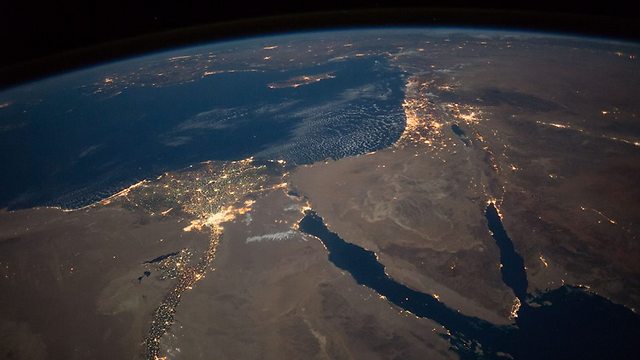
Israel and Egypt from space at night (Photo: NASA)

Any solution must be characterized by the reconciliation of practicability, possibility and imagination.

With the above in mind, I introduce what I term THE NEW STATE SOLUTION.

ON CONTIGUITY

The least practical aspect of the two-state scenario results from the geographical positioning of the Gaza Strip in relation to Judea and Samaria (West Bank).

Unlike in other proposals, The New State Solution would front-load this most intractable geographical challenge rather than defer it to a nebulous ‘future date.’

The New State Solution would thus be anchored first and foremost in the Gaza Strip, with territorial expansion into a section of the Sinai Peninsula. This state could be larger than anything that could be accommodated by the minute area of Judea and Samaria, thus granting geographical viability. It also redefines the Gaza Strip as a central part of the solution, rather than an insurmountable problem.

ON THE ARAB STATES

The boundaries of the New State would be brokered and ratified by several other parties beside Israel; most notably Egypt. Egypt is a prime mover within the Arab world. Having their imprimatur would grant legitimacy among several Arab nations and non-western nations. Egypt also has a history of going alone in the Arab world where necessary, so long as its own best interests are assured.

ON FRATERNAL RELATIONS

The New State would enjoy clearly defined, secured borders. Good fences make good neighbors. To the south, Egypt would positively amend the current arrangements it has with the Gaza strip in line with the contours of The New State and the opportunities that spring forth. To the north, Israel would extend its arm even further and open its hand even wider to partner with its new, peace-seeking neighbor.

The New State would have cultural affinity with its Egyptian neighbors and there is far closer cultural familiarity between Israelis and Palestinian Arabs than many fully appreciate. That affinity could be built upon and expanded, creating triangulated, regional cooperation.

ON DOMESTIC SECURITY AND DEMILITARIZATION

There would be no IDF presence within the borders of the New State. None. Independent states do not want foreign troops within their land. The New State would thus be both demilitarized and have a highly effective security apparatus. Contrary to the perception of many, demilitarization does not mean no weapons. Nor does it mean no security. It means no military. For example, The New State would have APC’s but not tanks. It would have light air ordinance such as helicopters but no fighter jets. It would have speed boats and patrol boats, but no battleships or submarines. It would have a police force but not an army. The security and police forces of the state would maintain superior fire power and logistical capabilities. These are the same tools by which democratic states maintain daily, domestic security after all.


Gaza Strip (Photo: Southern Network)

ON PREVENTING ENDOGENOUS SPILLOVER AND INFILTRATION

Any Palestinian Arab state established in Judea and Samaria requires that both Israel and Jordan stand fast as military guarantors. No state in the region enjoys absolute, total security but Israel is a comparative super power in the Middle East. The long term security of Jordan is far more precarious. The establishment of a Palestinian Arab state in Judea and Samaria means that in the event of a collapsing or collapsed Jordan, an unimpeded corridor of potentially pernicious states would be established to Israel’s east, extending from Afghanistan and Pakistan, into Iran, through Iraq, via Jordan, across Judea and Samaria, and onto what would be the divided city of Jerusalem in the two state formula.

Israel would stand alone as the final bulwark against such threats. Advocates of the two state solution must not shut their eyes to this very stark possibility.

The New State Solution offers far more reasoned security guarantees. To the south, south-west and south-east of the New State, the Egyptian military would be present only on the Egyptian side of the shared border. Israel would maintain its security presence on the border with the New State on the Israeli side only.

Israeli and Egyptian forces manning the borders would not only offer reassurance to their own countries, but also to the New State. Both would closely assist and cooperate so as to prevent spillover beyond, and unwanted infiltration within, the borders of The New State.

ON COMMERCE


A state established in Judea and Samaria will be close to landlocked with very few natural resources. That may beget a culture of tremendous entrepreneurialism among its citizens, but it may not. It may beget despair. Nobody can be certain. A failing economy will yield only a failed or client state and will be a manifestation of a problem unresolved.

By contrast, The New State Solution, established as proposed, offers miles of beautiful, Mediterranean coastline.

With a shoreline no less inviting than that of Tel-Aviv, The New State would boast rich opportunity for trade, commerce, tourism, hotels, resorts, casinos (on or off-shore), import, export and both an open, commercial air-port and an open commercial sea-port. Both would be toward the western most section of the country. Favorable security coordination would be agreed between Israel, Egypt and The New State.Massive economic investment within The New State would come from all international parties who have pledged their commitment to resolving the conflict. Actors would include the United States, the E.U., Great Britain and both Israel and Egypt; at a minimum.

ON DEMOGRAPHICS

Financial and commercial assistance would be granted to any residents of Judea and Samaria wishing to relocate to The New State.

Consider that today, as in the past, Jews immigrate to Israel with the belief that a better life awaits them here. Their reasons for doing so are varied. Significantly, however, Jews come to Israel voluntarily. They are neither forcibly transferred into Israel as individuals, nor as whole communities.

So too should it be for the Palestinian Arabs of Judea and Samaria.

Like many in the Jewish Diaspora, some will wish to remain where they currently reside. Others will sense and seize upon the gleaming opportunity offered by The New State.

The Palestinian Arabs are no more monolithic than are the Jewish People. Some may wish to constitute their futures in Judea and Samaria, others will prefer the option of opening a hotel along the shores of their own state or the prospect of building a home overlooking the Mediterranean, or they will move seeking employment and the opportunity to build up a state in which they have agency. They ought to be allowed to choose.

Successful repatriation to The New State would significantly further reduce Israel’s demographic considerations regarding Judea and Samaria while those residents already in the Gaza Strip would be part of The New State, resolving that demographic concern.

For those not wishing to relocate from Judea and Samaria, the more favorable demographic realities enjoyed by Israel would engender the confidence needed to annex Judea and Samaria with full and equal rights being extended to all, regardless of race, religion or creed. This would take place only once a 50% immigration threshold to The New State is achieved.

Israel would continue the policy of the right of return and would control immigration policy within Israel. It would thus maintain its democratic and Jewish character by far more than the two-thirds majority advocated by some proponents of the one state solution.

Those Palestinian Arabs claiming citizenship overseas would have an open channel to immigration into The New State, with The New State affixing immigration policy for itself.

ON GOVERNANCE AND GOVERNMENT


Any future massive attack launched against the State of Israel from the Gaza Strip should serve as a prelude for the total and final toppling and dismantling of Hamas and their oppressive regime. The destruction of Hamas should be undertaken with the aim of facilitating and incubating the legitimate emergence of a new, pragmatic, though not necessarily westernized, government that will administer a free, viable, secure, burgeoning New State that is secured, supported and championed by Israel, Egypt and the international community.

The first footstep into Gaza by IDF soldiers as part of the next defensive operation in response to rocket or tunnel attacks should set in motion The New State Solution as strategy. The diplomatic groundwork should begin immediately however, in advance of any unwanted, but likely, future conflict.

THE CASE FOR THE NEW STATE SOLUTION

In December, 2015, Secretary of State John Kerry stated:

"The United States is deeply committed to securing Israel's future as a Jewish and Democratic state. We are also committed to an independent, viable Palestinian state, where Palestinians live with freedom and dignity. The only way to achieve that is through a negotiated solution that creates two states for two peoples living side by side in peace and security."The New State Solution adheres precisely to Kerry’s own spoken definition of the sole way forward, though not to his vision.

It offers a negotiated solution resulting in two states for two peoples living side by side in peace and security. The definition endures therefore. It is the vision that must change.

For too long, calls have come for a two state solution incorporating Judea and Samaria as the basis of a Palestinian state. At its core, such a plan requires the mass, likely enforced displacement of at least many tens of thousands of Jewish people in order to build a home for another people. Past experience within Israel does not bode well for any such notion, nor should it. I do not want to see the people of Israel go through such a process. I do not wish to see the Palestinian Arabs go through such a process. There should be no forced transfers of populations.


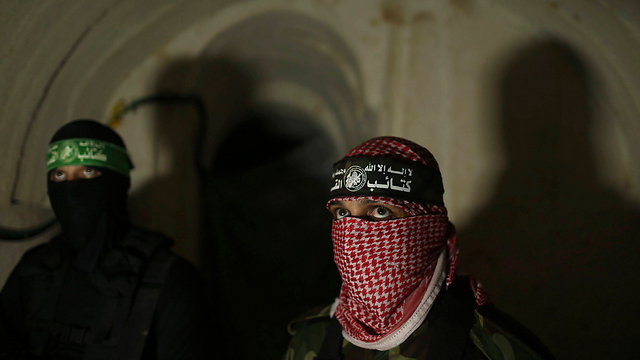
Hamas terrorists inside their attack tunnels (Photo: Reuters)

Politicians and communal figureheads frequently declare that the two-state solution is the ‘only solution.’ This tone of finality is both inaccurate and unhelpful. It places far too much faith in a plan that is demonstrably flawed and it blunts legitimate discussion and debate about alternatives.

There are alternative solutions to every problem – including to this problem. I am presenting my plan as one such alternative. It can be refined; but it is an alternative.

When assessing opportunities for peace, it is my hope that President-elect Trump brings with him a new attitude, where Presidents turn their gaze away from Israel’s east, and affix it instead upon Israel’s west when reviewing the peace process.

He, Israel’s Prime Minister and the President of Egypt could yet realize a new, fresh and viable vision by so doing.

I hear Mr. Trump has an eye for the development of gleaming, shining and bold new projects. This would be the boldest of all.


The two-state solution is defunct. Long live the New State Solution.

Wednesday, June 13, 2018

Bird's Eye View of Jeremy Corbyn and Uk Labour Party antiSemitism

Image result for Jeremy Corbyn anti israel and antisemitism

An analysis of the British Labour party under the chairmanship of Jeremy Corbyn provides a panoramic view of many aspects of socialist anti-Jewish hate-mongering. The most extreme comments come disproportionately from Muslims, a subject that is taboo for the British media. The incitement is accompanied by a whitewashing of the party’s anti-Semitism problem, a whitewashing that is supported by a great majority of its members. The ongoing hate-mongering in the party has led to some unprecedented reactions by the British Jewish leadership.

In the past decades, Western European social democrat politicians and parties have been among the most extreme inciters against Israel. In several cases, there have also been expressions of anti-Semitism. Leading socialist politicians, including the late Swedish Socialist Prime Minister Olof Palme and the late Greek Socialist Prime Minister Andreas Papandreou, have accused Israel of Nazi practices.

Only in the past two years, however, has a European socialist party – the British Labour Party – been exposed for widespread and extreme anti-Jewish incitement. Classic anti-Semitic as well as anti-Israel remarks by elected representatives have been published on a more or less ongoing basis. An analysis of the British Labour party provides a panoramic view of many aspects of socialist anti-Jewish hate-mongering.

In September 2015, extreme leftist Jeremy Corbyn became the party leader. A few months later, the first accusations about anti-Semitism concerning the Oxford University Labour Club became widely known. The party’s National Executive Committee chose to reveal only a limited summary of the findings exposed by Labour peer Lady Royall. Several months later the entire report was leaked to the press.

As the “anti-Semitism in Labour” issue started to interest the British media, it slowly became clear that extreme anti-Semitic expressions had been present in the party prior to Corbyn’s appointment. In 2014, for example, under previous Labour leader Ed Miliband, Naz Shah proposed – before she was elected MP in Bradford – that Israel should be relocated to the US. At that time, apparently no one was interested in publicizing this statement.

Among the expressions of anti-Semitic hate uttered by elected representatives, a disproportionate number has come from Muslims. This was the case during Miliband’s leadership and continues under Corbyn. Despite hundreds of articles on anti-Semitism in Labour, the specifically Muslim aspects remain taboo in the British media.

Miliband steered the party towards a proposal of recognition of a Palestinian state. This was possibly done to gain the support of Muslims during the May 2015 elections, as an estimated 4.5% of the British population are Muslim.
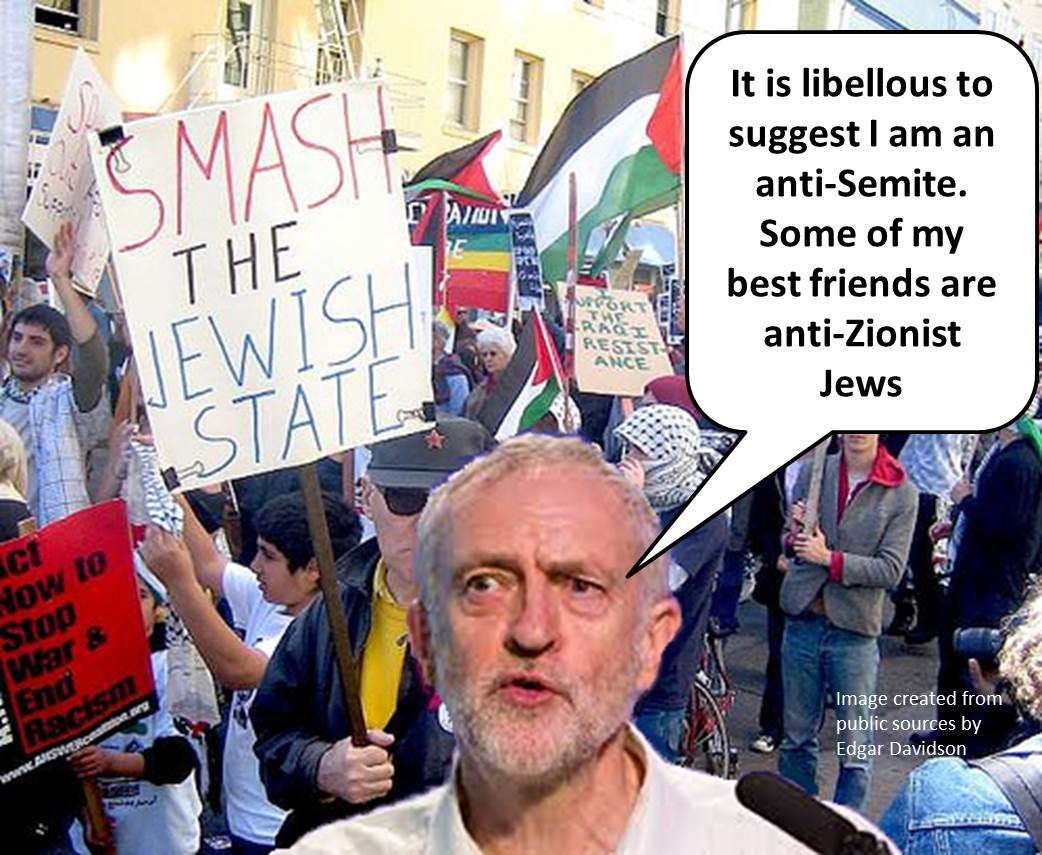
Image result for Jeremy Corbyn anti israel and antisemitism

Corbyn mixes with anti-Semites. He has donated money to, and attended gatherings of, a charity headed by Holocaust denier Paul Eisen. He has referred to the genocide-promoting Hamas and Hezbollah terrorist organizations as his friends. When he came to power he promoted anti-Semites, including Ken Livingstone, to senior positions. Livingstone, the former mayor of London, was later suspended after his repeated claims that Hitler had supported Zionism in the 1930s. Livingstone resigned from the party in 2018.

It is not easy to identify which of Corbyn’s acts fall squarely within the International Holocaust Remembrance Association’s definition of anti-Semitism, which was adopted by the UK government. In May 2018, Jonathan Arkush, outgoing President of the Board of Deputies, the umbrella organization of British Jewry, claimed that Corbyn held anti-Semitic views. He noted that the Labour leader had been chairman of the Stop the War organization, which is known for some of the worst anti-Israel discourse.

When media pressure concerning anti-Semitism in Labour became an issue, Corbyn appointed human rights activist Shami Chakrabarti in April 2016 to investigate the accusations. Her report was poorly written and unprofessional. Shortly afterwards, Corbyn proposed Chakrabarti for a peerage, which resulted in her becoming a baroness. Corbyn also appointed her the party’s Shadow Attorney General for England and Wales. Little has been heard from this supposed expert about ongoing Labour anti-Semitism.

It is by now abundantly clear that Corbyn has little desire to confront anti-Semitism in his party other than through general statements. As a result, the whitewashing of anti-Semitism in Labour has become a significant problem. In March 2018, a poll of paying Labour members found that 47% said anti-Semitism is a problem, but the extent of the problem is being exaggerated “to damage Labour and Jeremy Corbyn or to stifle criticism of Israel.” A further 30% said anti-Semitism is not a serious issue. Sixty-one percent thought Corbyn is handling the anti-Semitism claims well. Only 33% thought he is handling them badly.

The confrontation with anti-Semitism in one of the country’s two major parties has had an important impact on members of the Jewish community. Many of them no longer vote for Labour, and some have stopped donating. An unprecedented demonstration of the Jewish community against anti-Semitism in Labour took place in London outside a Parliamentary Labour Party (PLP) meeting. In a letter to the chair of the PLP, the Board of Deputies wrote: “Again and again, Jeremy Corbyn has sided with anti-Semites rather than Jews.”

In Parliament, several Jewish and pro-Jewish Labour MPs have reported that they have been subjected to tremendous harassment. Labour’s attempt to conquer the London constituency of Barnet – the most Jewish borough in the UK – failed in the May 2018 local elections.

The modest increase in Labour seats nationwide during those elections disappointed the party’s expectations and was seen as partly due to the anti-Semitism debate. Arkush went farthest, stating that Corbyn’s views could drive Jews to leave Britain if he were to become prime minister. He was one of the Jewish leaders who met Corbyn in April 2018, a meeting those leaders found disappointing.

Small groups on the Jewish left are enthusiastic supporters of Corbyn. He continues to provoke, and attended a Passover seder at Jewdas – a radical anti-Zionist Jewish organization that has called Israel a “steaming pile of sewage which needs to be properly disposed of.”

In March 2018, Corbyn said that since he became party chairman, there have been 300 complaints about anti-Semitism. He said that of those accused, 150 people have either been expelled or resigned, and added that the backlog of complaints is 60 cases. However, the Daily Mail reported a backlog of 74 cases and said MP John Mann claims to be aware of another 130 complaints. One source in Labour told the paper: “Many of these cases include the most shocking and blatant anti-Semitism that would make even a committed Nazi blush.”

The disappointing local election results may have been the impetus for Labour’s announcement that it will speed up dealing with the complaints with the intention of clearing the backlog by the end of July. In view of the party’s checkered past under Corbyn, we will have to wait and see whether this promise will be fulfilled.


Sunday, June 10, 2018

#OyVeyDonald Trump in Syria, Chaos and Mayhem in the Middle East


Trump’s Passive-Aggressive Syria Policy Risks Creating More Mayhem in the Middle East
The United States is pursuing a worst-of-both-worlds mix of hawkish confrontation and strategic retrenchment


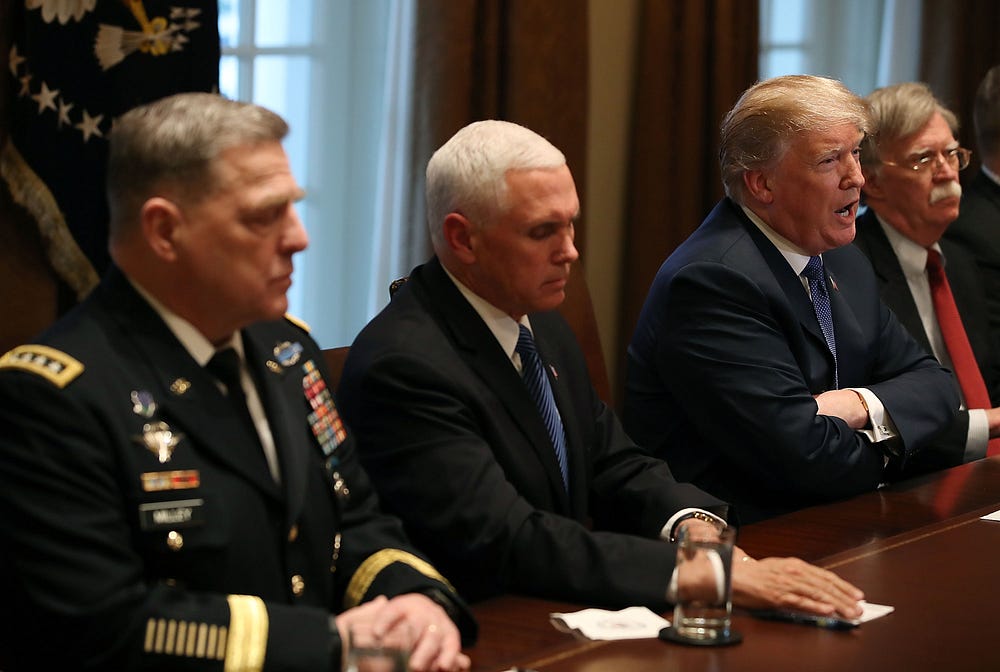
U.S. President Donald Trump speaks during a briefing on Syria in the White House on April 9. From left: U.S. Army Chief of Staff Mark Milley, Vice President Mike Pence, Trump, and National Security Advisor John Bolton. Photo: Mark Wilson/Getty Images

The addition of uber-hawkish fresh faces to President Donald Trump’s national security team raised justifiable worries that the president was assembling a “war cabinet.”

But as the limited targets of the U.S. missile strikes against Syria on Friday show, a continuation of the essence of Trump’s foreign policy in the Middle East is far more likely: a worst-of-both-worlds mix of tactical, hawkish confrontation and an underlying strategic retrenchment.

Call it a passive-aggressive Middle East strategy — aggressive enough to turn up the heat on the region’s conflicts yet passive enough to ensure that the United States does not really invest in addressing them.

Trump’s approach undercuts U.S. influence and ability to shape outcomes in the region:

Rip up the Iran nuclear deal, but make no serious plans to challenge Iran in the region. Crush the Islamic State militarily, but walk away from the aftermath. Launch limited strikes into Syria (which we support) without a strategy — all while barring America’s doors to Syrian victims. Then declare“mission accomplished” as Syria burns.

Roll out the red carpet for Saudi Crown Prince Mohammad bin Salman’s visit to Washington, but squander that leverage by writing him a blank check for continued regional conflict. Gain leverage, and then squander it. Rinse, repeat.

Delegate all meaningful follow-through down to the ghost ship of the nondefense national security bureaucracy. Strain the U.S. military by escalating tensions around the world and sending troops to a fake threat on America’s southern border at the same time. Trump has slapped the “America First” bumper sticker on a Middle East policy that does little to advance America’s interests or tackle its enduring challenges.

How will this approach play out on the ground?


The next two months will tell us a great deal. Just as Trump reshuffles his national security team, he has also arranged a series of self-imposed Middle East crises.

Over a single, head-spinning stretch in early May, Trump is likely to rip up the Iran nuclear deal and open a U.S. Embassy in Jerusalem — just as Iraqis head to the polls for national elections. And that was before Syrian President Bashar al-Assad’s horrific chemical weapons provoked a U.S. military response — and raised the stakes of Trump’s musings on pulling U.S. troops out of eastern Syria.

Over the coming month and a half, Trump and his team could well make three unforced errors in the Middle East.


Iran

Trump seems ready to isolate the United States and undermine its leverage by pulling it out of the Iran nuclear deal. This would increase security tensions in the region while unilaterally removing from the United States a key tool blocking Iran’s path to a nuclear weapon in the coming years. European countries, China, and Russia might well stay in the deal, and it remains to be seen what Iran would do. There is little evidence that Trump’s team — including John Bolton, the new national security advisor, and Mike Pompeo, the CIA director and Iran hawk whom Trump has nominated for secretary of state — is prepared to deal with the range of outreach and contingencies required to mount a credible campaign of renewed international pressure.

Looking beyond the deal to the broader region, the gap between Trump rhetoric and reality is wider still. The United States is largely bereft of an active strategy to engage and compete with Iran in the fields where it matters most, particularly regarding political and security situations on the ground.

Seeing the Trump team’s failure to compete in the nonmilitary, non-palace-pomp dimensions of regional leadership, one gets the feeling it views the United States as another regional monarchy, whose only tools are its Special Forces, Air Force, and royal court. And the results are likely to be similarly underwhelming unless the United States changes its approach.

Anti-Islamic State

The same brittle combination of aggressive militarism and strategic passivity may be also taking hold in the fight against the Islamic State.

Trump’s pledges, despite warnings from his team, to remove U.S. troops from eastern Syria “very soon” have been deferred, at least for now.

While we see the risks of continued presence, ultimately Trump’s proposed withdrawal would risk abandoning U.S. anti-Islamic State partners to Turkey, Russia, Iran, and the Syrian government. This could unleash a major new wave of fighting, mass displacement, and human suffering that might well breathe new life into the Islamic State.

Similar concerns exist in Iraq, where May elections represent a political inflection point. Whether the country can bridge its internal divisions is a key test of whether the military defeat of the Islamic State will be translated into a sustained political defeat. While attention is focused elsewhere, a great deal is at stake: Will Iraq’s next prime minister look to the United States, or will Iraq be dragged under Iranian domination? Will Iranian-backed militias be a problem to manage or coalition partners sharing the spoils? Will the Kurds unite to block a hard-line Iran-backed Shiite prime minister from dividing and ruling them?

The United States can have a significant impact in helping the new Iraqi government tackle the next phase in the fight against the Islamic State and define its relationship with its neighbors, particularly Iran and Saudi Arabia. But there is little evidence of such an effort underway amid all the churn at Trump’s National Security Council and the State Department. The risk is that, having invested so much into militarily defeating the Islamic State, the United States will needlessly fail to make a far smaller investment of resources and high-level attention to ensure that America can engage and compete. As an Iraqi told one of us, “He who does not show up has no influence.”
The Israeli-Palestinian conflict

The Trump team has promised a peace plan for Israelis and Palestinians but failed to do even the bare minimum to cultivate a Palestinian partner willing to engage in the process. By unilaterally moving the U.S. Embassy in Jerusalem — taking Jerusalem “off the table,” to use Trump’s evocative phrase, without asking for any constructive steps from Israel in response — Trump’s plan may be dead on arrival.

As events this past week — not just in Syria but in Yemen and the Gaza Strip — demonstrate, the Middle East remains a dangerous tinderbox where ongoing conflicts in particular corners of the region could easily erupt into wider conflagrations. Trump carries out episodic actions in a strategic vacuum. Scratch beneath the surface of his rhetoric and militarism and, in many instances, you find a shabby disengagement with the underlying drivers and challenges.

The actions the United States takes this May in the Middle East may set a new tenor for America’s engagement. Trump seems ready to add more fuel to the fire of the Middle East’s conflicts, with neither the will nor the game plan to put those fires out.

Thursday, June 7, 2018

Stability in Gaza is not directly proportionate to Economic Benefits


Economic Benefits Will Not Bring Stability to Gaza


Image result for hamas rally


The easing of economic conditions – a strategy that benefited Palestinian areas in the West Bank – is increasingly touted as the way to achieve political stability in Gaza, which is ruled by Hamas. But this strategy only works after the enemy is defeated.

Many experts claim that an easing of economic conditions in Gaza, particularly the granting of permission to Gazans to work in Israel, is the way to achieve political stability in a Gaza Strip ruled by Hamas.

This is a fallacious argument.

To understand why this is so, one must revisit the Marshall Plan for Europe, the most successful example in history of how economic largesse can facilitate the transformation of a destructive foe into a staunch and healthy ally. West Germany became a lynchpin in the security architecture of the Western alliance against the Warsaw Pact countries under the Soviet orbit.

No one can deny the success of the Marshall Plan, especially in contrast to the fallout from the destructive vindictiveness of western allies against Germany after World War I. Indeed, that vindictiveness contributed to the rise of Nazi Germany, forming the historical justification for the Marshall Plan.

By the same token, one can hardly deny the even greater importance of two geostrategic factors at the time that made such economic largesse towards a former enemy worthwhile.

First, the total defeat of Nazi Germany, and its subsequent occupation and division by the winning coalition, meant that the US and its allies could mold West Germany to their liking through denazification and democratic rule, just as the Soviet Union created an East Germany in its own totalitarian image.

Second, West Germany was, like the rest of free Europe, beholden to the US for its security in the face of a menacing Soviet Union and its satellite states.

In the face of these two basic facts, the Marshall Plan can be seen as having facilitated and reinforced a process.

Benjamin Netanyahu’s liberal economic policy towards the residents of Mahmoud Abbas’s Palestinian Authority (PA), primarily the allowing of over 100,000 workers with or without permits to work in Israel, succeeded in part because it satisfied the two basic conditions that made the Marshall Plan successful.

At the height of the second intifada in 2002, Israel reconquered major towns in the PA that had become sanctuary areas for Fatah, PA-linked, Hamas, and Islamic Jihad terrorism. It has prevented the reemergence of sanctuary areas ever since through preventive arrests throughout the West Bank that run into the thousands annually.

Like Germany, the PA was essentially defeated. And as was the case with West Germany and the US, Israel and the PA became allied against joint enemies – Hamas and Islamic Jihad.

If the PA ever had any doubts about who was more threatening to Abbas’s rule, Israel or Hamas, those doubts were put to rest after the Hamas takeover of Gaza in 2007.

It was only after these two conditions were met that economic prosperity could play its facilitating role.

And even then, the economic effects were limited compared to hard and fast political and military factors.

After all, even after workers from the West Bank were granted permission to commute to work in Israel, where they earn almost twice the wages of workers in the PA (after debiting commuting costs), over 250 Palestinians were motivated to commit murders in the wave of terrorism at the end of 2015-16.

The relative difference in the lethality of this terrorist wave – in which only 45 were killed compared to 800 in the second intifada by the same number of terrorists – was due not to a decrease in motivation but to the fact that they no longer had sanctuaries from which to organize elaborate suicide bombings or store large quantities of firearms.

In fact, by the time of the wave, the professional terrorist infrastructures of Hamas and Islamic Jihad had been thoroughly smashed.

In Gaza, neither of these conditions prevails. Gaza under Hamas rule remains a sanctuary area where Hamas can freely build up its military capabilities and launch a sophisticated campaign like the March of Return with little interference.

There is no common enemy that would render Hamas conciliatory, as was the case between the US and West Germany or between Israel and the PA.

Only a policy of toughness towards Hamas can induce it to assure stability and quiet in Gaza.

The three large-scale bouts of conflict between Israel and Hamas in 2008-9, 2012, and 2014 led the inhabitants of Gaza to demand that Hamas bring an end to the launching of missiles that had led to those clashes. Hamas acknowledged that pressure and acted upon it.

Further popular pressure after the failure of the March of Return campaign is likely to induce Hamas to stop campaigns of violence altogether.

Economic largesse at this point would only augment Hamas’s resources, as it taxes incoming goods and aid. That money will be funneled back to its hard core through campaigns such as the March of Return.

Gaza’s inhabitants voted in Hamas in 2006. They have lived to regret it. It is now incumbent upon them to defang their government by making sure it deals in butter, not guns.

Only when Hamas envisions its territory as a future Singapore rather than a murderous labyrinth of fundamentalist terrorism should economic benefits accrue to Gaza.