
Showing posts with label #OyVeyDonaldTrump.. Show all posts
Showing posts with label #OyVeyDonaldTrump.. Show all posts
Sunday, June 4, 2017

Saturday, May 27, 2017
Donald the Menace with Apologies to Dennis Oy Vey Oy Vey Oy Vey . #OyVeyDonaldTrump's disregard of facts, figures and reality are becoming a menace .
'Bad Germans' And Other Trump Blunders
Trump's Brussels trip displayed a now familiar disregard for the facts.
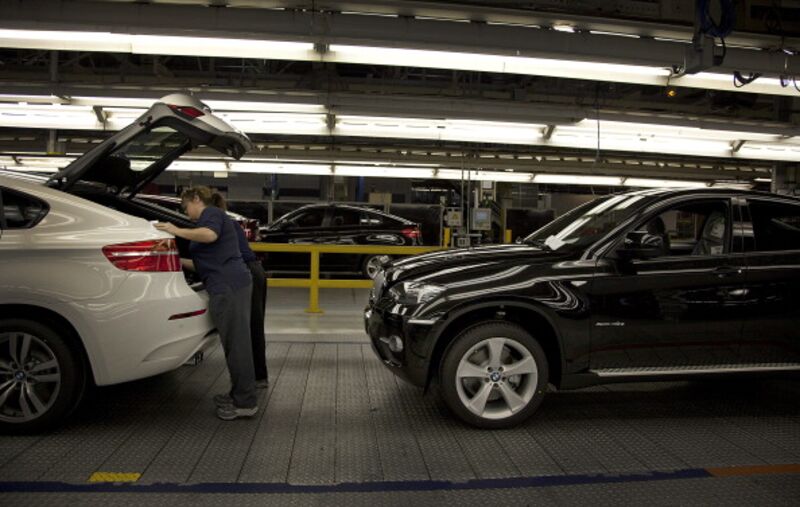
Made in the U.S.A. Photogaper: Ariana Lindquist/Bloomberg
During his first foreign trip since he was elected, President Donald Trump didn't look too out of place in Saudi Arabia or even in the Vatican. In Brussels, however, he was a befuddled elephant in a china shop, doing his best to convince European leaders that the U.S. was clueless on key cooperation issues.
It was bad enough that he shoved aside Montenegro Prime Minister Dusko Markovic to be in the front row during a North Atlantic Treaty Organization photo opportunity; Markovic, whose country has just been welcomed into NATO, graciously said that the U.S. president belonged out front. It was awful enough that he used a memorial opening ceremony to make a politically contentious speech in which he railed against NATO members' low defense spending and, unlike any of his predecessors, avoided explicitly affirming NATO's pledge of mutual defense -- the very Article 5 of the treaty that the memorial was supposed to commemorate.
One would expect a novice political leader in his first six months since being elected to climb a steep learning curve; instead Trump appeared to demonstrate a persistent unwillingness to learn. Despite having been told repeatedly that NATO member states had pledged to spend 2 percent of economic output on defense individually, not to pay that amount into some common pool, Trump repeated the canard that under-spenders "owe massive amounts of money from past years and not paying in those past years." There appears to be no way to explain to him that no NATO member is in arrears to the military bloc's budget.
"I never once asked what the new NATO headquarters cost," Trump said. "I refuse to do that." The number is published on NATO's website: 1.12 billion euros ($1.26 billion), an amount comparable with NATO's common budget for 2017 (1.5 billion euros) but contributed separately by the member states in proportion to the size of their economies. Besides, each country paid for the offices to be occupied by its mission.
At the meeting with top EU officials, Trump tore into Germany's trade surplus, showing a similar disregard for facts. "The Germans are bad, very bad," he said, according to Der Spiegel. "Look at the millions of cars they sell in the U.S. Horrible. We're going to stop that."
German carmakers don't sell millions of cars in the U.S. Last year, the total unit sales of Volkswagen, BMW and Daimler reached 1.3 million (not counting Lamborghinis). At the same time, the German companies produce about a million vehicles in the U.S. For example, BMW made 32,659 sports utility vehicles in Spartanburg, South Carolina, in April 2017; it churns out 1,400 a day, most of them for export. The relatively few BMW X5s on German roads are made in Spartanburg, too: It makes sense for BMW to make the large cars closer to their main market.
Daimler made a total of 300,000 Mercedes cars in Tuscaloosa, Alabama, in 2016. The plant is the state's biggest exporter. VW's Chattanooga, Tennessee, operation has a 150,000-vehicle production capacity and also is export-oriented.
The U.S. does have an auto trade deficit with Germany. According to the U.S. Census Bureau, it exported $2 billion worth of cars, trucks, buses and parts to Germany (including those BMW X5s) in the first three months of 2017, and imported $7 billion worth. But it's with Mexico and Japan that the U.S. has the biggest vehicle trade shortfalls.
If Trump is intent on making sure Americans buy more U.S.-made cars, he should be the biggest lobbyist for German car manufacturers. They bring jobs to the U.S. and work to reduce the country's trade deficit. The stocks of all three major carmakers fell following Trump's remark -- but the drops weren't dramatic. Investors may be betting that someone will give Trump better information and he'll change his tune. As his NATO "debts" comments show, that is unlikely.
Trump refuses to understand things that go against his deep convictions. He wants to tailor reality to them, which may mean he'll actually try to impose punitive taxes on German-made vehicles. That may bring the price of a Mini, not made in the U.S., close to that of an SUV made by BMW, playing havoc with the firm's North American sales structure -- but the German Big Three will, of course, adapt to it, just as VW has absorbed the enormous costs of the U.S.-generated diesel scandal.
European NATO members, too, need to adapt. That will mean grim patience for the next few years, but also stepped-up at European military cooperation outside NATO.
Europe reluctantly rolled out the red carpet for Trump for his Brussels visit. He would have acquitted himself better had he roller-bladed down it in his birthday suit. Europeans will be watching keenly for what comes next, fearing that the Trump presidency is becoming a menace to European trade and security interests. Maybe that threat will produce the cooperation from each other that is sorely lacking from Washington.
This column does not necessarily reflect the opinion of the editorial board or Bloomberg LP and its owners.
Thursday, April 27, 2017
Half a Dozen Major Ways Donald Trump Is Bringing Chaos to Our Lives:It’s time to separate Trump’s fake chaos from the real chaos he’s causing. A more volatile global era is taking shape.

This week's hyperventilating news was filled with fake chaos. It’s like watching old reruns, where you know the character’s defects and wait for the punch lines. When Trump is in trouble, he blames everyone else. Hence, he tweeted that the House’s far-right Freedom Caucus will “hurt” the “entire Republican agenda” if they don’t get on board. Then he slapped the New York Times again, which has “gotten me wrong for two solid years,” ending with a threat to “Change libel laws?”
This is not chaos. This is flailing, for failing to pass anything in Congress. What Trump and House Speaker Paul Ryan tried to do to Obamacare and to Medicaid was abhorrent for the pain it would have caused millions. No one saw the far right would kill it because it wasn’t destructive enough to government. But now, as the dust settles and the nation is reminded that Republicans face their own civil war, Trump’s screeching should be seen for what it is: more fake chaos than not.
While that GOP split will have real-life implications when the House gets some version of its act together, for now it’s thankfully Exhibit A for a do-nothing body. While it might be entertaining in a politically twisted way to see Trump squirm like an "Apprentice" contestant who has yet to quit or be fired, the chamber that’s done the real harm so far is the GOP-led Senate. They have rubber-stamped Trump’s top appointees and next week will show the country how far they will go, possibly by rigging the vote-counting rules to ram through a stolen Supreme Court seat.
That takes us to the real chaos. This is an important distinction. Americans who see Trump for the sociopath that he is, and see Republicans as a party driven by a catalog of other dysfunctions, need to hold on to this to preserve their sanity. The nation and the world in the Trump era are facing more chaos and becoming destabilized in numerous ways. It’s not all Trump’s fault, although his vanities, lack of political experience, cabinet picks and advisers, and policies are making lots of matters far worse than they need to be.
Here are a half-dozen developing ways we are experiencing an escalation of real chaos under Trump.
1. America’s Overseas Wars Are Growing
Trump’s proposed $54 billion increase in Pentagon spending for the next federal budget has yet to be debated in Congress, but the military under his watch “is deepening its involvement in a string of complex wars in the Middle East that lack clear endgames,” the New York Times reported Thursday, citing the impact on ongoing wars in Syria, Iraq and Yemen of Trump’s vow to unshackle soldiers from Obama-era restraints. The report noted that “no one is planning for peace” and that Trump's “military-first approach [comes] even as he has proposed cuts in diplomatic spending.” As the region’s chaotic wars are expanding, the cost of crude oil, which translates into what’s paid at the pump for gasoline and heating oil, has begun rising.
2. Tillerson Tells Repressive Regimes to Ignore Human Rights
The State Department is abandoning its defense of human rights, the glue that attempts to hold civilization’s thin skin in place. Secretary of State Rex Tillerson removed the human rights restrictions that the Obama White House put on a $2.8 billion sale of fighter jets to Bahrain, where the U.S. has a major Persian Gulf base. Bahrain, Saudi Arabia and other autocratic regimes will interpret that as a nod to repress dissidents and protesters, foreign policy experts say. Meanwhile at the UN on Wednesday, U.S. Envoy Nikki Haley attacked the UN human rights council as “so corrupt,” but gave no proof. Embracing militarism and dismissing restraint may please wartime profiteers, but it’s also a formula for more strife and chaos.
3. Splintering Alliances Bring More Volatile Global Era
This is not just Trump supporting Brexit, the departure of Great Britain, the continent’s second-largest economy, from the European Union. Brexit is indicative of the unraveling of the complex international system that has shaped the West since World War II. Trump’s signing this week of orders undoing Obama’s climate change policies, including steps to meet the 2015 Paris Agreement, signals more than an inward turning toward nationalism and self-interest. Trump is abdicating political and economic leadership and putting the nation in a position of responding to world events, not managing them to prevent crises. Thinking a bigger military is sufficient for American leadership in the 21st century is another invitation to a chaotic future.
4. Climate Denial Means Coast-to-Coast Troubles
Americans will soon know that the Trump’s administration’s willful ignorance on climate science, policies and government responses is not going to lead to bliss. When Trump allows outdated carbon-producing industries to make one last run at the bank, as his executive orders do for coal and domestic oil and gas production, he’s putting one industry ahead of the country in innumerable ways that can only backfire. Americans who live on the coasts, or whose livelihoods—like agriculture—are pegged to climate and science, will face more volatility. And that is looking with the most near-term lens. Ignoring planetary peril invites unthinkable chaos.
5. Immigration Crackdown and Growing Federal Police State
Trump’s war on America’s 11 million visa-less migrants keeps unfolding and inciting fears and chaos in immigrant communities and households across America. Unlike President Obama, whose administration cruelly deported millions but identified its targets, Trump has told federal police to go after anyone. The administration's latest responses are intended to sow fear by arresting migrant leaders in sanctuary communities and targeting ordinary people nationwide. Attorney General Sessions has upped the ante this week by threatening local police departments with revoking federal funds if they don’t join his deportation efforts. Meanwhile, undocumented immigrants who are victims of crime, domestic abuse or employer rip-offs have nowhere to turn, for fear of being held for deportation. These policies are upending millions of lives.
6. Outbursts of Hate, Racism, Misogyny by Trump Legions
Whether it’s Bill O’Reilly on Fox News making fun of an African-American congresswoman’s hair, White House Press Secretary Sean Spicer scolding a female reporter who questioned his propagandistic claims, or a marked increase in hateful actions since the election, civility is ebbing in many public settings across America. In its place are brasher, more incendiary behaviors.
Paying the Price
The biggest current danger of the Trump administration is the deep chaos its appointees and their varied policies are setting the stage for, not the president's petty taunts and schoolyard incitements. Just as most Americans know we are living in a world of real and fake news, we need to distinguish between the real and fake chaos Trump and his team are inciting.
It’s another necessary survival skill in an era where Trump and the GOP are more enamored by destroying institutions and societal norms than modernizing or advancing them. The turn toward a more militant foreign policy and away from the daily tweet storms is a telling reminder. As we read the news, watch broadcasts and comment on social media, we need to separate Trump’s real chaos from the fake.
Thursday, February 2, 2017
#OyVeyDonaldTrump's Main Hombre, Key Alt Right Wingman' Steve Bannon's War on the Press #AmericaHangsItsHeadInShame ( again and Again)
 In an interview with the New York Times, Steve Bannon said the media should “keep its mouth shut.”Photograph by Chris Kleponis / Bloomberg via Getty
Somewhere in the West Wing of the White House, I’m guessing, Stephen Bannon, Donald Trump’s chief political strategist, is chuckling to himself. A quick call with a Times reporter, and, a day later, there was his mug on the paper’s front page, next to a story in which he was quoted as saying, “The paper of record for our beloved Republic, the New York Times, should be absolutely ashamed and humiliated. They got it 100 per cent wrong.” Talk about hitting the enemy where it lives.
Of course, the Gray Lady didn’t give Bannon front-page treatment simply for trolling her. In his interview, Bannon delivered a broadside at the press more generally, saying, “The media should be embarrassed and humiliated and keep its mouth shut and just listen for a while.” Bannon also said, “I want you to quote me on this. The media here is the opposition party. They don’t understand this country. They still do not understand why Donald Trump is the president of the United States.”
When the Times posted its story online, the reaction in some quarters was one of righteous outrage. Jacob Weisberg, the editor-in-chief of the Slate Group, said on Twitter, “ ‘The media should keep its mouth shut’ is a terrifying, tyrannical comment. It’s coming from inside the White House.” CNN’s Christiane Amanpour asked, “Sorry, what country are we living in?”
Outrage is evidently what Bannon intended to produce. A former Goldman Sachs investment banker and Hollywood producer who remade himself as a leading figure in the alt-right, he enjoys playing the role of provocateur and bomb thrower. At a cocktail party in November, 2013, he described himself as “Leninist” to the writer and historian Ronald Radosh. In a piece at the Daily Beast, Radosh recalled that Bannon had said to him, “Lenin wanted to destroy the state, and that’s my goal, too. I want to bring everything crashing down, and destroy all of today’s establishment.” (Bannon subsequently told Radosh that he didn’t recall the conversation.)
To a good Leninist, the very notion of an objective press is a liberal piety. Media outlets like the Times and the Washington Post are merely the ideological arm of highly educated urban cosmopolitans, liberals, and financiers—the “donor class,” Bannon calls them—who have benefitted from globalization and large-scale immigration. “I’m not a white nationalist,” Bannon told the Hollywood Reporter’sMichael Wolff shortly after the election. “I’m a nationalist. I’m an economic nationalist. The globalists gutted the American working class and created a middle class in Asia.”
The first part of this statement was dubious. Regardless of Bannon’s personal views, about which there is some dispute, he undoubtedly provided a platformfor white nationalists, racists, and other right-wing extremists when he ran Breitbart News, a conservative Web site. But Bannon’s reading of the past thirty years of American economic history wasn’t entirely off the mark, and neither was his claim that some in the media underestimated Trump’s appeal—and still do. To many of Trump’s critics, myself included, his first week has amply demonstrated why he isn’t fit for office. But many of his supporters, I’d be willing to bet, see a strong President who is carrying out his campaign pledges to build a wall, protect American jobs, and put America first.
Where Bannon lapsed into hyperbole was in claiming that the media is the “opposition party.” During any Administration, the relationship between the White House and the press corps is somewhat adversarial. All Administrations try to spin things their way, and the media, to a lesser or greater extent, depending on the circumstances, tries to push back. But there is also a symbiosis between the two sides. The news media needs content, which the Administration provides. The Administration needs distribution, which the media provides.
Even the advent of the Internet—and Trump’s 22.5 million Twitter followers—hasn’t altered this logic. While Bannon was lashing out at the Times and other media outlets, his boss was busy exploiting the huge amounts of free airtime that the broadcast networks continue to afford him. On Wednesday and Thursday alone, Trump conducted two hour-long interviews in prime time (ABC and Fox News) and delivered two speeches, which the cable-news networks carried in full (one at the Department of Homeland Security, the other at a Republican retreat in Philadelphia). On Friday, he held a press conference with Theresa May, the British Prime Minister. A host of networks carried the event live.
What’s new isn’t that we have a President who uses the media whenever he can. It’s that, simultaneously, he has made demonizing the press a central part of his political strategy. During the campaign, Trump’s attacks on the “dishonest media” fired up his base and kept him in the news. Now, judging by Bannon’s remarks, the aim is to portray the media as a political adversary rather than an independent monitor, so that when damaging stories appear the Administration can dismiss them. “Much of the media—not all of it—is very, very dishonest,” Trump told Sean Hannity, of Fox News, on Thursday. “Honestly, it’s fake news. Fake. They make things up.”
To repeat what I’ve said many times before: Trump is a menace. And Bannon is his eager accomplice. Even Richard Nixon at his most demented never levelled the sort of charges that Trump hurls on a daily basis. And as far as I know, there is no precedent for a senior White House official telling the press to “keep its mouth shut.”
In the months and year to come, if the Trump Administration goes beyond merely berating reporters, and tries to restrict their activities, journalists might well have to fall back on the foundations of a free media, starting with the First Amendment, which says that “Congress shall pass no law . . . abridging the freedom of speech, or of the press.” However, as two law professors—RonNell Andersen Jones, of the University of Utah, and Sonja R. West, of the University of Georgia—pointed out in a recent Op-Ed in the Times, the Constitution provides “only limited protection for the press,” which doesn’t necessarily include the ability to gain access to information or to protect the anonymity of sources. Moreover, public confidence in the press has fallen to a historic low, many lower courts have become less favorable to reporters, and the Supreme Court hasn’t taken on a major press case in more than a decade. “Like so much of our democracy, the freedom of the press is only as strong as we, the public, demand it to be,” Andersen and West wrote.
Fortunately, large numbers of Americans are rallying behind the media just when their support is most needed. The unprecedented protest marches all across the country last weekend demonstrated the existence of a huge and active popular resistance, which is urging the press to hold Trump to account. While Bannon may be tempted to portray the marchers as out-of-touch intellectual-property lawyers and globalists, their sheer numbers belie such a description. (According to some accounts, Saturday’s marches were the biggest political demonstration in American history.) As Trump’s Presidency gets under way, marches and protests provide an essential reminder that, although he rallied an impressive number of alienated and dispossessed white voters, the majority of Americans rejected him, and still reject him. They are the real opposition, and they are too many for Trump and Bannon to silence.
Another reason not to despair is Trump himself. During his first week in office, he was the person who did most to undermine his credibility and authority. By repeatedly saying things that weren’t true, or even nearly true—that his Inauguration drew the biggest audience ever; that he would have won the popular vote but for enormous voter fraud—he invited criticism and ridicule, which duly poured down upon him. Perhaps his ravings didn’t do him much damage among his core supporters: they tend to cheer anything he says. But the impetuous behavior unnerved Republicans on Capitol Hill, some of Trump’s business supporters, and, judging by the steady stream of leaks to reporters, even some of his own staff and appointees. On Friday, Brian Beutler, of The New Republic, pointed out that, in the past few days, the Times, the Washington Post, and Politico have all published stories “sourced to the White House—portraying Trump as a fragile, erratic, television-obsessed snowflake.”
Trump’s tender ego and impulsiveness aren’t his only vulnerabilities. In refusing to divest his businesses, he has invited the suspicion that he intends to enrich himself and his family. In cozying up to Vladimir Putin, he has invited speculation about whether the Russians have some sort of hold over him. Going forward, both of these areas will continue to provide target-rich environments for investigative reporters and other Trump antagonists.
Bannon, by the way, has had some critical things to say about Putin in the past. “I think that Putin and his cronies are really a kleptocracy . . . an imperialist power that wants to expand,” he said in a speech in 2014, according to a transcriptobtained by BuzzFeed. The next time a reporter gets Bannon on the phone, that quote might be worth bringing up. On Friday, Trump confirmed that he is weighing whether to lift economic sanctions that are aimed squarely at Putin and his cronies.
Sunday, January 29, 2017
#OyVeyDonaldTrump ‘Muslim ban’: Why weren’t these countries included?
Priebus on immigration ban: 'perhaps we need to take it further'


#OyVeyDonaldTrump’s executive order banning the citizens of seven countries from entering the United States is supposed to protect the nation from “radical Islamic terrorists”.
But conspicuously, the order does not apply to several other Muslim-majority countries that suffer from well documented problems with terrorism.
On Friday, Mr Trump signed the order temporarily suspending the entry of people from Iraq, Syria, Sudan, Iran, Somalia, Libya and Yemen into the US for at least 90 days.
Mr Trump’s executive order also suspended the US refugee program for 120 days and ordered his administration to develop “extreme vetting” measures for migrants from the seven countries.
However, Egypt, Turkey, Saudi Arabia, Pakistan, the United Arab Emirates (UAE), Indonesia and Afghanistan were not included on the list, sparking speculation as to why. Was Mr Trump taking potential diplomatic fallout into account, or did he fail to include those nations because of his own business ties?
THE DOUBLE STANDARD
According to the American public policy institute Cato, Americans’ fear of foreign terrorists is over-inflated, as the chances of being killed in an attack committed by a foreigner are about one in 3.6 million per year.
In the past four decades, 3024 people have been killed by foreign terrorists on US soil. The September 11 attacks, perpetrated by citizens of Saudi Arabia, the UAE, Egypt and Lebanon, account for 98.6 per cent of those deaths. None of those countries are on Mr Trump’s list.
In fact, in that period, no American has been killed on US soil by anyone from the nations named in his executive order.

Not welcome in the USA.Source:Supplied
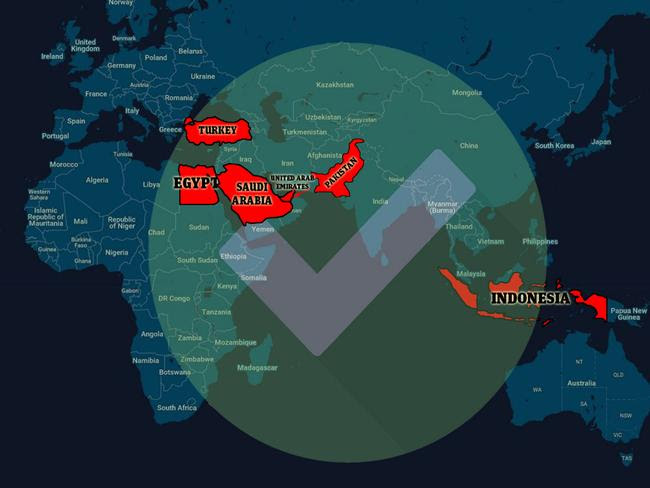
The countries conspicuously excluded from Mr Trump’s ban.Source:news.com.au
By contrast, several of the countries the president excluded are considered hotbeds of terrorism.
Just days ago, the US State Department updated a travel warning for Americans visiting Turkey, warning of an increased risk to its citizens. The country has suffered a wave of terror attacks in recent months, including the New Year’s Eve shooting at an Istanbul nightclub which left 39 revellers dead. Istanbul has been the target of many recent attacks by Islamic State and Kurdish extremist groups.
In December last year, 13 off-duty Turkish soldiers on a weekend shopping trip were killed and dozens more wounded in a car bombing. Dozens more people have been killed in other incidents in the past 12 months, including an attack which left 47 dead after a triple suicide bombing and gun attack at Istanbul’s Ataturk airport in June.
Mr Trump’s executive order also makes no mention of Saudi Arabia, despite the fact that 15 of the 19 September 11 hijackers once called it home.
29 Jan
 Frank Luntz
✔ @FrankLuntz
Reminder: The 19 hijackers on 9/11 were from Saudi Arabia (15), the UAE (2), Egypt (1), and Lebanon (1)
None of those countries are listed. https://twitter.com/foxnews/status/825476891733794816 …
Follow
Frank Luntz✔@FrankLuntz
The Boston bombers were from Russia, and 1 of the San Bern shooters was from Pakistan.
Neither country is listed. https://twitter.com/foxnews/status/825476891733794816 …
1:43 AM - 29 Jan 2017
322322 Retweets
331331 likes
Pakistan is not on the banned list despite a wave of terror attacks there, and long-running accusations that it’s been a state sponsor of terrorism.
The San Bernardino massacre, in which 14 people were killed, was perpetrated by Syed Rizwan Farook, who is of Pakistani descent, and his wife Tashfeen Malik, who grew up in Saudi Arabia.
The Pulse nightclub attack in Orlando, where 49 died, was carried out by Omar Mateen, a US citizen of Afghan descent.
The Boston Marathon bombing was orchestrated by the Tsarnaev brothers, both of whom were Russian.

US shooter Syed Rizwan, who is of Pakistani descent and wife Tashfeen Malik, who grew up in Saudi Arabia, were responsible for the San Bernardino massacre.Source:Supplied
BUSINESS LINKS
Mr Trump has been accused of excluding certain countries from the travel ban because he has business interests in those territories.
Liberal watchdog group Citizens for Responsibility and Ethics in Washington is among those accusing Mr Trump of a conflict of interest.
It has filed a lawsuit that alleges Mr Trump is in violation of a constitutional provision that bans federal officials from accepting payments from foreign officials, The Washington Post reports.
The group’s chairman, who is a former ethics adviser to Barack Obama, tweeted that the move was unconstitutional and pointed out the apparent hypocrisy of Mr Trump’s order.
Follow
 Norm Eisen @NormEisen
1/ WARNING: Mr. Pres. your Muslim ban excludes countries where you have business interests.That is a CONSTITUTIONAL VIOLATION.See u in court
2:49 PM - 26 Jan 2017
9,0169,016 Retweets
14,70414,704 likes
According to Bloomberg, the list of banned countries doesn’t include Muslim-majority nations where the Trump Organization has done business or pursued potential deals. This includes golf courses in the UAE as well as two luxury towers in Turkey.
In a full list Mr Trump’s perceived conflicts of interest, Bloomberg also revealed Mr Trump had business interests or ties with Egypt, Indonesia, Turkey and Saudi Arabia. In 2015, he registered eight hotel-related companies in Saudi Arabia and also has two companies in Egypt.
Pakistan and Afghanistan, both of which have suffered a spate of terror atrocities in recent years, also did not make the list.

President Donald Trump’s executive orders have sparked backlash across the world. Picture: Alex Brandon/APSource:AP
REAL REASON BEHIND THE ORDER
Dr David Smith, of the University of Sydney United States Studies Centre, said the executive order was hypocritical in the extreme, and Mr Trump’s strategy revolved around keeping America’s strategic allies onside.
Dr Smith, a senior lecturer in American politics and foreign policy, said it wasn’t in the US’s interest for oil-rich Saudi Arabia, for example, to be included in the ban, despite it being the “land of beheadings” and having been described as “ISIS with borders”.
Nations such as Pakistan were also a strategic military ally, he noted.
Dr Smith said Mr Trump’s business interests were not the sole reason for the order.
“The fact that a lot of Americans have business interests in places like Saudi Arabia, the UAE and Turkey is another reason (along with military and political alliances) that these countries don’t get included in travel restrictions,” he said.
The seven countries listed in the executive order had long been regarded as terror hot spots under White House policy, but they were also, with the exception of Iran, “poorer” and not in control of their populations.
“The fact remains the UAE, Egypt and Turkey are relatively wealthy allies of the US,” Dr Smith said.
“They tend to get exempt from things like this because the US doesn’t want to cause offence.
“The cost to the US (from the seven) is small, so is something they can afford.”
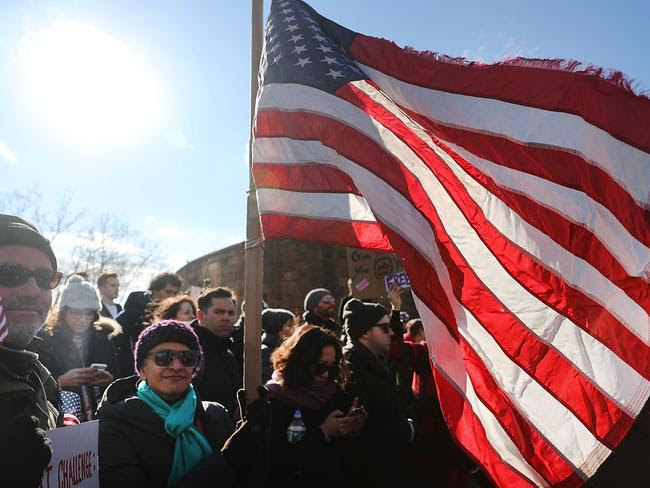
People attend an afternoon rally in Battery Park, New York, to protest Mr Trump’s new immigration policies. Picture: Spencer Platt/Getty Images/AFPSource:AFP
‘OBAMA DID THE SAME THING’
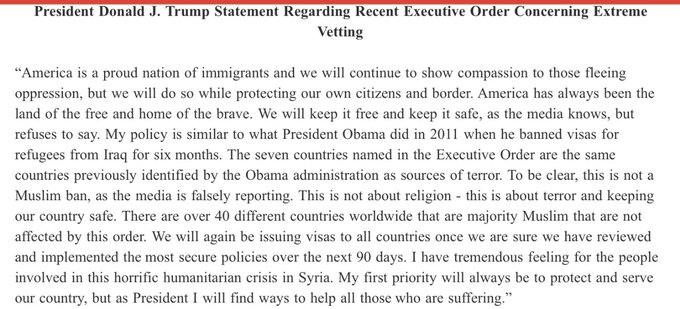
In a statement today, President Trump said America was “a proud nation of immigrants” and would “continue to show compassion to those fleeing oppression”.
Mr Trump said his executive order did not amount to a “Muslim ban” and the countries affected had previously been identified as “sources of terror” by the Obama administration. He also pointed out that Mr Obama levelled a “similar” ban against refugees from Iraq in 2011.
View image on Twitter
Follow
 Zeke Miller
✔@ZekeJMiller
NEW: President Donald J. Trump Statement Regarding Recent Executive Order Concerning Extreme Vetting
11:37 PM - 29 Jan 2017
142142 Retweets
122122 likes
“This is not about religion — this is about terror and keeping our country safe,” Mr Trump said today.
“We will again be issuing visas to all countries once we are sure we have reviewed and implemented the most secure policies over the next 90 days.”
Mr Trump highlighted that there were at least 40 Muslim-majority countries that were not affected by this order.
Dr Smith said it was true that Mr Obama banned visas to Iraqis, but it was only for six months.
While the Obama White House, as did previous administrations, maintained a longstanding policy to identify all seven countries as terrorist hot spots, citizens from the other six nations were never banned from entering the country.
Dr Smith said Mr Trump’s comments on Mr Obama were “misleading” because this ban is much wider in scope but also because it had also included permanent residents of the United States, which is totally unprecedented.
The Department of Homeland Security has now retracted that part.
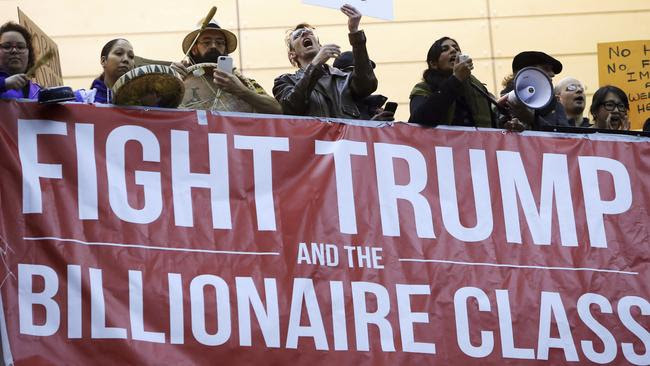
Donald Trump’s order restricting immigration to the US and puts an indefinite hold on a program resettling Syrian refugees has sparked reaction within the country. Picture: Genna Martin/seattlepi.com via APSource:AP
WHAT IT MEANS FOR AUSTRALIA
Dr Jiyoung Song, a director and research fellow at the Lowy Insitute’s Migration and Border Control Policy Project, said Mr Trump’s ban was hypocritical because it didn’t apply to other hot beds of terrorism.
“Trump is delivering on his campaign promises to ban Muslim immigrants,” Dr Song said.
“Some of those (orders) are temporary and some indefinite, but it’s a completely discriminatory and racist policy.”
Dr Song said while Australia had been given assurances that its refugee deal with the US would go ahead despite the executive order, it was now a question of how many would be accepted.
Under the deal reached with President Barack Obama last year, Australia agreed to take refugees from Central America if the US accepted a number of refugees in offshore detention centres. Dr Song said she expected the US wouldn’t take any of the single men on Manus but would look more towards taking refugees of a Christian background or families.
“Malcolm Turnbull will save face as the deal will still go ahead, but the critical issue will be the number of refugees taken,” she said.
‘THE WORLD IS ANGRY AS IT GETS’
Last week, in his first interview since taking office, Mr Trump told US broadcaster ABC News he didn’t believe his executive order would spark a backlash from the Muslim world.
ABC journalist David Muir questioned whether it was a Muslim ban, something Mr Trump denied. Instead, he insisted the executive order was about “countries that have tremendous terror”.
“You’re looking at people that come in, in many cases, in some cases with evil intentions. I don’t want that,” he said. “They’re ISIS (Islamic State). They’re coming under false pretence. I don’t want that.”
When asked why only certain countries would be included, Mr Trump said it would be “extreme vetting in all cases”.
“We are excluding certain countries. But for other countries we’re gonna have extreme vetting,” Mr Trump said. “It’s going to be very hard to come in. Right now it’s very easy to come in. It’s gonna be very, very hard. I don’t want terror in this country.”
Mr Muir also asked Mr Trump if he was concerned this move would spark anger in Muslim countries.
“There’s plenty of anger right now,” the President said. “How can you have more?
“The world is a mess. The world is as angry as it gets. What? You think this is gonna cause a little more anger? The world is an angry place.”
Subscribe to:
Posts (Atom)