Showing posts with label :Donald Trump. Show all posts

Wednesday, April 26, 2017

#OyVeyDonaldTrump's first 100 days ranked the very worst for any President except for William Henry Harrison who died after just 31 days in office after catching pneumonia at his outdoors inauguration ceremeony


Franklin D. Roosevelt invented the idea of a president’s first 100 days. Roosevelt was actually referring to the first 100 days of a special Congressional session to fight the Great Depression, as Robert Speel of Penn State notes. But the idea soon came to mean the 100 days that start on Jan. 20 and that, for President Trump, will end on Saturday.
No doubt, you’ve seen a torrent of coverage in recent days of the milestone. And while it’s certainly an arbitrary milestone, it’s also a meaningful one. Presidents are at their most influential in their early months, which makes that period a particularly important one for a presidency.


Here’s my reading of Trump’s start: It’s the least successful first 100 days since the concept existed.

Even if you forget about the content of his actions — whether they strengthened or weakened the country — and focus only on how much he accomplished, it’s a poor beginning. His supporters deserve to be disappointed, and his opponents should be cheered by how unsuccessful he has been so far.

Before now, the weakest starts probably belonged to Bill Clinton and to John F. Kennedy. Partly as a result, neither of them ended up being as consequential presidents as, say, Lyndon B. Johnson, Ronald Reagan or Barack Obama. And yet Trump’s first 100 days have been vastly weaker than Clinton’s or Kennedy’s:

Trump has made no significant progress on any major legislation. His health care bill is a zombie, and he’s only now releasing basic principles of a tax plan. By contrast, George W. Bush and Ronald Reagan had made substantial progress toward passing tax cuts, and Barack Obama had passed, among other things, a huge stimulus bill that also addressed education and climate policy.

Trump is far behind staffing his administration. Trump has made a mere 50 nominations to fill the top 553 positions of the executive branch, as of Friday. That’s right: He hasn’t even nominated anyone for 90 percent of its top jobs. The average president since 1989 had nominated twice as many, according to the Partnership for Public Service.

Part of the reason is a lack of execution: The administration has been slow to make nominations. And part of the reason is who is being nominated: A disproportionate number of affluent investors and business executives with many potential conflicts of interest that require vetting. Either way, the effects are real. The executive branch can’t push through the president’s priorities if it doesn’t have his people in place.

The Trump administration is more nagged by scandal than any previous administration. No new administration has dealt with a potential scandal anywhere near as large or as distracting as the Russia investigation. It could recede over time, true. But it also could come to dominate the Trump presidency.

Trump has no clear foreign policy. Is he protectionist, as he appeared to be when starting a trade spat with Canada on Tuesday, or a globalist, as he appeared when backing off his criticism of China? Is he an isolationist, an interventionist or some alternative? No one seems to know, which confuses allies and does a favor for rivals who would welcome diminished American influence.

Trump is by far the least popular new president in the modern polling era. His approval rating is just 41 percent, according to FiveThirtyEight. All other elected presidents since Roosevelt have had an approval rating of at least 53 percent after 100 days. (Gerald Ford was at 45 percent.) Some, including Obama, Reagan and Johnson, have been above 60 percent.

Trump’s low approval isn’t only a reflection of his struggles. It also becomes a cause of further struggles. Members of Congress aren’t afraid to buck an unpopular president, which helps explain the collapse of Trumpcare.

Obviously, Trump can claim some successes on his own terms. Most consequentially, he has named a Supreme Court justice who could serve for decades. Trump has also put in place some meaningful executive orders, on climate policy above all, and he has allied the federal government with the cause of white nationalism, as Jonathan Chait wrote.
Trump remains the most powerful person in the country, if not the world. It would be foolish for anyone to be complacent about what he can do. Yet by the modern standards of the office, he is a weak president off to a uniquely poor start.

It’s worth considering one final point, too. So far, I’ve been judging him on his own terms. History, of course, will not. And I expect that a couple of his biggest so-called accomplishments — aggravating climate change and treating nonwhite citizens as less than fully American — are likely to be judged very harshly one day.

For a different take on Trump’s first 100 days, read Ross Douthat’s column today. The full Opinion report from The Times follows, including Frank Bruni’s look at a university’s efforts to help underpriveleged students and Dawn Eden Goldstein on the Pope’s comparison of refugee camps to concentration camps.

Monday, March 13, 2017

The Elephant in the Room : The Mental Health of #OyVeyDonadl Trump republished from Psychology Today


The Elephant in the Room

It’s time we talked openly about Donald Trump’s mental health.

This post is in response to Shrinks Battle Over Diagnosing Donald Trump by Psychology Today Editorial Staff

In late 2015, we commenced what would become an ongoing conversation about then-presidential candidate Donald Trump’s mental health.

We were concerned that, given his “straightforward” or "outsider" presentation and charisma, he would appeal to people who were unaware of the dangers of his obvious narcissistic personality type, and the offensive behaviors that can accompany it. These behaviors include but are not limited to condescension, gross exaggeration (lying), bullying, jealousy, fragile self-esteem, lack of compassion, and viewing the world as Us-vs.-Them. Having observed the schoolyard-bully tactics Trump employed during public debates, as well as his boasting presentation during interviews, we felt it was important to raise awareness about his behaviors. So in January 2016, we posted Bullies: An Exploration Into Different Types of Bullies.

As Trump’s campaign, and his narcissism, gained momentum, so did our efforts. In March 2016, we posted The Narcissistic Personality: How to Spot a Narcissist, in which we shared clinically documented narcissistic behaviors and hoped it would be easy for readers to see that Trump fit every example.

And then on January 31 of this year, Psychology Today’s editors posted Shrinks Battle Over Diagnosing Donald Trump: Chaos in the White House Fuels Discord Amongst the Experts. The article reported on a petition by author and psychologist John Gartner, Ph.D., declaring that Trump has “a serious mental illness that renders him psychologically incapable of competently discharging the duties of President of the United States.” Gartner, a former professor of psychiatry at Johns Hopkins, is currently in private practice in New York and Baltimore. To date, more than 26,000 psychologists, psychiatrists, and other mental-health professionals have signed his petition, which has no legal power but drives home the point that these professionals are gravely concerned about the mental health of our president. The point of the editors' post was to highlight the conflict within the mental-health field: While some believe it is possible to diagnose through observation, some feel it is unethical and inappropriate to do so, while still others question whether or not psychology should be used to address issues of governance at all.

Duty to Warn

Journalist Lawrence O’Donnell has taken it upon himself to champion Gartner’s effort to help educate the public. On his MSBC program, The Last Word, he recently spoke with Gartner and Lance Dodes, M.D., a retired professor of psychiatry at Harvard Medical School, in a segment titled "Mental-Health Experts Say Donald Trump Is Unfit to Serve." Gartner contended that mental-health professionals have a duty to warn the public of dangerous individuals in their midst. According to Gartner, mental-health professionals can observe a person's behavior and words, from afar, and diagnose that person. He claimed that the idea of the psychiatric interview as the gold standard for assessment is not true, and added that we have thousands of hours of Trump’s behavior in front of us. He continued:

“As far as ethics go, I would argue with my colleagues that those who don’t speak out are being unethical. If we have knowledge and understanding about the unique danger that Donald Trump presents through our psychiatric training and we don’t say something about it, history is not going to judge us kindly.”


Dodes was asked by O’Donnell to watch and comment on a much-played clip of Trump claiming during a debate that he had lost "hundreds" of friends on 9-11. Dodes’ said there were two pieces to Trump’s lying: First, he lies because of his sociopathic tendencies — “He lies in the way a person scams people; he’s trying to sell an idea or a product by telling you something that’s not true.” The other aspect of his lying was more serious — his loose grip on reality. For example, when he lies and has been told that what he said is not true, he still carries on with the lie. Dodes said that this indicates Trump cannot accept an aspect of reality and therefore rejects it, making his grasp on reality, and his attention to it, loose. "This is an extremely dangerous trait in a president,” Dodes continued. "And that makes him unqualified.”

Both Gartner and Dodes agreed that as far as the depth of mental illness, this is the "worst case" scenario. Gartner added, "He’s just sane enough to ‘pass’ but is detached from reality." Gartner argued that what is real for the president is fluid, meaning that it’s malleable. Combine this non-reality with paranoia, and being at a hand’s reach of the nuclear codes is troubling. "He actually imagines he is under attack by people who are not actually attacking him,” Gartner said, creating "a very dangerous combination of someone who can act on his paranoid fantasies in a way that can have catastrophic consequences.”

The Elephant in the Room

On his next broadcast, O’Donnell interviewed author Lee Siegel, who recently wrote an article for the Columbia Journalism Review titled, "Avoiding Questions About Donald Trump’s Mental Health Is a Betrayal to Public Trust." (Dodes appeared again as well, and both enlightening segments can be viewed here.)

It’s important to note that Siegel wrote:

“Mental illness does not need to be professionally diagnosed. We don’t need to be told by a doctor that the guy coughing and sneezing at the other end of the train car is probably sick...When someone is compulsively lying, continuously contradicting himself, imploring the approval of people even as he is attacking them, exalting people one day and abusing and vilifying them the next, then the question of his mental state is moot. The safe thing to do is not just to stay away from him, but to keep him away from situations where he can do harm.”

In "Time Perspective Therapy" Terms
Through our observations, we can see Trump as embodying an unconstrained present hedonist—living only in the present moment and saying whatever it takes to pump up his ego and assuage his inherent low self-esteem, without thought of past reality or potentially devastating future consequences. He is the poster boy for a time perspective that is totally unbalanced. Unfortunately, given his personality type, there is little hope of reversal or any meaningful improvement.
Our Future

What can we do? Be observant. Be vigilant. Share this article to spread awareness. Write or call your elected government officials and state your concerns about Donald Trump’s mental health. And hope that with the backing of 26,000 mental-health therapists (a number that continues to grow — last month the number was 18,000) in agreement that he is mentally unfit to be President of the United States, we will have a new, mentally fit president as soon as possible through some judicially appropriate political action.

No matter whom you voted for in the election, or if you didn’t vote, we the people did this — at least those of us representing an Electoral Colleges majority. We need to correct this threat to our ecology, our society, and our international relations soon—before it's too late.

Thursday, March 2, 2017

@realDonaldTrump Versus the European Union #RIPPAxAmericana ? or revived #PaxAmericana like never seen before without the $ cost

Image result for Donald Trump RIP Pax Americana cartoon

Members of the European political and media establishment seemed to be sure that the 45th president of the United States would be Hillary Clinton, or at least they were desperately hoping so. The days after the election one could hear clamor of indignation from top journalists and politicians alike. It almost felt as if the European project had lost shoulder to shoulder with Clinton, now that America, Europe’s most powerful ally, would be ruled by an “inhuman right-wing populist,” an outspoken critic of the European Union, and a sympathizer of the UK Independence Party. And after all he says “America first.” For the European establishment, this is an outrageous position to hold for an American president.
General secretary of the ruling Socialist Party in France, Jean-Christophe Cambadélis, has compared Trump to the Front National’s top candidate Marine Le Pen and noted that the French Left knew full well about the challenges ahead. French prime minister Manuel Valls emphasized that Europe needs to close its ranks, take responsibility and respond to the events on the other side of the Atlantic Ocean, adding that he does not believe in “the triumph of simplicity and demagoguery.”
German minister of foreign affairs Frank-Walter Steinmeier who called Trump a “preacher of hate” during the election campaign stated shortly after the outcome was certain that “American foreign policy will now become less predictable,” but that Germany “should not sit mesmerized like the rabbits before the snake.” Germany “should remain self-confident and needs to preserve its culture of public and political discourse.” But who knows to what kind of cultivated discourse he was actually referring?
Indeed, Donald Trump was compared to Adolf Hitler in German television news at one point in his campaign when he had already far exceeded the expectations of most pundits. But, hardly anyone could imagine him becoming the next US president. On the very evening of November 9 when the unthinkable was taking shape, the consortium of public broadcasters in Germany (ARD) presented a survey according to which only 4 percent of the German electorate would have voted for Trump. One wonders whether this representative survey was conducted exclusively among the employees of the consortium.
When the Austrian presidential candidate and populist Norbert Hofer lost to Alexander Van der Bellen in early December, the EU establishment had its first moment of relief since the Brexit vote in the United Kingdom last June. “Hofer has hoped for the Trump effect in vain” ARD’s news anchor declared somewhat triumphantly at the evening of the election.
However, at the same time the Italian people voted against President Matteo Renzi’s proposal to change the Italian constitution, which led to his resignation and potentially a chance for the Eurosceptic Five Star Movement around comedian Beppe Grillo to form the new national government after early elections. This means that the three largest countries of the Eurozone and the EU (UK excluded), Germany, France and Italy, will hold national elections within the next year. The Italian daily La Stampa wrote that the referendum “tells the same story as Brexit and Trump.”
Hence, it is pretty obvious that almost all political events and ongoing developments in Europe are now interpreted in light of Trump’s victory. There is no question that Trump already has had an impact on European politics regarding strategy and rhetoric.
Looming Economic Realities in Europe
The most important issues, after the currency and debt crisis has mysteriously vanished from the scene for a time, is immigration, the stabilization of the Middle East, and how to react to millions of people coming into Europe.
Trump has such a significance for the political regime of the EU, among other things, because he was elected while openly advocating positions not expected to be capable of winning a majority, either in the US, and most certainly not in Europe. It runs completely against the position that the US government under Bush and Obama has taken, that Clinton sought to continue, and that the political leadership of the EU still wholeheartedly advocates and that is embedded in a broader political program. It is a program that mainstream media is vigorously promoting by emphasizing the benefits of open borders, diversity and multiculturalism, the importance of humanitarian assistance, as well as an official responsibility of the West to improve living conditions in the developing nations of Africa and Asia. That the latter so regularly turns into the very opposite in the form of aggressive military interventions is deliberately hushed up. Trump’s anti-interventionist positions in foreign policy have, against all odds, successfully challenged the globalist line of approach.
After an initial period in which Trump and his supporters were arrogantly ridiculed, a good dose of European superiority complex, vis-à-vis the US, was breaking through, and the general tenor has changed. In an act of self-defense, European political and media elites have desperately tried to make a bogeyman out of Trump and the movement behind him as they saw the broader implications it might have.
Trump was admittedly courting some of the slogans used against him, but most of them are just hysterical exaggerations or allegations. And, while the European establishment claims a position on the moral high-ground, even the most promising aspect of Trump’s advocated isolationism from a humanitarian viewpoint — withdrawal from foreign military interventions — is turned against him. It is argued that Trump will abandon Europe and that European countries will have to substantially increase their own military budgets in the future.
The fact that the aggressive foreign policy of the West under the leadership of the US over the past decades has triggered the destabilization of the Middle East and Northern Africa in the first place, and hence reinforced the immigration crisis that Europe is facing right now, is not critically highlighted at all.
Trump Will Be an Excuse for More Centralization
The EU establishment has obviously itself contributed to the problems it now tries to exploit in order to further centralize the political power structure of Europe. Trump will serve as a scapegoat that left Europe alone in the midst of an international conflict and humanitarian crisis. This narrative was spread before Trump had been in office for a single day, and it will be used as a justification for more intrusive EU policies if the peoples of Europe let it happen. However, chances are that the national governments all over Europe will face ever stronger opposition in the near future, if they are not directly replaced. Unfortunately, these opposition movements are not pushing in the right direction in every respect. But, all our problems will not be solved with next round of national elections anyway. They are much more fundamental and ideological. They are of a long-term nature.

Friday, December 23, 2016

#RIPUSA Obama shows his colours ( finally) Israel and Zion .... Two Presidents Two Policies


 Image result for obama and trump in the white house
#RIPUSA Obama shows his colours ( finally) Israel and Zion .... Two Presidents Two Policies . . On just about everything else.... LBGTQ rights, Abortion Right, Privacy, Freedom of the Press, Donald Trump spells disaster .....back to 60 and 70's but on Israel, Zion and Judaism he may edge Truman as the post pro Israel President yet.

So what happens when the most powerful country in the world effectively has two presidents at once? Its policy regarding one of the most complex conflicts on the planet collapses into a muddled mess.

Or, more precisely, you have what unfolded over the last 48 hours: The Egyptian government submits to the UN Security Council a resolution against Israeli settlements in the West Bank and East Jerusalem. This raises the possibility that the Obama administration could express its opposition to Israeli settlement policy by abstaining from the vote, rather than vetoing the resolution as it had with a similar one in 2011. Enraged Israeli officials call up Donald Trump, who tweets that the United States should veto. Abdel Fattah el-Sisi, the president of Egypt, abruptly calls off the vote. At some point during all this, Trump has a phone conversation with Sisi where they chat about jointly solving various issues in the Middle East. Anonymous Israeli officials, essentially siding with the incoming Trump administration, criticize Obama in unusually harsh terms for plotting with the Palestinians to abandon Israel at the United Nations. A day later, Malaysia, New Zealand, Senegal, and Venezuela reintroduce the resolution, which comes to a vote and is adopted by the Security Council, including Egypt, with the United States abstaining. Barack Obama delivers a powerful parting message to Israel’s leaders that is powerfully undercut by Donald Trump’s opening message. “As to the U.N., things will be different after Jan. 20th,” Trump tweets shortly after the vote.

Still with me?

Transitions of power are always awkward, uncertain moments in the life of a nation and its relations with the world. Richard Nixon’s campaign aides, for example, allegedly interfered with Vietnam War peace talks organized by Lyndon Johnson. But Donald Trump has involved himself in international affairs like no U.S. president-elect in recent memory. NBC News reviews some of the history:


President Bill Clinton told the press after his 1992 victory that he would “reaffirm the essential continuity of American foreign policy” and recognized “that America has only one president at a time.”

President George W. Bush declined questions on topics like North Korea and Israel until he took the oath of office in early 2001. “We have one president, and we’ll have one president, and the current president is President Clinton, and our nation must speak with one voice,” Bush said at a press conference.

In 2008-2009, Barack Obama’s transition team repeatedly invoked the norm that the United States has “only one president at a time” to explain why Obama was staying silent on issues like the Gaza War. That “constitutional principle,” Obama’s incoming press secretary said at the time, is “extremely important in the arena of foreign policy,” where it must be “clear who is speaking on behalf of the United States.” Noting the “delicate negotiations” that were occurring at the time between Israelis and Palestinians, Obama argued that “we can’t have two voices coming out of the United States when you have so much at stake.”

Yet in the waning days of 2016, two conflicting voices on high-stakes international issues is exactly what we have. Barack Obama is vowing to retaliate against the Russian government’s interference in the U.S. election; Donald Trump is questioning whether Russia interfered and thanking Vladimir Putin for his “very nice” Christmas card. Obama’s Pentagon demanded that China return a U.S. underwater drone seized in the South China Sea; Trump elevated the incident to an “unprecedented act” and then suddenly reversed course, suggesting the Chinese just “keep” the darn thing. Obama is dismantling a registration system for visitors from many Muslim-majority countries; Trump might soon revive it.

These contradictions have created such confusion in recent weeks that Jared Huffman, a Democratic congressman from California, has introduced legislation to amend the 1799 Logan Act, which prohibits unauthorized private citizens from conducting U.S. foreign policy. Huffman wants to clarify that the law applies to presidents-elect, since “only the president, not the president-elect who is fresh off the campaign trail and not yet in office, has the authority to make critical foreign-policy decisions that impact America’s safety, economy, and global standing.” The legislation is still pending, with weeks to go before inauguration.

Wednesday, December 14, 2016

#RIPUSA Have Trump Tweets Replaced Fed Speak? The DOD? The State Department? The Surgeon General? NASDAC? NYSE?

Image result for trump twitter cartoon
Another day, another Tweet from President-elect Trump has moved the market.


Lockheed Martin shares have taken a tumble following Trump highlighting the obvious on Twitter — the F-35 is an expensive boondoggle. This follows shares of Boeing dropping last week following a social media outburst criticizing the costs of a new Air Force One (the stock bounced back following the Obama Administration’s assurance there was nothing to see here), as well as a number of pharmaceutical companies seeing their stock impacted following criticism of drug prices in America. Meanwhile shares of Sprint benefited after Trump held an impromptu press conference with Masayoshi Son, CEO of SoftBank which owns the US-based cellular provider.

Last week Kellyanne Conway appeared on CNBC’s Squawk Box and was asked about the power of the soon-to-be POTUS’s social media. Her response signaled that the Trump team understands the influence he wields on the market and plans to continue using it:

President-elect Trump sees that he has this massive online platform, he says about 35 million on Twitter and Facebook combined. ... And he sees an opportunity to communicate right to people by cutting through the noise or the silence, whatever the case may be, through social media platforms. But you see that through tweets now he can affect industry, he affected the stock market yesterday, frankly, and he did it twice.
While some are rightfully horrified at the idea of bulls and bears being unleashed via Twitter, this is essentially a blunter version of the “forward guidance” policy of Ben Bernanke. While a tweet from @RealDonaldTrump is far more entertaining than an John Hilsenrath article explaining what a Fed press release REALLY means, the end result is the same: the market being steered purely based on the words of a prominent government official (or a soon to be one.)

It will be interesting to see to what extent Trump’s actions match his tweets. After all, Janet Yellen was forced to recently admit to Congress that the Fed’s forward guidance had lost its potency after they continued to signal rate increases that never happened. Even Yellen’s attempt to move away from Bernanke’s preference of steering via vague wording to a more data-driven approach couldn’t revive trust in the Fed that cried wolf.

Whether it be via tweet or press release, the idea of having our economy guided via messaging is inherently absurd. This is the unfortunate product of an economy totally detached from real market prices, one where even the most cautious investors are forced out of traditional safe investments and into frothy markets, desperately following momentum to get real returns on their savings.

If President Trump is the conclusion of decades of botched economic policy enriching the financial elite at the expense of the rest of society, then financial managers investing based on exclamation point-saturated Trump tweets is the perfect illustration of just how absurd the whole game has become.

Though it will offend the sensibilities of those in the financial media that have enjoyed casting central bankers as heroic figures following the financial crisis, their track record has shown that a building full of PhD’s is no better equipped to pick winners and losers in the economy than a former reality star sitting in his luxurious Trump Tower suite.

Of course Trump has more weapons at his disposal than those at the Fed, a reason why his tweets carry so much weight.

Next month he will inherit the most powerful executive branch in history, thanks to decades of consolidating power in the executive branch. His army of regulators and bureaucrats can ruin the lives of any business owner, or have his favor be their greatest asset. And this is precisely the problem.

We need to end the era of personality-driven policy, and return to an economy based on rewarding real production and the creation of value. This can only come by decoupling the economy from politics, which requires: massive deregulation, the abolishment of programs designed to subsidize both markets and individual businesses (such as the housing GSEs or the Ex-Im Bank), and a return to sound money beyond the manipulation of policy makers — such as the gold standard.

This may sound like a broken record for anyone who listened to Ron Paul over the years, but that’s because these principles are timeless. Markets know better than anyone in New York City, regardless of their address.

The fact American policymakers still think otherwise is, as Trump may Tweet, “Sad!”

Tuesday, December 13, 2016

#RIPUSA Electoral College voters under intense pressure


The 538 delegates to the Electoral College will gather at governors’ offices and statehouses across the country Monday to make President-elect Donald Trump’s victory over Democrat Hillary Clinton official.

The results aren’t expected to deviate much from Election Day, when Trump won 306 electoral votes to Clinton’s 232.

Despite media coverage, social media chatter and announcements from a handful of electors who have made their protest votes public, it’s unlikely that electors will defect in significant numbers.
Even so, scattered groups of liberals are using every means at their disposal — lawsuits, petitions, and public and private pressure — to try to convince 37 GOP electors to peel away from Trump to deprive him of the 270 votes needed for victory.
Bob Muller, a GOP county chairman in North Carolina and a Trump elector, said he’s gotten correspondence from “everywhere from Maine to California” asking him to vote differently.
“I just ignore them,” Muller said.
So far, only a few Electoral College voters have publicly declared that they will not back the candidates that their states supported — including just one of the 37 Trump voters that the self-styled Hamilton Electors, a group of mostly Democrats, need to make any noise on Monday.
And even if the rogue electors achieve their aims, they would only succeed in sending the election to a Republican-majority House, which would almost certainly certify Trump’s victory.
Virtually all Republican electors reached by The Hill said they will vote enthusiastically for Trump.
“I’m voting how the people of Florida have told me to vote,” said Brian Ballard, a Florida elector who raised money for Jeb Bush and Marco Rubioduring the GOP primary. “I don’t know anyone who isn’t. I appreciate people using First Amendment rights to reach out and try to convince me otherwise, but I’m obligated to support Trump because he won Florida. 
“Also, I love the guy and want him to be president.”
Faithless electors are rare but not unheard of in American history.
Only 82 electors in history have voted against their state’s popular vote for personal reasons. Another 71 electors have changed their votes after the death of a candidate. None of those instances have ever changed the outcome of an election, according to data compiled by the nonprofit group FairVote. 
There have been only nine cases in the past 100 years of electors breaking from their jurisdiction’s popular vote. Each of those instances happened in a separate election.
It’s been more than 100 years since a group of electors have banded together to choose a different candidate. The most recent push came in 1912 after President William Howard Taft’s vice president died.
Political experts warn that an Electoral College revolt next week — particularly one waged on the heels of such a bitterly divisive election — would cast the nation into crisis. It could roil the financial markets, further harden political divisions and set off an unprecedented struggle for power.
“It would give a lot of people serious confusion and create a sense of panic, even though it would be a perfectly legal, logical progression,” said Brandon Rottinghaus, a political science professor at the University of Houston.
But that hasn’t stopped some liberals from launching a last-ditch effort to block Trump through the Electoral College.
On Capitol Hill, two Democratic lawmakers, Reps. Jim Himes (Conn.) and David Cicilline (R.I.), have openly advocated for an Electoral College revolt.
Lawsuits are underway in California, Washington and Colorado challenging state laws that bind the delegates to voting for their party’s nominee. A federal judge dismissed the case in Colorado on Monday as a “political stunt,” though an appeal could be in the works.
Some Democratic electors have justified their efforts by pointing to Clinton’s 2.8 million popular vote margin to argue that Trump’s victory was illegitimate.
Others are seizing on media reports about Russian interference in the election to demand intelligence briefings for all of those casting ballots, believing it could cause some GOP delegates to abandon Trump. Clinton campaign chairman John Podesta publicly backed the intelligence briefings on Monday.
Meanwhile, several high-profile liberals and progressive groups, like former Labor Secretary Robert Reich, academic Lawrence Lessig and the Progressive Change Campaign Committee (PCCC), are providing logistical support and helping the interested parties to coordinate behind the scenes. Lessig has offered legal help to faithless electors who come from states with laws that prohibit voting for anyone but the winner of the state.
With less than a week before the vote,  though, liberals have very little to show for their efforts.
Only one Republican elector, Chris Suprun of Texas, has publicly said he won’t vote for Trump. Suprun told The Hill that he’s “confident” he won’t be the only Republican to buck Trump, but no others have made their intentions public.
Democratic electors would have a better chance of blocking Trump if they joined 38 GOP electors in supporting a Republican alternative, like Ohio Gov. John Kasich, but there is little appetite for that on either side. Kasich himself shot down the idea of using him as a compromise candidate last week.
At this point, the effort appears to be more about undermining Trump, complicating his ability to govern and following personal convictions — and less about actually winning the Electoral College for another candidate.
“I am not looking to be satisfied with just the vote on Dec. 19 or 20, but on January of 2030, when Mr. Trump has either served no time, one term or two terms,” Suprun told The Hill. “History is going to judge my actions on whether he turned out to be Ronald Reagan, Herbert Hoover or Richard Nixon.”
Liberals efforts are a long shot in part because many of the GOP delegates aren’t reluctant Republicans supporting their party’s candidate but outright Trump supporters. That list includes Pam Bondi, the Florida attorney general and close Trump ally, and Ed Crawford, a top fundraiser for Trump in Ohio.
Other Trump electors are GOP loyalists with political ambitions who would risk being frozen out of the party should they break from Trump.
Still, the pressure on these delegates has been intense.
While most electors say that they’re not hearing much from the Democratic delegates who are purportedly campaigning to get GOP electors on board, they’re still being flooded with letters, emails and phone calls from private citizens across the country urging them to abandon Trump.
Ballard said he has received more than 500 letters and postcards to his home address from people pleading with him not to vote for Trump. He’s also a defendant in at least one lawsuit against all of the Florida electors that claims voter fraud caused Trump’s victory in the state.
Peter Feaman, another Florida elector, responds with a form letter as long as “the sender is from Florida and is polite.”
“I will follow the will of the voters,” his response reads in part. “This is how this Republic works. It is governed by the rule of law, not individual feelings and fears. I fear you have fallen victim to the unwarranted fear-mongering put out by those that oppose Mr. Trump.”
No Republicans interviewed by The Hill are worried about the outcome.
“I don’t take it seriously at all,” said conservative lawyer Jim Bopp. “It’s inconceivable.”

Wednesday, November 30, 2016

#RIPUSA Congress Should "Pack" the Supreme Court


One of the many political myths to which Americans continue to cling is the idea that the Supreme Court is an "non-political" institution and that its traditions and institutional framework are sacrosanct.

The court has never been non-political, of course, and has always been composed of political appointees closely connected to elected officials in Washington.

Indeed, the truly political nature of the court is well documented. Its politics can take many forms. For an example of its role in political patronage, we need look no further than Earl Warren, a one-time candidate for president and governor of California, who was appointed to the court by Dwight Eisenhower. It is widely accepted that Warren’s appointment was payback for Warren’s non-opposition to Eisenhower’s nomination at the 1952 Republican convention. The proposition that Warren somehow transformed from politician to Deep Thinker after his appointment is unconvincing at best. Or we might point to the famous “switch in time that saved nine” in which Justice Owen Roberts completely reversed his legal position on the New Deal in response to political threats from the Franklin Roosevelt administration. Indeed, Supreme Court justices are politicians, who behave in the manner Public Choice theory tells us they should. They seek to preserve and expand their own power.

Similarly dubious is the idea that the court must be composed of nine judges and that the US Senate has an obligation to appoint new members when a vacancy occurs. It is even widely assumed that the US Constitution dictates the size and makeup of the Supreme Court. In truth, the Constitution is silent on this matter, the Court has not always been composed of nine judges, and there have not always been an odd number of justices. At times, the Court has functioned on a super-majority model.


Following the death of Antonin Scalia, though, many otherwise-well-informed people were absolutely convinced that the US Senate was acting contrary to the Constitution when Senate Republicans announced they had no intention of filling the vacancy until after the 2016 election.

Indeed, this puts Trump in the position of appointing potentially more than one Supreme Court justice during a single four-year term. He comes in with a vacancy on day one, and the three oldest members of the Court are all left-leaning judges — which means the complexion of the Court could be changed considerably over Trump's term.

While the political climate will no doubt result in a Scalia replacement being picked relatively soon, the Senate has no obligation to ever ratify anyone to fill the Scalia vacancy. The Senate is constitutionally free to refuse to confirm any new justices indefinitely, thus making a de facto change in which the Court consists of eight justices. The Congress overall is also free to pass a law formally reducing the size of the court. But it need not do so.
Undermine the Court by Making It Bigger

However, there is no reason why the Congress could not go in the opposite direction and appoint multiple new members to the Supreme Court. It certainly has the Constitutional authority to do so. As was the case with Franklin Roosevelt's so-called "court-packing" plan, enormous reforms to the Supreme Court require nothing more than a change in statute, or in come cases, Senate inaction.

This move would help to make it abundantly clear the fact that the Supreme Court is a political institution just as it was always intended to be. It would also be helpful in asserting Congressional supremacy over the Court. Apart from the Constitutional mandate that there be a Supreme Court — of indeterminate nature — it is totally a creature of Congressional regulation.

If Congress wishes it, it could fill the Scalia vacancy, and then add three or more seats in recognition of the approaching deaths and (possible) current senility of Justices Breyer (age 78) Kennedy (age 80), and Ginsburg (age 83).

As justification, Congress need only explain that the 3 new seats will allow for new justices to be ready and already trained on "day one" following the next death or resignation on the Court. Congress can elect to then not fill the Ginsburg vacancy (for example) and allow the court to slowly revert to nine judges.

But why be so conservative? Given that the Supreme Court is now more of a Supreme Legislature than a Supreme Court — issuing what are essentially Constitutional amendments with each new ruling — the court could quite reasonably be expanded to be more representative of the 320 million people the justices like to continually boss around.

Indeed, as the court has become vastly more powerful, it has become far less representative. In 1790, for example, there was one Supreme Court judge for every 600,000 Americans. Today, there is one Supreme Court judge for every 35 million Americans.

If one seeks a court that actually knows something about what's going on the United States, the very least the Congress could do is increase the size of the court to 50 justices with the intent of having one justice from each of the 50 states.

On the other hand, perhaps we're just wasting our time with details when what we reallyshould be doing is stripping the Court of everything but its Constitutional powers. After all, the US Constitution grants jurisdiction to the Supreme Court in only a small handful of cases. According to the text:


The judicial power shall extend to all cases, in law and equity, arising under this Constitution, the laws of the United States, and treaties made, or which shall be made, under their authority;--to all cases affecting ambassadors, other public ministers and consuls;--to all cases of admiralty and maritime jurisdiction;--to controversies to which the United States shall be a party;--to controversies between two or more states;--between a state and citizens of another state;--between citizens of different states;--between citizens of the same state claiming lands under grants of different states, and between a state, or the citizens thereof, and foreign states, citizens or subjects.

In all cases affecting ambassadors, other public ministers and consuls, and those in which a state shall be party, the Supreme Court shall have original jurisdiction. In all the other cases before mentioned, the Supreme Court shall have appellate jurisdiction, both as to law and fact, with such exceptions, and under such regulations as the Congress shall make.

Constrained to its Constitutional powers, the Court would effectively have no power at all over anything that took place within the boundaries of a single state. Moreover, outside the Supreme Court, the federal court system is totally at the mercy of Congress since the Constitution stipulates that federal courts exist only when "Congress may from time to time ordain and establish" them.

In all of this, however, the important thing to keep in mind is that the Supreme Court does not demand our reverence, our awe, or our respect for its little traditions and institutions.

#RIPUSA Trump's Student Loan Plan Treats the Symptoms, Not the Disease


Image result for cartoon trump student loans


At a campaign stop in Columbus, Ohio, one month before election day, Donald Trump shared his plan for addressing voters’ growing concerns about student loan debt.

Trump’s student loan repayment plan came late in the campaign cycle, long after Senator Bernie Sanders and Secretary Hillary Clinton released their respective plans, both of which would have increased government intervention in higher education, further distorting the already-convoluted education and student loan markets.

At the time of his speech, Trump’s proposal seemed likely to elicit support from voters, especially among millennials concerned about college affordability and rising levels of student loan debt. From 1980–2014, the cost of attending college rose by nearly 260 percent. Total student loan debt is nearing $1.25 trillion, and over 43 percent of former students who borrowed from the federal government are in default, behind on their payments, or aren’t making payments on their federal student loans.

Free market advocates had hoped that Trump’s proposals would constructively tackle the causes of the student loan bubble. Alas, this was not to be. Instead, Trump’s plan bears more similarities to alternative plans released by Obama, Clinton, and Sanders than many conservatives would like to admit.

Called “the most liberal student loan repayment plan since the inception of the federal financial aid program” by The Washington Post, Trump’s proposal would cap repayment at 12.5 percent of a borrower’s discretionary income. Furthermore, a borrower’s remaining student loan balance would be forgiven after he or she makes their full payments for 15 years. While it’s possible that Trump has consideredrestoring the pre-2010 system, in which private banks (instead of the government) issue student loans, such loans would still be subsidized and guaranteed by the federal government, eliminating much of the risk that incentivizes banks to engage in prudent and sustainable lending.

Why College Costs Are So High

Basic economics helps us predict how Trump’s student loan plan would affect the greater economy and the financial welfare of individuals. At any given time, there exists a limited amount of funds available in capital markets. This capital can be directed toward any number of alternative uses (home loans, car loans, business loans, etc.). But government artificially boosts demand for student loans when it intervenes in the market by enabling student borrowers to repay less than the balance of their loan. Moreover, when student loans are subsidized — as they are today — demand is greater (and thus, prices are higher) than they would have been otherwise. This artificial demand for student loans bids capital away from alternative uses, making it more difficult for families and businesses to receive loans for other important purposes.

Moreover, the cost of Trump’s plan to taxpayers would be steep. The federal government (and, by extension, current and future generations of taxpayers) would be responsible for paying the remaining balance of everyone’s student loan debt after their loans are forgiven. Colleges and universities would grow even richer, receiving billions of dollars as wealth is redistributed from America’s taxpayers to its institutions of higher learning.

In the face of increased demand for student loans, unless supply keeps pace with demand, prices will inevitably rise. Millions of students have become burdened with previously unimaginable levels of student loan debt needed to finance schooling that has been made artificially expensive by government intervention.

If Trump had been sincerely concerned about college affordability and the soon-to-burst student loan bubble, his plan would have eliminated the federal student loan system entirely. As Jason Morgan predicted in his recent article for Mises Wire, “Without the artificial demand generated through taxpayer-funded subsidies, universities [would] be forced to lower their tuition prices to meet what students and their families are able and willing to pay. This new reality [would] force higher education institutions to adapt to the needs of students.”

Instead of addressing the underlying cause of the problem (namely, the inflated cost of education resulting from federal education subsidies), Trump’s proposal attempts to mitigate the regrettable effects of government’s intervention into the student loan market by forgiving the debt of millions of working professionals.

While Trump’s proposal might score him political points among millennials saddled with an excessive amount of student loan debt, it certainly doesn’t make good economic sense. We might momentarily feel better if our student loan payments are reduced and our balances are forgiven, but we will all be poorer because of it.

Wednesday, November 23, 2016

Donald Trump continues to back track on campaign promises #RIPUSA, $AmericaHangsItsHead Inshame,#KeepTrumpInCheck


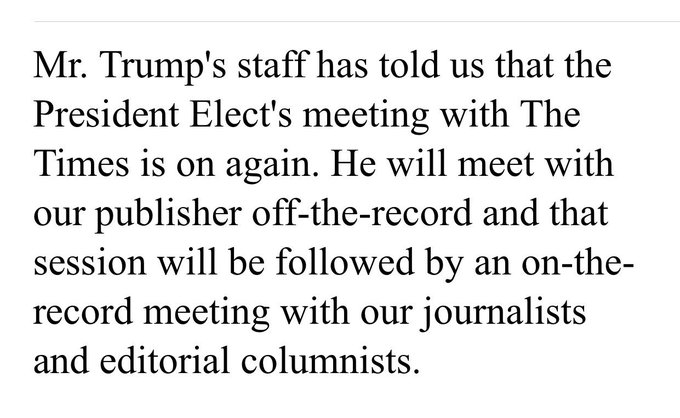
Donald Trump meets with the “failing” New York Times, takes back much of what he campaigned on Donald Trump meets on the record with the Times and leaves everyone wondering, What does he actually stand for?

Onlookers watch as President-elect Donald Trump shakes hands with a security guard as he leaves the New York Times building following a meeting, Tuesday, Nov. 22, 2016, in New York. (AP Photo/Mark Lennihan)(Credit: AP)


While the heads of broadcast news and cable news networks agreed to meet on Monday with President-elect Donald Trump off the record at his New York high-rise, The New York Times did not. Yet on Tuesday the newspaper that Trump had often maligned was still granted a sit-down interview with him on Tuesday — after he first tweeted otherwise! — that was on the record and quite revealing, according to many of the reporters in the room who live tweeted the event.
And Times staffers also tweeted what Trump had to say about climate change:
Yet Trump’s own past tweets on the matter of climate change have taken quite a different tone:
And here’s what Trump himself had to say about The New York Times on Tuesday:
Yet he has said the following about the Times — as recently as early Tuesday morning:
Here’s what Trump said about President Barack Obama during his Tuesday meeting at the Times:
But Trump has in the past has tweeted this about Obama’s birth certificate:
Trump said the following on Tuesday about his adviser Steve Bannon, who has served as an executive of Breitbart: 
ADVERTISEMENT
Trump said this on Tuesday about Hillary Clinton, according to Times staffers: 
But keep in mind just a little more than a month ago Trump tweeted the following about Clinton:
Sophia Tesfaye
Sophia Tesfaye is Salon's Deputy Politics Editor and biggest Golden State Warriors fan in Brooklyn. You can find her on Twitter at @SophiaTesfaye.