Showing posts with label . #RIPUSA. Show all posts

Wednesday, April 26, 2017

#OyVeyDonaldTrump's first 100 days ranked the very worst for any President except for William Henry Harrison who died after just 31 days in office after catching pneumonia at his outdoors inauguration ceremeony


Franklin D. Roosevelt invented the idea of a president’s first 100 days. Roosevelt was actually referring to the first 100 days of a special Congressional session to fight the Great Depression, as Robert Speel of Penn State notes. But the idea soon came to mean the 100 days that start on Jan. 20 and that, for President Trump, will end on Saturday.
No doubt, you’ve seen a torrent of coverage in recent days of the milestone. And while it’s certainly an arbitrary milestone, it’s also a meaningful one. Presidents are at their most influential in their early months, which makes that period a particularly important one for a presidency.


Here’s my reading of Trump’s start: It’s the least successful first 100 days since the concept existed.

Even if you forget about the content of his actions — whether they strengthened or weakened the country — and focus only on how much he accomplished, it’s a poor beginning. His supporters deserve to be disappointed, and his opponents should be cheered by how unsuccessful he has been so far.

Before now, the weakest starts probably belonged to Bill Clinton and to John F. Kennedy. Partly as a result, neither of them ended up being as consequential presidents as, say, Lyndon B. Johnson, Ronald Reagan or Barack Obama. And yet Trump’s first 100 days have been vastly weaker than Clinton’s or Kennedy’s:

Trump has made no significant progress on any major legislation. His health care bill is a zombie, and he’s only now releasing basic principles of a tax plan. By contrast, George W. Bush and Ronald Reagan had made substantial progress toward passing tax cuts, and Barack Obama had passed, among other things, a huge stimulus bill that also addressed education and climate policy.

Trump is far behind staffing his administration. Trump has made a mere 50 nominations to fill the top 553 positions of the executive branch, as of Friday. That’s right: He hasn’t even nominated anyone for 90 percent of its top jobs. The average president since 1989 had nominated twice as many, according to the Partnership for Public Service.

Part of the reason is a lack of execution: The administration has been slow to make nominations. And part of the reason is who is being nominated: A disproportionate number of affluent investors and business executives with many potential conflicts of interest that require vetting. Either way, the effects are real. The executive branch can’t push through the president’s priorities if it doesn’t have his people in place.

The Trump administration is more nagged by scandal than any previous administration. No new administration has dealt with a potential scandal anywhere near as large or as distracting as the Russia investigation. It could recede over time, true. But it also could come to dominate the Trump presidency.

Trump has no clear foreign policy. Is he protectionist, as he appeared to be when starting a trade spat with Canada on Tuesday, or a globalist, as he appeared when backing off his criticism of China? Is he an isolationist, an interventionist or some alternative? No one seems to know, which confuses allies and does a favor for rivals who would welcome diminished American influence.

Trump is by far the least popular new president in the modern polling era. His approval rating is just 41 percent, according to FiveThirtyEight. All other elected presidents since Roosevelt have had an approval rating of at least 53 percent after 100 days. (Gerald Ford was at 45 percent.) Some, including Obama, Reagan and Johnson, have been above 60 percent.

Trump’s low approval isn’t only a reflection of his struggles. It also becomes a cause of further struggles. Members of Congress aren’t afraid to buck an unpopular president, which helps explain the collapse of Trumpcare.

Obviously, Trump can claim some successes on his own terms. Most consequentially, he has named a Supreme Court justice who could serve for decades. Trump has also put in place some meaningful executive orders, on climate policy above all, and he has allied the federal government with the cause of white nationalism, as Jonathan Chait wrote.
Trump remains the most powerful person in the country, if not the world. It would be foolish for anyone to be complacent about what he can do. Yet by the modern standards of the office, he is a weak president off to a uniquely poor start.

It’s worth considering one final point, too. So far, I’ve been judging him on his own terms. History, of course, will not. And I expect that a couple of his biggest so-called accomplishments — aggravating climate change and treating nonwhite citizens as less than fully American — are likely to be judged very harshly one day.

For a different take on Trump’s first 100 days, read Ross Douthat’s column today. The full Opinion report from The Times follows, including Frank Bruni’s look at a university’s efforts to help underpriveleged students and Dawn Eden Goldstein on the Pope’s comparison of refugee camps to concentration camps.

Friday, April 21, 2017

#OyVeyDonaldTrump’s lies are failing him, and it is making him deeply frustrated


Image result for Cartoon Trump's lies


The events of this week are revealing with a new level of clarity that President Trump and the White House have ventured far beyond unconventional levels of dishonesty. Instead, they are revealing on their part something more remarkable and challenging to our system: a kind of deep rot of bad faith — a profound contempt for democratic process and the possibility of agreement on shared reality — that is wildly beyond anything in recent memory and strains the limits of our political vocabulary.

During a House Intelligence Committee hearing, Rep. Jim Himes (D-Conn.) asked FBI Director James Comey and National Security Agency head Michael Rogers about tweets President Trump sent out while the hearing was ongoing. (Photo: Matt McClain/The Washington Post/Reuters)

The precipitating moment is the clash between the White House and the FBI over the ongoing investigation of possible Russia-Trump campaign collusion, and in this context, the New York Times has some remarkable new reportingon Trump’s mental state and the reaction to it of the people around him. They are absorbing the fallout, now that Trump’s tweets — in which he claimed that former president Barack Obama wiretapped him and that the Trump-Russia story was “fake news” — were effectively demolished by the testimony of FBI Director James B. Comey:

People close to the president say Mr. Trump’s Twitter torrent had less to do with fact, strategy or tactic than a sense of persecution bordering on faith: He simply believes that he was bugged in some way, by someone, and that evidence will soon appear to back him up. …

The president, people close to him have said over the last several weeks, has become increasingly frustrated at his inability to control the narrative of his action-packed presidency, after being able to dominate the political discourse or divert criticism by launching one of his signature Twitter attacks.

Let’s pause to consider how remarkable it is that those paragraphs appeared in a major newspaper. Trump continues to vaguely believe that what he tweeted will somehow be validated later, at least in some form. But at the same time, Trump himself is growing aware that his nonstop lies — or delusions, or self-deception, or whatever you want to call all of it — are failing him. And he’s frustrated by it. This is coming to us according to people close to Trump.

FBI Director James B. Comey said at a House Intelligence Committee hearing that he has no information that Trump Tower was wiretapped by former president Barack Obama. (Photo: Matt McClain/The Washington Post/Reuters)

The way in which Trump made those charges about Obama; the way the White House subsequently handled the mess, by demanding that Congress investigate them after an internal search that turned up nothing to back them up; the way in which Trump continues to blithely dismiss the need to get to the bottom of Russian meddling in our election — all of those things are a function of something that is seeping into pretty much everything the White House is doing these days.

[Comey’s testimony humiliates Trump]

This bad faith — this deep contempt for process, fact-based debate and policy reality — borders on all-corrosive. It includes a frontal assault on the news media for accurately reporting on Trump’s inaugural crowd size, in defiance of Trump/White House lies about it. It includes Trump’s explicit exhortations to his supporters to disbelieve the news media and choose their own facts and reality instead. It includes the laughably slapdash process that produced the first travel ban, and the decision to delay the second one to bask in good pressfrom Trump’s speech to Congress, even though it was supposed to be an urgent national security matter (never mind that the substantive case for it was undercut by Homeland Security’s own analysts).


It includes Trump embracing a health plan that would leave 24 million people uninsured after promising “insurance for everybody.” It includes the continued presidential trips to Mar-a-Lago, which use the power of the White House to promote memberships at the Trump-owned resort, sinking money into his pockets. As ethics experts Norm Eisen and Richard Painter detail, the broader pattern here is unprecedented — it isn’t just that the known transgressions reveal deep disdain for ethical norms; it’s also that the full scale of the violations remains unknown, due to Trump’s own lack of transparency.

It should be stated that the White House may rack up wins that make these early contretemps look less consequential in retrospect. Republicans may push through a repeal-and-replace bill; the travel ban may survive the courts; Neil Gorsuch may get confirmed to the Supreme Court; Trump and Republicans may get a budget through, including deep tax cuts for the rich; and so forth. Those could easily end up resetting the narrative.

But the FBI investigation will continue overshadowing the Trump presidency. And in the present moment, the Comey takedown — a brutal institutional debunking of one of Trump’s and the White House’s highest-visibility moments of pure contempt for norms and process — has exposed the deep rot of bad faith in a new way. And this could have consequences. It could help inspire an escalation in institutional pushback — from the courts, the media, government leakers and civil society — that exercises a further constraining effect.

[Republicans read Trump’s cue cards on Russia and wiretapping]

If the sources who spoke to the Times are to be believed, Trump is already reportedly frustrated that his showmanship and improvisational approach to reality are failing him. One shudders to imagine how he will react to more serious setbacks.

Sunday, April 9, 2017

#OyVeyDonaldTrump's Confusing Strike on Syria.If President#OyVeyDonaldTrump broadens his aims against Assad, he will enter the very morass that Candidate #OyVeyDonaldTrump warned against.


Illustration by Tom Bachtell

On August 7, 1998, Al Qaeda suicide bombers struck two U.S. embassies in East Africa, killing two hundred and twenty-four people, most of them Africans. Two weeks later, President Bill Clinton launched Operation Infinite Reach, a fusillade of cruise missiles aimed at a reported Al Qaeda meeting in Afghanistan, and at a factory in Sudan, which was suspected of involvement with chemical weapons. “There will be no sanctuary for terrorists,” Clinton declared. The retaliation produced few tangible benefits. And yet, since then, from Kosovo to Waziristan to Libya, the United States has repeatedly threatened or carried out missile and drone attacks and air strikes for limited and sometimes imprecise purposes. In the modern Presidency, firing off missiles has become a rite of passage.

Last Thursday, his seventy-seventh day in office, President Donald Trump pressed the cruise-missile button, sending fifty-nine Tomahawks to strike an airbase in Syria. He did so after concluding from intelligence reports that President Bashar al-Assad’s Air Force had, on April 4th, killed or sickened hundreds of people in a chemical attack on Khan Sheikhoun, a town held by rebels seeking Assad’s overthrow. Trump said that his strike was aimed at ending “the slaughter and bloodshed in Syria.”


The President’s decision was familiar for being both spontaneous and confusing. As has happened before, he was apparently inspired to act by what he saw on TV—in this case, distressing images of stricken women and children. Yet, despite having previously seen similarly horrifying pictures, Trump had been skeptical of military action in Syria. In 2013, Assad’s forces attacked civilians and rebels near Damascus with sarin, a banned nerve agent, killing more than a thousand people. Trump advised President Obama, via Twitter, “Do not attack Syria. There is no upside and tremendous downside.” (Obama had called Assad’s use of chemical arms crossing a “red line,” which might lead the U.S. to take military action, but he did not strike. Instead, Russia helped broker an agreement by which Assad gave up many—but evidently not all—of his chemical arms.)

Trump has said, “I’m very capable of changing to anything I want to change to.” In the case of Syria, however, he seems to have acted without a clear plan in place. During the campaign, he promised to “bomb the shit out of” isis, which holds territory in Syria, but he also said that it was foolish to become mired in the civil war, or to target Assad, who has opposed isis—at least, rhetorically. As recently as March 30th, Secretary of State Rex Tillerson said that Assad’s future would be “decided by the Syrian people,” words that signalled a sharp departure from Obama’s insistence that Assad must leave office. Then, last Thursday, Tillerson seemed to shift direction, saying that “it would seem there would be no role” for Assad in Syria’s political future. But he later said, “I would not in any way attempt to extrapolate that to a change in our policy or our posture relative to our military activities in Syria today.”

Syria’s civil war is the worst geopolitical disaster of the twenty-first century. It has claimed at least four hundred and seventy thousand lives; prompted a refugee crisis that has destabilized European politics and fuelled the rise of nativist populism; and created a playing field for Russian and Iranian adventurism in the Middle East. Six years of efforts to end the war through diplomacy have failed. The interference of regional and global powers, combined with the fragmentation of militias and guerrillas on the battlefield, have made the conflict appear all but unresolvable. During the past year, the more mainstream rebels opposing Assad have suffered repeated setbacks, including the loss of Aleppo, Syria’s second-largest city.

Why, then, would the Trump Administration want to lob a few dozen cruise missiles into this splintered landscape? One limited rationale might be that Syria’s conflict has eroded global treaties banning the use of chemical arms—every time Assad gasses civilians, he increases the likelihood that another dictator or general will use them. It seems odd, though, to initiate armed intervention to prevent one sort of Syrian war crime but not others. Assad has tortured and executed thousands of his own people. Syrian and Russian forces routinely violate international law by targeting civilians, physicians, and rescue workers with bombs and artillery shells. And, if Trump has suddenly been moved to address the suffering, he might start recognizing the legitimacy of Syrians as refugees of war and welcoming them to resettle in the United States.

If President Trump broadens his aims against Assad, to establish civilian safe havens, for example, or to ground Syria’s Air Force, or to bomb Assad to the negotiating table, he will enter the very morass that Candidate Trump warned against. He would have to manage risks—military confrontation with Russia, an intensified refugee crisis, a loss of momentum against isis—that Obama studied at great length and concluded to be unmanageable, at least at a cost consistent with American interests.

Since the Cold War’s end, the United States has led or joined more than half a dozen wars or armed interventions lasting longer than a few months, including the ouster of Iraqi forces from Kuwait, in 1991; the conflicts in Somalia, Bosnia, and Kosovo; the invasions of Afghanistan and Iraq after 9/11; and, in 2011, during the Arab uprisings, the removal of the Libyan dictator Muammar Qaddafi. A few of these wars achieved their aims, albeit at a cost in lives and treasure; others went sideways or turned into disasters, as in Libya, where Obama’s intervention has been followed by six years of chaos, civil war, and the rise of a branch of isis. You don’t need an advanced degree in military history to identify the main lessons: once started, even limited wars upend initial plans and assumptions, violence produces unintended consequences, and conflicts are much easier to begin or escalate than to end.

Canadian, European, and Middle Eastern allies, as well as some sections of the Washington foreign-policy establishment, applauded Trump for his strike, pointing out its narrow scope, and noting that Assad had brought it on himself. Unfortunately, Donald Trump’s continual search for approval seems to contribute to his unpredictability. Perhaps he will soon rediscover his inclination to proceed cautiously in Middle Eastern wars. Given his bombast, his inconsistency, and his preference for gut instinct over policy knowledge, he always seemed likely to be a dangerous wartime President. The worry now is that he will also be an ambitious one. ♦

Friday, April 7, 2017

Neil Gorsuch’s Supreme Court Confirmation Five Things that are now empanticall


The Senate voted Friday to confirm Neil Gorsuch to the Supreme Court.

It’s over. The Senate has confirmed Neil Gorsuch to the Supreme Court on a largely party-line 54-45 vote, ending a months-long process marked by partisanship and a historic rule change that could have major implications for the future of the court. Now that the fight is finished — and Congress heads home for its Easter recess — here are some takeaways from the drama surrounding Gorsuch’s confirmation.

The standard for Supreme Court nominees is now undeniably political


Throughout its history, the Supreme Court always has been a red-hot political issue for the other two branches of government (google “FDR and Supreme Court” and “Nixon and Supreme Court”). But the Gorsuch nomination shows how profoundly the standard for judging SCOTUS nominees has shifted.

For nearly 40 years, the primary test for senators has been a Supreme Court nominee’s qualifications, character and past actions. That led to bipartisan support of justices from Antonin Scalia (98-0), whose seat Gorsuch will fill on the court, to Sonia Sotomayor (68-31). Those justices represented clear sides of the judicial spectrum, but were still supported by both parties because of their qualifications. This slide into politics arguably started with Justice Samuel Alito and continued with Justice Elena Kagan, both of whom received more partisan opposition than we’d seen in the past. It accelerated last year, when Senate Republicans refused to consider Merrick Garland, former President Barack Obama’s nominee to fill Scalia’s seat. Republicans defended the move; Democrats have decried it as a political power play, and a low point for the Senate.

But now, with Gorsuch, it is clear. Supreme Court nominations have become a sport measured as much by partisan philosophy as judicial merit.

Paralysis Explained: The failed compromise attempt on Gorsuch highlights the bigger problem in Congress

Last weekend, a group of some 10 senators tried to avoid parliamentary bloodbath and find a compromise over Judge Gorsuch, senators involved in the talk told NewsHour and other media outlets.

Led by Sens. Susan Collins (R-Maine), and Chris Coons (D-Del), the senators from both parties generally agreed to some big terms: Democrats would move Gorsuch forward, in exchange for a promise from Republicans to hold off on changing the confirmation rules for a certain number of years.

But the deal fell apart, Coons said, in large part because Republicans wanted an exception for “extraordinary circumstances,” among other conditions. And Democrats simply did not trust Republicans to set a high enough bar for that. “We are in a moment of bad faith,” Coons said, noting that every Democrat feels Republicans acted in bad faith by blocking Garland and nearly every Republican feels the same about how Democrats almost universally have opposed Gorsuch.

Conclusion: For nearly 20 years, razor-sharp politics and ever increasing campaign money battles were the prime forces causing Washington gridlock. Now, add to that, a deep and growing mistrust.


Senate Majority Leader Mitch McConnell, R-Ky., gives a thumbs up after the Senate invoked the “nuclear option” to confirm a Supreme Court justice nominee on Thursday, April 6. Photo By Tom Williams/CQ Roll Call.

Precedents still matter in the Senate. And the new key precedent is 2013

Leading up to the decision to “go nuclear” and alter how the rules work for Supreme Court nominations, we heard many lawmakers speak about what a sad day it was going to be in the Senate. But the truth is, the 2017 drama was barely a shadow of the intense emotion and electric divide of 2013, when Democrats first launched the “nuclear option” to get through a backlog of lower court and other presidential nominations.

The Senate remains a place of precedent. Which is why, technically, Republicans did not alter the words in the rules this week — they just changed the precedent for how the rules work. Now we’ll watch if any more precedents change.

The GOP has its first major accomplishment since Trump took office

It’s been a rocky first few months in power for President Donald Trump and the GOP-controlled Congress. The president’s travel bans have been blocked in court. Several high-profile investigations are underway into Russia’s interference in the 2016 election and its possible ties to Trump campaign associates. And House Republicans failed to pass a bill that aimed to repeal and replace the Affordable Care Act, dealing the party an embarrassing setback. This is not the start Republicans had hoped for in January, as they gained control of both chambers of Congress and the White House.

So Gorsuch’s confirmation was a much-needed win for the GOP, even if the confirmation process was ugly and controversial. Much of the attention now is on the “nuclear option.” That will always be a footnote to Gorsuch’s confirmation. But the focus on Senate rules will fade. What matters to Republicans and their base is getting a conservative judge on the court. Trump promised to do that if he won the election. With Gorsuch’s confirmation, Trump delivered. Whatever else happens on issues like immigration and health care — not to mention foreign policy — placing a justice (or possibly multiple justices) on the Supreme Court will be a major part of Trump’s legacy.

Gorsuch’s confirmation also brings short-term advantages. Gorsuch won’t change the balance of power on the court, but he does shore up its conservative wing. That will matter if cases on Trump’s orders on immigration and other policies come before the court in the next few years.

Republican SCOTUS strategy is working

Neil Gorsuch is 49. When Chief Justice John Roberts joined the court in 2005 he was 50. Justice Samuel Alito was 55 when he was confirmed the next year. Roberts and Alito are now in their sixties, but they could remain on the court for another two decades, if not longer. Gorsuch joins them as the court’s third relatively young conservative justice, forming a formidable group that could have a huge influence on American law for years to come.

Former President Barack Obama’s two Supreme Court appointments were also on the younger side. Justice Sotomayor was 55 when she joined the court in 2009, and Justice Kagan was 50 when she was confirmed in 2010. But with the addition of Gorsuch, the court’s conservative wing is now younger than the liberal wing. If Trump adds a fourth justice who is 60 or younger, that could tilt the balance of power for a very long time.

Friday, March 31, 2017

The Repulsive Worldview of #OyVeyDonaldTrump and #SiegHeilSteveBannon, perfectly captured in one poll. The full Quinnipiac University Poll is attached


Bannon predicts there will be an ideological 'fight every day'

A new CNN poll out this morning tests one of the fundamental tenets of the Trump and Bannon worldview in a very illuminating way. It finds that large majorities reject the basic idea that undocumented immigrants who have been in this country for a long time — and have not committed serious crimes — should nonetheless be subject to removal.

It’s the latest sign of a larger trend that goes like this: Little by little, the narrative that President Trump and his top adviser, Stephen K. Bannon, have been telling about what is happening in this country is getting translated into concrete policy specifics. And Americans are recoiling from the results.

The CNN poll tries to pin down public sentiment about Trump’s expanded deportation efforts. It finds that 58 percent of Americans worry that those efforts “will go too far and result in deportation of people who haven’t committed serious crimes,” while only 40 percent worry that those efforts “won’t go far enough and dangerous criminals will remain.”

The poll also finds that a whopping 90 percent favor allowing those who have been working here “for a number of years,” know English, and are willing to pay back taxes to stay and eventually apply for citizenship. Only nine percent want them deported. And 60 percent say the government should prioritize legalizing those working here illegally over deporting them.

Trump has vastly expanded the pool of undocumented immigrants who are now targets for deportation, enshrining in policy the idea that even longtime residents and low-level offenders are nothing more than lawbreakers who should be subject to enforcement. In the Trump/Bannon narrative, these people remain threats — cultural, demographic, economic, and physical. But these CNN findings suggest the public broadly rejects this general notion, and sees assimilation as a more appropriate outcome.

This mirrors a recent Quinnipiac poll finding that support for allowing undocumented immigrants to remain is at a new high of 63 percent, even as a plurality thinks Trump’s deportation policies are “too aggressive.” Meanwhile, sizable majorities disapprove of Trump’s planned border wall and ban on refugees and migrants from Muslim-majority countries.

Bannon flatly rejects the very existence of such public sentiments. In the wake of the initial outcry over Trump’s travel ban, Bannon insisted that the “overwhelming majority of Americans” support his “populist nation-state policies,” meaning that a large majority is rooting for Trumpism to succeed. But this is just false, as much of the polling on his immigration policies confirms.

Now this notion will be subjected to another test. The American electorate and political world are now digesting Trump’s budget — which is the most ambitious blueprint yet for realizing the Trump/Bannon “America First” vision, as well as Bannon’s vow to destroy “the administrative state.” That phrase would appear to be shorthand for national regulations and international commitments created by allegedly unaccountable bureaucrats who are supposedly disenfranchising U.S. workers and weakening American sovereignty.

Thus, the Trump budget would boost spending to fund Trump’s border wall and increased deportations. It would deeply cut into the State Department budget in ways that weaken America’s constructive international engagement, to pay for a massive military buildup. It would slash away at the Environmental Protection Agency budget, weakening environmental protections and scrapping funding for international climate change programs and for Obama policies to reduce carbon dioxide emissions, which are essential to meeting our commitments as part of the Paris climate accord. It would cut deeply into funding for scientific and medical research with a recklessness that has alarmed scientists.

And so, we are now seeing what the Trump/Bannon “America First” vision, backed up by the dismantling of the “administrative state,” might really look like in concrete terms. The public reaction to this will be illuminating, too.

One change that House leaders are considering is adding a work requirement for able-bodied adults who receive Medicaid. The change may appease some conservatives without alienating moderates that leadership needs to hold on to.

Conservatives think the GOP bill still spends too much to help poor people, so maybe adding in an onerous provision like this one will make up for that deficiency.

Under the ACA, premium tax credits make up for geographical differences. … In contrast, under the Ryan bill, the geographical price disparities would be shouldered by enrollees, so that same 60-year-old living in Caribou would pay hundreds more per month in premiums compared to a Portland resident. … “Older people living in rural America would be really left behind,” Collins said.

If two more GOP senators oppose the bill, it goes down. Of course, House GOP leaders are going to change it. But those changes will be to appease conservatives, not lawmakers like Collins.

* REPUBLICANS REJECT TRUMP’S BUDGET: The Post talks to a number of congressional Republicans and finds no love for Trump’s deep spending cuts:

It is not uncommon for Congress to disagree with some priorities in a White House budget. But the blueprint risks putting GOP lawmakers on a collision course with Trump over demands for spending cuts they cannot deliver. Even those fiscal conservatives who do want to cut spending don’t necessarily think slashing major domestic programs is the answer.

It’s almost as if railing about Out Of Control Big Government in the abstract is a whole lot easier than cutting programs that people actually rely upon.

* TRUMP’S BUDGET WOULD HURT HIS VOTERS: The New York Times reports that Trump’s massive budget cuts would downsize aspects of government that help many of his voters:

The approach is a risky gamble for Mr. Trump, whose victory in November came in part by assembling a coalition that included low-income workers who rely on many of the programs that he now proposes to slash. For now, the president and his advisers appear willing to take that risk by casting the administration as better caretakers of taxpayers’ money.

That might work. Or maybe Trump can simply say that any reporting on how his budget will hurt his voters is Fake News.

* TRUMP’S BUDGET WOULD HURT HIS VOTERS, PART II: The Post’s Jeff Guo reports that the budget would eliminate government agencies that spend money on projects to help “rural regions stuck in generational cycles of poverty”:

More than 37 million people would be affected in the 698 counties where the agencies work — in Appalachia, the Mississippi basin, and rural northern New England — places where the poverty rate is 33 percent higher than the national average. By proposing to zero out these programs, the president’s budget would eliminate a key effort to help to some of the nation’s poorest regions.

But Trump is going to bring manufacturing and coal jobs roaring back, so it’ll all be just fine.

* GOP FANTASY POLICIES, UNMASKED: Paul Krugman explains how Trump’s budget and the GOP health-care plan will reveal the truth about GOP policy to voters:

What will happen if anti-big-government politicians find themselves in a position to put their agenda into practice? Voters will quickly get a lesson in what slashing spending really means — and they won’t be happy. That’s basically the wall Obamacare repeal has just smashed into. And the same thing will happen if this Trump whatever-it-is turns into an actual budget.

As Krugman notes, people hate spending on generic bureaucracy, but they will not support deep cuts to federal programs that protect the environment and feed the hungry.

* TRUMP AND MERKEL SET TO DISCUSS CLIMATE: Trump and German Chancellor Angela Merkel are set to meet today, and look what’s on the agenda:

Merkel … is likely to press Trump for assurances of support for a strong European Union and a commitment to fight climate change. … A U.S. official said the Trump administration’s position on U.S. participation in the Paris agreement to curb climate change would likely come up in the Merkel meeting and be further clarified in the weeks and months ahead.

Administration officials have battled internally over the Paris climate accord. Bannon is against it and Secretary of State Rex Tillerson is for it, so clarifying its position will be valuable.

March 8, 2017 - U.S. Voters Say Sessions Lied And Should Resign, Quinnipiac University National Poll Finds; Support For Immigrant 'path To Citizenship' At New High
PDF format
Additional Trend Information
Sample and Methodology detail

American voters say 52 - 40 percent that U.S. Attorney General Jeff Sessions lied under oath during his confirmation hearings and say 51 - 42 percent that he should resign, according to a Quinnipiac University national poll released today.

Voters disapprove 54 - 32 percent of the way President Donald Trump is handling U.S. policy towards Russia, the independent Quinnipiac (KWIN-uh-pe-ack) University poll finds.

American voters support 66 - 30 percent an "independent commission investigating potential links between some of Donald Trump's campaign advisors and the Russian government." The only listed party, gender, age or racial group opposed is Republicans, opposed 64 - 30 percent.

A total of 61 percent are "very concerned" or "somewhat concerned" about President Trump's relationship with Russia. A total of 62 percent of voters say alleged Russian interference in the 2016 election is a "very important" or "somewhat important" issue.

Healthcare should be President Trump's top priority, 36 percent of voters say, while 30 percent list infrastructure; 16 percent list taxes and 15 percent list immigration.

American voters say 51 - 45 percent that Trump should not support efforts to repeal the Affordable Care Act (ACA). Trump and Republicans in Congress should repeal parts of the ACA, 49 percent of voters say, while 27 percent say there should be no repeal and 21 percent say repeal all of the ACA.

"The gavel comes down hard on Attorney General Jeff Sessions," said Tim Malloy, assistant director of the Quinnipiac University Poll.

"He lied and he should quit because of it, say Americans, who are clearly very concerned about the Russian affair and all the administration personnel involved with it."

It is "very important" that health insurance be affordable for all Americans, 84 percent of voters say, while 12 percent say it is "somewhat important."

A total of 44 percent of voters are "very confident" or "somewhat confident" that Republicans in Congress will replace Obamacare with something as good or better, while 54 percent are "not so confident" or "not confident at all."

Immigration

Illegal immigrants should be allowed to remain in the U.S. and eventually become citizens, 63 percent of American voters say, the highest level of support for this option since Quinnipiac University began asking the question in 2012.

Another 11 percent say illegal immigrants should be allowed to stay, but not become citizens, and 23 percent say they should not be allowed to stay.

Only illegal immigrants who have committed a serious crime should be deported, 55 percent of voters say, while 21 percent say deport illegal immigrants who have committed any crime. All illegal immigrants should be deported, 19 percent say, while 3 percent say no immigrants should be deported.

There are wide gender, racial and party divisions as American voters oppose 51 - 42 percent suspending immigration from "terror prone" regions. Men are divided 48 - 47 percent, as women oppose the suspension 55 - 36 percent. White voters are divided 47 - 47 percent, with non-white voters opposed 61 - 29 percent. Republicans back the suspension 80 - 14 percent, with Democrats opposed 79 - 13 percent and independent voters opposed 53 - 41 percent.

American voters support 90 - 8 percent increased federal spending for infrastructure, but oppose 51 - 45 percent a $54 billion increase in defense spending.

Transgender Students

Public schools should allow transgender students to use bathrooms and locker rooms consistent with their gender identity, 48 percent of voters say, with 45 percent opposed. There is a wide gender gap, as women support the idea 55 - 37 percent, with men opposed 54 - 39 percent.

From March 2 - 6, Quinnipiac University surveyed 1,283 voters nationwide with a margin of error of +/- 2.7 percentage points. Live interviewers call landlines and cell phones.

The Quinnipiac University Poll, directed by Douglas Schwartz, Ph.D., conducts public opinion surveys in Pennsylvania, New York, New Jersey, Connecticut, Florida, Ohio, Virginia, Iowa, Colorado and the nation as a public service and for research.

Visit poll.qu.edu or www.facebook.com/quinnipiacpoll

Call (203) 582-5201, or follow us on Twitter @QuinnipiacPoll.

5. Is your opinion of Jeff Sessions favorable, unfavorable or haven't you heard enough about him?
WHITE...... COLLEGE DEG Tot Rep Dem Ind Men Wom Yes No Favorable 23% 51% 3% 22% 31% 16% 26% 30% Unfavorable 43 8 72 43 38 47 51 28 Hvn't hrd enough 33 40 24 33 30 35 22 41 REFUSED 1 1 1 2 1 1 1 1 AGE IN YRS.............. WHITE..... 18-34 35-49 50-64 65+ Men Wom Wht NonWht Favorable 11% 21% 29% 33% 39% 19% 28% 11% Unfavorable 45 43 45 37 33 45 39 51 Hvn't hrd enough 44 36 25 28 27 36 32 35 REFUSED - - 1 2 1 1 1 2
28. As you may know, President Trump has mentioned several issues that are priorities for him as president. Which of the following issues should President Trump focus on first: healthcare, taxes, infrastructure, or immigration?
WHITE...... COLLEGE DEG Tot Rep Dem Ind Men Wom Yes No Healthcare 36% 38% 37% 35% 31% 41% 31% 38% Taxes 16 18 12 16 16 15 16 15 Infrastructure 30 11 42 33 33 27 38 24 Immigration 15 31 5 14 18 13 11 21 DK/NA 3 2 3 3 3 3 3 3 AGE IN YRS.............. WHITE..... 18-34 35-49 50-64 65+ Men Wom Wht NonWht Healthcare 44% 26% 35% 42% 27% 41% 34% 41% Taxes 11 22 14 15 17 14 16 16 Infrastructure 30 33 33 23 32 30 31 26 Immigration 14 17 14 17 21 12 16 13 DK/NA 2 2 4 3 2 4 3 3
33. Do you approve or disapprove of the way Donald Trump is handling - the nation's policy toward Russia?
WHITE...... COLLEGE DEG Tot Rep Dem Ind Men Wom Yes No Approve 32% 72% 4% 29% 41% 25% 27% 49% Disapprove 54 11 87 56 48 60 59 35 DK/NA 14 17 9 15 11 16 14 16 AGE IN YRS.............. WHITE..... 18-34 35-49 50-64 65+ Men Wom Wht NonWht Approve 23% 34% 36% 35% 48% 29% 38% 18% Disapprove 62 52 53 49 40 53 47 71 DK/NA 14 13 11 16 12 18 15 11
TREND: Do you approve or disapprove of the way Donald Trump is handling - the nation's policy toward Russia?
App Dis DK/NA Mar 08, 2017 32 54 14 Feb 22, 2017 31 57 13
34. As president, do you think Donald Trump should - lower taxes on the wealthy, or not?
WHITE...... COLLEGE DEG Tot Rep Dem Ind Men Wom Yes No Yes/Should 21% 41% 8% 18% 26% 16% 21% 26% No 74 51 91 76 70 78 74 69 DK/NA 5 8 2 5 4 6 5 5 AGE IN YRS.............. WHITE..... 18-34 35-49 50-64 65+ Men Wom Wht NonWht Yes/Should 11% 22% 23% 25% 30% 17% 23% 13% No 83 73 74 69 65 77 71 83 DK/NA 6 5 3 7 5 6 5 4
TREND: As president, do you think Donald Trump should - lower taxes on the wealthy, or not?
Yes No DK/NA Mar 08, 2017 21 74 5 Feb 23, 2017 18 76 6 Nov 23, 2016 29 67 4
35. As president, do you think Donald Trump should - lower taxes on businesses and corporations, or not?
WHITE...... COLLEGE DEG Tot Rep Dem Ind Men Wom Yes No Yes/Should 45% 74% 22% 45% 53% 39% 44% 51% No 49 20 72 49 43 54 50 42 DK/NA 6 6 7 6 5 8 6 7 AGE IN YRS.............. WHITE..... 18-34 35-49 50-64 65+ Men Wom Wht NonWht Yes/Should 33% 48% 46% 51% 56% 40% 47% 39% No 61 46 48 40 39 52 46 56 DK/NA 6 5 6 9 5 8 6 5
TREND: As president, do you think Donald Trump should - lower taxes on businesses and corporations, or not?
Yes No DK/NA Mar 08, 2017 45 49 6 Feb 23, 2017 43 50 6
36. As president, do you think Donald Trump should - remove regulations on businesses and corporations, or not?
WHITE...... COLLEGE DEG Tot Rep Dem Ind Men Wom Yes No Yes/Should 36% 67% 12% 33% 48% 25% 37% 44% No 53 22 77 57 45 60 54 46 DK/NA 11 11 11 10 7 15 9 10 AGE IN YRS.............. WHITE..... 18-34 35-49 50-64 65+ Men Wom Wht NonWht Yes/Should 25% 36% 40% 41% 55% 27% 41% 24% No 65 52 51 45 40 59 50 62 DK/NA 9 12 9 14 5 14 10 14
TREND: As president, do you think Donald Trump should remove regulations on businesses and corporations, or not?
Yes No DK/NA Mar 08, 2017 36 53 11 Feb 23, 2017 34 54 12 Feb 08, 2017 39 49 12 Jan 12, 2017 39 51 10 Nov 23, 2016 38 48 14
37. As president, do you think Donald Trump should - remove specific regulations intended to combat climate change, or not?
WHITE...... COLLEGE DEG Tot Rep Dem Ind Men Wom Yes No Yes/Should 29% 60% 10% 26% 36% 23% 27% 39% No 62 27 84 66 58 66 67 51 DK/NA 9 13 7 8 6 11 6 10 AGE IN YRS.............. WHITE..... 18-34 35-49 50-64 65+ Men Wom Wht NonWht Yes/Should 22% 32% 29% 33% 41% 26% 33% 18% No 73 61 62 52 54 63 59 73 DK/NA 5 7 9 14 6 11 8 9
TREND: As president, do you think Donald Trump should remove specific regulations intended to combat climate change, or not?
Yes No DK/NA Mar 08, 2017 29 62 9 Feb 23, 2017 27 63 10 Feb 08, 2017 29 61 10 Jan 12, 2017 32 59 9 Nov 23, 2016 31 59 9
38. As president, do you think Donald Trump should - support efforts to repeal the Affordable Care Act, also known as Obamacare, or not?
WHITE...... COLLEGE DEG Tot Rep Dem Ind Men Wom Yes No Yes/Should 45% 87% 13% 45% 52% 39% 42% 63% No 51 10 83 51 45 56 56 33 DK/NA 4 3 4 4 3 5 2 4 AGE IN YRS.............. WHITE..... 18-34 35-49 50-64 65+ Men Wom Wht NonWht Yes/Should 40% 46% 45% 51% 61% 45% 52% 29% No 60 53 50 43 37 51 44 66 DK/NA 1 1 5 7 2 4 3 5
TREND: As president, do you think Donald Trump should - support efforts to repeal the Affordable Care Act, also known as Obamacare, or not?
Yes No DK/NA Mar 08, 2017 45 51 4 Feb 23, 2017 43 54 3 Feb 08, 2017 46 50 4 Jan 12, 2017 48 47 5
39. Which comes closest to your view about illegal immigrants who are currently living in the United States? A) They should be allowed to stay in the United States and to eventually apply for U.S. citizenship. B) They should be allowed to remain in the United States, but not be allowed to apply for U.S. citizenship. C) They should be required to leave the U.S.
WHITE...... COLLEGE DEG Tot Rep Dem Ind Men Wom Yes No A) Stay/Citizenship 63% 36% 84% 64% 54% 71% 64% 52% B) Stay/Not citizen 11 15 8 10 13 9 12 9 C) Not stay 23 43 7 22 29 17 20 34 DK/NA 4 6 1 4 4 4 4 5 AGE IN YRS.............. WHITE..... 18-34 35-49 50-64 65+ Men Wom Wht NonWht A) Stay/Citizenship 77% 59% 62% 58% 49% 66% 58% 75% B) Stay/Not citizen 8 11 11 13 12 9 10 12 C) Not stay 14 28 22 23 35 20 27 12 DK/NA 1 3 5 5 4 4 4 2
TREND: Which comes closest to your view about illegal immigrants who are currently living in the United States? A) They should be allowed to stay in the United States and to eventually apply for U.S. citizenship. B) They should be allowed to remain in the United States, but not be allowed to apply for U.S. citizenship. C) They should be required to leave the U.S.
Stay/ Sty/Not Not Citizen Citizen Stay DK/NA Mar 08, 2017 63 11 23 4 Jan 12, 2017 59 9 25 6 Nov 23, 2016 60 12 25 4 Link to full trend on website
40. In your opinion, has the Trump administration been too aggressive in deporting immigrants who are here illegally, not aggressive enough, or has the Trump administration been acting appropriately when it comes to deporting immigrants who are here illegally?
WHITE...... COLLEGE DEG Tot Rep Dem Ind Men Wom Yes No Too aggressive 49% 6% 81% 52% 41% 56% 51% 31% Not aggressive enough 9 18 2 8 12 6 8 13 Acting appropriately 38 71 12 36 44 32 37 52 DK/NA 5 4 5 3 3 6 5 5 AGE IN YRS.............. WHITE..... 18-34 35-49 50-64 65+ Men Wom Wht NonWht Too aggressive 58% 50% 47% 41% 32% 48% 41% 69% Not aggr. enough 4 14 7 11 14 6 10 6 Acting appropriately 34 31 42 42 50 39 45 21 DK/NA 4 5 4 6 3 6 5 4
41. Thinking about people who have immigrated to the U.S. illegally, who do you think should be deported: should no illegal immigrants be deported, only illegal immigrants that have committed a serious crime, only illegal immigrants that have committed any crime, or should all illegal immigrants be deported?
WHITE...... COLLEGE DEG Tot Rep Dem Ind Men Wom Yes No No immigrants 3% - 3% 4% 3% 3% 3% 2% Only serious crime 55 31 77 52 51 58 56 41 Only any crime 21 30 11 24 23 20 24 25 All immigrants 19 34 7 18 21 16 15 30 DK/NA 2 4 1 2 2 3 2 1 AGE IN YRS.............. WHITE..... 18-34 35-49 50-64 65+ Men Wom Wht NonWht No immigrants 5% 4% 1% 2% 2% 3% 3% 3% Only serious crime 64 48 53 54 44 53 49 69 Only any crime 18 19 25 22 27 23 25 13 All immigrants 11 27 18 19 26 19 22 11 DK/NA 2 2 3 3 1 2 2 4
TREND: Thinking about people who have immigrated to the U.S. illegally, who do you think should be deported: should no illegal immigrants be deported, only illegal immigrants that have committed a serious crime, only illegal immigrants that have committed any crime, or should all illegal immigrants be deported?
Serious Any None Crime Crime All DK/NA Mar 08, 2017 3 55 21 19 2 Feb 23, 2017 3 53 22 19 3
42. How accepting do you think the U.S. is of transgender people today; very accepting, somewhat accepting, not so accepting, or not accepting at all?
WHITE...... COLLEGE DEG Tot Rep Dem Ind Men Wom Yes No Very accepting 12% 20% 8% 10% 12% 12% 11% 11% Somewhat accepting 51 52 51 50 48 52 52 52 Not so accepting 25 16 31 25 26 24 30 21 Not accepting at all 8 5 8 11 9 7 4 8 DK/NA 4 7 3 4 5 4 3 7 AGE IN YRS.............. WHITE..... 18-34 35-49 50-64 65+ Men Wom Wht NonWht Very accepting 11% 14% 11% 10% 12% 10% 11% 15% Somewhat accepting 48 53 50 52 51 53 52 46 Not so accepting 27 24 27 22 25 27 26 25 Not accepting at all 11 7 7 8 7 5 6 13 DK/NA 3 2 4 9 5 5 5 2
43. Do you think more acceptance of transgender people would be a good thing for the country, a bad thing for the country, or do you think that it would not make much difference either way?
WHITE...... COLLEGE DEG Tot Rep Dem Ind Men Wom Yes No Good thing 41% 13% 62% 41% 35% 46% 51% 30% Bad thing 14 31 4 14 15 14 11 20 Not much difference 42 53 33 42 47 37 35 47 DK/NA 3 3 1 3 3 3 3 4 AGE IN YRS.............. WHITE..... 18-34 35-49 50-64 65+ Men Wom Wht NonWht Good thing 50% 48% 39% 28% 33% 47% 41% 41% Bad thing 6 15 15 18 17 14 15 13 Not much difference 41 37 44 49 48 35 41 44 DK/NA 3 1 2 4 3 4 3 3
44. Do you think President Trump and the Republicans in Congress should repeal all of the Affordable Care Act, also known as Obamacare, should repeal parts of the healthcare law but keep other parts, or should not repeal any of the Affordable Care Act?
WHITE...... COLLEGE DEG Tot Rep Dem Ind Men Wom Yes No Repeal all 21% 50% 3% 16% 24% 18% 19% 31% Repeal parts 49 42 45 58 49 49 51 50 Should not repeal 27 3 51 24 25 29 29 16 DK/NA 3 5 1 2 2 3 1 3 AGE IN YRS.............. WHITE..... 18-34 35-49 50-64 65+ Men Wom Wht NonWht Repeal all 18% 23% 21% 22% 29% 22% 25% 13% Repeal parts 48 50 50 48 50 50 50 45 Should not repeal 31 27 26 25 19 25 22 38 DK/NA 3 1 2 4 2 3 2 4
TREND: Do you think President Trump and the Republicans in Congress should repeal all of the Affordable Care Act, also known as Obamacare, should repeal parts of the healthcare law but keep other parts, or should not repeal any of the Affordable Care Act? (*President-elect)
Repeal Repeal Not All Parts Repeal DK/NA Mar 08, 2017 21 49 27 3 Jan 27, 2017 16 51 30 3 Jan 12, 2017* 18 47 31 4
45. If Congress decides to repeal Obamacare, do you think that Congress should repeal Obamacare as soon as possible even if they have not decided on a plan to replace it, or should they wait to repeal Obamacare until they have a plan to replace it?
WHITE...... COLLEGE DEG Tot Rep Dem Ind Men Wom Yes No Repeal now 10% 21% 2% 9% 13% 8% 9% 14% Wait to repeal 87 77 93 89 84 89 88 84 DK/NA 3 2 5 3 3 3 3 2 AGE IN YRS.............. WHITE..... 18-34 35-49 50-64 65+ Men Wom Wht NonWht Repeal now 9% 10% 13% 8% 14% 10% 12% 7% Wait to repeal 89 86 84 89 85 87 86 89 DK/NA 2 4 3 2 1 3 2 4
TREND: If Congress decides to repeal Obamacare, do you think that Congress should repeal Obamacare as soon as possible even if they have not decided on a plan to replace it, or should they wait to repeal Obamacare until they have a plan to replace it?
Now Wait DK/NA Mar 08, 2017 10 87 3 Jan 27, 2017 13 84 2
46. How important is it to you that health insurance be affordable for all Americans; very important, somewhat important, not so important, or not important at all?
WHITE...... COLLEGE DEG Tot Rep Dem Ind Men Wom Yes No Very important 84% 68% 98% 86% 79% 89% 82% 79% Somewhat important 12 26 1 10 15 10 14 17 Not so important 2 3 - 2 3 1 2 2 Not important at all 1 1 - 1 2 - 1 1 DK/NA 1 2 - 1 1 1 1 1 AGE IN YRS.............. WHITE..... 18-34 35-49 50-64 65+ Men Wom Wht NonWht Very important 88% 82% 83% 83% 75% 87% 81% 91% Somewhat important 8 14 13 13 19 12 15 6 Not so important 3 2 2 1 4 1 2 2 Not important at all - 2 1 1 2 - 1 1 DK/NA - - 2 2 1 1 1 1
TREND: How important is it to you that health insurance be affordable for all Americans: very important, somewhat important, not so important, or not important at all?
Very Smwht NotSo NotImp Imp Imp Imp Atall DK/NA Mar 08, 2017 84 12 2 1 1 Jan 27, 2017 84 12 2 1 -
47. If your U.S. Senator or Congressperson votes to repeal Obamacare, will that make you more likely to vote for their reelection, less likely to vote for their reelection, or won't it matter much either way?
WHITE...... COLLEGE DEG Tot Rep Dem Ind Men Wom Yes No More likely 28% 62% 6% 23% 32% 24% 25% 39% Less likely 42 5 74 41 36 48 50 28 Won't matter 27 30 17 33 29 25 23 30 DK/NA 3 3 2 4 3 3 2 2 AGE IN YRS.............. WHITE..... 18-34 35-49 50-64 65+ Men Wom Wht NonWht More likely 20% 30% 29% 30% 36% 29% 33% 16% Less likely 49 44 41 38 33 44 39 51 Won't matter 28 24 25 28 29 24 27 27 DK/NA 3 2 5 4 2 2 2 5
TREND: If your U.S. Senator or Congressperson votes to repeal Obamacare, will that make you more likely to vote for their reelection, less likely to vote for their reelection, or won't it matter much either way?
More Less Won't Likely Likely Matter DK/NA Mar 08, 2017 28 42 27 3 Jan 27, 2017 24 43 29 4
48. How confident are you that the Republicans in Congress will replace Obamacare with a health care law that is as good or better than Obamacare; very confident, somewhat confident, not so confident, or not confident at all?
WHITE...... COLLEGE DEG Tot Rep Dem Ind Men Wom Yes No Very confident 21% 54% 3% 17% 24% 19% 18% 33% Somewhat confident 23 36 9 26 24 22 21 32 Not so confident 20 5 30 22 18 23 23 15 Not confident at all 34 3 57 35 32 36 38 19 DK/NA 1 1 1 1 2 1 1 1 AGE IN YRS.............. WHITE..... 18-34 35-49 50-64 65+ Men Wom Wht NonWht Very confident 16% 20% 22% 25% 28% 23% 25% 11% Somewhat confident 20 17 25 28 28 25 26 15 Not so confident 21 27 20 15 17 21 19 23 Not confident at all 41 36 33 29 27 30 28 49 DK/NA 1 - 1 3 1 1 1 1
TREND: How confident are you that the Republicans in Congress will replace Obamacare with a health care law that is as good or better than Obamacare: very confident, somewhat confident, not so confident, or not confident at all?
Very Smwht Not so Not Confdt Confdt Confdt Confdt DK/NA Mar 08, 2017 21 23 20 34 1 Feb 23, 2017 21 25 18 34 2
49. How concerned are you about climate change; very concerned, somewhat concerned, not so concerned, or not concerned at all?
WHITE...... COLLEGE DEG Tot Rep Dem Ind Men Wom Yes No Very concerned 46% 6% 73% 49% 41% 50% 49% 35% Somewhat concerned 25 32 19 26 25 25 23 25 Not so concerned 14 30 4 11 14 14 14 18 Not concerned at all 15 30 2 13 20 10 13 21 DK/NA 1 1 1 - - 1 1 1 AGE IN YRS.............. WHITE..... 18-34 35-49 50-64 65+ Men Wom Wht NonWht Very concerned 53% 44% 46% 41% 36% 48% 42% 55% Somewhat concerned 20 28 25 25 23 25 24 26 Not so concerned 17 11 12 16 18 14 16 9 Not concerned at all 9 16 16 18 23 12 17 9 DK/NA - 1 1 1 - 1 1 -
TREND: How concerned are you about climate change; very concerned, somewhat concerned, not so concerned, or not concerned at all?
Very Smwht NotSo Not Concern Concern Concern Concern DK/NA Mar 08, 2017 46 25 14 15 1 Feb 08, 2017 44 28 12 14 - Jan 27, 2017 44 30 14 12 - Jan 12, 2017 45 29 14 13 1 Nov 23, 2016 37 31 15 16 1 Link to full trend on website
50. Do you think the United States is doing enough to address climate change, doing too much, or do you think more needs to be done to address climate change?
WHITE...... COLLEGE DEG Tot Rep Dem Ind Men Wom Yes No Doing enough 18% 35% 7% 17% 20% 17% 18% 23% Doing too much 19 38 3 20 25 14 20 26 More to be done 59 22 87 60 54 64 59 46 DK/NA 4 5 3 3 2 5 3 5 AGE IN YRS.............. WHITE..... 18-34 35-49 50-64 65+ Men Wom Wht NonWht Doing enough 15% 19% 19% 19% 22% 19% 21% 13% Doing too much 14 19 22 21 30 16 23 10 More to be done 71 59 55 53 46 58 53 74 DK/NA - 2 4 7 2 6 4 3
TREND: Do you think the United States is doing enough to address climate change, doing too much, or do you think more needs to be done to address climate change?
Doing Doing MoreTo Enough TooMuch BeDone DK/NA Mar 08, 2017 18 19 59 4 Feb 08, 2017 17 18 59 5
52. Do you support or oppose increasing federal spending for roads, bridges, mass transit and other infrastructure?
WHITE...... COLLEGE DEG Tot Rep Dem Ind Men Wom Yes No Support 90% 90% 90% 91% 92% 88% 92% 94% Oppose 8 7 7 8 6 9 6 5 DK/NA 2 3 3 1 2 3 2 2 AGE IN YRS.............. WHITE..... 18-34 35-49 50-64 65+ Men Wom Wht NonWht Support 85% 89% 93% 93% 94% 93% 93% 83% Oppose 12 9 5 5 4 6 5 13 DK/NA 4 3 2 2 2 1 2 4
TREND: Do you support or oppose increasing federal spending for roads, bridges, mass transit and other infrastructure?
Sup Opp DK/NA Mar 08, 2017 90 8 2 Feb 23, 2017 87 10 3 Feb 08, 2017 89 9 2 Nov 23, 2016 83 15 2
53. Do you support or oppose increasing federal spending for the Defense Department by about 54 billion dollars?
WHITE...... COLLEGE DEG Tot Rep Dem Ind Men Wom Yes No Support 45% 84% 17% 41% 51% 39% 40% 60% Oppose 51 11 77 54 46 54 56 36 DK/NA 5 5 6 5 3 6 4 4 AGE IN YRS.............. WHITE..... 18-34 35-49 50-64 65+ Men Wom Wht NonWht Support 31% 42% 48% 54% 58% 43% 50% 31% Oppose 64 55 47 37 40 51 46 63 DK/NA 4 4 4 8 2 6 4 6
54. Do you support or oppose reducing taxes across the board?
WHITE...... COLLEGE DEG Tot Rep Dem Ind Men Wom Yes No Support 58% 82% 39% 58% 62% 54% 49% 67% Oppose 37 16 55 37 35 39 46 29 DK/NA 5 1 6 5 3 7 5 4 AGE IN YRS.............. WHITE..... 18-34 35-49 50-64 65+ Men Wom Wht NonWht Support 51% 63% 60% 57% 62% 55% 58% 55% Oppose 45 31 37 35 35 39 37 39 DK/NA 4 5 3 8 3 6 5 6
54a. Do you support or oppose reducing taxes across the board? (If support q54) If the tax reductions caused an increase in the deficit, would you still support reducing taxes across the board, or not?
WHITE...... COLLEGE DEG Tot Rep Dem Ind Men Wom Yes No Support even if incr deficit 29% 48% 14% 29% 30% 27% 25% 34% Support only if not incr deficit 26 28 22 27 28 23 22 29 Oppose 37 16 55 37 35 39 46 29 DK/NA 8 7 9 7 6 10 7 8 AGE IN YRS.............. WHITE..... 18-34 35-49 50-64 65+ Men Wom Wht NonWht Support even if incr deficit 24% 32% 30% 30% 32% 27% 29% 26% Support only if not incr deficit 24 30 27 23 28 24 26 26 Oppose 45 31 37 35 35 39 37 39 DK/NA 7 7 6 12 6 10 8 9
55. Do you think public schools should allow transgender students to use bathrooms and locker rooms that are consistent with the gender they identify with or don't you think so?
WHITE...... COLLEGE DEG Tot Rep Dem Ind Men Wom Yes No Yes/Should 48% 15% 77% 47% 39% 55% 56% 34% No/Should not 45 79 16 45 54 37 36 60 DK/NA 8 6 8 8 7 8 8 6 AGE IN YRS.............. WHITE..... 18-34 35-49 50-64 65+ Men Wom Wht NonWht Yes/Should 57% 53% 45% 40% 36% 54% 45% 54% No/Should not 36 41 48 50 59 38 48 38 DK/NA 7 6 8 11 5 8 7 8
56. Do you support or oppose suspending immigration from "terror prone" regions, even if it means turning away refugees from those regions?
WHITE...... COLLEGE DEG Tot Rep Dem Ind Men Wom Yes No Support 42% 80% 13% 41% 48% 36% 37% 58% Oppose 51 14 79 53 47 55 59 36 DK/NA 7 5 8 6 5 8 4 6 AGE IN YRS.............. WHITE..... 18-34 35-49 50-64 65+ Men Wom Wht NonWht Support 32% 46% 43% 46% 56% 39% 47% 29% Oppose 64 50 51 41 41 53 47 61 DK/NA 4 5 6 13 3 7 5 9
TREND: Do you support or oppose suspending immigration from "terror prone" regions, even if it means turning away refugees from those regions?
Sup Opp DK/NA Mar 08, 2017 42 51 7 Feb 22, 2017 43 49 8 Feb 07, 2017 44 50 6 Jan 12, 2017 48 42 10 Nov 23, 2016 50 44 6
57. How concerned are you about President Trump's relationship with Russia; very concerned, somewhat concerned, not so concerned, or not concerned at all?
WHITE...... COLLEGE DEG Tot Rep Dem Ind Men Wom Yes No Very concerned 41% 4% 71% 40% 33% 48% 43% 25% Somewhat concerned 20 21 18 21 20 20 22 21 Not so concerned 16 27 6 16 19 14 14 22 Not concerned at all 22 45 5 22 28 16 20 30 DK/NA 1 4 - 1 1 2 1 2 AGE IN YRS.............. WHITE..... 18-34 35-49 50-64 65+ Men Wom Wht NonWht Very concerned 40% 39% 44% 41% 26% 42% 34% 57% Somewhat concerned 24 22 15 19 21 22 21 17 Not so concerned 21 16 15 14 20 17 18 11 Not concerned at all 13 22 26 25 33 17 25 15 DK/NA 3 - 1 1 1 3 2 1
TREND: How concerned are you about President Trump's relationship with Russia: very concerned, somewhat concerned, not so concerned, or not concerned at all?
Very Smwht NotSo Not Concern Concern Concern Concern DK/NA Mar 08, 2017 41 20 16 22 1 Feb 23, 2017 42 22 16 18 2
58. Do you think that the alleged Russian interference in the 2016 election is a very important issue, a somewhat important issue, a not so important issue, or not an important issue at all?
WHITE...... COLLEGE DEG Tot Rep Dem Ind Men Wom Yes No Very important 42% 7% 71% 42% 36% 48% 45% 30% Somewhat important 20 20 20 20 16 23 19 19 Not so important 12 22 3 11 14 10 12 13 Not important at all 23 47 4 23 31 16 20 33 DIDN'T INTERFERE(VOL) 1 2 - 2 2 1 1 2 DK/NA 2 2 2 1 1 2 2 2 AGE IN YRS.............. WHITE..... 18-34 35-49 50-64 65+ Men Wom Wht NonWht Very important 38% 41% 47% 42% 30% 45% 38% 55% Somewhat important 32 21 13 17 16 22 19 21 Not so important 16 8 12 11 13 12 13 8 Not important at all 12 24 25 27 37 18 27 14 DIDN'T INTERFERE(VOL) - 3 1 1 2 2 2 - DK/NA 2 3 2 1 2 2 2 2
TREND: Do you think that the alleged Russian interference in the 2016 election is a very important issue, a somewhat important issue, a not so important issue, or not an important issue at all?
Very Smwht NotSo NotImp DIDN'T Imp Imp Imp Atall INTRFR DK/NA Mar 08, 2017 42 20 12 23 1 2 Feb 23, 2017 47 18 12 20 1 2 Jan 30, 2017 47 20 11 19 1 2
59. Do you support or oppose an independent commission investigating the potential links between some of Donald Trump's campaign advisors and the Russian government?
WHITE...... COLLEGE DEG Tot Rep Dem Ind Men Wom Yes No Support 66% 30% 88% 70% 62% 69% 70% 55% Oppose 30 64 9 27 36 25 27 42 DK/NA 4 5 3 3 2 5 3 3 AGE IN YRS.............. WHITE..... 18-34 35-49 50-64 65+ Men Wom Wht NonWht Support 72% 71% 64% 59% 58% 66% 63% 73% Oppose 22 26 33 38 40 29 35 20 DK/NA 7 2 3 4 1 4 3 6
60. As you may know, during his Cabinet confirmation hearing, U.S. Attorney General Jeff Sessions stated that he did not have any communications with Russian officials while working with the Trump campaign. It has since been revealed that he did meet with the Russian ambassador when he was a Senator on the Armed Services Committee and a top advisor for the Trump campaign. Do you think he lied under oath about this issue, or do you think he made an unclear statement without lying?
WHITE...... COLLEGE DEG Tot Rep Dem Ind Men Wom Yes No Lied under oath 52% 14% 83% 53% 44% 59% 49% 40% Unclear statement 40 76 12 38 49 32 42 51 DK/NA 8 10 5 9 7 9 9 10 AGE IN YRS.............. WHITE..... 18-34 35-49 50-64 65+ Men Wom Wht NonWht Lied under oath 64% 52% 49% 45% 37% 51% 44% 70% Unclear statement 28 39 44 49 56 37 46 24 DK/NA 8 9 7 6 7 12 9 6
61. Do you think Jeff Sessions should resign over this matter or should he remain as U.S. Attorney General?
WHITE...... COLLEGE DEG Tot Rep Dem Ind Men Wom Yes No Resign 51% 11% 83% 52% 44% 58% 50% 36% Remain 42 80 12 42 52 33 43 56 DK/NA 7 8 5 6 4 9 6 8 AGE IN YRS.............. WHITE..... 18-34 35-49 50-64 65+ Men Wom Wht NonWht Resign 60% 52% 49% 45% 37% 49% 43% 70% Remain 31 42 46 50 60 40 50 23 DK/NA 9 7 5 5 3 10 7 7
62. Which of the following statements best describes your view of U.S. Attorney General Jeff Sessions' actions in this matter: he did something illegal, he did something unethical, but nothing illegal, or he did not do anything seriously wrong?
WHITE...... COLLEGE DEG Tot Rep Dem Ind Men Wom Yes No Illegal 34% 4% 58% 33% 29% 38% 35% 22% Unethical/Not illegl 29 27 35 28 27 31 26 32 Not seriously wrong 30 61 4 31 38 22 32 39 DK/NA 7 9 4 8 6 8 7 7 AGE IN YRS.............. WHITE..... 18-34 35-49 50-64 65+ Men Wom Wht NonWht Illegal 41% 31% 36% 28% 24% 32% 28% 46% Unethical/Not illegl 34 35 26 26 25 32 29 32 Not seriously wrong 14 28 34 41 46 27 36 15 DK/NA 11 6 4 6 4 9 7 7
65. Do you think Donald Trump should publicly release his tax returns, or not?
WHITE...... COLLEGE DEG Tot Rep Dem Ind Men Wom Yes No Yes 67% 32% 95% 65% 60% 72% 68% 54% No 29 59 3 30 33 24 27 40 DK/NA 5 9 2 5 6 4 5 6 AGE IN YRS.............. WHITE..... 18-34 35-49 50-64 65+ Men Wom Wht NonWht Yes 73% 65% 66% 64% 55% 67% 61% 81% No 22 32 29 29 39 29 34 15 DK/NA 5 2 5 7 6 4 5 4
TREND: Do you think Donald Trump should publicly release his tax returns, or not?
Yes No DK/NA Mar 08, 2017 67 29 5 Feb 23, 2017 68 27 5
66. Do you support or oppose a review of President Trump's finances to identify possible conflicts of interest that may interfere with his job as president?
WHITE...... COLLEGE DEG Tot Rep Dem Ind Men Wom Yes No Support 66% 31% 88% 68% 61% 70% 68% 55% Oppose 30 62 9 28 35 26 29 41 DK/NA 4 7 3 4 5 4 3 4 AGE IN YRS.............. WHITE..... 18-34 35-49 50-64 65+ Men Wom Wht NonWht Support 73% 67% 63% 59% 56% 66% 61% 76% Oppose 21 32 32 36 40 30 35 18 DK/NA 6 2 4 5 3 4 4 5
TREND: Do you support or oppose a review of President Trump's finances to identify possible conflicts of interest that may interfere with his job as president? (*President-elect)
Sup Opp DK/NA Mar 08, 2017 66 30 4 Jan 26, 2017 70 27 3 Jan 10, 2017* 72 22 6
67. Since President Trump's election, have you become more politically active, less politically active, or are you just as politically active as before?
WHITE...... COLLEGE DEG Tot Rep Dem Ind Men Wom Yes No More 34% 29% 46% 30% 29% 39% 34% 32% Less 4 4 5 4 5 3 3 4 Same 61 67 48 66 66 57 63 64 DK/NA - - - - - - - - AGE IN YRS.............. WHITE..... 18-34 35-49 50-64 65+ Men Wom Wht NonWht More 38% 36% 36% 26% 25% 40% 33% 37% Less 6 5 4 2 5 2 4 6 Same 55 59 59 71 69 58 64 56 DK/NA - - 1 1 - - - 1
TREND: Since President Trump's election, have you become more politically active, less politically active, or are you just as politically active as before?
More Less Same DK/NA Mar 08, 2017 34 4 61 - Feb 23, 2017 35 3 61 1
68. Have you recently become more interested in attending town hall meetings with your U.S. Senator or Congressperson, less interested, or are you just as interested in attending those meetings as before?
WHITE...... COLLEGE DEG Tot Rep Dem Ind Men Wom Yes No More 28% 10% 42% 28% 26% 29% 30% 20% Less 11 12 10 10 8 13 7 12 Same 60 76 45 61 64 55 61 65 DK/NA 2 2 3 1 2 3 1 3 AGE IN YRS.............. WHITE..... 18-34 35-49 50-64 65+ Men Wom Wht NonWht More 31% 30% 28% 21% 22% 28% 25% 34% Less 5 10 11 12 8 11 10 13 Same 62 59 58 62 69 58 63 50 DK/NA 2 - 3 5 2 2 2 3
70. When it comes to presidential elections, which do you believe is the biggest problem: voter fraud, voter suppression, or outside interference?
WHITE...... COLLEGE DEG Tot Rep Dem Ind Men Wom Yes No Voter fraud 33% 62% 10% 31% 38% 28% 28% 45% Voter suppression 34 9 57 32 32 35 38 25 Outside interference 26 20 27 29 22 29 26 21 DK/NA 8 10 6 7 7 8 8 9 AGE IN YRS.............. WHITE..... 18-34 35-49 50-64 65+ Men Wom Wht NonWht Voter fraud 29% 34% 32% 35% 42% 32% 36% 24% Voter suppression 42 37 31 26 30 32 31 40 Outside interference 24 25 28 27 21 26 24 32 DK/NA 5 4 9 12 7 10 9 4
TREND: When it comes to presidential elections, which do you believe is the biggest problem: voter fraud, voter suppression, or outside interference?
Voter Voter Outside Fraud Supprn Intrfrn DK/NA Mar 08, 2017 33 34 26 8 Feb 23, 2017 31 33 28 7 Feb 08, 2017 30 33 29 7
71. Does the election of Donald Trump make you feel more safe, less safe, or just as safe as you did before?
WHITE...... COLLEGE DEG Tot Rep Dem Ind Men Wom Yes No More safe 28% 71% 2% 24% 32% 25% 25% 42% Less safe 49 4 86 47 39 57 52 33 Just as safe 23 24 12 29 29 18 22 26 DK/NA - - - - - - - - AGE IN YRS.............. WHITE..... 18-34 35-49 50-64 65+ Men Wom Wht NonWht More safe 15% 26% 32% 37% 38% 29% 34% 14% Less safe 54 50 48 43 33 51 42 63 Just as safe 31 24 20 19 29 19 24 22 DK/NA - - 1 1 - - - 1
TREND: Does the election of Donald Trump make you feel more safe, less safe, or just as safe as you did before?
More Less JustAs Safe Safe Safe DK/NA Mar 08, 2017 28 49 23 - Feb 23, 2017 27 51 21 1 Feb 08, 2017 33 50 16 1 Jan 26, 2017 28 45 26 1 Jan 10, 2017 27 45 27 1 Nov 22, 2016 29 39 32 1

Wednesday, March 29, 2017

President Steve Bannon is starting to get on #OyVeyDonaldTrump's nerves.#AmericaHangsItsHeadInShame


In the last six weeksof Trump’s presidency, many have speculated that Steve Bannon, the former Breitbart chief, is the one calling the shots in the White House. The numerous executive orders signed by Trump fit neatly into Bannon’s white nationalist agenda; their poor execution signal that a government novice is pulling the strings; and Bannon’s unconventional (and possibly illegal) appointment to the National Security Council suggests that he, more than anyone, holds Trump’s ear.

View image on Twitter


Follow

Pia Guerra @PiaGuerra


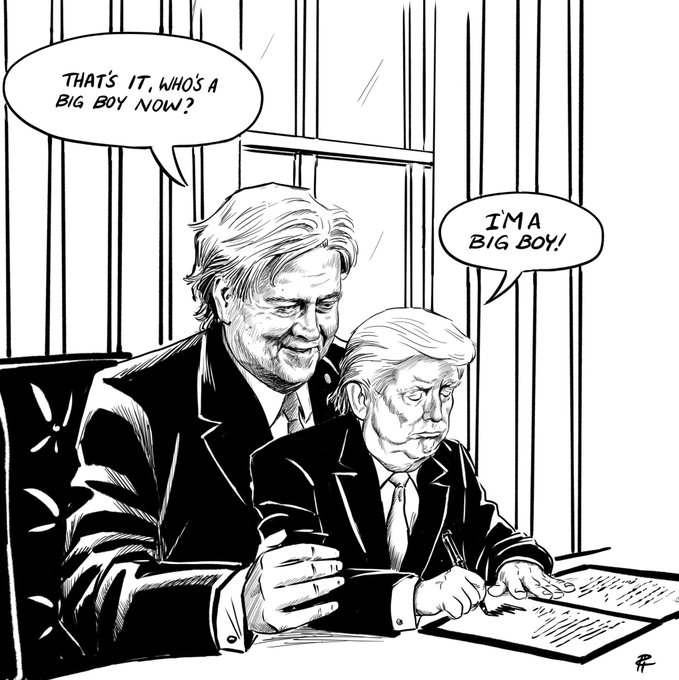
Big Boy. #PresidentBannon
4:32 AM - 30 Jan 2017

29,29229,292 Retweets
42,23542,235 likes

Last night, The New York Times published a piece that said as much. According to the Times, upon entering the White House, Bannon “rushed into the vacuum, telling allies that he and [adivsr Stephen] Miller have a brief window in which to push through their vision of Mr. Trump’s economic nationalism.” But with protests erupting around the country, and headlines shouting that Bannon is the power behind the throne, it seems like Trump is starting to get annoyed with his racist Wormtongue. While Bannon remains Trump’s “dominant adviser,” Trump is angry that he treated him like a human fountain pen, sneaking his way into the National Security Council through an executive order that Trump apparently didn’t read. And Chief of Staff Reince Priebus, who seems to have been muscled out by Bannon, has regained some control, instituting a “10-point checklist” before any new initiatives are rolled out.

It’s clear that the President Bannon memes are getting to Trump. He might not like to do boring boss things, but he definitely wants to look like the boss. This morning he tweeted:


Follow

Donald J. Trump
✔@realDonaldTrump


I call my own shots, largely based on an accumulation of data, and everyone knows it. Some FAKE NEWS media, in order to marginalize, lies!
2:07 PM - 6 Feb 2017

24,34724,347 Retweets
127,188127,188 likes


Trump wants all the world to know that he is the biggest boy in the White House.

Monday, March 6, 2017

Sniveling idiots: The media, a teleprompter, and the toxic bigotry of sycophantic desperation


It’s not my habit to write about blogging process for a Sunday post. But this is the disastrous Trump era, however long it lasts. And in the disastrous Trump era, news moves at such a pace that what is a big story mid-week is likely to be overtaken by an even bigger story by the end of the week. Even as I write these lines, I wonder if the new big news will be overtaken by even bigger news tomorrow or the next day.
But this post isn’t really about Trump. It’s about the media that are so responsible for the disaster that is Trump. As I wrote last summer, when so much that is not and must never be accepted as normal came to be the lived reality: If fascism ever does come to America, the media will be goose stepping right in line.
There are many independent reasons why the popular vote loser Trump sits in the Oval Office. There are many independent factors without any one of which Hillary Clinton would be president. These include the Clinton campaign's failure to lock down its firewall states; the Russian government's manipulations, investigations of which Republicans on all levels are with clear intent assiduously and cynically obstructing; and of course the unprecedented and unethical interference of the New York FBI office and FBI director James Comey, which also may never be fully investigated.
But another factor that by itself made possible Trump's historically narrow Electoral College victory was the incompetence and at times complicity of the major media. They made Trump possible, and despite his unprecedented hostility toward them, they continue to enable him. It would be embarrassing for them, if they hadn't long ago proven they are beyond embarrassing. It is, however, dangerous.
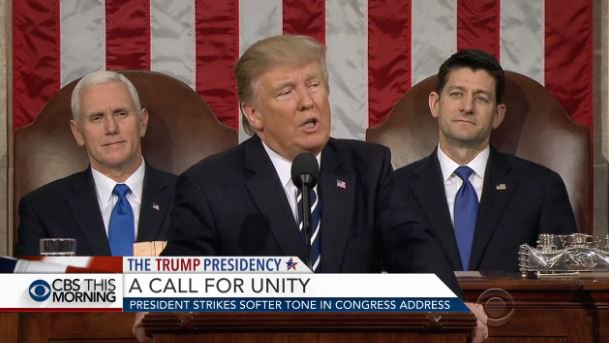
The depth of the media's sycophantic depravity with Trump is exemplified by the image at the top of this post.
The inexplicable prominence of Chris Cillizza as Washington Post analyst is exemplified by his pathological obsession with Clinton's emails last year, and he continues to prove he hasn't grown or learned a thing since. In this case, he does acknowledge Trump's disassociation with facts, as highlighted in the Post’s adjoining article, but that doesn't prevent him from writing:
he can be, dare I say it, presidential when the moment demands it.
And:
He's not going anywhere, folks. And that speech suggests he might have more upside than almost anyone thought.
Specifically, Cillizza points to these as among Trump's supposed highlights:
Trump hit a few very nice notes: His condemnation of threats against Jewish community centers at the start of the speech was a very nice grace note, and his honoring of the widow of the Navy SEAL killed in the recent Yemen raid was a remarkably powerful moment.
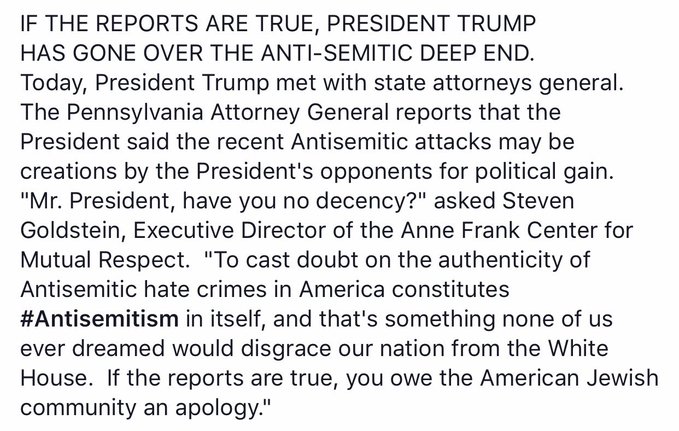
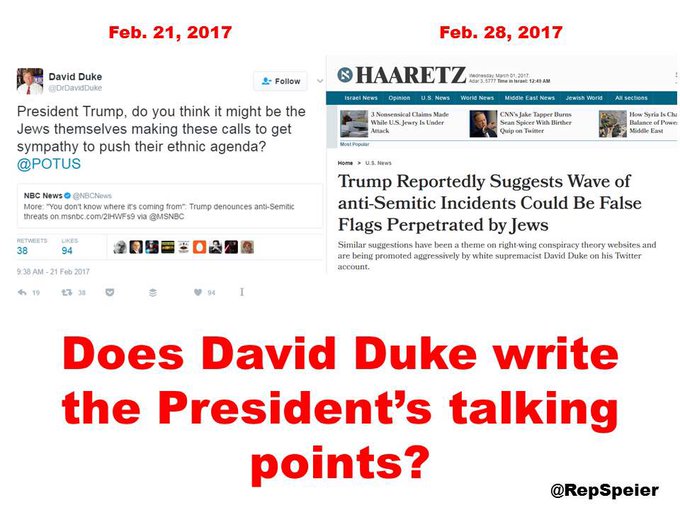
And never mind that earlier on the same day, in an unscripted and unteleprompted meeting Trump bizarrely and ominously suggested that those threats against Jewish community centers may be a false flag operation designed to make him look bad.
View image on Twitter
Does @DrDavidDuke write @POTUS ’s talking points? #25thAmendment
just hours ago he suggested the anti-Semitic attacks were a Jewish false flag—he was the President of the United States in that moment, too
My Jewish high school got a bomb threat today but thankfully the police were able to assure everyone that Ivanka is a Jew
And never mind that the Navy SEAL was killed in a failed operation that also has yet to be fully investigated, but that Trump on the same day as his speech blamed on the military and the Obama administration. But Trump read words, and to Cillizza's ilk that was the big pivotal moment they've been so desperately waiting for. More intelligent and principled observers from across the political spectrum—including military veterans and military analysts—had a different reaction.
Photo published for Donald Trump Blames SEAL's Death On Military: 'They Lost Ryan'

Donald Trump Blames SEAL's Death On Military: 'They Lost Ryan'

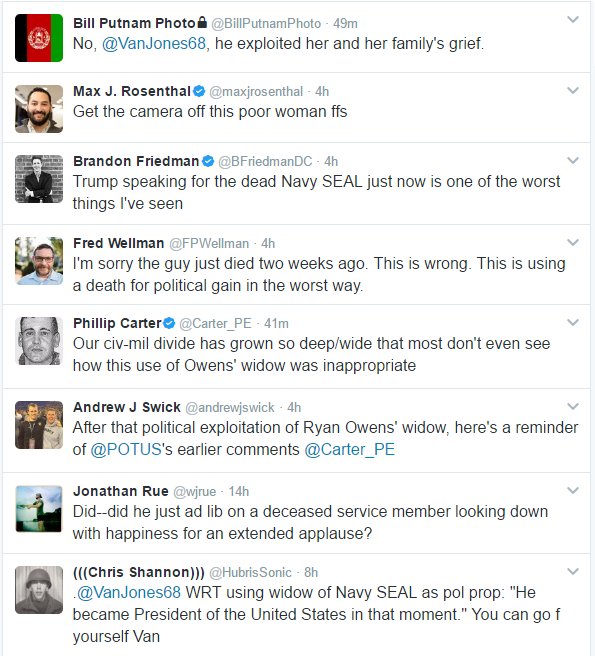
If watching POTUS publicly exploit S/Chief Owens' grieving widow didn't make your skin crawl, I worry about you -- as an American & a human.
So "the generals" got S/Chief Owens killed, but let's spotlight his widow on live TV.


Has Stockholm Syndrome overtaken the whole country?
Hi I'm a real journalist and a Marine's wife. Ask me anything about honoring sacrifice without scoring cheap political points. https://twitter.com/proudmoma98/status/837179670877601794 …
View image on TwitterView image on Twitter
Media people in my feed (left) viewed Trump's Navy SEAL moment last night very differently from the veterans (right). A story in two images:
Trump sent a soldier off to die in a half-baked raid and then used his grieving widow as a prop. I'm still processing this.
Did...did Trump just say a slain Navy SEAL is looking down happily from heaven because his mention broke an applause record?
But Cillizza was not alone. The punditocracy was beside itself lauding Trump's apparently remarkable ability to read words off a teleprompter, and they found Trump's staged and calculated honoring of the Navy SEAL's courageous widow transformationally presidential. This despite the lingering questions around the political circumstances of his having been killed; the administration's repeated lies about those circumstances; the report just a day earlier (and confirmed a day later) that the mission itself produced no significant intelligence; Trump’s own questionable behavior that horrible night; and the civilian women and children who also were killed that horrific night.
This ain't about saving time. It's a dangerous desire to pass the buck. Let me lay this out in a few tweets. http://www.thedailybeast.com/articles/2017/03/01/generals-may-launch-new-isis-raids-without-trump-s-ok.html?via=desktop&source=twitter …
Photo published for Generals May Launch New ISIS Raids Without Trump’s OK

Generals May Launch New ISIS Raids Without Trump’s OK

At best, call the media's reaction to Trump the toxic bigotry of no expectations. They’re desperate to believe he can be what he’s spent decades proving he never will be. A more realistic assessment of the media would be to wonder how they'll get Trump's boot polish off their tongues. Do they understand that the public's reaction was far less impressed, with both the size of the audience and the approval rating being significantly less than for the first joint speeches of Barack Obama and even the Lesser Bush?
View image on Twitter
43.4 million watched. Down from 52M for Obama's 2009 speech. #trumpaddress http://adweek.it/2lshHqB
Better yet: Total U.S. Population is up about 6% since 2009 (324M vs. 306M).https://www.census.gov/popclock/  https://twitter.com/TurkanaDK/status/837028551228444672 …
"Very positive" reaction to equivalent speech, per CNN/ORC


Bush 2001: 66%
Obama 2009: 68%


Trump 2017: 57%


Photo published for 7-in-10 speech-watchers say Trump boosted optimism

7-in-10 speech-watchers say Trump boosted optimism

NBC's Jacob Rascon just spent morning in TX interviewing dozens of people to gauge reaction to President Trump's speech. 90% hadn't seen it
The deferential desperation by so many in the media is even more proof of the totality of their degradation. It hasn’t been even a week since their colleagues were shut out of a White House press office gaggle, while Trump himself was doubling down on his dangerous authoritarian labeling of the media as enemies of the American people, before taking it to the next level and declaring the intentions of the New York Times are evil. But nothing Trump says or does prevents large segments of the major media and their punditocracy from throwing themselves at his feet like the timid toadies they are.
They made his ascension possible in the first place by lavishing him with billions of dollars of free coverage. They openly touted the profits he made them. He plays them for the fools they are, and they continue to grovel and do his bidding. If he now reversed course and decided to attend their annual exercise in self-congratulation know as the White House Correspondents’ Dinner, they’d probably strew rose petals before him.
But some did pay attention to the substance behind the gloss, and some of those paying attention are among the professional media, although lacking requisite obsequy is not likely to land them on television.
Oh shit. The office of “Victims Of Immigrant Crime Engagement.” This is exactly how it starts. #jointsession
View image on Twitter
FACT CHECK: Trump touts clean air and water while trying to kill air, water rules http://politi.co/2lUnUO7
Words NOT in Trump's speech: ***PLANNED PARENTHOOD*** or ***ABORTION***
Word NOT in Trump's speech: ***GUNS***
Word NOT in Trump's speech: ***CLIMATE***
Trump emphasizes threat of jihadi terrorism. It's real, killing 123 Americans since 9/11. In that period, guns have killed 450,000.
And there were many who were unimpressed with the media’s breathless fawning.
The television commentary was even more embarrassing than usual. And it is usually pretty cringeworthy https://twitter.com/jonfavs/status/836954635344621569 …
Pundit: “Doubts about Donald Trump have been quelled now that he has delivered an hour-long speech without jamming a pen into anyone’s eye."
I will ask this all day long: why was his tone more important than his lies and falsehoods? https://twitter.com/katyturnbc/status/836925827191275523 …
For any other president this would be a boring, laundry list speech. For Trump - amazing, responsible, detailed, uniting, presidential!
He put in his thumb,
And pulled out a plum,
I'll never understand why the media tries so hard to find the good in Trump after they tried so hard to find the bad in Hillary.
I'm so sick of folks grading Trump on a curve. If he's merely competent at reading a speech they want to give him a Medal of Honor. NOT ME!…
Last night was good evidence that if Trump was not a complete fuck up, he could keep horrible policies and be adored by pundits.
Things we're calling "presidential"


telling egregious lies that've been debunked


vilifying immigrants as criminals


reading from prompter
Senior White House official just described Trump's speech to me as "nationalism with an indoor voice"
"Indoor voice" is a phrase we use for toddlers, not presidents. So... please proceed.
View image on Twitter
What folks look like trying to explain why they think Trump reading a TelePrompter makes him more Presidential.
We  may yet get through this without suffering too much damage to too many people, but any damage to any people makes those responsible beyond excuse. And the media types who fawned and slobbered over Trump’s speech are as responsible as those who helped usher Trump into the White House in the first place. It didn’t take even 24 hours for their idiocy to be exposed for what it was. Not that they will learn. But they can at least take comfort in knowing their insular little club wasn’t alone in lauding Trump’s speech.  
The KKK loved Trump's speech.