Showing posts with label l#JustARipRoaringZionist. Show all posts

Thursday, May 18, 2017

UNESCO In Your face . MIri Regev wears Jerusalem Slick or Kitch it got the message across in Cannes


Firebrand Israeli Culture Minister Miri Regev has never been shy about her opinions, and some of the ways she’s expressed them have become phrases and images every Israeli knows. This week we learned that she even knows how to bring her unique political style to places where she doesn’t even speak the language—via fashion.

Israeli Culture Minister Miri Regev at Cannes. (Facebook)

On Wednesday night, Regev showed up on the red carpet at Cannes in a getup that, much like her political messaging back in Israel, was anything but subtle. She wore a Jerusalem-of-Gold-themed dress, and it wasn’t like one of those dresses at the Met Gala, where you struggle to figure out how it’s connected to the theme. No, this dress was gold on top and had Jerusalem on the bottom. Literally. The Jerusalem skyline was printed across her skirt.

Her outfit set corners of the internet ablaze. One of the best jokes currently circulating online is that Regev is very thrifty: she used the walls of her sukkah as a dress. And of course there are the memes—putting her Jerusalem skirt on Maria Von Trapp, advertising an upcoming Peace Now rally, and more.

Since we’re talking about fashion here, let’s get the easy part out of the way: She looked great. The A-line cut was flattering, the gold suited her complexion, she wore an elegant updo and wisely chose very subtle jewelry that did not compete for attention with the dress. But Regev obviously wasn’t out to make heads turn on the red carpet just because she’s pretty: Regev’s fashion statement was a political statement, and a defiant one at that.

Her Jerusalem of Gold frock, designed by Aviad Arik Herman, came at a time when Israel and the Jewish People’s ties to Jerusalem are under constant assault by the international community. There were two UNESCO decisions in the past year denying Jewish ties to Jerusalem and disavowing Israeli sovereignty in its capital city. France abstained from the UNESCO vote this month.

And there’s the ongoing controversy about President Donald Trump’s upcoming visit to Israel and his trip to the Western Wall. Israel’s most popular evening news broadcast, on Channel 2, reported that a White House official wouldn’t let Prime Minister Benjamin Netanyahu join Trump at the Kotel because it’s not in Israel. While the White House denied that the statement reflects its policies, and called into question whether it truly came from one of its officials, National Security Advisor H.R. McMaster refused to say whether the Western Wall is in Israel or not. And Israelis still are not invited to join Trump at the Kotel—so at least one MK, Bezalel Smotrich, has threatened to use his parliamentary immunity to crash POTUS’ party, in protest. The next day, news came out that Trump gave top-secret information to Russia, and many reports pointed to Israel as the source of information, but Israelis still seemed much more upset about the Kotel situation. What the world doesn’t seem to understand is that Western Wall is at the core of Israeli Jewish identity. It should be simple enough to point out that Jewish nationalism is called Zionism, and Zion means Jerusalem, but, apparently it’s not.

The 50th anniversary of the Six Day War and Jerusalem’s reunification is coming up, which is the reason Regev gave in a statement for wearing the dress, and even if there are different plans for what’ll happen to Jerusalem in the event of a two-state solution, there isn’t more than a tiny minority of Jewish Israelis who think the Western Wall should be in anyone else’s hands ever again. It’s a fail-proof political message; Netanyahu often accuses his rivals in elections of wanting to divide Jerusalem.

And that brings us back to Regev, a longtime Jerusalem warrior. She has been a huge proponent of Jews, who are not allowed to pray, having equal rights to Muslims at the Temple Mount. In one of her most famous political speeches, from the 2013 election campaign, where she grabbed an Israeli flag on stage and waved it around, she said: “Israel is the Jewish State whose capital is Jerusalem forever and ever. Applause!” earning her the nickname Miri “Applause” Regev and spawning remixes and memes.

And now Regev’s getting attention for wearing Jerusalem, instead of shouting about it.

Sunday, May 14, 2017

#OYVeyDonaldTrump's Conflict of Interest Problem ( See the list below)

Image result for Trump’s Conflicts Controversies

By Sheelah Kolhatkar   November 14, 2016
Donald Trump with his wife and adult children at the opening of the Trump International Hotel in Washington, D.C., shortly before the election.

“Are you planning on putting your assets in a blind trust should you become President?” the Fox Business Network anchor Maria Bartiromo asked Donald Trump during a Presidential-primary debate in South Carolina, in January. “How difficult will it be for you to disentangle yourself from your business and your money and prioritize America’s interests first?”

“If I become President, I couldn’t care less about my company,” Trump answered, waving her off. “It’s peanuts.”

“So you’ll put your assets in a blind trust?” Bartiromo asked again.

“I would put it in a blind trust—well, I don’t know if it’s a blind trust if Ivanka, Don, and Eric run it. Is that a blind trust? I don’t know.” He looked around and shrugged. “But I would probably have my children run it with my executives, and I wouldn’t ever be involved.”

The comments were startling at the time he made them, but what is even more remarkable is what has occurred since: Trump was elected President and, so far at least, has shown no sign that he understands or has ever even thought about conflict-of-interest laws, or conflicts of interest. On November 10th, two days after the election, an attorney for the Trump Organization named Michael Cohen told CNN that the President-elect intended simply to turn control of his company over to his three children from his first marriage, who would run it through a “blind trust,” a suggestion that makes little sense on its face, given that a trust is only considered “blind” if the trustees are individuals with no financial relationship with the company’s owner. The former Presidents Ronald Reagan, George H. W. Bush, Bill Clinton, and George W. Bush all placed their assets in blind trusts while serving as President. (Obama has all of his money in Treasury bills and index funds, investments that aren’t seen as a conflict.) In any case, the idea of Trump setting up an impossible-sounding blind trust with his children dissolved the following day, when he announced that three of his children would serve on the executive committee of his Presidential transition team, helping him to fill jobs in his government.

Trump and his offspring had already been treating the Presidential campaign like a world-spanning, high-stakes branding opportunity for Trump-related businesses. The Trump campaign directed millions of dollars in campaign expenses to Trump-related ventures: rent was paid to Trump Tower, where the campaign headquarters was located; events were held at Trump golf courses and other properties; Trump’s Mar-a-Lago club was paid for lodging, facilities, and catering, according to Politico. Trump’s daughter Ivanka used campaign appearances as an opportunity to advertise clothing from her own fashion line. The perception of Trump as a talented businessman drove a large part of his appeal to voters who want a piece of his gilded capitalism for themselves. It’s hard to imagine that he’ll be willing to let that all go and dedicate himself to public service. (Trump himself reportedly donated upwards of fifty million dollars to the campaign.)

It turns out that there is no legal requirement that a President divest himself or herself of private business interests or investments while in office. Nor is there a requirement that he place investments or companies he controls in a blind trust, by which an independent third party manages the assets while he serves in government. There are federal ethics rules that prohibit members of Congress and Cabinet members from accepting gifts from anyone who has business before their agency, as well as requiring that they recuse themselves from governmental affairs that affect their financial interests. The roles of President and Vice-President were exempted from those rules because it was believed that the office of the President was so vast in its responsibilities that it would be virtually impossible to police. As Kenneth Gross, a partner at Skadden Arps, and a former associate general counsel of the Federal Election Commission, notes, it was also assumed that no President would attempt to run the government and a business simultaneously.

The authors of the Constitution, however, did have insight into the potential abuse of the office of President, and they inserted something called the Emoluments Clause into Section 9 of Article I. It states, in part, that “no Person holding any Office of Profit or Trust under them, shall, without the Consent of the Congress, accept of any present, Emolument, Office, or Title, of any kind whatever, from any King, Prince, or foreign State.” This clause, Gross said, basically means that anything of significant value from a foreign government or a company controlled by one that accrues to the Trump Organization while Trump owns it could provide the seed of an investigation and impeachment. Trump listed five hundred and sixty-four line items on his financial-disclosure form; appearing under “Filer’s Positions Held Outside United States Government” are the names DT Marks Qatar LLC, DT Marks Dubai LLC, THC Services Shenzhen LLC, and many other opaque, foreign-sounding entities.

“This is not something esoteric. This is an area that the incoming President must address, along with his other conflicts,” Gross, who advised Michael Bloomberg on the management of his assets while he was the Mayor of New York City, said. (I formerly worked at Bloomberg L.P.) “This is a very unique problem for him—we don’t have a very good picture of his financial situation, we really don’t know what he owns, we don’t know all his entanglements.”

Gross noted that, in some sense, it’s impossible to separate Trump from his assets. “One of the problems that Trump has is he already knows what properties he already owns. It does no good in terms of blinding assets he already owns, and it does no good if his children are running it, in resolving the conflict, because his self-interests are co-existent with his children’s interests,” Gross said.

In an interview on Sunday with Jake Tapper, on CNN, Rudy Giuliani argued that taking the family businesses away from Trump’s children and giving them to a third party would “be putting them out of work.” The best conflict-of-interest measure he could envision was a document attesting that President Trump would not be involved in the running of his companies.

If there is a precedent, it might be found in New York State government, where legislators serve part-time and are allowed to maintain outside businesses, which range from coffee shops to their own law firms. Disclosure requirements are intended to reveal potential conflicts, but there are no limitations on the amount of income legislators can bring in from outside work. It didn’t shock anyone when Sheldon Silver, the former speaker of the State Assembly, and Dean Skelos, the former Senate Majority Leader, were convicted, last year, of corruption charges. In Silver’s case, the crime was referring cases from companies with business before the state to law firms that paid him bonuses and referral fees; Skelos was accused of referring business to help his son. (Both cases are on appeal.)

“It’s a tremendous problem when it’s completely obvious how someone seeking governmental action from the United States can provide substantial benefit to its chief executive,” Arlo Devlin-Brown, a partner at Covington and Burling, who oversaw the Silver and Skelos prosecutions as the chief of the public-corruption unit at the Manhattan U.S. Attorney’s Office, said. A foreign or domestic company could choose to license the Trump name for a real-estate development or for marketing a line of Trump edible-fruit arrangements, to take one simple example; the company would know that it was benefitting the President no matter who was managing the Trump Organization, and President Trump would know it, too. “The problem here is the appearance of impropriety—nearly every single company is trying to get something from the executive branch,” Devlin-Brown said.

When I asked Ken Gross, of Skadden, if he knew of any other examples of world leaders attempting to continue earning enormous profits from their private companies while they were in office, he paused.

“There was a look at Silvio Berlusconi when I was representing Mike, but I think he ended up going to jail, if I’m not mistaken,” Gross said (He was nearly right: Berlusconi was convicted of various charges, but did community service.) “I think the private businesses and the government functions in Italy maybe are exactly what we should be worried about. And, obviously, there are non-democracies where the people in charge don’t get the concept of conflict of interest.”

Tracking Trump’s Conflicts Controversies
President Donald Trump came into office pledging to avoid conflicts of interest by resigning from his global business empire and handing control to his sons. Despite those steps, more potential conflicts have surfaced since his inauguration, fueled by the president’s critics and, in one case, his own tweet. Prominent examples – and the White House rebuttals – are summarized here. VOA will update the list as circumstances change or new possible conflicts arise.

Friday, May 12, 2017

US Embassy unlikely to move to Jerusalem #OyVeyDonaldTrump backtracks once again on clear electoral promises Liar Liar Liar your pants is on fire.


#OyVeyDonaldTrump backtracks once again but with an estimated costs of $1.65 billion over 5 years it  reasonable that even the US Embassy overlooking the Tel Aviv will continue to check out Israeli scantily dressed chicks rather than the Black Garb Penguins with dangling peiot in Jerusalem


The US Embassy in Tel Aviv. Photo: Krokodyl via Wikimedia Commons.

Israeli Prime Minister Benjamin Netanyahu’s office denied a report on Wednesday that it had received a notification from the White House that the US had decided against moving its embassy in the Jewish state from Tel Aviv to Jerusalem — a pledge made by President Donald Trump during the 2016 election campaign.

According to the Hebrew news site nrg, Trump will follow the example of his three immediate predecessors by vetoing a relocation of the embassy.

Under the terms of the Jerusalem Embassy Act, passed by Congress in 1995, the embassy should have been moved to the Israeli capital no later than May 1999. But all three presidents since the legislation went through — Bill Clinton, George W. Bush, and Barack Obama — have signed twice-yearly waivers delaying its implementation, on “national security” grounds.


President Trump has approved a plan to arm Syrian Kurds so they can participate in the battle to retake Raqqa...

President Obama signed the last waiver on October 16, 2016. Trump is due to make a decision on whether to sign on May 31.

The nrg report said Trump had originally planned to announce the move on his first day in office on January 20, but then changed his mind “for reasons unknown.” The report went on to say a message had now been relayed from Washington to Jerusalem clarifying that Trump would sign the waiver after all, “in contradiction to Israel’s explicit requests.”

The uncertainty over whether Trump will keep a promise made at the 2016 AIPAC conference — where, as a candidate in the Republican primaries, he stated his determination to move the embassy to “the eternal capital of the Jewish people” — comes one week after he hosted a meeting with Palestinian Authority President Mahmoud Abbas at the White House.

A report published earlier this week by the pro-Abbas Ramallah newspaper Al-Ayyam said Palestinian officials were pleasantly surprised by the warm reception they received in Washington, DC. Abbas is said to have told Trump that “We are left with the solution of two states: a Palestinian state in the 1967 borders, and Israel. We want a state in those borders, with East Jerusalem as its capital.”

Stephen Colbert Moderates An All-Trump Debate: #OyVeyDonaldTrump versus Donald Trump. Absolutely no one can save #OyVeyDonaldTrump from himself #ImpeachTrumpNow


No one in the White House is able to tell the 70-year-old newbie president how to behave
The staff is forced to explain the unexplainable.

So maybe a few times in your life you have screamed at the television set. And then what? You flip the channel, and get on with your life.


Ah, unless you're the current President of the United States. Because he probably watches way more TV than you do, and when he sees something he doesn't like, he doesn't flip. He stews. He calls his friends and complains. He tweets.


And then he acts, because he can.
According to a source with knowledge, Trump told friends he was increasingly concerned that FBI Director James Comey had grown "out of control" and was "pursuing his own agenda." Comey's testimony last week, this source says, "pushed him to the edge."
So he acted out, and decided to fire Comey, in a childish, impetuous -- and dangerous -- manner. Then he looked for a rationale, and found it in a memo written by Rod Rosenstein, deputy attorney general.


The White House used that cover story; so did the vice president. But now Trump has blown up that explanation by telling NBC that he would have fired Comey no matter what Justice officials had recommended. (Did Trump lie to Pence like Mike Flynn did? Just asking.)


And all credibility is lost.


Apparently, no one is able to tell the 70-year-old newbie how to behave. That firing the current FBI director in the middle of the Russia investigation -- no matter how tarnished his reputation -- is a bad idea. No one can tell him that, no matter how furious he is about an investigation that is growing and requiring more resources, trying to kill it by striking at the FBI director is a very, very bad idea. And that it might be interpreted as obstruction of justice.
But none of this matters to Trump. It never has. As Louise Sunshine, a former Trump organization employee told me months ago, Trump had always lobbed grenades -- and then walked away.


"Nobody ever knew when he walked in a meeting what he was going to say or do because he didn't," she said. "Donald has always managed to walk into a meeting and say something that nobody else expected him ever to say, upend the entire meeting, leave everybody agog, and control every situation that way, so by the time he leaves the room, he has the store, he owns the store."


But this isn't Trump's store anymore.


Trump has clearly learned little in office. He still throws tantrums, and his staff is sent to clean up the mess.


The pattern was set on the first full day in office.


That's when Trump fumed about the pictures about crowd size at his inauguration, and sent his press secretary Sean Spicer, out there to rationalize his obsession.
Then came the president's ridiculous assertion that there were 3 million illegal votes cast in the election -- and that's why he lost the popular vote.


That's when Spicer came out to try and explain the unexplainable. The solution -- just set up a presidential commission to examine the fiction, which the White House finally announced Thursday.


Then came the president's impulsive tweet-storm early on Saturday morning, March 4, when he accused his predecessor of having him wiretapped. Never mind that he was accusing Barack Obama of a felony, or that it wasn't true. He did it, anyway.


So then, once again, came the shovel brigade. Because to balk, even a bit, would be seen as disloyal to Trump --and that is not allowed. Ever.


Only this time it was really hard to figure out how to explain the unexplainable. And so a plan was hatched: call for congressional investigations. And stop talking about Russia hacks and potential Russian collusion with the campaign, but focus instead on investigating leaks that cast a negative light on Trump and his people.

You get the idea. The President tweets nonsense, and the staff scrambles to make it sensible. Even if the emperor has no clothes, you can't tell him.


So it was with the firing of James Comey.


The President decides he wants to fire Comey, and the staff is tasked to come up with a rationale. But it was very hard this time -- absurd on its face. After he praised Comey in late October on the campaign trail and last week his spokesman declared confidence in the FBI director, are we to suddenly believe that the president really thought Comey was unfair to Hillary? Really? As one source close to the president tells me, his real concern was that if Comey had treated Clinton so badly, he would do the same to Donald Trump.


Oh, and as he told NBC, Comey was a "showboat" and a "grandstander." It was a telling insult; in Trump's galaxy, there can be no star brighter than Trump.


One requirement of the presidency is to believe that your job is about something greater than yourself -- your country.


But first you have to believe there is something greater than yourself.

Sunday, April 30, 2017

Share. This is well worth a visit!!! .....A New Memorial to all those who have Fallen in Defence of Israel ( plus via acts terrorism ) has opened Mount Herzl with the names of all those who have fallen ( plus a database on each) .It is 250 meters from the graves of Zeev Jabotinsky and his wingman Theodore Herzl the two founders of Zionism and Israel and some of his well known footmen, Menachem Begin,Yitzhak Shamir, Levi Eshkol, Zalman Shazar, Poodle Peres, Renegade Rabin,Yitzchak Navon,Ephraim Katzir....Quite recently when I visited Har Herzl sat on Zeev Jabotisky Grave ( Hey, Steve take a load off your feet ) for an hour and a half reading an excellent new work on the founder of Zionism and group after group lead by the official guides of the site chose to give his grave a miss.....it is the last grave before exited the "official (tourist) path", ..... DON'T LET Don't let these Meretz , Ratz, remnants of Social Zionism skip the grave of the most important person on Har Zion .....PM Netanyahu At The Inauguration Of The Hall of Remembrance


Ceremony marks opening of Israel's new Hall of Remembrance

On Mount Herzl, Israel's government and military officials gathered in the new Hall of Remembrance for a dedication ceremony on the eve of Yom HaZikaron. Israeli Prime Minister Benjamin Netanyahu called it: "The hall of remembrance, grief, pride and heroism."

In the presence of Israel's government and military officials, a ceremony marking the inauguration of the new Hall of Remembrance on Mount Herzl took place on Sunday morning. During the ceremony, a mezuzah was placed at the entrance to the site and a memorial torch was lit by Israeli Prime Minister Benjamin Netanyahu. In addition, the heads of all of the Israeli security forces lit together the 23,544 candles in the hall in memory of all of Israel’s fallen soldiers.

Netanyahu called the new site "the hall of remembrance, grief, pride and heroism, a hall that perfectly combines everything.” He added: “This memorial hall is now one of Israel's symbols." According to Netanyahu, "Each of us carries on our back the generations that came before and marches with them forward."

"Generation after generation, we pray so our sons and daughters will have no more war and generation after generation, we are forced to lay to rest like eternal flowers our best sons and daughters, young people whose lives and dreams had just begun to take shape,” said Israeli Defense Minister Avigdor Lieberman. “It is the terrible and painful price of the rebirth of Israel, of the decision of the Jewish people to hold their fate in their own hands and to build this fate in their homeland forever.”
Rivlin: "The memory of our beloved sons and daughters will be preserved in our hearts, in the heart of the nation" Photo Credit: Hillel Meir, TRS/Channel 2 News

Israeli President Reuven Rivlin stated, "I know that many parents ask, 'Who will remember our child after we have left?' Today, more than ever, we promise: the memory of our beloved sons and daughters will be preserved in our hearts, in the heart of the nation, for generations and generations."
23,544 candles lit in memory of Israel's fallen Photo Credit: Channel 2 News
As previously reported by JOL, the hall is made up of a mountain of stones piled one on top of the other, reaching a height of 60 feet. More than 23,000 bricks make up the walls, each with the engraved name of a fallen soldier, the date that he or she was killed and a candle that will be lit on the anniversary of their death.

Wednesday, January 25, 2017

#OyVeyDonaldTrump Protesters Deliver Body Blow to Trump's Populism


Strength in Numbers

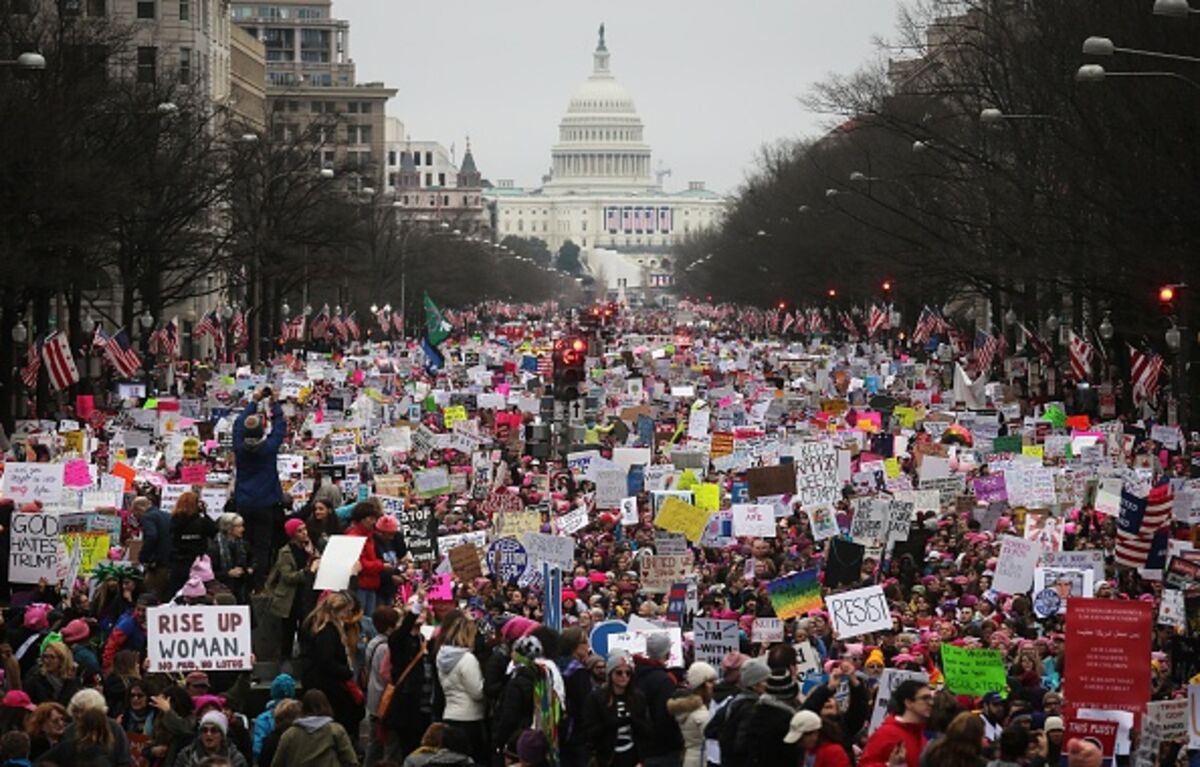
The White House can't get over the disparity between Donald Trump's modest inaugural crowd on Friday and the massive protests that took place the next day.

But what matters most is not how the numbers of marchers across America surpassed the numbers celebrating the inaugural. What matters, now and over the long term, is how those protesting bodies challenged the words of Trump's inaugural address, and neutered them.

Millions of Americans took to the streets for a "Women's March" that, in the end, had less to do with sexual politics than with a broad defiance of Trump's new order. They turned out in Boston, Los Angeles, New York, Seattle and Washington D.C., but also in places like Boise, Idaho, and Anchorage, Alaska.

Trump being Trump, he probably would’ve been unnerved by the size of the protests regardless: Size is a simple handle for an unsubtle mind. But White House strategist Steve Bannon and the shrewder members of the Trump team surely grasped that the protests had just obliterated an inaugural address that was less than 24 hours old.

In his broken beer bottle of a speech, Trump jabbed at the "establishment" he had defeated. "For too long," he said, "a small group in our nation's capital has reaped the rewards of government while the people have borne the cost."

The "rewards of government" is a curious phrase for an American inaugural address, with "rewards" sounding much like the spoils that go to the victor. To make this language less jarring, especially as fabulously wealthy Trump appointees assume power enmeshed in doubts about their ethics and public spirit, Trump insisted in his address that it's really "the people" who have triumphed.

What truly matters is not which party controls our government, but whether our government is controlled by the people.

January 20th, 2017, will be remembered as the day the people became the rulers of this nation again.

Like countless populists before him, Trump has set himself up as the representative, voice and will of "the people." As Jan-Werner Mueller wrote in "What Is Populism?":

The claim to exclusive representation is not an empirical one; it is always distinctly moral. When running for office, populists portray their political competitors as part of the immoral, corrupt elite; when ruling, they refuse to recognize opposition as legitimate.

Team Trump relishes the condemnation of elites. When bow-tied George Will called Trump's address the worst in history, it was a victory for Bannonism, the guiding force of Trumpism. A president elected with 46 percent of the popular vote, who entered office with historically low approval ratings, needs the scorn of elites to prop himself up and to buff his populist street cred.

Yet the number of people marching against Trump on Saturday appears to have been north of two million. If Trump embodies the people, who were those millions of bodies insisting that he doesn't represent them? Bow ties were not much visible in the crowds.

Neither Trump nor the organizers of the Women's March could've known how the populist words of his inaugural would be so devastatingly refuted by Saturday's tide of humanity. True, it's a short-term victory. The Trump administration will be the arena for a long and fierce battle. We are at the opening bell.

But it mattered. Everyone in Washington -- from a determined Speaker Paul Ryan to a shell-shocked White House, from tentative Democrats climbing out from the rubble to liberal interest groups searching for an ideological anchor -- just got a look at a very different people from the one described by Trump.

Monday, January 16, 2017

Jewish Belief in the Moshiach

Image result for Messiah in Judaism
What is the “End of Days”?

The term “End of Days” is taken from Numbers 24:14. This has always been taken as a reference to the messianic era. Here we shall explore—albeit briefly—the Jewish belief in the coming of Moshiach.

What does the word Moshiach mean?

Moshiach is the Hebrew word for “messiah.” The word messiah in English means a savior or a “hoped-for deliverer.” The word moshiach in Hebrew actually means “anointed.” In Biblical Hebrew, the title moshiach was bestowed on somebody who had attained a position of nobility and greatness. For example, the high priest is referred to as the kohen ha-moshiach.

In Talmudic literature the title Moshiach, or Melech HaMoshiach (the King Messiah), is reserved for the Jewish leader who will redeem Israel in the End of Days.

What is the belief in Moshiach?

One of the principles of Jewish faith enumerated by Maimonides is that one day there will arise a dynamic Jewish leader, a direct descendant of the Davidic dynasty, who will rebuild the Temple in Jerusalem, and gather Jews from all over the world and bring them back to the Land of Israel.

All the nations of the world will recognize Moshiach to be a world leader, and will accept his dominion. In the messianic era there will be world peace, no more wars nor famine, and, in general, a high standard of living.

All mankind will worship one G‑d, and live a more spiritual and moral way of life. The Jewish nation will be preoccupied with learning Torah and fathoming its secrets.

The coming of Moshiach will complete G‑d’s purpose in creation: for man to make an abode for G‑d in the lower worlds—that is, to reveal the inherent spirituality in the material world.

Is this not a utopian dream?

No! Judaism fervently believes that, with the correct leadership, humankind can and will change. The leadership quality of Moshiach means that through his dynamic personality and example, coupled with manifest humility, he will inspire all people to strive for good. He will transform a seemingly utopian dream into a reality. He will be recognized as a man of G‑d, with greater leadership qualities than even Moses.

In today’s society, many people are repulsed by the breakdown of ethical and moral standards. Life is cheap, crime is rampant, drug and alcohol abuse are on the increase, children have lost respect for their elders. At the same time, technology has advanced in quantum leaps. There is no doubt that today man has all the resources—if channeled correctly—to create a good standard of living for all mankind. He lacks only the social and political will. Moshiach will inspire all men to fulfill that aim.

Why the belief in a human messiah?

Some people believe that the world will “evolve” by itself into a messianic era without a human figurehead. Judaism rejects this belief. Human history has been dominated by empire builders greedy for power.

Others believe in Armageddon—that the world will self-destruct, either by nuclear war or by terrorism. Again, Judaism rejects this view.

Our prophets speak of the advent of a human leader, of a magnitude that the world has not yet experienced. His unique example and leadership will inspire mankind to change direction.

Where is Moshiach mentioned in the Scriptures?

The Scriptures are replete with messianic quotes. In Deuteronomy 30:1 Moses prophesies that, after the Jews have been scattered to the four corners of the earth, there will come a time when they will repent and return to Israel, where they will fulfill all the commandments of the Torah. The gentile prophet Balaam prophesies that this return will be led by Moshiach (see Numbers 24:17–20). Jacob refers to Moshiach by the name Shiloh (Genesis 49:10).

The prophets Isaiah, Jeremiah, Ezekiel, Amos, Joel and Hosea all refer to the messianic era. (For full references, the reader is referred to the book Moshiach by Rabbi Dr. J. I. Schochet.) It is interesting to note that the wall of the United Nations Building in New York is inscribed with the quote from Isaiah (11:6), “And the wolf shall lie with the lamb.” Furthermore, it is clear from the prophets, when studied in their original Hebrew, that Moshiach is a Jewish concept, and his coming will entail a return to Torah law, firmly ruling out any “other” messianic belief.

What sort of leader will Moshiach be?

Moshiach will be a man who possesses extraordinary qualities. He will be proficient in both the written and oral Torah traditions. He will incessantly campaign for Torah observance among Jews, and observance of the seven universal Noahide laws by non-Jews. He will be scrupulously observant, and encourage the highest standards from others. He will defend religious principles and repair breaches in their observance. Above all, Moshiach will be heralded as a true Jewish king, a person who leads the way in the service of G‑d, totally humble yet enormously inspiring.

When will Moshiach come?

Jews anticipate the arrival of Moshiach every day. Our prayers are full of requests to G‑d to usher in the messianic era. Even at the gates of the gas chambers, many Jews sang “Ani Maamin”—I believe in the coming of Moshiach!

However, the Talmud states that there is a predestined time when Moshiach will come. If we are meritorious, he may come even before that predestined time. This “end of time” remains a mystery, yet the Talmud states that it will be before the Hebrew year 6000. (The Hebrew year at the date of this publication is 5772.)

This does not rule out the possibility of Moshiach coming today and now, if we merit it. It should be noted that many Torah authorities are of the opinion that we are in the “epoch of the Moshiach,” and the Lubavitcher Rebbe, Rabbi Menachem Mendel Schneerson, of righteous memory, stated on numerous occasions that the messianic redemption is imminent.

Could Moshiach come at any time, in any generation?

Yes. In every generation there is a person who potentially could be the Moshiach. When G‑d decides that the time has arrived, He will bestow upon that individual the necessary powers for him to precipitate that redemption.

Any potential Moshiach must be a direct descendant of King David, as well as erudite in Torah learning. It should be noted that many people living today can trace their lineage back to King David. The chief rabbi of Prague in the late 16th century, Rabbi Yehuda Loew (the Maharal), had a family tree that traced him back to the Davidic dynasty. Consequently, any direct descendant of the Maharal is of Davidic descent.

Maimonides, a great Jewish philosopher and codifier of the 12th century, rules that if we recognize a human being who possesses the superlative qualities ascribed to Moshiach, we may presume that he is the potential Moshiach. If this individual actually succeeds in rebuilding the Temple and gathering in the exiles, then he is the Moshiach.

What exactly will happen when Moshiach comes?

Maimonides states in his Mishneh Torah—a compendium of the entire halachic tradition—that Moshiach will first rebuild the Temple and then gather in the exiles. Jerusalem and the Temple will be the focus of divine worship, and “from Zion shall go forth Torah, and the word of the L‑rd from Jerusalem.”

The Sanhedrin—the supreme Jewish law court of 71 sages—will be re-established, and will decide on all matters of law. At this time, all Jews will return to full Torah observance and practice. It should be noted that in this present age of great assimilation and emancipation, an unprecedented return of Jews to true Torah values has taken place. This “baal teshuvah” phenomenon is on the increase, and paves the way for a full return in the messianic era.

Will miracles happen?

The Talmud discusses this question and again arrives at the conclusion that, if we are meritorious, the messianic redemption will be accompanied by miracles. However, the realization of the messianic dream, even if it takes place naturally, will be the greatest miracle.

According to some traditions, G‑d Himself will rebuild the third Temple. According to others, it will be rebuilt by Moshiach; still others suggest a combination of the two opinions. Some suggest that there will be two distinct periods in the messianic era: first a non-miraculous period, leading into a second, miraculous period.

Maimonides writes, “Neither the order of the occurrence of these events nor their precise detail is among the fundamental principles of the faith . . . one should wait and believe in the general conception of the matter.”

What will become of the world as we know it?

Initially, there will be no change in the world order, other than its readiness to accept messianic rule. All the nations of the world will strive to create a new world order, in which there will be no more wars or conflicts. Jealousy, hatred, greed and political strife (of the negative kind) will disappear, and all human beings will strive only for goodness, kindness and peace.

In the messianic era there will be great advances in technology, allowing a high standard of living. Food will be plentiful and cheap.

However, the focus of human aspiration will be the pursuit of the “knowledge of G‑d.” People will become less materialistic and more spiritual.

What are the “birthpangs” of Moshiach’s arrival?

The Talmud describes the period immediately prior to the advent of Moshiach as one of great travail and turmoil. There will be a world recession, and governments will be controlled by despots. It is in this troubled setting that Moshiach will arrive.

There is a tradition that a great war will take place, called the war of Gog and Magog, and there is much speculation as to the precise timing of this war in relation to Moshiach’s arrival.

There is a tradition that Elijah the Prophet will come to the world and announce the imminent arrival of Moshiach. However, according to other opinions, Moshiach may arrive unannounced. Elijah would then arrive to assist in the peace process. Some suggest that if the Moshiach arrives in his predestined time, then Elijah will announce his arrival; but if Moshiach comes suddenly, then Elijah will appear after Moshiach has come.

As mentioned before, it is unclear as to exactly how these events will unfold. However, this uncertainty does not affect the general matter of Moshiach’s arrival.

When will the resurrection of the dead take place?

One of the principles of Jewish faith is belief in the resurrection of the dead. According to the Zohar—an early Kabbalistic text—the resurrection will take place forty years after the arrival of Moshiach. However, certain righteous individuals will arise with the coming of Moshiach. All the dead will be resurrected in the Land of Israel.

There is a small bone in the body called the luz bone (some identify this bone as the coccyx), from which the body will be rebuilt at the time of resurrection. Our daily prayers are replete with requests for the resurrection, and there are many customs connected with it. (See the book To Live and Live Again by the present author, published by S.I.E. Publications.)

What can be done to bring Moshiach?

In general, mankind must strive to perform more acts of goodness and kindness. The Jew is mandated to learn and be aware of the messianic redemption, and strengthen his or her faith in Moshiach’s ultimate and imminent arrival.

Charity is a catalyst for redemption. And every day in our prayers, we sincerely plead many times for the rebuilding of Jerusalem, the ingathering of the exiles and the return to Torah observance under the leadership of Moshiach. The Lubavitcher Rebbe mounted a worldwide Moshiach campaign to heighten the awareness of Moshiach’s imminent arrival. The Rebbe constantly urged every Jew to prepare on a personal, family and community level for the arrival of Moshiach. This can best be achieved by “living with Moshiach”—that is, by learning 
about Moshiach and yearning for his coming.

Jewish Messiah 

"Jewish Messiah", "Messiah of Israel", "Mashiach" and "Moshiach" redirect here. For the Israel windsurfer, see Nimrod Mashiach. For individuals who claimed to be the Jewish Messiah, see Jewish Messiah claimants. For the religious movement, see Messianic Judaism. For an overview of the title in Abrahamic religions, see Messiah.

In Judaism, messiah (Hebrew: מָשִׁיחַ‎, translit. māšîaḥ‎; Greek: χριστός, translit. khristós, lit. 'anointed, covered in oil') is a title for a savior and liberator of the Jewish people. The concept of messianism originated in Judaism, and in the Hebrew Bible, a messiah is a king or High Priest traditionally anointed with holy anointing oil. However, messiahs were not exclusively Jewish, as the Hebrew Bible refers to Cyrus the Great, king of Persia, as a messiahfor his decree to rebuild the Jerusalem Temple.

In Jewish eschatology, the Messiah is a future Jewish king from the Davidic line, who is expected to be anointed with holy anointing oil and rule the Jewish people during the Messianic Age and World to come. The Messiah is often referred to as "King Messiah" (Hebrew: מלך משיח‎, translit. melekh mashiach‎) or malka meshiḥa in Aramaic.

Historical


In Jewish eschatology the term mashiach, or "Messiah", came to refer to a future Jewish king from the Davidic line, who is expected to be anointed with holy anointing oil and rule the Jewish people during the Messianic Age. The Messiah is often referred to as "King Messiah", or, in Hebrew, מלך משיח (melekh mashiach), and, in Aramaic, malka meshiḥa.

Orthodox views have generally held that the Messiah will be descended from his father through the line of King David,] and will gather the Jews back into the Land of Israel, usher in an era of peace, build the Third Temple, father a male heir, re-institute the Sanhedrin, and so on. Jewish tradition alludes to two redeemers, both of whom are called mashiach and are involved in ushering in the Messianic age: Mashiach ben David; and Mashiach ben Yosef. In general, the term Messiah unqualified refers to Mashiach ben David (Messiah, son of David).


Talmud

The Talmud extensively discusses the coming of the Messiah (Sanhedrin 98a–99a, et al.) and describes a period of freedom and peace, which will be the time of ultimate goodness for the Jews.

Tractate Sanhedrin contains a long discussion of the events leading to the coming of the Messiah, for example:

R. Johanan said: When you see a generation ever dwindling, hope for him [the Messiah], as it is written, "And the afflicted people thou wilt save."[II Samuel 22:28] R. Johanan said: When thou seest a generation overwhelmed by many troubles as by a river, await him, as it is written, "When the enemy shall come in like a flood, the Spirit of the Lord shall lift up a standard against him;" which is followed by, "And the Redeemer shall come to Zion."

R. Johanan also said: The son of David will come only in a generation that is either altogether righteous or altogether wicked. in a generation that is altogether righteous, — as it is written, "Thy people also shall be all righteous: they shall inherit the land for ever." Or altogether wicked, — as it is written, "And he saw that there was no man, and wondered that there was no intercessor;" and it is [elsewhere] written, "For mine own sake, even for mine own sake, will I do it."


The Talmud tells many stories about the Messiah, some of which represent famous Talmudic rabbis as receiving personal visitations from Elijah the Prophet and the Messiah. For example:


R. Joshua b. Levi met Elijah standing by the entrance of R. Simeon b. Yohai's tomb. He asked him: "Have I a portion in the world to come?" He replied, "if this Master desires it." R. Joshua b. Levi said, "I saw two, but heard the voice of a third." He then asked him, "When will the Messiah come?" — "Go and ask him himself," was his reply. "Where is he sitting?" — "At the entrance." "And by what sign may I recognise him?" — "He is sitting among the poor lepers: all of them untie [them] all at once, and rebandage them together, whereas he unties and rebandages each separately, [before treating the next], thinking, should I be wanted, [it being time for my appearance as the Messiah] I must not be delayed [through having to bandage a number of sores]." So he went to him and greeted him, saying, "Peace upon thee, Master and Teacher." "Peace upon thee, O son of Levi," he replied. "When wilt thou come, Master?" asked he. "Today," was his answer. On his returning to Elijah, the latter enquired, "What did he say to thee?" — "peace Upon thee, O son of Levi," he answered. Thereupon he [Elijah] observed, "He thereby assured thee and thy father of [a portion in] the world to come." "He spoke falsely to me," he rejoined, "stating that he would come today, but has not." He [Elijah] answered him, "This is what he said to thee, To-day, if ye will listen to his voice."


Views of Maimonides

The influential Jewish philosopher Maimonides discussed the messiah in his Mishneh Torah, his 14 volume compendium of Jewish law, in the section Hilkhot Melakhim Umilchamoteihem, chapters 11 & 12.

According to Maimonides, Jesus of Nazareth is not the Messiah, as is claimed by Christians and Muslims.


Ancient Israel

Many of the scriptural requirements concerning the Messiah, what he will do, and what will be done during his reign are located in the Book of Isaiah, although requirements are mentioned by other prophets as well. Views on whether Hebrew Bible passages are Messianic may vary from and among scholars of ancient Israel looking at their meaning in original context and from and among rabbinical scholars.

  • Isaiah 1:26: "And I will restore your judges as at first and your counsellors as in the beginning; afterwards you shall be called City of Righteousness, Faithful City." Some Jews[11] interpret this to mean that the Sanhedrin will be re-established." (Isaiah 1:26)
  • Once he is King, leaders of other nations will look to him for guidance. (Isaiah 2:4)
  • The whole world will worship the One God of Israel (Isaiah 2:11–17)
  • He will be descended from King David (Isaiah 11:1) via Solomon (1 Chronicles 22:8–10, 2 Chronicles 7:18)
  • The "spirit of the Lord" will be upon him, and he will have a "fear of God" (Isaiah 11:2)
  • Evil and tyranny will not be able to stand before his leadership (Isaiah 11:4)
  • Knowledge of God will fill the world (Isaiah 11:9)
  • He will include and attract people from all cultures and nations (Isaiah 11:10)
  • All Israelites will be returned to their homeland (Isaiah 11:12)
  • Death will be swallowed up forever (Isaiah 25:8)
  • There will be no more hunger or illness, and death will cease (Isaiah 25:8)
  • All of the dead will rise again (Isaiah 26:19)
  • The Jewish people will experience eternal joy and gladness (Isaiah 51:11)
  • He will be a messenger of peace (Isaiah 52:7)
  • Nations will recognize the wrongs they did to Israel (Isaiah 52:13–53:5)
  • The peoples of the world will turn to the Jews for spiritual guidance (Zechariah 8:23)
  • The ruined cities of Israel will be restored (Ezekiel 16:55)
  • Weapons of war will be destroyed (Ezekiel 39:9)
  • The people of Israel will have direct access to the Torah through their minds and Torah study will become the study of the wisdom of the heart (Jeremiah 31:33)
  • He will give you all the worthy desires of your heart (Psalms 37:4)
  • He will take the barren land and make it abundant and fruitful (Isaiah 51:3, Amos 9:13–15, Ezekiel 36:29–30, Isaiah 11:6–9)
Second Temple period and apocalypticism

The majority of Second Temple texts have no reference to an individual end-time Messiah. Exceptions among the Dead Sea Scrolls include 4Q521, the "Messianic Apocalypse." Other messianic concepts are found in the Old Testament pseudepigrapha. Messianic allusions to some figures include to Menahem ben Hezekiah who traditionally was born on the same day that the Second Temple was destroyed.


Present-day Jewish positions
Orthodox Judaism

Orthodox Judaism maintains that Jews are obliged to accept the 13 Principles of Faith as formulated by Maimonides in his introduction to Chapter Helek of the Mishna Torah.[citation needed] Each principle starts with the words Ani Maamin (I believe). Number 12 is the main principle relating to Mashiach. The text is as follows


אני מאמין באמונה שלמה בביאת המשיח, ואף על פי שיתמהמה עם כל זה אחכה לו בכל יום שיבוא

Ani Maamin B'emunah Sh'leimah B'viyat Hamashiach. V'af al pi sheyitmahmehah im kol zeh achake lo b'chol yom sheyavo.

I believe with full faith in the coming of the Messiah. And even though he tarries, with all that, I await his arrival with every day.


Hasidic Judaism

Hasidic Jews tend to have a particularly strong and passionate belief in the immediacy of the Messiah's coming, and in the ability of their actions to hasten his arrival. Because of the supposed piousness, wisdom, and leadership abilities of the Hasidic Masters, members of Hasidic communities are sometimes inclined to regard their dynastic rebbes as potential candidates for Messiah. Many Jews, (see the Bartenura's explanation on Megillat Rut, and the Halakhic responsa of The Ch'sam Sofer on Choshen Mishpat [vol. 6], Chapter 98 where this view is explicit) especially Hasidim, adhere to the belief that there is a person born each generation with the potential to become Messiah, if the Jewish people warrant his coming; this candidate is known as the Tzadik Ha-Dor, meaning Tzaddik of the Generation. However, fewer are likely to name a candidate.


Conservative Judaism

Emet Ve-Emunah, the Conservative movement's statement of principles, states the following:


Since no one can say for certain what will happen in the Messianic era each of us is free to fashion personal speculation. Some of us accept these speculations are literally true, while others understand them as elaborate metaphors... For the world community we dream of an age when warfare will be abolished, when justice and compassion will be axioms of all, as it is said in Isaiah 11: "...the land shall be filled with the knowledge of the Lord as the waters cover the sea." For our people, we dream of the ingathering of all Jews to Zion where we can again be masters of our own destiny and express our distinctive genius in every area of our national life. We affirm Isaiah's prophecy (2:3) that "...Torah shall come forth from Zion, the word of the Lord from Jerusalem.


We do not know when the Messiah will come, nor whether he will be a charismatic human figure or is a symbol of the redemption of humankind from the evils of the world. Through the doctrine of a Messianic figure, Judaism teaches us that every individual human being must live as if he or she, individually, has the responsibility to bring about the messianic age. Beyond that, we echo the words of Maimonides based on the prophet Habakkuk (2:3) that though he may tarry, yet do we wait for him each day.


Reform and Reconstructionist Judaism

Reform Judaism and Reconstructionist Judaism generally do not accept the idea that there will be a Messiah. Some believe that there may be some sort of "messianic age" (the World to Come) in the sense of a "utopia", which all Jews are obligated to work towards (thus the tradition of Tikkun olam).

In 1999, the Central Conference of American Rabbis, the official body of American Reform rabbis, authored "A Statement of Principles for Reform Judaism", meant to describe and define the spiritual state of modern Reform Judaism. In a commentary appended to the platform, it states:


Messianic age: The 1885 Pittsburgh Platform rejected the traditional Jewish hope for an heir of King David to arise when the world was ready to acknowledge that heir as the one anointed (the original meaning of mashiach, anglicized into "messiah"). This figure would rule in God’s name over all people and ultimately usher in a time of justice, truth and peace. In the Avot, the first prayer of the Amidah, Reformers changed the prayerbook’s hope for a go-el, a redeemer, to geulah, redemption. Originally this idea reflected the views of Georg Wilhelm Friedrich Hegel and the French Positivist philosophers that society was growing ever more enlightened. The cataclysmic events of the first half of the 20th Century smashed that belief, and most Reform Jews saw the messianic age as a time that would probably be far off. Still, we renew our hope for it when we express the belief that Shabbat is mey-eyn olam ha-ba, a sampler of the world to come, when we sing about Elijah, herald of the messiah, when Havdalah brings Shabbat to a close, when we open the door for Elijah late in the Pesach Seder, and when we express the hope in the first paragraph of the Kaddish that God’s sovereignty will be established in our days.


Chabad Messianism

Menachem Mendel Schneerson declared often that the Messiah is very close, urging all to pray for the coming of the Messiah and to do everything possible to hasten the coming of the Messiah through increased acts of kindness. In the late 1980s, the Rebbe called for his followers to become involved in outreach activities with the purpose of bringing about the Jewish Messianic Age,[ which led to controversy surrounding the messianic beliefs of Chabad. Some Chabad Hasidim, called mashichists, "have not yet accepted the Rebbe’s passing"] and even after his death regard him as the (living) 'King Messiah' and 'Moses of the generation', awaiting his second coming.

The Chabad-Messianic question, regarding a dead Moshiach, got oppositional addresses from a halachic perspective by many prominent Orthodox authorities, including leaders from the Ashkenazi non-Hasidic Lithuanian (Litvak) institutions, Ponevezh yeshiva in Bnei Brak, Israel, and got vehement opposition, notably that of the Rabbinical Seminary of America (Yeshivas Chofetz Chaim) in New York and that of the Rabbinical Council of America (See The Rebbe, the Messiah, and the Scandal of Orthodox Indifference)

Friday, January 13, 2017

Shabbat versus Shabbos .You Say Potato I say..... On the difference between Sepharadic and Ashkenazic pronunciation


My Sepharadi friends celebrate Shabbat, and my Ashkenazi friends call it Shabbos. The Sepharadim call a groom a chatan, and the Ashkenazim refer to him as a chosson. To bolster their claim, the Sepharadim evoke modern Hebrew pronunciation, which follows their tradition. What’s the right way to speak Hebrew?

Language and the way we speak is constantly evolving. For example, it has only been several hundred years since the British began colonizing, and Americans, South Africans and Australians all have distinct ways of speaking English. Likewise, Hebrew evolved differently in various Jewish communities. When you consider that Jews have been on the go for two millennia, it is a miracle that we have managed to keep our Hebrew as consistent as we have—especially since Hebrew has primarily been a second language since the 

Babylonian exile.

So while it’s tempting to make sweeping generalizations and just split the different pronunciations into Sepharadic and Ashkenazic, in truth, there are many variants in Ashkenaz and Sepharad themselves. Let’s explore the origins of the divide, the major differences and the practical implications.

Origins of Sepharad and Ashkenaz

In the literal sense, Sepharad refers to the Iberian peninsula (Spain, Portugal, etc.), and Ashkenaz refers to Germany and the “Holy Roman Empire.” However, when referring to “Sepharadi Jews,” the term has grown to encompass Jews from the Mediterranean regions, including Spain, Greece and North Africa (and many times the Middle East as well). And “Ashkenazi” has come to include Jews hailing from places such as Eastern and Central Europe, including countries such as Hungary, Lithuania, Poland and Russia.

Over time, Ashkenaz and Sepharad developed distinct pronunciations for Hebrew. However, there is much debate over the origins of these dialects. Some say the split occurred in Medieval Europe. Others say that the split can be traced back to the Geonic period (7th–11th centuries), with the Ashkenazic dialect developing in Israel (Palestine) and the Sepharadic in Babylonia. Yet others say the divide can be traced still further, to Mishnaic times (1st−2nd centuries)—the Sepharadic pronunciation was derived from the Judean dialect of Hebrew and the Ashkenazic from the Galilean.

Regardless of which theory one subscribes to, it’s clear that the distinct pronunciations go back quite a bit. In fact, there were always various ways of pronouncing Hebrew words. In biblical times, the tribe of Ephraim was unable to pronounce the word shibolet (or shiboles for the Ashkenazim among us) the same as their compatriots from the other 12 tribes.And in Talmudic times, some towns didn’t differentiate between the letters alef and ayin (which Ashkenazim today commonly don’t do either).

The Basic Differences Between the Two

On a very basic level, Ashkenazic pronunciation tends to differentiate between more of the vowels. Kamatz and patach are pronounced “oh” and “ah,” respectively, and tzayray and segol are differentiated as “ay” and “eh.” On the other hand, Sepharadim pronounce both kamatz and patach as “ah,” while tzaray and segol are both pronounced as “eh.”

Ashkenazim don’t differentiate between the chet and chof; Sepharadim do. Ashkenazim pronounce the non-accented tav similar to the samech, while most Sepharadim pronounce it like the tet.

(There are some differences that have evolved but are not “official” distinctions. For example, certain Yiddish-influenced Ashkenazim say “oy” (or “ay” or “ow”) where Sepharadim say “oh.”)

Of course, this is a gross oversimplification, and there are many variants within Ashkenazic and Sepharadic pronunciations. It should be noted that in ancient Hebrew, all letters and vowels had distinct sounds, and both Ashkenaz and Sepharad have lost some of those distinctions. (The Yemenite pronunciation is perhaps the most correct, but that deserves an article of its own.)

If You Speak Modern Hebrew

Modern Hebrew is a simplified hybrid in which the nuances of both traditions are lost. Thus, while Ashkenazim may view it as Sepharadic, it has the weaknesses of both Sepharad and Ashkenaz. It also maintains the (probably incorrect) uvular trill for resh, which was probably introduced via the French and German origins of Ashkenaz.

Although today many Jews (both Ashkenazim and Sepharadim) learn to read and pronounce Hebrew in accordance with the modern (“Sepharadic”) pronunciation, there is lively debate whether an Ashkenazi may pray in that dialect.

Some Ashkenazim claim that even if you generally use this pronunciation, when you say G‑d’s Name (A-do-nai) you should follow the Ashkenazic pronunciation of A-do-noy. They explain that adonai simply means “my masters,” and the word is only sacred when pronounced A-do-noy, a nuance that does not exist in the Sepharadic tradition. They go so far as to say that Sepharadim are not pronouncing G‑d’s Name properly.

Others counter that a) regardless of whether G‑d’s Name is pronounced “-nai” or “-noy,” it is always plural (as Maimonides explains, this name of G‑d is intentionally plural8 ); and b) there are many Sepharadic grammarians who do in fact distinguish, albeit very subtly, between the two versions of the word.

In practice, all dialects of Hebrew are acceptable.

The Lubavitcher Rebbe addresses the differences in pronunciation by referring to the Arizal’s explanation regarding the differences in Sepharadic and Ashkenazic customs. While all Jews are equally bound by the basic Torah laws, there are many customs that have evolved differently in various communities. These customs correspond to spiritual gates through which one connects to G‑d. Thus, one should follow the customs of his forebears.

Therefore, the Rebbe writes that he sees no reason why one should change from the pronunciation that he is used to. However, if one does have reason to change his pronunciation, he should make sure to be consistent and pray the entire prayer (including G‑d’s Name13) with the same pronunciation, be it Sepharad, Ashkenaz or Modern Hebrew.

Although the pronunciation of our prayers, as well as some of the wording, may vary from community to community, we are all united in praying for one thing: the end of pain and suffering in this bitter exile and the coming of Moshiach, may it be speedily in our days!