Strength in Numbers
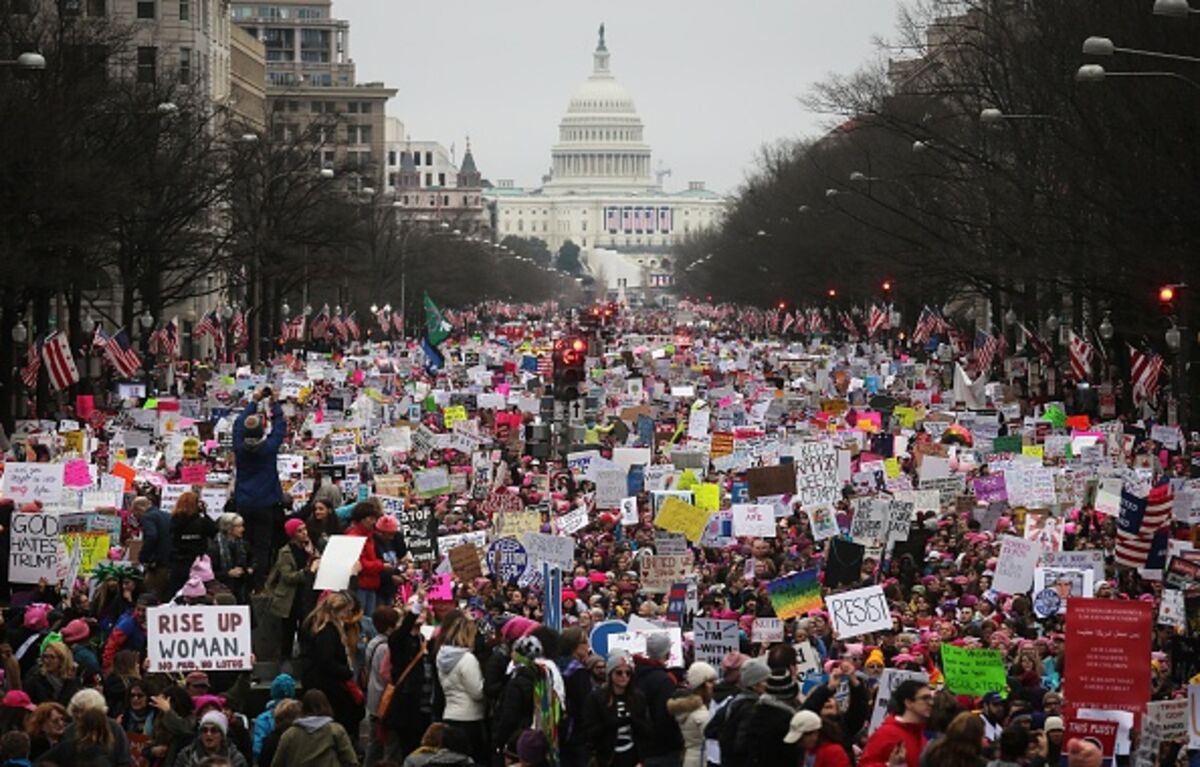
The White House can't get over the disparity between Donald Trump's modest inaugural crowd on Friday and the massive protests that took place the next day.
But what matters most is not how the numbers of marchers across America surpassed the numbers celebrating the inaugural. What matters, now and over the long term, is how those protesting bodies challenged the words of Trump's inaugural address, and neutered them.
Millions of Americans took to the streets for a "Women's March" that, in the end, had less to do with sexual politics than with a broad defiance of Trump's new order. They turned out in Boston, Los Angeles, New York, Seattle and Washington D.C., but also in places like Boise, Idaho, and Anchorage, Alaska.
Trump being Trump, he probably would’ve been unnerved by the size of the protests regardless: Size is a simple handle for an unsubtle mind. But White House strategist Steve Bannon and the shrewder members of the Trump team surely grasped that the protests had just obliterated an inaugural address that was less than 24 hours old.
In his broken beer bottle of a speech, Trump jabbed at the "establishment" he had defeated. "For too long," he said, "a small group in our nation's capital has reaped the rewards of government while the people have borne the cost."
The "rewards of government" is a curious phrase for an American inaugural address, with "rewards" sounding much like the spoils that go to the victor. To make this language less jarring, especially as fabulously wealthy Trump appointees assume power enmeshed in doubts about their ethics and public spirit, Trump insisted in his address that it's really "the people" who have triumphed.
What truly matters is not which party controls our government, but whether our government is controlled by the people.
January 20th, 2017, will be remembered as the day the people became the rulers of this nation again.
Like countless populists before him, Trump has set himself up as the representative, voice and will of "the people." As Jan-Werner Mueller wrote in "What Is Populism?":
The claim to exclusive representation is not an empirical one; it is always distinctly moral. When running for office, populists portray their political competitors as part of the immoral, corrupt elite; when ruling, they refuse to recognize opposition as legitimate.
Team Trump relishes the condemnation of elites. When bow-tied George Will called Trump's address the worst in history, it was a victory for Bannonism, the guiding force of Trumpism. A president elected with 46 percent of the popular vote, who entered office with historically low approval ratings, needs the scorn of elites to prop himself up and to buff his populist street cred.
Yet the number of people marching against Trump on Saturday appears to have been north of two million. If Trump embodies the people, who were those millions of bodies insisting that he doesn't represent them? Bow ties were not much visible in the crowds.
Neither Trump nor the organizers of the Women's March could've known how the populist words of his inaugural would be so devastatingly refuted by Saturday's tide of humanity. True, it's a short-term victory. The Trump administration will be the arena for a long and fierce battle. We are at the opening bell.
But it mattered. Everyone in Washington -- from a determined Speaker Paul Ryan to a shell-shocked White House, from tentative Democrats climbing out from the rubble to liberal interest groups searching for an ideological anchor -- just got a look at a very different people from the one described by Trump.
 Protests invite generalizations, and I was about to irresponsibly philosophize about what Saturday's historic Women's March means — specifically, what it teaches us about American self-portraiture — when I stumbled on this photograph of the new president and his wife. Surrounded by a truly unreasonable number of roses at the inaugural luncheon on Jan. 20 — a day that ought to have brought them some joy — they look the very picture of unhappiness. This is Adam and Eve sulking outside of Eden. This is every marriage gone wrong, every midlife crisis, every spiritual void that leads a soul to snatch something they'll wake up in the night regretting.
So I stopped short, because that image with its blue dress and red tie crystallized so much of what happened in America this weekend. It provoked the crowds of people in red hats who gathered in Washington, D.C., one day and the crowds of people in pink hats who gathered there — and all over the country and the world — the next. Is there anything true worth saying about a country that produced both those spectacles and this portrait of a man and a woman caught off guard, slathered in wealth, their misery on exhausted display in a rare moment when they forgot about the cameras?
There is. The Trumps may not be "relatable" in the strictest sense — their gold-encrusted habitat was always intended to alienate and impress — but that photograph captures, in its own small way, the country they now represent: divided, afflicted by comfort, addicted to outrage, bitterly convinced they've been wronged. They are, above all, camera-conscious and camera-ready.
Never has an administration been more consumed with its own image, and this weekend turned into a contest between the spectacle-producing power of the president vs. the protesters. President Trump, we now know, is trying to use his reality TV experience to generate particular effects: He padded his first press conference with paid staffers to clap — thereby making it look like he had more support than he did. He reportedly wanted tanks and missile launchers at his inaugural parade to maximize his show of power. (The military said no). When turnout for his inauguration was significantly lower than President Obama's in 2009, he rebuked the National Park Services for calling attention to the comparison, accused the press of dishonesty, and made his press secretary spend his very first press conference lying to the American people: "This was the largest audience to ever witness an inauguration, period," Sean Spicer said — a statement so easy to disprove it generated a day of Twitter jokes with the hashtag #spicerfacts.
But there may have been a reason for Spicer to lie so brazenly on his first day: First of all, in the contest for who had the bigger and better spectacle, Trump lost. That required a distraction. The crowd of protesters in Washington was three times bigger than Trump's inauguration crowds, and an estimated 3 million people protested in 670 cities worldwide. If Trump slightly underperformed, the Women's March exceeded expectations on every front: Chicago's expected 75,000 protesters grew to roughly 250,000; Boston expected 25,000 and ended up with about 175,000; L.A. drew somewhere around 500,000 people; New York expected about 100,000 and got twice that. Nor were the protests limited to the "coastal elites." There were protests of several thousand in places like Boise, Lincoln, and Charleston, West Virginia — and St. Louis and Albuquerque and Birmingham and Anchorage.
Worse still, Trump lost on multiple fronts. He lost to the Women's March the day after his inauguration, and he lost to Obama in both crowd turnout and television ratings the day of. If you fancy yourself a ratings machine and a populist, it is hard to appear that, well, unpopular.
Lying may have been the administration's effort to deprive the Women's March of media oxygen, but it was also likely an effort to consolidate support among hard-core Trumpists. If Spicer and Kellyanne Conway — the latter attempted to rebrand Spicer's falsehoods as "alternative facts" this weekend — are cultivating an audience that will accept Trump's administration's word over the evidence of their eyes, the squabble over crowd size is a perfect, low-stakes opportunity. When gauging the extent to which your followers will follow, lie obviously about something that doesn't much matter.
It's hard to imagine a better test, because the Women's March was massively photographed by almost everyone in it. A protest movement that flooded with self-portraiture poses a real problem to this administration because it floods every social media venue with images that cannot possibly be attributed to Trump's legendary "dishonest media." These are people's friends and families posting photos of their signs, of the crowds, of marches all over the world. The media simply cannot be blamed for the stunning ubiquity of the Women's March.
But that, for Trump's administration, is all the more reason to blame them anyway. Perhaps they'll convince some folks that the hundreds of thousands of people participating all over the world and uploading their photos are evil reporters or "paid protesters."
The larger point is this: From the images of Pence and Trump waving at empty bleachers to the hordes of protesters spilling over into side streets in cities all over the country, the weekend became a battle of camera angles, of the stories that spectacle sells. For all that Trump fancies himself a master of spectacle, he lost this round. And he seemed to know it even in the photograph with which I began this piece. Many emotions are legible in his face, and frustration and defeat are among them.
The Women's March was an inspiring, tendentious, flawed, necessary, and successful event. That will not be enough. Critics have been quick to point out that, for all the good feeling it generates, a march accomplishes little in itself. That's true. But it might be less true in this case than it would be in others. This happens to be a president for whom spectacle matters more than almost anything else; that means he's uniquely susceptible to this kind of protest. Crowds matter so much to him, in fact, that — per The New York Times — he sulked through much of his first weekend as president: "He spent his Friday night in a whirlwind of celebration and affirmation. When he awoke on Saturday morning, after his first night in the executive mansion, the glow was gone, several people close to him said, and the new president was filled anew with a sense of injury."
That man is in power now. He is slowly reshaping his press coverage to his specifications, floating the idea of "putting in his own security and intelligence community," whatever that might mean, and praising authoritarian leaders who crack down on dissident populations. The Women's March will be remembered as a global rebuke to this administration and the manifestation of a massive political will to resist. But if it does what protests should — if it provokes a response — much more will have to come from it.


