Showing posts with label Just A Rip Roaring Zion. Show all posts

Tuesday, April 11, 2017

How Trump’s Supreme Court Could Overturn Roe v. Wade Without Overturning It Respect for precedent could slow change but probably won’t stop it.


The Supreme Court on the night of Neil Gorsuch’s nomination.


Throughout the 2016 presidential campaign, both liberals and conservatives hoped that their candidate could shift the direction of the Supreme Court by appointing justices willing to knock down high-profile decisions that have profoundly shaped social policy. Now, President Trump is aiming to do just that, nominating federal appeals court judge Neil Gorsuch, a conservative straight out of Republican central casting, to fill the seat once held by Antonin Scalia. Given the age of the justices on the court’s liberal wing, Trump will likely get to appoint more than one justice, leading many observers to anticipate that historic liberal decisions such as the 1973 ruling in Roe v. Wade, which affirmed abortion rights, are facing a new and serious threat.

An outright reversal of Roe would be a dramatic move for the nation’s highest court, in no small part because the decision has been the foundation of abortion law and policy for four decades. But by sanctioning abortion restrictions that the court might have struck down in the past a strongly conservative court could gradually narrow Roe’s scope, thereby limiting access to abortion while leaving the decision technically intact.

The fate of signature liberal rulings like Roe won’t depend just on Trump’s nominees’ political ideology, but also on their judicial philosophy, especially their approach to precedent. Respect for precedent is a foundational legal concept that asks judges to take past decisions into account when they rule on related cases. In practice, this means that when the Supreme Court justices hear a case that deals with issues such as abortion or the death penalty, deference to precedent generally leads them to render a decision that’s in line with prior decisions on the issue. But adhering to precedent isn’t just a yes-or-no proposition; precedents can be narrowed or enlarged or clarified, or they can be shifted through a series of decisions that slowly change the way a ruling is applied by the lower courts.


In a legal system where judges are often unelected and can serve lifetime terms, the appeal of precedent is obvious: It promises certainty and continuity, and it guards against the whims of a handful of judges who decide they don’t like the rules. But precedent is also not, as Chief Justice William Rehnquist observed in 1991, “an inexorable command.” Since 1810, when the Supreme Court first broke with precedent, the justices have overruled their predecessors more than 250 times — that is, the justices explicitly acknowledged a change to precedent, whether in a majority opinion or a dissenting opinion.

These reversals, however, are only a tiny fraction of the thousands of cases that the Supreme Court has heard over the years. A look at the numbers from the Supreme Court Database, an online clearinghouse for data about the court, shows that although a few precedents are generally altered each term, that doesn’t mean the Supreme Court will change a precedent on a dime. Since 1953, when Earl Warren took over as chief justice, the court has altered precedents in just over two percent of cases. The court’s willingness to overturn precedent can also ebb and flow: In the 1955 term, early in Warren’s time on the court, no precedents were altered, but in the 1962 term, the justices changed precedent in just under four percent of their cases, including in a landmark decision establishing the right to an attorney for defendants who can’t afford one, overruling a 20-year-old precedent.

The relative rarity of breaks with precedent would seem to spell bad news for any court-watcher — liberal or conservative — hoping for an immediate shift in the Supreme Court’s approach. Even if Gorsuch proves open to breaking with precedents, that might not represent a significant change, because Scalia himself was quite willing to depart from precedent in his quest to deliver decisions that he felt were more closely in line with the original meaning of the Constitution. Scalia rarely dissented when precedent was changed: In the precedent-altering decisions that came down during his time on the bench, Scalia voted in the majority 82 percent of the time. Even in some cases where he agreed with the outcome — including in a 2014 decision that struck down a Massachusetts abortion-protest law — Scalia scolded his fellow justices for not attacking an underlying precedent.

It’s a little hard to know what Gorsuch’s approach to precedent would be (although he has expressed suspicion about an important precedent that requires courts to largely defer to federal agencies about how the bureaucracies’ responsibilities are defined), but it’s safe to say that he won’t be a threat to Scalia’s legacy: A group of academics and lawyers recently concluded that Gorsuch is the most Scalia-like of the three candidates who were reportedly on Trump’s short list for the job. Gorsuch’s influence could also extend beyond his own vote: He once clerked for Justice Anthony Kennedy, who often serves as the court’s swing vote, so he might be able to convince Kennedy to join more conservative majorities.

Precedents — and the court’s willingness to set them aside — can cut both ways ideologically.

Under Warren in the 1950s and 1960s, nearly all alterations of precedent resulted in a more liberal ruling, with decisions in favor of criminal defendants, environmental regulations, unions or civil rights claimants. Since then, the court has moved to the right: Despite a small spike in left-leaning precedent changes in the past few years, 63 percent of the Roberts court’s precedent-altering decisions have been conservative.

The Roberts court is already showing signs that it may be willing to rethink signature liberal rulings. Other chief justices — Warren, for example, in the lead-up to the 1954 Brown v. Board of Education school-desegregation case — worked to build large (or even unanimous) majorities to overturn established precedents. Chief Justice John Roberts also prizes unity and consensus, but on his court, the share of precedent-changing cases decided by a slim one-vote majority is higher than it has been under any other chief justice. That suggests that the current court may be more willing to start chipping away at precedent, according to Lee Epstein, a professor at Washington University and a contributor to the Supreme Court Database. “Overruling can tell you something, but not the whole story,” she said.

Still, the real threat to liberal precedent would come if Trump has the opportunity to replace a member of the aging liberal vanguard. That, more than the Gorsuch nomination, would tilt the ideological balance of the court toward the conservatives. But even then, change could be gradual, said Jeffrey Segal, another Supreme Court Database contributor and a political science professor at Stony Brook University. “They might not overturn a precedent right away, but they start chipping away at it until they can say, ‘Look, this precedent just isn’t workable and it’s time for it to go,’” he said. In the case of Roe v. Wade, this might mean upholding a series of state-level restrictions on abortion, until the original precedent is eventually overwhelmed. “It’s not overruling a decision so much as eviscerating it,” Segal said.

In other cases, the justices don’t need to formally overrule precedent to render a historic decision unusable. Barry Friedman, a professor of law and politics at New York University, argues that over the course of several decades, the court systematically undermined its landmark 1966 ruling in Miranda v. Arizona without ever formally reversing it. Friedman said justices were aware of the backlash they would face they reversed the now-iconic ruling requiring police to read defendants their rights. “My hypothesis is that the court doesn’t want to take heat where it doesn’t need to take it,” he said. In 2000, after the court heard a case designed to take down Miranda, Rehnquist wrote a majority opinion where he declared that the Miranda warnings had become “part of our national culture.” This decision, Friedman says, was followed almost immediately by cases effectively inviting police to ignore the Miranda ruling.

Sunday, October 16, 2016

Donald Trump's Toast at Ivanka's 2009 Wedding..... the full transcript

Saturday, October 1, 2016

Donald Trump’s middle-of-the-night tweets about a beauty queen sex tape are frustrating Republican supporters, who worry once again that their candidate’s lack of discipline and temperance will hamper his campaign.


Trump sex tape comments frustrate GOP supporters


Getty Images


Donald Trump’s middle-of-the-night tweets about a beauty queen sex tape are frustrating Republican supporters, who worry once again that their candidate’s lack of discipline and temperance will hamper his campaign.

They say Trump needs to keep his focus on Democratic nominee Hillary Clinton, prepare for their second debate, on Oct. 9 in St. Louis, and quit taking the bait from Democrats.

“It’s unlikely the Miss Universe flap is hurting Trump with current supporters, but it’s hard to see how it helps grow our vote,” said one GOP lawmaker who supports Trump.

“Maybe it's quaint conventional wisdom. But it seems he would help himself to talk about the real world problems that every day voters face,” the lawmaker said.

Trump has not been able to let go his feud with former Miss Universe Alicia Machado.

In a series of tweets beginning at 3:19 a.m. on Friday and ending at 5:30 a.m., the New York billionaire sought to discredit Machado by drawing attention to tawdry details about her past, including allegations — debunked by fact-checkers — that she has filmed a “sex tape.”

Those allegations reignited Democratic attacks against Trump over his treatment of Machado just as the issue seemed ready to peter out.

Clinton already had been doing everything she could to keep the Machado story going, believing Trump’s fat-shaming of the Venezuelan would help her with both women and Hispanic voters.

She responded to Trump’s tweet-storm with her own series of tweets, calling Trump “unhinged.”

What kind of man stays up all night to smear a woman with lies and conspiracy theories?,” Clinton tweeted.

“When something gets under Donald's thin skin, he lashes out and can't let go,” she said. “This is dangerous for a president. To Donald, women like Alicia are only as valuable as his personal opinion about their looks.”

Machado followed with a Spanish-language post on her Instagram account accusing Trump of “defamations and false accusations.”

“The attacks are slander and cheap lies generated with bad intentions and no basis that have been spread by tabloids,” Machado wrote. “This, of course, is not the first time I've faced a situation like this. Through his campaign of hate, the Republican candidate insists on discrediting and demoralizing a woman, which is definitely one of his most terrifying characteristics.”


Trump’s supporters believe he has once again been blown off course at a critical juncture in the race.

“We should be talking about the 33,000 emails,” Rep. Marsha Blackburn (R-Tenn.), a top Trump supporter and surrogate, told The Hill.

She said the GOP nominee needs to focus on Clinton’s weaknesses.

“We should be talking about the fact that the House had to do another hearing yesterday with James Comey about this issue,” she said. “We should be talking about new information on the Iran deal. We should be talking about what is happening with the Clinton Foundation and how in heaven's name two people leave the White House saying they are dead broke and a few years later they're worth several hundred million dollars and it seems like the Foundation is a conduit for that activity.”

Democrats are basking in Trump’s response, believing they’ve baited him into another ill-fated fight. It comes as the GOP nominee faces a critical stretch in which he needs to make up ground on Clinton in the polls. New surveys from Suffolk University released on Friday showed him trailing Clinton in Florida, Michigan and Nevada.

“Trump must grow his base of support to win ... and specifically he needs to grow the vote with college-educated women,” said the GOP lawmaker.

Many conservatives are angered that the media has run with the Clinton campaign’s narrative that Machado is an innocent victim in the right’s long-running war on women.

They point to media reports from the late 1990s that indicate Machado was once suspected of driving the getaway car for her boyfriend after he attempted to murder someone at a funeral.

Machado was never charged, but the judge in the case later accused her of threatening him. She dodged questions about the incident in an interview with CNN’s Anderson Cooper this week.

Fox News anchor Megyn Kelly has challenged Machado’s assertion that Trump drove her to anorexia and bulimia, reading from an old Washington Post story quoting Machado as saying she developed eating disorders before becoming Miss Universe.

Machado claims the paper made the quote up.

Trump on Friday entertained conspiracy theories bouncing around far-right websites about Machado having filmed a sex tape, as well as allegations that Clinton helped the Venezuelan become a U.S. citizen for the express purpose of attacking him at the debate.

Machado was photographed topless for Playboy and appeared in a Spanish reality TV show that featured a risqué scene of her in bed with a male contestant.

But fact-checkers have rated claims that she appeared in a sex tape as “ false,” saying that searches for Machado porn videos turn up women who look like her but are someone else.

Democrats are having a field day with the ordeal.

“I'm almost @realDonaldTrump's age, so get the urge to get up in the middle of the night, but impt safety tip: don't reach for your phone,” tweeted Clinton campaign chairman John Podesta.

And the largest super-PAC supporting Clinton, Priorities USA, resurfaced a campaign ad it ran several months earlier featuring an actor playing Trump tweeting and “zinging another loser” at 3 a.m. in the White House while ignoring an urgent call on a red ringing phone.

Trump responded over Twitter: “For those few people knocking me for tweeting at three o'clock in the morning, at least you know I will be there, awake, to answer the call!”

Ben Carson’s former campaign manager, Barry Bennett, who has advised the Trump campaign in the past, said the controversy won’t move the needle on votes but that the opportunity cost for Trump can’t be overstated.

“It’s sucking up time and time management at this point in the race is critical,” Bennett said. “By tweeting last night, he just guaranteed another day of coverage when he should be telling voters he understands all the problems they face.”

Tuesday, September 27, 2016

Fortune Magazine: Clinton Trumped Donny T and won the debate by a margin of 77% to 20 % with 3% calling it a draw.


Who Won the First Presidential Debate? by Tory Newmyer ( republished with permission of the Author and Fortune Magazine)
Image result for First Presidential Election debate


We ranked the candidates’ performances in Monday’s contest.

Hillary Clinton won by 77 to 20 with 3% undecided. In the first and potentially most consequential presidential debate of 2016, the Democratic nominee presented as composed and commanding, ticking through her policy prescriptions while landing a series of devastating blows on Donald Trump’s record and readiness. A fidgety Trump meanwhile tried repeatedly to ruffle her with interruptions while riffing his way through his own answers, but struggled on both counts.

Trump arguably had his best moments in the opening section of the debate, which tends to be its most-watched portion. Drawing from his stump speech, he conjured an image of a blighted U.S., outsmarted by its trading partners and abused by its own companies. He promised, with his trademark bluster and imprecision, to get tough on those responsible at home and abroad. “We have to stop our jobs from leaving,” he said, dismissing Clinton as a member of the entrenched political class that’s presided over an economic hollowing-out.

Yet Clinton moved from the start to stick Trump in his softest spot: his business dealings. In her second answer, she explained their differing approaches to the economy as the product of their “different perspectives.” While she was raised in a middle-class family, she said, Trump started out in the real-estate business with $14 million in loans from father. Trump maintains he only received a small fraction of that amount, a key to his narrative about being self-made.

Trump took the bait, the first of several times that he allowed Clinton to provoke him with scripted digs that kept him on the defensive. She weaved into an answer about economic progress under President Obama, for example, a mention that Trump cheered the housing collapse at the time as an opportunity to turn a profit. And Trump chimed in: “That’s called business, by the way.” He deployed another self-defeating interruption as Clinton listed reasons Trump might be avoiding releasing his tax returns. “Maybe he doesn’t want the American people, all of you watching tonight, to know that he’s paid nothing in federal taxes,” Clinton said. Trump, apparently confirming the charge, blurted, “That makes me smart.”

It got worse for Trump as the night wore on. After Clinton reeled off a summary of her plans for criminal justice reform, Trump offered his own version, which boiled down to reviving the stop-and-frisk approach pioneered and since abandoned by the New York City Police Department. Promising to restore law and order, Trump once again painted a dystopic vision of American inner cities as war zones, noting he’s seen them in person on recent visits while Clinton “decided to stay home.” Clinton interjected, “I think Donald just criticized me for preparing for this debate. And, yes, I did. And you know what else I prepared for? I prepared to be president. And I think that’s a good thing,” prompting a round of applause from the crowd, which had been instructed to stay silent.

Later in the debate, the Republican nominee asserted that he’s “developed very, very good relationships over the last little while with the African-American community.” Polling doesn’t support the claim, with national surveys showing Trump’s support among black voters hovering in the low single digits. But the Clinton campaign likewise has concerns with the demographic — that their middling enthusiasm with her candidacy with lead to low turnout, which could tip the balance in key swing states like Florida and North Carolina. Clinton helped her cause on that front in the debate, in part thanks to Trump injuring his own.

Asked about his years-long push for the lie that President Obama was born abroad — a campaign viewed by African-Americans as a racist attempt to discredit the first black president — Trump offered no apologies. Instead, he once again tried to blame Clinton’s 2008 primary campaign for originating the myth and claimed credit for settling it by finally annoying Obama into releasing his long-form birth certificate in 2011. And when pressed by NBC moderator Lester Holt on what he’d say to black voters about his birther advocacy, Trump replied, “I say nothing. I say nothing, because I was able to get him to produce it. He should have produced it a long time before. I say nothing.”

Trump didn’t fare much better when the topic turned to women, with whom Clinton also enjoys a disproportionate advantage. Asked to explain what he meant when he remarked recently that Clinton doesn’t have a “presidential look,” Trump insisted he was referring to her stamina, which he called lacking. It’s a familiar critique from Trump, who first used it to greater effect against former Florida Gov. Jeb Bush in the primaries. Ironically, Trump attempted it Monday toward the end of the debate, as he himself appeared increasingly gassed. Clinton quickly turned it back around on him, using it to land a final — and brutal — scripted attack: “You know, he tried to switch from looks to stamina. But this is a man who has called women pigs, slobs and dogs,” she said. “And one of the worst things he said was about a woman in a beauty contest. He loves beauty contests, supporting them and hanging around them. And he called this woman Miss Piggy. Then he called her Miss Housekeeping, because she was Latina. Donald, she has a name. Her name is Alicia Machado. And she just became a U.S. citizen, and you can bet she is going to vote this November.

Trump didn’t have a ready reply, mentioning that he’d directed some of his rougher comments about women toward Rosie O’Donnell, “and I think everybody would agree that she deserves it and nobody feels sorry for her.” Then, the candidate who’s styled himself as the consummate tough guy gave himself credit for holding back on something “extremely rough to Hillary” that he could have said but decided against. And he complained that Clinton has “spent hundreds of millions of dollars on negative ads on me, many of which are absolutely untrue. They’re untrue. And they’re misrepresentations. And I will tell you this, Lester: It’s not nice. And I don’t deserve that.”

It was as if after getting manhandled for the better part of 90 minutes before a nine-figure audience, Trump was asking for a reprieve. He didn't get  . He lost by 57 percenage points . Hillary Clinton ran the table and then walked off with it. 

Tuesday, August 30, 2016

A Yiddish Farewell to Gene Wilder Baruch Dayan Emet


A Yiddish Farewell to Gene Wilder


An English translation of a wonderful scene from ‘The Frisco Kid.’

2016 once proves itself to be a banner year, when we learned today of the passing of Gene Wilder. He was 83, but DANG is it sad.
Gene Wilder-One of the truly great talents of our time. He blessed every film we did with his magic & he blessed me with his friendship.
God. It’s just. The saddest thing.
Well, what we have to remember him for is a lot of laughter. We could literally just sit here all day and throw Gene Wilder moments back and forth. But this is Jewcy, so let’s pick just one that is particularly Jewish.
Remember The Frisco Kid? It’s a wholly underwatched, underrated 1979 comedy-adventure flick where Wilder plays an immigrant rabbi trying to schlep across the wild west with a bank-robbing, drop-dead-gorgeous Harrison Ford as his companion.
Once again, picking one moment from this film to share is impossible. The movie is so unapologetically Jewish, from the rabbi’s insistence to not ride a horse on Shabbos (even with a posse on his tail), to his absolute devotion to the Torah scroll he’s meant to bring to San Francisco. So here, for good measure are links to a scene where he tries to explain Jewish divinity to Native Americans, and one where Harrison Ford teaches him, well, colorful American language.
But for our featured clip, we’d like to remind you that Wilder belongs on the list of Jewish actors you may have forgotten spoke Yiddish onscreen (remember Doris Roberts in Hester Street?). Wilder’s rabbi has become lost and destitute, when spotting a group of men with beards wearing black hats, he attempts to talk to them in what he assumes is their native language. They turn out to be Amish.
The clip is only online subtitled in Hebrew and Arabic, so we’ve included an English translation (admittedly mostly from the Hebrew), below:
Wilder [in Yiddish]: “Landsmen [Yiddish word for compatriots, brothers, of my people, etc.]! Landsmen! HELLO! Landsmen! Landsmen! Hello! Landsmen— God! God! Thank God that I found you! Something terrible and awful happened to me! I was on my way to San Francisco and horrible bastards robbed me! They almost killed me!”
Amish men [In Pennsylvania Dutch]: “What did he say?” “I can’t understand any of it.”
Wilder [Yiddish]: “What’s the matter? You don’t understand Yiddish?”
Amish Men [Penn. Dutch]: “Is he speaking German?” “No, it’s not German… Do you speak English?”
Amish Man [In English]: “Dost thou speak English?”
Wilder [In English, noticing Christian Bible]: “Dost… thou… speak… OY GEVALT!”
Still from The Frisco Kid via Google+.


God Save America from Donny T ....Trump ties woos women and minorities by pitting one group against another and insulting both . Pleaaaaeease don't straight jacket him until November 9th . Let the disconnect between Trump'sbrain and mouth and political reality continueh Donald


Trump ties woos women and minorities by pitting one group against another and insulting both


Trump protesters demonstrate outside a meeting between Donald Trump and minority Republicans at Trump Tower in New York on Aug. 25. (Bebeto Matthews/AP)


Immigrants and refugees are taking jobs from black workers. Undocumented criminals prey on American women. Muslims pose a threat to gay men and lesbians.

For Donald Trump, appealing to minority groups and women often amounts to an “us vs. them” proposition — warning one group that it is being threatened or victimized by another, using exaggerated contrasts and a very broad brush.

“Poor Hispanics and African American citizens are the first to lose a job or see a pay cut when we don’t control our borders,” the Republican presidential candidate said at a rally last week in Akron, Ohio, adding that blacks in particular should vote for him because their lives are so terrible. “What do you have to lose?” he said. “You’ll be able to walk down the street without getting shot. Right now, you walk down the street, you get shot.”

From the start of his campaign, Trump has shaped his message around who is to blame for the nation’s problems — often pointing at illegal immigrants, Black Lives Matter activists and other minorities in a pitch that was aimed primarily at white Republicans.

But now, as Trump seeks to reach out to women and minorities who favor Democratic nominee Hillary Clinton, he has increasingly taken to pitting one group against another in a bid for support. It’s not clear how well it will work: Many minority voters, already turned off by months of blunt and polarizing statements, still hear the language of separation in Trump’s words.

Republican presidential candidate Donald Trump repeated his pitch to minority voters in Ohio on Aug. 22, asking them "What do you have to lose?" and promising to "straighten it out" in inner cities. (The Washington Post)

“Look, I just think a lot of his views are very ignorant,” Crystal Woods-Brookes, who is black, said as she folded clothes at a laundromat a few miles south of Trump’s Akron rally. “This is not our country, in his words. . . . I believe that’s his whole purpose, to divide, to put us . . . against each other, make one believe the other side is better.

“I believe now he’s trying to change because — it’s not about black people, it’s about the votes,” she added. “He’s already made his point quite clear, as far as I’m concerned.”

[Inside Donald Trump’s new strategy to counter the view of many that he is ‘racist’]

The real estate developer and his team insist that he wants to be an “inclusive” president, and he is in the midst of an outreach effort that includes a new stump speech and meetings with blacks, Latinos and other groups. He also has engaged in a war of words with Clinton over racial issues, repeatedly calling her “a bigot” because, he says, her policies have not helped minorities.

Amid criticism for courting minority voters while speaking to overwhelmingly white audiences, Trump will hold a question-and-answer session Saturday at Great Faith Ministries International in Detroit, which has a primarily black congregation. It will be the first of many such events at black and Latino community centers, according to the campaign.


For many of Trump’s supporters — including some minorities fearful of national security threats — Trump’s rhetoric on immigration is more about facing up to the grim realities of a dangerous world, even if that means saying uncomfortable things about Muslims.

Alejandro Lugo, who moved to Miami more than 20 years ago after living in Cuba for 30 years, said outside a recent campaign event in Fort Lauderdale, Fla., that he’s concerned that the United States is not vetting new immigrants sufficiently. He also rejected any comparison between Cuban refugees and Syrian refugees seeking to escape the Islamic State.


What Donald Trump is doing on the campaign trail

View Photos
The GOP presidential nominee is out on the trail ahead of the general election in November.

“The Cubans that came were running away from Castro. They settled in Miami, they worked. But we did not use an 18-wheeler truck to kill 150 Americans. And the Muslims, they do that. Cubans don’t do that,” Lugo said. “If the Cubans come from Cuba and they start killing American people, they have to be vetted. If you have connections with al-Qaeda and you come here to kill my family, I don’t want you in this nation.”

For the most part, though, Trump’s message has not resonated with minorities or women, who strongly favor Clinton in opinion polls. Most also think Trump is biased against those groups, polls show.

The Rev. William Barber II, the president of the North Carolina NAACP, said in a recent interview that he objects to Trump’s reductive view of the black community: that all African Americans live in poverty, that their communities are the sources of crime and that they have been fooled into voting for Democrats.

“You’re saying: ‘All black people. . . . They’re all lazy, they’re all poor,’ ” he said. “It fits that racialized narrative that crime is a particular community’s problem rather than crime being a reality in the American construct.”

After Trump cited the “oppression of women and gays in many Muslim nations” in June to support his call to temporarily ban Middle Eastern immigrants from entering the country, LGBT leaders accused Trump of fear-mongering after a massacre at a gay nightclub in Orlando — and of suggesting that there are no gay Muslim immigrants.


Women’s groups and activists also have blasted Trump for suggesting that immigrants are a disproportionate threat to women, a rhetorical appeal they say is intended to divide communities among racial lines.

“This is the culmination of all the different ways in which he has painted groups with a very broad brush,” said Marcy Stech, vice president of communications for Emily’s List. “Every week he has shown us this side of him, exposing his racist and misogynistic worldview. And any attempt to erase those moments now is just not going to work.”

José Torres, 54, a computer programmer who works at the Orlando airport, said he was unmoved by Trump’s new pitch to African Americans and Latinos and his potential “softening” on whether he would seek mass deportation of 11 million undocumented immigrants.

“Honestly, the guy as I see him is good at earning money, but as a politician, he’s got radical ideas, and I’m not in agreement with him. I think he’s very racist, also,” Torres said. “It’ll cause disunity in the country.”

‘Racialists’ are cheered by Trump’s latest strategy

Jeremiah Armstrong, 33, of Akron said Trump’s new message to black voters suggests a competition between voters where one really doesn’t exist. Armstrong, a self-employed barber, said the notion that immigrants are taking jobs away from other minorities in the United States does not match with his experience.

“Let me ask you a question: How many black farmworkers do you know? Where around here can you find someone where a Hispanic has come and taken a job?” Armstrong said. “We don’t accept those jobs anyway. I’ve never been offered one, and I’ve never had one taken away from me, so I don’t think that’s the issue.”

Trump’s tough law-and-order talk also has agitated members of the Black Lives Matter movement, who think he doesn’t understand their concerns. Trump has escalated his law enforcement rhetoric in recent months, suggesting several times that protesters are wrong to question police actions.

“Those peddling the narrative of cops as a racist force in our society, a narrative supported with a nod by my opponent, share directly in the responsibility for the unrest in Milwaukee and many other places within our country,” Trump said at a campaign rally in West Bend, Wis. “They have fostered the dangerous anti-police atmosphere in America.”


Many political strategists say the real payoff to Trump’s overtures to minority voters would be to assuage moderate Republicans who are concerned by charges that he is racist. But most doubt his effort will change the minds of minority voters.

“The attempt is at trying to fix a problem he has with mainstream voters, and I’m not optimistic that will work,” said John Weaver, a longtime GOP strategist. “It’s heavy-handed, it’s such a ham-handed attempt. Here’s his problem: People would have to have Etch A Sketch memory in their brains to forget everything he has said.”

Monday, August 29, 2016

Gene Wilder June 11.1933-August 28,2016 ....Baruch Dayan Haemet

Image result for gene wilder young frankenstein movies
Young Frankenstein 

Jerome Silberman (June 11, 1933 – August 28, 2016), known professionally as Gene Wilder, was an American stage and screen comic actor, screenwriter, film director, and author.
Wilder began his career on stage, and made his screen debut in the TV-series Armstrong Circle Theatre in 1962. Although his first film role was portraying a hostage in the 1967 motion pictureBonnie and Clyde, Wilder's first major role was as Leopold Bloom in the 1968 film The Producersfor which he was nominated for an Academy Award for Best Supporting Actor. This was the first in a series of collaborations with writer/director Mel Brooks, including 1974's Blazing Saddles and Young Frankenstein, which Wilder co-wrote, garnering the pair an Academy Award nomination for Best Adapted Screenplay. Wilder is known for his portrayal of Willy Wonka in Willy Wonka & the Chocolate Factory (1971) and for his four films with Richard PryorSilver Streak (1976), Stir Crazy(1980), See No Evil, Hear No Evil (1989), and Another You (1991). Wilder directed and wrote several of his own films, including The Woman in Red (1984).
His third wife was actress Gilda Radner, with whom he starred in three films. Her death from ovarian cancer led to his active involvement in promoting cancer awareness and treatment, helping found the Gilda Radner Ovarian Cancer Detection Center in Los Angeles and co-founding Gilda's Club.
After his most recent contribution to acting in 2003, Wilder turned his attention to writing. He produced a memoir in 2005, Kiss Me Like a Stranger: My Search for Love and Art; a collection of stories, What Is This Thing Called Love? (2010); and the novels My French Whore (2007), The Woman Who Wouldn't (2008) and Something to Remember You By (2013).

Early life and education

Born Jerome Silberman in MilwaukeeWisconsin, on June 11, 1933, Wilder was the son of William J. and Jeanne (Baer) Silberman. His father was a Russian Jewish immigrant, as were his maternal grandparents. He adopted "Gene Wilder" for his professional name at the age of 26, later explaining, "I had always liked Gene because of Thomas Wolfe's character Eugene Gant in Look Homeward, Angel and Of Time and the River. And I was always a great admirer of Thornton Wilder." Wilder first became interested in acting at age 8, when his mother was diagnosed with rheumatic fever and the doctor told him to "try and make her laugh."
At the age of 11, he saw his sister, who was studying acting, performing onstage, and he was enthralled by the experience. He asked her teacher if he could become his student, and the teacher said that if he were still interested at age 13, he would take Wilder on as a student. The day after Wilder turned 13, he called the teacher, who accepted him; Wilder studied with him for two years
When Jeanne Silberman felt that her son's potential was not being fully realized in Wisconsin, she sent him to Black-Foxe, a military institute in Hollywood, where he wrote that he was bullied and sexually assaulted, primarily because he was the only Jewish boy in the school. After an unsuccessful short stay at Black-Foxe, Wilder returned home and became increasingly involved with the local theatre community. At age 15, he performed for the first time in front of a paying audience, as Balthasar (Romeo's manservant) in a production of Shakespeare's Romeo and Juliet. Gene Wilder graduated from Washington High School in Milwaukee in 1951.
Wilder was raised Jewish, but he held only the Golden Rule as his philosophy. He described himself as a "Jewish-Buddhist-Atheist" in an interview published in 2005.

Acting career

Early starts: Old Vic and Army

Wilder studied Communication and Theatre Arts at the University of Iowa, where he was a member of the Alpha Epsilon Pi Fraternity. Following his 1955 graduation from Iowa, he was accepted at the Bristol Old Vic Theatre School in Bristol, England. After six months of studying fencing, Wilder became the first freshman to win the All-School Fencing Championship.Desiring to study Stanislavski's system, he returned to the U.S., living with his sister and her family in Queens. Wilder enrolled at the HB Studio.
Wilder was drafted into the Army on September 10, 1956. At the end of recruit training, he was assigned to the medical corps and sent to Fort Sam Houston for training. He was then given the opportunity to choose any post that was open, and wanting to stay near New York City to attend acting classes at the HB Studio, he chose to serve as paramedic in the Department of Psychiatry and Neurology at Valley Forge Army Hospital, in Phoenixville, Pennsylvania.In November 1957, his mother died from ovarian cancer. He was discharged from the army a year later and returned to New York. A scholarship to the HB Studio allowed him to become a full-time student. At first living on unemployment insurance and some savings, he later supported himself with odd jobs such as a limousine driver and fencing instructor. Wilder's first professional acting job was in Cambridge, Massachusetts, where he played the Second Officer in Herbert Berghof's production of Twelfth Night. He also served as a fencing choreographer.
After three years of study with Berghof and Uta Hagen at the HB Studio, Charles Grodin told Wilder about Lee Strasberg's method acting. Grodin persuaded him to leave the studio and begin studying with Strasberg in his private class. Several months later, Wilder was accepted into theActors Studio. Feeling that "Jerry Silberman in Macbeth" did not have the right ring to it, he adopted a stage name. He chose "Wilder" because it reminded him of Our Town author Thornton Wilder, while "Gene" came from Thomas Wolfe's first novel, Look Homeward, Angel. He also liked "Gene" because as a boy, he was impressed by a distant relative, a World War II bomber navigator who was "handsome and looked great in his leather flight jacket." He later said that he could not see Gene Wilder playing Macbeth, either. After joining the Actors Studio, he slowly began to be noticed in the off-Broadway scene, thanks to performances in Sir Arnold Wesker's Roots and in Graham Greene's The Complaisant Lover, for which Wilder received the Clarence Derwent Award for "Best Performance by an Actor in a Nonfeatured Role."

Mel Brooks

In 1963, Wilder was cast in a leading role in Mother Courage and Her Children, a production starring Anne Bancroft, who introduced Wilder to her boyfriend Mel Brooks A few months later, Brooks mentioned that he was working on a screenplay called Springtime for Hitler, for which he thought Wilder would be perfect in the role of Leo Bloom. Brooks elicited a promise from Wilder that he would check with him before making any long-term commitments. Months went by, and Wilder toured the country with different theatre productions, participated in a televised CBSpresentation of Death of a Salesman, and was cast for his first role in a film—a minor role in Arthur Penn's 1967 Bonnie and Clyde. After three years of not hearing from Brooks, Wilder was called for a reading with Zero Mostel, who was to be the star of Springtime for Hitler and had approval of his co-star. Mostel approved, and Wilder was cast for his first leading role in a feature film, 1968's The Producers.
The Producers eventually became a cult comedy classic, with Mel Brooks winning an Academy Award for Best Original Screenplay and Wilder being nominated for an Academy Award for Best Supporting Actor. Nevertheless, Brooks' first directorial effort did not do well at the box office and was not well received by all critics; New York Times critic Renata Adler reviewed the film and described it as "black college humor".
In 1969, Wilder relocated to Paris, accepting a leading role in Bud Yorkin's Start the Revolution Without Me, a comedy that took place during theFrench Revolution. After shooting ended, Wilder returned to New York, where he read the script for Quackser Fortune Has a Cousin in the Bronxand immediately called Sidney Glazier, who produced The Producers. Both men began searching for the perfect director for the film. Jean Renoirwas the first candidate, but he would not be able to do the film for at least a year, so British-Indian director Waris Hussein was hired.

Willy WonkaYoung Frankenstein, and Richard Pryor

In 1971, Wilder auditioned to play Willy Wonka in Mel Stuart's film adaptation of Roald Dahl's Charlie and the Chocolate Factory. After reciting some lines, Wilder prepared to leave the auditioning station, but Mel Stuart (who was a Gene Wilder fan) ran after him, offering the role to Wilder immediately. Wilder was initially hesitant when he learned more on the role, but finally accepted the role under one condition:
When I make my first entrance, I'd like to come out of the door carrying a cane and then walk toward the crowd with a limp. After the crowd sees Willy Wonka is a cripple, they all whisper to themselves and then become deathly quiet. As I walk toward them, my cane sinks into one of the cobblestones I'm walking on and stands straight up, by itself... but I keep on walking, until I realize that I no longer have my cane. I start to fall forward, and just before I hit the ground, I do a beautiful forward somersault and bounce back up, to great applause.[24]
When Stuart asked why, Wilder replied, "Because from that time on, no one will know if I'm lying or telling the truth."The scene appeared in the movie much as Wilder described it.
All three films Wilder did after The Producers were box office failures: Start the Revolution and Quackser seemed to audiences poor copies of Mel Brooks films, while Willy Wonka & the Chocolate Factory was not a commercial success, seeming, to some parents, a moral story "too cruel" for children to understand, thus failing to attract family audiences.Willy Wonka did gain a cult following and an Oscar nomination for Best Score, as well as a Golden Globe award nomination for Wilder. When Woody Allen offered him a role in one segment of Everything You Always Wanted to Know About Sex* (*But Were Afraid to Ask), Wilder accepted, hoping this would be the hit to put an end to his series of flops.Everything... was a hit, grossing over $18 million in the United States alone against a $2-million budget
Wilder in 1984
After Everything You Always Wanted to Know About Sex* (*But Were Afraid to Ask), Wilder began working on a script he called Young Frankenstein. After he wrote a two-page scenario, he called Mel Brooks, who told him that it seemed like a "cute" idea, but showed little interest. A few months later, Wilder received a call from his agent,Mike Medavoy, who asked if he had anything where he could include Peter Boyle and Marty Feldman, his two new clients. Having just seen Feldman on television, Wilder was inspired to write a scene that takes place at Transylvania Station, where Igor and Frederick meet for the first time. The scene was later included in the film almost verbatim. Medavoy liked the idea and called Brooks, asking him to direct. Brooks was not convinced, but having spent four years working on two box-office failures, he decided to accept. While working on the Young Frankenstein script, Wilder was offered the part of the Fox in the musical film adaptation of Saint Exupéry's classic book, The Little Prince. When filming was about to begin in London, Wilder received an urgent call from Brooks, who was filming Blazing Saddles, offering Wilder the role of the "Waco Kid" after Dan Dailey dropped out at the last minute, while Gig Young became too ill to continue. Wilder shot his scenes for Blazing Saddles and immediately afterwards filmed The Little Prince.
After Young Frankenstein was written, the rights were to be sold to Columbia Pictures, but after having trouble agreeing on the budget, Wilder, Brooks, and producer Michael Gruskoff went with 20th Century Fox, where both Brooks and Wilder had to sign five-year contracts. Young Frankenstein was a commercial success, with Wilder and Brooks receiving Best Adapted Screenplay nominations at the 1975 Oscars,losing to Francis Coppola and Mario Puzo for their adaptation of The Godfather Part II. While filming Young Frankenstein, Wilder had an idea for a romantic musical comedy about a brother of Sherlock Holmes. Marty Feldman and Madeline Kahn agreed to participate in the project, and Wilder began writing what became his directorial début, 1975's The Adventure of Sherlock Holmes' Smarter Brother.
In 1975, Wilder's agent sent him a script for a film called Super Chief. Wilder accepted, but told the film's producers that he thought the only person who could keep the film from being offensive was Richard Pryor. Pryor accepted the role in the film, which had been renamed Silver Streak, the first film to team Wilder and Pryor. While filming Silver Streak, Wilder began working on a script for The World's Greatest Lover, inspired by Fellini's The White Sheik. Wilder wrote, produced, and directed The World's Greatest Lover, which premièred in 1977, but was a critical failure. The Frisco Kid (1979) was Wilder's next project. The film was to star John Wayne, but he dropped out when the Warner Brothers executives tried to dissuade him from charging the studio his usual $1-million fee. Wayne also was ill for many years and died in June 1979.Harrison Ford, then an up-and-coming actor, was hired for the role.

Sidney Poitier and Gilda Radner

In 1980, Sidney Poitier and producer Hannah Weinstein persuaded Wilder and Richard Pryor to do another film together. Bruce Jay Friedman wrote the script for Stir Crazy, with Poitier directing, for Columbia Pictures. Pryor was struggling with a severe cocaine addiction, and filming became difficult, but once the film premiered, it became an international success. New York magazine listed "Skip Donahue" (Wilder) and "Harry Monroe" (Pryor) as number nine on their 2007 list of "The Fifteen Most Dynamic Duos in Pop Culture History", and the film has often appeared in "best comedy" lists and rankings.
Poitier and Wilder became friends, with the pair working together on a script called Traces—which became 1982's Hanky Panky, the film where Wilder met comedian Gilda Radner. Through the remainder of the decade, Wilder and Radner worked on several projects together. After Hanky Panky, Wilder directed his third film, 1984's The Woman in Red, which starred Wilder, Radner, and Kelly Le BrockThe Woman in Red was not well received by the critics, nor was their next project, 1986's Haunted Honeymoon, which failed to attract audiences. The Woman in Red did win an Academy Award for Best Original Song for Stevie Wonder's song "I Just Called to Say I Love You".
TriStar Pictures wanted to produce another film starring Wilder and Pryor, and Wilder agreed to do See No Evil, Hear No Evil only if he were allowed to rewrite the script. The studio agreed, and See No Evil, Hear No Evil premiered on May 1989 to mostly negative reviews. Many critics praised Wilder and Pryor, as well as Kevin Spacey's performance, but they mostly agreed that the script was terrible. Roger Ebert called it "a realdud"; the Deseret Morning News described the film as "stupid", with an "idiotic script" that had a "contrived story" and too many "juvenile gags", while Vincent Canby called it "by far the most successful co-starring vehicle for Mr. Pryor and Mr. Wilder", also acknowledging that "this is not elegant movie making, and not all of the gags are equally clever".[

1990s–2000s

After starring as a political cartoonist who falls in love in the 1990 film Funny About Love, Wilder performed in one final movie with Pryor, the 1991 feature Another You, in which Pryor's physical deterioration from multiple sclerosis was clearly noticeable. It was Pryor's last starring role in a film (he appeared in a few cameos before he died in 2005) and also marked Wilder's last appearance in a feature film. Neither of his last two movies were financially successful. His remaining work consisted of television movies and guest appearances in TV shows.
In 1994, Wilder starred in the NBC sitcom Something Wilder.]The show received poor reviews and lasted only one season. He went back to the small screen in 1999, appearing in three television movies, one of which was the NBC adaptation of Alice in Wonderland. The other two, Murder in a Small Town and The Lady in Question, were mystery movies for A&E TV that were cowritten by Wilder, in which he played a theatre director turned amateur detective. Three years later, Wilder guest-starred on two episodes of NBC's Will & Grace, winning a Primetime Emmy Award for Outstanding Guest Actor on a Comedy Series for his role as Mr. Stein, Will Truman's boss

Personal life
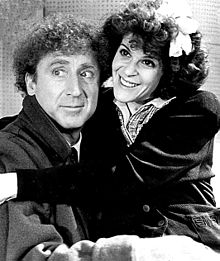
Wilder with Gilda Radner, 1986

Relationships

Wilder met his first wife, Mary Mercier, while studying at the HB Studio in New York. Although the couple had not been together long, they married on July 22, 1960. They spent long periods of time apart, eventually divorcing in 1965. A few months later, Wilder began dating Mary Joan Schutz, a friend of his sister. Schutz had a daughter, Katharine, from a previous marriage. When Katharine started calling Wilder "Dad," he decided to do what he felt was "the right thing to do," marrying Schutz on October 27, 1967, and adopting Katharine that same year. Schutz and Wilder separated after seven years of marriage, with Katharine thinking that Wilder was having an affair with his Young Frankenstein co-star, Madeline Kahn. After the divorce, he briefly dated his other Frankenstein co-star, Teri Garr. Wilder eventually became estranged from Katharine.
Wilder met Saturday Night Live actress Gilda Radner on August 13, 1981, while filming Sidney Poitier'sHanky Panky. Radner was married to guitarist G. E. Smith at the time, but Wilder and she became inseparable friends. When the filming of Hanky Panky ended, Wilder found himself missing Radner, so he called her. The relationship grew, and Radner eventually divorced Smith in 1982. She moved in with Wilder, and the couple married on September 14, 1984, in the south of France. The couple wanted to have children, but Radner suffered miscarriages, and doctors could not determine the problem. After experiencing severe fatigue and suffering from pain in her upper legs on the set of Haunted Honeymoon, Radner sought medical treatment. Following a number of false diagnoses, she was found to have ovarian cancer in October 1986. Over the next year and a half, Radner battled the disease, receiving chemotherapy and radiotherapy treatments. The disease finally went into remission, giving the couple a respite, during which time Wilder filmed See No Evil, Hear No Evil. By May 1989, the cancer returned and had metastasized. Radner died on May 20, 1989. Wilder later stated, "I always thought she'd pull through."
Following Radner's death, Wilder became active in promoting cancer awareness and treatment, helping found the Gilda Radner Ovarian Cancer Detection Center in Los Angeles and co-founding Gilda's Club, a support group to raise awareness of cancer that began in New York City and now has branches throughout the country.
While preparing for his role as a deaf man in See No Evil, Hear No Evil, Wilder met Karen Webb (née Boyer), who was a clinical supervisor for the New York League for the Hard of Hearing. Webb coached him in lip reading. Following Gilda Radner's death, Wilder and Webb reconnected, and on September 8, 1991, they married. The two lived in Stamford, Connecticut, in the 1734 Colonial home that he shared with Radner.

Political views

Wilder was a supporter of the Democratic Party, and staunchly opposed U.S. actions in the Vietnam War and the Iraq War. He supported Eugene McCarthy in the 1968 presidential election. In terms of being politically active himself, Wilder stated, "I'm quietly political. I don't like advertising. Giving money to someone or support, but not getting on a bandstand. I don't want to run for president in 2008. I will write another book instead."

Semi-retirement and authorship[edit]

The Wilders spent most of their time painting watercolors, writing, and participating in charitable efforts.
In 1998, Wilder collaborated on the book Gilda's Disease with oncologist Steven Piver, sharing personal experiences of Radner's struggle with ovarian cancer. Wilder himself was hospitalized with non-Hodgkin lymphoma in 1999, but confirmed in March 2005 that the cancer was in complete remission following chemotherapy and a stem cell transplant.
In October 2001, he read from Charlie and the Chocolate Factory as part of a special benefit performance held at the Westport Country Playhouse to aid families affected by the September 11 attacks. Also in 2001, Wilder donated a collection of scripts, correspondences, documents, photographs, and clipped images to the University of Iowa Libraries.
On March 1, 2005, Wilder released his highly personal memoirKiss Me Like a Stranger: My Search for Love and Art, an account of his life covering everything from his childhood up to Radner's death. Two years later, in March 2007, Wilder released his first novel, My French Whore, which is set during World War I. His second novel, The Woman Who Wouldn't, was released in March 2008.
In a 2008 Turner Classic Movies special, Role Model: Gene Wilder, where Alec Baldwin interviewed Wilder about his career, Wilder said that he was basically retired from acting for good. "I don't like show business, I realized," he explained. "I like show, but I don't like the business."
In 2010, Wilder released a collection of stories called What Is This Thing Called Love?. His third novel, Something to Remember You By: A Perilous Romance, was released in April 2013.
When asked in a 2013 Time Out New York magazine interview whether he would act again if a suitable film project came his way, Wilder responded, "I’m tired of watching the bombing, shooting, killing, swearing and 3-D. I get 52 movies a year sent to me, and maybe there are three good [ones]. That’s why I went into writing. It’s not that I wouldn’t act again. I’d say, 'Give me the script. If it’s something wonderful, I’ll do it.' But I don’t get anything like that."

Death

Wilder died at the age of 83 on August 28, 2016, at home in Stamford, Connecticut, from complications of Alzheimer's disease.

Work[edit]

Film[edit]

YearTitleRoleNotes
1966Death of a SalesmanBernardTelevision
1967Bonnie and ClydeEugene Grizzard
1968The ProducersLeo BloomNominated – Academy Award for Best Supporting Actor
1970Start the Revolution Without MeThe twins Claude and Philippe
Quackser Fortune Has a Cousin in the BronxQuackser Fortune
1971Willy Wonka & the Chocolate FactoryWilly WonkaNominated – Golden Globe Award for Best Actor - Motion Picture Musical or Comedy
1972Everything You Always Wanted to Know About Sex* (*But Were Afraid to Ask)Dr. Doug Ross
The ScarecrowLord Ravensbane/The ScarecrowTelevision
1974RhinocerosStanleyBased on Eugène Ionesco's play Rhinoceros
Blazing SaddlesJim, "The Waco Kid"
The Little PrinceThe Fox
Thursday's GameHarry EversTelevision
Young FrankensteinDr. Frederick FrankensteinNominated – Academy Award for Writing Adapted Screenplay
1975The Adventure of Sherlock Holmes' Smarter BrotherSigerson HolmesAlso director and writer
1976Silver StreakGeorge CaldwellNominated – Golden Globe Award for Best Actor - Motion Picture Musical or Comedy
1977The World's Greatest LoverRudy Valentine, aka Rudy HickmanAlso producer, director, and writer
1979The Frisco KidAvram Belinski
1980Sunday LoversSkippyDirected "Skippy" segment
Stir CrazySkip Donahue
1982Hanky PankyMichael Jordon
1984The Woman in RedTeddy PierceAlso director and writer
1986Haunted HoneymoonLarry AbbotAlso director and writer
1989See No Evil, Hear No EvilDave LyonsAlso writer
1990Funny About LoveDuffy Bergman
1991Another YouGeorge/Abe Fielding
1999Murder in a Small TownLarry "Cash" CarterTelevision; co-written with Gilbert Pearlman
Alice in WonderlandThe Mock Turtle
The Lady in QuestionLarry "Cash" CarterTelevision; co-written with Gilbert Pearlman

Television[edit]

  • Voice for The Electric Company's segment The Adventures of Letterman (60 episodes, 1972–1977)
  • Something Wilder (1994–1995)
  • Will & Grace Episodes "Boardroom and a Parked Place" (2002) and "Sex, Losers & Videotape" (2003); (Guest Star – Mr. Stein)

Stage[edit]

  • The Complaisant Lover (Broadway, 1962)
  • Mother Courage and Her Children (Broadway, 1963)
  • One Flew Over the Cuckoo's Nest (Broadway, 1963)
  • The White House (Broadway, 1964)
  • Luv (Broadway, 1966)
  • Laughter on the 23rd Floor (London, 1996)

Documentaries

  • "Expo: Magic of the White City" (2005)

Publications

  • Piver, M. Steven and Gene Wilder. Gilda's Disease: Sharing Personal Experiences and a Medical Perspective on Ovarian Cancer. Broadway Books, 1998. ISBN 0-7679-0138-X
  • Wilder, Gene. Kiss Me Like a Stranger: My Search for Love and ArtSt. Martin's Press, 2005. ISBN 0-312-33706-X
  • Wilder, Gene. My French Whore. St. Martin's Press, 2007. ISBN 0-312-36057-6
  • Wilder, Gene. The Woman Who Wouldn't. St. Martin's Press, 2008. ISBN 0-312-37578-6
  • Wilder, Gene. What Is This Thing Called Love?. St. Martin's Press, 2010. ISBN 978-0-312-59890-7
  • Wilder, Gene. Something to Remember You By. St. Martin's Press, 2013. ISBN 9780312598914