Donald Trump attacks 'biased' Lester Holt and accuses Google of conspiracy
The Republican nominee lashes out in the wake of his poor debate showing and hints at more attacks on the Clintons’ marriage
Republished unedited from The Guardian (UK) ( with permission)
Donald Trump has gone on the offensive after his underwhelming debate performance by criticizing debate moderator Lester Holt as biased and accusing Google of a conspiracy to rig search results in favor of Hillary Clinton.
He also had surrogates attack his Democrat rival for her husband’s infidelities while suggesting she wants to “strip [the United States] of its status as a sovereign nation”.
The Republican nominee launched the latest salvo of attacks in an interview with Fox News’s Bill O’Reilly where he claimed Holt “was much, much tougher on me than he was on Hillary”. Trump said that while initially “I said good things right after the show” he had changed his mind about Holt’s performance “after seeing the way he badgered and even the questions I got”.
In particular, Trump expressed his discontent over the fact that Holt asked him “the birther question” in Monday’s debate. Trump had long falsely claimed that Barack Obama was not born in the United States, an accusation widely considered to be a racist dogwhistle. Although Trump only recently acknowledged that Obama was born in the United States in an event at a Washington hotel, he falsely blamed Hillary Clinton for the conspiracy theory’s origin. He since said that he only acknowledged Obama’s actual birthplace in order to “get on with the campaign”.
Trump also introduced a new conspiracy theory the campaign on Wednesday night when he accused Google of somehow colluding with Hillary Clinton’s campaign. “Google search engine was suppressing the bad news about Hillary Clinton,” the Republican told a cheering crowd of supporters in Waukesha, Wisconsin. Neither Google nor the Trump campaign responded to requests for comment on this accusation. The reference to Google did not appear to be ad libbed as it was in Trump’s prepared remarks.
Also, at the rally, Trump unveiled a new accusation towards Clinton, whom he has repeatedly attacked as “a globalist”, by saying she was a “vessel for special interests ... who want to strip [the United States] of its status as a sovereign nation”. Although the former secretary of state has long favored immigration reform as well as number of free trade agreements, there is no evidence that she has ever supported stripping the United States of its sovereignty.
However, Clinton is facing scrutiny over her complicated marital history. After Trump publicly congratulated himself for not bringing up former president Bill Clinton’s past infidelities in Monday’s debate, his campaign has cited them in talking points in an attempt to rebut past crude statements about a beauty queen.
 The statements about former Miss Universe Alicia Machado, which included calling her “Miss Piggy” for her weight and “Miss Housekeeping” in reference to her Hispanic heritage, were brought up by Hillary Clinton in Monday’s debate. Trump owned part of the Miss Universe pageant at the time.
In talking points distributed to Trump surrogates on the topic, they were told to change the topic to Monica Lewinsky and included the line “Mr Trump has never treated women the way Hillary Clinton and her husband did when they actively worked to destroy Bill Clinton’s accusers.” In interviews on Wednesday, Trump surrogates repeatedly brought the subject up. Trump himself tried to cast himself as an ally of Machado in an interview with O’Reilly. He repeatedly said “I saved her job” and added in seeming regret: “I helped somebody and this is what you get for helping somebody.”
Clinton spent the day campaigning with former rival Bernie Sanders in New Hampshire. The two tried to appeal to millennial voters by repeatedly touting Clinton’s proposal to reduce the cost of college tuition. Clinton is facing declining enthusiasm among millennial voters who were one of the key groups in the winning coalition forged by Obama in his election victories. According to a recent poll conducted by ABC/Washington Post only 49% of voters under the age of 40 said they were likely to vote in November. A similar poll in 2012 put that number at 71%. The Democratic nominee also held two fundraisers on Wednesday, one of which featured an appearance from Massachusetts senator and progressive Elizabeth Warren.
The leading third party alternative to Clinton and Trump suffered his own embarrassment on Wednesday. Gary Johnson, the Libertarian nominee for the White House, was unable to name a single foreign leader he admired in an interview with MSNBC’s Chris Matthews. He referred to his inability to come up with a single name as “another Aleppo moment”. This was a reference to a televised interview several weeks ago when the former two-term governor of New Mexico, having been asked “What would you do if you were elected, about Aleppo?” on MSNBC’s Morning Joe, responded with the question “What is Aleppo?”. Johnson seemed unaware of the Syrian city which has been long under siege in the midst of that country’s civil war and the site of numerous atrocities by the Assad regime and its allies.
The candidates will return to the campaign trail on Thursday by meeting voters in states that they are long familiar with from the primaries. Clinton is holding an event in Iowa while Trump returns to the trail in New Hampshire.
Donald Trump attacks 'biased' Lester Holt and accuses Google of conspiracy
The Republican nominee lashes out in the wake of his poor debate showing and hints at more attacks on the Clintons’ marriage
Republished unedited from The Guardian (UK) ( with permission)
Donald Trump has gone on the offensive after his underwhelming debate performance by criticizing debate moderator Lester Holt as biased and accusing Google of a conspiracy to rig search results in favor of Hillary Clinton.
He also had surrogates attack his Democrat rival for her husband’s infidelities while suggesting she wants to “strip [the United States] of its status as a sovereign nation”.
The Republican nominee launched the latest salvo of attacks in an interview with Fox News’s Bill O’Reilly where he claimed Holt “was much, much tougher on me than he was on Hillary”. Trump said that while initially “I said good things right after the show” he had changed his mind about Holt’s performance “after seeing the way he badgered and even the questions I got”.
In particular, Trump expressed his discontent over the fact that Holt asked him “the birther question” in Monday’s debate. Trump had long falsely claimed that Barack Obama was not born in the United States, an accusation widely considered to be a racist dogwhistle. Although Trump only recently acknowledged that Obama was born in the United States in an event at a Washington hotel, he falsely blamed Hillary Clinton for the conspiracy theory’s origin. He since said that he only acknowledged Obama’s actual birthplace in order to “get on with the campaign”.
Trump also introduced a new conspiracy theory the campaign on Wednesday night when he accused Google of somehow colluding with Hillary Clinton’s campaign. “Google search engine was suppressing the bad news about Hillary Clinton,” the Republican told a cheering crowd of supporters in Waukesha, Wisconsin. Neither Google nor the Trump campaign responded to requests for comment on this accusation. The reference to Google did not appear to be ad libbed as it was in Trump’s prepared remarks.
Also, at the rally, Trump unveiled a new accusation towards Clinton, whom he has repeatedly attacked as “a globalist”, by saying she was a “vessel for special interests ... who want to strip [the United States] of its status as a sovereign nation”. Although the former secretary of state has long favored immigration reform as well as number of free trade agreements, there is no evidence that she has ever supported stripping the United States of its sovereignty.
However, Clinton is facing scrutiny over her complicated marital history. After Trump publicly congratulated himself for not bringing up former president Bill Clinton’s past infidelities in Monday’s debate, his campaign has cited them in talking points in an attempt to rebut past crude statements about a beauty queen.
The statements about former Miss Universe Alicia Machado, which included calling her “Miss Piggy” for her weight and “Miss Housekeeping” in reference to her Hispanic heritage, were brought up by Hillary Clinton in Monday’s debate. Trump owned part of the Miss Universe pageant at the time.
In talking points distributed to Trump surrogates on the topic, they were told to change the topic to Monica Lewinsky and included the line “Mr Trump has never treated women the way Hillary Clinton and her husband did when they actively worked to destroy Bill Clinton’s accusers.” In interviews on Wednesday, Trump surrogates repeatedly brought the subject up. Trump himself tried to cast himself as an ally of Machado in an interview with O’Reilly. He repeatedly said “I saved her job” and added in seeming regret: “I helped somebody and this is what you get for helping somebody.”
Clinton spent the day campaigning with former rival Bernie Sanders in New Hampshire. The two tried to appeal to millennial voters by repeatedly touting Clinton’s proposal to reduce the cost of college tuition. Clinton is facing declining enthusiasm among millennial voters who were one of the key groups in the winning coalition forged by Obama in his election victories. According to a recent poll conducted by ABC/Washington Post only 49% of voters under the age of 40 said they were likely to vote in November. A similar poll in 2012 put that number at 71%. The Democratic nominee also held two fundraisers on Wednesday, one of which featured an appearance from Massachusetts senator and progressive Elizabeth Warren.
The leading third party alternative to Clinton and Trump suffered his own embarrassment on Wednesday. Gary Johnson, the Libertarian nominee for the White House, was unable to name a single foreign leader he admired in an interview with MSNBC’s Chris Matthews. He referred to his inability to come up with a single name as “another Aleppo moment”. This was a reference to a televised interview several weeks ago when the former two-term governor of New Mexico, having been asked “What would you do if you were elected, about Aleppo?” on MSNBC’s Morning Joe, responded with the question “What is Aleppo?”. Johnson seemed unaware of the Syrian city which has been long under siege in the midst of that country’s civil war and the site of numerous atrocities by the Assad regime and its allies.
The candidates will return to the campaign trail on Thursday by meeting voters in states that they are long familiar with from the primaries. Clinton is holding an event in Iowa while Trump returns to the trail in New Hampshire.
Christian Debate.Civil religion died on Monday night.The belief in a common purpose that long defined America’s civil religion was strikingly absent on Monday night
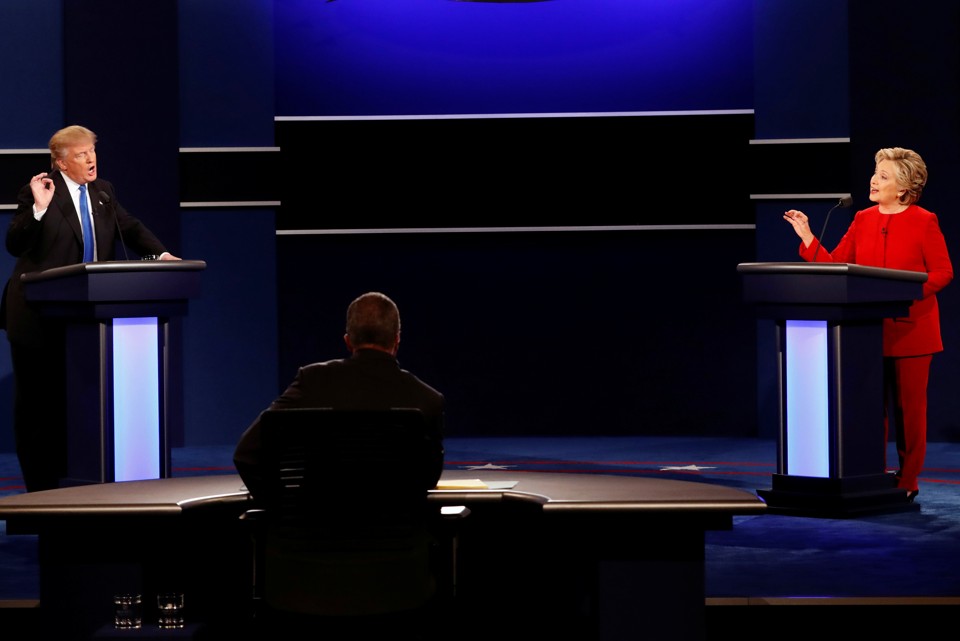
For more than 90 minutes, two presidential candidates traded charges on stage. The bitterness and solipsism of their debate offered an unnerving glimpse of American politics in a post-Christian age, devoid of the framework that has long bound the nation together.
Hillary Clinton may have offered little sense of humility, of obligation, of responsibility in Hempstead, but it was Donald Trump who directly rejected those virtues, reframing them instead as vices. He painted altruism as a sucker’s game, and left sacrifice for the losers. It was a performance that made clear one broader meaning of his candidacy—the eclipse of the values that long defined America.
Until now, the political debate has generally been framed by a set of shared principles, even if they’ve often been applied to contrary ends. Washington told his fellow citizens that they “have the same religion, manners, habits, and political principles”; Lincoln observed that they “read the same Bible and pray to the same God” even as “each invokes His aid against the other”; and Obama reminded them that they “worship an awesome God” in states both red and blue.
America may never have been a Christian nation, but its civil religion drew heavily on Judeo-Christian values. Americans long subscribed to the belief, as the sociologist Robert Bellah famously put it, that they shoulder a peculiar “obligation, both collective and individual, to carry out God’s will on earth.” That, Bellah argued, constituted a shared civil religion, one capable of binding together a diverse nation.
There are necessary corollaries to that belief, which long shaped the political debate. That individual success is a means of advancing the general good. That there are limits to what any of us can accomplish on our own. That our actions must serve some higher purpose. And that, individually and collectively, Americans can and must do great things.
Hillary Clinton, a devout Methodist, tends not to discuss her Christian faith before general audiences, or to infuse her rhetoric with the language of religion. In that, she follows the path of many recent Democratic nominees. (Senator Ben Sasse, a Nebraska Republican, argues that this aversion to the language of public religion is what turned evangelicals into Republicans, writing that it is “more accurate to conceive of much of grassroots white America as being repelled by a secular left, than as attracted by the particular policy visions of a religious right.”) On Monday night, Clinton limited herself to passing references to the black church and faith communities as civic institutions.
Nor, more significantly, did she invoke the language of civil religion. She did stress that “we have to bring communities together,” and refer to the “future we’ll build together,” but there was little emphasis on either America’s distinctive mission, or on the individual or collective responsibility to achieve it.
Trump, on the other hand, didn’t just abandon the rhetoric of American religion; he repudiated it. He spoke sometimes in the first person, sometimes in the majestic plural, but always to explain what he himself intended to do, and never to summon his fellow Americans to join him in the work. The solutions he offered all rested, to greater or lesser extents, on actions he would take as president.
He promised to impose law and order. To renegotiate trade deals. “I will bring back jobs,” he said. “I’ll be reducing taxes tremendously.” He didn’t ask Americans to make any sacrifices. He didn’t tell them what they might achieve together. He didn’t affirm that his own actions are subordinate to some higher purpose.
To the contrary. When Clinton criticized him for profiting from the misfortune of others in the housing crash, he defended himself: “That’s called business, by the way.” When she hit him for stiffing his creditors, he said he’d just “taken advantage of the laws of the nation.” When she attacked him as a tax-dodger who failed to shoulder his share of responsibility for the common good by paying federal income taxes, he replied: “That makes me smart.”
It’s easy to get so caught up in the madness of 2016 that all of this seems normal. But the Clinton-Trump debate was decidedly Marxian in its assumptions—all about material concerns, with little regard for higher purpose. To see the contrast, look back just four years, to the first presidential debate of 2012. Obama stressed that his policies were “designed to make sure that the American people—their genius, their grit, their determination—is channeled and they have an opportunity to succeed.”
And Romney, while stressing liberty and individual freedom, also emphasized responsibility. “We're a nation that believes that we're all children of the same god,” he said, “and we care for those that have difficulties, those that are elderly and have problems and challenges, those that are disabled. We care for them.”
Instead of promising to fix things himself, the Republican nominee urged the federal government to make space Americans to solve their own problems. “We can care for our own poor in so much better and more effective a way than having the federal government tell us how to care for our poor,” Romney said. “The right approach is one which relies on the brilliance of our people and states.”
That was then.
Now, the Republican nominee stands up at his convention, rattles off a litany of dysfunction, and proclaims: “I alone can fix it.”

