
Young Frankenstein
Jerome Silberman (June 11, 1933 – August 28, 2016), known professionally as Gene Wilder, was an American stage and screen comic actor, screenwriter, film director, and author.
Wilder began his career on stage, and made his screen debut in the TV-series Armstrong Circle Theatre in 1962. Although his first film role was portraying a hostage in the 1967 motion pictureBonnie and Clyde, Wilder's first major role was as Leopold Bloom in the 1968 film The Producersfor which he was nominated for an Academy Award for Best Supporting Actor. This was the first in a series of collaborations with writer/director Mel Brooks, including 1974's Blazing Saddles and Young Frankenstein, which Wilder co-wrote, garnering the pair an Academy Award nomination for Best Adapted Screenplay. Wilder is known for his portrayal of Willy Wonka in Willy Wonka & the Chocolate Factory (1971) and for his four films with Richard Pryor: Silver Streak (1976), Stir Crazy(1980), See No Evil, Hear No Evil (1989), and Another You (1991). Wilder directed and wrote several of his own films, including The Woman in Red (1984).
His third wife was actress Gilda Radner, with whom he starred in three films. Her death from ovarian cancer led to his active involvement in promoting cancer awareness and treatment, helping found the Gilda Radner Ovarian Cancer Detection Center in Los Angeles and co-founding Gilda's Club.
After his most recent contribution to acting in 2003, Wilder turned his attention to writing. He produced a memoir in 2005, Kiss Me Like a Stranger: My Search for Love and Art; a collection of stories, What Is This Thing Called Love? (2010); and the novels My French Whore (2007), The Woman Who Wouldn't (2008) and Something to Remember You By (2013).
Early life and education
Born Jerome Silberman in Milwaukee, Wisconsin, on June 11, 1933, Wilder was the son of William J. and Jeanne (Baer) Silberman. His father was a Russian Jewish immigrant, as were his maternal grandparents. He adopted "Gene Wilder" for his professional name at the age of 26, later explaining, "I had always liked Gene because of Thomas Wolfe's character Eugene Gant in Look Homeward, Angel and Of Time and the River. And I was always a great admirer of Thornton Wilder." Wilder first became interested in acting at age 8, when his mother was diagnosed with rheumatic fever and the doctor told him to "try and make her laugh."
At the age of 11, he saw his sister, who was studying acting, performing onstage, and he was enthralled by the experience. He asked her teacher if he could become his student, and the teacher said that if he were still interested at age 13, he would take Wilder on as a student. The day after Wilder turned 13, he called the teacher, who accepted him; Wilder studied with him for two years
When Jeanne Silberman felt that her son's potential was not being fully realized in Wisconsin, she sent him to Black-Foxe, a military institute in Hollywood, where he wrote that he was bullied and sexually assaulted, primarily because he was the only Jewish boy in the school. After an unsuccessful short stay at Black-Foxe, Wilder returned home and became increasingly involved with the local theatre community. At age 15, he performed for the first time in front of a paying audience, as Balthasar (Romeo's manservant) in a production of Shakespeare's Romeo and Juliet. Gene Wilder graduated from Washington High School in Milwaukee in 1951.
Wilder was raised Jewish, but he held only the Golden Rule as his philosophy. He described himself as a "Jewish-Buddhist-Atheist" in an interview published in 2005.
Acting career
Early starts: Old Vic and Army
Wilder studied Communication and Theatre Arts at the University of Iowa, where he was a member of the Alpha Epsilon Pi Fraternity. Following his 1955 graduation from Iowa, he was accepted at the Bristol Old Vic Theatre School in Bristol, England. After six months of studying fencing, Wilder became the first freshman to win the All-School Fencing Championship.Desiring to study Stanislavski's system, he returned to the U.S., living with his sister and her family in Queens. Wilder enrolled at the HB Studio.
Wilder was drafted into the Army on September 10, 1956. At the end of recruit training, he was assigned to the medical corps and sent to Fort Sam Houston for training. He was then given the opportunity to choose any post that was open, and wanting to stay near New York City to attend acting classes at the HB Studio, he chose to serve as paramedic in the Department of Psychiatry and Neurology at Valley Forge Army Hospital, in Phoenixville, Pennsylvania.In November 1957, his mother died from ovarian cancer. He was discharged from the army a year later and returned to New York. A scholarship to the HB Studio allowed him to become a full-time student. At first living on unemployment insurance and some savings, he later supported himself with odd jobs such as a limousine driver and fencing instructor. Wilder's first professional acting job was in Cambridge, Massachusetts, where he played the Second Officer in Herbert Berghof's production of Twelfth Night. He also served as a fencing choreographer.
After three years of study with Berghof and Uta Hagen at the HB Studio, Charles Grodin told Wilder about Lee Strasberg's method acting. Grodin persuaded him to leave the studio and begin studying with Strasberg in his private class. Several months later, Wilder was accepted into theActors Studio. Feeling that "Jerry Silberman in Macbeth" did not have the right ring to it, he adopted a stage name. He chose "Wilder" because it reminded him of Our Town author Thornton Wilder, while "Gene" came from Thomas Wolfe's first novel, Look Homeward, Angel. He also liked "Gene" because as a boy, he was impressed by a distant relative, a World War II bomber navigator who was "handsome and looked great in his leather flight jacket." He later said that he could not see Gene Wilder playing Macbeth, either. After joining the Actors Studio, he slowly began to be noticed in the off-Broadway scene, thanks to performances in Sir Arnold Wesker's Roots and in Graham Greene's The Complaisant Lover, for which Wilder received the Clarence Derwent Award for "Best Performance by an Actor in a Nonfeatured Role."
Mel Brooks
In 1963, Wilder was cast in a leading role in Mother Courage and Her Children, a production starring Anne Bancroft, who introduced Wilder to her boyfriend Mel Brooks A few months later, Brooks mentioned that he was working on a screenplay called Springtime for Hitler, for which he thought Wilder would be perfect in the role of Leo Bloom. Brooks elicited a promise from Wilder that he would check with him before making any long-term commitments. Months went by, and Wilder toured the country with different theatre productions, participated in a televised CBSpresentation of Death of a Salesman, and was cast for his first role in a film—a minor role in Arthur Penn's 1967 Bonnie and Clyde. After three years of not hearing from Brooks, Wilder was called for a reading with Zero Mostel, who was to be the star of Springtime for Hitler and had approval of his co-star. Mostel approved, and Wilder was cast for his first leading role in a feature film, 1968's The Producers.
The Producers eventually became a cult comedy classic, with Mel Brooks winning an Academy Award for Best Original Screenplay and Wilder being nominated for an Academy Award for Best Supporting Actor. Nevertheless, Brooks' first directorial effort did not do well at the box office and was not well received by all critics; New York Times critic Renata Adler reviewed the film and described it as "black college humor".
In 1969, Wilder relocated to Paris, accepting a leading role in Bud Yorkin's Start the Revolution Without Me, a comedy that took place during theFrench Revolution. After shooting ended, Wilder returned to New York, where he read the script for Quackser Fortune Has a Cousin in the Bronxand immediately called Sidney Glazier, who produced The Producers. Both men began searching for the perfect director for the film. Jean Renoirwas the first candidate, but he would not be able to do the film for at least a year, so British-Indian director Waris Hussein was hired.
Willy Wonka, Young Frankenstein, and Richard Pryor
In 1971, Wilder auditioned to play Willy Wonka in Mel Stuart's film adaptation of Roald Dahl's Charlie and the Chocolate Factory. After reciting some lines, Wilder prepared to leave the auditioning station, but Mel Stuart (who was a Gene Wilder fan) ran after him, offering the role to Wilder immediately. Wilder was initially hesitant when he learned more on the role, but finally accepted the role under one condition:
When I make my first entrance, I'd like to come out of the door carrying a cane and then walk toward the crowd with a limp. After the crowd sees Willy Wonka is a cripple, they all whisper to themselves and then become deathly quiet. As I walk toward them, my cane sinks into one of the cobblestones I'm walking on and stands straight up, by itself... but I keep on walking, until I realize that I no longer have my cane. I start to fall forward, and just before I hit the ground, I do a beautiful forward somersault and bounce back up, to great applause.[24]
When Stuart asked why, Wilder replied, "Because from that time on, no one will know if I'm lying or telling the truth."The scene appeared in the movie much as Wilder described it.
All three films Wilder did after The Producers were box office failures: Start the Revolution and Quackser seemed to audiences poor copies of Mel Brooks films, while Willy Wonka & the Chocolate Factory was not a commercial success, seeming, to some parents, a moral story "too cruel" for children to understand, thus failing to attract family audiences.Willy Wonka did gain a cult following and an Oscar nomination for Best Score, as well as a Golden Globe award nomination for Wilder. When Woody Allen offered him a role in one segment of Everything You Always Wanted to Know About Sex* (*But Were Afraid to Ask), Wilder accepted, hoping this would be the hit to put an end to his series of flops.Everything... was a hit, grossing over $18 million in the United States alone against a $2-million budget
After Everything You Always Wanted to Know About Sex* (*But Were Afraid to Ask), Wilder began working on a script he called Young Frankenstein. After he wrote a two-page scenario, he called Mel Brooks, who told him that it seemed like a "cute" idea, but showed little interest. A few months later, Wilder received a call from his agent,Mike Medavoy, who asked if he had anything where he could include Peter Boyle and Marty Feldman, his two new clients. Having just seen Feldman on television, Wilder was inspired to write a scene that takes place at Transylvania Station, where Igor and Frederick meet for the first time. The scene was later included in the film almost verbatim. Medavoy liked the idea and called Brooks, asking him to direct. Brooks was not convinced, but having spent four years working on two box-office failures, he decided to accept. While working on the Young Frankenstein script, Wilder was offered the part of the Fox in the musical film adaptation of Saint Exupéry's classic book, The Little Prince. When filming was about to begin in London, Wilder received an urgent call from Brooks, who was filming Blazing Saddles, offering Wilder the role of the "Waco Kid" after Dan Dailey dropped out at the last minute, while Gig Young became too ill to continue. Wilder shot his scenes for Blazing Saddles and immediately afterwards filmed The Little Prince.
After Young Frankenstein was written, the rights were to be sold to Columbia Pictures, but after having trouble agreeing on the budget, Wilder, Brooks, and producer Michael Gruskoff went with 20th Century Fox, where both Brooks and Wilder had to sign five-year contracts. Young Frankenstein was a commercial success, with Wilder and Brooks receiving Best Adapted Screenplay nominations at the 1975 Oscars,losing to Francis Coppola and Mario Puzo for their adaptation of The Godfather Part II. While filming Young Frankenstein, Wilder had an idea for a romantic musical comedy about a brother of Sherlock Holmes. Marty Feldman and Madeline Kahn agreed to participate in the project, and Wilder began writing what became his directorial début, 1975's The Adventure of Sherlock Holmes' Smarter Brother.
In 1975, Wilder's agent sent him a script for a film called Super Chief. Wilder accepted, but told the film's producers that he thought the only person who could keep the film from being offensive was Richard Pryor. Pryor accepted the role in the film, which had been renamed Silver Streak, the first film to team Wilder and Pryor. While filming Silver Streak, Wilder began working on a script for The World's Greatest Lover, inspired by Fellini's The White Sheik. Wilder wrote, produced, and directed The World's Greatest Lover, which premièred in 1977, but was a critical failure. The Frisco Kid (1979) was Wilder's next project. The film was to star John Wayne, but he dropped out when the Warner Brothers executives tried to dissuade him from charging the studio his usual $1-million fee. Wayne also was ill for many years and died in June 1979.Harrison Ford, then an up-and-coming actor, was hired for the role.
Sidney Poitier and Gilda Radner
In 1980, Sidney Poitier and producer Hannah Weinstein persuaded Wilder and Richard Pryor to do another film together. Bruce Jay Friedman wrote the script for Stir Crazy, with Poitier directing, for Columbia Pictures. Pryor was struggling with a severe cocaine addiction, and filming became difficult, but once the film premiered, it became an international success. New York magazine listed "Skip Donahue" (Wilder) and "Harry Monroe" (Pryor) as number nine on their 2007 list of "The Fifteen Most Dynamic Duos in Pop Culture History", and the film has often appeared in "best comedy" lists and rankings.
Poitier and Wilder became friends, with the pair working together on a script called Traces—which became 1982's Hanky Panky, the film where Wilder met comedian Gilda Radner. Through the remainder of the decade, Wilder and Radner worked on several projects together. After Hanky Panky, Wilder directed his third film, 1984's The Woman in Red, which starred Wilder, Radner, and Kelly Le Brock. The Woman in Red was not well received by the critics, nor was their next project, 1986's Haunted Honeymoon, which failed to attract audiences. The Woman in Red did win an Academy Award for Best Original Song for Stevie Wonder's song "I Just Called to Say I Love You".
TriStar Pictures wanted to produce another film starring Wilder and Pryor, and Wilder agreed to do See No Evil, Hear No Evil only if he were allowed to rewrite the script. The studio agreed, and See No Evil, Hear No Evil premiered on May 1989 to mostly negative reviews. Many critics praised Wilder and Pryor, as well as Kevin Spacey's performance, but they mostly agreed that the script was terrible. Roger Ebert called it "a realdud"; the Deseret Morning News described the film as "stupid", with an "idiotic script" that had a "contrived story" and too many "juvenile gags", while Vincent Canby called it "by far the most successful co-starring vehicle for Mr. Pryor and Mr. Wilder", also acknowledging that "this is not elegant movie making, and not all of the gags are equally clever".[
1990s–2000s
After starring as a political cartoonist who falls in love in the 1990 film Funny About Love, Wilder performed in one final movie with Pryor, the 1991 feature Another You, in which Pryor's physical deterioration from multiple sclerosis was clearly noticeable. It was Pryor's last starring role in a film (he appeared in a few cameos before he died in 2005) and also marked Wilder's last appearance in a feature film. Neither of his last two movies were financially successful. His remaining work consisted of television movies and guest appearances in TV shows.
In 1994, Wilder starred in the NBC sitcom Something Wilder.]The show received poor reviews and lasted only one season. He went back to the small screen in 1999, appearing in three television movies, one of which was the NBC adaptation of Alice in Wonderland. The other two, Murder in a Small Town and The Lady in Question, were mystery movies for A&E TV that were cowritten by Wilder, in which he played a theatre director turned amateur detective. Three years later, Wilder guest-starred on two episodes of NBC's Will & Grace, winning a Primetime Emmy Award for Outstanding Guest Actor on a Comedy Series for his role as Mr. Stein, Will Truman's boss
Personal life
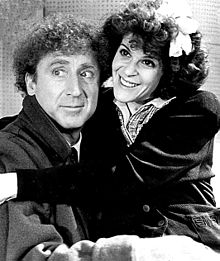
Wilder with Gilda Radner, 1986
Relationships
Wilder met his first wife, Mary Mercier, while studying at the HB Studio in New York. Although the couple had not been together long, they married on July 22, 1960. They spent long periods of time apart, eventually divorcing in 1965. A few months later, Wilder began dating Mary Joan Schutz, a friend of his sister. Schutz had a daughter, Katharine, from a previous marriage. When Katharine started calling Wilder "Dad," he decided to do what he felt was "the right thing to do," marrying Schutz on October 27, 1967, and adopting Katharine that same year. Schutz and Wilder separated after seven years of marriage, with Katharine thinking that Wilder was having an affair with his Young Frankenstein co-star, Madeline Kahn. After the divorce, he briefly dated his other Frankenstein co-star, Teri Garr. Wilder eventually became estranged from Katharine.
Wilder met Saturday Night Live actress Gilda Radner on August 13, 1981, while filming Sidney Poitier'sHanky Panky. Radner was married to guitarist G. E. Smith at the time, but Wilder and she became inseparable friends. When the filming of Hanky Panky ended, Wilder found himself missing Radner, so he called her. The relationship grew, and Radner eventually divorced Smith in 1982. She moved in with Wilder, and the couple married on September 14, 1984, in the south of France. The couple wanted to have children, but Radner suffered miscarriages, and doctors could not determine the problem. After experiencing severe fatigue and suffering from pain in her upper legs on the set of Haunted Honeymoon, Radner sought medical treatment. Following a number of false diagnoses, she was found to have ovarian cancer in October 1986. Over the next year and a half, Radner battled the disease, receiving chemotherapy and radiotherapy treatments. The disease finally went into remission, giving the couple a respite, during which time Wilder filmed See No Evil, Hear No Evil. By May 1989, the cancer returned and had metastasized. Radner died on May 20, 1989. Wilder later stated, "I always thought she'd pull through."
Following Radner's death, Wilder became active in promoting cancer awareness and treatment, helping found the Gilda Radner Ovarian Cancer Detection Center in Los Angeles and co-founding Gilda's Club, a support group to raise awareness of cancer that began in New York City and now has branches throughout the country.
While preparing for his role as a deaf man in See No Evil, Hear No Evil, Wilder met Karen Webb (née Boyer), who was a clinical supervisor for the New York League for the Hard of Hearing. Webb coached him in lip reading. Following Gilda Radner's death, Wilder and Webb reconnected, and on September 8, 1991, they married. The two lived in Stamford, Connecticut, in the 1734 Colonial home that he shared with Radner.
Political views
Wilder was a supporter of the Democratic Party, and staunchly opposed U.S. actions in the Vietnam War and the Iraq War. He supported Eugene McCarthy in the 1968 presidential election. In terms of being politically active himself, Wilder stated, "I'm quietly political. I don't like advertising. Giving money to someone or support, but not getting on a bandstand. I don't want to run for president in 2008. I will write another book instead."
Semi-retirement and authorship[edit]
The Wilders spent most of their time painting watercolors, writing, and participating in charitable efforts.
In 1998, Wilder collaborated on the book Gilda's Disease with oncologist Steven Piver, sharing personal experiences of Radner's struggle with ovarian cancer. Wilder himself was hospitalized with non-Hodgkin lymphoma in 1999, but confirmed in March 2005 that the cancer was in complete remission following chemotherapy and a stem cell transplant.
In October 2001, he read from Charlie and the Chocolate Factory as part of a special benefit performance held at the Westport Country Playhouse to aid families affected by the September 11 attacks. Also in 2001, Wilder donated a collection of scripts, correspondences, documents, photographs, and clipped images to the University of Iowa Libraries.
On March 1, 2005, Wilder released his highly personal memoir, Kiss Me Like a Stranger: My Search for Love and Art, an account of his life covering everything from his childhood up to Radner's death. Two years later, in March 2007, Wilder released his first novel, My French Whore, which is set during World War I. His second novel, The Woman Who Wouldn't, was released in March 2008.
In a 2008 Turner Classic Movies special, Role Model: Gene Wilder, where Alec Baldwin interviewed Wilder about his career, Wilder said that he was basically retired from acting for good. "I don't like show business, I realized," he explained. "I like show, but I don't like the business."
In 2010, Wilder released a collection of stories called What Is This Thing Called Love?. His third novel, Something to Remember You By: A Perilous Romance, was released in April 2013.
When asked in a 2013 Time Out New York magazine interview whether he would act again if a suitable film project came his way, Wilder responded, "I’m tired of watching the bombing, shooting, killing, swearing and 3-D. I get 52 movies a year sent to me, and maybe there are three good [ones]. That’s why I went into writing. It’s not that I wouldn’t act again. I’d say, 'Give me the script. If it’s something wonderful, I’ll do it.' But I don’t get anything like that."
Death
Wilder died at the age of 83 on August 28, 2016, at home in Stamford, Connecticut, from complications of Alzheimer's disease.
Work[edit]
Film[edit]
| Year | Title | Role | Notes |
|---|
| 1966 | Death of a Salesman | Bernard | Television |
| 1967 | Bonnie and Clyde | Eugene Grizzard | |
| 1968 | The Producers | Leo Bloom | Nominated – Academy Award for Best Supporting Actor |
| 1970 | Start the Revolution Without Me | The twins Claude and Philippe | |
| Quackser Fortune Has a Cousin in the Bronx | Quackser Fortune | |
| 1971 | Willy Wonka & the Chocolate Factory | Willy Wonka | Nominated – Golden Globe Award for Best Actor - Motion Picture Musical or Comedy |
| 1972 | Everything You Always Wanted to Know About Sex* (*But Were Afraid to Ask) | Dr. Doug Ross | |
| The Scarecrow | Lord Ravensbane/The Scarecrow | Television |
| 1974 | Rhinoceros | Stanley | Based on Eugène Ionesco's play Rhinoceros |
| Blazing Saddles | Jim, "The Waco Kid" | |
| The Little Prince | The Fox | |
| Thursday's Game | Harry Evers | Television |
| Young Frankenstein | Dr. Frederick Frankenstein | Nominated – Academy Award for Writing Adapted Screenplay |
| 1975 | The Adventure of Sherlock Holmes' Smarter Brother | Sigerson Holmes | Also director and writer |
| 1976 | Silver Streak | George Caldwell | Nominated – Golden Globe Award for Best Actor - Motion Picture Musical or Comedy |
| 1977 | The World's Greatest Lover | Rudy Valentine, aka Rudy Hickman | Also producer, director, and writer |
| 1979 | The Frisco Kid | Avram Belinski | |
| 1980 | Sunday Lovers | Skippy | Directed "Skippy" segment |
| Stir Crazy | Skip Donahue | |
| 1982 | Hanky Panky | Michael Jordon | |
| 1984 | The Woman in Red | Teddy Pierce | Also director and writer |
| 1986 | Haunted Honeymoon | Larry Abbot | Also director and writer |
| 1989 | See No Evil, Hear No Evil | Dave Lyons | Also writer |
| 1990 | Funny About Love | Duffy Bergman | |
| 1991 | Another You | George/Abe Fielding | |
| 1999 | Murder in a Small Town | Larry "Cash" Carter | Television; co-written with Gilbert Pearlman |
| Alice in Wonderland | The Mock Turtle | |
| The Lady in Question | Larry "Cash" Carter | Television; co-written with Gilbert Pearlman |
Television[edit]
- Voice for The Electric Company's segment The Adventures of Letterman (60 episodes, 1972–1977)
- Something Wilder (1994–1995)
- Will & Grace Episodes "Boardroom and a Parked Place" (2002) and "Sex, Losers & Videotape" (2003); (Guest Star – Mr. Stein)
Stage[edit]
- The Complaisant Lover (Broadway, 1962)
- Mother Courage and Her Children (Broadway, 1963)
- One Flew Over the Cuckoo's Nest (Broadway, 1963)
- The White House (Broadway, 1964)
- Luv (Broadway, 1966)
- Laughter on the 23rd Floor (London, 1996)
Documentaries
- "Expo: Magic of the White City" (2005)
Publications
- Piver, M. Steven and Gene Wilder. Gilda's Disease: Sharing Personal Experiences and a Medical Perspective on Ovarian Cancer. Broadway Books, 1998. ISBN 0-7679-0138-X
- Wilder, Gene. Kiss Me Like a Stranger: My Search for Love and Art. St. Martin's Press, 2005. ISBN 0-312-33706-X
- Wilder, Gene. My French Whore. St. Martin's Press, 2007. ISBN 0-312-36057-6
- Wilder, Gene. The Woman Who Wouldn't. St. Martin's Press, 2008. ISBN 0-312-37578-6
- Wilder, Gene. What Is This Thing Called Love?. St. Martin's Press, 2010. ISBN 978-0-312-59890-7
- Wilder, Gene. Something to Remember You By. St. Martin's Press, 2013. ISBN 9780312598914


