Showing posts with label @darorifoundation. Show all posts

Thursday, February 23, 2017

Donald Trump's biggest executive actions, explained. After entering office, President Trump began issuing a flurry of executive orders and presidential memorandums that have set a new course for US policy. Trade, security, energy, health care, immigration – there are few areas that Mr. Trump’s executive actions have not touched.

Image result for Cartoon Trump Executive order


Quantitatively, Trump does not stand out from the pack. The new president issued 18 public executive actions in his first 12 days in office: more than Presidents Clinton, George W. Bush and Reagan, but less than President Obama. Such memorandums date back to George Washington. But presidential scholars Gerhard Peters and John Woolley with the American Presidency Project say Trump's early actions feel different than years past because of "the chaotic and rapid pace of their implementation."

Not all executive actions are created equal. In many cases, congressional legislation and funding would be necessary to carry through the intent of presidential memorandums (which have the authority to govern the action of government agencies) and executive orders (which require the president to cite specific constitutional authority). But if Trump's actions become laws, this administration could become as transformative as President Reagan’s three decades ago.


1. Reverse Obamacare – Jan. 20, 2017

Shortly after his inauguration, Trump signed the Executive Order: Minimizing the Economic Burden of the Patient Protection and Affordable Care Act. It instructs the secretary of Health and Human Services and other agency leaders to waive, exempt, or delay any further implementation of ACA that would “impose a fiscal burden” on any state, individual, health insurer, or health-care provider.

At the top of his campaign agenda, this order is the first step to weaken Obamacare until Congress can repeal it. By directing agencies to interpret ACA legislation as loosely as possible, it may have a direct impact on ACA’s individual mandate, which requires Americans to pay a fee if they are uninsured. The mandate excludes Americans who can prove financial hardship, and with Trump’s executive order in place, the government may loosen the exemption qualifications. “The Trump executive order should be seen as more as a mission statement,” writes The New York Times, “and less as a monarchical edict that can instantly change the law.”

2. Federal hiring freeze – Jan. 23, 2017


The Presidential Memorandum: Hiring Freeze aims to shrink the size of the government, excluding the military. No government position declared vacant as of Jan. 22 may be filled and no new positions may be created, “except in limited circumstances,” until the director of the Office of Management and Budget creates a long-term plan for reducing the size of the federal workforce. OMB has 90 days to come up with that plan.

This memorandum is routine and “mostly symbolic” as it speaks to President Trump’s campaign promise to control the size of the federal government, says George Edwards III, a political scientist at Texas A&M University. President George W. Bush also instituted a hiring freeze shortly after he took office in 2001, but his freeze only applied to federal agencies without an appointed head.

“There’s less there than meets the eye” because the memorandum includes a lot of exceptions, including the military, which makes up more than one-third of government employees, and other national security agencies, such as the Secret Service, Paul Light, professor of public service at New York University, tells Politico. If the freeze stays in place for only the 90 days dictated in the memorandum, there will be minimal consequences.

3. Void Pacific trade deal – Jan. 23, 2017

In his Presidential Memorandum: Withdrawal of the United States from the Trans-Pacific Partnership Negotiations and Agreement, Trump directed the US trade representative to withdraw the United States from the TPP and any subsequent negotiations. “Trade with other nations is, and always will be, of paramount importance to my administration and to me,” the president wrote, but he stressed that his administration will focus on country-to-country (bilateral) trade agreements rather than regional or multilateral ones.


Trump’s action on the TPP is symbolic, since the 12-nation deal was all but dead in Congress. Going forward, however, his trade rhetoric suggests he is preparing to reverse decades of GOP trade orthodoxy. GOP presidents have long argued that trade allows companies to source their products from the most cost-efficient places, reducing costs for consumers and strengthening the economy, which will create more jobs. That has happened, with employment at an all-time high, thanks to a burgeoning service sector. But manufacturing jobs have declined. By cutting back on free trade agreements like TPP and the North American Free Trade Agreement (NAFTA), Trump aims to reverse that trend. Americans will pay for these moves through higher consumer prices.

“The Trump administration has focused much more on the flip side of the coin: that this will bring production into the US and create more jobs,” says Puneet Manchanda, a marketing professor at the University of Michigan’s Ross School of Business. “But I’m not sure they have thought through the short-term pain that these moves will inflict on us as consumers.”

4. Defund foreign health groups counseling abortion – Jan. 23, 2017


The Presidential Memorandum: The Mexico City Policy prevents federal money from going to international organizations that perform abortions, lobby for legalization of abortion, or promote abortion. It reinstates the policy first put in place by President Reagan, which some human rights organizations label the “global gag rule.” Trump expanded the scope of the law by changing the application from family planning health services to all global health services, including HIV/AIDS clinics that had previously been exempted by George W. Bush.

“It wasn’t unexpected that they would reinstate the global gag rule, but the dramatic expansion of the scope of it is truly shocking,” Geeta Rao Gupta, senior fellow at the United Nations Foundation, told Slate. The move drew praise from antiabortion advocates. It “sends a strong signal about his administration’s pro-life priorities,” Marjorie Dannenfelser, president of the Susan B. Anthony List, in a statement.

5. Expedite energy pipelines – Jan. 24, 2017


Trump issued three actions – “Presidential Memorandum: Construction of the Dakota Access Pipeline,” “Presidential Memorandum: Construction of the Keystone XL Pipeline,” and “Executive Order: Expediting environmental reviews and approvals for high priority infrastructure projects” – to push through two of the most controversial energy projects of recent years. The first memorandum is a reaction to the US Army Corps of Engineers’ decision in December to deny an easement to finalize the Dakota Access pipeline (DAPL) after months of protests by the Standing Rock Sioux tribe and its supporters. The second is an attempt to resurrect the Keystone oil pipeline between Canada and Nebraska, which President Obama canceled in 2015 after years of protests.

Like many of Trump’s memorandums and orders, the pipeline executive actions signal the direction of future policy rather than accomplish something right away. For example, his memorandum on Keystone XL invites TransCanada “to promptly re-submit” an application to the State Department to construct the pipeline. And the memorandum on the DAPL asks the corps to “review and approve in an expedited manner” the Dakota Access pipeline, while requesting the corps’ director to “rescind or modify” the environmental impact statement that prevented the completion of the final 10 percent of the pipeline under Lake Oahe in North Dakota.

The executive order that expedites environmental reviews for “high priority infrastructure projects” will also help push forward the construction of DAPL and Keystone XL.

Trump also signed another memorandum – Construction of American Pipelines – that mandates that all new pipelines in the US, as well as repairs of existing pipelines, “use materials and equipment produced in the United States, to the maximum extent possible and to the extent permitted by law.” That will apply to all the steel and iron needed for construction.

6. Strengthen US-Mexico border – Jan. 25, 2017

Along with authorizing the construction of a physical wall on the US-Mexico border,

“Executive Order: Border Security and Immigration Enforcement Improvements” ends the “catch-and-release” policy, hires 5,000 additional Border Patrol agents, and enacts federal-state partnerships to enforce federal immigration policies.

Some Republican legislators say Trump’s order is legal under the Secure Fence Act of 2006, which calls for 700 miles of barrier between the US and Mexico. The wall was never completed under the Secure Fence Act, so the Homeland Security secretary could interpret the act to apply to Trump’s proposed wall more than 10 years later. But even if this act validates Trump’s wall, the president will still need money from Congress. During the campaign, he promised that Mexico would pay for the wall, a statement that Mexico adamantly rejects. But with this order, Trump says the US will pay for the wall with federal funds only to be reimbursed by Mexico at a later date. Senate majority leader Mitch McConnell estimates the wall would cost around $15 billion; others put it at $25 billion, a sum does not account for other expenses such as maintenance (which could cost as much as $750 million a year).

In 2006, President Bush officially ended “catch-and-release,” a protocol that allows immigrants caught with an illegal status to be set free while waiting for a hearing with an immigration judge. But the US continues the practice because it doesn’t have the necessary detention centers. Nearly 45,000 parents and children were apprehended near the border during the last three months of 2016, but detention centers only have 3,300 beds for immigrant families. Building them will take time and money. The increase of border patrol agents is also dependent on money from Congress.

7. Travel ban for immigrants, refugees – Jan. 27, 2017

Executive Order: Protecting the Nation from Foreign Terrorist Entry into the United States suspends visa issuance as well as immigration entry to “nationals of countries of particular concerns” for 90 days. The Trump administration applied this order to seven predominantly Muslim countries: Iraq, Iran, Syria, Yemen, Sudan, Somalia, and Libya. The order also suspends all refugee admission to the US for 120 days and indefinitely denies entry to all Syrian refugees.

The legality of the executive order is open to debate. Under the Immigration and Nationality Act of 1952, the US president has the right to suspend the entry of any immigrants he or she finds to “be detrimental to the interests of the United States.” But 13 years later, President Johnson signed the Immigration and Nationality Act of 1965, which banned discrimination of immigrants because of their “race, sex, nationality, place of birth, or place of residence.” More than three dozen lawsuits have been filed since Trump signed his order Jan. 27. And the attorneys general of at least five states – Virginia, New York, Massachusetts, Minnesota, and Washington – joined lawsuits challenging its constitutionality. The order does not explicitly bar immigrants from these seven countries because they are Muslim. But if courts decide that Trump’s executive order is meant to act as a Muslim ban – which some of Trump’s spokesmen have publicly suggested – then the order may violate the Constitution’s Establishment clause.

But presidents are granted sweeping powers over immigration. “I think the administration could win,” Stephen Yale-Loehr, a professor of immigration law at Cornell Law School, told CNN. “Courts tend to defer to whatever a president declares on immigration.”

8. Ethics pledge – Jan. 28, 2017

Executive Order: Ethics Commitments by Executive Branch Appointees mandates that every executive agency appointee after Jan. 20, 2017, sign and ethics pledge, which includes a five-year ban on officials becoming lobbyists after they leave government and a lifelong ban against White House officials becoming lobbyists for a foreign government.

The ethics pledge changes the timelines of Mr. Obama’s 2009 ethics pledge, which barred appointees from lobbying for two years after federal employment, prevented appointees from working for a lobbying group within the one year prior to his or her appointment, and prevented the appointee from working on anything related to their past lobbying interest for two years after beginning their job with the government. Although they now have to wait five years before working as a lobbyist, appointees can contact their former agencies within one year. Trump’s order also expands the definition of a lobbyist from strictly registered lobbyists to include those working or researching for an advocacy campaign or creating lobbying strategies.

Although both presidents have allowed ethics waivers for some officials, Trump’s order does not require the White House to disclose which appointees are granted waivers.

9. Reorganize national security apparatus – Jan. 28, 2017

Presidential Memorandum: Organization of the National Security Council and the Homeland Security Council includes three main actions. It separates (again) the staffs of the NSC and HSC; it allows the president’s chief political strategist, Steve Bannon, to attend any NSC meeting as well as participate in the highly influential Principals Committee; and it denies the director of national intelligence (DNI), former Indiana Sen. Dan Coats, and the chairman of the Joint Chiefs of Staff, Marine Gen. Joseph Dunford, permanent seats at the Principal Committee.

Since its inception in 1947, the NSC has been organized differently under each president. But Trump’s reorganizing of the NSC is “particularly significant,” Kelly Magsamen, NSC director for Iran under Presidents George W. Bush and Obama, writes in the Atlantic. While Mr. Bannon – the former publisher of Breitbart, which publishes white nationalist, anti-Semitic, and misogynistic material – is highly controversial, to include any political operative in such discussions is highly unusual. “To place a purely political operative on the NSC – alongside actual Cabinet members with national-security responsibilities or expertise – is an unprecedented move with profound implications for how national-security policies are developed and executed,” she writes. “It may be likely that Trump would consult Steve Bannon regardless, but giving him a formal seat at the NSC sends a chilling message to men and women in uniform, to diplomats and intelligence professionals – that Bannon’s political advice matters as much as theirs.”

10. ISIS battle plan – Jan. 28.

Presidential Memorandum: Plan to Defeat the Islamic State of Iraq and Syria requests that the Defense Secretary James Mattis, submit a preliminary draft of “a new plan to defeat ISIS” within 30 days.

The plan should include recommended policy changes, potential ways to cut off ISIS’ funding, potential new coalition partners, and cyber strategies and public diplomacy. But the memorandum is not specific. The recommended policies included in the memo sound a lot like the previous administration’s approach, says the US Naval Institute. But as the Washington Post reports, it may include potentially deploying US forces closer to the front lines in Iraq and Syria or sending more advisers.

11. Reduce regulation – Jan. 30, 2017

For every new regulation, ax two others. That’s the mantra of Executive Order: Reducing Regulation and Controlling Regulatory Costs, which also directs agency heads to ensure that new regulations don’t add to the total costs of regulations, unless advised otherwise by the director of the Office of Management and Budget. The order also imposes a regulatory budget beginning in fiscal year 2018, which will require agency heads to limit regulation costs as well as the number of regulations.

Republicans have long complained about over-regulation by governmental agencies. Both ideas – a regulatory budget and a 2-for-1 reduction in rules – have been considered before. Trump wants to “double down by mandating both at the same time.” The challenge will be actually implementing the order, since there’s no clear definition of what counts as a regulation or which agencies will be included in the order.

12. Financial deregulation – Feb. 3, 2017

In two executive actions – Executive Order: Core Principles for Regulating the United States Financial System and Presidential Memorandum: Fiduciary Duty Rule – Trump took on regulation in the financial industry. The first deals with loosening regulations of the financial system, including the far-reaching Dodd-Frank Act, which aims to prevent another meltdown. The second calls for an investigation into the impact of an investment-advice rule.

Repealing Dodd-Frank will be hard. Passed by Congress in 2010, the law would need a filibuster-proof 60 votes in the Senate, where even Republicans have differing views on the need to help the financial industry. The industry argues that the law is costly and too onerous – a theme of Trump’s executive order, which doesn’t mention Dodd-Frank by name. It lays out a list of core principles, including fostering “vibrant financial markets” and rationalizing financial regulations. The order directs the Treasury secretary to consult with the heads of the regulatory agencies and report back in 120 days on any laws, treaties, regulations, and reporting requirements that run counter to the core principles.

The key will be what the regulatory agencies do, says Aaron Klein, policy director of the Center on Regulation and Markets at the Brookings Institution in Washington. Over time, the administration can change the regulators as their terms come up. “An administration determined to roll back financial regulation could implement a decent amount of their agenda,” he says, but it will take years.

The White House can have quicker success with the fiduciary rule, which requires brokers to put their clients’ interests before their own when offering advice on retirement. The industry claims the rule is too complex and will boost the cost of retirement advice. The presidential memorandum calls for the Labor Department to examine whether Americans are adversely affected in accessing retirement advice. Because the rule was implemented as an executive action from President Obama, Trump can reverse it – if it goes through the notice and comment process, emails Barbara Roper, director of investor protection at the Consumer Federation of America, which supports the rule. The acting Labor secretary said in a statement that implementation of the rule, scheduled for April 10, 2017, could be delayed as the department conducts its research. It could take a year before the rule is officially scrapped or amended, an industry source says.

13. Crime reduction – Feb. 9, 2017

Trump’s three executive orders – Task Force on Crime Reduction and Public Safety, Enforcing Federal Law with Respect to Transnational Criminal Organizations and Preventing International Trafficking, and Preventing Violence Against Federal, State, Tribal, and Local Law Enforcement Officers – are all aimed at cracking down on illegal immigration, drug trafficking, and violent crime. They create a task force to reduce crime, aim to combat criminal groups that operate in more than one country, and call for more effective ways to prosecute those who attack police officers.

These orders represent standard Republican fare. For example, the crime-reduction task force echoes similar moves by Presidents Reagan and George H.W. Bush to better coordinate the federal departments involved in fighting crime. The order aimed at transnational crime groups calls for enhanced information sharing among domestic and foreign law-enforcement agencies, a review of laws pertaining to international drug and human trafficking, and a report within 120 days on how bad the problem is.

Still, aspects of these orders have drawn criticism from the left and the right. For example, the order on preventing violence against police calls for legislation to define new federal crimes to protect law-enforcement officers – proposals that don’t sit well with some conservatives. “For the past 30 years, the Right has been sounding the alarm about the growth of government and the federalization of crime,” the libertarian Cato Institute points out. “Trump and [new Attorney General Jeff] Sessions seem not only uninterested, they seem intent on exacerbating the problem.” On the left, the American Civil Liberties Union says the president is aiming at the wrong problems, such as a crime rate already at or near historic lows, while ignoring police shootings of minorities.


Friday, February 10, 2017

Quo Vadis the Supreme Court . For Justices may not outlive the #OyVeyDonaldTrump Presidency. Ruth Ginsburg will certainly try


Justice Ruth Bader Ginsburg Wakes Up Long Enough to Issue This Threat to Trump!


One of the main reasons Donald Trump was elected over Hillary Clinton as our president: Supreme Court justices. Americans did NOT want Hillary Clinton nominating the next Supreme Court justice(s). With the seat vacancy of the late Justice Antonin Scalia, who was appointed by Reagan, Americans wanted a conservative to fill the vacancy.

The Supreme Court already has 4 justices appointed by Democrats and Americans want a justice who is loyal to the Constitution and has a strong commitment to pro-life. President Trump’s first choice, Federal Appeals Court Judge Neil Gorsuch has just that. He will also help break for the most part, the current 4-4 tie on the Supreme Court.


It’s no surprise Supreme Court Justice, Ruth Bader Ginsburg, appointed by Bill Clinton, is no fan of Donald Trump’s. Most would say it’s past time for Justice Ginsburg to retire, including Donald Trump.


But Democrats are going to try to keep her on for as long as they can, because the retirement of Justice Ginsburg would give President Trump one more conservative appointment to the Supreme Court; that’s not something Democrats are looking forward to.

U.S. Supreme Court Justice Ruth Bader Ginsburg, whose job it is to uphold the Constitution is calling for a change in the Electoral College. As the code of conduct for US judges states: Canon 2: A Judge Should Avoid Impropriety and the Appearance of Impropriety in all Activities (A) Respect for Law. A judge should respect and comply with the law and should act at all times in a manner that promotes public confidence in the integrity and impartiality of the judiciary.

CBSNews Reports: STANFORD, Calif. — U.S. Supreme Court Justice Ruth Bader Ginsburg lamented partisanship in Congress during a talk at Stanford University on Monday and said she hoped it would return to an era when “it was working for the good of the country and not just along party lines.” Ginsburg did not address the nomination of Neil Gorsuch to the Supreme Court seat vacated by the late Justice Antonin Scalia or President Trump’s travel ban, which could end up before the high court. But she did say she would like to change the Electoral College, a comment that drew applause from the packed, 1,200-seat Stanford Memorial Church. She did not elaborate.

Ginsburg said during the presidential campaign that she presumed Democrat Hillary Clinton would win and have the opportunity to make a few appointments to the court.

She said at the time she did not want to think about the possibility of a Trump victory, calling Trump in one interview a “faker” who “really has an ego.”


She later apologized and said her remarks were ill-advised.


It’s highly inappropriate that a United States Supreme Court justice get involved personally in politics. As I said earlier, Ginsburg was appointed by Bill Clinton and is a typical liberal on the Supreme Court. Supreme Court Justices are suppose to judge on the side of the law – the Constitution. They are there to make sure our nation is governed by the law and the law – the Constitution – is enforced, but it’s been somewhat of a “free-for-all” the last 8 years with Obama in charge.

Democrats must be really freaking out now with the possibility that President Trump may not only have the opportunity to appoint 2 justices to the Supreme Court, but maybe even more. Ginsburg is 83, Kennedy is 80 and Breyer is 78.

Either way, no judges including Justice Ginsburg, should be making personal statements about immigration or anything else outside of the US Supreme Court. Ginsburg’s remarks underscore the need for Supreme Court justices to keep their political opinions to themselves.

Maybe Justice Ginsburg should listen to her own advice:

“I wish there was a way I could wave a magic wand and put back when people were respectful of each other and the Congress was working for the good of the country and not just along party lines,…Someday there will be great people, great elected representatives who will say, ‘enough of this nonsense, let’s be the kind of legislature the United States should have,”….

Friday, January 20, 2017

Gunning for Donny T : The Teflom Man spins with Chutzpa his yarns and lies of great success and says he can fix the Democratic Party & Obama caused mess in which his great nation is now debt burdened and quagmired by The Bard of Bat Yam, Poet Laureate of Zion

Democracy in those many States S&W of Canada  voted again
in that Pax America Symbol of Freedom and Capitalism  for  men
where every man  "is equal" especially he
who has missions and billions B.Franklin  money.
Step forward Donald Trump into the fray
in which he has a lot to bombastically  say.
He egotistically says he isn't like the rest
he's better than them all, he's simply hugely the  best.
 
The Teflom Man spins with Chutzpa his yarns and lies  of great success
and says he can fix the Democratic Party & Obama caused  mess
in which his great nation is now debt burdened and  quagmired
and for causing it many people to be underemployed and even fired.
He says that he is his own egomaniac man
He can't be bought, blackmailed or brided so he can
run the  country and ignore the $20 trillion deficit  with his zest and libedo
and yes  those Mexican and Arab immigrants and rapist will have to go.

Donny T  agrees  that although tens of thousands die,
shot dead every godforsaken year by
those in Constitution  possession of a gun
he will not intervene to spoil the mayhem and  fun
of all those proud Americans and illegals, friends and foe  who
own a pistol, automatic gun and even a tank ,  or maybe two,
or three or four and often even  more,
leading to the shocking and deadly annual score.

Donald Trump says2nd amendment carnage  simply lies
in the minds of the infants, kids, grannies and guys
who pull  the trigger and it is they alone
who are responsible for causing the war zone,
which the US has become,
a place where people seem to be numb
to the repeated scenes of carnage they see
reported daily in social media meas and  their tv.

If Donald is really his own man, and he
truly cares and wants to see
an end to the bloodbath and gore  in his land,
then he needs to see that guns are banned
from being sold to anyone who wants to buy
without any care about who may die,
he needs to introduce a bill
to stop the provision of the means to kill,
and if, as he says he cannot be bought
then he must fear absolutely nought,
especially those who have turned their hobby
into the powerful, All Mighty God , pro-gun lobby. 

Thursday, January 19, 2017

Inequality Doesn't Create Poverty.... and hey Neoliberialism isn't responsible either


Oxfam, the leftwing NGO devoted to poverty relief has released a new report blaming poverty in wealth inequality. In other words, its central claim is that the existence of very wealthy people creates poverty. 
The report is largely just an extended op-ed that asserts that the existence of some very wealthy people is the cause of poverty in the world. Notable buzzwords and phrases include "trickle down," "obscene levels of inequality," and "neoliberalism."
The "solution" to the alleged problem, which should surprise no one, is a list of taxes that should be either introduced or raised significantly, including higher income taxes, "a tax on financial transactions," a "global wealth tax," and a so-called "anonymous wealth tax." 
These taxes, we are told, will put an end to the poverty-causing inequality that now is a global crisis. 
But there's a problem for Oxfam in this data. The report never actually demonstrates that inequality causes poverty, or how it does it. It does claim that many wealthy people are getting richer faster than poor people. As Marketwatch sums up: 
Oxfam said new data from its report “An Economy for the 99%,” shows that between 1988 and 2011, the incomes of the poorest 10% rose by just $3 a year, while incomes of the richest 1% increased 182 times that much. In 2015, the world’s richest 1% held on to their share of global wealth, owning vastly more than the other 99%, said the charity.
Even this statement is questionable, as Felix Salmon points out at Fusion. The way the report calculates wealth has a tenuous relationship with reality: 
The result is that if you use Oxfam’s methodology, my niece, with 50 cents in pocket money, has more wealth than the bottom 40% of the world’s population combined. As do I, and as do you, most likely, assuming your net worth is positive. You don’t need to find eight super-wealthy billionaires to arrive at a shocking wealth statistic; you can take just about anybody.
Economist Mateusz Machaj adds at mises.org: 
[I]f you put 30 dollars into your bank account, does it mean that you caused extreme poverty for 10% of the world population? This is what Oxfam is implying in its biased pseudo-economic analysis.
But, let's just a for minute accept Oxfam's central claim that the rich are getting rich faster than the poor. This in itself tells us something. It used to be that we were told "the rich get richer while the poor get poorer." 
Note, however that Oxfam does not claim this. They can't claim this because the poor are not getting poorer.
In fact, the the global poor have more access to basic necessities and wealth than ever before. 

Global Poverty Is In Decline 

But, as this data shows, global poverty has been declining for decades: 
Moreover, given that "extreme poverty" as defined by the World Bank no longer even exists in the wealthy "global north," this is really a measure of poverty in places like South Asia and Africa and Latin America. 
But what about more tangible issues such as hunger and starvation? Well, that's been falling significantly as well in recent decades. According to data from the the UN's Food and Agriculture Organization, we find: 
In this case, I've included data for South Asia (which includes places like India and Bangladesh) and Sub-Saharan Africa for comparison. Note that in all cases, malnourishment is in decline. 
On a related note, we might also look to access to clean water and sanitation. After all, water-borne disease is one of the worst afflictions still faced by people in the poorest parts of the world. Here too, there has been progress: 
But, as any parent knows, infant mortality is one of the most noticeable and important measures of well-being. Fortunately, this is one of the areas where the most progress has been made, as we can see: 
But merely avoiding death is never enough. How about education? Well, world literacy rates are rising: 
The Oxfam report, of course, ignores all of this. When the Oxfam report says that certain groups are "worse off," what they really mean is that people in those demographic or socio-economic groups tend to be improving their situation more slowly than people in other groups. "Worse off" most certainly does not mean "worse now compared to 20 years ago." 

Our Enemy, the Markets

But, Oxfam has identified who is at fault for the fact that many people aren't getting rich as quickly as we'd like. The group they have identified is, not surprisingly, the "neoliberals." 
As we've noted here before, "neoliberal" is an amorphous term that has been applied to everyone from Janet Yellen to Ludwig von Mises. Neoliberalis should not be confused with advocates for free-markets. Nevertheless, some neoliberals do indeed engage in limited advocacy for markets. From the left's perspective, however, the primary problem with the neoliberals is not their many deviations from free-market economics — a support for central banks chief among these deviations. The problem with neoliberals, we are told, is their limited pro-market rhetoric. Thus, we see time and time again that any reform that moves in the direction of less government regulation or more freedom in markets is denounced as "neoliberal." "Neoliberal" is in many cases simply code for "libertarian." 
To its credit, the report spends a few short paragraphs on the problem of "crony capitalism," noting that: 
Since 1990, there has been a big increase in billionaire wealth that has been derived from industries with very close relationships to governments, such as construction and mining. This is particularly true in the developing world, but is also an important factor in the rich world.
The report neglects to note that this has been especially true in the wealthy West in the financial sector. The marriage between huge banks and central banks has been an enormous source of crony capitalism in the West and has helped to enrich the wealthiest through the money-creation mechanisms at central banks. 
But, as we might expect, the problem of the wealthy using political power to enrich themselves is not solved by reducing the power of political institutions. No, when the wealthy abuse the power of the state, the solution is to make the state more powerful! How exactly this will then prevent from the wealthy from abusing the state's even-greater power remains unanswered. 
"Just raise taxes" is the moral of the Oxfam story. "You can trust us and our friends in government." 

There's No Causal Relationship Between Inequality and Poverty

Ultimately, the Oxfam report is little more than a demand for higher taxes. It does not show how inequality causes poverty, and it resorts to abusing language by implying that people become "worse off" when someone else becomes better off faster. 
Carefully ignoring the fact that the global spread of markets in recent decades has coincided with enormous declines in poverty, the report focuses on inequality, without ever demonstrating why it's so bad. 
This, however, is where arguments about inequality almost always end up: the fight against inequality becomes an end in itself because it cannot be shown that inequality is an obstacle to reducing poverty. 
If every person in the world had access to clean, safe housing, clean food and water, basic health care, and reading materials for education, wouldn't we consider this a great victory for mankind? After all, a dry room to sleep in and enough food to eat was regarded as something of a utopian fantasy in the 19th century in the West. Since then, the West, of course, has already far surpassed this and the rest of the world is moving in the same direction. 
But, Oxfam would have you believe that these victories would mean nothing if there are rich people out there somewhere who own a yacht, or have a home theater system, or own a luxury car. Whether or not the poor are gaining access to basic necessities mean nothing to them so long as other people are buying luxuries. 
Their "solution" is simply to redistribute wealth from the wealthiest to the poorest — after governments take their cut, of course. 
But this solution assumes that wealth creation would continue at the same pace once massive new redistribution schemes are put in place. Would large corporations continue to employ as many people or pay dividends to as many investors — many of whom are hardly billionaires themselves — were the wealth of those organizations redistributed? That is hardly a given. Workers would almost certainly find themselves with fewer options. 
Not surprisingly, the empirical data is clear that countries with more free trade, more wealth, and more freedom in markets are better places for the poor to live. 
According to analysis from the Fraser Institute, we find that the lowest percentiles of earners make more in more economically free countries, and also possess a larger share of the wealth.
In more economically free countries, there is less poverty overall: 
In more economically free countries, the poorest have more of the total share of wealth: 
In more economically free countries, the poorest have more income:
If we seek to make further gains against poverty, the solution is obvious.

#RIPUSA #RIPSUPREME COURT under Donald Trump


The Supreme Court operates in counterpoint to the rest of the government. The Justices do not initiate; they respond. Every major political issue of the day eventually winds up in their courtroom, and they either embrace or resist what’s happening in the rest of the world. When Franklin D. Roosevelt pushed the New Deal through Congress, the conservatives on the Court, for a time, fought him to a standstill. When the civil-rights movement gathered steam, the Justices gave first a hesitant and then a fuller endorsement of the cause. But resistance from the Justices never lasts too long. The truism that the Supreme Court follows the election returns happens to be true. Elections have consequences.

For the past eight years, the Court has been called upon to respond to President Obama’s agenda. In certain crucial ways, a majority of the Justices have upheld the work of the Administration, most notably in two cases that posed existential threats to the Affordable Care Act. In other cases, the Court has rebuked the President. In Burwell v. Hobby Lobby, the Court rejected the Administration’s view that the A.C.A. required closely held corporations to subsidize forms of birth control that the owners opposed on religious grounds. Over all, the Court has reflected the fierce partisan divisions in the country. Conservatives won many cases (striking down campaign-finance regulations and gutting the core of the Voting Rights Act), while liberals won others (expanding gay rights and reaffirming abortion rights). The Trump Presidency will shape the Justices’ work even before they decide a case. If Trump succeeds in overturning the Affordable Care Act, the Court’s two landmark endorsements of that law, in 2012 and 2015, will become nullities, like rave reviews of a closed restaurant.

George W. Bush, the previous Republican President, had to wait until his second term to make his first appointment to the Supreme Court. Trump will have a vacancy to fill as soon as he takes the oath of office. Antonin Scalia died in February, but Mitch McConnell, the Senate Majority Leader, decreed that the seat would be held open, to be filled by the next President. The voters mostly ignored this brazen defiance of institutional norms, but its consequences, as McConnell intended, have been enormous. In an unusual move for a Presidential candidate, Trump released a list of twenty-one people whom he might consider as nominees. The list includes some curiosities, such as Mike Lee, the senator from Utah (who revealed, the morning after the election, that he had voted for the Independent Evan McMullin), and Margaret Ryan, who serves on the United States Court of Appeals for the Armed Forces. But most are Republican appointees to the federal courts of appeal or state supreme courts, and all appear to be strongly conservative in outlook. If one is nominated and confirmed, the new Justice will probably vote much as Scalia did. McConnell’s blockade prevented the creation of the first liberal majority since the Nixon Administration. Instead, there will be a conservative majority of five Justices, with Anthony Kennedy occasionally and John Roberts rarely voting with the liberals.

Confirmation of any Trump nominee should be a mere formality. When Hillary Clinton appeared to be the likely winner, several Republican senators suggested that they would keep Scalia’s seat open throughout her term; eight Justices were enough for them. Democrats take a more genteel approach to judicial confirmations of nominees from the opposition party. At confirmation hearings, the senators from the Democratic minority will doubtless ask the nominee a series of questions about such issues as gay rights, Roe v. Wade, and the Citizens United case, regarding campaign finance. The nominee will answer with generalities and evasions. Trump’s party narrowly controls the Senate, but any Republican defections on a matter of this magnitude are unlikely. Democrats have never mounted a successful filibuster against a Republican Supreme Court nominee, and McConnell would probably abolish the practice if they even tried. So Trump will have his Justice in short order.

The new Court will then begin confronting the Trump agenda. Two issues are likely to stand out. In the period leading up to the 2016 election, Republican-dominated state legislatures passed a series of voter-suppression initiatives, including photo-identification requirements and limitations on early voting and absentee voting. (These efforts may have limited Democratic turnout in several battleground states, including Wisconsin, Ohio, and North Carolina.) Some lower federal courts, especially those with judges appointed by President Obama, began interpreting what was left of the Voting Rights Act as justification for curtailing these practices. A conservative majority on the Court would likely give the states a free hand, which would allow them to enact even greater restrictions.

The other area is immigration. Trump made the building of a wall along the Mexican border and the eviction of roughly eleven million undocumented immigrants the centerpiece of his campaign. He has not detailed how he plans to round up so many people, but he will surely tighten immigration enforcement; just as surely, the targets will turn to the courts for relief. Undocumented immigrants by definition enjoy fewer rights than citizens, and their fate is likely to become a defining issue for the new Court.

Looking farther ahead involves playing a high-stakes game of actuarial roulette. The Court’s senior liberals, Ruth Bader Ginsburg and Stephen Breyer, are eighty-three and seventy-eight, respectively; Kennedy is eighty. The chances for dramatic change on such issues as abortion rights and affirmative action hinge on their continued service. The one certainty about the Court is that it never stands in the way for long. In broad terms, it reflects the political tenor of its era. If Trump and the ideological tendency he represents remain ascendant, the Court will mirror those views, too, and probably sooner rather than later. Presidents shape Supreme Courts, not the other way around, and it is Donald Trump’s turn now.

Sunday, January 15, 2017

Much , Much More Funnier In Yiddish


Yiddish is a language with words derived primarily from German, Hebrew, and Aramaic.

When someone wants to know if you speak Yiddish, sometimes, they just say, “Do you speak Jewish?”

Many of the Yiddish words are popular and have become commonplace in our communications now-a-day.

One of my friends used to say, “Jokes are always funnier in Yiddish.”

And sure enough, there is something about Yiddish words, pronunciations, and nuances that make getting a point across very potent and at the same time, quite humorous.

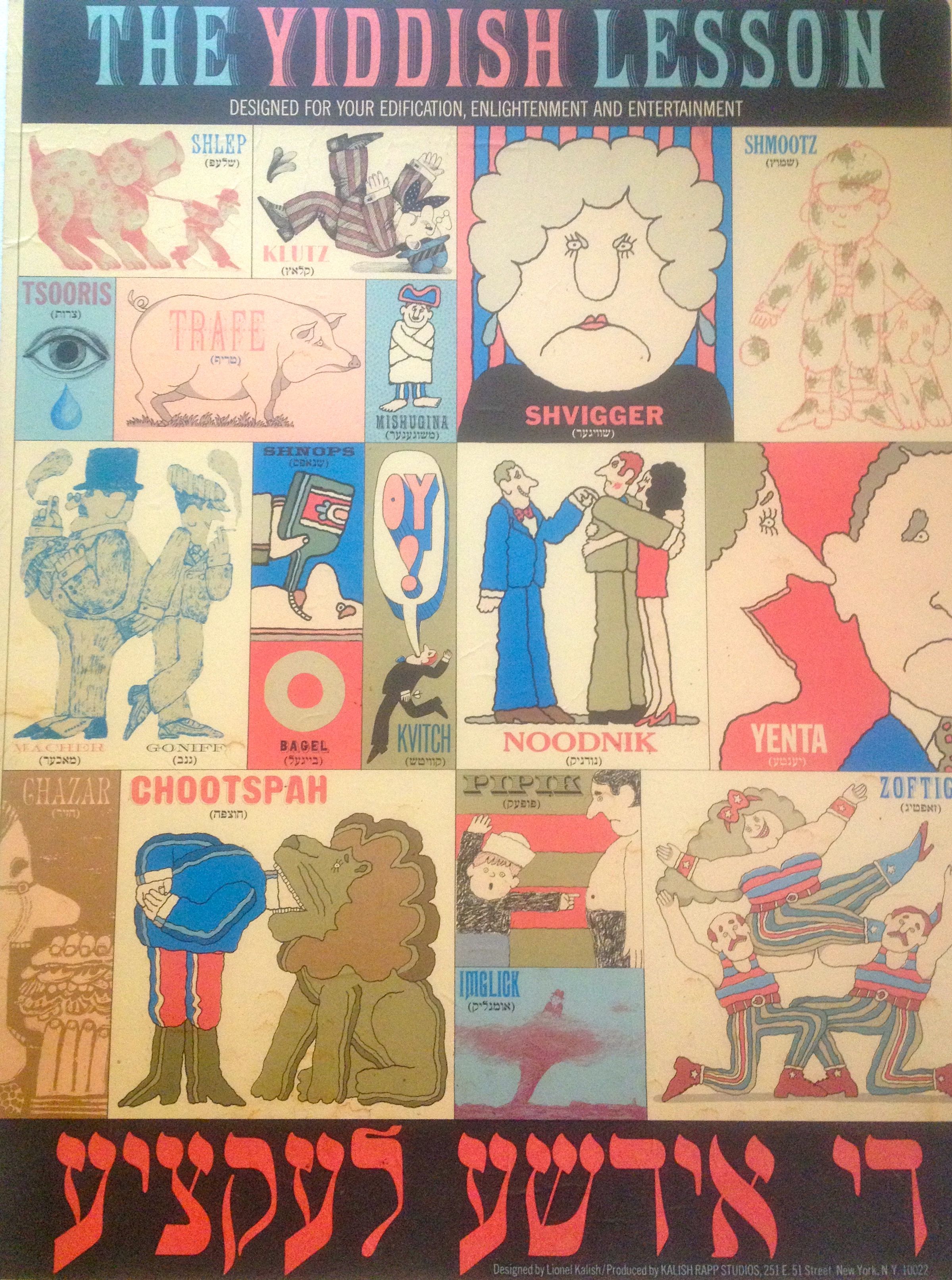
Take the words on this eduational Yiddish poster–it’s like the Yiddish words just sound like and makes perfect sense for what it is (see how many you recognize):

– Bagel – Bagel
– Chazar – Pig
– Chootspah (chutzpah) – Gall
– Gonif – Thief
– Imglick – Luck
– Klutz – Clumsy
– Kvitch (kvetch)- Complainer
– Macher – Big shot
– Mishugina (mashugana) – Crazy
– Noodnik – Annoying
– Pipik – Belly Button
– Shlep – Lug
– Shmootz – Dirt
– Shnops (schnapps) – Liquor
– Shvigger – Mother-in-law
– Trafe – Unkosher
– Tsooris – Problems
– Yenta – Talker
– Zoftig – Fat

There is one more word not on the list here that is probably recongizable and that is a “shmuck,” which refers to a contemptable person, but literally refers to a man’s private parts–ah, maybe that’s why it’s not on the picture poster.

#RIPUSA Donald Trump's iInaugural Speech Poet , Linguist ,Wordsmith, Philosopher hell no not a chance for ataunting “nyah-nyah”sfull of threat and vengeance

Related image


At the risk of sounding like a total candy-ass, I swear I have developed P.T.S.D. from the venom of this election. O.K., even before voting season began, I was wobbly enough to be seeing a shrink. But when I confessed to her, a month ago, that I was sleeping less and checking news outlets compulsively, like a rat pushing a bar down for a pellet, she said, “So are a hundred per cent of my patients.” Then she added, “So am I.” A friend’s cardiologist told her that patients had been flooding into his office or calling from emergency rooms with false reports of tachycardia.

Those of us who experienced trauma as children, often at the hands of bullies, felt old wounds open up just hearing Trump’s fierce idiom of outrage. All of us used to be kids. All of us were, at some point, silenced by someone bigger and louder saying, “Wrong, wrong,” but meaning “It’s not what you’re doing that’s wrong—it’s who you are that’s wrong.”

Language is key. Trump’s taunting “nyah-nyah”s are the idiom of threat and vengeance. For him, it’s not enough to ban abortion; women who have abortions should be punished. It’s not enough to defeat Hillary Clinton; we have to hate, jail, and possibly even kill her. Eric Trump responded to David Duke’s endorsement not by saying, “We don’t want his vote,” but with the line “The guy does deserve a bullet.”

This violent poetry has been gathering force on our airwaves for decades. It started with shock-jock radio and moved to Fox News. Then, there’s the ubiquitous browbeating by social media, which, I suspect, has contributed to the tripling of the suicide rate for adolescent girls in the past fifteen years.

It was only a matter of time before a hair-triggered guy took this vernacular to the national political stage. Nasty talk didn’t start with Trump, but it was the province of people we all viewed as idiots—schoolyard mobs, certain drunks in bars, guys hollering out of moving cars.“I’m doing some reorganizing—are there any of your possessions that you want to keep?”

When a Presidential candidate mocks a disabled man or a Muslim family that has sacrificed a son for our country, the behavior is stamped with a big “O.K.” Some Trump supporters felt O.K. shoving and hitting protesters. At a Wisconsin football game, a fan wore an Obama mask and a noose.

If you ever doubted the power of poetry, ask yourself why, in any revolution, poets are often the first to be hauled out and shot—whether it’s Spanish Fascists murdering García Lorca or Stalin killing Mandelstam. We poets may be crybabies and sissies, but our pens can become nuclear weapons.

Like Trump, I trained early for the gutter brawl. I grew up in a huge state with an “X” in its middle, marking the place where the mouthy and the well-armed crisscross the boundaries of propriety like cattle rustlers. Littler than my cohort, I learned that a verbal bashing had a lingering power that a bloody nose could never compete with. When a boy named Bubba said, “Your mama’s a whore,” I shot back, “So what? Your nose is flat.”

The vicious language of this election has infected the whole country with enough anxiety and vitriol to launch a war. American lawn signs used to be low-key. You might see venomous slogans on bumper stickers, but not where anybody actually lived. In Florida this Halloween, one yard featured black effigies hanging in the trees above a Trump sign. Strange fruit indeed.

Whatever you think of Hillary Clinton, there’s no question that she was the more circumspect candidate, and that’s partly why her detractors hated her. She was “politically correct.” By my yardstick, that means trying not to hurt people’s feelings (whether Bubba said something mean about your mother or not). And yet, among a huge portion of our population, this registers not as civility but as insincerity.

We Democrats have mostly tried to follow Clinton’s example, but I confess that, among friends, I’ve often enjoyed making ad-hominem attacks on Trump and his family in a way that—on reflection—shames me. And, certainly, the left has made use of that insidious “If/then” construction that Trump favors (i.e., “If I were President, you’d be in jail”). A putative friend once told me, “If you eat endangered fish, I won’t be friends with you anymore.” I replied, “If I cared more about a fish than a person, I’d examine my values.”

Today, I’m examining my values. As a Buddhist pal said to me on Election Night, “America has spoken.” Now it falls to us to listen with gracious and open hearts. This is not giving in or giving up. The hardest thing about democracy is the boring and irritating process of listening to people you don’t agree with, which is tolerable only when each side strives not to hurt the other’s feelings. To quote my colleague George Saunders, let today be National Attempt to Have an Affectionate / Tender Thought About Someone of the Opposing Political Persuasion Day. And (please, God) every day hereafter as well.

Saturday, January 14, 2017

#RIPUSA Oy Vey ( again) Cantankerous Testy Touchy Trump Tramp 5 days from his Inauguration twitter a fight with Civil Rights Icon John Lewis The worst is yet to come. #ImpeachTrumpNow


President-elect Donald Trump began a long holiday weekend that honors slain black civil rights leader Martin Luther King Jr. by attacking another rights activist and politician who had said he does not see Trump as a "legitimate president."

U.S. Representative John Lewis, a Georgia Democrat, said on a segment of "Meet the Press" released by NBC on Friday he thought hacking by Russians had helped Trump, a Republican, get elected in November. Lewis said he does not plan to attend Trump's Jan. 20 inauguration, the first time he would miss such an event since being elected to the House in 1986.

On Saturday Trump tweeted that Lewis had falsely complained about the election results and instead "should spend more time on fixing and helping his district, which is in horrible shape and falling apart (not to mention crime infested)."

"All talk, talk, talk - no action or results. Sad!" Trump tweeted.

During the campaign, Trump said Democrats had failed African-Americans and Hispanics. "What the hell do you have to lose? Give me a chance," he said at a rally last year in Ohio.

Trump won the presidency with less support from black and Hispanic voters than any president in the last 40 years, only 8 percent and 28 percent, respectively, polling data showed.

The 76-year-old Lewis, who has been a civil rights leader for more than half a century, was beaten by police during a march he helped lead in 1965 in Selma, Alabama, drawing attention to hurdles for blacks to vote. He protested alongside King that day and on other occasions.

"I believe in forgiveness," Lewis said in the NBC segment about Trump. "I believe in trying to work with people," he said. "It’s going to be very difficult. I don’t see this president-elect as a legitimate president."

At least 10 other Democratic U.S. politicians have also said they plan to skip the inauguration, including Representatives Raul Grijalva, Lacy Clay and Mark Takano.

Supporters of Trump see him as a brash person who tells things as they are. His comments about Lewis came ahead of an anti-Trump march in Washington headed by the Rev. Al Sharpton. The protest by about 2,000 marchers kicked off a week of rallies planned by dozens of groups against Trump before, during and after the inauguration.

DisruptJ20, which is working with Black Lives Matter and other protest groups, said they are planning to disrupt balls celebrating the inauguration in Washington.

Several of Trump's fellow Republicans also criticized his tirade against Lewis.

Michael Steele, who served as the first black chairman of the Republican National Committee until 2011, said Trump's tweets were unfortunate.

"John Lewis has a walk that very few people in this country, least of all Donald Trump, have ever walked, so you have to respect that," Steele said on MSNBC.

If Trump is looking to fix a bridge to black voters, their expectation is he "will do so in a way that shows respect for our leadership," Steele said.

Senator Ben Sasse of Nebraska tweeted that "John Lewis and his 'talk' have changed the world."

Conservative critic Bill Kristol tweeted "It's telling, I'm afraid, that Donald Trump treats (Russian President) Vladimir Putin with more respect than he does John Lewis."

Some 12 hours after his first tweets against Lewis, Trump came back with one more recommendation for the black leader.

"Congressman John Lewis should finally focus on the burning and crime infested inner-cities of the U.S. I can use all the help I can get!," Trump tweeted late in the day.

So who is John Lewis 

John Robert Lewis (born February 21, 1940) is an American politician and civil rights leader. He is the U.S. Representative for Georgia's 5th congressional district, serving since 1987, and is the dean of the Georgia congressional delegation. His district includes the northern three-quarters of Atlanta.

Lewis, who as chairman of the Student Nonviolent Coordinating Committee (SNCC) was one of the "Big Six" leaders of groups who organized the 1963 March on Washington, played many key roles in the Civil Rights Movement and its actions to end legalized racial segregation in the United States. A member of the Democratic Party, Lewis is a member of the Democratic leadership of the U.S. House of Representatives and has served as a Chief Deputy Whip since 1991 and Senior Chief Deputy Whip since 2003. As Senior Chief Deputy Whip, he has led other Chief Deputy Whips and serves as the primary assistant to the Democratic Whip.

John Lewis was the youngest of the Big Six civil rights leaders as chairman of SNCC from 1963 to 1966, some of the most tumultuous years of the Civil Rights Movement. During his tenure, SNCC opened Freedom Schools, launched the Mississippi Freedom Summer, and organized some of the voter registration efforts that led to the pivotal Selma to Montgomery marches. As the chairman of SNCC, Lewis had written a speech in reaction to the Civil Rights Bill of 1963. He denounced the bill because it didn't protect African Americans against police brutality. It also did not provide African Americans the right to vote.

He graduated from the American Baptist Theological Seminary in Nashville and then received a bachelor's degree in Religion and Philosophy from Fisk University. As a student, Lewis was very dedicated to the Civil Rights Movement. He organized sit-ins at segregated lunch counters in Nashville and took part in many other civil rights activities as part of the Nashville Student Movement. He was instrumental in organizing student sit-ins, bus boycotts and nonviolent protests in the fight for voter and racial equality.

In 1960, Lewis became one of the 13 original Freedom Riders. There were seven whites and six blacks who were determined to ride from Washington, D.C., to New Orleans in an integrated fashion. At that time, several states of the old Confederacy still enforced laws prohibiting black and white riders from sitting next to each other on public transportation. The Freedom Ride, originated by the Fellowship of Reconciliation and revived by Farmer and CORE, was initiated to pressure the federal government to enforce the Supreme Court decision in Boynton v. Virginia (1960) that declared segregated interstate bus travel to be unconstitutional. In the South, Lewis and other nonviolent Freedom Riders were beaten by angry mobs, arrested at times and taken to jail. When CORE gave up on the Freedom Ride because of the violence, Lewis and fellow activist Diane Nash arranged for the Nashville students to take it over and bring it to a successful conclusion.

In 1963, when Chuck McDew stepped down as SNCC chairman, Lewis, one of the founding members of SNCC, was quickly elected to take over. Lewis's experience at that point was already widely respected. His courage and his tenacious adherence to the philosophy of reconciliation and nonviolence made him emerge as a leader. By this time, he had been arrested 24 times in the nonviolent struggle for equal justice. He held the post of chairman until 1966.

50th Anniversary of the 1965 Selma Marches - Former First Lady Laura Bush, First Lady Michelle Obama, President Barack Obama, John Lewis, and Former President George W. Bush
By 1963, as chairman of SNCC, he was named one of the "Big Six" leaders who were organizing the March on Washington, along with Whitney Young, A. Philip Randolph, James Farmer and Roy Wilkins. The occasion of Dr. King's celebrated "I Have a Dream" speech, Lewis also spoke at the March and is its last remaining living speaker. At 23 he was the youngest speaker that day.

In 1964, Lewis coordinated SNCC's efforts for "Mississippi Freedom Summer," a campaign to register black voters across the South. The Freedom Summer was an attempt to expose college students from around the country to the perils of African-American life in the South. Lewis traveled the country encouraging students to spend their summer break trying to help people in Mississippi, the most recalcitrant state in the union, to register and vote. Lewis became nationally known during his prominent role in the Selma to Montgomery marches when, on March 7, 1965 – a day that would become known as "Bloody Sunday" – Lewis and fellow activist Hosea Williams led over 600 marchers across the Edmund Pettus Bridge in Selma, Alabama. At the end of the bridge, they were met by Alabama State Troopers who ordered them to disperse. When the marchers stopped to pray, the police discharged tear gas and mounted troopers charged the demonstrators, beating them with night sticks. Lewis's skull was fractured, but he escaped across the bridge to Brown Chapel, the movement's headquarter church in Selma. Before Lewis could be taken to the hospital, he appeared before the television cameras calling on President Johnson to intervene in Alabama. Lewis bears scars from the incident on his head that are still visible today.

Historian Howard Zinn wrote: "At the great Washington March of 1963, the chairman of the Student Nonviolent Coordinating Committee (SNCC), John Lewis, speaking to the same enormous crowd that heard Martin Luther King's I Have a Dream speech, was prepared to ask the right question: 'Which side is the federal government on?' That sentence was eliminated from his speech by organizers of the March to avoid offending the Kennedy Administration. But Lewis and his fellow SNCC workers had experienced, again and again, the strange passivity of the national government in the face of Southern violence."

Lewis (far right) with Bayard Rustin, Andrew Young, Congressman William Fitts Ryan, and James Farmer
John Lewis and the SNCC had reason to be angry. At 21 years old, John Lewis was the first of the Freedom Riders to be assaulted while in Rock Hill, South Carolina. He tried to enter a whites-only waiting room and two white men attacked him, injuring his face and kicking him in the ribs. Nevertheless, only two weeks later Lewis joined a Freedom Ride that was bound for Jackson. "We were determined not to let any act of violence keep us from our goal. We knew our lives could be threatened, but we had made up our minds not to turn back," Lewis said recently in regard to his perseverance following the act of violence

In an interview with CNN during the 40th anniversary of the Freedom Rides, Lewis recounted the sheer amount of violence he and the 12 other original Freedom Riders endured. In Anniston, Alabama, the bus was fire-bombed after Ku Klux Klan members deflated its tires, forcing it to come to a stop. In Birmingham, the Riders were mercilessly beaten, and in Montgomery, an angry mob met the bus, and Lewis was hit in the head with a wooden crate. "It was very violent. I thought I was going to die. I was left lying at the Greyhound bus station in Montgomery unconscious," said Lewis, remembering the incident.
The original intent of the Freedom Rides was to test the new law that banned segregation in public transportation. It also exposed the passivity of the government regarding violence against citizens of the country who were simply acting in accordance to the law. The federal government had trusted the notoriously racist Alabama police to protect the Riders, but did nothing itself, except to have FBI agents take notes. The Kennedy Administration then called for a "cooling-off period," a moratorium on Freedom Rides.Lewis had been imprisoned for forty days in the Mississippi State Penitentiary in Sunflower County, Mississippi, after participating in a Freedom Riders activity in that state.

In February 2009, forty-eight years after he had been bloodied by the Ku Klux Klan during civil rights marches, Lewis received an apology on national television from a white southerner, former Klansman Elwin Wilson.

After leaving SNCC in 1966, Lewis worked with community organizations and was named community affairs director for the National Consumer Co-op Bank in Atlanta.

Jerusalem of Zion by the Bard of Bat Yam , Poet Laureate of Zion


Push. 

Tug a war of a city. 
We want it all, they say
It is our land, pride, inheritance. 

Criminals, they accuse. 
Inhumane, they fabricate. 

Push,
Pull,
Push.

Who do I belong to, she wonders. 

Blood bathes her innocent angelic walls,
The freshness of it molds into the fire red sky. 
The enclosing walls sing a death march tune in mourning,
Deafening the passerby to any other sound other than their thudding heart, vanishing breath, and magically invisible skin.

At four-forty-seven AM she collects her tears and wears them as a mask of bravery. 

I don’t want to be brave no more, she says. 
Let me bawl. 
Let me be. 
Too much pain I hold. 
Too many murders I have born witness to.  
Allow me to raise my voice and scream,
Allow the blood curling in my veins to implode,
Allow my high pitched tones to reach the heavens. 
They will echo back towards me, and that’s ok. 
Allow me to be. 
Please.