Showing posts with label Inauguration. Show all posts

Sunday, January 22, 2017

#OYVeyDonaldTrump Trump era Met with Massive Protests, Uncertainty, Critism and Disgust by Leaders Abroad #RIPUSA #AmericaHangsItsHeadInShame

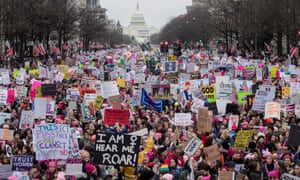
Thousands of people on Pennsylvania Avenue participate in the Women’s March and rally to protest President Donald J. Trump the day after he was sworn in as the 45th President of the United States.


There were protests in cities across the globe, from Manila to Ciudad Juárez, Mexico, against Donald J. Trump.

There was dismay in Britain, applause in Russia and silence in Japan. French populists found hope, Mexican leaders expressed concern and Germany’s vice chancellor offered an allusion to his country’s dark past.

In his first speech as president of the United States, Donald J. Trump showed the world he could be as divisive abroad as he is at home. His vow to place America first — and his threat to upend longstanding alliances, trade deals and many other tenets of the liberal democratic order the nation has chosen for nearly 70 years — was received across the globe with fear, silence and glee, sometimes within the same country.

In searching for a historical analogy, some in Britain reached back to the 1930s, when a bleaker vision of the world prevailed with America on the sidelines. China imposed unusually tight state control over coverage of the inaugural, though state media highlighted “violent” protests in the United States. In the Philippines, nationalists set fire to an effigy of Mr. Trump, while the country’s president welcomed his American counterpart’s apparent willingness to stop telling other leaders how to govern.

In Britain, Prime Minister Theresa May said she would tell a skeptical Mr. Trump how important NATO and the European Union are for European and world stability. “With the threats we face, it’s not the time for less cooperation,” Mrs. May, who is supposed to travel to Washington soon, told The Financial Times.

It is a sad day, indeed, when the likes of Marine Le Pen and Vlad Putin are delighted with the country's presidential choice.

Have a having lived abroad in Israel for 30 years in the 70s, it's always fascinated me how those outside the United States view us.I suspect...

There are multiple Trumps for the world’s observers to draw on but his speech must have, as noted, drawn a punch of radical departure for...

Nationalist movements embraced Mr. Trump’s words as a validation. The far-right French politician Marine Le Pen, a serious candidate in presidential elections this spring, declared that Mr. Trump’s victory had opened “a new era in the cooperation between nations.”

The mixed reaction reflected the global uncertainty about what a Trump presidency would look like — and the divided world into which he steps. A fractured landscape of self-interest — whether from rising nationalist movements in many European countries, an emboldened Russia or longstanding allies such as Britain or Japan — underscored the confused, and often contradictory, responses. He is, in some ways, a Rorschach test for a polarized world.

“Time to buckle your seatbelts and cross your fingers,” said Marcos Troyjo, a Brazilian economist and diplomat.

For those hoping the president would sound different from the candidate, there was little comfort in his address.

In Germany, Vice Chancellor Sigmar Gabriel warned of a “drastic radicalization” in American politics and said Berlin stood ready to fill the void left by an isolationist Washington. The only thing missing was a denunciation of Parliament as a “gossip chamber,” he added, using a term that fascists applied to German institutions in the 1920s.

Chancellor Angela Merkel said Germany would approach relations with Washington through the traditional channels of existing international agreements, including the Group of 20, which Germany will host this year. “Even when there are differing opinions, possibilities and compromise are always best found through respectful exchange with one another,” she said.

For a world confronting a tide of populist rage, his words both soothed and frightened. President François Hollande of France, battling nationalist currents in his own country, did not even wait for Mr. Trump to give his address before offering his take.

“We are in an open world economy, and it is not possible nor advisable to want to be isolated from the world economy,” he said.

In Mexico, which Mr. Trump has made a whipping boy for the false promise of trade and the threat of migration, the response from President Enrique Peña Nieto, who plans to deliver his own address on foreign policy on Monday, was almost immediate. On Twitter, after a congratulatory note, he wrote: “Sovereignty, national interest and the protection of Mexicans will guide our relationship with the new government of the United States.”

And an influential member of the president’s governing party, Manlio Fabio Beltrones, warned in a speech after Mr. Trump’s Inaugural Address that “a weak and offended neighbor is not a good ally.”

Yet the response was not all bad.

There were the usual gestures of cooperation, mixed with hope that Mr. Trump’s angry and nationalistic words would not mean an American retreat from global responsibility. There was also joy, whether among nationalist parties or global powers long at odds with the United States.Photo

Protesters set fire to an American flag with a picture of President Trump’s face outside the United States Embassy in Manila on Friday. CreditRomeo Ranoco/Reuters

Russia, where often vicious mockery of Barack Obama has for months been a state-sponsored national sport, responded with glee to Mr. Obama’s departure from office and the arrival of President Trump.

The inauguration received blanket coverage on state media, with Rossiya 24, a round-the-clock television news channel, broadcasting the entire ceremony and Mr. Trump’s address live, along with scenes of anti-Trump demonstrators smashing shop windows in Washington.

Stirring particular delight among Russian politicians and commentators were Mr. Trump’s remarks in his inaugural address about the need “to unite the civilized world against radical Islam.” One of Russia’s biggest gripes against Mr. Obama was that he criticized President Vladimir V. Putin for supporting the Syrian dictator Bashar al-Assad, a position that Moscow presented as tantamount to supporting terrorism.


In France, Ms. Le Pen, the National Front leader, lauded the British vote to leave the European Union and Mr. Trump’s victory. “In 2016, the Anglo-Saxon world woke up,” she said. “In 2017, I am sure it will be the year of peoples across the continent rising up!”

Ms. Le Pen was to join other far-right leaders from Germany, Italy and the Netherlands in the German city of Koblenz on Saturday, just a day after Mr. Trump’s inauguration, at a conference to consult and celebrate what they consider a popular shift in their direction.

And in saying nothing, some world leaders seemed to embrace the new reality, seeking to accommodate a galvanizing political force whose message has been echoed in mass movements across continents.

Prime Minister Shinzo Abe of Japan, who was the first world leader to meet with Mr. Trump after his election in November, said nothing publicly after Mr. Trump’s speech. But in a congratulatory message to Mr. Trump after the inauguration, the Japanese news media reported, he called Japan’s alliance with the United States an “axis of Japan’s foreign and security policies,” even though Mr. Trump was vocal as a candidate in attacking Japanese trade practices and questioning American military support for the country.

In China, which also offered no public response, the silence was notable for another reason.

It appeared to have been codified in an explicit directive. China Digital Times, an American-based website that tracks Chinese media and reports regularly on leaked orders from China’s propaganda apparatus, published a directive that forbade the country’s online news organizations to run photographs of the inauguration or to include it among their top five news stories of the day.

Notwithstanding a few aberrations, the words of analysts were less muted, freed from the constraints of political niceties and the obligation of world leaders to work with the new American president.

In Japan, Goro Hashimoto, a special editor at the right-leaning Yomiuri Shimbun, the world’s largest-circulation newspaper, compared Mr. Trump’s speech to President John F. Kennedy’s inaugural address — and not favorably.

“When I heard Kennedy’s speech when I was a child, I was so excited,” he said. “He talked about American values as well as the benefits for the world. Trump didn’t talk in that way.”

Zhang Zhe, a Chinese student who is pursuing a doctorate in political science at Brown University in Rhode Island, watched Mr. Trump’s inauguration with his parents. The picture Mr. Trump presented of “American carnage,” he said in an email, did not register with the family.

“My parents have only been in America for a few months and they don’t know much about it, but even they could not bear what Trump said,” Mr. Zhang wrote. “My father asked me, ‘This president, why does he describe the United States as a society that is worse off than China’s old feudal society?’”

The shift in policy left some determined to forge a path without the United States as the leader.

“We can’t sit around & hope for US support & cooperation,” the former Belgian prime minister Guy Verhofstadt wrote on Twitter. “Europe must take its destiny & security in its own hands.”

Still, amid the hand-wringing of establishment voices worried about a return to a less globalized world, there was a silver lining.

“The upside today is that the demagogues of the 1930s did not have to stand for re-election,” wrote Josef Joffe, the publisher and editor of Die Zeit, the German weekly, wrote in The Guardian.

Saturday, January 21, 2017

#OyDonaldTrump The First White House Press Conference is devoted to the Press and Fabrication of Crowd Sizes ......Sean Spicer pictures NEVER Lie . They never do a Donald Trump #AmericaHangsItsHeadInShame again


Reuters Staff / Reuters

In his first appearance in the White House briefing room since President Trump’s inauguration, Press Secretary Sean Spicer delivered an indignant statement Saturday night condemning the media’s coverage of the inauguration crowd size, and accusing the press of “deliberately false reporting.”

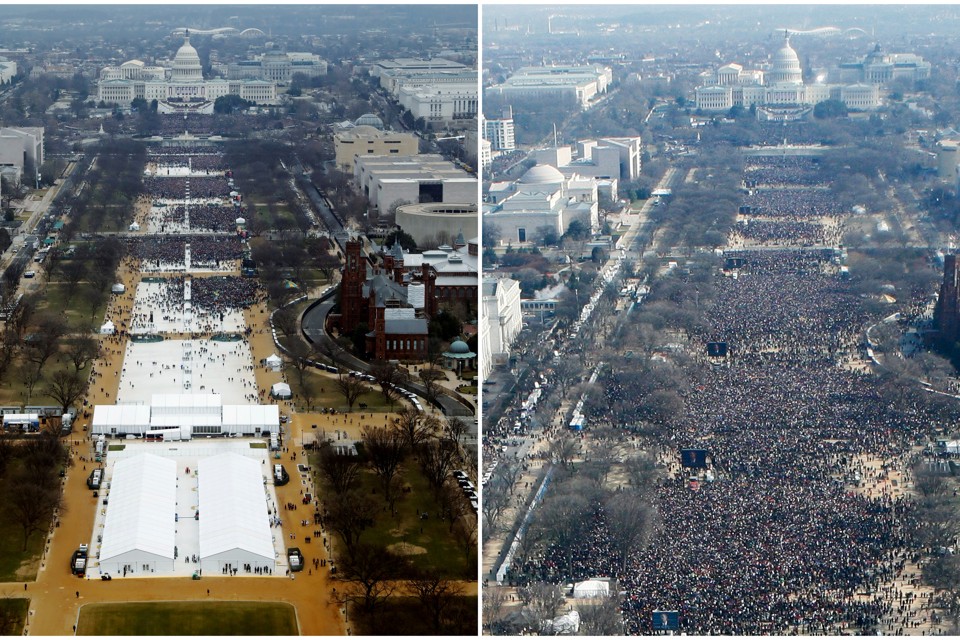
Standing next to a video screen that showed the crowd from President Trump’s vantage point, Spicer insisted that media outlets had “intentionally framed” their photographs to minimize its size. After attacking journalists for sharing unofficial crowd-size estimates—“no one had numbers,” he said—he proceeded to offer a categorical claim of his own. “This was the largest audience ever to witness an inauguration, period, both in person and around the globe,” he said, visibly outraged. “These attempts to lessen the enthusiasm of the inauguration are shameful and wrong.”

As my colleague Robinson Meyer explained on Friday, modern crowd-counting methods can be laborious efforts. Steve Doig, a professor of journalism at Arizona State University, has provided estimates of crowds at past inaugurals, and is well-versed in the challenges they present. “There's no turnstiles; you didn't have to buy tickets ... so the standard metrics for measuring a contained crowd are not available," he said. "The fallback is overhead imagery.” That allows experts to estimate the density of the crowd, and divide it by the area it covers, to produce “a reality-based estimate of the crowd.” Based on the photographs available in the media showing the part of the crowd that was on the mall, he said, “the claim that this is the largest ever is ludicrous on its face.”

The only numbers Spicer cited were ridership numbers from WMATA, the D.C. public-transit system. “We know that 420,000 people used D.C. Metro public transit yesterday, which compares to 317,000 that used it for President Obama's last inaugural,” he said. But the figures Spicer offered were not consistent with those provided by WMATA officials, who told the Washington Post that 570,557 riders used the Metro system between its 4 a.m. opening and its midnight closure on Friday. That number falls short of both President Obama’s 2009 and 2013 inaugurations, which saw 1.1 million trips and 782,000 trips respectively.

Preliminary Nielsen figures also show that Trump’s inauguration received fewer average TV viewers in the United States than Obama’s first inauguration. The Los Angeles Times reported that 30.6 million viewers tuned in for Friday’s ceremonies, 19 percent below the 37.8 million viewers who watched in 2009. The figures still place Trump’s inauguration ahead of Obama’s second inauguration, as well as the first ceremonies for President Clinton and both President Bushes. Ronald Reagan holds the record for inauguration viewership, after 41.8 million viewers watched his swearing-in ceremony in 1981.

As Spicer later correctly noted, the National Park Service does not offer official crowd estimates. The agency abandoned the practice after receiving criticism for its low estimate of the Million Man March in 1995. But independent estimates, and other publicly available evidence, indicates the crowd was smaller than the one that appeared for President Obama’s first inauguration in 2009. Keith Still, a professor at Manchester Metropolitan University in England, told The New York Times that the crowd on the mall itself was about a third the size it had been in 2009. Photos taken from the Washington Monument facing towards the Capitol show a visibly smaller audience compared to similar images taken in 2009, images from the parade route showed largely vacant stands and stretches of empty sidewalk, and Washington mass-transit officials reported far comparatively lower ridership figures for the city’s Metro system.

Spicer did not take questions. He also did not address the far larger crowds in Washington, D.C., on Saturday that took part in the Women’s March on Washington.

Doig, the journalism professor, cautioned, “take all partisan estimates of crowd size with a grain of salt. Crowd size has become a badge of honor or shame depending on who's wielding it. This has gone on for decades, claiming exceptionally large crowds or claiming really the crowd was tiny." He defended the role of the media in adjudicating these disputes. “Let the partisans on either side claim whatever they want about the size of the crowd," he said, “but somebody needs to produce an independent estimate.”

Sunday, January 15, 2017

#RIPUSA Donald Trump's iInaugural Speech Poet , Linguist ,Wordsmith, Philosopher hell no not a chance for ataunting “nyah-nyah”sfull of threat and vengeance

Related image


At the risk of sounding like a total candy-ass, I swear I have developed P.T.S.D. from the venom of this election. O.K., even before voting season began, I was wobbly enough to be seeing a shrink. But when I confessed to her, a month ago, that I was sleeping less and checking news outlets compulsively, like a rat pushing a bar down for a pellet, she said, “So are a hundred per cent of my patients.” Then she added, “So am I.” A friend’s cardiologist told her that patients had been flooding into his office or calling from emergency rooms with false reports of tachycardia.

Those of us who experienced trauma as children, often at the hands of bullies, felt old wounds open up just hearing Trump’s fierce idiom of outrage. All of us used to be kids. All of us were, at some point, silenced by someone bigger and louder saying, “Wrong, wrong,” but meaning “It’s not what you’re doing that’s wrong—it’s who you are that’s wrong.”

Language is key. Trump’s taunting “nyah-nyah”s are the idiom of threat and vengeance. For him, it’s not enough to ban abortion; women who have abortions should be punished. It’s not enough to defeat Hillary Clinton; we have to hate, jail, and possibly even kill her. Eric Trump responded to David Duke’s endorsement not by saying, “We don’t want his vote,” but with the line “The guy does deserve a bullet.”

This violent poetry has been gathering force on our airwaves for decades. It started with shock-jock radio and moved to Fox News. Then, there’s the ubiquitous browbeating by social media, which, I suspect, has contributed to the tripling of the suicide rate for adolescent girls in the past fifteen years.

It was only a matter of time before a hair-triggered guy took this vernacular to the national political stage. Nasty talk didn’t start with Trump, but it was the province of people we all viewed as idiots—schoolyard mobs, certain drunks in bars, guys hollering out of moving cars.“I’m doing some reorganizing—are there any of your possessions that you want to keep?”

When a Presidential candidate mocks a disabled man or a Muslim family that has sacrificed a son for our country, the behavior is stamped with a big “O.K.” Some Trump supporters felt O.K. shoving and hitting protesters. At a Wisconsin football game, a fan wore an Obama mask and a noose.

If you ever doubted the power of poetry, ask yourself why, in any revolution, poets are often the first to be hauled out and shot—whether it’s Spanish Fascists murdering García Lorca or Stalin killing Mandelstam. We poets may be crybabies and sissies, but our pens can become nuclear weapons.

Like Trump, I trained early for the gutter brawl. I grew up in a huge state with an “X” in its middle, marking the place where the mouthy and the well-armed crisscross the boundaries of propriety like cattle rustlers. Littler than my cohort, I learned that a verbal bashing had a lingering power that a bloody nose could never compete with. When a boy named Bubba said, “Your mama’s a whore,” I shot back, “So what? Your nose is flat.”

The vicious language of this election has infected the whole country with enough anxiety and vitriol to launch a war. American lawn signs used to be low-key. You might see venomous slogans on bumper stickers, but not where anybody actually lived. In Florida this Halloween, one yard featured black effigies hanging in the trees above a Trump sign. Strange fruit indeed.

Whatever you think of Hillary Clinton, there’s no question that she was the more circumspect candidate, and that’s partly why her detractors hated her. She was “politically correct.” By my yardstick, that means trying not to hurt people’s feelings (whether Bubba said something mean about your mother or not). And yet, among a huge portion of our population, this registers not as civility but as insincerity.

We Democrats have mostly tried to follow Clinton’s example, but I confess that, among friends, I’ve often enjoyed making ad-hominem attacks on Trump and his family in a way that—on reflection—shames me. And, certainly, the left has made use of that insidious “If/then” construction that Trump favors (i.e., “If I were President, you’d be in jail”). A putative friend once told me, “If you eat endangered fish, I won’t be friends with you anymore.” I replied, “If I cared more about a fish than a person, I’d examine my values.”

Today, I’m examining my values. As a Buddhist pal said to me on Election Night, “America has spoken.” Now it falls to us to listen with gracious and open hearts. This is not giving in or giving up. The hardest thing about democracy is the boring and irritating process of listening to people you don’t agree with, which is tolerable only when each side strives not to hurt the other’s feelings. To quote my colleague George Saunders, let today be National Attempt to Have an Affectionate / Tender Thought About Someone of the Opposing Political Persuasion Day. And (please, God) every day hereafter as well.