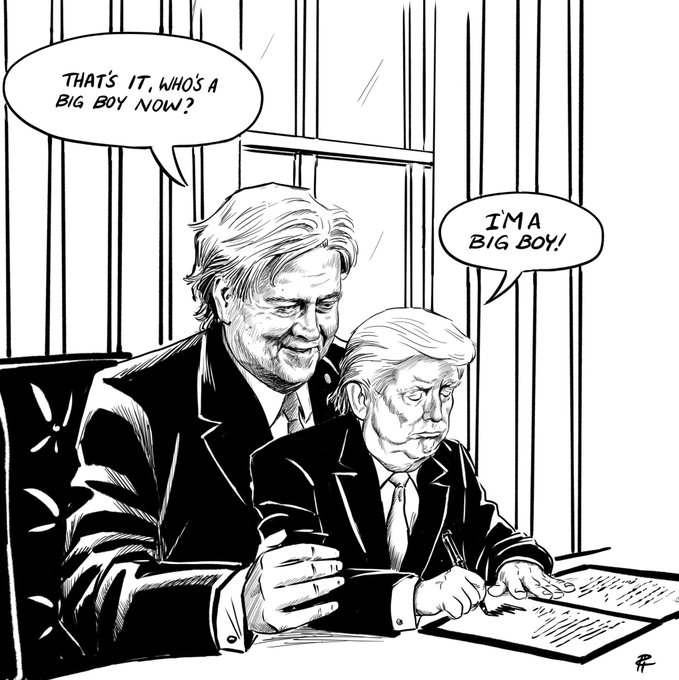
In the last six weeksof Trump’s presidency, many have speculated that Steve Bannon, the former Breitbart chief, is the one calling the shots in the White House. The numerous executive orders signed by Trump fit neatly into Bannon’s white nationalist agenda; their poor execution signal that a government novice is pulling the strings; and Bannon’s unconventional (and possibly illegal) appointment to the National Security Council suggests that he, more than anyone, holds Trump’s ear.
View image on Twitter
Follow
 Pia Guerra @PiaGuerra
Big Boy. #PresidentBannon
4:32 AM - 30 Jan 2017
29,29229,292 Retweets
42,23542,235 likes
Last night, The New York Times published a piece that said as much. According to the Times, upon entering the White House, Bannon “rushed into the vacuum, telling allies that he and [adivsr Stephen] Miller have a brief window in which to push through their vision of Mr. Trump’s economic nationalism.” But with protests erupting around the country, and headlines shouting that Bannon is the power behind the throne, it seems like Trump is starting to get annoyed with his racist Wormtongue. While Bannon remains Trump’s “dominant adviser,” Trump is angry that he treated him like a human fountain pen, sneaking his way into the National Security Council through an executive order that Trump apparently didn’t read. And Chief of Staff Reince Priebus, who seems to have been muscled out by Bannon, has regained some control, instituting a “10-point checklist” before any new initiatives are rolled out.
It’s clear that the President Bannon memes are getting to Trump. He might not like to do boring boss things, but he definitely wants to look like the boss. This morning he tweeted:
Follow
 Donald J. Trump
✔@realDonaldTrump
I call my own shots, largely based on an accumulation of data, and everyone knows it. Some FAKE NEWS media, in order to marginalize, lies!
2:07 PM - 6 Feb 2017
24,34724,347 Retweets
127,188127,188 likes
Trump wants all the world to know that he is the biggest boy in the White House.
 The US President is said to have had an “invoice” printed out outlining the sum estimated by his aides as covering Germany’s unpaid contributions for defence. [...]
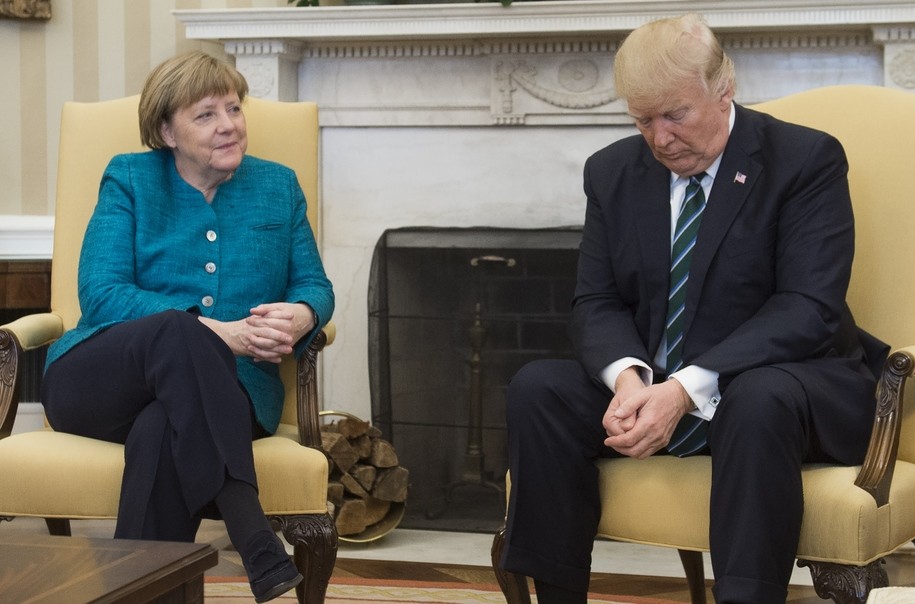
The current sitting president is an idiot manchild. On a related note: During last weekend's meeting between Idiot Manchild and German leader Angela Merkel, the idiot manchild allegedly handed Merkel a printed "bill" for roughly 370 billion Euros, the amount Donald Trump thinks Germany "owes" Nato.
But the bill has been backdated even further to 2002, the year Mrs Merkel’s predecessor, Gerhard Schröder, pledged to spend more on defence.
Mr Trump reportedly instructed aides to calculate how much German spending fell below two per cent over the past 12 years, then added interest.
That this stunt did not create an immediate international incident is evidence of Merkel's own professionalism and/or evidence that even our international allies do not take Idiot Manchild seriously. Instead, she "ignored the provocation."
Trump's staff—and by this I think we can safely presume Steve Bannon's staff, because there's no way any other members of even this White House could come up with a concept simultaneously so idiot-manchild stupid and so pointlessly insulting—apparently has similar "bills" drawn up for the other Nato members, for presentation when he meets with them as well. This particular bout of idiocy, in other words, is going to continue.
As to what Idiot Manchild and his confederacy of morons expects to accomplish with the move, that's not clear. It is never clear. As with the recent healthcare fiasco of Steve Bannon meeting with Republican lawmakers to demand they just do whatever Steve Bannon wants them to, the strategy seems to be to angrily demand things and then be surprised when the other side, your own allies, tell you to sod off. It may have worked for a crooked New York real estate developer trying to scam subcontractors out of promised wages, but it's not likely to work with The Freaking Chancellor of Germany.
For what it is worth, the White House is now denying that this incident took place. But this White House notoriously lies about everything, all the time, even when it's patently obvious they are lying, so that is worth nothing.
 There was a Spartacus Rebel in his own BathTub called Jonathan Dean,
Watching Barcelona FC wizardry ,he dined on one pea, and one bean;
Joey D. Giuseppe Garibaldi dogmatically remarked, 'More than that,
Would make, like my worried Yiddisha Dad Stephen, much too fat,'
That cautious Jonty D. Che Guevara - Pancho Villa wayward son supreme


Roosevelt stops at Artists' point in Yellowstone National Park.
Biographers of presidents, in days gone by, attempted to tell their subject’s entire life, often in multivolumes. Robert Caro’s “The Years of Lyndon Johnson,’’ for example, is a superlative account in four books with a concluding fifth planned — but it is an exception to the rule. Nowadays publishers want shorter works, for shorter attention spans.
Authors, pushing back, are increasingly opting for what is called “partial biography” — a single significant volume focusing on a particular aspect, angle, or period of the subject’s life. Douglas Brinkley’s “Rightful Heritage: Franklin D. Roosevelt and the Land of America’’ belongs to this new strain — and illustrates just how potent it can be, both as biography and history. For not 999 out of 1,000 Americans, I would wager, is aware just how much we owe FDR for his crusading efforts to save and improve America’s forests, trails, parks, refuges, and natural habitats. Think 3 billion trees planted, crucial landscapes saved, from the Okefnokee Swamp to the Olympic Mountains — and more acreage conserved (118 million) than the size of California!
FDR’s four lifelong passions were ornithology, stamps, sailing — and silviculture, or tree management. Already as governor of New York he had begun to promote conservation, but it was the Great Depression that, ironically, gave him the chance to put his vision of sustainable land use into effect on a national scale.
As Brinkley makes wonderfully clear, Roosevelt was not merely the inheritor of his uncle Teddy’s passion for wilderness, hiking, and matchless vistas; he was among the first national leaders to see from the start that forestation meant water and soil stabilization, in good times and bad.
“Rightful Heritage’’ is broken into four sections: the first takes readers from FDR’s birth to his ascension to the presidency, and the other three chronicle his efforts while in office. At more than 700 pages it is a long book yet its very size reflects both how much conservation was a part of his life and the breadth of his achievements — especially given the myriad simultaneous problems he faced, nationally and internationally.
Growing up in the Hudson Valley Roosevelt had learned at an early age how to manage land; thus, when his father died while FDR was at Harvard, his mother Sara gave him responsibility for the farm and 600 acres of land around the family home in Hyde Park. It was the beginning of FDR’s lifelong obsession with trees and the importance of trees to the environment.
FDR’s greatest contribution to the preservation and management of American nature came during the New Deal: His “Tree Army,” or Civilian Conservation Corps (CCC), not only planted billions of trees but built many thousands of recreational facilities, from roads to trails and cabins, and helped so many young people (over 3 million) without means get through the Depression positively.
Until you read the book it’s difficult to comprehend just how skillfully, and with what narrative brio, Brinkley manages to tell this story of one man’s single-minded odyssey, aided and abetted by men like Harold Ickes and FDR’s uncle Frederic Delano.
Perhaps he is a little quick to absolve FDR from the ecological downsides of some of his schemes. He acknowledges, for example, that, thanks to “fertilizers, industrial sludge, dredging, chemicals, and sewage” the waterways of the Deep South were, “ecologically speaking, made worse by the New Deal,” yet quickly passes on to more forestry. But Brinkley’s admiration for the leader’s devotion to the land is clearly sincere, and FDR’s story is surely a unique and hitherto neglected one, fully deserving of such a big canvas. Right up to the end, Roosevelt, despite his paralyzed lower limbs, was looking outward and onward — ultimately dreaming of global conservation policies, not just domestic, as he steered the United Nations into existence in 1945.
To me the most moving moment of “Rightful Heritage’’ comes, however, when Roosevelt flies to Tehran in late November 1943 to meet Stalin for the first time. Embroiled in a global conflict, his health compromised, the 61-year-old was, Brinkley recounts, still “appalled by the ecological abuse” he saw from the sky. “Of course,” FDR wrote the young shah, who had hosted the summit, “I do not pretend to know Iran well on account of the shortness of my visit, but may I write to you about one of the impressions I received on my air trip to Tehran? It relates to the lack of trees on the mountain slopes and the general aridity of the country which lies above the plains. All my life I have been very much interested in reforestation and the increase of water supply that goes with it.”
What a president! What a book!

Andee , the Hell Angel from Burbank not Cape Cod
Thought babies were fashioned by God,
But 'twas not the Almighty
Who hiked up her nightie -
'Twas Roger, her Netanya lodger, by God!