Sunday, March 5, 2017

"....the best protection is not to elect one.".... @realDonaldTrump isn't the most stable GI Joe ( understatement) : How Likely Is an Irrational US Presidential Order to Use Nuclear Weapons?


Image result for donald trump nuclear weapons cartoon


There is no scientifically valid way to predict US presidential irrationality. Nor is there any analytically acceptable way for an American president to foretell the nuclear outcomes of any considered policy decision. There is another, less frequently considered possibility that is just as impossible to predict: that President Trump could refuse to follow through on deterrent threats, thereby allowing assorted Russian aggressions – including those that might involve Israel.

Back in 1976, I was a young professor of political science researching a new book on nuclear strategy and nuclear war. Because I was especially interested in the distant but still conceivable prospect of an irrational American president with nuclear decisional authority, I wrote to General Maxwell Taylor, a former Chairman of the Joint Chiefs of Staff, for some informed clarification. On 14 March 1976, in a handwritten letter to me, General Taylor advised: "....the best protection is not to elect one."

This was not a disingenuous response. On the contrary: it revealed, generically, that the so-called "two-man rule" of redundant nuclear safeguards simply does not apply at the highest level of American political decision-making. However odd or ironic, this utterly unrestricted or ultimate form of presidential authority still obtains today. While it is increasingly under discussion among concerned persons in the just-beginning Trump era, salient apprehensions have generally been expressed surreptitiously, in more-or-less decorous whispers.

It is unlikely that such core apprehensions will remain suppressed, even in the near term. Over the next several months, President Trump could, for example, be severely tested by Pyongyang, and may have to make time-urgent decisions concerning North Korea's expanding nuclearization. How is he likely to respond to such tests?

From a purely analytic or scientific standpoint, there is no reliable way to answer such a vital question. More precisely, to credibly assess whether Mr. Trump can be expected to react rationally or irrationally, we would first have to assume the existence of pertinent and recoverable past experience. This is because all scientifically meaningful assessments of probability need to be based upon a determinable frequency of past events.

This is a requirement for all excursions into probabilistic outcomes, whether in areas of international relations, or in actuarial judgments of individual client life expectancies.

Is it true that there have been no pertinent past events regarding national nuclear decision-making? The only conceivable case, it seems, would be the 1962 Cuban missile crisis. During that uniquely uncertain episode, President John F. Kennedy ordered his "quarantine" of Cuba (a euphemism for "blockade," always a possible casus bellum) with an apparent awareness of the corresponding risks.

According to Theodore Sorensen, his biographer, JFK seemingly believed that even his intentionally softened escalatory response would carry heavy odds of an ensuing nuclear war with the USSR: more precisely, with an expected probability of "between one out of three and even." Although we now know, based upon what we have learned about ascertaining probabilities and the discernible frequency of past events, that any such estimate was necessarily without any scientific foundation, what matters is that at the time, JFK believed in those ominously high odds. Was JFK's "quarantine" a genuine instance of nuclear decisional irrationality, one that turned out well only by happenstance? Could it have ended, as then Secretary of Defense Robert McNamara had feared, in some sort of "Armageddon"? Or was it rather an example of what might today be most aptly termed the "rationality of pretended irrationality?"

The answer is important. If the latter, JFK was playing a more or less carefully calculated strategic game, much like the game of Chicken once played in cars by teenagers. In Chicken, the objective of each player is twofold: not to be a chicken, but also not to be dead. JFK plausibly sought similar objectives, although, of course, at a far wider collective level, and for immeasurably higher stakes.

President Trump's upcoming nuclear-related policy judgments can never be based upon scientifically garnered probabilities, an incapacity that has nothing whatever to do with his own personal strengths or weaknesses. We must further inquire about a related but still discrete presidential decisional problem. This issue references the corollary matter of President Trump being unable to calculate the probable outcomes of any particular nuclear decision that he himself should ultimately make. Again, this expected inability has nothing to do with any personal intellectual deficit on his part; to be sure, the very same analytic problem would confront any American president. It has to do rather with the indisputable absence of any pertinent past events.

Let's assume, for example, that President Trump should seek out an "expert" probability assessment or prediction concerning North Korean escalation to nuclear weapons (in the near term, such an escalation could more or less plausibly affect Japan, US forces in the region, and/or certain targets in Alaska or Hawaii). There would be no relevant history to evaluate. In any such scenario, there would be, by definition, no available opportunity to render a scientifically meaningful assessment of applicable probabilities, or "odds."

On the core issue of prospective presidential irrationality regarding nuclear weapons, it is at least conceivable that such consequential missteps could become less likely over time, on the "common sense" assumption that experience would correlate favorably with prudential caution. But that conclusion would merely offer a "man-in-the-street" explanation. At best, it would represent a naively contrived extrapolation from earlier historical eras – one, moreover, wherein the main argument could only have made sense in the pre-nuclear past.

In any event, during a nuclear crisis involving the US, President Trump would somehow have to strike an optimal balance between the unavoidably competitive search for "escalation dominance," and the corresponding need to avoid being locked into any increasingly desperate sequence of move and countermove. In any such sequence, the inherently self-limiting pattern could lead inexorably to a nuclear exchange or even full-blown war.

Fortuitously, perhaps, President Kennedy revealed in 1962 that strategic risk-taking can be advantageous up to a point – but figuring out exactly where that point should be is by no means an easy task. Indeed, various well-documented histories of the Cuban Missile Crisis all seem to agree that the superpowers came close to a very different, and genuinely calamitous, conclusion. An important lesson to be learned is that a great deal rests on chance when there is a lack of pertinent historical examples.

Nuclear strategy is a game that sane national leaders must learn to play, but never with any reassuringly plausible guarantees of probable outcomes. The only way this can change is if, in the years ahead, examples should begin to accumulate of nuclear escalations and outcomes. Naturally, this is not something one ought to wish for. Instead, it would be better to continue to have to concede our incapacity to reliably "figure the odds" in any nuclear crisis engagement, and also to augment this "concession" with a renewed dedication to stable nuclear deterrence.

We can't yet determine how likely it is that America's new president would ever give an irrational order to use American nuclear weapons, but we can still advise Mr. Trump that unimaginable nuclear dangers lurk not only in sudden "bolt from the blue" enemy attacks, but also in unanticipated and uncontrolled forms of nuclear escalation. As far as pretending irrationality is concerned – a tactic that may or may not have figured in the Cuban Missile Crisis, depending upon one's own interpretation of JFK's 1962 strategic calculations – it could rapidly become a double-edged sword.

One final observation. Expressed worries about an irrational US presidential order to use nuclear weapons notwithstanding, it is increasingly plausible that Mr. Trump could do precisely the opposite. He might steadfastly refuse to make good on a variety of America's core deterrent threats, and/or give the impression of such an intended refusal to one or more prospective aggressors. If, for example, Moscow should believe it can undertake further aggression in Ukraine and Syria with impunity – that is, without any fear of consequential reprisals from Washington – Putin might well decide to proceed.

The consequences of any such Russian calculations in Syria could even impact the safety and security of Israel.

The Author of this blog is Louis René Beres is Emeritus Professor of International Law at Purdue and the author of twelve books and several hundred articles on nuclear strategy and nuclear war. He is a frequent contributor to Harvard National Security Journal (Harvard Law School), The Bulletin of the Atomic Scientists, The Atlantic, The Jerusalem Post, US News & World Report, and Israel Defense. His newest book is Surviving Amid Chaos: Israel's Nuclear Strategy (Rowman & Littlefield, 2016).

Republished with permission of BESA. NESA  Center Perspectives Papers are published through the generosity of the Greg Rosshandler Family

Hilary Clinton : Making sense of her collosal defeat to @realDonaldTrump And still #AmericaHangsItsHeadInShame


Hillary Clinton, still sorting through the wreckage of her 2016 presidential campaign, recently had former aides on her campaign team meet with outside strategists and consultants to look at what went wrong.

For months, Clinton and her top aides have blamed their devastating loss on FBI Director James Comey and Russia’s interference in the presidential election. While their outlook hasn’t changed, Clinton still wanted a thorough, detailed post-mortem of the campaign.

The meeting — an echo of similar efforts done after Clinton lost the 2008 Democratic primary to Barack Obama — “was an attempt to dot all the i's and cross all the t’s," said one source familiar with the fact-finding mission. “But I don’t think anyone learned all that much.”

Another ally added, “It wasn’t fun for the people who had to sit through it.”

Behind the scenes, the former Democratic nominee has spent the last few months reaching out to donors, associates and friends, many of whom have given their own two cents on the loss.

“She has tried her best to get a full account of what went wrong and where she could have done better,” one longtime friend said.

The finger pointing began the day after the election and has continued inside Clinton’s orbit.

Late last month, Lynn de Rothschild, a donor and friend of Clinton’s, took to Twitter to blast campaign chairman John Podesta for the defeat.

“HRC lost because you ran an arrogant out of touch campaign,” she wrote before calling him a loser.

In the days and weeks following her surprise loss, allies say it was difficult for Clinton to read the headlines. Instead, she went on long walks in and around her home Chappaqua, N.Y. and out to dinner with her husband. She caught The Color Purple and Sunset Boulevard on Broadway and went grocery shopping for the first time in months.

But those who have spoken to her since then say she’s trying her best to move on from the bruising campaign.

“She’s in a much better place than she was in two months ago,” said one confidant who has spoken to her in the last few weeks. “I think she’s very much forward-thinking and -looking than people think she is right now.

“I don’t think she’s obsessing about the past but she’s focused on a ‘country-first’ type thing,” the confidant added.

To that point, those around her say Clinton has taken it upon herself to not let Trump go unanswered. And in a string of posts on Twitter, she has been criticizing the president on a variety of issues, from the rise in domestic hate crimes to the travel ban.

After a federal appeals court refused to reinstate Trump’s travel bad, the president took to Twitter: “SEE YOU IN COURT, THE SECURITY OF OUR NATION IS AT STAKE!” he wrote.

Clinton had her own reply: “3-0” she taunted, referring to the three judge panel on the US Circuit Court of Appeals in San Francisco that ruled against him.

Her daughter, Chelsea, has also been hitting Trump on Twitter, a pivot from her past use of social media (and leading some to believe that she has her sites set on her own political career.)

“It’s as if the administration doesn’t understand the H, the B, the C, or the U (or understand why HBCUs were started & remain vital),” the former first daughter tweeted earlier this week about Trump, referring to Historically Black Colleges and Universities.

Lately, though, the biggest I-told-you-so from the Clintons and their allies is the continuing story about the Trump campaign’s ties to Russia.

For months, in private conversations, Clinton has griped about Trump’s connection to Russian President Vladimir Putin and suggested that no one seemed to care about it during the election.

At a gathering with donors in December, she was blunt. “Putin publicly blamed me for the outpouring of outrage by his own people … that is the direct line between what he said back then and what he did in this election,” Clinton said, according to audio obtained by the New York Times.

Months later, the former secretary of State is still plotting her next moves. It’s unclear if she will continue the work she started at the Clinton Foundation prior to launching her presidential campaign or if she’ll take on other work, those around her say. And while some have suggested a run for mayor of New York is possible, those close to her say she isn’t interested.

In the meantime, she has made several appearances on the speaking circuit, including one this week at Wellesley College, her alma mater.

And even all these months later, she can’t escape questions about what went wrong.

Asked at Wellesley what she’d change about her campaign, Clinton replied: “I’d win.”

Saturday, March 4, 2017

Ivanka Trump ... our Lord , Our Saviour from Trumpism on the Environment


Top Trump Advisers Are Split on Paris Agreement on Climate Change


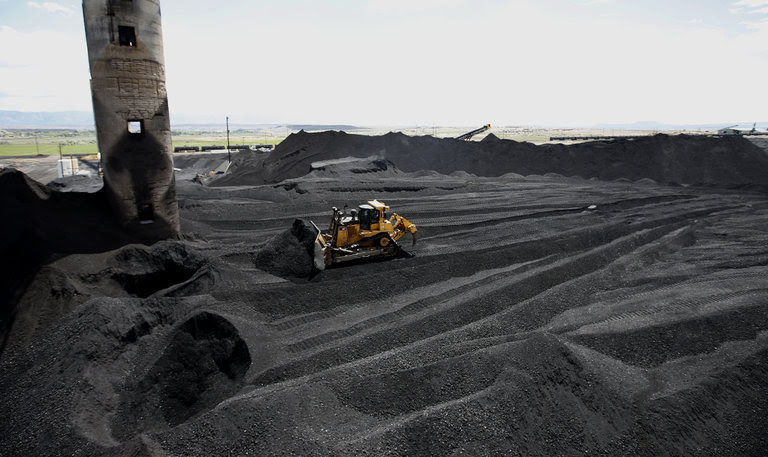
A bulldozer moving coal at a processing facility in Price, Utah. President Trump campaigned with a promise to “cancel” the Paris agreement, which binds countries to combat global warming. CreditGeorge Frey/Bloomberg

WASHINGTON — The White House is fiercely divided over President Trump’s campaign promise to “cancel” the Paris agreement, the 2015 accord that binds nearly every country to curb global warming, with more moderate voices maintaining that he should stick with the agreement despite his campaign pledge.

Stephen K. Bannon, Mr. Trump’s senior adviser, is pressing the president to officially pull the United States from the landmark accord, according to energy and government officials with knowledge of the debate. But, they say, he is clashing with Secretary of State Rex Tillerson and the president’s daughter Ivanka Trump, who fear the move could have broad and damaging diplomatic ramifications.

Mr. Trump vowed on the campaign trail to tear up President Barack Obama’s global warming policies, and on the home front he is moving aggressively to meet those pledges with deep cuts to the Environmental Protection Agency and a new E.P.A. administrator, Scott Pruitt, who is a skeptic of climate science.

Next week, Mr. Trump plans to sign an executive order directing Mr. Pruitt to start the lengthy legal process of unwinding Mr. Obama’s E.P.A. regulations for cutting greenhouse pollution from coal-fired power plants. Those regulations are the linchpin of the last administration’s program to meet the nation’s obligations to reduce climate emissions under the Paris agreement.Continue reading the main story

While the president cannot, as Mr. Trump suggested, unilaterally undo a 194-nation accord that has already been legally ratified, he could initiate the four-year process to withdraw the world’s largest economy and second-largest climate polluter from the first worldwide deal to tackle global warming. Such a move would rend a global deal that has been hailed as historic, throwing into question the fate of global climate policy and, diplomats say, the credibility of the United States.

But it would also demonstrate to his supporters that Mr. Trump is a man of his word, putting American coal interests ahead of a global deal forged by Mr. Obama.

On one side of that debate is Mr. Bannon, who as a former chief executive of Breitbart News published countless articles denouncing climate change as a hoax, and who has vowed to push Mr. Trump to transform all his major campaign promises into policy actions.Photo

Secretary of State Rex Tillerson, center, is worried about the fallout if the United States withdraws from the accord. CreditAl Drago/The New York Times

On the other side are Ms. Trump, Mr. Tillerson, and a slew of foreign policy advisers and career diplomats who argue that the fallout of withdrawing from the accord could be severe, undercutting the United States’ credibility on other foreign policy issues and damaging relations with key allies.

Although Ms. Trump has not spoken out publicly for action to combat climate change, proponents and opponents of such action see her as an ally. Former Vice President Al Gore met with her during the Trump transition, and was ushered in by the “first daughter” to see the president-elect. The actor and activist Leonardo DiCaprio even slipped her a DVD copy of his climate-change documentary.

“President Trump Must Not Wobble on Climate Change — No Matter What Ivanka Says …,” blared a Breitbart post on Monday written by James Delingpole, who is close to Mr. Bannon and who leads the website’s coverage of climate-change policy.

Mr. Trump wants to make a decision by next week, say people familiar with the White House’s debate on the climate pact, in order to announce his executive order to undo Mr. Obama’s climate regulations in conjunction with his plans for the Paris deal.

According to leaked budget documents, the president will also propose killing off nearly two dozen E.P.A. programs, including the Obama-era Clean Power Program, climate partnership programs with local governments, Energy Star grants to encourage efficiency research in consumer products and climate-change research. Those would be part of a broader budget submission that would cut the E.P.A.’s funding by 25 percent, to around $6.1 billion from $8.2 billion, and its staff by 20 percent.

“If the goal is to fulfill the president’s campaign promises and implement his agenda, there is no value in staying in Paris,” said Thomas J. Pyle, an adviser to the Trump transition and the president of the Institute for Energy Research, an organization partly funded by the billionaire brothers Charles G. and David H. Koch, who have worked for years to undermine climate-change policies.

Mr. Trump has cited Mr. Pyle’s group as being influential in shaping his energy and climate proposals, including his campaign pledge to withdraw from the Paris deal.

Get the Morning Briefing by Email

What you need to know to start your day, delivered to your inbox Monday through Friday.

Sign Up

Receive occasional updates and special offers for The New York Times's products and services.


SEE SAMPLE
PRIVACY POLICY

“The two greatest obstacles to a Clexit (climate exit from U.N. Paris agreement) are probably Ivanka and Tillerson,” wrote Marc Morano, a former Republican Senate staff member who now runs Climate Depot, a fossil-fuel-industry-funded website that promotes the denial of climate science, in an email. “Tillerson with his ‘seat at the table’ views could be biggest proponent of not withdrawing the U.S. from the agreement.”

Mr. Tillerson is a former chief executive of Exxon Mobil, which, like many major global corporations, endorsed the Paris agreement. While his former company once denied human-caused climate change, it has more recently publicly acknowledged the threat posed by burning oil and supported proposals to tax carbon dioxide pollution.

Asked during his Senate confirmation hearing about the Paris accord, Mr. Tillerson said, “It’s important that the U.S. maintains its seat at the table about how to address the threat of climate change, which does require a global response.”

Under the Paris agreement, every nation has formally submitted plans detailing how it expects to lower its planet-warming pollution. The Obama administration pledged that the United States would reduce its carbon pollution about 26 percent from 2005 levels by 2025. However, that pledge depends on enactment of Mr. Obama’s E.P.A. regulations on coal-fired power plants, which Mr. Trump and Mr. Pruitt intend to substantially weaken or eliminate.

But under the Paris deal, those numerical targets are not legally binding, and there are no sanctions for failing to meet them. The only legal requirements of the deal are that countries publicly put forth their emissions reductions targets, and later put forth reports verifying how they are meeting the targets. It would be possible for the Trump administration to stay in the deal and submit a less ambitious target.

Even senior Republican voices in the foreign policy debate have said it may be wiser to stay in but keep a low profile.

“There’s really no obligation,” Senator Bob Corker, Republican of Tennessee and chairman of the Foreign Relations Committee, said in an interview. “It doesn’t require us to do anything. I think they may take a little time to assess whether pulling out makes sense now.”Photo

Scott Pruitt, the new E.P.A. administrator, made a career on suing the agency he now leads to eliminate regulations. CreditStephen Crowley/The New York Times

Foreign policy experts say withdrawing from Paris would have far greater diplomatic consequences than President George W. Bush’s withdrawal from the world’s first global climate-change accord, the 1997 Kyoto Protocol.

“I think it would be a major mistake, even a historic mistake, to disavow the Paris deal,” said R. Nicholas Burns, a retired career diplomat and under secretary of state under Mr. Bush.

“In international politics, trust, reliability and keeping your commitments — that’s a big part of how other countries view our country,” Mr. Burns said. “I can’t think of an issue, except perhaps NATO, where if the U.S. simply walks away, it would have such a major negative impact on how we are seen.”

The Paris deal is more consequential than Kyoto. Unlike that pact, which required action only from developed economies, the Paris agreement includes commitments from every nation, rich and poor, to cut emissions, including China and India, the world’s largest and third-largest polluters. Also, the science of climate change has become far more certain and the impact more visible in the 20 years since Kyoto. Each of the last three years has surpassed the previous one as the hottest on record.

Some of the United States’ closest allies are urging the Trump administration not to pull out. In a letter to Mr. Trump after he won the election, Chancellor Angela Merkel of Germany wrote, “Partnership with the United States is and will remain a keystone of German foreign policy, especially so that we can tackle the great challenges of our time.” They include, she wrote, “working to develop farsighted climate policy.”

As Mr. Trump and his advisers weigh their Paris options, one proposal is gaining traction, according to participants in the debate: Mr. Trump could declare that the Paris agreement is a treaty that requires ratification by the Senate. The pact was designed not to have the legal force of a treaty specifically so that it would not have to go before the United States Senate, which would have assuredly failed to ratify it.

“If there are camps forming in the White House, then let the people decide, the elected representatives,” Mr. Pyle said. “Let’s put the question to them.”

Proponents of that idea say it could shift some of the weight of the decision from Mr. Trump to Senator Mitch McConnell of Kentucky, the majority leader, at least in the eyes of some foreign diplomats, and of the president’s daughter.

Friday, March 3, 2017

.Leigh Goldberg,,,,,And I don't think you knew My long distance interest in you by the Bard of Bat Yam, Poet Laureate of Zion


Leigh Goldberg , when did my feelings for you get so deep

When did they take that big long love leap
Going from Facebook friend to hush hush crush
What a rip roaring rush


And I don't think you knew


My long distance interest in you

Leigh,since when your smile make me go weak
when did yor tears make mine start to leak
Why does this happen when I'm always so strong
When people called me Superman Steve I guess they were wrong


And I don't think you knew


My long distance interest in you


Leigh, when you talk I t watch your beauty mark above your and 2 x lip


To notice their shape and curves when they dip
Wait, why am I looking? Single , available I don't even know
And I can't help but wonder what is your status quo


And I don't think you knew


My long distance interest in you


Your beautiful green eyes are like the color of mine
They're so deep and bright you'd believe they were stars on cloud nine
They pour forth emotions in raging rivers
They could make even me believe that Santa always delivers


And I don't think you knew


My long distance interest in you


Your body is perfection though you probably deny it
It makes my head spin with every glance I give, I must admit
You have bewitched me for months you beautiful female Joburg Lion
Our displaced Candice Swanepoel and Charlize Theron living in Zion


And I don't think you knew


My long distance interest in you


I, the Poet Laureate of Zion love how you look and who you are
Be my muse for many love poems with romantic flair
I love your eloquent columns,smart with a heart so strong
Personally, enticing and nothing at all with them wrong


And I don't think you knew


My long distance interest in you


Now 2016 has gone and 2017 has begunwith Donny T coup d'etat,
I wonder if I invited you and you would care for 10 x C Coffee, Cake , Chat
Conversation, Cuddles, Caresses, 2 are ex rated and not for publication
If that goes well to a Chuppah with Children , two preferably or a zillion


Now that I, The Bard of Bat Yam, have said it with my poetic skill and ingenuity
Message me back your acceptance, date and time with utmost alacrity

Thursday, March 2, 2017

@realDonaldTrump Versus the European Union #RIPPAxAmericana ? or revived #PaxAmericana like never seen before without the $ cost

Image result for Donald Trump RIP Pax Americana cartoon

Members of the European political and media establishment seemed to be sure that the 45th president of the United States would be Hillary Clinton, or at least they were desperately hoping so. The days after the election one could hear clamor of indignation from top journalists and politicians alike. It almost felt as if the European project had lost shoulder to shoulder with Clinton, now that America, Europe’s most powerful ally, would be ruled by an “inhuman right-wing populist,” an outspoken critic of the European Union, and a sympathizer of the UK Independence Party. And after all he says “America first.” For the European establishment, this is an outrageous position to hold for an American president.
General secretary of the ruling Socialist Party in France, Jean-Christophe Cambadélis, has compared Trump to the Front National’s top candidate Marine Le Pen and noted that the French Left knew full well about the challenges ahead. French prime minister Manuel Valls emphasized that Europe needs to close its ranks, take responsibility and respond to the events on the other side of the Atlantic Ocean, adding that he does not believe in “the triumph of simplicity and demagoguery.”
German minister of foreign affairs Frank-Walter Steinmeier who called Trump a “preacher of hate” during the election campaign stated shortly after the outcome was certain that “American foreign policy will now become less predictable,” but that Germany “should not sit mesmerized like the rabbits before the snake.” Germany “should remain self-confident and needs to preserve its culture of public and political discourse.” But who knows to what kind of cultivated discourse he was actually referring?
Indeed, Donald Trump was compared to Adolf Hitler in German television news at one point in his campaign when he had already far exceeded the expectations of most pundits. But, hardly anyone could imagine him becoming the next US president. On the very evening of November 9 when the unthinkable was taking shape, the consortium of public broadcasters in Germany (ARD) presented a survey according to which only 4 percent of the German electorate would have voted for Trump. One wonders whether this representative survey was conducted exclusively among the employees of the consortium.
When the Austrian presidential candidate and populist Norbert Hofer lost to Alexander Van der Bellen in early December, the EU establishment had its first moment of relief since the Brexit vote in the United Kingdom last June. “Hofer has hoped for the Trump effect in vain” ARD’s news anchor declared somewhat triumphantly at the evening of the election.
However, at the same time the Italian people voted against President Matteo Renzi’s proposal to change the Italian constitution, which led to his resignation and potentially a chance for the Eurosceptic Five Star Movement around comedian Beppe Grillo to form the new national government after early elections. This means that the three largest countries of the Eurozone and the EU (UK excluded), Germany, France and Italy, will hold national elections within the next year. The Italian daily La Stampa wrote that the referendum “tells the same story as Brexit and Trump.”
Hence, it is pretty obvious that almost all political events and ongoing developments in Europe are now interpreted in light of Trump’s victory. There is no question that Trump already has had an impact on European politics regarding strategy and rhetoric.
Looming Economic Realities in Europe
The most important issues, after the currency and debt crisis has mysteriously vanished from the scene for a time, is immigration, the stabilization of the Middle East, and how to react to millions of people coming into Europe.
Trump has such a significance for the political regime of the EU, among other things, because he was elected while openly advocating positions not expected to be capable of winning a majority, either in the US, and most certainly not in Europe. It runs completely against the position that the US government under Bush and Obama has taken, that Clinton sought to continue, and that the political leadership of the EU still wholeheartedly advocates and that is embedded in a broader political program. It is a program that mainstream media is vigorously promoting by emphasizing the benefits of open borders, diversity and multiculturalism, the importance of humanitarian assistance, as well as an official responsibility of the West to improve living conditions in the developing nations of Africa and Asia. That the latter so regularly turns into the very opposite in the form of aggressive military interventions is deliberately hushed up. Trump’s anti-interventionist positions in foreign policy have, against all odds, successfully challenged the globalist line of approach.
After an initial period in which Trump and his supporters were arrogantly ridiculed, a good dose of European superiority complex, vis-à-vis the US, was breaking through, and the general tenor has changed. In an act of self-defense, European political and media elites have desperately tried to make a bogeyman out of Trump and the movement behind him as they saw the broader implications it might have.
Trump was admittedly courting some of the slogans used against him, but most of them are just hysterical exaggerations or allegations. And, while the European establishment claims a position on the moral high-ground, even the most promising aspect of Trump’s advocated isolationism from a humanitarian viewpoint — withdrawal from foreign military interventions — is turned against him. It is argued that Trump will abandon Europe and that European countries will have to substantially increase their own military budgets in the future.
The fact that the aggressive foreign policy of the West under the leadership of the US over the past decades has triggered the destabilization of the Middle East and Northern Africa in the first place, and hence reinforced the immigration crisis that Europe is facing right now, is not critically highlighted at all.
Trump Will Be an Excuse for More Centralization
The EU establishment has obviously itself contributed to the problems it now tries to exploit in order to further centralize the political power structure of Europe. Trump will serve as a scapegoat that left Europe alone in the midst of an international conflict and humanitarian crisis. This narrative was spread before Trump had been in office for a single day, and it will be used as a justification for more intrusive EU policies if the peoples of Europe let it happen. However, chances are that the national governments all over Europe will face ever stronger opposition in the near future, if they are not directly replaced. Unfortunately, these opposition movements are not pushing in the right direction in every respect. But, all our problems will not be solved with next round of national elections anyway. They are much more fundamental and ideological. They are of a long-term nature.

Wednesday, March 1, 2017

Parallel Tensions, US and Iran and Israel and Hesbollah


As US pressures Iran, parallel tensions grow between Israel and Hezbollah

A decade of relative calm along the Israel-Lebanon border is being rattled as both Israel and Hezbollah threaten each other. The threats were provoked by the Trump administration signaling an intent to roll back the growing influence of Iran, Hezbollah’s sponsor.


The calm that has prevailed for more than a decade along the Lebanon-Israel border is being rattled by a flurry of fiery warnings from both sides that has many here concerned another war between the Jewish state and Lebanon’s Hezbollah organization may be drawing closer.

Hezbollah leader Sheikh Hassan Nasrallah has threatened to hit Israel's nuclear reactor should the Jewish state attack. Israeli officials have warned that all Lebanon will be struck if Hezbollah attacks the Israeli home front.

The prospect of a mutually destructive war unleashed on Lebanon and Israel continues to act as a deterrence, but it remains perilously vulnerable to a miscalculation that could spiral into a conflict before either side can dial it back.

"I don' think [a war] is imminent. But mistakes based on miscalculations and wrong messaging can happen," says Randa Slim, a scholar with the Washington-based Middle East Institute and an expert on Hezbollah. "Despite Nasrallah's blustery rhetoric, Hezbollah is in no position to wage this war now [and] Israel cannot afford to call Nasrallah's bluff about targeting the nuclear plant. The mutual deterrence regime that has been in place on the Israeli-Lebanese border has been beneficial to both Israel and Hezbollah and I don't think either side is ready yet to upend it."

The latest mutual threats were provoked by the new Trump administration signaling an intention to roll back the growing influence of Iran, Hezbollah’s sponsor, across the Middle East. But given the extensive influence Iran wields in Syria and Iraq and to a lesser extent in Yemen, a new US effort to dent the Islamic Republic's reach could have ramifications for the more pressing goal of defeating the self-declared Islamic State, and could incur a potent backlash against American interests from Iran-backed groups across the region.

Targeting several militant groups

On Tuesday, the Pentagon handed the White House a preliminary plan to defeat the self-declared Islamic State – which Trump has touted as a top foreign policy priority. While the proposal remains classified, some reports have suggested the recommendations include expanding the scope to other militant extremist groups operating in the Middle East, among them Al Qaeda and possibly Hezbollah.

Gen. Joseph Dunford, the chairman of the Joint Chiefs of Staff, hinted at a broader approach to trans-regional threats in the Middle East in comments made last week in which he described Iran as a “malign influence” in the region.

“They [the Iranians] have got a very aggressive proxy war,” he told an audience at the Brookings Institution in Washington on Friday. “We see that in Yemen. We see their influence in Syria. We see their malign influence in Lebanon, as well as in Iraq and the rest of the region.”

The renewed focus on Iranian activity in the Middle East has triggered some tough rhetoric from both sides of the Lebanon-Israel border.

Nasrallah sought to bolster his organization's deterrence capabilities by threatening to target Israel's nuclear reactor in Dimona, in southern Israel, and the ammonia storage facilities in Haifa in the north, should Israel attack Lebanon. While Hezbollah was not seeking a conflict with the Jewish state, Nasrallah told Iran's Channel 1 News, "Israel should think a million times before waging any war with Lebanon."

In return, Israeli Defense Minister Avigdor Lieberman dismissed Nasrallah’s warnings, saying “a dog that barks doesn’t bite.” Another Israeli minister said that if Hezbollah attacks, “all of Lebanon will be hit.”


A war to dwarf the last one

Despite the posturing, both sides understand that the scale of the next war will completely dwarf the last one in 2006. That grim reality has helped ensure 10 years of relative tranquillity along the Lebanon-Israel border.

Still, the risk of a miscalculation by one side or the other could quickly turn the calm into violence. Israel has pushed the envelope more than Hezbollah in recent years, with assassinations of Hezbollah personnel and airstrikes in Syria against suspected arms depots or convoys destined for the Lebanese group. Hezbollah has been careful to tailor its reprisal operations to deliver a slap to Israel, but not be hard enough to upset the “balance of terror.”

In the past decade, the Lebanese group has expanded massively in terms of manpower, weaponry, and experience. Since 2012, Hezbollah fighters have learned a new set of battlefield skills in Syria, where the group has intervened to defend the regime of President Bashar al-Assad.

Hezbollah, Arabic for the Party of God, has become too small a name for what the organization has evolved into, says a veteran Hezbollah commander who has served multiple tours in Syria.

“We should be called Jaysh al-Allah,” the Army of God, he says.

With the Assad regime lately gaining an upper hand in the military struggle, some in Israel fret that Hezbollah might turn its attention back to its primary enemy.

“The fact that the organization is identified with the ‘winning side’ will only give it more confidence in its abilities to shift the fighting toward its main enemy – Israel,” wrote Giora Eiland, a former Israeli national security adviser, in the Yedioth Ahranot daily last week.

Among the tactics practiced by Hezbollah in Syria is offensive operations, hardening the view that in the next war the cadres will cross the border into northern Israel to conduct ambushes and raids, a development first revealed by The Christian Science Monitor in April 2008 and subsequently alluded to by Nasrallah in a speech three years later. The Israeli military is taking the threat seriously, and in recent months has bolstered its defenses along the northern border with Lebanon, placing concrete blocks at potential breach points and even excavating the sides of valleys adjacent to the frontier into un-climbable sheer cliffs.

Although much of the attention on Hezbollah in recent years has been on the organization’s activities in Syria, it has not abandoned the Israel front.

Many of its top fighters, especially anti-tank missile teams and the rocket units, have stayed in Lebanon rather than go to Syria. For the past two months, plain-clothed Hezbollah units have been conducting a thorough but low-key survey of the Lebanon-Israel border, taking extensive measurements of adjacent terrain, including slope gradients, and photographing Israel’s own new defenses on the other side of the fence, according to sources based in south Lebanon. The survey, which is part operational planning and part psychological needling of Israeli troops watching from the other side of the fence, underlines that Hezbollah’s anti-Israel activities have not slowed despite the involvement with Syria.

Clearly Crafted Tear Jerker : The@realDonalTrump , the President emerges, for a night

After a blustery start to his presidency, Trump delivered a speech to Congress that projected a more optimistic view of America's path forward. But Democrats remain concerned.


On the morning of his debut speech to Congress, Donald Trump awarded himself high marks as president – except on communication.

"In terms of messaging, I would give myself a C or a C+," President Trump told Fox News.

Trump may well revise the grade, after delivering the most polished, optimistic address of his short political career on Tuesday night.

“This speech was a new face on the president that looked very presidential,” Rep. Michael McCaul (R) of Texas, chairman of the Homeland Security Committee, told the Monitor in the Capitol rotunda afterward.

After almost six weeks in office, Trump supporters hope he is hitting his stride and has learned from his early stumbles. The next phase of Trump’s crash course in public service now moves to Congress, where he will embark on the delicate task of trying to pass a budget, and legislation on health care, tax reform, and immigration.

Whether this proves to be the long-awaited pivot toward a more presidential Trump, or a rare night of polished oratory remains to be seen. And while even Democratic lawmakers and commentators agreed that the president showed a new face Tuesday, some offered a caveat: A more effective communicator of an unacceptable agenda makes Trump more dangerous.

Embedded in Trump’s agenda, Democrats warn, is the threat of mass deportations, the gutting of environmental protections, and the loss of health coverage for millions of newly insured low-income Americans.

For now, Trump is apparently allowing himself to linger in this presidential “moment,” and reportedly won’t sign a revised travel ban on Wednesday, as planned. The original order, drafted hastily and now on hold, temporarily barred travel to the US by citizens of seven largely Muslim countries and suspended Syrian refugee resettlement.

Trump did not discuss the travel ban in his speech Tuesday, or his reported willingness to allow millions of otherwise law-abiding illegal immigrants to stay in the US and work – a revival of campaign talk of a compromise on immigration.

'A message of unity and strength'

On its face, the content of Trump’s speech contained many of the touchstones of a typical State of the Union address. He spoke of healing and hope, and called for bipartisanship in the name of common national purpose.

And he began by condemning the recent vandalism and threats against Jewish targets, and the shooting of two Indian men in Kansas last week, following criticism that he was slow to speak out against such attacks.

“I am here tonight to deliver a message of unity and strength,” Trump said.

It was also a message centered on policies that serve his controversial campaign theme of “America first,” including a major increase in defense spending, a pull-back from multilateral trade agreements, the border wall, and tax cuts for corporations and the middle class. He expressed support for NATO, but also signaled a retrenchment of America's role on the global stage.

“My job is not to represent the world,” Trump said. “My job is to represent the United States of America.”

In addition, Trump offered policies that play well across the aisle, such as a call for investment in infrastructure, paid family leave, and guaranteed access to health insurance for those with pre-existing conditions.

The speech won early high marks from the American public, with 7 in 10 Americans who tuned in saying it made them feel more optimistic about the country, according to a CNN poll.

Republicans hopeful, Democrats unmoved

Still, these are early days for the mercurial Trump, and it’s anybody’s guess as to whether he can keep up the more presidential posture he adopted Tuesday night.

All through the campaign, as even supporters and family members urged him to tone down the inflammatory rhetoric, he insisted he could be “presidential.”

But he never quite got there, until now. His convention address came across as dark and dystopic; ditto his short inaugural speech, remembered for the phrase “American carnage.” Now his supporters have a more positive message to point to.

Republican strategist Ford O’Connell points to a particular moment of “optimism and compassion” in Tuesday’s speech: “Everything that is broken in our country can be fixed. Every problem can be solved. And every hurting family can find healing and hope.”

Some Democrats weren’t particularly moved by Trump’s message. Sen. Jeff Merkley (D) of Oregon dismissed his talk of clean air and water as “empty” words. He was also unimpressed by the president’s inclusive language.

“It’s just a rehash of everything we’ve heard before,” said Senator Merkley, one of the chamber’s most liberal members.

Democrats are in the minority on Capitol Hill, and they have pledged to do everything they can to block a Trump agenda that aims to undo key parts of President Obama's legacy. But Republicans are hopeful.

"Trump’s overall goal of the address was to instill in Congress the 'will to govern,' to compromise where possible in an effort to get things done on behalf of the American people," writes Mr. O'Connell in an email. "It's not an easy task in a broken, bipartisan town like Washington, D.C. But on this night, he succeeded."