
Predictions are a treacherous business, especially when they concern Donald J. Trump. Nevertheless, I'm going to stick my neck out: Within four years, President Trump will tank the economy.
First off, a few things that I don't think will matter, since a lot of other commentators obsess over them: Trump's erratic behavior isn't going to panic the stock market, and his changes to global trade arrangements will be modest, perhaps even positive.
Worries to the contrary all make a similar mistake: They assume the wealthy and their willingness to invest is the central driver of economic action. Instead what matters is the activity of ordinary people: their trades, their purchases, their daily work, their small risks, their ongoing efforts to make life for their families a bit better. Without all that, there are no financial assets for investors to park their money in.
This brings us to Trump and the Congressional GOP.
It's unlikely their policies will create a repeat of the 2008 financial crisis. They could if they dismantled Dodd-Frank's financial regulations, but the Republicans' majority in the Senate isn't anywhere near big enough to break a filibuster. To paraphrase Tolstoy, all happy economies are the same; all unhappy ones are unhappy in their own way.
Instead, Trump and the Republicans will gut the U.S. budget, and thus the economy, via reconciliation, a Senate procedural move that allows lawmakers to pass bills with simple majorities if they're solely concerned with budgetary questions. They'll use this tool to suck hundreds of billions of dollars out of ordinary economic activity every year, depriving Americans of spending money, shrinking business revenue, lowering investment, and cutting tens of thousands of government jobs. This will lead to even less macro-economic spending, thus sending the economy into a tailspin.
House Speaker Paul Ryan has his budget ready to go, which would take an axe to Medicaid, food stamps, housing assistance, and the rest of the safety net. Then there's another budget-slashing proposal from the arch-conservative Heritage Foundation, which is apparently serving as a basis for Trump's plans as well. As The Hill just reported, these cuts would extend far beyond the safety net, and decimate most of the government's investments in civil society.
A quick sampling: Programs at the Department of Justice that deal with civil rights and violence against women will be reduced or eliminated; energy programs to promote nuclear physics, green energy, efficiency, and more will be cut; the Corporation for Public Broadcasting would be privatized; the National Endowment for the Arts and the National Endowment for the Humanities would be wiped out entirely. Tens of billions will be cut from energy subsidies, transit, water conservation, and more.
Every safety net program is extra money in people's pockets to spend in their communities, sustaining business and the jobs they create. Every government project invested in, every staff position created, is one more person with a paycheck, who can then go out and spend, producing ripples through the private sector, and leading to more investment and more hiring. Trumps' cuts will bleed hundreds of billions of dollars out of those virtuous cycles every year.
To get a sense of the sheer scale of the change, the total reductions in the Heritage blueprint come to $10.5 trillion over the next decade. That's roughly one quarter of all federal spending. That's truly gargantuan.
Now, some of the cuts in Heritage's budget are to Medicare and Social Security, which Trump is staying away from so far. Ultimately, the GOP may even balk at repealing ObamaCare's subsidies. All of which would bring that $10.5 trillion down to $7.5 trillion or $6.5 trillion. Which is still a gargantuan sum.
On top of that, Trump's appointments to the Federal Reserve will probably slow the economy further. During his campaign, the president was all over the place on monetary policy. But he eventually settled on the standard GOP line: Tight money and higher interest rates. This would be like tying weights to the economy's back after Trump's budgets have already bled it by a thousand cuts.
One could argue that Trump's tax cuts will offset all this. They could add up to $6 trillion themselves to the debt over 10 years, though right now no one really knows what Trump is planning. But the vast bulk of those cuts would not put money back in the pockets of ordinary workers and consumers. They would put money back in the pockets of wealthy investors. Even Trump's much-ballyhooed infrastructure plan is reportedly going to be graft for big business via corporate tax cuts. All in all, spending reductions will probably far outweigh tax cuts, at least in terms of the economic activity that drives most economic growth.
It's possible this outlook is too bleak. Trump could defy his party and resist more than just the cuts to Social Security and Medicare. Or he could switch back to his old love for low interest rates. Or the Republicans themselves could just wimp out in the face of popular backlash. All of that seems unlikely, though.
My analysis might even be too optimistic. Trump is a consummate salesman but an empty vessel when it comes to policy. So he could just wind up caving to the congressional GOP's demands, and give the country the "full Heritage."
So, best-case scenario: The already-lackluster economic recovery slows even further to a bare crawl. Worst-case scenario: The policies of President Trump and the Republicans pitch us into recession sometime in the next four years.
You heard it here first.

Photo: Michele Asselin/Contour by Getty Images (Trump) President-elect Donald Trump.
When he took office in 2001, George W. Bush inherited a healthy Republican Party roughly at parity with its opposition. When he left office eight years later, Bush had degraded his party’s image and taught a generation of Americans to loathe the GOP, and members of that generation have clung to their disgust through every election cycle since (though their enthusiasm for showing up at the ballot box has waxed and waned). Bush was such a comprehensive political fiasco that his only saving grace, in terms of the brand management of the Republican Party, was handing his successor a financial crisis so deep it allowed Republicans in Congress to run against his successor’s attempts to recover from it. The Bush administration cratered because it was filled with hacks, ideologues, and business cronies and led by a mental lightweight. Many people believed that for the Republican Party to recover, it would have to develop a governing class that grasped science and evidence.
It is safe to say that this has not exactly transpired. The Trump administration will make the last failed Republican presidency look like an age of reason. The United States has never elected a president so openly contemptuous of democratic norms. There’s no So You’ve Elected a Bullying, Racist, Authoritarian Swindler As President pamphlet within easy reach. The loyal opposition faces an unusual paradox. What will almost certainly be a catastrophe for the Republican Party in the long run will also be a catastrophe for the United States much sooner. The threat posed by Trump requires a massive countermobilization of people and resources with the dual tasks of safeguarding the large-D Democratic Party and small-D democracy.

A letter to Trump from a first-grade student at Woodland School, Portola Valley, California.Photo: Bobby Doherty/New York Magazine
The immediate theater of action will be in Washington, where the key political dynamic has been identified by Mitch McConnell, the Senate majority leader. “We worked very hard to keep our fingerprints off of these proposals,” he told The Atlantic in 2011, referring generally to the agenda of Barack Obama and his fellow Democrats in Congress. “Because we thought — correctly, I think — that the only way the American people would know that a great debate was going on was if the measures were not bipartisan. When you hang the ‘bipartisan’ tag on something, the perception is that differences have been worked out, and there’s a broad agreement that that’s the way forward.” Democrats in Congress have to understand this. Most people, and especially low-information voters who decide elections, pay little attention to legislative details. Bipartisanship tells them things are going well. Partisan conflict tells them things are going badly. McConnell filibustered the first bill that come up in 2009, a conservation measure with broad bipartisan appeal that ultimately passed with 77 votes.
The second element of this dynamic is equally crucial: It is the governing party that will be held accountable by the voters. Bipartisanship suggests high presidential approval, which leads to more success for the governing party in Congress and for the president’s reelection. Helping the majority govern means helping the majority maintain power. As McConnell said in 2010, “The reward for playing team ball this year was the reversal of the political environment and the possibility that we will have a bigger team next year.” The conventional wisdom of the pre-Obama years, that the minority would pay a price for obstruction, was precisely backward. The minority party pays a price for bipartisanship.
This does not mean Democrats should ape destructive tactics like shutting down the government or threatening default (which, in any case, they have no opportunity to do without the majority in either chamber of Congress). It does not even mean they should rule out all cooperation. It means they should carefully weigh every policy concession they can win, assuming that any present themselves, against the enormous political price they will pay by getting it. A few policy goals could meet this test. If Trump is somehow willing to abandon his catastrophic plan to destroy the international climate accords and unleash irreversible planetary catastrophe, or perhaps rethink his party’s plan to deny access to medical care to millions of Americans too poor or sick to afford it, the political sacrifice of offering bipartisan cover to Trumpian moderation would be worthwhile.
In the short run, this calculation is almost entirely theoretical. Trump’s allies in Congress are prepared to collect on their devil’s bargain. House Speaker Paul Ryan described the election as a “mandate” — a curious term for an election in which his party will finish second in the national vote — andRepublicans will move with maximal haste on plans to cut taxes for the rich, deregulate the financial industry, and cut social spending for the poor. There is no other conceivable course of action: The Republican Party in Washington has been organized over the last three decades as a machine to redistribute resources upward. It has no other ideas and automatically rejects any proposals with any other effect. The political cost of waging class war for the rich will not deter them because it is their reason for existing. Trump managed to pass himself off to many hard-pressed voters as an enemy of concentrated wealth, but concentrated wealth mostly knew better, which is why stock of Goldman Sachs, Morgan Stanley, and JPMorgan Chase swelled on the news of the incoming friendly administration. Democrats in Congress must make it their task to expose the contradiction Trump has heretofore concealed.
So should anyone who voted for Hillary Clinton. The day after the election, protesters swarmed the streets of major cities shouting that Trump was “not my president.” Good for them. They were not expressing the traditional postelection decorum, but then again, many were simply describing reality: Trump has almost explicitly promised not to be the president of large swaths of this country. His campaign was rooted in his belief that Mexican-Americans and Muslim immigrants cannot become real Americans. There can be purpose beyond catharsis to theatrical expressions of alienation and anger. Just look at the tea party.
Trump’s loyal opposition has a duty to respect the law. More than that — for all those who are wondering, everyone must hope he can avoid the worst. It might help Democrats regain power if Trump throws 20 million Americans off their insurance, dissolves NATO, or prosecutes Hillary Clinton, but that is not an agenda to root for. Less horrible is better. At the same time, Americans who did not support Trump have no obligation to normalize his behavior. To the contrary: Upholding the dignity and value of the presidency means refusing to treat the ascendancy of a Trump into the office as normal. Trump is counting on a combination of media weariness and Republican partisan solidarity to allow him to grind governing norms to dust. Two days after the election, his attorney reaffirmed his intention to have his children run his business even while he serves as president — an arrangement creating limitless opportunity for corruption, as his use of the presidency enriches his brand and foreign leaders strike deals that curry personal favor.
Whatever signs of normality he has given since Tuesday’s triumph are, thus far, purely superficial. To submit to a world where we say the words President Trump without anger or laughter is to surrender our idea of what the office means.
A broader and even more vital mission, one that should attract support far beyond the Democratic Party, is to safeguard and expand space for political dissent. American politics has regularly been stalked by authoritarian figures, from Charles Coughlin to Joseph McCarthy to George Wallace. None of them has ever had command of a party with full control of government. It is now within the realm of imagining that the United States will come to resemble some sort of illiberal democracy or quasi-democracy — Berlusconi’s Italy or, eventually, even Putin’s Russia.
This is no mere Trumpian personal idiosyncrasy. The GOP is absorbing the ideological tendencies of other far-right nationalist parties. The Nevada Republican Party chair raged at evening early-voting in Las Vegas: “Last night, in Clark County, they kept a poll open till ten o’clock at night so a certain group could vote … Yeah, you feel free right now? Think this is a free or easy election?” Alabama’s Jeff Sessions, Trump’s closest Senate ally, has railed against “a global intellect — elites with their big money” and “George Soros and his globalist crowd.” Milwaukee sheriff David Clarke, who spoke at the Cleveland convention and has been touted as a potential Homeland Security secretary, tweeted that anti-Trump protests “must be quelled.” A recent Pew survey asked whether certain characteristics are important to maintaining a strong democracy. Fewer than half of the Trump supporters surveyed agreed with the statements “Those who lose elections recognize the legitimacy of the winners” and “News organizations are free to criticize political leaders.” Traditional Republicans in Washington will go along with all this, provided Trump signs Paul Ryan’s fiscal agenda into law.
American small-D democrats need to treat the election of Trump’s party in a way not unlike how we respond to authoritarianism overseas. The nonprofit sector has a long tradition of subsidizing institutions to safeguard open discourse, human rights, labor rights, and ballot access. (Not coincidentally, Soros has made enemies in the Putinsphere by doing precisely this.) Trump’s government will probably set itself the task of grinding down all these rights, from union organizing to civil-rights enforcement to freedom from torture. Philanthropists should subsidize legal defenses for journalists threatened by the tactic, embraced by Trump and his ally Peter Thiel, of bankrupting critics through exorbitant legal action. America already has a nonprofit infrastructure devoted to safeguarding domestic civil, human, and political rights, but it will have to scale up radically to meet the threat of a Trumpist party in full command of the federal government. Democracy will not disappear overnight, but it can be eroded over time. The fight to defend it must be joined in full.
There is one glimmer of — dare I say it — hope. Opposition parties tend to suffer from a lack of charismatic, high-profile leaders. American liberals enjoy the unusual good fortune of having the most popular politician in America on their side in Barack Obama. Obama has floated plans to devote his postpresidency to mentoring young black men. This is both a worthy endeavor and no longer the most high-leverage use of his time.
Obama very properly offered his deference to the validity of Trump’s election (proving himself a more committed democrat than the president-elect, who refused beforehand to bind himself to the outcome and who, in 2012, took to Twitter on Election Night to call for revolution when it momentarily seemed that Obama would win the Electoral College while losing the popular vote). But the political-cultural norm of former presidents’ steering clear of politics is not rooted in any particular public interest. All recent living ex-presidents left office either infirm, unpopular, or in some way disgraced. (A pardon scandal in his final days, compounded by his sexual dalliance, created an especially noxious odor around Bill Clinton.) There is no example of a young, popular former president facing a successor committed to destroying all of his work.
And so the man who thought he was through with politics has, it turns out, one more essential role left: Beginning next year, Obama needs to rally the opposition, to community-organize his coalition, and to exploit his celebrity to make the case for saving his legacy. His visibility alone would serve a vital function. Trump’s election has sent a statement to Americans and the world about the country’s identity. It has been received viscerally, by bullies abusing minorities as well as by fearful allies overseas. Obama is a powerful symbol of rationalism, thoughtfulness, and pluralism — the ultimate anti-Trump, both ideologically and symbolically. Women, religious minorities, immigrants and prospective immigrants, transgender people, young Africans with iPhones, the beat-down opposition in places like Russia and China, and the people who bully all the preceding groups and more — the whole planet, really — need reminding that Obama’s version of America has prevailed before and will prevail again.
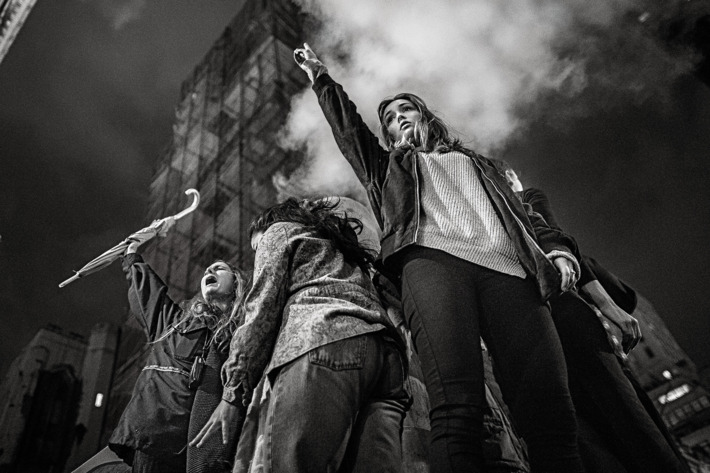
The night after the election.Photo: Andres Kudacki
And prevail we can. The aftermath of every election plunges the losers into despair and launches the victors into giddiness, and Trump’s shocking victory has had an unusually distorting effect. American progressives are burdened with a habit, stretching back decades, of handling political success badly — taking power for granted, bemoaning compromised progress, and collapsing into sectarian cannibalism. Hillary Clinton suffered from the same liberal ennui that bedeviled Al Gore in 2000, Hubert Humphrey in 1968, and Harry Truman in 1948. She suffered additionally from the self-inflicted wounds of bad decisions regarding hired speeches and her private email server, months of bruising attacks on her ethics from Bernie Sanders, and a widespread sexism that made her ordinary shortcomings seem sinister. Add to that a press corps that obsessed over her email lapse and twin attacks by Russian intelligence and rogue, right-wing FBI agents. It all culminated with the director of the FBI’s breaking all precedent to float new insinuations of wrongdoing against her ten days before the election, sealing her image as an untrustworthy and even criminal figure. Polls taken at the end of the campaign demonstrated that voters, astonishingly, believed that she was less honest and trustworthy than her opponent — a man who is literally facing trial for fraud.
Trump will solve the Democrats’ voter-complacency problem for them. He may also help them solve another problem: massive Republican gerrymandering. The House map is redrawn every ten years, and Republicans had the good fortune that the last redrawing followed their 2010 anti-Obama midterm wave, allowing them to lock into place a map of districts designed to virtually guarantee Republican control throughout the decade. Should Democrats generate an effective response to Trump, an anti-incumbent wave could allow the party to capture governorships in 2018 and legislatures that year and in 2020. They would then be in a position to create district maps that are more fair and democratic — and which, more often then not, would turn more Democratic.
Remember: When Trump showed the first signs of seriously challenging for the nomination, the panicked Republican Establishment identified him as a political calamity — a candidate who appealed to the party’s shrinking white, non-college-educated base and alienated the minorities and educated voters whose share of the electorate was growing. Its calculations were off, but only to a degree. Trump drew every ounce out of a shrinking coalition.
The party Establishment was on track to wipe its hands of the foul nominee after his expected defeat, clearing the way for fresh-faced, conventionally right-wing figures like Ryan and Marco Rubio to rebuild their party’s standing. The flip side of a president who will sign Ryan’s agenda into law is that there will be no more oh-so-earnest Ryan speeches apologizing from the bottom of his heart for the nominee’s transgressions. Instead, a man who embodies hateful, misogynistic bluster will define the party’s imprint in a lasting way. Tens of millions of young voters, and children too young to vote, will grow up associating the Republican Party with a man who embodies reactionary hate against them. The Trump stink will not wash away easily.
Notwithstanding his ability to appear reasonable from time to time, Trump has character traits that are consistent and long-standing. The post election hope that his lifelong childlike attention span, monumental ego, obsession with dominance and vengeance, and greed verging on outright criminality will abate in his eighth decade is fanciful. More so the notion that the experience of enjoying electoral vindication against his critics, then ascending to the most powerful position in the world, will curtail these tendencies.
Trump’s election is one of the greatest disasters in American history. It is worth recalling, however, that history is punctuated with disasters, yet the country is in a better place now than it was a half-century ago, and a better place than a half-century before that, and so on. Despair is a counterproductive response. So is denial — an easy temptation in the wake of the inevitable post election pleasantries and displays of respect needed to maintain the peaceful transfer of power. The proper response is steely resolve to wage the fight of our lives.
 American articles have ascribed the term “Lügenpresse,” recently hurled at reporters in some Donald Trump rallies, to the Nazi era. That’s partially accurate. The derogatory German term for “lying press” was already being widely used by German Catholics a century before the Nazis came to power to describe their opponents in the liberal and democratic newspapers. The term was back in vogue in the First World War to cast aspersions on the foreign media and their negative reporting on Deutschland. The term Lügenpresse was then exploited by the Nazis as catchphrase for Jewish-owned and other liberal media outlets, but it was no less prevalent over the past year among Germans who accused modern German media of covering up sordid crimes committed by Muslim immigrants. So it is a loaded term with deep roots in German consciousness that sounds detached and even ridiculous in an American context – except, possibly, if you’re a Nazi yourself.
This is not to say that comparisons between the rise of Donald Trump and the ascent of Adolf Hitler are inappropriate. On the contrary: Such analogies may be light years from perfect, but they are hardly misplaced. It just seems to me that the emergence of the specifically German word Lügenpresse provided a convenient peg for some in the media to remake a connection that they have otherwise been shying away from in recent months, either because they are wary of the expected pushback or because, as Americans, they would prefer not to believe that America in 2016 bears any resemblance whatsoever to Germany of the 1920’s or 1930’s.
Nonetheless, some of the elements of the Nazi ascent to power, as well as the emergence of other totalitarian regimes in Europe at the time, can provide clues and early warning signs to explain Trump’s success in the Republican primaries and his continuing popularity as we approach the presidential elections. Conversely – and this has been dealt with less in the media – Trump’s astonishing selection as the GOP candidate for the presidency, his continuing appeal to millions of Americans and the basic characteristics of his message have provided a new and valuable viewing angle on one of the last century’s most perplexing questions: how was Adolf Hitler possible?
And please spare me your “how dare you compare” indignation, if you are so inclined. I do not claim that America is Nazi Germany, that Trump is Hitler or that another Holocaust is just around the corner. But the blanket ban on using the most discussed, most debated and most researched issue of the 20th century as a reference point for viewing current events is, in my view, beyond ridiculous. Especially as it usually comes from people who routinely depict every two-bit Arab propagandist as a Goebbels and every minuscule human rights NGO as successors of kapos and Judenrats.
Viewed through the lenses of the current presidential campaign, historical descriptions of Hitler’s appeal to the German masses suddenly seem hauntingly familiar. Take, for example, Hitler biographer Ian Kershaw’s description of the recurring themes in Hitler’s speeches: “The contrast of Germany’s strength in a glorious past with its current weakness and national humiliation – a sick state in the hands of traitors and cowards who had betrayed the Fatherland to its powerful enemies and behind them, the Jews...a cheating and corrupt government and party system presiding over economic misery, social division, political conflict and ethical collapse.”
Richard Evans, writing in The Coming of the Third Reich: “He gained much of his oratorical success by telling his audiences what they wanted to hear. He used simple, straightforward language that ordinary people could understand, short sentences, powerful emotive slogans...There were no qualifications in what he said; everything was absolute, uncompromising, irrevocable, undeviating, unalterable, final. He seemed, as many who listened to his early speeches testified, to speak straight from the heart, and to express their deepest fears and desires. Increasingly, too, he exuded self-confidence, aggression, belief in the ultimate triumph of his party, even a sense of destiny.”
Of course, most people didn’t take Hitler seriously at first. Refined Germans viewed him with distaste and dismissed him as a buffoon, and not only because of his melodramatic speeches and volatile gestures. Writing in the New Statesman, social critic William Crotch recounted his own impressions of the future German dictator in the late 1920’s: “Another thing that struck me was the man’s utter incapacity to deal with important details....His talk was a succession of vague generalities, couched in attractive if flowery language, but showing in every case either complete ignorance or at least complete contempt for detail.”
But while Hitler was becoming the darling of the masses nonetheless, he never considered himself one of them. As historian Yaakov Talmon wrote in Myth of the Nation and Vision of Revolution, Hitler was contemptuous of the slow-witted German masses. “Denying them rational understanding, judgment, willpower, and mental balance, he composed an astonishingly shrewd vade-mecum (handbook, CS): how to bamboozle them with hysteria and incitement, oversimplification and repetition, stunts and tricks, parades and ceremonials. Brooding morbidly over its lost glory and wallowing in an ecstasy of self-pity, a defeated Germany offered a uniquely propitious target for the possessed demagogue to cast his spell and hypnotize its masses: he and they shared the same resentment of defeat and foreign dictation.”
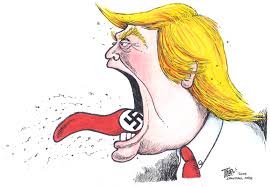 In The Origins of Totalitarianism, Hannah Arendt writes that initial successes of the Nazis and other totalitarian movements in the 1920’s and 1930’s stemmed from their reliance on hitherto politically uninvolved masses desperate for economic and social relief. Their success proved “that democratic government had rested as much on the silent approbation and tolerance of the indifferent and inarticulate sections of the people as on the articulate and visible institutions and organizations of the country.” Having been detached from political discourse and ignorant of recent history, Arendt writes, these masses were willing to accept bold lies and bald assertions as fact and to adopt the fantastical depictions of reality made by their leaders. And this was before the age of the Internet and social media, when the so-called Lügenpresse could still dictate the public’s agenda.
For me, at least, the rise of Donald Trump has been an eye-opener. Watching so many Americans fall under his spell has provided a prism to the hypnotic influence that Hitler had on Germans close to a century ago. How justified grievances and genuine economic plight, the disintegration of classes in society and the formation of others in their stead could combine with resentment, racism and downright ignorance to bring a patently unqualified and dangerous person so close to a position of so much power. How masses of Germans were willing to accept and support the litany of lies, the fountains of fabrications and dangerous delusions offered by Hitler. How hatred toward foreigners and those perceived as foreigners can burst out from the underground and then be drummed up to fever pitch. How the established leadership of a country, like that of a political party, can find itself weak and paralyzed even when faced with such an existential danger. How a politician more disciplined, more focused, more knowledgeable and more persuasive than Trump – but with the same dangerous ideas – might have easily made up the 5-10 percent of popular support that Trump seems to be missing.
In The Origins of Totalitarianism, Hannah Arendt writes that initial successes of the Nazis and other totalitarian movements in the 1920’s and 1930’s stemmed from their reliance on hitherto politically uninvolved masses desperate for economic and social relief. Their success proved “that democratic government had rested as much on the silent approbation and tolerance of the indifferent and inarticulate sections of the people as on the articulate and visible institutions and organizations of the country.” Having been detached from political discourse and ignorant of recent history, Arendt writes, these masses were willing to accept bold lies and bald assertions as fact and to adopt the fantastical depictions of reality made by their leaders. And this was before the age of the Internet and social media, when the so-called Lügenpresse could still dictate the public’s agenda.
For me, at least, the rise of Donald Trump has been an eye-opener. Watching so many Americans fall under his spell has provided a prism to the hypnotic influence that Hitler had on Germans close to a century ago. How justified grievances and genuine economic plight, the disintegration of classes in society and the formation of others in their stead could combine with resentment, racism and downright ignorance to bring a patently unqualified and dangerous person so close to a position of so much power. How masses of Germans were willing to accept and support the litany of lies, the fountains of fabrications and dangerous delusions offered by Hitler. How hatred toward foreigners and those perceived as foreigners can burst out from the underground and then be drummed up to fever pitch. How the established leadership of a country, like that of a political party, can find itself weak and paralyzed even when faced with such an existential danger. How a politician more disciplined, more focused, more knowledgeable and more persuasive than Trump – but with the same dangerous ideas – might have easily made up the 5-10 percent of popular support that Trump seems to be missing.
Of course, it goes without saying that freethinking and individualistic Americans are not regimented discipline-yearning Germans. Or that the U.S. is strong and resilient, while Hitler would never have come to power without the double whammy of Germany’s crushing defeat in World War I and the catastrophic 1929-1930 depression, though perhaps I underestimate the ability of modern social media and cynical politicians to create a delusional world in which things seem just as bad today. Or that the united forces confronting Trump in 2016 are nothing like the splintered body politic of the late Weimar Republic – hopefully – with the Communists exerting a radical influence in the other direction that pulled Germany apart.
“How did Adolf Hitler – described by one eminent magazine editor in 1930 as a “half-insane rascal,” a “pathetic dunderhead,” a “nowhere fool,” a “big mouth” – rise to power in the land of Goethe and Beethoven? What persuaded millions of ordinary Germans to embrace him and his doctrine of hatred? How did this “most unlikely pretender to high state office” achieve absolute power in a once democratic country and set it on a course of monstrous horror?” asks Michiko Kakutani in her New York Times book review of Volker Ullrich’s new biography of Hitler. The answer, I propose, is clearer today than it was before Trump emerged on the scene.
Even if you believe the polls and assume that the 2016 elections will have a happier ending and that Donald Trump will soon wind up as a sorry footnote in history, it’s hard to deny that his stupendous success thus far has been, at the very least, educational. As Evans writes: “The story of how Germany, a stable and modern country, in less than a single lifetime led Europe into moral, physical and cultural ruin and despair is a story that has sobering lessons for us all.”
Trumpisms: A look at one of Trump's most common speech patterns. Say it, repeat it, say it again.
'Believe me': People say Trump's language is affecting political discourse 'bigly'
Of all the rules of politics that Donald Trump has broken in his run for the White House, his way with words may top the list.
Perhaps not since Sarah Palin gave Americans her tossed-word salads has a candidate’s speech pattern been so debated, celebrated and mocked.
But Trump is more than just a free-style rambler. Experts say he employs a very deliberate, effective communications approach unlike any other presidential candidate in memory.
The Trumpisms — “Believe me,” “People say,” “Sad!” — have become so well known they are the subject of spoofs. But like a savvy salesman or break-through advertising campaign, Trump’s techniques carry a quiet power.
Here’s a breakdown of Trump-speak.
 Donald Trump talks with reporters on his campaign plane. (Evan Vucci / Associated Press)
The art of the insult
Donald Trump talks with reporters on his campaign plane. (Evan Vucci / Associated Press)
The art of the insult
Little Marco. Lyin’ Ted. Crooked Hillary. Even in the rough-and-tumble world of presidential politics, Trump has taken the art of the insult to a new level.
Trump’s name-calling may sound like simple bullying. But labeling his opponents with cutting nicknames also creates simple frames — catch phrases — that stick in voters’ minds, often because they reinforce existing perceptions.
George Lakoff, a linguistics professor at UC Berkeley who has written extensivelyabout political speech, says studies show that 98% of thought is unconscious. Creating those nicknames is a way to make the broader message resonate with voters long after the rallies have ended — like a good advertising jingle.
“Even if he loses the election, Trump will have changed the brains of millions of Americans, with future consequences,” Lakoff writes on his blog.
As a businessman, Trump learned that speaking in an irreverent, shock-jock manner often won him free media attention. Now some Trump supporters are cheering that same willingness to give voice to politically incorrect opinions that they may secretly share, but would never say out loud.
Among the most controversial examples were his description of Mexican immigrants as “rapists” and his pondering of whether the Muslim mother of a U.S. Army captain killed in Iraq wasn’t “allowed” to speak alongside her husband at the Democratic convention.
“He has this great talent for, any time there’s a lull, he goes and grabs up all the attention again,” said Barton Swaim, author of “The Speechwriter: A Brief Education in Politics.” “I’m out of the business of predicting how he won’t go to the next level.”
 Trump unveils his 10-point plan to crack down on illegal immigration during a campaign event in Phoenix. (David Cruz / AFP/Getty Images)
Say it. Repeat it. Say it again.
Trump unveils his 10-point plan to crack down on illegal immigration during a campaign event in Phoenix. (David Cruz / AFP/Getty Images)
Say it. Repeat it. Say it again.
It’s a crescendo of almost every Trump rally, the call-and-response moment when Trump promises to build a “great wall” along the Southern border. “Who’s going to pay for it?” he asks. “Mexico!” the crowd answers.
Of course the Mexican president has said unequivocally that his country will not be paying for Trump’s wall. But that hardly matters. In Trump’s world, repeating something makes it seem true, even when it’s demonstrably not.
For example, Trump continues to insist that he warned against entering the 2003 Iraq War, despite a 2002 audio clip of him voicing support. He has repeatedly claimed to have watched TV footage of Muslims in New Jersey cheering on 9/11, despite no evidence of such an event.
He often repeats false claims that inner-city crime is at record highs or that neighbors of the San Bernardino terrorists saw bomb-making materials in their apartment but did not report it.
“The more a word is heard, the more the circuit is activated and the stronger it gets, and so the easier it is to fire again,” Lakoff writes. “Trump repeats. Win. Win. Win. We’re gonna win so much you’ll get tired of winning.’”
 “I know more about ISIS than the generals do. Believe me," Trump has said. (Evan Vucci / Associated Press)
‘Believe me’
“I know more about ISIS than the generals do. Believe me," Trump has said. (Evan Vucci / Associated Press)
‘Believe me’
With this two-word imperative, Trump draws voters in, hoping to inspire confidence, create intimacy and form a bond of trust with voters. It’s a connection that has often eluded Hillary Clinton, with her multi-point solutions to the nation’s problems.
He often uses it to reassure his audience that he has the answers to the nation’s problems or to allay doubts about his abilities.
“I know more about ISIS than the generals do. Believe me.”
“We are going to get rid of the criminals,” he says about his immigration plan, “and it’s going to happen within one hour after I take office.… Believe me.”
Experts say it plays to listeners’ desire for a strong leader with easy solutions. Trump becomes like someone who is huddling close to tell a secret, or like a salesman giving you the inside scoop on a deal.
But Jennifer M. Sclafani, associate teaching professor in linguistics at Georgetown University and author of the forthcoming book “Talking Donald Trump: A Sociolinguistic Study of Style, Metadiscourse, and Political Identity,” said “what people interpret from this particular command is ambiguous.”
That makes “believe me” a double-edged sword for Trump, she said. For Trump’s supporters, it reinforces what they already believe about Trump. But skeptics “are likely to interpret this phrase as coming from an untrustworthy candidate who needs to command his audience to believe him, because he is naturally unbelievable.”
 The “people say” construct allows Trump, shown in August, to float an idea without taking full ownership or blame. (Loren Elliott / Associated Press)
People say…
The “people say” construct allows Trump, shown in August, to float an idea without taking full ownership or blame. (Loren Elliott / Associated Press)
People say…
One of Trump’s signature constructs comes when he’s about to say something controversial — even conspiratorial — but wants to lean on others to do it.
“Many people are saying that the Iranians killed the scientist who helped the U.S. because of Hillary Clinton's hacked emails,” Trump tweeted last month, though such a conspiracy theory was easily debunked.
After the Orlando nightclub shooting, Trump implied President Obama did not want to stop terrorists, but tried to take cover by putting the offensive remark in the mouths of others. “There are a lot of people that think maybe he doesn't want to get it," Trumpsaid on the “Today” show. "A lot of people think maybe he doesn't want to know about it.”
The “people say” construct allows him to float an idea without taking full ownership or blame.
“What he’s doing is making use of principles that people use all day every day — to get across ideas that are not true,” Lakoff said.
Trump dismissed criticism that he linked rival Sen. Ted Cruz’s father to President Kennedy’s assassination, insisting he was only pointing to a National Enquirer story about the elder Cruz allegedly meeting with Lee Harvey Oswald.
This Trump style, too, has found a home on social media. One band in Texas tweeted recently: “Many people are saying our next album will heal the sick and end all war. It's just what many people are saying.”
Never having to say you’re sorry
Trump rarely issues a public apology, no matter how wrong he is proven to be or how strong the public pressure.
He insisted he did not “regret anything” about his attacks on the Gold Star Khan family. He refused to back down from his claims that an American-born judge overseeing the Trump University fraud lawsuit could not be fair due to his Mexican heritage.
He won’t apologize for leading the so-called “birther” movement questioning Obama’s citizenship, even though advisors say it might help him win over African American voters.
“I like not to regret anything,” he told radio host Don Imus earlier this year when asked if he regretted questioning whether Sen. John McCain of Arizona, captured during the Vietnam War, should be considered a war hero.
His one and only public expression of regret came last month, but even that was vague and included the verbal architecture of an I’m-sorry-if-you-were-offended apology.
"Sometimes, in the heat of debate and speaking on a multitude of issues, you don't choose the right words or you say the wrong thing,” Trump told a crowd in North Carolina. “I have done that, and I regret it, particularly where it may have caused personal pain.”
 Donald Trump speaks to the American Legion National Convention in Cincinnati. (Evan Vucci/Associated Press)
Keep it simple
Donald Trump speaks to the American Legion National Convention in Cincinnati. (Evan Vucci/Associated Press)
Keep it simple
One of Trump’s biggest strengths with voters has been his ability to speak plainly and to simplify — some would say oversimplify — complex issues.
Build the wall to stop illegal immigration. Bring back coal and steel-manufacturing jobs. Defeat the terrorists “so fast your head will spin.” He convinces supporters that simple solutions would work and intractable problems linger only because of the “stupidity” of U.S. leaders.
In contrast, Clinton is often criticized for sounding too scripted, too poll-tested, too detail-oriented. Obama, too, seemed sometimes paralyzed by the complexity of challenges.
His tweeting is a prime example, mastering the ability to boil down talking points and policy views to 140 characters or less.
Lakoff says that Trump’s simple solutions appeal to those who see direct cause-effect of problems, but not those who view the world in more complex terms.
Clinton is “very careful about what she says. But when she does that, that means she’s not engaging in normal everyday conversation,” Lakoff said. “He’s using all of these mechanisms: It’s what you hear, not what you say. He has just taken it to the extremes and run with it.”
Say it ‘bigly’
Trump’s plans are “tremendous.” His victories “HUUUGE.” Exaggeration and hyperbole are hallmarks of Trump’s communication style.
His financial disclosure statement used all capital letters to boast his wealth: “TEN BILLION DOLLARS.” Though he is the first presidential candidate in decades to refuse to release his tax returns, he insisted recently that he has “released the most extensive financial review of anybody in the history of politics.”
The Clinton Foundation is not merely a scandal, according to Trump, “it’s the most corrupt enterprise in political history.”
And then there’s “bigly.”
“We’re going to win bigly,” Trump said in a victory address in Indiana after becoming the presumptive nominee.
Much has been said and written about “bigly” — if it’s a word and if it’s what Trump is saying. Dictionaries say “bigly” exists in one of those old-timey ways that hasn’t been in fashion for 100 years or so.
But Trump’s spokeswoman, Hope Hicks, told Slate magazine it’s not “bigly” at all. Trump, she said, is saying, “big league.”
Like much of Trump’s speech, it seems open for interpretation.
