
Sunday, January 29, 2017

Lets get the Facts and Fiction Sorted out before venturing into the Israeli -Palestinian Middle East Quagmire.
Model of Temple Mount, image by Galerie des Bois, Benjamin Wood, via Flickr
EXECUTIVE SUMMARY: The US is usually thought to be biased in favor of Israel, even after its recent acceptance of UNSC Resolution 2334. But for many years, the US has been a big part of the reason why the diplomatic world accepts a false narrative of the Arab-Israeli conflict that harms Israel and makes it harder to achieve peace. Washington should move to a truth-telling strategy to dismantle the structure of false views that slander Israel and stand in the way of peace.
The widely accepted false narrative of the Israeli-Palestinian conflict is built on the following premises:
- Israel stole and now occupies Palestinian territory;
- there are millions of “Palestinian refugees” who have a “right of return” to Israel;
- Israel and the Palestinians have equal or comparable claims to Jerusalem;
- the Palestinian community and its leadership are ready to accept a two-state solution that will end Palestinian efforts to eliminate the Jewish state.
The US has consistently either supported or been unwilling to contradict these premises.
Palestinian leaders have an additional false view on which they insist when they speak in Arabic, and which they often proclaim to international audiences. This view is that the Jewish people did not, in fact, live in and rule parts of Palestine, including Jerusalem, for hundreds of years long before the beginning of Islam. While this false claim is not generally accepted diplomatically, UNESCO recently endorsed the fiction that the ancient Jewish temples were not built on the Temple Mount – a site UNESCO calls “al-Aqsa Mosque/al-Haram al-Sharif" (Noble Sanctuary).
This Palestinian false history is not challenged by the US or by any other democracy. Had the US utilized an active strategy of telling the truth, the Palestinians would not have been able to continue to use their false picture to resist peace.
Rejecting false premises does not mean rejecting a peace agreement based on a two-state solution. The truth is compatible with a variety of ideas about what should be done in the future. Those who support a two-state solution can also support a strategy of telling the truth, as can those who doubt the feasibility of a two-state solution.
US policy has always been to ignore, and sometimes even to support, the falsity of these diplomatically accepted narratives in order to avoid contradicting the Palestinians and arousing the wrath of the Arab and Muslim nations. This longstanding American willingness to put reality aside to try to encourage negotiations has been unsuccessful thus far, and has become increasingly harmful.
For many years, US policy was to appear “even-handed” even at the expense of truth – that is, to be superficially even-handed between the arsonist and the firefighter, the terrorist and the victim of terror. Washington should switch to an even-handed policy of supporting truth, whether it comes from Palestinians or from Israelis: a policy of rejecting falsehood from both sides.
Of course, many statements are partly true and partly false, and often there are good reasons for different opinions about what is true. But there would be a great improvement in the diplomatic environment if the US took the lead in rejecting the most important and clearly false elements of diplomatic consensus.
A truth-telling strategy does not mean being absurd by always insisting on truth. The realities of human nature, and of politics and international relations, require substantial room for untruth. The US government cannot and should not act like an innocent who expects everyone to always tell the truth, and who views not doing so as evil.
The False Claim That There Is Such a Thing as “Palestinian Territory”
The biggest falsehood the US needs to expose is that there exists “Palestinian territory” that Israel refuses to “give back” because of its expansionist ambitions and purported security needs. It is controversial, rather than a falsehood, to say that justice and peace require Israel to turn over to a Palestinian state essentially all the land it seized in its defensive war in 1967. But there is a big difference between the controversial statement that the West Bank should become Palestinian territory as part of a peace agreement and the false statement that these areas are now, or ever were in the past, Palestinian territory.
The distinction between saying that the West Bank (including East Jerusalem) is Palestinian territory and saying that it should become Palestinian territory is important for both the past and the future. For the past, the statement that the West Bank is Palestinian means that Israel stole land that was not Jewish and should “give it back.” For the future, the distinction determines whether Israeli proposals to provide land for a Palestinian state are returning stolen property or are offers to give up disputed land to which it has serious claims, in order to make a healthy peace with its neighbor. From the Palestinian point of view, it differentiates between an immoral submission to a thief who has more power and a wise compromise with neighbors who have overlapping claims of right.
A US truth-telling strategy would not ignore Palestinian assertions about “Palestinian land,” but would point out that the land in question is disputed. It is not Palestinian territory – despite US acceptance of a UNSC resolution that refers to it as such – because there is no Palestinian territory and never has been. Palestinians have never ruled or been sovereign over any land. This is an indisputable fact, not a question of policy or interpretation.
The West Bank is disputed territory: it is territory for which Israel has historic and legal claims based on League of Nations resolutions endorsed by the US government in the 1920s and confirmed in Article 80 of the UN Charter. The most recent sovereigns before the West Bank came into dispute were the British Mandate from the League of Nations to promote a Jewish national home (1922-48) and the Ottoman Empire (1517-1917).
Individual Palestinians certainly own much land in the disputed area, just as they own land in Israel, in the US, and elsewhere. But ownership of land by individual Palestinians does not make it Palestinian territory, either in Nablus or in New York.
Palestinian national rights to the land do not come from international law, but from a principle that has become widely accepted over the last century: that the people who live in an area should govern it. But this principle is not automatic and self-executing. Implementing it presents difficulties that require exceptions (or else east Boston would have become part of Ireland). Who the majority is in an area depends on how the borders are drawn. For example, Israelis are the great majority of the population of Area C in the West Bank – a Jewish majority that was not created by removing Arabs.
The Falsehoods about “Palestinian Refugees”
The second most important part of a new truth-telling strategy would be to expose how the Arabs have abused what they call the “Palestinian refugees” in order to maintain them as a weapon for destroying Israel as a Jewish and democratic state.
The politely accepted story in diplomatic circles is that there are nearly 5 million “Palestinian refugees” from 1948, more than a million still living in UNRWA “refugee camps” because Israel refuses to let them return home despite the “right of return” granted them by the UN General Assembly.
The reality is that only some 50,000 of the “Palestinian refugees” are refugees as the world defines the term. The others are descendants of refugees who have died. The Palestinian leadership and the Arab states have prevented these descendants, who never lived in Israel, from settling and living normal lives in any Arab state (except Jordan).
Furthermore, UNGA Resolution 194 did not, in fact or in law, grant the right of return to all refugees, and would have had no authority to do so even if it had tried.
It is widely recognized in private that the Arab insistence on the “right of return” does not come from concern over the wellbeing of the “refugees,” who have not been given any choice about their unfortunate status. The miseries imposed on them for three generations are the result of the Arab world’s decision to prevent their resettlement in the hope that someday, Israel will be forced to take in so many “refugees” that it cannot continue to be both Jewish and democratic.
The false diplomatic story with which the US has been playing along for generations is that the Arab position on the “right of return” is a plausible negotiating position that might prevail in the final stage of peace talks. The issue should not yet be addressed, so the thinking goes, because it is so hard to resolve. The truth, which is widely understood in the diplomatic community although no country will admit it publicly, is that the “refugees” do not have any real legal “right of return,” and Israel cannot allow them to move to its territory if it is to survive. It is well understood that the “right of return” is a weapon to destroy Israel, not a normal negotiating demand that can be compromised.
A truth-telling strategy would declare that peace depends on finally settling the “refugees,” and that it is needless cruelty to keep them in refugee camps and without normal citizens’ rights any longer.
The US should start the process of closing down UNRWA, the UN agency that has made it possible to conceal the truth about Palestinian “refugees.” And it should be made clear to the Palestinians that they will never get international support for the notion of forcing Israel to take in millions of Palestinians.
It should be noted that the Israeli government has favored continued support for UNRWA. This is one of a number of instances where the government of Israel has chosen to appease international opinion rather than use the truth to defy it. It is time for Israel too to move away from such appeasement, which has not worked.
The more sophisticated diplomatic discussion of how peace might be negotiated asserts that the “refugee” issue does not prevent peace, because the Palestinian leadership already understands that no more than a token fraction of refugees will ever be allowed to move to Israel. The “refugees” will have to be satisfied with apologies and compensation – a premise widely acknowledged but never uttered out loud.
Diplomats around the world, particularly in the US, privately understand that Israel cannot and should never be forced to take in millions of “Palestinian refugees.” But no one says so officially, or tells that to the Palestinians. A truth-telling strategy would hold that it is time to say openly what everyone knows to be true.
Telling the truth that there is no “right of return” leaves open the question of compensation for Palestinian refugees from Israel and for Jewish refugees from the Arab countries. This does not have to be an obstacle to peace. It is indisputable that the creation of Israel led to at least as many Jewish refugees from Arab countries as Palestinian refugees from Israel. And the Jewish refugees, who were all resettled without international help (mostly in Israel), were forced to leave behind more assets than did the Palestinian refugees.
False “Even-Handedness” About Jerusalem
A much less important, but highly symbolic, piece of American truth-telling will be moving the US embassy in Israel to the country’s capital, Jerusalem. The US can further increase its truth-telling by allowing the passports of American citizens born in Jerusalem to record the fact that they were born in Israel. At present, Washington is unwilling to allow this truth to appear in American passports.
Because the US has been willing to ignore these truths for so long, there will be great Arab resistance to their being stated in public. The fiercer their protests, the more the Arabs will demonstrate the cost of having avoided truth-telling for so long. In the long run, a recognition that the US has a commitment to the truth will reduce the harm done by violent protests. Conversely, a policy of avoiding the truth in deference to threatened violence will lead to more such violence – or to US subservience to the rioters.
Jerusalem is a good example of the biased “even-handedness” that has long characterized the US stance. Official statements always refer to Jerusalem as sacred to both sides – sometimes adding that it is sacred to Christians as well – and typically imply that a fair solution will require equal treatment for Israel and the Palestinians on Jerusalem. But in reality, there is very little symmetry between the Israeli and Palestinian connections to Jerusalem.
The al-Aqsa Mosque, which is located in Jerusalem, has significance for the religion of Islam (although its origins are controversial) – but it is in no way central. The city of Jerusalem is not mentioned even once in the Koran, nor in regular Muslim prayers. On the other hand, Jerusalem is a central feature of the Jewish religion and of daily Jewish prayer and identity. The climax of every Jewish wedding ceremony is when the groom breaks a glass to symbolize the exile from Jerusalem and repeats a quotation from Psalm 137: “If I forget you, o Jerusalem, let my right hand wither.”
Jewish and Muslim performance in ruling Jerusalem since 1948 has also been very different. Under Israeli rule over Jerusalem (West Jerusalem for 19 years and the entire city for 50 years), there has been freedom of religion and protection of the holy sites of all religions. During the 19 years of Jordanian rule over East Jerusalem, Jews were not allowed entry even to the Jewish Quarter, and Jewish religious sites were destroyed.
The religion of Islam takes no notice of Jerusalem as a city. Muslims have expressed interest in Jerusalem only when it was ruled by non-Muslims. For over a thousand years of Muslim rule over Jerusalem, it was never made into the capital of any part of the Muslim empire, not even the local district. From 1948 to 1967, when it was ruled by Jordan, Jerusalem was treated as inferior to Amman. By contrast, the city of Jerusalem has always been a major concern of the Jewish religion and of Jewish identity, including throughout the nearly 2,000 years during which it was in the hands of others. Israel cannot survive as a Jewish state without Jerusalem as its capital.
Israeli and Palestinian interests in the future of Jerusalem are not at all symmetrical. Israel needs Jerusalem to continue to be a vibrant working city. The Palestinians, by contrast, would make an important gain in their effort to destroy Israel if they achieved new arrangements for Jerusalem that allowed its health as a city to be undermined by violent conflict.
To follow an even-handed truth-telling strategy about Jerusalem, the US should state that a fair disposition of the city will acknowledge it as the capital of Israel, protect the religious concerns of all religions, and assure that the city’s health will not be jeopardized by internal conflict. The Palestinian interest in having Jerusalem as the capital of a new Palestinian state should be satisfied in a way that is consistent with these three values.
The False Assertion that the Palestinians are Ready to Make Peace with Israel
A US truth-telling strategy would also address the question of whether the Palestinian community and leadership are in fact willing to make peace with Israel. While there cannot be any indisputable truth about such a hypothetical and complex question, there is evidence that can be examined in order to respectfully try to understand the point of view of the Palestinians.
A search for truth would ask why the Palestinian leadership (both intellectual and political) takes such pains to falsely deny the ancient Jewish presence in the land. It must be unpleasant and difficult for informed Palestinians to tell such obvious falsehoods that there never was a Jewish Temple in Jerusalem (from which Christ could chase the money-changers), or that Jews did not rule the land for centuries before most of them were exiled by the Romans 2,000 years ago. This denial of history is not part of the religion of Islam; it is a recent Palestinian invention. Older Muslim sources explain that the Dome of the Rock was built on the Temple Mount because it was the site of the Jewish Temple. One of the traditional Arab names for the Mount is Bayt al-Maqdis (The Temple).
One plausible explanation why the Palestinian leadership is so insistent on such an extreme denial of reality is that if the Palestinian people knew the truth, they might be more willing to accept Israel on part of the land. This suggests that it might be constructive for the US to remind the Palestinians that according to Islamic tradition, the Temple Mount was built by Jews as the site of the Jewish Temple. A public airing of the fact that there is no doubt that there were ancient Jewish kingdoms in the land a thousand years before Islam might increase the readiness of the Palestinian people to make peace with the Jewish people, who share their connection to the holy land.
Persistent US truth-telling would so undermine the Palestinian leadership’s efforts to deny basic historical truths that they would not be able to continue without embarrassing themselves before their own people. It would show the Palestinians that the US, and presumably other democracies, are not prepared to accept blatant falsehoods as justification to force Israel to accept a Palestinian victory. This would undermine one of the major Palestinian reasons for thinking they might still be able to destroy Israel: their hope that it is not too late to remove Israel from the land completely. That Palestinian hope is the fundamental obstacle to peace.
When Did the Palestinians Have an Internal Dispute about Making Peace with Israel?
If we are to gain a truthful answer to the question whether the Palestinians are now willing to make peace with Israel, we must also ask the following question: If the Palestinian leadership and public are now willing to make peace with Israel, when did they change? And what was the political process that produced the change?
Since before the establishment of Israel, despite the deep desire of many Palestinians for peace, the Palestinian community and its leadership were determined not to accept a Jewish state on any terms and were committed to struggle to destroy it until it was removed from land that had once been Muslim-ruled. Whatever some Palestinians might have thought or said in private or in English, any suggestion of a basis for accepting Israel or of allowing the “refugees” to be settled outside Israel was taboo in Arabic public discourse for many years.
This is a statement of fact, not an accusation. It could be disproved if one could point to Arabic public statements to the effect that it is necessary to end the struggle to destroy Israel, or that a major share of the “refugees” might not be allowed to enter Israel. There is no evidence of such statements. Nor can one find many Palestinian political voices who say such things in Arabic in public. The Palestinian political discourse is available translated into in English on MEMRI.
Before there can be any major change in Palestinian policy, there will have to be a sharp public debate among Palestinians. Certainly there would be strong voices initially rejecting any willingness to give up the war to destroy Israel or to settle the “refugees” outside of Israel. This debate would be visible in public channels, and it would be possible to see which side was eventually forced to retreat.
There has been no such debate. Palestinian discourse still maintains the taboo against suggesting it is necessary or desirable to give up the war against Israel on any terms. Nor is it acceptable to discuss the possibility of some “refugees” not being allowed to move to Israel.
A truth-telling US strategy would not continue to assume that peace can be negotiated with the Palestinians if Israel makes appropriate concessions. Truth-telling is consistent with urging negotiations between Israel and the Palestinians, but not from the position that the success of those negotiations will depend on what Israel does. A truth-telling strategy would recognize that agreement on peace can only happen after Palestinians have public debates about “refugees” and about accepting Israel.
Why the US Should Move Toward a Truth-Telling Strategy
A large edifice built on falsehood has come to define the diplomatic and policy environment of the Israeli-Palestinian conflict. This structure of unreality has failed to produce useful results. Perhaps, therefore, the new US president, who campaigned on making significant changes to US policy, should adopt a new strategy of truth-telling, which might lead to better results.
International pressure is one of the main weapons with which the Palestinians hope to destroy Israel. They will not give up that goal until it has become clear that there is no way it can succeed. Demonstrating that the world will no longer pretend to believe Palestinian falsehoods might lead more Palestinians to see that they have no chance of eliminating Israel. They might then seek the benefits of peace.
Furthermore, forcing Palestinians to acknowledge Israel’s historical and moral claim to the land would provide them with an honorable basis for compromise with Israel. If Israel were a stranger to the land, simply a colonial power taking Arab land by force, as the Palestinians falsely argue, it would be cowardly for them to yield.
When the American and European democracies accept Palestinian falsehoods, it creates a disincentive for the Palestinians and their supporters to face the realities of their situation. But these realities have to be the basis of any resolution of the conflict. A truth-telling strategy would offer a sound long-term foundation on which peace can eventually be built.
Why Israel Should Move Toward a Truth-Telling Strategy
Even with a new administration that has promised to break with the policies of the past, there may not be much chance that the US will depart radically from its policies of the last 50 years. But whether Washington alters past positions or not, Israel should advocate a truth-telling strategy for the US and the other democracies and pursue that strategy itself.
Israel is now imprisoned by an internationally accepted structure of falsehoods. It is tactically wiser for Israel to argue for truth-telling than to continue to appease the international consensus, for example by explaining why settlements are not the obstacle to peace, or that Israeli security requires that Israel occupy what people think of as “Palestinian land.”
Israel needs to go on the diplomatic offensive. Framing its position as an effort to get recognition for the truth is more likely to get its story heard than simply making demands and claims. And criticisms of the Palestinians that Israel needs to make to change the diplomatic consensus will be more effective if they are made as part of a broader strategy of urging democracies to face the truths about the conflict.
It is politically difficult for the US or other countries to take positions that are more “pro-Israel” than the positions of the Israeli government. If Israel would like other states to move toward more truth-telling about the conflict, it needs to stop holding back from presenting its own case out of fear that criticism of the Palestinians and assertions of Israeli rightful claims would seem to conflict with negotiations for peace.
It is notable that the US is thought to be biased in favor of Israel even though it does not stand for the truths essential to Israel’s position. Despite its longstanding alliance with Israel, the US under many presidents has allowed Israel to be forced to operate according to the international structure of falsehood that now dominates Israel’s diplomatic position. This policy should be replaced by a truth-telling strategy.
Briefly, some of the main truths that the US has been denying or ignoring, and that a truth-telling strategy should make prominent in the international discussion, are:
- Although there are good reasons why there should eventually be “Palestinian territory,” there is not now, and never has been, any such thing. No territory was “taken from” the Palestinians; nor can any territory be “given back” to them. They have always lived in territory ruled by others.
- West Jerusalem is located in Israel and is the capital of Israel. The Palestinian and Israeli connections to Jerusalem are neither equal nor symmetrical. Jerusalem is demonstrably more important to Israel than it is to the Palestinians.
- The Jewish people lived in and ruled most of the area of Israel in ancient times. Israelis did not come to the land as European colonialists; they came as a people returning to its homeland. Israel’s rule over the land is not based only on its military strength; it has historical, legal, and moral claims.
- The Jewish international legal right to settle in the land from the Jordan to the Mediterranean Sea was established by the League of Nations’ Mandate in 1922, in recognition of the Jewish People’s millenarian attachment to the Land of Israel. It is not based on Jewish suffering in the Holocaust.
- The claim of a “right of return” for Palestinian “refugees” is not a humanitarian effort to provide help or justice to those unfortunate individuals, who are not truly refugees. It is an Arab weapon intended to destroy Israel via demographic subversion. And it is not a valid legal claim. Peace between Israel and the Palestinians requires resettling the “refugees” outside of Israel and ending UNRWA’s mandate. (While this truth is not indisputable, it is the understanding held by independent and informed people, most of whom do not publicly say what they personally believe.)
- It is not an established truth that the Palestinian leadership and community have decided to give up the goal of destroying Israel and are ready to make a peace that accepts Israel if Israel makes appropriate concessions. The evidence for and against this generally accepted assumption needs to be examined. Much of it indicates that the Palestinian community is not willing to make peace with Israel on any terms.
The US should be more genuinely even-handed between Israel and the Palestinians than it has been in the past. It could advance the cause of peace by telling the truth. It is not even-handed for the US to let one side’s systematic falsehoods dominate the diplomatic discussion, when a truth-telling strategy could make the policy debate more realistic and improve the long-term prospects for peace.
Petition calling on UK to cancel #OyVeyDonaldTrump state visit reaches 1,3 million signatures in the first 48 hours
The matter will now go to debate in Parliament
More than 1.3 million people have signed a petition calling for the US President to be prevented from making a state visit to the United Kingdom, in just a few hours.
The UK government responds to all petitions that receive more than 10,000 signatures, and at 100,000 signatures it must consider them for debate in Parliament.
Citing Mr Trump’s “well documented misogyny and vulgarity”, the petition calls for Mr Trump to be allowed into the country, but not invited to meet the Queen.
At the time of writing on Sunday afternoon, approximately 45,000 people were adding their name to the petition every minute.
Nobel Laureates join academics in protest against Trump's refugee ban
Petition for Trump's tax returns gets record number of signatures
Petition calling for release of Trump's tax returns reaches 2,000,000
“Donald Trump should be allowed to enter the UK in his capacity as head of the US Government,” the petition reads, “but he should not be invited to make an official State Visit because it would cause embarrassment to Her Majesty the Queen.”
It continues: “Donald Trump’s well documented misogyny and vulgarity disqualifies him from being received by Her Majesty the Queen or the Prince of Wales. Therefore during the term of his presidency Donald Trump should not be invited to the United Kingdom for an official State Visit.”
The petition met the criteria for consideration by 12.45pm on Sunday after a link was posted on Facebook in just 12 minutes ....... 10,000 signatures. At one point it was signed over 86,000 times in an hour.
Petition data shows most of the signatures came from north, south, and central London, with other hotspots scattered across the UK, including in the cities of Brighton, Bristol, Edinburgh and Manchester.
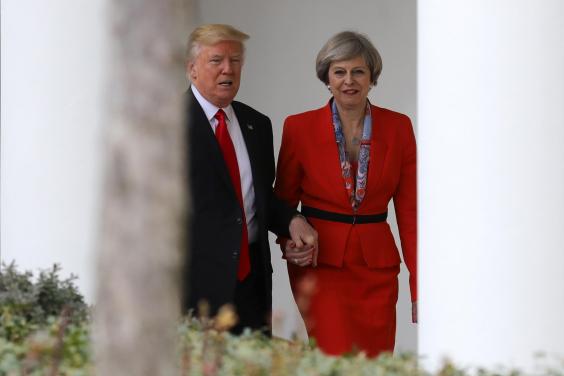
Theresa May visited Donald Trump in Washington on Friday(Getty Images)
The Prime Minister first announced last week, during her visit to Washington, that Mr Trump had accepted an invitation from the Queen to visit the UK later this year.
Theresa May refused three times during her trip to condemn Mr Trump’s controversial immigration policy, which bans people from seven Muslim-majority countries from entering the US.
One of Ms May’s own MPs, Nadhim Zahawi, said the ban would stop him entering the country. He said he felt demeaned by the policy, adding: “For the first time in my life last night I felt discriminated against.”
I
The petition was launched as Labour leader Jeremy Corbyn called for Mr Trump’s state visit to be put on hold for as long as the immigration ban is in place.
Just before midnight on Saturday, under considerable pressure from the public, a spokesperson for Ms May released a statement opposing the ban, saying: “Immigration policy in the United States is a matter for the government of the United States, just the same as immigration policy for this country should be set by our government.
“But we do not agree with this kind of approach and it is not one we will be taking. We are studying this new executive order to see what it means and what the legal effects are, and in particular what the consequences are for UK nationals.”
Campaigners are currently calling on social media for London to stage the “biggest protest ever” against Mr Trump, if his visit to the UK does take place.
#OyVeyDonaldTrump ratchets up defense of immigrant ban as outrage mounts

President Donald Trump: “To be clear, this is not a Muslim ban, as the media is falsely reporting." |

President Donald Trump on Sunday defended his executive order barring refugees and some legal immigrants from entering the United States, even as a top Cabinet official walked back part of the measure — signaling confusion and fissures within the new administration.
“America is a proud nation of immigrants and we will continue to show compassion to those fleeing oppression, but we will do so while protecting our own citizens and border,” Trump said in an afternoon statement that also cited what he described as precedent set by former President Barack Obama. “To be clear, this is not a Muslim ban, as the media is falsely reporting. This is not about religion — this is about terror and keeping our country safe."
Trump — who also took the time Sunday to accuse Sens. John McCain and Lindsey Graham of “looking to start World War III” — and his aides struggled to stay on message as protests spread and global outrage grew over the executive order. The directive effectively bars entry to the United States by people ranging from Iraqi translators to Syrian refugees to many international college students. It initially was said to apply to legal U.S. permanent residents — so-called green card holders — as well as many foreigners with multiple nationalities.
Conflicting interpretations spurred Homeland Security Secretary John Kelly to clarify that green card holders were indeed exempt from Trump's broad order.
"In applying the provisions of the president's executive order, I hereby deem the entry of lawful permanent residents to be in the national interest," Kelly said in a statement Sunday evening. Some permanent residents were caught up in the weekend's confusion as they attempted to return from overseas visits.
Thousands gathered outside the White House to demand Trump rescind the order — one of many protests nationwide. Prominent Republicans and foreign leaders chided Trump, warning that the order could backfire by inspiring terrorists. Democrats lunged for the political opening, vowing legislation to repeal the order and hinting at lawsuits filed by state attorneys general. Meanwhile, a string of rulings from judges halted the deportation of travelers caught in the drama, but also bewildered U.S. officials unsure how to enforce Trump’s order.
The developments underscore the haphazard approach the Trump administration has taken toward using its political power. Trump issued the order Friday with little notice to or input from the Department of Homeland Security, the State Department or other agencies critical to implementing it, according to multiple sources. The order's complexity left administration lawyers scrambling to interpret it as advocacy groups filed lawsuits.
Trump did not appear moved by the chaos.
In his statement, he asserted that Obama had “banned visas for refugees from Iraq for six months” in 2011. Actually, the Obama administration, reacting to intelligence indicating some refugees may have had terrorist ties, had instituted additional security checks, severely slowing down the visa issuance process. Trump also noted that the seven countries targeted by his order were also listed by Obama as potential terror sources.
Early Sunday, Trump tweeted: "Our country needs strong borders and extreme vetting, NOW. Look what is happening all over Europe and, indeed, the world — a horrible mess!" Later in the morning, he sent out another tweet: "Christians in the Middle-East have been executed in large numbers. We cannot allow this horror to continue!"
On Sunday evening, a senior administration official said “the guidance from the beginning” was that legal U.S. permanent residents were exempt from the executive order. He denied reports that the White House had overruled Homeland Security officials in deciding that legal permanent residents were subject to additional vetting before they would be allowed back inside the United States. But the official acknowledged that some 170 legal permanent residents caught up in the drama have had to apply for waivers to be allowed back in, though he stressed that all received the waivers.
“Some of the confusion stems from the semantic debate about the meaning of the word exemption,” the official told reporters. “Every false, misleading, inaccurate, hyperventilating, confused, misguided or other kind of report again covers a fractional marginal minuscule percentage of travelers to our airports on any given day.
“It really is a massive success story in terms of implementation on every single level,” said the official, who spoke on condition of anonymity.
Opponents of the executive order bristled at the notion that just because a small number of people were affected that it didn’t matter.
Ibrahim Lutfi and his relatives are natives of Sudan. Lutfi said his nephew, Ali Nadeeb, is a diabetic who has been in a coma at Howard University Hospital in Washington, D.C. Ali’s mother planned to fly to the U.S. from Qatar to visit her son, but she was not allowed to board the plane despite having obtained a proper visitor’s visa, said Lutfi, who added that he became a U.S. citizen eight years ago. On Sunday, he joined hundreds of people protesting the Trump order at Dulles International Airport near Washington.
"It's her only son," Lutfi said, holding a sign with a picture of a smiling Ali alongside a second image of him in a hospital bed.
Trump's executive order, issued Friday, has many elements, but its main features include an indefinite ban on Syrian refugees, a pause for all refugee admissions to the United States, and the temporary suspension of all visa holders from seven Muslim-majority countries: Iran, Iraq, Syria, Somalia, Sudan, Yemen and Libya.
In his Sunday afternoon statement, Trump pointed out that more than 40 Muslim-majority countries were not singled out in the order. He also noted that the suspension of entries from those countries was temporary until the administration undertook a review and determined within 90 days that the safeguards involved in screening those travelers were strong enough.
But Trump failed to mention that the conditions he has set in his executive order may not be able to be met by some or possibly all of those countries. The president wants, for instance, for the countries to share information with the U.S. to help it vet travelers. But some of the countries are weakly governed, wrecked by war or do not have diplomatic ties with Washington, making it possible their citizens could be indefinitely barred from entering the United States. (U.S. officials have long used other measures to vet citizens of the seven countries.)

Activists gather near the White House to protest President Trump's temporary ban on immigration on Jan. 29. | John Shinkle/POLITICO
U.S. officials also said initially that people with multiple citizenships also are barred from entering the United States if one of their nationalities is from the seven countries. But even that was up for debate, especially as Canada said it was told its dual nationals would not be affected, and British Foreign Secretary Boris Johnson announced he’d obtained assurances that U.K. citizens who hold one of the seven countries’ nationalities also were exempt so long as they were not traveling to the United States from one of the seven countries.
A Homeland Security official late Sunday said that it all could depend on the passport a traveler decides to use. “[Customs and Border Protection] processes individuals based on the passport they present. In other words, if a French dual national presents their French passport, they are good to go,” the official said. She did not reply to follow-up questions about why the interpretations had changed.
The executive order took immediate effect Friday, and the result was panic and confusion at airports across the country over the weekend as some travelers' legal status changed midflight. Those caught up included an Iraqi who obtained a special U.S. visa for helping American troops, as well as legal U.S. permanent residents returning from trips abroad. Lawyers rushed to airports to help the stranded on Saturday, while protesters did, too, jamming up streets outside major points such as O’Hare International Airport in Chicago and New York’s John F. Kennedy International Airport.
Demonstrations continued nationwide Sunday. Hundreds of people streamed into Lafayette Square outside the White House, waving flags and signs. "No hate! No fear! Refugees are welcome here!" the crowd shouted. At Dulles, protesters cheered midday Sunday as passengers arrived on a plane from Saudi Arabia. Some of the travelers, whose exact nationalities were unclear, were obviously distressed. As they met their relatives, the crowd shouted "Welcome!" and "Glad you're here!"
Benjamin Netanyahu's tweet Praising #OyVeyDonaldTrump's Plan for Mexico Wall Prompts International and Local Backlash. Arse licking sycophant, toady brownnoser of Trump's Rump doesn't become you Bibikins
tweet praising Trump's plan for Mexico wall prompts international backlash

When Benjamin Netanyahu sent a tweet in support of President Donald Trump’s plan for a wall along the Mexican border, the Israeli prime minister can barely have expected it would be retweeted 40,000 times and cause a backlash at home and abroad.
Already under arguably the greatest pressure he has faced in his 11 years as prime minister, with police questioning him in two criminal probes into abuse of office, aligning himself with Trump may further undermine his standing.
The tweet, sent from his personal account shortly before the Jewish sabbath officially ended on Saturday, was very clear:
“President Trump is right. I built a wall along Israel’s southern border. It stopped all illegal immigration. Great Success. Great idea,” Netanyahu wrote, appending pictures of the Israeli and US flags alongside each other.

Netanyahu was referring to a steel fence Israel has built along its border with Egypt, mainly to keep out migrants fleeing conflicts in Africa, including Somalis, Sudanese and Eritreans.
Israel has also built a steel and concrete barrier along its border with the occupied West Bank, which it says is to prevent militants crossing into Israel. Palestinians see the barrier, which has drawn international condemnation, as a land grab.
On the one hand, Trump’s election as president was seen as a godsend for Netanyahu, the first time in four terms as prime minister that he would have a Republican in the White House.
As well as the Republicans being more ideologically aligned with Netanyahu’s right-wing coalition, Trump has already shown a willingness to turn a blind eye to Israel’s settlement-building in the West Bank, which Barack Obama’s administration frequently criticised, casting a pall over US-Israeli ties.
On the other hand, Trump is an unpredictable actor who in just nine days in office has sown division across the United States and shocked capitals around the world with a series of executive actions that are overturning decades of US policy.
The Mexican government was outraged that he would involve himself in what it regards as a bilateral issue.The adverse reaction to Netanyahu’s tweet, which was retweeted by Trump and drew far more attention than Netanyahu’s tweets usually do as a result, appeared to be an early sign of the danger Netanyahu faces in aligning himself with Trump.
“The foreign ministry expressed to the government of Israel, via its ambassador in Mexico, its profound astonishment, rejection and disappointment over Prime Minister Netanyahu’s message,” the foreign ministry said in a statement.
“Mexico is a friend of Israel and should be treated as such by its Prime Minister.”
Dan Shapiro, who served as ambassador to Israel under Obama until nine days ago and still lives in the country, ditched diplomacy to question Netanyahu’s motives in sending the tweet.
“Hard to explain this intervention on a hotly debated issue in domestic US politics. Unless this endorsement is Trump’s demand of Netanyahu for something Netanyahu wants,” he wrote on Twitter, suggesting it may be linked to Trump’s promise to move the US embassy from Tel Aviv to Jerusalem.
The controversial laws Donald Trump has already passed
“To me, it looks like Trump is already squeezing Netanyahu hard.”
Opposition politician Yair Lapid, who is ahead of Netanyahu in recent opinion polls, was also scathing. Whereas Lapid has shied away from criticising Netanyahu over the police investigations into him, this time he didn’t hold back.
“A serious mistake by Netanyahu,” Lapid tweeted in Hebrew.
“It is a needless declaration of war on Mexico and Hispanics and a rupture with the Democrats (including the majority of US Jews). It doesn't matter what we think of the wall, don’t we have enough troubles of our own?”
Although Netanyahu has not deleted the tweet, Israel’s foreign ministry immediately sought to nuance its content.
The prime minister was referring to Israel’s “specific security experience”, the foreign ministry spokesman said, adding: “We do not express a position on US-Mexico relations.”

In the wake of#OyVeyDonaldTrump's executive order on immigration Friday, many critics quickly took up a familiar rallying cry, lifting words from the Statue of Liberty that have for decades represented American immigration: "Give me your tired, your poor / Your huddled masses yearning to breathe free."

'Give Me Your Tired, Your Poor': The Story Behind the Statue of Liberty’s Famous Immigration Poem
In the wake of President Donald Trump's executive order on immigration Friday, many critics quickly took up a familiar rallying cry, lifting words from the Statue of Liberty that have for decades represented American immigration: "Give me your tired, your poor / Your huddled masses yearning to breathe free."
Former independent presidential candidate Evan McMullin, Minnesota Rep. Keith Ellison and former Secretary of State Madeleine Albright all invoked those words — written by American author and poet Emma Lazarus in 1883 — as they condemned Trump's suspension of the country's refugee assistance program.

Circa 1880, American poet and essayist Emma Lazarus (1849-1887), who wrote 'The New Colossus,' the poem later engraved on the base of the Statue of Liberty. Hulton Archive/Getty Images
Richard Spencer — the alt-right leader and white nationalist who last week unwittingly launched an internet debate over whether it's OK to punch a Nazi — responded by criticizing the famous poem.
RELATED

IMMIGRATIONNationwide Confusion and Anger Over President Trump's Immigration Order
"It's offensive that such a beautiful, inspiring statue was ever associated with ugliness, weakness, and deformity," Spencer said in a tweet Saturday.
But the statue was not initially met with widespread popularity in the U.S. due to its cost, and some have argued that Lazarus' sonnet, "The New Colossus," actually imbued it with meaning.
The poet James Russell Lowell said he liked the poem "much better than I like the Statue itself" because it "gives its subject a raison d’être which it wanted before," according to the New York Times.
“Emma Lazarus was the first American to make any sense of this statue," Esther Schor, who wrote a biography on Lazarus, told the Times in 2011.
Lazarus, who was born in New York City in 1849 to a wealthy Jewish family, composed "The New Colossus" for a fundraiser benefiting the Statue of Liberty in 1883. (While the statue was a gift from France, the United States was responsible for covering the cost of its base and pedestal.)
Lazarus drew inspiration from her Sephardic Jewish heritage and from her work on Ward's Island, where she helped Jewish refugees who had been detained by immigration authorities, according to the National Park Service.
"Wherever there is humanity, there is the theme for a great poem," she once said, according to the Jewish Women's Archives.
The poem was later published in New York World and the New York Times, just a few years before Lazarus died in 1887.
The Statue of Liberty arrived in New York in 1885 and was officially unveiled in 1886, but Lazarus' poem did not become famous until years later, when in 1901, it was rediscovered by her friend Georgina Schuyler. In 1903, the last lines of the poem were engraved on a plaque and placed on the pedestal of the Statue of Liberty, where it remains today.
The poem, in its entirety, is below:
The New Colossus
Not like the brazen giant of Greek fame,
With conquering limbs astride from land to land;
Here at our sea-washed, sunset gates shall stand
A mighty woman with a torch, whose flame
Is the imprisoned lightning, and her name
Mother of Exiles. From her beacon-hand
Glows world-wide welcome; her mild eyes command
The air-bridged harbor that twin cities frame.
"Keep ancient lands, your storied pomp!" cries she
With silent lips. "Give me your tired, your poor,
Your huddled masses yearning to breathe free,
The wretched refuse of your teeming shore.
Send these, the homeless, tempest-tost to me,
I lift my lamp beside the golden door!"
Subscribe to:
Posts (Atom)