Some reflections from an unapologetic Rip Roaring Zionist, an Urban Scavenger for the unexpected. Stephen Darori (#stephendarori,@stephendarori) is a Finance and Marketing Whiz,Social Media Publicist, Strategist ,Investor. Journalist,Author, Editor & Prolific Blogger.
More than 1.3 million people have signed a petition calling for the US President to be prevented from making a state visit to the United Kingdom, in just a few hours.
The UK government responds to all petitions that receive more than 10,000 signatures, and at 100,000 signatures it must consider them for debate in Parliament.
Citing Mr Trump’s “well documented misogyny and vulgarity”, the petition calls for Mr Trump to be allowed into the country, but not invited to meet the Queen.
At the time of writing on Sunday afternoon, approximately 45,000 people were adding their name to the petition every minute.
“Donald Trump should be allowed to enter the UK in his capacity as head of the US Government,” the petition reads, “but he should not be invited to make an official State Visit because it would cause embarrassment to Her Majesty the Queen.”
It continues: “Donald Trump’s well documented misogyny and vulgarity disqualifies him from being received by Her Majesty the Queen or the Prince of Wales. Therefore during the term of his presidency Donald Trump should not be invited to the United Kingdom for an official State Visit.”
The petition met the criteria for consideration by 12.45pm on Sunday after a link was posted on Facebook in just 12 minutes ....... 10,000 signatures. At one point it was signed over 86,000 times in an hour.
Petition data shows most of the signatures came from north, south, and central London, with other hotspots scattered across the UK, including in the cities of Brighton, Bristol, Edinburgh and Manchester.
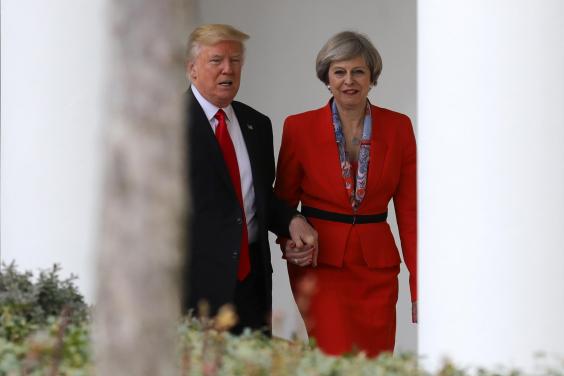
Theresa May visited Donald Trump in Washington on Friday(Getty Images)
The Prime Minister first announced last week, during her visit to Washington, that Mr Trump had accepted an invitation from the Queen to visit the UK later this year.
Theresa May refused three times during her trip to condemn Mr Trump’s controversial immigration policy, which bans people from seven Muslim-majority countries from entering the US.
One of Ms May’s own MPs, Nadhim Zahawi, said the ban would stop him entering the country. He said he felt demeaned by the policy, adding: “For the first time in my life last night I felt discriminated against.” I The petition was launched as Labour leader Jeremy Corbyn called for Mr Trump’s state visit to be put on hold for as long as the immigration ban is in place.
Just before midnight on Saturday, under considerable pressure from the public, a spokesperson for Ms May released a statement opposing the ban, saying: “Immigration policy in the United States is a matter for the government of the United States, just the same as immigration policy for this country should be set by our government.
“But we do not agree with this kind of approach and it is not one we will be taking. We are studying this new executive order to see what it means and what the legal effects are, and in particular what the consequences are for UK nationals.”
Theresa May's US speech in full as Tory leader evokes spirit of Thatcher Speaking to congressmen from the Republican Party in Philadelphia, Mrs May called on the USA to renew its special relationship with the UK
Theresa May evoked the memory of Margaret Thatcher and Ronald Reagan while calling on the USA to renew its special relationship with the UK.
Speaking to congressmen from the Republican Party in Philadelphia, Mrs May said the two countries had a "responsibility" to offer leadership to the rest of the world.
And she signalled support for some of Donald Trump's key foreign policy priorities, condemning the "malign influence" of Iran, vowing to fight the Daesh terror group and promising to "stand up" for the security of Israel.
Here's the transcript of the speech in full...
Theresa May speaks at the Republican congress in Philadelphia (Photo: Getty)
She will on Friday become the first world leader to meet he new President (Photo: Getty)
Thank you very much for that fantastic welcome.
Majority Leader McConnell, Mr Speaker, Distinguished Members of the Senate and Representatives of the House.
I would like to thank Congress and the Congressional Institute for the invitation to be here today.
The opportunity to visit the United States is always special. And to be invited to be the first serving Head of Government to address this important conference is an honour indeed.
I defy any person to travel to this great country at any time and not to be inspired by its promise and its example.
For more than two centuries, the very idea of America – drawn from history and given written form in a small hall not far from here – has lit up the world.
That idea – that all are created equal and that all are born free – has never been surpassed in the long history of political thought.
And it is here – on the streets and in the halls of this great city of Philadelphia – that the founding fathers first set it down, that the textbook of freedom was written, and that this great nation that grew “from sea to shining sea” was born.
Since that day, it has been America’s destiny to bear the leadership of the free world and to carry that heavy responsibility on its shoulders.
But my country, the United Kingdom of Great Britain and Northern Ireland, has been proud to share that burden and to walk alongside you at every stage.
For the past century, Britain and America – and the unique and special relationship that exists between us – have taken the idea conceived by those “fifty-six rank-and-file, ordinary citizens”, as President Reagan called them, forward.
And because we have done so, time and again it is the relationship between us that has defined the modern world.
One hundred years ago this April, it was your intervention in the First World War that helped Britain, France, our friends in the Commonwealth and other allies to maintain freedom in Europe.
A little more than seventy-five years ago, you responded to the Japanese attack on Pearl Harbour by joining Britain in the Second World War and defeating fascism not just in the Pacific but in Africa and Europe too.
And later, in the aftermath of these wars, our two countries led the West through the Cold War, confronting communism and ultimately defeating it not just through military might, but by winning the war of ideas. And by proving that open, liberal, democratic societies will always defeat those that are closed, coercive and cruel.
But the leadership provided by our two countries through the Special Relationship has done more than win wars and overcome adversity. It made the modern world.
The institutions upon which that world relies were so often conceived or inspired by our two nations working together.
The United Nations – in need of reform, but vital still – has its foundations in the Special Relationship, from the original Declaration of St James’ Palace to the Declaration by United Nations, signed in Washington, and drafted themselves by Winston Churchill and President Franklin D. Roosevelt.
The World Bank and International Monetary Fund, born in the post-war world at Bretton Woods, were conceived by our two nations working together.
And NATO – the cornerstone of the West’s defence – was established on the bonds of trust and mutual interests that exist between us.
Some of these organisations are in need of reform and renewal to make them relevant to our needs today. But we should be proud of the role our two nations – working in partnership – played in bringing them into being, and in bringing peace and prosperity to billions of people as a result.
Because it is through our actions over many years, working together to defeat evil or to open up the world, that we have been able to fulfil the promise of those who first spoke of the special nature of the relationship between us. The promise of freedom, liberty and the rights of man.
“We must never cease”, Churchill said, “to proclaim in fearless tones the great principles of freedom and the rights of man which are the joint inheritance of the English-speaking world and which through Magna Carta, the Bill of Rights, the Habeas Corpus, trial by jury, and the English common law, find their most famous expression in the American Declaration of Independence”.
So it is my honour and privilege to stand before you today in this great city of Philadelphia to proclaim them again, to join hands as we pick up that mantle of leadership once more, to renew our Special Relationship and to recommit ourselves to the responsibility of leadership in the modern world.
CHANGE IN AMERICA
And it is my honour and privilege to do so at this time, as dawn breaks on a new era of American renewal.
CHANGE IN BRITAIN
And a newly emboldened, confident America is good for the world.
An America that is strong and prosperous at home is a nation that can lead abroad. But you cannot – and should not – do so alone. You have said that it is time for others to step up. And I agree.
Sovereign countries cannot outsource their security and prosperity to America. And they should not undermine the alliances that keep us strong by failing to step up and play their part.
This is something Britain has always understood. It is why Britain is the only country in the G20 – other than yours – to meet its commitment to spend 2% of GDP on defence, and to invest 20% of that in upgrading equipment.
It is why Britain is the only country in the G20 to spend 0.7% of gross national income on overseas development.
It is why my first act as Prime Minister last year was to lead the debate in Parliament that ensured the renewal of Britain’s independent nuclear deterrent. And it is why the Government I lead will increase spending on defence in every year of this Parliament.
Trump has vowed to personally negotiate a trade deal with Mrs May (Photo: PA)
It is why Britain is a leading member – alongside the United States – of the coalition working successfully to defeat Daesh; why we have agreed to send 800 troops to Estonia and Poland as part of NATO’s forward presence in eastern Europe; why we are increasing our troop contribution to NATO’s Resolute Support mission that defends the Afghan government from terrorism; and it is why we are reinforcing our commitment to peacekeeping operations in Kosovo, South Sudan and Somalia.
And it is why Britain is leading the way in pioneering international efforts to crack down on modern slavery - one of the great scourges of our world - wherever it is found. I hope you will join us in that cause – and I commend Senator Corker in particular for his work in this field. It is good to have met him here today.
As Americans know, the United Kingdom is by instinct and history a great, global nation that recognises its responsibilities to the world.
And as we end our membership of the European Union – as the British people voted with determination and quiet resolve to do last year – we have the opportunity to reassert our belief in a confident, sovereign and Global Britain, ready to build relationships with old friends and new allies alike.
We will build a new partnership with our friends in Europe. We are not turning our back on them, or on the interests and the values that we share. It remains overwhelmingly in our interests – and in those of the wider world – that the EU should succeed. And for as long as we remain members we will continue to play our full part, just as we will continue to cooperate on security, foreign policy and trade once we have left.
But we have chosen a different future for our country.
A future that sees us restore our parliamentary sovereignty and national self-determination, and to become even more global and internationalist in action and in spirit.
A future that sees us take back control of the things that matter to us – things like our national borders and immigration policy, and the way we decide and interpret our own laws - so that we are able to shape a better, more prosperous future for the working men and women of Britain.
A future that sees us step up with confidence to a new, even more internationalist role, where we meet our responsibilities to our friends and allies, champion the international cooperation and partnerships that project our values around the world, and continue to act as one of the strongest and most forceful advocates for business, free markets and free trade anywhere around the globe.
This is a vision of a future that my country can unite around – and that I hope your country, as our closest friend and ally, can welcome and support.
A RENEWED SPECIAL RELATIONSHIP
So as we rediscover our confidence together – as you renew your nation just as we renew ours – we have the opportunity – indeed the responsibility – to renew the Special Relationship for this new age. We have the opportunity to lead, together, again.
Because the world is passing through a period of change – and in response to that change we can either be passive bystanders, or we can take the opportunity once more to lead. And to lead together.
I believe it is in our national interest to do so. Because the world is increasingly marked by instability and threats that risk undermining our way of life and the very things that we hold dear.
The end of the Cold War did not give rise to a New World Order. It did not herald the End of History. It did not lead to a new age of peace, prosperity and predictability in world affairs.
The UK Prime Minister spoke primarily about foreign policy (Photo: PA)
For some – the citizens of Central and Eastern Europe in particular – it brought new freedom.
But across the world, ancient ethnic, religious and national rivalries – rivalries that had been frozen through the decades of the Cold War – returned.
New enemies of the West and our values – in particular in the form of Radical Islamists – have emerged.
And countries with little tradition of democracy, liberty and human rights – notably China and Russia – have grown more assertive in world affairs.
The rise of the Asian economies – China yes, but democratic allies like India too – is hugely welcome. Billions are being lifted out of poverty and new markets for our industries are opening up.
But these events – coming as they have at the same time as the financial crisis and its fall out, as well as a loss of confidence in the West following 9/11, and difficult military interventions in Iraq and Afghanistan - have led many to fear that, in this century, we will experience the eclipse of the West.
But there is nothing inevitable about that. Other countries may grow stronger. Big, populous countries may grow richer. And as they do so, they may start to embrace more fully our values of democracy and liberty.
But even if they do not, our interests will remain. Our values will endure. And the need to defend them and project them will be as important as ever.
So we – our two countries together – have a responsibility to lead. Because when others step up as we step back, it is bad for America, for Britain and the world.
It is in our interests – those of Britain and America together – to stand strong together to defend our values, our interests and the very ideas in which we believe.
“Haven’t you ever noticed, sometimes opposites attract?” she smiled (Photo: PA)
This cannot mean a return to the failed policies of the past. The days of Britain and America intervening in sovereign countries in an attempt to remake the world in our own image are over.
But nor can we afford to stand idly by when the threat is real and when it is in our own interests to intervene. We must be strong, smart and hard-headed. And we must demonstrate the resolve necessary to stand up for our interests.
And whether it is the security of Israel in the Middle East or the Baltic states in Eastern Europe, we must always stand up for our friends and allies in democratic countries that find themselves in tough neighbourhoods too.
We each have different political traditions. We will sometimes pursue different domestic policies. And there may be occasions on which we disagree. But the common values and interests that bring us together are hugely powerful.
And – as your foremost friend and ally – we support many of the priorities your government has laid out for America’s engagement with the world.
It is why I join you in your determination to take on and defeat Daesh and the ideology of Islamist extremism that inspires them and many others terrorist groups in the world today. It is in both our national interests to do so.
This will require us to use the intelligence provided by the finest security agencies in the world. And it will require the use of military might.
But it also demands a wider effort. Because one of the lessons of fighting terrorism in the last 15 years or so is yes, killing terrorists can save innocent lives. But until we kill the idea that drives them, the ideology, we will always have to live with this threat.
And as they are defeated on the ground, the terrorists are exploiting the internet and social media to spread this ideology that is preying on vulnerable citizens in our own countries, inspiring them to commit acts of terror in our own cities.
That is why the UK has led the world in developing a strategy for preventing violent extremism, and why the British and American governments are working together to take on and defeat the ideology of Islamist Extremism.
I look forward to working with the President and his Administration to step up our efforts still further in order to defeat this evil ideology.
But of course, we should always be careful to distinguish between this extreme and hateful ideology, and the peaceful religion of Islam and the hundreds of millions of its adherents - including millions of our own citizens and those further afield who are so often the first victims of this ideology’s terror.
And nor is it enough merely to focus on violent extremism. We need to address the whole spectrum of extremism, starting with the bigotry and hatred that can so often turn to violence.
(Photo: PA)
Yet ultimately to defeat Daesh, we must employ all of the diplomatic means at our disposal. That means working internationally to secure a political solution in Syria and challenging the alliance between the Syrian regime and its backers in Tehran.
When it comes to Russia, as so often it is wise to turn to the example of President Reagan who - during his negotiations with his opposite number Mikhail Gorbachev - used to abide by the adage “trust but verify”. With President Putin, my advice is to “engage but beware”.
There is nothing inevitable about conflict between Russia and the West. And nothing unavoidable about retreating to the days of the Cold War. But we should engage with Russia from a position of strength. #
And we should build the relationships, systems and processes that make cooperation more likely than conflict – and that, particularly after the illegal annexation of Crimea, give assurance to Russia’s neighbouring states that their security is not in question.
We should not jeopardise the freedoms that President Reagan and Mrs Thatcher brought to Eastern Europe by accepting President Putin’s claim that it is now in his sphere of influence.
And progress on this issue would also help to secure another of this nation’s priorities – to reduce Iran’s malign influence in the Middle East.
This is a priority for the UK too as we support our allies in the Gulf States to push back against Iran’s aggressive efforts to build an arc of influence from Tehran through to the Mediterranean.
The nuclear deal with Iran was controversial. But it has neutralised the possibility of the Iranians acquiring nuclear weapons for more than a decade.
It has seen Iran remove 13,000 centrifuges together with associated infrastructure and eliminate its stock of 20% enriched uranium. That was vitally important for regional security.
But the agreement must now be very carefully and rigorously policed – and any breaches should be dealt with firmly and immediately.
STRONG INSTITUTIONS AND NATIONS
To deal with the threats of the modern world, we need to rebuild confidence in the institutions upon which we all rely.
In part that means multinational institutions. Because we know that so many of the threats we face today – global terrorism, climate change, organised crime, unprecedented mass movements of people – do not respect national borders.
So we must turn towards those multinational institutions like the UN and NATO that encourage international cooperation and partnership.
But those multinational institutions need to work for the countries that formed them, and to serve the needs and interests of the people of those nations.
They have no democratic mandate of their own. So I share your reform agenda and believe that, by working together, we can make those institutions more relevant and purposeful than they are today.
I call on others, therefore, to join us in that effort and to ensure they step up and contribute as they should.
That is why I have encouraged Antonio Guterres, the new UN Secretary General, to pursue an ambitious reform programme, focusing the United Nations on its core functions of peacekeeping, conflict prevention and resolution.
And it is why I have already raised with my fellow European leaders the need to deliver on their commitments to spend 2% of their GDP on defence – and 20% of their defence budgets on equipment.
It is also why I have already raised with Jens Stoltenberg – the Secretary General of NATO – the need to make sure the Alliance is as equipped to fight terrorism and cyber warfare, as it is to fight more conventional forms of war.
America’s leadership role in NATO – supported by Britain – must be the central element around which the Alliance is built.
But alongside this continued commitment, I am also clear that EU nations must similarly step up to ensure this institution that provides the cornerstone of the West’s defence continues to be as effective as it can be.
Yet the most important institution is – and should always be – the nation state. Strong nations form strong institutions.
And they form the basis of the international partnerships and cooperation that bring stability to our world.
Nations, accountable to their populations – “deriving” as the Declaration of Independence puts it “their just powers from the consent of the governed” – can choose to join international organisations, or not. They can choose to cooperate with others, or not. Choose to trade with others, or not.
Which is why if the countries of the European Union wish to integrate further, my view is that they should be free to do so. Because that is what they choose.
But Britain – as a sovereign nation with the same values but a different political and cultural history – has chosen to take a different path.
Because our history and culture is profoundly internationalist.
President Donald Trump (Photo: Getty)
We are a European country – and proud of our shared European heritage – but we are also a country that has always looked beyond Europe to the wider world.
We have ties of family, kinship and history to countries like India, Pakistan, Bangladesh, Australia, Canada, New Zealand, and countries across Africa, the Pacific and Caribbean.
And of course, we have ties of kinship, language and culture to these United States too. As Churchill put it, we “speak the same language, kneel at the same altars and, to a very large extent, pursue the same ideals”.
And, today, increasingly we have strong economic, commercial, defence and political relationships as well.
So I am delighted that the new Administration has made a trade agreement between our countries one of its earliest priorities.
A new trade deal between Britain and America must work for both sides and serve both of our national interests.
It must help to grow our respective economies and to provide the high-skilled, high-paid jobs of the future for working people across America and across the UK.
And it must work for those who have too often felt left behind by the forces of globalisation.
People, often those on modest incomes living in relatively rich countries like our own, who feel that the global system of free markets and free trade is simply not working for them in its current form.
Such a deal – allied to the reforms we are making to our own economy to ensure wealth and opportunity is spread across our land – can demonstrate to those who feel locked out and left behind that free markets, free economies and free trade can deliver the brighter future they need.
And it can maintain – indeed it can build – support for the rules-based international system on which the stability of our world continues to rely.
The UK is already America’s fifth largest export destination, while your markets account for almost a fifth of global exports from our shores.
Exports to the UK from this State of Pennsylvania alone account for more than $2 billion a year. The UK is the largest market in the EU – and the third largest market in the world – for exporters here.
America is the largest single destination for UK outward investment and the single largest investor in the UK. And your companies are investing or expanding in the UK at the rate of more than ten projects a week.
British companies employ people in every US state from Texas to Vermont. And the UK-US Defence relationship is the broadest, deepest and most advanced of any two countries, sharing military hardware and expertise.
And of course, we have recently invested in the new F-35 strike aircraft for our new aircraft carriers that will secure our naval presence – and increase our ability to project our power around the world – for years to come.
Because of these strong economic and commercial links – and our shared history and the strength of our relationship – I look forward to pursuing talks with President Trump and his new Administration about a new UK/US Free Trade Agreement in the coming months.
It will take detailed work, but we welcome your openness to those discussions and hope we can make progress so that the new, Global Britain that emerges after Brexit is even better equipped to take its place confidently in the world.
CONCLUSION
Such an agreement would see us taking that next step in the special relationship that exists between us. Cementing and affirming one of the greatest forces for progress this world has ever known.
Seventy years ago in 1946, Churchill proposed a new phase in this relationship – to win a Cold War that many had not even realised had started. He described how an iron curtain had fallen from the Baltic to the Adriatic, covering all the capitals of the ancient states of Central and Eastern Europe: Warsaw, Berlin, Prague, Vienna, Budapest, Belgrade, Sofia and Bucharest.
Today those great cities – homes of great culture and heritage – live in freedom and peace. And they do so because of the leadership of Britain and America, and of Mrs Thatcher and President Reagan.
They do so - ultimately - because our ideas will always prevail.
And they do so because, when the world demands leadership, it is this alliance of values and interests – this Special Relationship between two countries – that, to borrow the words of another great American statesman, enters the arena, with our faces marred by dust and sweat and blood, to strive valiantly and know the triumph of high achievement.
As we renew the promise of our nations to make them stronger at home – in the words of President Reagan as the “sleeping giant stirs” – so let us renew the relationship that can lead the world towards the promise of freedom and prosperity marked out in parchment by those ordinary citizens 240 years ago.
So that we may not be counted with the “cold and timid souls who know neither victory or defeat”, but with those who “strive to do the deeds” that will lead us to a better world.
That better future is within reach. Together, we can build it.
Head-to-head: How Theresa May and Andrea Leadsom compare
Theresa May is a long time friend of Zion and Judaism and spoke in the the Synagogue of Chief Rabbi Ephraim Mirvis during the Yom Haatzmaut Service in 2015.
Andrea Leadsom and Theresa May are vying to be the next Conservative leader - and the second female prime minister in British history. How do the two contenders measure up?
Image copyrightEPA/PAImage captionAndrea Leadsom, left, and Theresa May, right
Theresa May - the basics
Age: 59
Position: Home Secretary, MP for Maidenhead since 1997
Education: Grammar school, degree in Geography from Oxford University
Job before politics: Financial consultant at Bank of England
Family: Only child of a Church of England vicar. Grew up in Oxfordshire. Married for 36 years, no children.
Off-duty: Guards her personal life - and has spoken of her regret at not being able to have children. Enjoys spending time in the kitchen and claims to own 100 cookbooks, but none by Delia Smith (she is not a fan). She is a fan of cricket, however.
Full Theresa May profile
Andrea Leadsom - the basics
Age: 53
Position: Energy and climate change minister, MP for South Northamptonshire since 2010
Education: Grammar School, degree in Political Science from Warwick University
Job before politics: Banking
Family: Daughter of a builder's merchant, her mother divorced when she was four. Grew up in Kent. Married for 23 years, two sons and one daughter.
Off-duty: Charity work with organisation that helps parents bond with their babies. Committed Christian who takes part in Bible studies groups with other MPs. Watches her favourite film Four Weddings and a Funeral at least once a year. Rugby fan who supports Northampton Saints.
Full Andrea Leadsom profile
Pitch for the top job
Image copyrightAP
Theresa May: "We have immediate work to do to restore political stability and economic certainty, to bring together the Party and the country, and to negotiate a sensible and orderly departure from the European Union. But more than that, we have a mission to make Britain a country that works not for the privileged and not for the few but for every one of our citizens."
Andrea Leadsom: "I want to spread prosperity to every corner of our country. I want to help create more jobs, because we need to hear and heed those millions of our fellow citizens who feel and fear that their country's leaders are not worrying about them enough."
Where they stand on Brexit
Theresa May: Officially a Remainer, but she kept a low profile during the campaign and has now accepted the verdict of the people, saying "Brexit is Brexit".
Andrea Leadsom: A star performer for the Leave campaign during the referendum, although she appears, from comments made in 2013, to have been a recent convert to the cause.
Strengths
Theresa May: Experience. One of Britain's longest-serving home secretaries with a reputation for toughness. Proudly claims not be a member of any Westminster cliques or the privileged party elite. Not afraid to take on vested interests, such as the Police Federation.
Andrea Leadsom: Backed Brexit, like many grassroots Conservative members who will choose the next PM. Relatively humble background may work in her favour among Tory members seeking a break from Etonians. A fresh face carrying little baggage from the Conservatives' six years in government.
Weaknesses
Theresa May: On the losing side in the EU referendum, making some question whether she is the right person to negotiate Britain's exit. Her failure to curb immigration will also be used against her.
Andrea Leadsom: Lack of experience in government - she has never been a cabinet minister - although supporters say she has real world experience. She has also faced questions over whether her banking career was as stellar as initially claimed. Her business and tax affairs have also faced press scrutiny.
What kind of prime minister would they be?
Image copyrightGETTY IMAGES
Theresa May: May was one of the modernising forces during the Conservatives' wilderness years, famously telling Tory activists they were seen as the "nasty" party over their perceived intolerance of minorities. Backed same sex marriage. After six years as Home Secretary the view is that she would be a serious, sober presence in Number 10, not springing too many surprises and adopting a strong - critics might say authoritarian - line on law and order.
Andrea Leadsom: We still have more to learn about her style of leadership, but she is known to be more socially conservative than May - has said she supports gay marriage but "does not like" gay marriage laws - but is equally determined to reach out to neglected voters in unfashionable parts of Britain. Is passionate about her belief in the power of early years intervention to cure society's ills. There might be a hint of Thatcher in her approach - she has been hailed as a "Thatcherite figure" by Tory grandee Lord Tebbit.
The Thatcher factor
Image copyrightPA
Every Tory leader since Margaret Thatcher, who was prime minister for 11 years, has been measured against the Iron Lady by Tory activists and often found wanting. The comparison is even harder to avoid with two women vying to follow in her footsteps.
Theresa May: Has spoken of her admiration for Margaret Thatcher but claims not to have a role model in politics, preferring to forge her own path. Was described by former cabinet colleague Ken Clarke, in candid remarks recorded without his knowledge, as a "bloody difficult woman," although nothing compared to his former boss Thatcher. Mrs May appears to have taken it as a compliment, saying she would be "bloody difficult" with EU bosses in the Brexit negotiations.
Andrea Leadsom: Has said she aspires to emulate her political heroine Margaret Thatcher by combining toughness with "personal warmth". "As a person, she was always kind and courteous and as a leader she was steely and determined," shetold The Daily Telegraph. The same age as Thatcher when she became prime minister.
Their other halves
Theresa May: Philip May, a pension fund manager she met at university, where, according to The Guardian, they were introduced to each other by Benazir Bhutto, who would later become the prime minister of Pakistan, at a Conservative Association dance.
Andrea Leadsom: Ben Leadsom, an investment banker and former director of a company that designed software algorithms for hedge funds, who reportedly donated £10,000 to his wife's election campaign.
What others say
"I know that Theresa has the qualities and the character to take our country forward and, with her quietly determined, down-to-earth style, to re-unite us after the referendum, behind a plan to address the deep divisions in our society that it has exposed," Foreign Secretary Philip Hammond.
"Andrea Leadsom has that rare combination of deep compassion for those less fortunate than herself coupled with real world experience which has given her enormous ability to make clear and informed decisions when needed," former work and pensions secretary Iain Duncan Smith.

 Theresa May speaks at the Republican congress in Philadelphia (Photo: Getty)
 She will on Friday become the first world leader to meet he new President (Photo: Getty)
 Trump has vowed to personally negotiate a trade deal with Mrs May (Photo: PA)
 The UK Prime Minister spoke primarily about foreign policy (Photo: PA)

 (Photo: PA)
 President Donald Trump (Photo: Getty)


