Saturday, February 4, 2017

#OyVeyDonaldTrump who made more than a TrumpTower full of Benjamin Franklins in the Great Recession of 2008 vows to Dismantle al the Dodd-Franl Legislation to prevent a repetition of the gross negligence of Finaciancila Institutions & limit questionable financial derivatives and other instruments that triggered the Recession..

Image result for Cartoon Donald Trump Financial Regulations cartoon Dodd Frank
Great Seal of the United States
Long title
an Act to promote the financial stability of the United States by improving accountability and transparency in the financial system, to end "too big to fail", to protect the American taxpayer by ending bailouts, to protect consumers from abusive financial services practices, and for other purposes.
Nicknames
Dodd–Frank
Enacted by
Effective
July 21, 2010
Citations
Public law
124 Stat. 1376–2223
Codification
Acts amended
  • Introduced in the House as "The Wall Street Reform and Consumer Protection Act of 2009" (H.R. 4173) byBarney Frank (DMA) on December 2, 2009
  • Committee consideration by Financial Services
  • Passed the House on December 11, 2009 (223–202)
  • Passed the Senate with amendment on May 20, 2010 (59–39)
  • Reported by the joint conference committee on June 29, 2010; agreed to by the House on June 30, 2010 (237–192) and by the Senate on July 15, 2010 (60–39)
  • Signed into law by President Barack Obama on July 21, 2010


President Trump signed an executive order on Monday requiring that with every new federal regulation proposed, two must be revoked. By REUTERS. Photo by Stephen Crowley/The New York Times. 

WASHINGTON — President Trump on Monday reiterated his intention to roll back Dodd-Frank financial regulations enacted to prevent another financial crisis, telling reporters that he soon planned to do “a big number” on the 2010 law.

During the 2016 campaign, Mr. Trump had pledged to “dismantle” Dodd-Frank, passed when Democrats controlled the White House and Congress, without specifying the actions he planned to take. He has not announced his timetable for carrying through on that pledge as president.

Mr. Trump’s pick for secretary of the Treasury, Stephen T. Mnuchin, a hedge fund manager, also has promised to “kill” parts of the law, including the so-called Volcker rule restricting banks from making certain kinds of speculative investments of the kind that led to the 2008-9 global economic crisis.

“Dodd-Frank is a disaster,” the president said during a 10-minute session with reporters as he signed an executive order slashing government regulations.

“We’re going to be doing a big number on Dodd-Frank,” Mr. Trump said. “The American dream is back.”

Before meeting with business leaders late Monday morning, Mr. Trump again took credit for the performance of the stock market, which recently crossed the 20,000 milestone for the first time.

Perhaps the most important section of Dodd-Frank is the requirement that banks undergo periodic stress tests to monitor liquidity and their ability to withstand a financial shock akin to the collapse of the housing market in 2008.

In response to the law, banks have curbed parts of their businesses, including proprietary trading, and focused more on raising revenue through consumer services.

The financial services industry spent millions seeking to prevent Dodd-Frank from going into effect, but some in the industry have cautioned against creating new upheaval by scrapping it completely.

“We’re not asking for wholesale throwing out Dodd-Frank,” Jamie Dimon, the chief executive of J.P. Morgan Chase, said at a financial services conference in December.

The executive order that Mr. Trump signed on Monday requires federal agencies to identify two regulations they plan to cut whenever requesting a new one — a requirement that opponents have called arbitrary, but one that fulfills an early campaign pledge.

American and Israeli Jews .... Twins? Foes? Bickering first cousins fighting over the family heritage ,responsibility and leadership throne?

Image result for American Jews vs Israeli Jews Cartoon
American and Israeli Jews: Twin Portraits From Pew Research Center Surveys

If you are Jewish, odds are that you live in Israel or the United States. Four out of every five Jews in the world live in these two countries, with approximately 6 million Jews in each.

Differing perspectives

Pew Research Center has surveyed Jewish adults in both places, and has found deep bonds between them. Nevertheless, their experiences and perspectives are very different. For instance, we asked Jews in Israel to describe, in their own words, the biggest long-term problem facing their country. They were as likely to cite economic concerns (such as Israel’s high cost of living, or a shortage of affordable housing in Tel Aviv and other cities) as they were to mention military or national security issues (such as terror attacks or Iran’s nuclear program).
In many respects, Israel is a red state and American Jews are a blue country. —

Yet when American Jews were asked to name Israel’s biggest long-term problem, fully two-thirds cited a military or security issue, and hardly any (1%) mentioned economic difficulties – which suggests that many Jews in the United States either don’t know much about Israelis’ day-to-day economic challenges or don’t worry much about them.

Israeli Jews aren’t simply Pollyannaish about their security problems. In fact, Jews in Israel are much less optimistic than Jews in the United States about the prospects for a two-state solution to the Israeli-Palestinian conflict. Fewer than half of Israeli Jews (43%) polled in 2014 and 2015 said they believe “a way can be found for Israel and an independent Palestinian state to coexist peacefully with each other,” compared with a clear majority of American Jews (61%) polled on the same question in 2013.
Like Jews in the United States, Jews in Israel are deeply divided over settlement construction in the West Bank, which Palestinians view as an obstacle to peace. Overall, however, Israeli Jews lean toward the position that settlements help Israel’s security, while a plurality of American Jews think settlements hurt Israel’s own security. Younger American Jews are especially likely to question whether Israel’s government is sincerely seeking peace and to say the United States gives “too much” support to Israel, leading some commentators to suggest that the two Jewish communities may be drifting apart.

“Israelis live in the least hospitable region on the planet, not only for Jews, for everybody. And American Jews live in the most welcoming society, the most hospitable society that Jews have ever known in 4,000 years.”

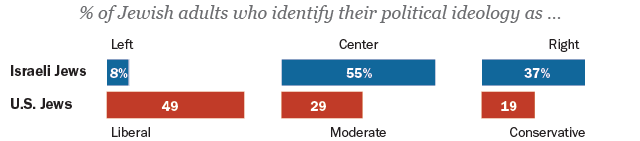
Clearly, Jews face a different constellation of political and economic issues in Israel than they do in the United States. But it’s interesting to note that on the Israeli political spectrum, most Jews place themselves in the center or on the right, while on the American spectrum, most Jews identify with the center or the political left.


Minority and majority

These broad ideological differences may be connected to the very different social contexts in which Israeli and U.S. Jews live. American Jews are a highly educated and, on the whole, warmly regarded religious minority in a very large, Christian-majority country. Jews represent about 2% of the U.S. adult population of roughly 300 million people. Only about one-third of American Jews say that either “all” (5%) or “most” (27%) of their close friends are Jewish. A substantial proportion (44%) of U.S. Jews who are married say their spouse is not Jewish – including a majority of those who have gotten married since 2000.
GIFGIF


By contrast, Jews make up about 80% of Israel’s adult population of 8 million. The vast majority of Israeli Jews say that either all (67%) or most (31%) of their close friends are Jewish, and nearly all married Jews in Israel have Jewish spouses. There’s also very little conversion between major religious groups in Israel, while in the United States, religious switching is remarkably common, including many U.S. adults who have drifted away from organized religion altogether. In our 2013 survey, one out of every five Jewish Americans said they do not identify with any religion, even though they also said they had at least one Jewish parent or were raised Jewish, and they consider themselves Jewish in other ways aside from religion (such as culturally or ethnically). In Israel, by contrast, nearly all Jews say their religion is Judaism.

“American Jews like to think of Israel as an extension of themselves. They think, ‘I’m an American Jew, they’re Jews, they’re just like me.’ But … Jews are living in two worlds.”
Jewish identity in Israel

Of course, not all Israeli Jews are religiously observant. Nor are they unchanging in their religious identity. Indeed, there is a fair amount of movement among different categories of Jews in Israel.

Some Israeli Jews are raised in a largely secular environment but choose to follow Jewish religious law (halakha) later in life. Such a person is known in Hebrew as a “baal teshuva,” or “one who returns.” But more Israeli Jews move in the other direction: They were raised in religious families but embrace a more secular lifestyle as adults. They are sometimes called “datlash,” short for “dati le’she’avar” (which translates as “formerly religious”).

Most American Jews are part of organized Jewish denominations or “streams,” which include the relatively large Reform and Conservative movements as well as Orthodox Judaism. In Israel, only about 5% of Jews identify as either Reform or Conservative. Instead, Jews in Israel generally place themselves into one of four informal categories of Jewish religious identity. These labels – Haredi (ultra-Orthodox), Dati (religious), Masorti (traditional) and Hiloni (secular) – are not connected to formal Jewish organizations or denominations, but instead are loose identity groups (similar, for example, to an American Christian calling herself an “evangelical” rather than a “Southern Baptist”).
“I was dumbfounded because I just learned in history of the American Jews that they have Orthodox, Conservative, Reform, but I never saw anything like it and I felt like it came out of the book.”

Four Israelis on what being Jewish means to them


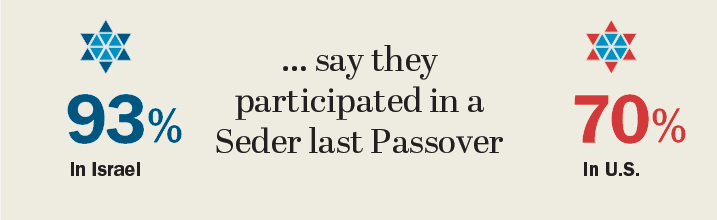
Self-described secular Jews, or Hilonim, make up about half of all Israeli Jews. Many are indeed firmly secular – a majority of Hilonim say they never pray or go to synagogue, and 44% say they do not believe in God. But, nonetheless, many Hilonim take part in Jewish rituals that are now deeply embedded in Israeli culture. For instance, nearly nine-in-ten (87%) say they attended or held a Seder last Passover. About a third of Israeli secular Jews say they keep kosher at home, and a similar share (30%) fasted all day last Yom Kippur.

Here [in Israel] it was very, you know, it was a dichotomy – either you’re observant or you’re secular.

Masortim (traditional Jews) are, religiously speaking, the middle ground of Israeli society – on average, they are not as observant of Jewish law as Orthodox Jews, but they are not as secular as Hilonim. They also appear to be shrinking as a share of Israeli Jews, which suggests some religious polarization may be taking place over time (meaning people are more clustered at each end of the religious spectrum, with fewer in the middle).

In America, I just felt that Judaism was, you know, people were living their life and then there was a little bit of Jewish interest, and that was not a total interest.— SHULA

Two categories of Israeli Jews are what Americans might think of as Orthodox: Datiim are similar in some ways to Modern Orthodox Jews in the United States. They are highly observant of Jewish law but also strongly integrated into Israeli society (for instance, by serving in the Israeli military). Many – though by no means all – Datiim describe themselves as “religious Zionists” and hold political views that entwine religious identity and nationalism. Datiim are more likely than any other religious group in Israel to identify with the political right, to favor Jewish settlements in the West Bank and to say Arabs should be expelled or transferred from Israel.

Haredim (sometimes called ultra-Orthodox Jews) are much less integrated into Israel’s broader society than are Datiim. Most do not serve in the Israeli military, and many Haredi men remain outside the workforce, instead receiving some form of subsidy from the government for religious study. Politically, Haredim have been focused primarily on the economic well-being and religious concerns of their community. Due to very high fertility rates – 28% of Haredim ages 40 and older report having had seven or more children – they are growing as a percentage of Israeli Jews and changing the dynamics of Israeli Jewish society in the process. For instance, non-Haredi Israeli politicians have proposed drafting Haredim into the military and reducing some government subsidies for Haredim as the group grows.

“In the Haredi community in general, we stick with our own. We stick with our people, the ones that are similar to you. Those are the ones you marry. Those are the ones you stay around and those are the ones your kids go to school with.”

Together, Haredim and Datiim make up 22% of Israeli Jews – more than double the share of U.S. Jews who identify as Orthodox (10%). This is one reason Jews in Israel are, on average, more religious than American Jews.

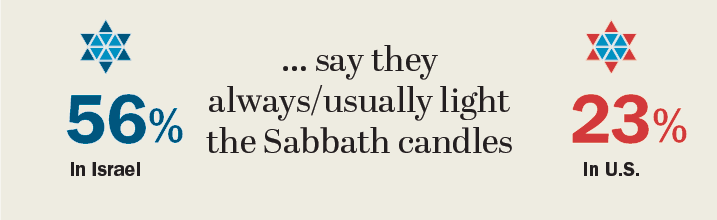
But it is not the only reason; non-Orthodox Jews in Israel also are more likely than non-Orthodox Jews in the U.S. to keep kosher dietary laws, observe the Sabbath and fast on Yom Kippur, to name just a few traditional practices. One possible explanation: Jewish observance is more ingrained in daily life in Israel than it is in the U.S. For example, many Israeli businesses close early on Friday afternoon before the start of the Sabbath. Kosher food is more widely available than it is in the U.S., and major Jewish holidays are Israeli national holidays.

% of Jews in each country who❬


And although Israeli Jews are – on the whole – more religious than American Jews, that’s not the whole story. Because 22% of Israeli Jews are Orthodox and an even larger number are secular, Israel has a more religiously polarized Jewish public than America does.


If you ask me whether Israeli Jews are more religious than American Jews or less religious than American Jews, the answer is: ‘Yes.’

For example, while there are more Israeli Jews than American Jews who attend synagogue weekly (27% vs 11%), there also are more Israeli Jews than American Jews who never attend synagogue (33% vs. 22%). A substantial proportion of American Jews (35%) say they go to synagogue “a few times a year,” such as for the High Holidays, while just 14% of Israeli Jews describe themselves as attending synagogue in such a regular, yet infrequent, way.

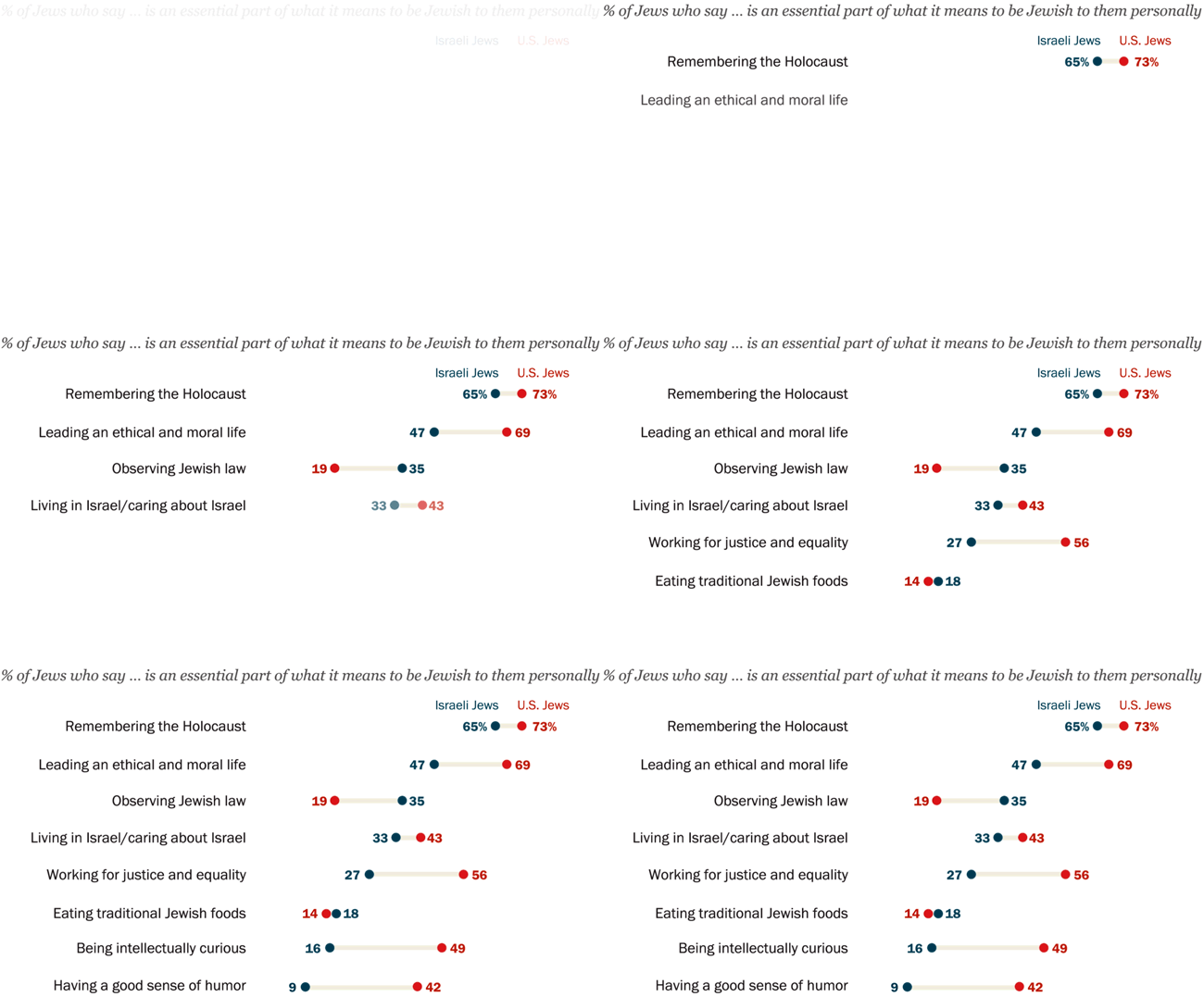
Jews in the U.S. and Israel also differ on what “being Jewish” means to them, personally. While both groups largely agree that remembering the Holocaust is vital to their Jewish identity, Americans are far more likely than Israelis to say that pursuing ethics, morality and justice in society, as well as displaying “intellectual curiosity” and having a “good sense of humor,” are essential to what being Jewish means to them. Israeli Jews, meanwhile, more commonly highlight observance of Jewish law and a connection to Jewish history, culture or community.


“American Jewish critics of Israel, they’ll say, ‘That’s not … how could Israel have done this, that’s not Jewish?’ I’m thinking, ‘Well, not Jewish for who?’”

Drawing together

For two populations that live an ocean apart – both literally and metaphorically – Israeli Jews and American Jews remain remarkably close in other ways. About four-in-ten American Jews have traveled to Israel at least once (many have done so more than once), and a similar share of Israeli Jews have visited the United States.

The affinity between the two groups is definitely there, and it’s quite strong.—

Jewish Americans feel a strong emotional connection with the Jewish state: A solid majority say they are either “very” or “somewhat” attached to Israel and that caring about Israel is either “essential” or “important” to what being Jewish means to them. The connection is felt both ways: Most Israeli Jews say Jewish Americans have a good impact on the way things are going in Israel. In addition, most Israeli Jews say that a thriving diaspora is vital to the long-term survival of the Jewish people and that Jews in the two countries share a “common destiny.”


Jews are a people who often look back and feel pride in a long, resilient history. When Jews in both Israel and the United States look ahead, many see their counterparts in the other country – despite all their differences – as fellow passengers on the same journey.

#OyVeyDonaldTrump Terroris unde venis qui operatur in Americam? From Where do The Terrorists who have commits acts in America Come From


An ISIS billboard in Raqqa, SyriaNour Fourat / Reuters

This weekend, Rudy Giuliani went on Fox News to explain why Donald Trump’s decision to bar Syrian refugees from U.S. shores and suspend visas for citizens of seven Muslim-majority countries did not amount to a Muslim ban. “What we did was, we focused on, instead of religion, danger,” the former New York City mayor said, in reference to the targeted nations: Iran, Iraq, Libya, Somalia, Sudan, Syria, and Yemen. “Which is a factual basis, not a religious basis. … It’s based on places where there are substantial evidence that people are sending terrorists into our country.”

But Trump’s policy does not have the factual basis that Giuliani claims. The data on terrorism in the United States consistently indicates that the threat largely lies elsewhere.

ISIS does control territory in Syria, Iraq, and Libya, while al-Qaeda has a major presence in Yemen and the terrorist group al-Shabab is based in Somalia. The U.S. State Department alleges that the governments of Iran, Sudan, and Syria support international terrorism. The Trump administration also selected these countries because the Obama administration and Congress had previously designated them as places people couldn’t visit if they planned to participate in the U.S. visa-waiver program.

In addition, people from the countries in Trump’s crosshairs have certainly committed acts of terrorism in the United States; a Somali refugee injured several people in an attack at Ohio State University just this fall. Asylum-seekers have also recently been implicated in terrorist plots in Europe.

But after sifting through databases, media reports, court documents, and other sources, Alex Nowrasteh, an immigration expert at the libertarian Cato Institute, has arrived at a striking finding: Nationals of the seven countries singled out by Trump have killed zero people in terrorist attacks on U.S. soil between 1975 and 2015.

Zero.

Six Iranians, six Sudanese, two Somalis, two Iraqis, and one Yemeni have been convicted of attempting or executing terrorist attacks on U.S. soil during that time period, according to Nowrasteh’s research. (Nowrasteh focused on plots against the U.S. homeland, which presumably Trump cares most about, rather than other terrorism-related offenses, like supporting a foreign terrorist group or trying to join a jihadist organization overseas.) Zero Libyans and zero Syrians have been convicted of doing the same. “Foreign-born terrorism is a hazard,” Nowrasteh argues, “but it is manageable given the huge economic benefits of immigration and the small costs of terrorism.”

As for refugees, Nowrasteh writes, Trump’s action “is a response to a phantom menace.” Over the last four decades, 20 out of 3.25 million refugees welcomed to the United States have been convicted of attempting or committing terrorism on U.S. soil, and only three Americans have been killed in attacks committed by refugees—all by Cuban refugees in the 1970s.

Zero Americans have been killed by Syrian refugees in a terrorist attack in the United States.

Between 1975 and 2015, the “annual chance of being murdered by somebody other than a foreign-born terrorist was 252.9 times greater than the chance of dying in a terrorist attack committed by a foreign-born terrorist,” according to Nowrasteh.

Nowrasteh has listed foreign-born individuals who committed or were convicted of attempting to commit a terrorist attack on U.S. soil by their country of origin and the number of people they killed. As in any exercise like this, the statistics are rough and directional rather than precise. For example, the San Bernardino attacker Tashfeen Malik, who was born in Pakistan but lived in Saudi Arabia most of her life, is counted as originating from Saudi Arabia. In the case of attacks perpetrated by multiple terrorists, like 9/11, each terrorist is assigned an equal number of victims.

Still, it’s worth noting that the countries at the top of the list, including Saudi Arabia and Egypt, are not included in Trump’s ban. I’ve bolded the countries included in Trump’s executive order.

The 9/11 attacks were carried out by 19 men—from Saudi Arabia (15), the United Arab Emirates (2), Egypt (1), and Lebanon (1). The incident remains influential in how Americans think about the nature of terrorism; Trump’s executive order cites 9/11 as a prime example of the U.S. visa process catastrophically breaking down. But it’s misleading as a guide to where today’s terrorists come from.

Nowrasteh found that foreign-born terrorists who entered the country, either as immigrants or tourists, were involved in 3,024 of the 3,432 murders caused by terrorists on U.S. soil from 1975 through 2015. But 2,983 of those murders came on 9/11 alone.Alex Nowrasteh / Cato Institute

The stereotype of the foreign terrorist infiltrator is outdated, according to the New America think tank. The organization has compiled its own data on patterns of terrorism in the United States, which unlike Cato’s focuses on jihadist terrorism in the country following 9/11. The dataset includes people charged with terrorism-related crimes, not just those convicted, as well as U.S. citizens and residents rather than solely foreigners.

“[E]very jihadist who conducted a lethal attack inside the United States since 9/11 was a citizen or legal resident,” New America reports. During that time period, more than 80 percent of individuals who were charged with or died engaging in jihadist terrorism or related activities inside the United States have been U.S. citizens or permanent residents (the tally also includes Americans accused of engaging in such activity abroad). Many have been second-generation immigrants: The Orlando nightclub attacker, for instance, was a U.S. citizen and son of Afghan immigrants. One of the San Bernardino shooters was a U.S. citizen and son of Pakistani immigrants; the other, Tashfeen Malik, was a Pakistani national and conditional U.S. permanent resident who came to the United States on a fiancee visa.

New America

As Jane Holl Lute, the former deputy secretary of the U.S. Department of Homeland Security, said at the Aspen Ideas Festival last year, “What’s been our theory of the case for 12 or 15 years following 9/11? Our theory of the case is the bad guys are out there, trying to come here. … What if [the bad guys are] already here?”

The 9/11 attackers entered the United States using various types of visas. But between then and 2015, “among attackers claiming or appearing to be motivated by extremist Islam, only one would have needed a visa to enter the United States at the time of the attack,” according to yet another tally, by The New York Times. Half of the prominent jihadist attacks analyzed by the Times were carried out by men born in the United States. “Security experts argue that the risks of routine travel—including the U.S. visa waiver program, which allows citizens of Britain, France, Belgium and 35 other countries to enter the United States without a visa for stays of up to 90 days—are greater than the threat of foreign terrorists coming through the refugee program,” the paper added.

Trump is understandably focused on the threat from ISIS. But here, too, the statistics don’t align with Trump policy. Since 2014, the majority of individuals charged in the United States with ISIS-related offenses have been U.S. citizens (58 percent) or permanent residents (6 percent), according to George Washington University’s Program on Extremism. Additionally, more ISIS fighters in Iraq and Syria appear to come from Saudi Arabia, Tunisia, Morocco, Turkey, Russia, Egypt, and China than any countries included in Trump’s ban.

One could argue that America hasn’t experienced high levels of terrorism by foreign-born individuals precisely because, well before Trump, the U.S. government was limiting immigration from countries afflicted by terrorism, and subjecting the modest number of refugees it accepted to more rigorous vetting than any other type of traveler to the United States. As my colleague Graeme Wood has written, “If the Islamic State intends to kill Americans by sending an Iraqi or Syrian to get a visa, they are doing it the hard way. Most of the attackers will blow themselves up out of frustration with the American immigration bureaucracy before they can ever reach American shores to blow themselves up near their intended targets.”

But even if that’s the case, it still doesn’t explain why the Trump administration would suddenly block all refugees and citizens of entire countries, as if it were confronting Syrian refugees and Iraqi immigrants pouring across America’s borders to commit terrorism. Like his border wall, which will be erected to stop a mass Mexican migration that no longer exists, Trump’s immigration ban is a solution that misdiagnoses the actual problem.

As Nowrasteh notes, future terrorists could very well come from different countries than terrorists have in the past. Judged by the evidence to date, however, Trump’s ban “will likely stop few terrorists, prevent zero deaths, and slightly reduce immigration and tourism. All minor economic pain, no gain.”

#OyVeyDonaldTrump Versus Governement Produced Statistics.... niggle , wiggle and ...... well #GodSaveUSFromDonaldTrump' Irrationality r( again)


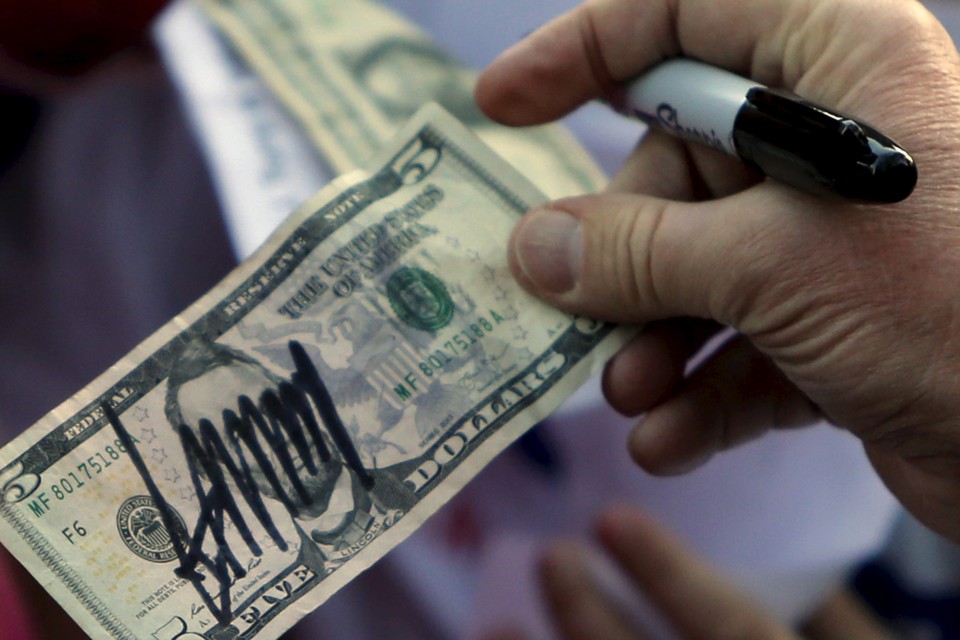
Donald Trump gives a signed five-dollar bill back to an attendee of one of his campaign rallies.Jonathan Ernst / Reuters

On the evening of September 1, 2011, I had the unpleasant task of delivering the confidential August jobs report to President Obama before it would be made public the next day. “I don’t like the look on your face,” I remember the president saying to me in the Oval Office.

“The job number is zero,” I said.

“Zero?” he asked. “What do you mean, ‘zero’?”

“The payroll jobs data is zero,” I replied.

Incredulous, the president asked, “You mean it is exactly zero? Like, if I took that paper out of your hand and looked at it, I would just see a zero?”

“Yes,” I replied with a wince.

“Has that ever happened before?” he asked.

“I don’t think so, sir,” I replied.

This was obviously not happy news. After he’d helped pass a payroll-tax cut and an extension of unemployment benefits near the end of 2010, the economy was projected to grow more than 3 percent in 2011. But after chaotic global events such as the Arab Spring and the Fukushima nuclear meltdown, as well as the self-inflicted wound of the debt-limit crisis, the economy had once again weakened. And politically, the president knew that “zero” would be easy partisan fodder. Sure enough, when the official numbers were released the next morning, it took the Republican National Committee only 94 minutes to coin and publicize the nickname “President Zero.” Commemorative buttons soon followed.


The irony? When the revisions came in two months later, it turned out the economy had actually seen the addition of 107,000 jobs in August 2011—not spectacular, but not the disaster it appeared to us that evening, and to everyone else the following morning. This was hardly an isolated occurrence. In 2010, the job numbers were revised up in 11 out of 12 months, with the more-impressive revisions never getting the attention received by the less-impressive initial announcements, which clearly hurt Obama politically. Yet, however negative or seemingly unfair this trend was, there was one thing neither the president nor anyone on his team would consider doing: attacking the credibility of the workers at the Bureau of Labor Statistics (BLS). The same went for those at other agencies, such as at the Bureau of Economic Analysis, that are responsible for compiling and announcing America’s major economic indicators.

For every administration in the past four decades, any public comment from the president casting doubt on the legitimacy of the government’s jobs, GDP, or health reports would have been unthinkable, for a few reasons. One, it would have been considered unfair to career civil servants to even suggest, with no evidence or proof, that they were tampering with numbers. Two, it would have hurt global confidence in the United States to even imply that anyone in the government was in any way manipulating the government’s economic reports—doing so would risk pushing the U.S.’s reputation toward that of China, whose published economic numbers aren’t widely trusted.


And additionally, every administration since 1974 had been cautious about never again allowing the type of ugly political interference that President Richard Nixon became famous for. Near the end of his first term, Nixon became convinced that the BLS’s assistant commissioner, Harold Goldstein, was not putting enough positive spin on the monthly jobs reports. Livid with Goldstein, Nixon ordered his top aides to “reorganize” BLS, demanding a count of the number of Democrats and Jews in the Bureau. He ended up demoting Goldstein, replacing him with a “politically sensitive, loyal Republican,” as well as appointing a loyalist as the new deputy commissioner overseeing all data analysis. A year later, the president and his top aides also forced the removal of the BLS’s commissioner, Geoffrey Moore, before the end of his term, which came after months of trying to re-assign him to another federal post.

Goldstein and the two more-junior career BLS employees demoted during Nixon’s crusade were Jewish, and the publication of Bob Woodward and Carl Bernstein’s 1976 book The Final Days, as well as the Nixon tapes, made clear that Nixon’s beliefs about and actions toward the BLS were motivated by paranoia and anti-semitism. “There’s a Jewish cabal, you know, running through this,” Nixon was recorded as saying, adding, “Now how the hell do you ever expect us to get anything from that [BLS] staff, the raw data, let alone what the poor guys have to say [inaudible] that isn’t gonna be loaded against us?”

The only positive legacy of this sad history is that it drove home for future administrations the importance of avoiding even the perception of political interference in the collection and production of U.S. economic numbers. In fact, following the Nixon scandal, the Office of Management and Budget issued a number of directives more strictly mandating the separation between releases of technical economic news and statements about politics and policy. Put simply, it would have been considered unthinkable in any of the post-Nixon administrations for anyone in the White House to seek to impede or publicly question the production of economic numbers.

On the eve of the release of the first jobs report during Trump’s presidency, this leads to a pressing question: Will he revive the Nixonian tradition of interfering with federal economic agencies if they announce numbers that do not please him?

Perhaps President Trump, who inherits a strong and stable economy, will be greeted by only positive economic news going forward, and will have routine cause to boast about government economic releases. And perhaps, even if economic numbers come in that do not bolster his message, he will handle it maturely, without berating government officials or trying to subvert the collection and posting of economic data.

However, with regard to the latter possibility, recent events are not encouraging. First, Trump has shown an almost compulsive unwillingness to accept any number that does not align with a combination of his self-image and gut instinct. His insistence that the crowd at his inauguration (which was estimated to number 160,000 to 250,000) was larger than that at Barack Obama’s (1.8 million)—or even the 450,000 to 500,000 who showed up for the Women’s March the next day—is the latest and most disturbing example of this behavior. It is not hard to imagine Trump refusing to accept a weak manufacturing jobs report because it contradicts his gut view that his bully-pulpit efforts to encourage domestic car production are working. Similarly, if GDP doesn’t reach his promised 4 percent growth per year, will he simply dismiss the validity of such numbers?


Second, President Trump seems not to care much for the norms dictating that presidents shouldn’t berate everyday citizens or castigate career government officials. Recent events—including the president’s personal attack on the local union head for the air-conditioning company Carrier and his phone call to the National Park Service’s acting director pressuring him to find proof that the crowd at the inauguration was larger than their photos implied—suggest a president who is not beyond intimidating anyone who does not provide him with what he wants. Similarly, in 2013, he tweeted, with no proof, that “census workers cooked the job numbers for Obama right before the election.” It is not encouraging that Trump has already imposed a ban that prevents career government officials and scientists at the Environmental Protection Agency and the Department of Agriculture from speaking to reporters or posting on social media about their work.

Third, Trump has already made a habit of trying to delegitimize the Bureau of Labor Statistics. He has made absurd economic statements, as when he argued that the “real” unemployment rate is 42 percent (at the time, it was actually 5.1 percent). More generally, he has called the BLS’s employment numbers “total fiction,” “one of the biggest hoaxes in modern American politics,” and “phony.” During a recent media briefing, his press secretary refused to answer when he was asked to simply state the unemployment rate.

While it's very unlikely that any president could succeed in getting BLS or the Census Bureau or the Centers for Medicare and Medicaid Services to actually juice up their numbers, there is certainly reason to worry that Trump, like Nixon, might bring about the demotion of officials whom he feels are not on his team and replace them with political loyalists, which itself would cast doubt on the objectivity of published statistics. Even more likely is the possibility that he would undermine the credibility of these agencies by publicly attacking their officials or telling the public to ignore their statistical findings.

Another troubling outcome would be if he sought to defund economic agencies already low on resources, or called for ending surveys in areas he didn’t think would play well to his agenda. For example, if Trump comes to fear that his eventual replacement for Obamacare will not meet his commitment to lower costs, lower deductibles, and lower premiums without hurting coverage, will he seek to simply terminate any health-care surveys that would reveal its shortcomings?

As the first few jobs reports come out, Trump will likely have no qualms about blaming Obama should they turn out to be poor, just as he would probably not hesitate to take credit for any positive numbers coming out early on in his tenure. But as later jobs reports (and any other future government findings that could displease him) are published, it will fall to Trump’s advisors and to Republican Congressional economic leaders to warn him not to politicize official economic data. If they can’t—or worse, won’t even try to—convince him, his attacks will damage global confidence in the American economy and public confidence in the rule of law.

Friday, February 3, 2017

#OyVeyDonaldTrump's Styrofoam Presidency and the Art of Kakistocracy

Image result for Donald trump Cartoon Styrofoam Presidency

KakistocracyA (English pronunciation: /kækɪsˈtɑkɹəsi/) is a state or country run by the worst, least qualified, or most unscrupulous citizens.[1][2] The word was coined by English author Thomas Love Peacock in 1829.


The word comes from the Greek words kakistos (κάκιστος; worst) and kratos (κράτος; rule), with a literal meaning of government by the worst people.[3] Despite its Greek roots, the word was first used in English, but has been adapted into other languages. Its Greek equivalent is kakistokratia (κακιστοκρατία), Spanish kakistocracia, French kakistocracie, and Russian kakistokratiya (какистократия).
The writer Andrei Sinyavsky, perhaps the first person to become known as a Soviet dissident, once quipped that his “differences with the Soviet regime were primarily aesthetic.” Buried in a dense autobiographical essay and qualified as a joke, the line nonetheless was and remains one of the most-repeated sentences among the differently minded in the Soviet Union and in Putin’s Russia. It has a way of coming to mind every time one cringes at Russia’s political spectacle—which is nearly every time one turns on the television or radio or picks up a newspaper. Whether it’s the sight of Putin entering a room like a thug who owns it, or the sound of his below-the-belt jokes, or the ritual of politicians and talking heads trying to out-scream and out-sabre-rattle one another as they engage in what passes for discussion on television—though none of them seems to be able to form a complete sentence—it has a way of making one ashamed of seeing and hearing.
More than half a century after Sinyavsky came up with the phrase, Americans who witnessed Donald Trump’s inaugural weekend can now fully grasp its meaning. Throughout the campaign, anyone who watched Trump could see that he used a different aesthetic vocabulary than any candidate in living memory: his bullying was shameless, his hatred was naked, his disregard for decency and decorum was gratuitous. He mocked a disabled reporter, he humiliated women in a wide variety of ways, and he made highly ritualized occasions such as the presidential debates and the Al Smith dinner painful to watch. Most important, he lied constantly, blatantly, and inconsistently, stripping words of their meaning. Still, hope somehow persisted that the fact of becoming president would somehow elevate Trump—as though his aesthetics were not a reflection of his entire political self but merely a style that could be dropped when the occasion demanded it. But when the inauguration came, Trump, for twenty-four hours, not only trampled on some of the most hallowed public rituals of American power; he made a spectacle of it.
He defiled the inauguration with a speech that was not only mean and meaningless but also badly written, pitched to the basest level of emotion and intelligence. “We’ve made other countries rich while the wealth, strength, and confidence of our country has disappeared over the horizon” was how he summed up the American foreign policy legacy: a zero-sum game in which a penny spent—whether on the Marshall Plan or an ill-conceived war—is a penny lost. “For too long, a small group in our nation’s capital has reaped the rewards of government while the people have born the cost” is how he summed up the work of all the men and women who have come before him, in effect the entire political history of the country, which he declared to be over: “This American carnage stops right here and stops right now.” Having dismissed the political past, he offered, by way of vision, the future of a fortress under siege: a walled country that puts itself first, the way a self-help manual might advise you to “put yourself first,” convention and consideration for others be damned.
In his small-mindedness and lack of aspiration, Trump curiously resembles Putin, though the origins of the two men’s stubborn mediocrity could not be more different. Aspiration should not be confused with ambition—both men want to be ever more powerful and wealthier, but neither wants to be or even appear better. (One way in which Putin continuously reasserts his lack of aspiration is by making crude jokes at the most inappropriate times—as when, during a joint appearance with German Chancellor Angela Merkel in 2013, he compared EU monetary policy to a wedding night: “No matter what you do, the result will be the same,” his way of lightly covering up the “you get fucked” punchline. Watch this video to see the German chancellor cringe.
Trump marked his first moments in office by wielding power vengefully: the head of the D.C. National Guard lost his job at noon, and between festivities the new president signed an executive order to begin undoing his predecessor’s singular achievement, the Affordable Care Act. He swept the White House website clean of substantive content on climate policy, civil rights, health care, and LGBT rights, took down the Spanish-language site, and added a biography of his wife that advertises her mail-order jewelry line. At the same time, as Trump moved through the day, he repeatedly turned his back on his wife. He immediately degraded the look of the oval office by hanging gold drapes.
American political pageantry is aspirational. The extended ritual of the inauguration conveys an understanding of the importance of the office of president and awe and pride in the miracle of the repeated peaceful transfer of power. The ceremony, the concert, the lunch, the parade, the balls, and more—all of this serves to create a nationwide mood of celebration and self-congratulation. It is like a giant wedding designed to make even the most curmudgeonly of relations tear up. It is a moment for all to shine—for the celebrants in their magnanimity and for the less fortunate in their own generosity. As the day progresses and the new first couple accept the honor and the responsibility bestowed on them, they transition into a different state of being: as the country watches, they acquire the quality of being presidential (which so many pundits hoped against hope Trump would suddenly display).
Trump had no use for any of it: the magnanimity, the generosity, the awe (unless it’s inspired by him personally), the pride (unless it’s his own), the aspiration. Indeed, the single quality he displayed repeatedly was his lack of aspiration. Take his speech. Better yet, take the cake. On Saturday it emerged that the inaugural-ball cake that Trump and Vice President Mike Pence cut with a sword was a knock-off of President Obama’s 2013 inaugural-ball cake. Obama’s was created by celebrity chef Duff Goldman. Trump’s was commissioned from a decidedly more modest Washington bakery than Goldman’s, and the transition-team representative who put in the order explicitly asked for an exact copy of Goldman’s design—even when the baker suggested creating a variation on the theme of Goldman’s cake. Only a small portion of Trump’s cake was edible; the rest was Styrofoam (Obama’s was cake all the way through). The cake may be the best symbol yet of the incoming administration: much of what little it brings is plagiarized, and most of it is unusable for the purpose for which presidential administrations are usually intended. Not only does it not achieve excellence: it does not even see the point of excellence.
On Saturday, Trump went to the CIA and stood in front of a wall honoring the memory of agents who died in the line of duty, failed to acknowledge the location, and lied to the faces of the people gathered, provoking an unprecedented rebuke from outgoing CIA chief John Brennan. He lied uninventively, stupidly, embarrassingly—“Trust me, I’m like a smart person,” he said. He dispatched his press secretary to do the same. Perhaps drawing on his own approach to business dealing, he recklessly said that the US should have “kept” Iraq’s oil, and left open the possibility that it might do so in the future—apparently unaware of the implications of a policy of resource plunder for US military deployments around the world. And he did all of this in language that was offensive to the mind and the ears, and in clothes offensive to the eyes. His advisers and cabinet picks sport the same aesthetics: Kellyanne Conway’s coat inspired jokes about what happens when the gays refuse to dress you, and Betsy DeVos’s subliterate tweet (about the “historical” inauguration) inspired mockery of the incoming education secretary’s ignorance—as did her performance during her Senate hearing on Tuesday.
But even as Trump was promoting his brand at the CIA, the cringeworthy spectacle of his inauguration had already given way to its aesthetic opposite: pictures of millions of determined, peaceful Americans taking part in women’s protest marches in Washington and across the country—events that brimmed with witty slogans, good cheer, and irony. Of course, the marchers’ differences with Trump are more than aesthetic: they are political and philosophical. On the other hand, Trump does not appear to have any politics or philosophy. He may be as free of content as any human being in the public eye. The aesthetics of his inauguration reflected that spectacular vacuousness.
Russian sociologist Lev Gudkov has theorized that the Soviet totalitarian system, which ruled through violence and fear, created a society in which all initiative was suppressed, personal and professional growth was all but impossible, and the entire society became stagnant. As a result, the word “elite” became a misnomer in Russian: the people with the greatest access to money and power did not perform the traditional tasks of setting priorities, tastes, and the agenda for progress. In the absence of social mobility, there was no aspiration. In addition, because there was no mechanism for transfer of power and the powerful were forever frightened of losing it, the country became a gerontocracy, but also something else too: a kakistocracy.
The rule of the worst seemed to become a thing of the past in the 1990s, but under Putin mediocrity returned with a vengeance. Not only did the media come under the control of the Kremlin but it acquired an amateurish quality. Not only did the government start lying, but did so in dull, simple, and unimaginative language. Putin’s government is filled with people who plagiarized their dissertations—as did Putin himself. The ministers are subliterate. The minister of culture, who has a doctorate in history, regularly exposes his ignorance of history; indeed, Trump might be tempted to plagiarize the minister’s dissertation, which begins with the assertion that the criterion of truth in history is determined solely by the national interests of Russia—if it’s good for the country, it must be true (much of the rest of the dissertation is itself plagiarized). Other ministers provide the differently minded Russian blogosphere with endless hours of fun because they use words the meaning of which they clearly don’t know, or ones that don’t exist—as when a newly chosen education minister invented a word that seemed to mean that she had been appointed to the cabinet by God. They also make ignorant, repressive, inhumane policy. But their daily subversion of integrity and principle is indeed aesthetic in nature. And it serves a purpose: by degrading language and discrediting the spectacle of politics the Russian government is destroying the public sphere.
Sometimes vastly different processes yield surprisingly similar results. Trump is staging an assault on America’s senses that feels familiar to me—not because he admires Putin (though he does) or because he is Putin’s puppet, but because they seem to be genuinely kindred spirits. It might take a long time to understand why we have come to enter the age of a kakistocracy, but evidently we have.

Opposing #OyVeyDonaldTrump's "America First" Policies with the Complicated Relevance of Dr. Seuss's Political Cartoons


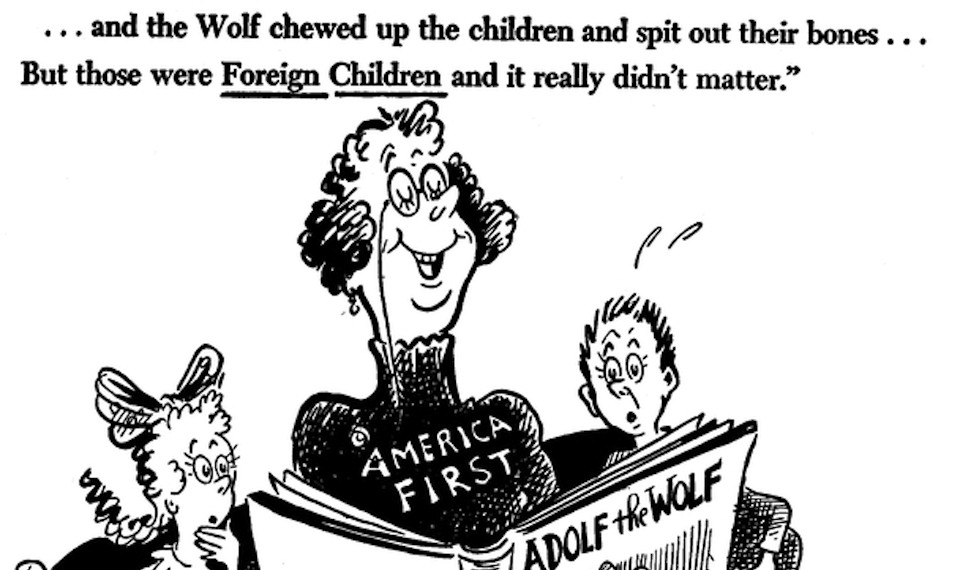
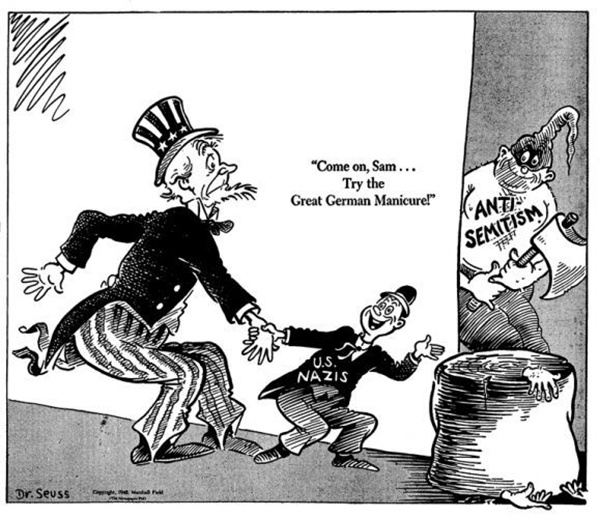
Of all the significant cultural figures finding new relevance during a turbulent news cycle, one of the more intriguing is Dr. Seuss. The German American cartoonist and author, born Theodor Seuss Geisel, is best known for his children’s books, The Cat in the Hat, The Lorax, and Horton Hears a Who among them. But for two years starting in 1941, Geisel worked as a political cartoonist for the liberal New York newspaper PM, crafting more than 400 cartoons on the subject of World War Two. One of these in particular, a drawing lampooning the non-Interventionist America First movement, has been reemerging recently amid protests against President Trump’s executive order barring immigrants and refugees from seven Muslim-majority countries.UC San Diego Library
Image result for Dr. Seuss's Political Cartoons
The cartoon, which mocks an apparent blithe naiveté about the dangers posed by Nazi Germany, as well as a callousness regarding the lives of children who aren’t American citizens, makes it a striking accompaniment to modern protests, not least of which is that Trump has named one of his own official platforms “America First.” As a collection, Geisel’s war cartoons target isolationism, anti-Semitism, and racism. They skewer Hitler, Mussolini, and a variety of American nationalists, including Charles Lindbergh and the Catholic priest and radio host Father Charles Coughlin, a fervent anti-Semite and conspiracy theorist. But they also deploy a fierce anti-authoritarianism and humanism that runs through all of Dr. Seuss’s books. Geisel’s political cartoons go a long way in demonstrating how the spirit of Seuss—zany, honest, brash, and brave—was born.

They also have their own flaws, most notably their racist portrayal of both Japanese citizens and Japanese Americans. Geisel’s bigoted treatment of both only a few months before the forced internment of Japanese Americans was something many believe he tried to atone for in his later books. But the body of work he created during the war helped establish the foundations of what the writer Philip Nel has described as “America’s first anti-Fascist children’s writer.” And it helps explain why Dr. Seuss continues to resonate now, more than 25 years after his death, and as American nationalism gains momentum once again.*
Image result for Dr. Seuss's Political Cartoons
According to Dr. Seuss Goes to War, Richard H. Minear’s 1999 book on Geisel’s editorial cartoons, PM was founded as an outspoken liberal publication, free of advertising, and funded by its five-cent purchase price. Ralph Ingersoll, its founder, described part of the paper’s mission as opposing “people who push other people around just for the fun of pushing, whether in this country or abroad.” Sometime around January 1941, Geisel drafted his first political cartoon and showed it to a friend who worked at PM, who passed it on to Ingersoll. It depicted Virginio Gayda, an Italian journalist and Fascist whom many saw as a mouthpiece for the dictator Benito Mussolini, beating furiously at the keys of a steam-emitting typewriter, all while suspended from a hook behind him. Geisel attached a note about Gayda with the cartoon that read, “Almost every day, in amongst the thousands of words that he spews forth, there are one or two sentences that, in their complete and obvious disregard of fact, epitomize the Fascist point of view.”
Image result for Dr. Seuss's Political Cartoons
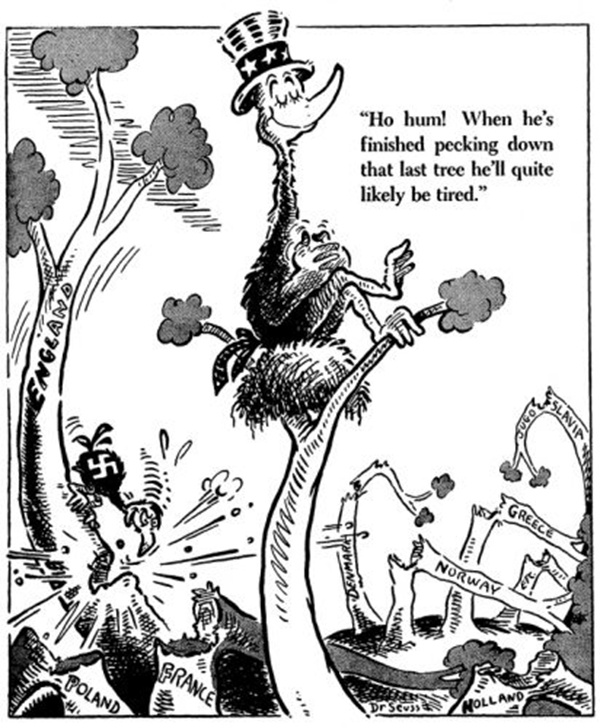
By May 1941, Geisel was publishing as many as seven cartoons a week in PM, and many of his most impassioned works came during this time, in the months leading up to the attack on Pearl Harbor. One drawing, published in April, depicted a coin featuring an ostrich burying its head in the sand, inscribed as “The Lindbergh Quarter.” Another published the next day showed Americans standing in line to purchase their own ostrich hats, guaranteed to relieve “Hitler headache.” The caption: “We always were suckers for ridiculous hats.”UC San Diego Library

Geisel’s antipathy toward anti-interventionists possibly stemmed from his German-American upbringing in Springfield, Massachusetts, and his circle of friends in New York. Minear told me that in 1976, Geisel wrote a note responding to an interview request from Dartmouth College, saying, “I believed the USA would go down the drain if we listened to the America-First-isms of Charles Lindbergh and Senators Wheeler and Nye, and the rotten rot that the Fascist priest Father Coughlin was spewing out on radio. I, probably, was intemperate in my attacks on them. But they almost disarmed this country at the time it was obviously about to be destroyed.”

Geisel took aim at Hitler and Mussolini, at Lindbergh, and particularly at America First adherents, whom he saw as turning a willful blind eye to the dangers posed by Hitler’s Fascist regime, or even directly associating themselves with Nazism. One cartoon, “The Isolationist,” even featured a limerick, accompanying a drawing of a whale suspending himself “safely” on top of a mountain, out of water, and thus out of danger. It reads, “Said a whale, ‘There is so much commotion/Such fights among fish in the ocean/I’m saving my scalp/Living high on an Alp/(Dear Lindy! He gave me the notion!)”UC San Diego LibraryUC San Diego Library

But after Pearl Harbor, Geisel’s cartoons became more overtly opposed to Japan, and more crude in style. He depicted Hideki Tojo, the Prime Minister and Supreme Military Leader of Japan, as an ugly stereotype, with squinting eyes and a sneering grin. In February 1942, he drew a long line of Japanese Americans on the Pacific Coast of the U.S. collecting blocks of TNT from a kiosk labeled “Honorable 5th Column,” with one pointing a telescope across the ocean. The caption read, “Waiting for a signal from home.”
Image result for Dr. Seuss's Political Cartoons
It’s more than a little baffling now to see Geisel, who’d railed repeatedly against racism, Jim Crow, and anti-Semitism in his cartoons, proffer up such bigoted depictions of Asians both in the U.S. and overseas. “We all have blind spots,” Minear told me. “I use that as a teaching moment—even Dr. Seuss went astray.” In his book, Minear also points out that such sentiment was common in the New York circles Geisel moved in at the time. Although there were reader complaints about drawings he made mocking dachshunds, and the pacifist John Haynes Holmes, there were no letters recorded objecting to his treatment of Asians.

Minear believes, though, that Geisel tried to make up for his earlier prejudice in later works. “Horton Hears a Who came after a trip to Japan, and is easy to read allegorically,” he told me. “The people of Whoville are Japan, Vlad Vladikoff is Russia, Horton is us/democracy, etc.” Geisel supposedly came up with the idea for Horton, in which an elephant discovers a microscopic universe, on a trip to Japan, and dedicated the 1954 book to a Japanese friend. The theme of the story, that “a person’s a person no matter how small,” seems to offer a note of contrition for jingoistic wartime expressions. In the 1980s, too, according to the writer Donald E. Pease, Geisel scanned his earlier books for racial stereotypes, and altered a reference to a “yellow-faced Chinaman who eats with sticks” in And to Think That I Saw It on Mulberry Street.

Horton isn’t the only book that echoes themes explored in Geisel’s political cartoons. Minear thinks that almost all of his later books (with the exception of the ones designed as reading aids) are political in some way or another. The Lorax is an obvious parable about environmentalism. The Sneetches and Other Stories includes an absurd fable about strange yellow creatures, half of whom have stars on their bellies and discriminate against the other half, and vice versa. The Butter Battle Book seems particularly potent today, with its tales of the Yongs and the Zooks, who live on either side of a vast wall, and hate each other because of the different ways they eat their bread and butter. The two sides create increasingly inventive and destructive weapons to fire over the wall until both come up with a device called the Bitsy Big-Boy Boomeroo, which means mutually assured destruction should it ever be fired. The book ends with a standoff, with both sides waiting to see what the other does. It’s a message to children made explicit in what Geisel wanted his last words to be, which he told his biographers, Judith and Neil Morgan, were: “We can and must do better than this!”
Related image
Then there’s Yertle the Turtle, a book of stories whose title character is the king of the pond, a ruthless authoritarian who demands that the other turtles stack themselves on top of each other so he can ascend to the top and get a better view. Yertle, who ignores the pain of his underlings, is finally bested by a burp, in a suitably absurd revolution. In the first drawing of him, Minear says, Geisel gave Yertle a Hitler mustache. But now Minear sees another figure in him. Between the narcissism nd the arrogance, he says, Yertle “is Trump 50 years ago.”
Image result for Dr. Seuss's Political Cartoons
Little surprise, then, that Geisel’s cartoons, political and non, are finding a new audience now, as protests ramp up against the 45th president, whose affects and actions are at times as recognizable and cartoonish as Dr. Seuss’s characters. It’s hard not to assume Geisel would be cheered by seeing his work inspire signs and memes and viral tweets. “Humor has a tremendous place in this sordid world,” he once said. “It’s more than just a matter of laughing. If you can see things out of whack, then you can see how they can be in whack.”