Showing posts with label Tel Aviv. Show all posts

Wednesday, July 20, 2016

Item image

FIVE UNEXPECTED BEACHES IN TEL AVIV


Frishman, Gordon AND Banana are not the only places to take a nap and accentuate your tan. A luxurious beach, sporty or nudist one; here is our selection of alternative beaches in Tel Aviv.
GAASH BEACH: THE WILDEST ONE
Article-gaash
In Gaash, there is no doubt that you either love it right away or you hate it all the way. Located a short distance north of Tel Aviv, you need to go there to understand what’s really in the air. While still very wild, it is not that easy to access but it’s worth the effort to enjoy a moment of serenity. Just a little bit of concern: we call it Paradise Beach too because it welcomes some visitors as naked as the day they are born.
GAZEBBO BEACH: THE FRENCH RIVIERA ONE
Article-gezabo
If you’re looking for quality mattresses and sophisticated food, you’re probably not thinking of going to the beach and its restaurants. Well, you might just be wrong. TheGazebbo Beach in Herzlyia is a slice of heaven. Soft lawn chairs and restaurants serving fine dishes, all of that placed on the fine sands of Israel’s Mediterranean beaches.
GIVAT ALYIA BEACH: THE PEACEFUL ONE
Article-givat
When you first look at it, it’s just a regular beach, but when you actually put its merits to the test, you understand how amazing it truly is. The future beach of the Hotel W, opening summer 2016, is a natural wonder and harbors the restaurant Cassis, a proprietor of mouth-watering dishes. But what actually gives it its charm is its closeness to the Peres Center for Peace overlooking the Mediterranean Sea.
JERUSALEM BEACH: THE ENVIRONMENTAL FRIENDLY ONE
Article-jeru
The name itself is all the appeal, emanating a symbolic aura of that of the holy city. Then we realized it was one of the few beaches in Israel that is eligible to display a Blue Flag. We now understand its success. Cleanliness, security and environmental protection might not directly impact your experience, but knowing that this is what the beach provides will make you feel more comfortable.
WEST SHORE: THE SPORTY ONE
Article-surf
Surfers personal paradise. In contrast to the other beaches in Tel Aviv, West Shore doesn’t have a breakwater, which gives the waves a unique pattern. Located between Tel Aviv and Yafo, it’s the beach to go to when the sun turns down to have a peek at the sexy surfers of Tel Aviv.
Item image

FIVE UNEXPECTED BEACHES IN TEL AVIV


Frishman, Gordon AND Banana are not the only places to take a nap and accentuate your tan. A luxurious beach, sporty or nudist one; here is our selection of alternative beaches in Tel Aviv.
GAASH BEACH: THE WILDEST ONE
Article-gaash
In Gaash, there is no doubt that you either love it right away or you hate it all the way. Located a short distance north of Tel Aviv, you need to go there to understand what’s really in the air. While still very wild, it is not that easy to access but it’s worth the effort to enjoy a moment of serenity. Just a little bit of concern: we call it Paradise Beach too because it welcomes some visitors as naked as the day they are born.
GAZEBBO BEACH: THE FRENCH RIVIERA ONE
Article-gezabo
If you’re looking for quality mattresses and sophisticated food, you’re probably not thinking of going to the beach and its restaurants. Well, you might just be wrong. TheGazebbo Beach in Herzlyia is a slice of heaven. Soft lawn chairs and restaurants serving fine dishes, all of that placed on the fine sands of Israel’s Mediterranean beaches.
GIVAT ALYIA BEACH: THE PEACEFUL ONE
Article-givat
When you first look at it, it’s just a regular beach, but when you actually put its merits to the test, you understand how amazing it truly is. The future beach of the Hotel W, opening summer 2016, is a natural wonder and harbors the restaurant Cassis, a proprietor of mouth-watering dishes. But what actually gives it its charm is its closeness to the Peres Center for Peace overlooking the Mediterranean Sea.
JERUSALEM BEACH: THE ENVIRONMENTAL FRIENDLY ONE
Article-jeru
The name itself is all the appeal, emanating a symbolic aura of that of the holy city. Then we realized it was one of the few beaches in Israel that is eligible to display a Blue Flag. We now understand its success. Cleanliness, security and environmental protection might not directly impact your experience, but knowing that this is what the beach provides will make you feel more comfortable.
WEST SHORE: THE SPORTY ONE
Article-surf
Surfers personal paradise. In contrast to the other beaches in Tel Aviv, West Shore doesn’t have a breakwater, which gives the waves a unique pattern. Located between Tel Aviv and Yafo, it’s the beach to go to when the sun turns down to have a peek at the sexy surfers of Tel Aviv.

Thursday, July 14, 2016

Get To Know Tel Aviv: Things Not To Miss In Israel's Coolest City in Zion

Get To Know Tel Aviv: Things Not To Miss In Israel's Coolest City in Zion

It’s a bold statement but someone has to make it – Tel Aviv is the destination of the year. Attracting travelers of all types – trendsetting millennials, digital nomads, seasoned travelers and even first-time adventurers – Tel Aviv is one of those places that has its own unique thing going on, yet in a totally familiar I belong here kind of way. That’s when you know a city is special. And while there are many, many reasons why Tel Aviv is the place to be right now, these three things deserve an honorable mention.


On Israel’s Mediterranean coast, Tel Aviv is one of the hottest destinations this year.

Five-star boutique hotels are popping up left and right.

Right now, if you ask anyone in Tel Aviv, they’ll tell you that the Norman, a chic 1920′s-inspired boutique hotel right off of Rothschild Boulevard, is without an undisputed doubt the hottest hotel in the city at the moment. With only 50 rooms between the hotel’s two Bauhaus buildings, which are connected by the cutest citrus garden in the city might I add, the exclusivity of the hotel is just a part of what makes it so special. From the rooftop pool to the beautiful Norman Restaurant, this isn’t only where the elite stay, it’s where the elite come to play. But the Norman isn’t the only first-class boutique hotel that’s turning heads in Tel Aviv, the Hotel Montefiore and Alma Hotel are just as elegant and luxurious. Add in the Brown Urban Hotel which is quickly becoming a hotspot for locals thanks to their mix of art and fashion events, and you have a mix of boutique hotels turned local hideaways that give an authentic taste of Tel Aviv that you wouldn’t normally expect to find quite so quickly as an outsider. And with newcomers like the Poli House expected to open at the end of June, Tel Aviv might be one of the only cities in the world where it’s completely acceptable to never leave your hotel every time you visit.


Tour the Best Boutique Hotel in Tel Aviv: The Norman

Tel Aviv’s food scene isn’t doing any crazy molecular gastronomy, but the simple straight forward food that they are doing? It’s absolutely incredible.

While you won’t find foams and spherified foods here, which is actually a much welcomed break from a trend that has taken over too much in recent years, what you will find is some of the most straight forward, perfectly executed food in the world. There’s a reason that they’ve been able to do this food for years without complaint or the need to reinvent the cuisine – it’s absolutely perfect just the way that it is. From the creamiest hummus that you’ll ever find – which locals swear is at Abu Hassan in Jaffa (seriously, it will ruin what you thought hummus was) – to the freshest fish and vegetables that speak for themselves, the food scene in Tel Aviv is vibrant and fresh without even having to try. And the places that you really want to seek out are the staples that locals love, from Ha’achim to Port Said to Yom Tov Delicatessen at Levinsky Market (who will also be opening a dedicated sandwich shop any day now in the same area), and you can’t forget Shmuel at Carmel Market. While you can still find five-star world-inspired cuisine at places like Catit (Mediterranean/French), why would you want to when you’re in a place with a local cuisine that’s this perfect?


The Jerusalem Mix Pita from Shmuel at Carmel Market is definitely for the adventurous eater – it’s a mix of chicken breast, hearts, liver and salad, topped with tahini.

Neve Tzedek is the city’s version of SoHo, but better.

Modern and chic, Neve Tzedek is one of the oldest districts in town and was also the first Jewish neighborhood built outside of Jaffa’s Old City. While the area itself is old, the vibe is young, making this part of town particularly attractive for shopping, eating and just mingling with stylish locals. Kind of like the good-old-days in New York City’s SoHo, before the chains and crowds of tourists came flocking in. Especially Shabazi Street, the main hub for the boutiques, galleries, cafes and restaurants that the area is known for among hip locals. And while the area is popular, it’s not overwhelming (remember what I just said about the tourists flocking to SoHo?). To make the best use of your time on Shabazi Street, head straight to Agas and Tamar Jewelry for a little piece to remember the city by, grab a gelato at the local favorite Anita to cool off, a bite at Suzanna (always opt to eat on the tucked away terrace) and finally end the day with wine at Zazo Wine Bar. While there’s a lot to experience in Neve Tzedek, do it all at your own pace, Tel Aviv is best enjoyed at leisure.


Shabazi Street, the main drag of Neve Tzedek. 

Thursday, June 30, 2016

Thursday 30th June Tel Aviv's White Night Laila Lavan . Largest Party in Zion

Tel Aviv’s White Night – what you need to know

From concerts to parties to road closures, the city that never sleeps prepares for its annual all-night festival.

The Israeli flag displayed on the Tel Aviv municipality
The Israeli flag displayed on the Tel Aviv Municipality

Thursday night marks the arrival of the Tel Aviv White Night (Laila Lavan) – the biggest cultural event in Israel’s party capital.

This year’s roster of free and low-cost beach concerts and parties, musical, theater and dance performances, special exhibitions and street fairs takes place all through the night from June 30 to July 1 throughout the streets, squares, courtyards and auditoriums of the city.
Additionally, many restaurants, bars and stores remain open all night.
Here is a selection of what to expect:
Free Events
  • Street Art Europa – The European Union (sans Britain) is presenting five hours of arts and crafts workshops. Some of the exhibits will be interactive, and there will be a dance party at the end of the night.
    Where: 1 Rothschild Boulevard.
    When: 8 p.m. –1 a.m.
  • Concerts at Jaffa - Head over to Jaffa Port and catch a variety of tunes.
    Where: Jaffa Port
    When: 8:00 p.m.
  • Radio TLV Silent Disco – Headphone Party.
    Where: Rabin Square
    When 8:00 p.m. – 2:00 a.m.
  • Jazz Orchestra
    Where: Sarona complex, Tel Aviv-Yafo
    When: 8:30 p.m. – 11:00 p.m.
  • Swing Dance Party – Dance classes and swing performances by Holy Land Swing Dance School.
    Where: Dizengoff Square
    When: 9:00 p.m. – 12:30 a.m.
  • 360 A White Night Panorama – Premiere of a panoramic film screened on the front wall of the Cinematheque, followed by all-night screenings, including a Star Wars marathon that starts at midnight.
    Where: Cinematheque
    When: 9 p.m.
Paid Events
  • White/Purple Night – Tribute to Price with concerts and movies.
    Where: Ozen Bar, 48 King George Street
    When: 10:00 p.m.
    Cost: 35 NIS
  • White Night Pub Crawl – Free booze and fast-tracked club entrance.
    Where: Rothschild Boulevard
    When: 9:30 p.m.
    Cost: 80 NIS
  • Pajama Party – An entire night of family-friendly programming, including activities, music and more. Dress code is pajama chic.
    Where: Eretz Israel Museum, 2 Chaim Levanon Street
    When: 6:00 p.m.
    Cost: 30 NIS
  • White Night Rooftop Techno Party
    Where: 25 King George Street
    When: 10:00 p.m. – 4:00 a.m.
    Cost: 20 NIS


Road Closures
Many streets will be blocked for traffic in light of the events. Israeli police call for visitors to use public transport and park in lots throughout the city.
Beginning at 9 p.m. the following roads will be closed:
  • Allenby Street – from Ha-Moshavot Square to Herbert Samuel St. in both directions
  • Rothschild Boulevard – from Herzl St. to Marmorek St. in both directions
  • Herbert Samuel Boardwalk
  • Kauffman and Hayarkon Streets – from Yerushalayim Ave. to Shalag St. in borth directions
  • Yerushalyim Avenue – from Derech Ben Tzvi to Eilat street, heading northbound
  • Tel Aviv Port Area – Rokach Boulevard and Hayarkon St. will be blocked between Ibn Gabirol St. and Sderot Nordau.
  • Rabin Square complex - Ibn Gabirol Street will be blocked to traffic from Arlozoroff St. to Sderot Shaul Hamelech in both directions.
Depending on traffic jams in the city, police may choose to block main arteries heading west into the city in the following stages:
  • Stage 1: Roads heading westbound off of Ibn Gabirol Street will be blocked to traffic including Nordau Boulevard, Basel, Arlozorov, Frishman, Dizengoff and Marmorek streets
  • Stage 2: Roads heading westbound off of Derech Namir and Menachem Begin will be blocked including Rokach Bld, Pinkas, Jabotinsky, Arlozorov, Shaul Hamelech, Kaplan, Carlebach and Harakevet
  • Stage 3:  Ayalon Highway (Route 20) all interchanges leading into the city will be blocked including Rokach, Hashalom, and La Guardia interchanges.
For more information, visit the Tel Aviv Municipality website by clickinghere, or the Tel Aviv travel guide website here.

Saturday, June 18, 2016

Sharona Market and Shopping Complex- Templars to Terror and back to Tranquility Resolute in Zion


Sarona market at night, with Tel Aviv's ultra-modern Azraeli tower in the background. (Shmuel Bar-Am)

Sarona was first settled by German Protestants in 1871. (Shmuel Bar-Am)

Sarona's first residents harvested oranges and produced wine. (Shmuel Bar-Am)

Sarona's indoor market area is popular with residents and tourists. (Shmuel Bar-Am)

Sarona's indoor market area. (Shmuel Bar-Am)

Sarona's original residents produced wine and stored it in underground cellars. (Shmuel Bar-Am)

Early settlers planted over a thousand Eucalyptus trees in what is now the Sarona complex. (Shmuel Bar-Am)

At the end of the 19th century hundreds of German settlers had made their homes in the area. (Shmuel Bar-Am)

Sarona's community center. (Shmuel Bar-Am)

The well outside of Sarona's winery was built by Arab residents of the area. (Shmuel Bar-Am)

The Wilhelmine House was built in 1872 and housed the colony's first radio, which residents used to listen to news from Germany. (Shmuel Bar-Am)<>


The day after the horrific act of terror on June 8 in Tel Aviv’s Sarona Market, things seemed to be back to normal. Or maybe abnormal. For more Israelis than usual — thousands, in fact — were wandering the complex, eating in the restaurants and shopping in the stores.


One shocked European film crew asked an Israeli correspondent if this resumption of normal activities wasn’t rather callous. The correspondent responded that this is how we do it in Israel: Life goes on, and we refuse to live in fear.

Sarona is a uniquely Israeli site that had its start in 1871. Indeed, more than 30 years before Theodor Herzl published a visionary volume about a utopian Tel Aviv, a group of Germans Templers settled in what is today the heart of that lively modern metropolis.

They called their new home Sarona, for the Templers were devout Christians and were thrilled to be living near the biblical Plains of Sharon. Way stricter than other German Protestants, they planned to establish a spiritual kingdom of God in the Holy Land together with the People of the Book.


Israeli security forces at the scene where two terrorists opened fire at the Sarona Market shopping center in Tel Aviv, on June 8, 2016, killing four Israelis. (Gili Yaari/Flash90)

I toured Sarona a few months ago with one of  the guides all of whom know the complex from top to bottom. She pointed out that these days, visitors munch on hamburgers inside the community center where the Templers once congregated to worship. Bustling boutiques fill charming former homes, a gourmet restaurant operates at the site where German colonists gathered around their first radio, tourists traipse through tunnels leading to the former winery, and the Sarona story is presented to the public inside what was once a lovely Templer residence.

What in the world happened to transform a thriving agricultural colony founded by an evangelical German sect into one of Israel’s sought-after and exciting tourist spots?


Sarona was the first agricultural Templer community in what is now Israel. (Shmuel Bar-Am)

The third Templer community to set down roots in the Holy Land, Sarona was the first to be based on agriculture. After a slow start, the community flourished and expanded so that by the end of the 19th century, hundreds of settlers lived in Sarona. They planted over a thousand eucalyptus trees, farmed fertile fields, introduced the Jaffa orange, produced excellent wines and labored in dozens of workshops.

But in 1917, the British conquered Palestine and British troops took over Sarona. They transformed the community house into a field hospital, used other buildings for storage and expelled most of the Templers to Egypt. When several hundred Templers returned in 1920, they found the colony in ruins. Hard work, a new emphasis on trade and an influx of immigrants requiring services and goods helped Sarona to recover, and even to thrive.

With the rise of the Nazi party in Germany, many Templers (they were of German extraction, don’t forget) swore fealty. Indeed, Sarona was the first community outside of Germany to operate a Nazi party chapter complete with military marches. Many a young Templer from Sarona joined the German army.

The British reacted by turning Sarona and several other colonies into camps surrounded by barbed wire fences. Thousands of German Templers were confined in the camps. Later, Sarona was occupied by the British, who expelled most of the Germans to Australia.


Sarona was the first community outside of Germany to have a Nazi party chapter complete with military marches. (Shmuel Bar-Am)

After the British left the Tel Aviv area at the end of 1947, the Haganah established a military camp in Sarona that later held Israeli government offices and headquarters for the Israel Defense Forces. For the next half a century Sarona was known as HaKiriya (literally, “the campus”).

Plans for demolishing the compound and filling it with commercial and residential towers began rearing their ugly heads in the mid-1990s. Fortunately, a fierce struggle led by the Society for the Preservation of Historic Sites was successful and a new preservation-oriented plan was adopted in 2006. Thus, while it stands on a background of high-rise structures, the Sarona Market Complex opened in 2014 with 36 fantastically restored houses hosting restaurants and shops, a tranquil and beautiful urban park, and a market to rival Boston Commons that was inaugurated last year.

One of our favorite guides, Rakower began our tour of the compound by showing us the few houses that had to be moved in order to widen Kaplan Street – a bustling east-west thoroughfare that was the main byway even back in 1871. From there we visited the first public building in Sarona: a community center, erected in early June of 1872, hosting communal gatherings, prayers and a school. A clock on the exterior wall is a copy of the original that helped them keep time.

One of the three bells on the rooftop was used for emergencies; a second rang every round hour and the third every 15 minutes. Since they were out in the fields cultivating oranges, potatoes and vegetables, they used the bells to help them figure out when to start for home.

During World War II, the former community center housed the headquarters of the British army. Later, after the founding of the State, the building held the Israel Philatelic Services and a post office used by everyone in the Kiriya.


The museum traces the site’s history from World War I. (Shmuel Bar-Am)

Sarona’s museum is located in a German residence complete with ground floor, basement and attic. Walking through the building, we viewed its handmade, stenciled walls and the floor tiles – produced long ago at a factory in nearby Neve Tzedek.

Rooms at the museum are divided into different eras: one illustrates the settlement’s neglect during World War I, another the period preceding World War II, when the country’s Jews boycotted the Templers because of their Nazi sympathies (and the young Templers tried to convince their parents to boycott the Jews. . .)

A third room is full of photos and memorabilia related to the British Mandate and a fourth is filled with drawers and file cabinets. It is here that the Minister of Police had his office, and later the room hosted the Prime Minister’s archives. On display is a copy of the Declaration of the State of Israel, for the original was probably stored in this room.


A crowd outside the Wilhelmina restaurant in Sarona, Tel Aviv. (Shmuel Bar-Am)

The first radio in the settlement was set up in a house built in 1874 by Wilhelmine and Andreas Schmidt that now hosts a successful restaurant. Café Beit Habad (Oil Press Café ) is situated in an old house next to – guess what – an oil press! A wonderful and exciting presentation inside the site tells the Templer story (diners at the café see it for free; others pay a small fee).

When the Templers required recreation they bowled in the colony bowling alley, which was located next to the beer garden. The alley is still here, alongside a modern-day restaurant.

Wine production was the main agricultural enterprise in the colony for over a century, and a visit there includes a cool underground walk in the cellars. During the War of Independence, parts from aircraft that had once belonged to the British Air Force were moved to the winery and assembled there for flight.

Just outside the winery, there is an old antilia well built by local Arabs who utilized a donkey for turning the wheel. The Germans had more modern methods: an engine turned the wheel and a chain moved up and down carrying boxes that came up from the well full of water and descended upside down.


The indoor market hosts 91 shops and eateries. (Shmuel Bar-Am)

A favorite attraction is the indoor market, which hosts 91 shops and eateries of every conceivable kind. It is fun to wander around breathing in a vast variety of aromas and trying all kinds of delicious treats. (N.B. several restaurants in Sarona are kosher.)

You can wander around Sarona seven days a week. The Visitors’ Center offers daily tours of the museum and winery tunnels at round hours, in English and Hebrew, but you must reserve in advance (if there are only a few of you, you will be added to an existing group). Phone: +972 3 604 9634.

Thursday, June 9, 2016

Zion seals off the Shomron and Judea and closes Yatta completely in response to the terrorist attack at the Sharona complex in Tel Aviv

Israel Seals Off West Bank and Gaza in Wake of Deadly Terror Attack in Tel Aviv
General closure begins midnight Thursday and will end midnight Sunday, after the holiday of Shavout, ( at least)  military says.


Israeli soldiers walk near a temporary checkpoint at the entrance of the Palestinian village of Yatta in the occupied West Bank on June 9,2016.

The Israeli army imposed a closure on the West Bank and the Gaza Strip midnight on Thursday, in the wake of a deadly terror attack in Tel Aviv on Wednesday.Following Tel Aviv attack, Lieberman orders holding of terrorists' bodies indefinitely.Terrorist funerals in the past have sparked violence and encouragement to others to commit more of these lone wolf indiscriminate  attacks on the innocent citizens of Zion.

The closure was scheduled to end midnight on Sunday, the Israeli army said in a statement, after the end of the Jewish holiday of Shavuot bit may be extended indefinitely.. 

Passage into Israel will be allowed only for humanitarian and medical reasons, per the decision of the Coordinator of Government Activities in the Territories. Worshippers  that reside in Israel (including East Jerusalem) will be allowed into the Temple Mount compound for Friday prayer.From the west Bank absolutely not until further notice.

The attack at an upscale food and retail complex in central Tel Aviv claimed the lives of four and left several wounded. The assailants, two cousins from the West Bank village of Yatta, were apprehended by law enforcement shortly after the attack. 

Israel Police and forensics experts at the scene of the attack at the Sarona marketplace complex in Tel Aviv, June 9, 2016.Tomer Appelbaum
Following the attack, all permits given to Palestinians for Ramadan were suspended. These include some 83,000 permits, most of them to visit family in Israel. Permits for Gaza residents to pray at the Temple Mount in Jerusalem have also been suspended. At the same time, the assailants' hometown has been placed under closure.
Prime Minister Benjamin Netanyahu responded by saying that the “attack was carried out by people who don’t value life." Lieberman, who was installed as defense minister last week, said: “This is not the time for declarations, but we will do what is required.”

The U.S. State Department urged Israel on Thursday not to punish innocent Palestinians for the attack."We understand the Israeli government's desire to protect its citizens ... and we strongly support that right, but we would hope that any measures it takes are designed to also take into consideration the impact on Palestinian citizens that are trying to go about their daily lives," State Department spokesman Mark Toner told a news briefing. 
Yatta or Yattah (Arabic: ÙŠØ·ّا‎‎) is a Palestinian city located in the Hebron Governorate in the West Bank approximately 8 km south of the city of Hebron in the West Bank.According to the Palestinian Central Bureau of Statistics, it had a population of 64,277 in 2016.

History

Located on a large, ancient hilltop, Yatta has been identified with the site of the Biblical town of Juttah. In 1931, a Jewish burial complex dating to the 2nd century AD was found in the town .Eusebius (4th century) wrote that Yatta was "a very large village of Jews eighteen miles south of Beit Guvrin." Some Palestinian residents of the town believe they originate from the Jewish kingdom of Khaybar in the south-western Arabian peninsula and are descended from the Jewish tribes of Arabia. Research by Yitzhak Ben Zvi in 1928 also suggested that three out of the six extended families in Yatta belonged to the "Mehamra" group and possibly descended from an Jewish Arab tribe.

Ottoman era

Yatta, like the rest of Palestine, was incorporated into the Ottoman Empire in 1517, and in the censusof 1596 the village appeared to be in the Nahiya of Halil of the Liwa of Quds. It had a population of 127 families, all Muslim, and paid taxes on wheat, barley, olives, goats and bee-hives.
In 1838, Edward Robinson passed by, and noted that Yatta had the "appearance of a large modern Mohammedan town, on low eminence, with trees around."[9]
In July 1863 Victor Guérin visited Youttha. He described it as a village of 2000 inhabitants, but at least half were living in tents, scattered in the all over, partly to finish the harvest, partly to avoid themilitary recruiters active in the area. In 1883, the Palestine Exploration Fund's Survey of Western Palestine described Yatta as being a "large village standing high on a ridge. It is largely built of stone. The water supply is from cisterns. On the south there are rock-cut tombs, and rock wine-presses are found all round the village. The neighborhood is extremely stony; south of the village are scattered olives, which are conspicuous objects; on the west, a little lower under a cliff, is a small olive yard in which the camp of the Survey party was pitched in 1874; to the south-west of camp were a few figs. The inhabitants are very rich in flocks; the village owned, it was said, 17,000 sheep, beside goats, cows, camels, horses, and donkeys. The Sheikh alone had 250 sheep. South of the village are several tombs; one has a shallow semicircular arch cut above a small square entrance. West of the village and of el Muturrif is a very fine rock-cut wine-press. A second occurs north of the village."

British Mandate era

In the 1922 census of Palestine conducted by the British Mandate authorities, Yatta had a population 3,179; all Muslims, increasing in the 1931 census to 4,034, still all Muslims.
In 1945 the population of Yatta was 5,260, all Arabs, and the land area was 174,172 dunams according to an official land and population survey. 3,254 dunams were plantations and irrigable land, 67,498 used for cereals, while 216 dunams were built-up (urban) land.

1948–67

In the wake of the 1948 War, and after the 1949 Armistice Agreements, Yatta came under Jordanian rule.

Post-1967

Elderly men in Yatta, 2012
After the Six Day War in  1967 war, Yatta feel under  Israeli control, along with the rest of the West Bank. In terms of the Oslo Accords Yatta now falls under administrative control of the Palestinian Authority.  http://www.btselem.org/map
At least seven Palestinians were killed in Yatta during the Second Intifada in different incidents from 2002-04.


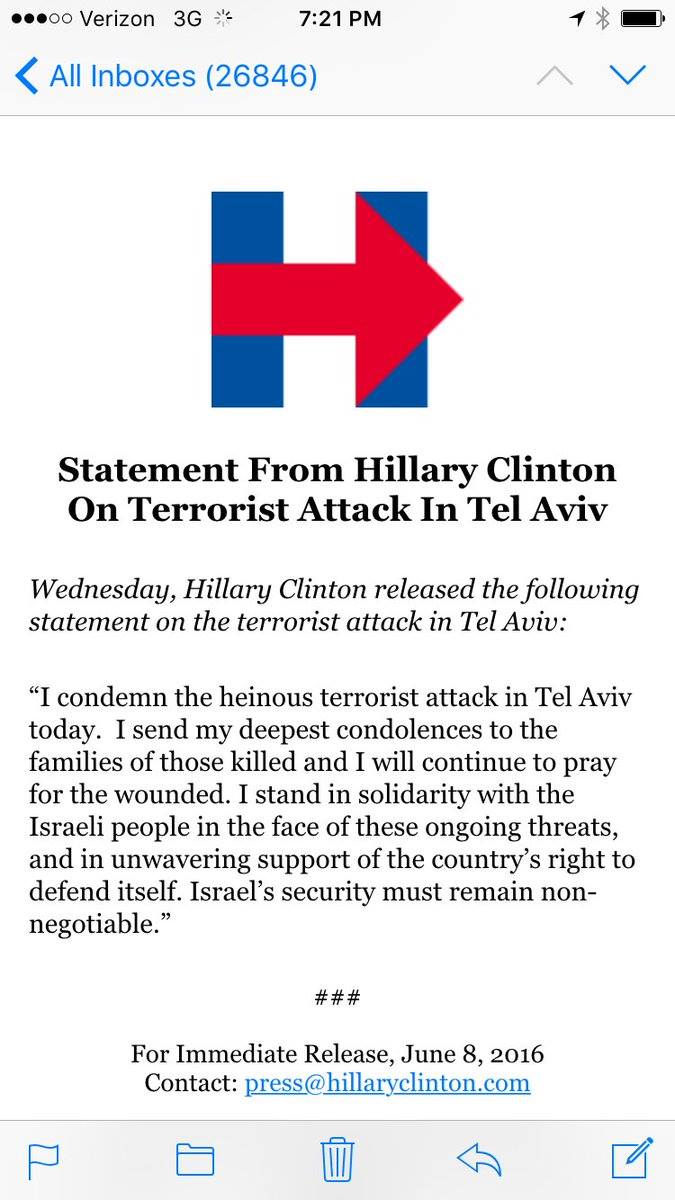
Hillary Clinton condemns Sharona Tel Aviv terrorist attack in Zion


Presumptive Democratic U.S. presidential nominee Hillary Clinton condemned a deadly attack on Wednesday at a popular shopping and restaurant area in Tel Aviv. Clinton reiterated her support of Israel’s right to defend itself.

Four people were killed and six others were wounded in the attack, after two Palestinians dressed in suit and tie and posing as customers at a restaurant, pulled out weapons and opened fire on passersby.

“I condemn the heinous terrorist attack in Tel Aviv today. I send my deepest condolences to the families of those killed and I will continue to pray for the wounded,” Clinton said in a statement released by her campaign. “I stand in solidarity with the Israeli people in the face of these ongoing threats, and in unwavering support of the country’s right to defend itself.”
“Israel’s security must remain non-negotiable,” Clinton added.

The U.S. State Department condemned the terrorist attack “in the strongest possible terms.”


Saturday, May 14, 2016

Surviving the Tel Aviv Summer in Zion

[2009_Apr_Beach_Img15.jpg]


It’s official: summer is approaching in Tel Aviv. I know this for two reasons. One, when I woke up this morning, I was the mere remains of a human being after being devoured by the first batch of this season’s mosquitoes; and two, people seem to have forgotten that they have jobs and obligations and instead have taken to the streets in frantic excitement to suck up the sun’s first tan-worthy rays. Coupled with our upcoming Passover break, Tel Avivians are busting out their bathing suits and saying a firm ‘No’ to that second helping of hummus to get their bums back in beach business.
For those of you who have never ventured to this part of the world at this time of year, be warned: it gets hot. Very hot. So hot that all anyone becomes capable of talking about are their various levels of shvitzing. So hot that if your oven is broken you could probably bake your cake in the oven that is the outdoors. So hot that is becomes difficult, nay, impossible, to even fathom stepping outside without the proper tools to get you through the day.
There is no need to fret. Given that there are still a number of weeks before the heat becomes little less than unbearable, I present you with a handy-dandy guide to Israel’s summer fun:
1)     Never leave the house without the following essentials: sunscreen, a bottle of water, a hat, sunglasses, and a bathing suit. The first three are no-brainers. I highly recommend not neglecting the first, and perhaps most essential ingredient, with the excuse of trying to get some colour. If the colour that makes your eyes pop is a blistery, painful mix between maroon and fuschia – by all means, be my guest. If you prefer not to have to spend your days in an air-conditioned room covered in yoghurt (yes, yoghurt–it’s an old trick for alleviating sunburn pain), then make sure you pile on the sunscreen at least every couple hours. The bathing suit is also a must, because no matter how busy you are or whatever plans you thought you had, your day will always start or end, or both, at the beach.
2)     Clothing: as little as possible, really. One of the great things about Tel Aviv in the summer is that clothing becomes optional, everywhere. The whole ‘no shirt, no shoes, no service’ gig? Not an issue. If you insist on covering up, wear light, airy, light-coloured fabrics that breathe. You do not want to be one of those people stuck in the bathroom, trying to un-stick your jeans from your ankles while angry hoards of hot, sticky people wait outside the door.
3)     Dating: the best place to do this, naturally, is at the beach. Your guard is already down, and if you don’t like the guy you can always escape into the ocean or accidentally-on-purpose get lost amongst the endless coloured towels and umbrellas and bikinis. If you insist on going on an actual date, make sure it’s somewhere air-conditioned so that you don’t spend the entire evening discussing how sweaty you are and how much more bearable back home (wherever that may be) is in the summer.
4)     That said, beware of the constant, roving eyes of pretty much every man you see. The whole ‘no clothing’ tip comes with a couple of setbacks, mostly that your hot bod is on display for all to leer at. Luckily, though Israeli men do tend to be quite forward, they also get the hint if you’re straightforward enough. Be firm, and don’t worry about hurting their egos – they’ve got enough stored up to keep them hanging in there for at least the rest of the season.
5)     Bugs. For those of you genuinely afraid of cockroaches, beetles and any other variation of crawling black blobs, this is a great opportunity to face your fears. While a nuisance, they are harmless and can easily be swiped away. The real problem is mosquitoes. They’re relentless and insatiable, so invest in the strongest insect repellent you can get your hands on and use generously.
6)     Yoga. Poses like legs up the wall or forward folds have a cooling effect, and Tel Aviv is filled with studios that offer single classes, ten-pass classes or monthly memberships for a pretty good price.
7)     Eating and drinking. There is a reason Coke, Juices and Beer are so popular in Tel Aviv. First of all, they’re both quite cheap. Secondly, they’re heat friendly, and as you may discover, ubiquitous at every street party in the city (don’t be surprised if you find yourself stumbling upon one one of these a day). In terms of food, Israel has a vast variety of fresh fruits and vegetables, so try to skip the heavy steak and opt for fresh fish and great fruit from the market instead.
That said – embrace the heat, and allow the limitlessness of long summer days to take you anywhere and everywhere you need to go. And ladies, if he looks too good… he’s probably gay.

Israel is the only country in the Middle East where LGBT people can openly show affection, so it’s no surprise tens of thousands of people gather each year for the annual Pride celebration in Tel Aviv. 2016 festivities included the city’s 18th annual Pride Parade, musical performances, and speeches from public figures such as Tel Aviv Mayor Ron Huldai, who lauded the city as the “most gay-friendly” in the world.
TelAvivPride2013 7

Friday, May 6, 2016

A Place for Meat (Makom Shel Basar) ,64 Shabazi St, Neve Tzedek, Tel Aviv | 03-5296054


In a 100 radius, in the northern tip of Neve Tzedek neighborhood, lay two of the best steakhouses in Tel Aviv (and probably in Israel), NG and A Place for Meat. Though there are enough carnivores in the city to fill the both, there is probably an enormous competition between the two places which constantly receive very good reviews from all around. Strangely enough, until this day we haven’t visited a Place for Meat. And then we did.
As a bold move, unlike NG, A Place for Meat introduces a menu where Steaks are the only main courses. Yes, it might not fit everyone, and maybe it isn’t the whole family classic place, but if it is a good Steak you are looking for, in a very romantic atmosphere as a plus, this is a very good option.
Caeser Salad
Caeser Salad
We did have some warm-up with starters such as Caeser Salad which was a classic dish that didn’t fill us up too much before the steaks, and the same goes to grilled Artichoke hearts in lemon and olive oil. Both of the dishes didn’t stand up as particularly good, but we didn’t mind as we were there to check whether the steaks are the best in town.
Fillet of Beef
Fillet of Beef
How unoriginal from us, we both picked the same part of the beef, the Fillet of Beef. Usually, veteran carnivores will disregard this part while praise the hanger steak and the more meat-flavored parts, but even though, the Fillet of Beef remains a very popular steak, and we were reminded why. Both of the steaks had the desirable external crust while tender and “al punto” just as we liked. Was it the best steak in Tel Aviv? Probably. The sides, baked potatoes and a famous Tower of onion rings were very good and summed up a great steak dinner at a very lovely place.
Tower of onion rings
The check please (2 people)
Caeser Salad – 42 NIS
Artichoke Hearts – 36 NIS
Fillet of Beef – 2 X 145 NIS
Pepsi – 13 NIS
San Pellegrino  – 14 NIS
All in all – 395 NIS
Summary:
Food: Meat
Price:  Expensive
Location: Neve Tzedek
The Cizer Kobrinsky Scale:
4.5 Forks
4.5 Forks
Contact Details: A Place for Meat
64 Shabazi St, Neve Tzedek,  Tel Aviv | 03-5296054 |
Mon – Sat 12:00 – 00:00 | http://makomshelbasar.rest-e.co.il