Showing posts with label Just a Rip Roaring Zionist hanging out and in the Internet of Zion. Show all posts

Saturday, June 25, 2016

Helen Mirren: Anaother Stage and Screen Icon "says in you Face BDS "and again visits Zion


▌ Helen has visited Israel several times, and has been a vocal critic of anti-Israel activists who have called for a cultural boycott of Israel.
▌ Mirren said she is a "believer" in Israel and rejected efforts to boycott it.
"I absolutely don’t believe in the boycott, and here I am."
▌ She said her strong connection to Israel dates back to 1967, when she volunteered on a kibbutz.
"I am a believer in Israel. I think this is an extraordinary country
filled with very, very extraordinary people."

Wanna quick Yiddish lesson? Say ' a herring is a fish''....

Image result for Quick Yiddish lesson
Want a quick Yiddish lesson? Say, "a herring is a fish" while pretending to read this:  אַ הערינג איז אַ פֿיש
And use this guy's accent:


You just read a Yiddish sentence meaning... a herring is a fish.

To explain, let's take a step back: As the Jewish diaspora spread through various parts of Europe, their move away from Hebrew as a spoken everyday language paralleled the change of Latin and Old Church Slavonic into Liturgical languages. Hebrew was too holy to be used to talk about milking cows and the cost of lumber.


So, the Jews  developed a version of their local languages to use as their own wherever they ended up. Yiddish is the language used in Central and Eastern Europe. By comparison,Ladino is what they spoke in Spain (e.g., check out the Ladino Hannukah song, Ocho Kandelikas)


Back to Yiddish, it ended up a bit of a mishmosh of languages (Scholars Debate Roots of Yiddish, Migration of Jews) combining not only Hebrew with German, as the other answers have noted, but also Slavic (particularly for Eastern Yiddish, spoken around Russia). In fact, the vocabulary is about 85% German, 10% Hebrew and 5% Slavic. The word Yiddish comes from the German for Jewish: Yid + ish.

The grammar, though, is almost 100% German, or more specifically Germanic. So, Yiddish is a branch of the High German language family. As you may know, English is a also Germanic language, which explains why the phrase a herring is a fish means the same thing in English and Yiddish.

As for the writing system, the learned, of course, still spoke Hebrew in shul or yeshiva (school) and even the illiterate would pray in Hebrew, so Hebrew was a constant influence. Indeed, the Hebrew writing system, known by the literate, was used and modified for writing Yiddish. 

It had to be modified because the sounds are Hebrew and German different and the sounds of German are used. The grammar is different, too, so the Semitic trilateral root, a key part of the grammar, was abandoned in favor of German inflection. The semitic vowel system, related to this grammatical part of the language, was replaced with a different method for writing vowels.

The Holocaust decimated the Yiddish-speaking population, a population that had existed for almost 1,000 years. Those that weren't killed moved to places where Yiddish wasn't relevant. So, Yiddish experienced a precipitous decline. My grandparents' 1st language was Yiddish. My parents knew a little. And I know a few dozen phrase and words. 

But just as Jews are moving back to Germany, so, too, are people starting to use Yiddish again. Some Orthodox Jews in the US, esp. in and around Brooklyn, use Yiddish as a first language - even the kids. The Daily Forward, the paper my grandfather read, still publishes a Yiddish version online and in print: The Yiddish Daily Forward

...though biweekly and not daily.

Time will tell if Yiddish experiences a true revival as a native language, or whether it becomes an interesting historical footnote of Jewish history.

Thursday, June 23, 2016

Helen Mirren: Another Icon of the Stage and Screen says ' in your face" to the BDS against Zion


Helen Mirren Denounces BDS Movement, Slams Artists Who Boycott Israel

'The artists of the country are the people you need to communicate with and make a relationship with and learn from and build upon. So I absolutely don't believe in the boycott, and here I am.'

 Oscar-winning actress Helen Mirren said Wednesday she was a "believer" in Israel and rejected efforts to boycott it.

Mirren showered Israeli artists with praise and said she opposed both the efforts by pro-Palestinian groups to boycott them and the decision of some international artists to shun Israel.
"I think that art is an incredibly important way of communication," she said at a press event in Jerusalem. "The artists of the country are the people you need to communicate with and make a relationship with and learn from and build upon. So I absolutely don't believe in the boycott, and here I am."

Mirren is in Israel to host the Genesis Prize, an award known as "the Jewish Nobel." The $1 million prize is being awarded to Israeli-American violinist Itzhak Perlman for his accomplishments as a musician, teacher and advocate for the disabled.

Mirren, who is not Jewish, has visited Israel several times, and has been a vocal critic of pro-Palestinian activists who have called for a cultural boycott of Israel. The Boycott, Divestment and Sanctions movement, known as BDS, has enlisted the support of Pink Floyd frontman Roger Waters and has persuaded Elvis Costello, Lauren Hill and other performers to call off concerts in Israel.

Mirren, 70, is one of the few actors to have won the so-called Triple Crown — collecting an Oscar, Tony and four Emmy awards over the years. She received her Academy Award for her portrayal of Queen Elizabeth II in the 2006 film "The Queen."

She played the role of a former Mossad agent in "The Debt," a remake of an Israeli film of the same name. And in "Woman in Gold," she played an elderly Jewish refugee who fought the Austrian government for a decade to reclaim an iconic Gustav Klimt painting stolen from her family by the Nazis.

She said her strong connection to Israel dates back to 1967, when she volunteered on a kibbutz, or collective farm, with her Jewish boyfriend at the time. She fondly recalled picking grapes and doing kitchen duty.

"I am a believer in Israel ... I think this is an extraordinary country filled with very, very extraordinary people," she said. "It's just a lucky, for me, accident in my life that I have had this privilege."
Mirren shied away from more political questions, but she said she had already voted by proxy in favor of Britain remaining in the European Union. She will be in Israel when the Brexit vote is held on Thursday.

Prime Minister Benjamin Netanyahu will present Perlman the award at Thursday night's ceremony in Jerusalem.

The prize was inaugurated in 2014 and is run in a partnership between the Israeli prime minister's office, the private Genesis Prize Foundation and the Jewish Agency, a nonprofit group with ties to the Israeli government. It is funded by a $100 million endowment set up by the foundation. Former New York City Mayor Michael Bloomberg was the recipient of the first prize, and actor Michael Douglas was last year's winner. Comedian Jay Leno hosted the first two ceremonies.


Actress Helen Mirren (R) poses for a picture with Jerusalem Mayor Nir Barkat after he awarded her the Jerusalem of Gold Award for Excellence in the Arts and Humanities, in Jerusalem June 22, 2016. 

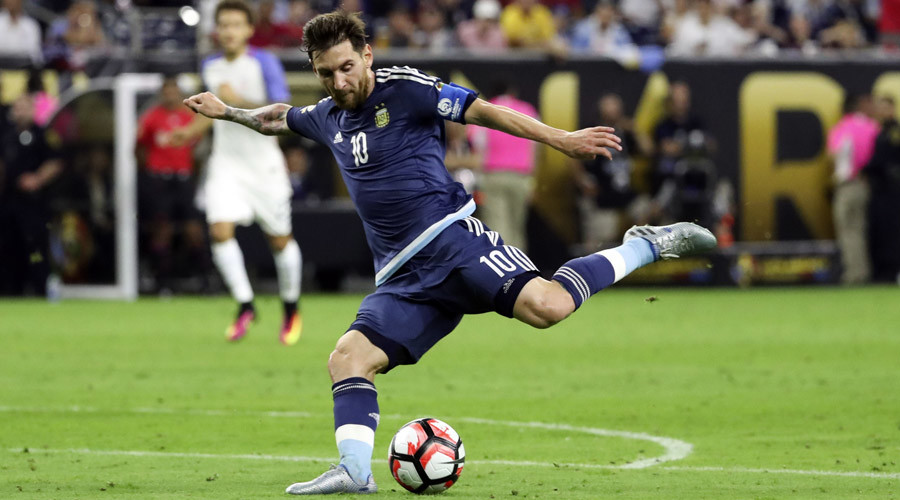
Messi Demi God and the Religion of Football .


What does God look like?

What did Beatlemania sound like?

How does it feel to be J.J. Watt on Sundays in the fall?

Lionel Messi knows the answer to two of those big three. And Argentina's living, breathing soccer deity was darn close to the athletic version of the big G right before our stunned eyes Tuesday night at NRG Stadium.

I'm about to tell you what it - the kick, the shot, the perfectly made unmakeable goal - was like. But I'm also going to be honest. If you weren't one of the 70,858 chosen ones who somehow got a ticket to Argentina 4, United States 0 in the Copa America semifinals, you'll never really know what watching Messi sink the unthinkable was like.


So turn this into your frozen-in-time postcard. And know the whole time you're reading that you really should have found a way to sneak into the stadium, so you could have seen the real thing up close.

"That is a conversation for another day, because there is a lot that goes into that," said United States midfielder Michael Bradley, after the team's captain was asked what separates Messi from the world's other soccer heroes.

Picture red, white and blue everywhere - first row to the very last. Hear "USA, USA, USA!!!" bouncing off NFL walls and echoing across the green grass. Find the far-away men scattered in packs. Then finally see him: No. 10, Messi, the one.


Messi, Argentina rout U.S. in Copa America semis

"The best player in the world," said U.S. defender Geoff Cameron, who spent 2008-12 with the Dynamo.

It's 1-0 best team in the world. The U.S. still has a dream shot. Then Messi goes down, a yellow card is waved and Messi gets back up.

Silence. Whispering. Building buzz.

The United States forms a wall. A 5-7, 28-year-old man from Rosario, Argentina breaks the useless, worthless thing down.

Messi skates on grass. He's grace; America's all nerves. Then the one they all paid so much to see does what no in the world should be able to do.

A thing of beauty

The ball is lifted off the earth. It arcs across white lines and searches for the top-right corner of the goal, soaring like it's personally attached to a top-secret magnet. U.S. keeper Brad Guzan flies upward, trying to save his country from certain destruction. Messi's shot laughs off the futility and doesn't stop until the net is swaying, Argentina's players are racing around and 70,000-plus are overcome with the shocking joy of disbelief.

"I'll look back at the replay and see if there's anything more I could have done," said Guzan, holding himself accountable for something that was entirely out of his hands.

Just the sight of his holiness was too much for one rabid admirer.

After 2-0 other country at halftime was a fact of life, an overzealous fanatic - perhaps hoping for John, Paul, George or Ringo in the flesh - madly raced onto the field and wrapped up Messi in a loving embrace.

The loon could've been of use on defense for the U.S., which allowed Argentina to complete a near-perfect 92 percent of its first-half passes and was outconnected 323-83 just 45 minutes into the match.

"We let them dictate the pace of the game," Cameron said. "We let them get in the flow. We weren't physical enough. We respected them a little too much."

One of the most-hyped soccer showdowns in Houston history felt more and more like a friendly exhibition as each minute passed. Messi did the sweet, smooth thing. Argentina easily put 3-0 up on the board and could have made it much worse. The panicked Americans chased the leader, desperately tried to stay within reach and weakly gave away almost every decent chance it had to appear internationally respectable.

Argentina is the global leader in round-ball awesomeness. So America's 90-minute setback wasn't exactly unexpected.

Neither was the soccer fury unleashed beneath a Texas state flag and two Texans AFC South championship banners.

There was a jumbotron-televised marriage proposal almost an hour before a nation's chant began ringing and patriotic drums started pounding.

When Argentina's flag was unfurled, NRG Stadium sounded like church. Hushed in reverence, silently proud.

Then Clint Dempsey was shown and the U.S. faithful took over. Then Messi's small, bearded face appeared in the light and a sold-out stadium of Americans briefly bled for Argentina.

Fired up, then defeated

The United States' best effort came a few minutes before the first kick. Every word of the national anthem rang out, with each successive line - "star-spangled banner," "land of the free" - outringing the next.

"Home of the brave" was everything. Until Messi touched the ball.

He perfectly assisted his country's first goal, barely touching a pass that glided and sailed before being expertly fired.

Three minutes in, 1-0 Messi already.

Then freedom created art.

After 32 minutes of oohs, aahs and lovingly drawn-out sighs, the man who really couldn't be as good as everyone swore - no way; overrated; yeah, sure - turned a free kick into sublime personal expression.

"It was perfect," Cameron said. "You can't do anything better than that."

Why does soccer rule the world? Why did a combined 183,985 scoop up tickets to the three Copa matches in Houston and NRG set a single-game soccer attendance record Tuesday?

If you saw Messi in person - one goal, two assists, the kick - you already know the answer for the rest of your life.

Wednesday, June 22, 2016

The Startup Nation comes of Age in Zion


High-Tech investments in Israel have shown a strong first quarter in 2016 according to the latest IVC statistics released in April. Total capital invested was $1.09 billion for the quarter, a run-rate of more than $4 billion a year, and the sixth straight quarter with over a billion dollars invested. This pace of investment has been reached only in recent years.

From an average of just about $2 billion invested per year in 2006-2012 (excluding 2009-2010 following the financial crisis), the industry has now more than doubled to $4.4 billion invested in 2015. The number of deals has also grown, going from an average of 490 deals per year (again excluding 2009-2010), to an average of over 680 over the last 3 years, a 40% increase.

The growth in capital invested is driven by two main forces, first, new company formation reached record levels in the last 3 years as evident by the 40% increase in number of deals, the majority of them being early-stage financing rounds. Many of these early deals are funded by angels and smaller VC funds who have emerged over the last couple of years. This trend in Israel follows closely the increased early stage activity also observed in the US in recent years.

The second, more substantial, phenomena driving the increased capital raising is the increase in the number of larger financing deals, many of them supporting growth stage, mature companies. Funding rounds larger than $20 million were a rare event in the Israeli market prior to 2013, but Israeli late-stage companies are now able to raise larger financing rounds and are willing to take the longer term view and swing for the fences, much more than in past years. There were 17 financing rounds larger than $20 million in 2013, 39 in 2014 and 65 in 2015.

The increase in late stage financing is driven mostly by later stage investors who have picked up on the fact that more Israeli companies have the potential and the desire to become independent companies. Late-stage and crossover investors that have not been in this market before, as well as a few new growth-stage local funds are busy identifying companies that have not just the potential to become large enterprises, but also the right management teams, mindset, and existing investor base to do so.

The current state of the market would not be complete without also mentioning an increased activity of corporate strategic investors, some who have been active in Israel for a while such as EMC, Cisco and Intel, but also a growing number that are new to the scene such as Microsoft, Disney, Lenovo and Qualcomm. The overall growing interest and increase in venture investing globally, coupled with Israel having a special spot as an innovation center, has also attracted new investors and crowd-funding to the local scene. Specifically, the last 2-3 years have seen an increased activity by Chinese investors directly investing in companies or as LPs in local funds.

Will the rate of investment continue at this accelerated pace of more than a billion dollars per quarter for the long run? Probably not. The slow-down evident earlier in the year in the US market is felt in the Israeli market as well. However, with the shift of a healthy number of companies to the ‘Scale-up’ phase, Israeli investment levels will unlikely go back to a $500 million-per-quarter level any time soon. Valuations of Israeli companies have not skyrocketed similar to the Unicorn herd in the US (Israeli Unicorns can be counted on one hand) and as the Unicorns of Silicon Valley are cooling off, investors are further digging into the Scale-up opportunities in Israel.

With this new phase of the local high-tech scene, we should continue to see large growth financing rounds for businesses that have a proven model and good trajectory. Early stage companies will also continue to get funded in promising technology areas going after large markets such as Cloud, mobile and FinTech. However, we are now getting back to a more normal financing environment and the companies caught up in a ‘soft spot’ of financing will be those in the middle stages of their development. The sentiment reflected by Bill Reichert of Garage Technology Ventures in a recent study by USF on US VC sentiment, holds also true for Israel: “The proliferation of incubators, accelerators, co-working spaces and funding groups has generated an ocean of startups that cannot be sustained. And the tide of capital that flowed in from non-venture sources will ebb with the downturn in valuations at the unicorn level”.

The increased investment activity in Israel did not develop in a vacuum. This trend is encouraged and supported by two factors: Israeli companies have come back to the public markets in recent years after a long drought, and M&A deal sizes have increased as well. Looking again at IVC data (excluding life science companies) there were an average of 7 acquisitions larger than $100 million per year in the years 2010-2012. That number has grown to an average of 12 such transactions per year in 2013-2015. These last three years also saw three transactions larger than $500 million, up from just one transaction in the previous three years.

Israeli venture investing used to be considered a game of Singles and Doubles. That is not the case anymore. Looking at the list of companies that have raised substantial growth financing rounds over the last 24 months, one finds an impressive group of high-flyers that share the potential of becoming independent, substantial companies. Investors are taking notice.

Saturday, June 18, 2016

Orlando, Gay Pride , Jihadists and Barbarism in the Middle East and even in Zion.


ISIS militants stone a man accused of homosexual acts in Homs, Syria, in June 2015.

The terrorist attack by a jihadist in Orlando is not only the latest instance of an ISIS fighter killing Americans, but also a reminder that jihadists hate gays. Curiously, the organizations that fight for gay rights have been mostly silent about the dangers Islamic supremacism poses to their constituency. But then, as Douglas Murray puts it: "the battle for gay rights stop[s] at the borders of Islam."


To be clear, jihadists do not necessarily hate homosexual acts (prohibited in the Qur'an). They hate "gays." They may oppose the act, but they especially detest the "sinner" who makes the act his identity, rather than hiding and denying what most of the Muslim world tolerates as a common, if temporary, deviation.

To jihadist eyes, "gays" celebrate openly, in a very American fashion, what should be hidden. In Iraq, when the Shia militias round up and stone young males with "Emo haircuts," they justify it as eliminating satanic, Westernized homosexuals. When Mahmoud Ahmadinejad spoke at Columbia University in 2007, he said: "In Iran we don't have homosexuals like in your country...we do not have this phenomenon."

As veterans of the Afghan wars know, homosexuality is not unusual among our allies and enemies alike. A declassified 2010 Pentagon study indicates that "Pashtun men commonly have sex with other men...have sexual relationships with boys and shun women both socially and sexually – yet they completely reject the label of 'homosexual.'"
Most gay rights advocates have paid scant attention to Islam.
Long before Orlando, jihadists have publically executed gay men. In Raqqa, ISIS throws them off rooftops. Many Muslim countries rule by a version of Sharia law that imposes the death penalty for homosexuality.

Bruce Bawer, an iconic gay rights intellectual, warned of the dangers Islam posed to the West in general and to gay men in particular. Bawer witnessed rapid changes in Dutch and Norwegian society after an expansion of immigration by Muslims in the 1990s. "To them,"he wrote, "the infidel's 'law' is a joke, and values such as pluralism, tolerance, and sexual equality are alien and immoral. They see Western society as the enemy, European men as wimps, European women as sluts." But there was a special disdain for gay men, and Bawer documents toleration for them in the heart of liberal Europe "slipping away like sand through the fingers."

The response to Orlando from gay rights groups has been tepid and confused. GLAAD calls the attack a "tragedy" but makes no reference to the ideology behind it. The ACLU calls it "a horrific event" and oddly endsits statement by expressing "solidarity with the Muslim community here in Florida and elsewhere" – as though Omar Mateen had targeted and killed Muslims.

Typing the word "Islam" into the search engine of the Gay Men's Health Crisis (GMHC) website yields a "No Results Found" message. The group's June 13 statement on the attack condemns "terror" but not Islamic terror. The GMHC might contemplate Bawer's warnings and consider the crisis Islamic supremacism poses to the health of gay men.
Will Hollywood celebrities' support for the LGBT community last longer than that for the girls kidnapped by Boko Haram?
And where are the Hollywood allies of the LGBT community? With very few exceptions they avoid Islam altogether. True, several made sure that cameras were present when they performed their #BringBackOurGirlsroutine, and many boycotted the Beverly Hills Hotel when the Sultan of Brunei (its owner) announced that he would henceforth rule his island nation with strict adherence to Sharia. But the attention span of the beautiful people seems short-lived. No one mentions the Chibok schoolgirls or their Boko Haram kidnappers anymore, and while the boycott has ended, the Sultan of Brunei still owns the Beverly Hills Hotel and still rules with Sharia.

Like most feminist organizations, most gay rights advocates have paid scant attention to Islam. Instead of (or in addition to) fighting Republicans and Evangelicals, or photographers and bakers who oppose gay marriage (Obama's position until May 9, 2012), a careful reprioritization of their foes might lead them to worthier enemies.

If so, I say welcome to the fight, and I humbly offer some unsolicited advice.
Seize the Orlando attack and turn it against Islamic supremacists. The celebrations of those killed, the concerts and telethons to benefit their families are natural educational platforms. Use them wisely. Call on your Hollywood allies and take advantage of their access to free publicity and legions of adoring fans.

Finally, and perhaps most importantly, find the face of your cause. Find your Malala. It might be Hussein Sabat, Mr. Gay Syria, whose boyfriend was killed by ISIS three years ago. Sabat now leads the precarious existence of a gay rights activist from his exile in Turkey. His message is a good start: "Everyone is scared of ISIS but it doesn't stop me from living my life. I won't let them be a barrier and I hate them more than I am scared."

House Passes $635.7 million for Israel Missile Defense Program , Lam Duck Obama treated to veto milltary increased support for Zion


Capitol Hill
House approves defense aid to Israel despite veto threat

House of Representatives passes defense spending bill which includes $635.7 million for U.S.-Israel missile defense programs

The United States House of Representatives on Thursday passed a $576 billion defense spending bill which includes $635.7 million for U.S.-Israel missile defense programs, despite a threat by the Obama administration to veto the bill, The Jewish Insider reports.

The fiscal 2017 defense appropriations bill includes $268.7 million in research and development funding for U.S.-Israel cooperative missile and rocket defense programs; $25 million in research and development funding for U.S.-Israel directed energy activities, such as laser technologies, to combat missiles and rockets; $72 million for procurement of the Iron Dome rocket defense system; $150 million for procurement of the David’s Sling missile defense system; and $120 million for procurement of the Arrow-3 missile defense system.

It passed by a majority of 282-138, noted the report.

In addition, the House included $42.7 million for U.S.-Israel anti-tunnel cooperation to continue developing technologies for dealing with the challenge of locating, mapping and destroying terrorist tunnel networks from Gaza.

The passing of the bill comes despite the fact that earlier this week, the White House announced its objection to the Congressional proposal to increase funding for Israeli missile defense in 2017.

White House officials on Wednesday night played down the statement objecting to the proposal, explaining that the administration believes any additional aid to Israel should be part of the 10-year military aid agreement the two countries are now negotiating, and not in the 2017 defense budget, as Congress proposed.

U.S. State Department spokesman John Kirby defended the administration’s opposition to the funding increase on Wednesday, calling it “the largest such non-emergency increase ever.” Kirby added that the increase “would consume a growing share of a shrinking U.S. Missile Defense Agency’s budget”, according to The Jewish Insider.

The current defense agreement between Israel and the United States remains in force until 2018, and Prime Minister Binyamin Netanyahu has been urged to accept President Barack Obama’s 10-year military aid package which reportedly includes a total of $145.8 million for Israeli missile defense programs, a sharp drop in financial support.

A total of $3 billion in defense aid is given annually, but Netanyahu has asked for an increase to $5 billion annually, in light of the greater need for security due to the growing Iranian threat after the nuclear deal.

In a statement released following Thursday’s vote, AIPAC commended the GOP-controlled House “for significantly bolstering its support of U.S.-Israel missile defense cooperation,” which will “help Israel defend its citizens against rocket and missile threats, and contribute to America’s missile defense programs.”

“As Israel faces dramatically rising security challenges, AIPAC urges inclusion of these vital funds in the final versions of the Fiscal Year 2017 defense authorization and appropriations bills,” AIPAC added, according to The Jewish Insider.

Essential Yiddish Insults that every good Zionists should know for the Sake of Zion


In the melting pot that is American English, Yiddish has contributed considerably to the alchemy of the language.  And while the oldest Jewish congregation was founded in New York in 1654, Jewish immigration to the United States was small until the 1880s.  After that it was relatively high until choked off by the 1925 restrictions designed to limit ethnically undesirable immigrants.  Jews had already established flourishing communities in the interim, however, and were busy speaking, writing, and publishing in their own melting-pot language, which combined influences from Hebrew, German, and other European languages.  For the past 130 years, Yiddish has given America a rainbow of fun, silly, and just plain useful terms.

A surprisingly large number of English words from Yiddish are devoted to insulting name-calling.  In fact, there are so many insults that I had to break it down into categories and subcategories.  Consider the following:
People Worthy of Your Scorn
Subcategory: Fools
schlub: a stupid, worthless, or unattractive person (from the Yiddish zhlob or zhlub meaning yokel or boor; Merriam-Webster‘s online, hereafter M-W).
schmegeggy: a contemptible person, an idiot (Oxford English Dictionary online, hereafter OED).
shmendrik: a contemptible, foolish, or immature person (the name of a character in an operetta by Yiddish-language playwright Abraham Goldfaden; OED).
schmo: an idiot, a fool (delightfully described in the OED as “a person who stands watching a machine make doughnuts, and [1] cannot understand the process, [2] cannot get up will power to leave”).
schnook: a dupe, a sucker; a simpleton, a dope; a pitiful wretch (OED).
Subcategory: Everyone Else
klutz: a clumsy person (from the Yiddish for “wooden beam,” from Middle High German klozmeaning “lumpy mass”; M-W).
nebbish: a timid, meek, or ineffectual person.  Note that this is a noun, not an adjective (M-W).
pisher: a young, inexperienced, or insignificant person (OED).
schlemiel: an unlucky bungler; a chump (M-W).  See “schlimazel” below.
schlimazel: a consistently unlucky, accident-prone person, a “born loser” (OED).  The classical explanation of this idiomatic idea is that the schlemiel chronically spills the soup, but the schlimazel is the one the soup always seems to get spilled on.
People Who Complain
noodge: a person who persistently complains or nags; a pest, a bore (OED).
kvetch: a habitual complainer (from the Yiddishkvetshn, literally, to squeeze or pinch, from Middle High German quetsche; M-W).  Note that this is more often used as a verb.
People Who Are Interpersonally Annoying
nudnik: a person who is a bore or nuisance (from Polish nudzić, from nuda boredom; M-W).
schmuck: a jerk; literally, penis (M-W).
schnorrer: a beggar, especially one who wheedles others into supplying his wants (M-W).
People Who Infuriate You
ganef or gonif: a thief, a rascal (from the Hebrewgannābh, also meaning thief; M-W)
mamzer: a bastard (both literally and figuratively; OED).  A mamzer is clever at dishonestly turning things to his own advantage.
meshuggener: a foolish or crazy person (M-W).
People Who Infuriate You in a Seriously Non-PC Way
schvartze: a depreciative term for a black man (OED).
shiksa: a derogatory word for a non-Jewish woman (or, in moments of internecine nastiness, Orthodox people also use it for Jewish females who do not follow Jewish precepts).  This comes from the Hebrew word for “blemish” or “abomination” (M-W).
People Doing the Name-Calling (i.e., Gossips)
kibitzer: one who looks on and often offers unwanted advice or comment, or, in general, voices opinions (M-W).
yenta: one that meddles; a blabbermouth, a gossip.  This descends from the first name Yente (M-W).