Showing posts with label Palestine. Show all posts

Wednesday, November 9, 2016

Zion and its role in the 1944 US Presidential Elections . The brilliance of Stephen Wise, BenZion Netnyahu, Abba Hilel Silver,Nahum Goldman and buttonholed, hardball politics .


During the three decades following Great Britain’s Balfour Declaration in 1917, American Zionists sustained a remarkably broad bipartisan coalition of support for their cause. Every president from Woodrow Wilson to Harry Truman endorsed the declaration’s pledge to facilitate the establishment of “a Jewish national home” in Palestine, as did the U.S. Congress, in a unanimous joint resolution, in 1922.


The summer of 1944, however, marked a crucial turning point. This was when support for Zionism was transformed from a low-risk political gesture to a bona fide election issue that would compel both Republicans and Democrats to compete for Jewish votes. This was also the moment when the Zionist cause faced its most severe political test, thanks to the actions of the president who enjoyed greater Jewish support than any of his predecessors or successors, Franklin D. Roosevelt.


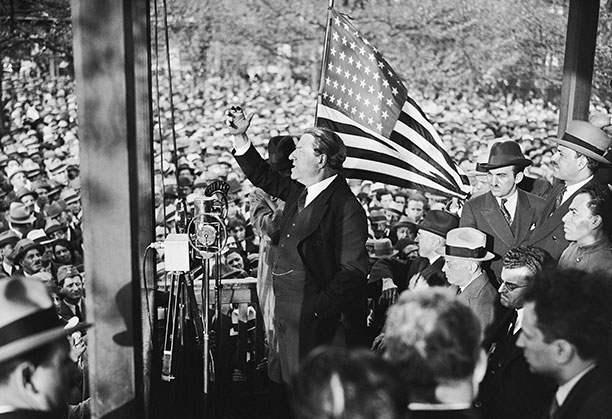
Rabbi Stephen S. Wise addresses a crowd of 100,000, New York, May 1933, during a protest against mistreatment of Jews in Germany. (Courtesy of the Bettman Archive.)

During the 1930s, Roosevelt had periodically offered perfunctory expressions of sympathy for Jewish development of the Holy Land but said little else with respect to a subject that was seldom a matter of concern to U.S. policymakers. Shortly before the 1936 presidential election, however, at the request of American-Jewish leaders, Roosevelt discouraged the British government from implementing a planned closure of Palestine to Jewish immigration. But three years later, when the Jews’ situation was far more dire, Roosevelt refused Jewish leaders’ pleas to intervene against the MacDonald White Paper, which barred all but a trickle of Jewish immigrants from entry into Palestine.

Following America’s entry into World War II, Roosevelt’s attitude toward Zionism became even chillier; now he regarded talk of Jewish statehood as a distraction from the war effort. Even Rooevelt’s most ardent Jewish supporter, Rabbi Stephen S. Wise, concluded that with regard to Palestine, Roosevelt was now “hopelessly and completely under the domination of the English Foreign Office [and] the Colonial Office.” Roosevelt rebuffed Chaim Weizmann’s personal plea, in July 1942, to mobilize a Jewish army to defend Palestine against a German invasion, fearing that such a move would antagonize the Egyptians. Roosevelt also rejected a request to permit the Palestine (Jewish) Symphony Orchestra to name one of its theaters the Roosevelt Amphitheatre, lest that small gesture be construed as a sign of too much support for Zionism.

By the autumn of 1943, there was growing concern among some prominent Democrats that the likely contenders for the 1944 Republican nomination, previous nominee Wendell Willkie and New York’s Governor Thomas Dewey, would make serious headway with Jewish voters in the next presidential election. Having won between 85 and 90 percent of the Jewish vote in 1936 and 1940, Roosevelt would seem to have had little reason for concern. But in October 1943, Vice President Henry Wallace noted in his diary “how vigorously Willkie is going to town for Palestine.” And Rabbi Wise confided to Roosevelt’s liaison to the Jewish community, David Niles, that he was “very much disturbed by the things that Dewey is saying about Palestine.”


Congressman Emanuel Celler, a Democrat of Brooklyn, was particularly concerned about Dewey. He was, after all, the popular governor of the state with by far the most electoral votes. New York’s 47 votes could be the key to the election, and the state’s large Jewish voting bloc—about 14 percent of New York’s electorate—could swing the state. In a memo to presidential secretary Marvin McIntyre, Celler warned:


The Jews in New York and other areas like Philadelphia, Chicago, Boston, Sanfrancisco [sic], [and] Cleveland are greatly exercised over the failure of our Administration to condemn the MacDonald White Paper [. . .] It would not surprise me in the least to have Governor Dewey make a pronouncement in the not too distant future to the effect that Palestine cannot be liquidated as a homeland for the Jews and that the MacDonald White Paper must be abrogated [. . .] as far as the race of Abraham, Isaac and Jacob is concerned, [Dewey] would steal the show right from under our noses.

Around the time that Celler wrote his memo, Benzion Netanyahu, the father of Israel’s current prime minister, was thinking along much the same lines. An emissary in the United States of Revisionist Zionism, the militant wing of the Zionist movement founded by Vladimir Ze’ev Jabotinsky, Netanyahu had organized rallies and authored full-page newspaper advertisements that criticized the Allies for abandoning European Jewry and shutting off Palestine. But he also spent part of his time on Capitol Hill. “Most of the Jewish and Zionist leaders, led by Rabbi Stephen Wise,” he later reported, “were devoted Democrats and supporters of President Roosevelt. The idea of having friendly relationships with Republicans was almost inconceivable to them.” In the months prior to the June 1944 Republican National Convention, Netanyahu made the case for Zionism to GOP leaders, including former president Herbert Hoover; Senator Robert Taft, who was chairing the convention’s Resolutions Committee; and the influential Connecticut congresswoman Clare Boothe Luce. Netanyahu’s goal was to have the GOP platform include a plank supporting Jewish statehood in Palestine, which neither party had ever done before.

Rabbi Abba Hillel Silver had the same idea. Silver was Rabbi Wise’s co-chair and arch-rival at the American Zionist Emergency Council, the Zionist umbrella organization. Unlike Wise, Silver felt no special loyalty to Roosevelt and the Democrats. In fact, the Cleveland rabbi enjoyed a close relationship with Ohio’s Senator Taft. It was Taft who invited Silver to deliver the benediction at the 1944 GOP convention, which facilitated Silver’s efforts to persuade Republican leaders to include Palestine in the platform.

The parallel lobbying efforts by Netanyahu and Silver resulted in the GOP’s adoption of the plank they sought, and then some:

In order to give refuge to millions of distressed Jewish men, women and children driven from their homes by tyranny, we call for the opening of Palestine to their unrestricted immigration and land ownership, so that in accordance with the full intent and purpose of the Balfour Declaration of 1917 and the Resolution of a Republican Congress in 1922, Palestine may be constituted as a free and democratic Commonwealth. We condemn the failure of the President to insist that the mandatory of Palestine carry out the provision of the Balfour Declaration and of the mandate while he pretends to support them.

Had the Republican plank referred only to Palestine and Jewish refugees, without mentioning Roosevelt, Rabbi Wise could not have objected. But the GOP’s criticism of Roosevelt—the president whom Wise revered as “the All Highest” and “the Great Man” in his private correspondence—was too much for him. Wise hurried to inform the president that he was “deeply ashamed” of the plank’s wording and issued a public statement criticizing the GOP for casting “an unjust aspersion” on Roosevelt.
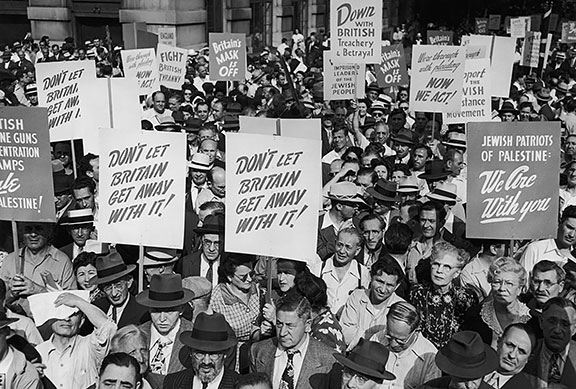


American Zionist Emergency Council protest, Madison Square Park, New York, denouncing British policy in Palestine, July 1946. (Photo by FPG/Hulton Archive/Getty Images.)


What happened next would help shape the relationship between the United States, the Zionist movement, and the State of Israel for decades to follow. Rabbi Wise had not planned to attend the Democratic convention, which was scheduled for Chicago in July. But the Republicans’ embrace of Palestine changed matters. “I now think I shall go there,” he informed Supreme Court Associate Justice Felix Frankfurter, “in order to be certain that the Resolution on Palestine which must now be adopted shall more than neutralize the damage done by the Silver-inspired attack upon the Chief.”

Meanwhile, a delighted Rabbi Silver wrote to a colleague that “for the first time, our [Zionist] Movement finds itself in the fortunate position where both major political parties are competing for its approval.” He counseled Wise to use the GOP plank “as a lever to put through a similar and, if possible, a better plank in the Democratic platforms.” But at the same time, Silver cautioned his rival that anti-Zionists in the State Department “will bring pressure to bear . . . to have a watered-down, meaningless plank on Palestine” in the Democrats’ platform. Thus, Silver wrote to Wise, “You might have to go to the very top.”

As much as he resented Silver, Wise must have realized that, in this instance, he had a point. In the days preceding the Democratic convention, Wise repeatedly asked White House aides for a meeting with President Roosevelt to secure his “personal and administration support of [the] Zionist program” and affirmation of his desire to bring about “maximum rescue [of] Jewish civilians.” Wise’s request was denied. Roosevelt was inclined to duck the rabbi if Wise’s agenda included issues that the president preferred to evade.

Soon after arriving at the convention in Chicago, Wise was alarmed to find himself shut out of the deliberations over the resolutions. “It’s all so confusing and distressing,” he complained to a friend. “I can’t break through a cordon of bell boys.” In a note to President Roosevelt that went unanswered, Wise reported: “My information is that either no plank concerning Palestine is to be adopted or that the Platform will include a plank which is utterly inadequate.” Wise also heard through the grapevine that presidential adviser and speechwriter Samuel Rosenman—a Jewish opponent of Zionism—was pushing for a Palestine resolution so weak that it would constitute, as Wise put it, “a great gift to Tom D[ewey],” the Republican nominee. He did secure permission to address a public hearing before the Resolutions Committee—only to find that Rabbi Morris Lazaron, of the anti-Zionist American Council for Judaism, had been granted equal time to testify against a Palestine plank.

But what Wise did in the hallways mattered more. Synagogue Council of America President Israel Goldstein, who joined him at the convention, later described how they positioned themselves near a revolving door directly downstairs from the room where the platform was being discussed, “so that every politician that came in would be bound to bump into Wise.”

He knew most of them by their first names [. . .] And he collared every one of these politicians and I was standing there at his side as a kind of junior assistant and the two of us together would indoctrinate that person in the two or three minutes that were available, and that person was on his way to the meeting of the Platform Committee which was upstairs.
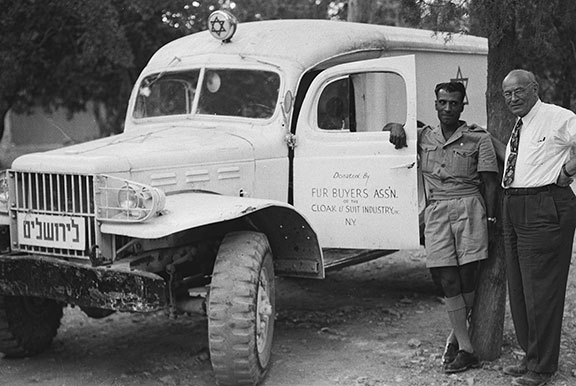


Congressman Emanuel Celler with an American-donated ambulance, Jerusalem, 1948. (Photo by Hugo Mendelson, Government Press Office, Israel.)

Assistant Attorney General Norman Littell described in his diary the experience of being buttonholed by Wise. The rejection of his plank would “hurt the president,” Wise warned him. “It will lose the President 400,000 or 500,000 votes.” The Republicans had adopted “a satisfactory plank” on Palestine, he reminded Littell, and the Democrats needed to match it. Littell supported Wise’s efforts; so did Congressman Celler, who was a member of the Resolutions Committee and who was not shy about pointing to the possible electoral consequences of a Democratic retreat from Zionism.

Wise submitted to the committee a draft plank calling for Palestine’s “establishment as a free and democratic Jewish commonwealth.” The committee members, apparently responding to pressure from the State Department, watered down the wording to “the establishment there of a free and democratic Jewish commonwealth.” Unhappy Zionist officials interpreted the addition of “there” as “implying partition” (which the Zionist movement, at that point, opposed). Nor did the Democrats’ plank mention the plight of European Jewry. Still, the language on Palestine was as strong as the GOP’s, and its reference to a “Jewish” commonwealth arguably was more explicit than the language adopted by the Republicans. Wise could happily announce that “with the plank in both platforms the thing is lifted above partisanship.” Support for Zionism, and later Israel, would henceforth become a permanent part of American political culture.
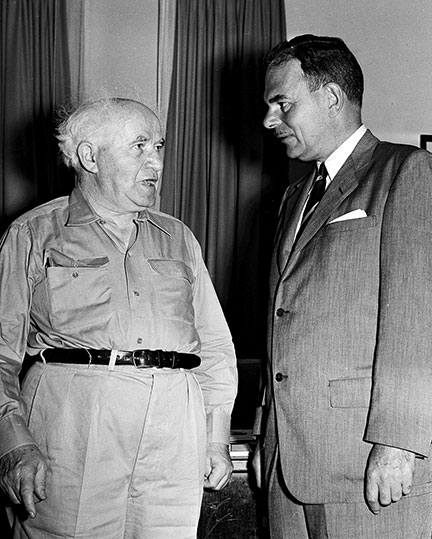

Former New York Governor Thomas E. Dewey visiting David Ben-Gurion, Jerusalem, October 5, 1955. (Photo by Moshe Pridan, Government Press Office, Israel.)


Soon after the Democratic convention, Jewish leaders learned that Governor Dewey planned to issue a major pro-Zionist statement before election day. Wise and his AZEC colleagues then resolved to seek a public affirmation by President Roosevelt of his support for the Democrats’ Palestine plank. “There are things afoot which I do not like, designed to hurt you,” Wise wrote to the president, explaining why it was urgent to see him and Silver. “Nearly everything can be done to avoid them if we can talk to you and have from you a word which shall be your personal affirmation of the Palestine plank in the Chicago platform of the Party.” Roosevelt did not respond. Wise turned to Samuel Rosenman. “[I]t would be definitely helpful to THE cause if we could see the Chief with the least possible delay,” Wise implored him. “I would not press this as I do if I did not have reason to fear that fullest advantage might be taken of the Chief’s failure to speak on this at an early date.” Meanwhile, in Jerusalem, Wise’s close colleague Nahum Goldmann was briefing Jewish Agency leaders: “Wise will tell [Roosevelt] that this declaration could secure for him 200,000 additional votes in New York, and there is a chance that at the end of October the president will perhaps issue the declaration.” Finally, after three weeks of calls and cables, Roosevelt agreed to see Wise (but not Silver). Accounts by Wise’s aides indicate that the rabbi and the president discussed the role of Palestine in the election campaign and that Wise presented a draft of a message from Roosevelt that he wanted to have read aloud at an upcoming Zionist convention.

The day after Wise’s White House meeting, Governor Dewey announced his endorsement of the GOP’s Palestine plank. “I am for the reconstitution of Palestine as a free and democratic Jewish commonwealth in accordance with the Balfour Declaration of 1917,” the Republican nominee declared:

I have also stated to Dr. Silver that in order to give refuge to millions of distressed Jews driven from their homes by tyranny, I favor the opening of Palestine to their unlimited immigration and land ownership [. . .] The Republican Party has at all times been the traditional friend of this movement. As President I would use my best offices to have our Government, working together with Great Britain, achieve this great objective for a people that have suffered so much and deserve so much at the hands of mankind.

Hoping to counter the media attention Dewey’s announcement attracted, Roosevelt quickly approved the message Wise had proposed—but not before he had weakened Wise’s draft in four important ways. The original draft endorsed the goal of a Jewish commonwealth and added: “Ways and means of effectuating this policy must and will be settled as soon as practicable.” Roosevelt diluted this to a vague promise that “efforts” would be made “to find appropriate ways and means” of implementing the policy. The phrase “must and will be settled” was deleted entirely. The original draft referred to “an undivided Palestine”; in the final version, “undivided” was removed. The pledge to “do all in my power” was reduced to “I shall help to bring about.”

Roosevelt had the political leeway to water down the statement because Rabbi Wise, his loyal friend, would never divulge that he had done so. Consequently, the audience at the Zionist gathering at which the president’s message was read had no way of knowing his ambivalence regarding Palestine and Zionism. Nor did the Jewish voters who cast their ballots for Roosevelt the following month. Years later, one of Roosevelt’s most loyal Jewish supporters, his ethnic affairs liaison David Niles, would remark, “There are serious doubts in my mind that Israel would have come into being if Roosevelt had lived.” The events of 1944 help explain these doubts.

Sunday, September 4, 2016


How Donald Trump and the GOP Dropped the Two-State Solution for Mideast Peace

Days before the Cleveland convention, Republicans have just abandoned Washington’s decades-long call for an independent Palestine.


Days before the Cleveland convention, GOP leaders and presumptive Republican presidential nominee Donald Trump have found a rare bit of common ground: ditching decades of bipartisan U.S. foreign policy calling for the creation of an independent Palestine.

The shift came when the Republican Platform Committee unanimously approved an Israel-Palestine provision Tuesday night that had a striking omission: any reference to a two-state solution to the long-running conflict. The platform instead uses staunchly pro-Israel language that promises to oppose any outside efforts to force Jerusalem into a deal.

The new platform language was drafted with not only the blessing but the intimate involvement of two of Trump’s closest aides, Jason Greenblatt and David Friedman, according to several sources behind the effort. The two men are Trump’s primary Israel advisors.

The successful push to eliminate the two-state language was led by a broad if seemingly unlikely coalition that included Sen. Ted Cruz’s national security advisor; a Mormon state representative from South Carolina; and a Jewish former media executive who runs a super PAC called Iron Dome Alliance, a reference to Israel’s storied Iron Dome missile defense system.

Members of the ad hoc alliance didn’t know where Trump, the infamously inconsistent businessman and presumptive nominee, stood on Israel-Palestine generally or the two-state question specifically. In the end, they were pleasantly surprised to see Greenblatt and Friedman, presumably with Trump’s blessing, working alongside them to craft the new language.

“The U.S. seeks to assist in the establishment of comprehensive and lasting peace in the Middle East, to be negotiated among those living in the region,” the new plank reads, according to a copy obtained by Foreign Policy. “We oppose any measures intended to impose an agreement or to dictate borders or other terms, and call for the immediate termination of all U.S. funding of any entity that attempts to do so.”

The Republican National Committee has yet to publicly release its platform, which will be formally adopted at the convention, but the Mideast language is a striking departure from what had been stated GOP policy as recently asfour years ago: “We support Israel’s right to exist as a Jewish state with secure, defensible borders; and we envision two democratic states — Israel with Jerusalem as its capital and Palestine.”

The significantly different new language raises the thorny question of whether Trump is in fact ready to take to the trail with a foreign policy that breaks with about 30 years of established thinking on one of the most fraught issues in American politics.

Trump tweeted Wednesday, “The Republican platform is most pro-Israel of all time!” and Greenblatt and Friedman quietly published a post noting their involvement from conception to approval.

“We stand resolutely with Mr. Trump in his belief that no country should pressure Israel into making peace, and we are gratified that this conviction is expressed in the platform,” they wrote, emphasizing Trump’s alignment with the party base.

Trump spokeswoman Hope Hicks did not respond to requests for comment Thursday on whether he supports a two-state solution, but Thursday afternoon, the campaign announced the formation of the “Israel Advisory Committee.” Greenblatt and Friedman are co-chairmen.

“The conflict between Israelis and Palestinians runs deep. Every president in modern history has tried and failed to resolve this conflict,” Trump saidin a statement. “We mustn’t fear taking new, constructive and mutually beneficial steps to advance the cause of peace in the region.”

Jeff Ballabon, whose Iron Dome Alliance was a significant player in the push, said Trump has been “somewhat of a cipher on policy.”

“He doesn’t have a foreign policy record to look at,” Ballabon told Foreign Policy on Wednesday. But he said he got the “very strong sense” from working with his Israel advisors that “they are exactly where the Republican Party is.”

“There was active involvement in contributing to this plank and moving it away from where it was,” he said, speaking of Greenblatt’s and Friedman’s work.

During the Republican primary, the Manhattan real-estate magnate came under fire from his opponents for saying he wanted to remain “neutral” on the Israel-Palestine conflict and indicating fault lay with Israelis.

“A lot will have to do with Israel and whether or not Israel wants to make the deal — whether or not Israel’s willing to sacrifice certain things,” Trump told The Associated Press in December.

Trump has tried to regain ground by giving a well-received, Obama-bashingspeech in March at the annual conference of the American Israel Public Affairs Committee (whose leadership later condemned the remarks) and taking pains to sound more clearly pro-Israel, rejecting a “nasty” comment on Israel from a June town hall attendee by saying, “We are going to protect them 100 percent.”

Still, the campaign hasn’t been able to shake the widespread perception that it’s willing to use anti-Semitic dog whistles and court the support of neo-Nazis and other extremists.

On July 6, Trump posted, then deleted, an image on his Twitter account depicting Hillary Clinton and a six-pointed star with piles of money in the background, feeding into Jewish stereotypes. He later said he regretted removing it.

Elliott Abrams, a longtime Republican foreign policy hand, said the two-state solution was implicit U.S. policy during the Camp David peace talks at the tail end of Democratic President Bill Clinton’s administration. The creation of an independent Palestine became the stated policy of the United States in 2002, during the administration of President George W. Bush.

The Republican handed off the policy to Democratic President Barack Obama, who in the ensuing years has developed a frosty relationship with Israeli Prime Minister Benjamin Netanyahu.

Alan Clemmons, the Mormon South Carolina Republican legislator, and Ballabon met for the first time in 2011 while they were in Jerusalem. They believed the Republican base had moved away from the two-state solution, and they decided the party’s platform “would be the ideal place to make that statement very publicly,” Ballabon told Foreign Policy on Wednesday.

In 2012, Ballabon said that AIPAC and other groups dedicated to what he called “lockstep bipartisanship” on U.S. policy toward Israel teamed up with supporters of nominee Mitt Romney to retain the two-state language. AIPAC did not respond to requests for comment.

So what changed in 2016?

“Barack Obama’s second term showed ever greater schisms between the parties,” Ballabon said, pointing to the heated debate around the Iran nuclear deal.

In the Republican primary, Ballabon advised several campaigns on Israel policy but eventually endorsed Cruz.

In a March debate before Super Tuesday, the Texan called out Trump for saying he’d be “neutral” between Israel and Palestine.

Trump doubled down, saying, “I would like to at least have the other side think I’m somewhat neutral as to them, so that we can maybe get a deal done.”

Once Trump had emerged as the last man standing, Ballabon reached out to his team and was similarly surprised that they were already on board with their Israel policy recommendations, including cutting the two-state language.

Clemmons, a South Carolina delegate, said in the last few weeks that he’s become acquainted with Trump, though he didn’t support him during the primary. While he’s only required to vote for the nominee on the first convention ballot, he said: “I am pleased to report that I will cast each and every vote for Donald Trump. … He sees Israel as I see Israel, and as I believe a majority of Americans, and certainly the base of the Republican Party, see Israel.”

Trump’s advisors vetted and tweaked the plank language, he said. While AIPAC expressed initial concern, it ultimately did not object at the final drafting committee meeting on Tuesday, according to Clemmons. The new language was adopted unanimously.

Despite the apparent convergence of Trump’s advisors and GOP leaders, that doesn’t mean removing the two-state solution from the platform will be without controversy — or risk.

A number of Republicans, including Abrams, have said Trump’s statements on foreign policy demonstrate dangerous inexperience — a point Clinton is hammering. And though only symbolic, the move still could reinforce fears in the Arab world about a potential Trump presidency, given his Islamophobic comments and on-again, off-again Muslim ban.

Abrams acknowledged that the new language could communicate to Palestinians, “‘Yeah, we’re OK with permanent occupation.’”

Still, he said the change was worthwhile because removing the two-state language says to the next U.S. president, “‘Don’t repeat what has failed time and again in the past: reaching for a comprehensive agreement not currently available,’” he said.

Ballabon argued that omitting the two-state solution creates an incentive for Palestinians. That may be why Trump’s advisors were so supportive, he said: “If Donald Trump is anything, he is not someone who likes to lose.”

Sunday, July 17, 2016

The Jewish Nakba to Zion

Most people are unaware of the size and scope of the Jewish refugee problem. In both human and economic terms, the expulsion was massive. Approximately 900,000 Jews fled Arab countries. Their property, confiscated or stolen outright by the Arab states—in particular Egypt and Iraq—is valued today in the hundreds of billions of dollars. Among these assets were the buildings that housed Jewish institutions, synagogues, factories, and personal property. 
The losses were particularly heavy for the Jews of Egypt. For them, the persecution came swiftly. When Israel was established, the Egyptian government announced that the property of anyone whose actions were deemed dangerous to the state would be confiscated. This law was aimed at the Jews, who were collectively accused of supporting Zionism. Hundreds of Jewish businesses were confiscated. Their owners were sent to prison on charges of colluding with Zionism. After a year and a half, they were expelled with their families, most of them with nothing more than the clothes on their backs.

In 1954, the pan-Arab dictator Gamal Abdel Nasser rose to power in Egypt. State harassment of the Jews and official Jewish institutions quickly intensified. Jewish schools, hospitals, and welfare and youth organizations were nationalized or outlawed. Following the Sinai War in 1956, a second wave of persecution and mass imprisonment began. Approximately 35,000 Jews accused of Zionism were expelled with a few days warning. The government then issued a special decree that confiscated all Jewish property. Those expelled had their passports nullified and were forced to sign a declaration that they had no claims on Egypt and would never return to it.

At the end of 1956, Shlomo Cohen-Zidon, the vice-chairman of a federation of Egyptian immigrants in Israel, asked then-Finance Minister Levi Eshkol for help documenting the property that had been left behind by the Egyptian exiles. Eshkol agreed. In March 1957, a committee led by Cohen-Zidon was convened. It worked for worked for a year and a half, and documented over 4,000 claims. The Israeli Justice Ministry would later document a further 3,000.

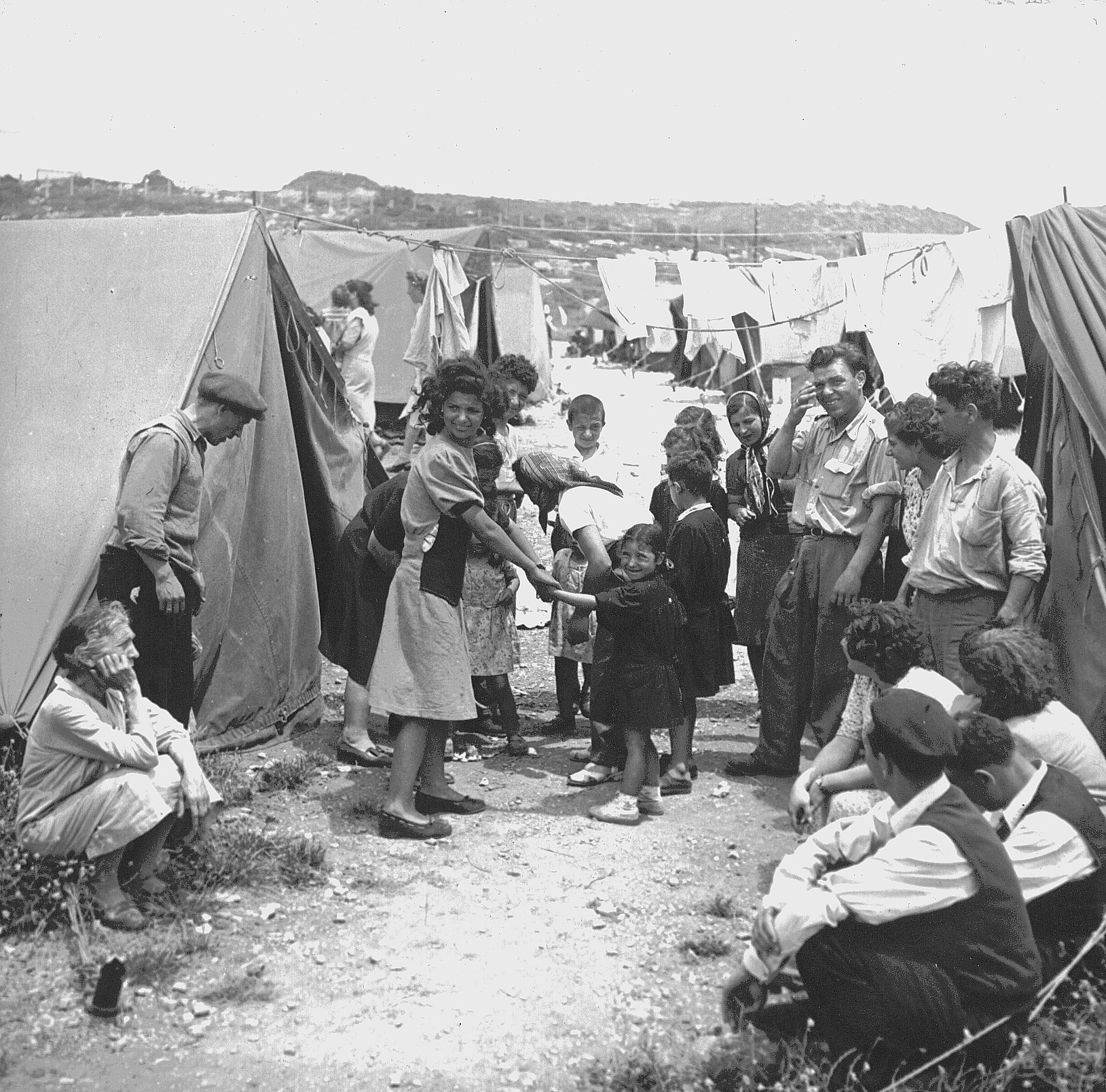
A ma’abara (refugee absorption center) in Israel, 1950. Photo: Jewish Agency for Israel / flickr

After the Six-Day War in 1967, a third wave of persecution took place in Egypt, accompanied by the imprisonment of all Jewish men and the confiscation of their property. This proved the last straw, and almost the entire Egyptian Jewish community, dating back thousands of years before the advent of Islam, took flight. The amount of Jewish private and public property stolen by Egypt is estimated today in the tens of billions of dollars, with some claiming that the number is in the hundreds of billions.

Along with the Jews of Egypt, the Jews of Iraq were hardest hit by the waves of persecution that swept the Arab world after 1948. In the 1950s, the Iraqi government allowed its Jews to leave the country on the condition that they renounce their citizenship and their property. This resulted in several massive waves of aliyah, whereby most of the community was brought to Israel—over 120,000 people. Under Baath party rule from 1968-1973, the Iraqi Jews suffered from harassment by the government, which did not allow them freedom of movement and confiscated their property. In 1969, a series of pogroms killed around 50 Jews. Following this, the entire community, dating back to the Babylonian exile, fled the country.

This pattern repeated itself throughout the Arab world. For years, the Jews of Syria were not permitted to leave. The Jews of Yemen, Libya, and other Arab states eventually fled under pressure from official persecution. Their property was, again, confiscated. During this time, the Jews of all the Arab countries were second-class citizens. The governments invariably saw them as a fifth columnists. In places like Lebanon, apartheid laws were put in place denying the Jews government jobs. In short, life was made impossible for the Jews until, as was likely intended, they fled.

For decades, the plight of the Jewish refugees from Arab countries has been denied or ignored. Certainly, it has not received proper attention from the international media. Everyone talks about the Palestinian Nakba and the eternal rights of Palestinian refugees. No one talks about the suffering of the Jews of the Arab countries, the persecution and violence they faced, and certainly not their confiscated property.
But there is reason to hope that this is changing. In 2008, the U.S. Congress unanimously adopted a resolution recognizing the rights of Jewish refugees from Arab countries and saying that, if aid is given to Palestinian refugees, there should be similar aid and compensation for the Jewish refugees. The Canadian parliament had done the same in 2004. (sic - 2014 - ed)

Israel has also made the issue a priority. Two lobbies have recently been established in the Knesset that deal with the issue: One for the preservation of the culture and legacy of the Jews of Arab and Islamic nations, and one for the return of confiscated Jewish property. In 2010, the Knesset adopted a law to protect the rights of Jewish refugees from Muslim countries to compensate for their stolen property. It explicitly placed the issue in the context of the peace process. More recently, the Knesset designated November 30 as “Jewish refugee day.”

These actions are heartening, because refugees and their descendants believe that it is not possible to make peace between Israel and the Palestinians while this issue is ignored. The fact that many do ignore it does not mean we have given up. We have a moral and legal obligation to demand compensation from the Arab nations for their crimes against us.

We must not forget the silent and silenced trauma of a people. In everything connected to the peace process, Israeli governments and the countries seeking to mediate negotiations must ensure that for any solution to the problem of the Palestinian refugees, any reference to recognition of the refugees, and the creation of any mechanisms for compensation, there must be reciprocity for Jewish refugees as well.


There may have been two Nakbas, but it must be noted that the Jewish Nakba is not only a story of catastrophe, it is also one of triumph over adversity. Even today, the Palestinian refugees and their descendants are considered refugees and receive aid from UNWRA. Every Palestinian child is recognized as a refugee and continues to be subsidized by the international community. The Palestinians refused to develop a new way of life, preferring to live in the illusion that someday they will be allowed to reenter Israel and overwhelm its Jewish population by sheer force of numbers. But the Jewish refugees from Arab nations succeeded in overcoming their difficulties. They came to Israel with little or nothing and built their homes here. Many of them became successful as doctors, engineers, and lawyers, while some have even been elected to the Knesset.

Nonetheless, the Jewish refugees should not be punished for their success. They had to overcome enormous difficulties to become part of Israeli society. The Jewish refugees arrived in Israel in a post-traumatic state. They did not talk about the past they had left behind. They were dispossessed and beaten down, and forged a life through an arduous process of survival. Most of them became part of larger society and made an extraordinary contribution to the state. But others, because their wealth and property had been stolen from them, remained mired in poverty on the periphery of Israel.

For them and their descendants, it is incumbent on the Western world to acknowledge that there were two Nakbas, two tragedies: The tragedy of the Palestinian refugees and the tragedy of the Jews from Arab nations.

The nature of aliyah from the Arab countries was diverse. Some chose to come to Israel out of Zionist convictions, but others did not. My family was one of the latter. We were third-generation residents of Lebanon, an inseparable part of Wadi Abu Jamil Street in the Beirut Jewish neighborhood of Harat Elihud. We did not want to leave. Over the years, we came to Israel for family visits, but always returned to our home in Lebanon. At that time, we were part of a community that numbered 7,000 in the 1970s.
Slowly, however, our situation became impossible. The rise of Hezbollah on one side and the weakness of the Lebanese government on the other left the Jews exposed to the same persecution our brothers and sisters had suffered before us. Slowly life became impossible. We became refugees, as defined in international law: someone who flees out of fear of persecution due to racial, religious, or national background.

We realized that this now applied to us in 1985, when Hezbollah kidnapped and murdered 12 Lebanese Jews.

Saturday, July 2, 2016

Arab Refuges in 1948 and the role of UNRWA for exponential fake increase for exerting International pressure on Zion

Arab Refuges in 1948 and the role of UNRWA for exponential  fake increase for exerting International pressure on Zion  

Historical Analysis Has Palestinian Refugees of 1948 Less Than 300,000

0


Fraudulent claims were made since UNRWA refugee camps were better than standard housing, so many non-refugee residents of Judea-Samaria & Gaza declared themselves refugees in order to gain access to free food, medical & educational benefits.


Most serious students of the history of Palestine would accept that the number of Arab refugees from Israel during and after 1948 claimed by Arab and UN sources—some 600,000 to 750,000—was exaggerated. It is very easy to refute that estimate and many have already done it. Yehoshua Porath , Israeli historian & professor emeritus of Middle East history.


It is a common misconception that around 650,000 Palestinian refugees were created because of fighting that took place in 1948. But a closer look at both the population data and statements made by UN officials at the time suggest that the true figure is much lower, possibly as low as 270,000.

The conventional figure of 650,000 cannot be true for more than one reason. Firstly, there were fewer than 660,000 Arabs living in the part of Palestine that eventually became Israel; and secondly, UNRWA (the United Nations Relief and Works Agency), either through incompetence or deliberate manipulation, handed out multiple identity cards to the same persons, some of whom were not refugees at all but permanent residents who took advantage of the aid offered by UNRWA. This is attested by UNRWA officials.

Before taking a look at UNRWA’s role in the invention of the Palestinian refugee problem, it is worthwhile examining the population data of Eretz Israel/Palestine prior to the 1948 Arab-Israeli War.

The Statistical Abstract of Palestine in 1944-45 set the figure for the total Arab population living in what would become the Jewish-settled territories at 570,800. Another set of figures based on a census taken in 1944 suggests there were 696,000 Arabs living in what would become Israeli-controlled territory. Tsvi Misinai, an Israeli researcher and historian, believes the figure to even lower. He believes that prior to the 1948 war, there were 390,000 Arabs living in areas that would fall into Israeli hands. (None of these figures include the number of Arab Palestinians residing in east Jerusalem, Gaza and Judea-Samaria. Figures vary, but the number of Arabs in those areas was probably 600,000, which brings the total number of Arabs residing between the Jordan River and the Mediterranean Sea to 1.2 million).

According to Misinai, there were in excess of 120,000 Arabs inside Israel’s borders by the end of the war, although most commentators believe the figure to be 160,000 or 170,000. (The discrepancy becomes less glaring when Israel’s repatriation of 20,000 Palestinian Arab refugees from Jordan is taken into account). This means that the number of Palestinian Arabs displaced from areas that came under Israeli control cannot be higher than 270,000.

Of the 270,000, most had ended up in neighbouring Arab countries, with the rest having fled to Judea-Samaria and Gaza. Around 4,000 had voluntarily moved from west Jerusalem into houses abandoned in east Jerusalem. During the course of the war, 77,000 Arabs (mostly Bedouin) returned to their homes in what would become Israeli territory. As the war went on, another 81,000 Palestinians fled, 24,000 of which had already fled and returned, only to flee again. By the war’s end, there were 270,000 Palestinian Arabs who had lost their homes and/or their land.

At first glance, this seems a rather low figure. A report submitted by the UN mediator Count Folke Bernadotte suggested that the number of Palestinian refugees totalled 330,000. Other contemporary reports put the number at around 424,000. Either way, it is statistically impossible for there to have been more than 430,000 genuine Palestinian Arab refugees from the 1948 war. This is the view of Dr Walter Pinner, who bases his figures on reliable census data carried out in the mid-1940s.


So we have a situation where no less than 270,000 and no more than 430,000 Palestinian refugees were created by the 1948 war. Misinai’s suggestion of 270,000 can be attributed to his rather low starting figure of 390,000 Arabs who resided in pre-state Israel. Perhaps if one takes into account the Arab migrants and citrus farm workers who had gone back to their country of origin, there may be a case for a final figure of 270,000. Plus, a reliable study undertaken in the mid-1960s suggests the figure of 270,000 may be close to the mark (more on this later).

Many books and websites quote a figure of 650,000 when discussing the number of Palestinian refugees created by the 1948 conflict. How did the figure of 650,000 arise?

One explanation is the attested fact that in the aftermath of the conflict, refugees were counted more than once. In order to receive extra funding, many refugees identified themselves twice before UNRWA officials. As a result, they received more than one identity card. One of the camp workers in Lebanon stated, “We try to count them, but they are coming and going all the time; or we count them in Western clothes, then they return in aba and keffiyeh and we count the same ones again.”

This was not the only fraud committed by the refugees. Another was the concealment of natural deaths so that families could continue to collect the deceased person’s food. Births, however, were always registered. In 1951, UNRWA reported that “it is still not possible to give an absolute figure of the true number of refugees as understood by the working definition of the word.” A reason given by UNRWA for the erratic data was that the refugees “eagerly report births and … reluctantly report deaths.” According to the July 23 1955 edition of the Cairo-based Mideast Mirror, “There are refugees who hold as many as 500 ration cards, 499 of them belonging to refugees long dead…. There are dealers in UNRWA food and clothing and ration cards to the highest bidder.”

Fraudulent claims were made regarding the number of dependents. It was alleged that refugees would “hire” children from other families at census time. In 1950, UNRWA director Howard Kennedy said that “fictitious names on the ration lists pertain to refugees in this area […] it is alleged that it is a common practice for refugees to hire children from other families at census time.”

The situation in Jordan was especially difficult because western Jordan was already populated by Arab Palestinians, so distinguishing a refugee from a non-refugee was particularly arduous. An UNRWA official noted that the Jordan ration lists alone “are believed to include 150,000 ineligibles and many persons who have died.” A similar situation arose in Lebanon. In a 1950 report to the UN General Assembly, the director of UNRWA noted that “many Lebanese nationals along the Palestinian frontier habitually worked most of the year on the farms or in the citrus groves of Palestine. With the advent of war they came back across the border and claimed status as refugees.” UNRWA conceded that up to 129,000 Lebanese workers may have falsely claimed Palestinian refugee status.

Palestinian UNRWA kindergarten refugee girls learn in a Jordanian classroom at the Jabal Hussein camp in 1961- 

In fact, this developed into a widespread trend. Because the UNRWA refugee camps were better than standard housing, some non-refugee residents of Judea-Samaria and Gaza declared themselves refugees in order to gain access to food, as well as medical and educational benefits. Many permanent residents of Judea-Samaria and Gaza came to carry both an UNRWA refugee card that had the address of a refugee camp and a regular ID card with their actual identity and address.

Another problem was the unrecorded movement of peoples, especially the Bedouin tribes who moved between Gaza, Israel, Jordan and Lebanon, thereby increasing multiple registrations. Even the UN acknowledged that 15,000 Bedouins were actually non-existent, that they were fictitious persons or people already registered. In the words of UNRWA, the movement of people introduced “a double source of error into any estimates of the number of persons who could have become refugees.”

By 1950, the UN disclosed that it was “not possible to give an absolute figure of the true number of refugees as understood by the working definition.” According to a report, the percentage of error in the UN statistics was “possibly as much as 50 per cent and represents a serious operational difficulty.”

Nonetheless, the UN kept revising its figures upwards because it pursued a maximalist position on who was a refugee, which ranged from a “needy person” who “has lost his home and means of livelihood” to “persons whose normal place of residence was Palestine between June 1946 and May 1948.” Even refugees who still had a house but had lost some or all of their land were considered refugees. In addition, Arabs who had settled in Palestine illegally prior to 1948 were also given refugee status. No wonder the figures were artificially high.

In 1966, Dr. Walter Pinner identified a huge number of fraudulent refugee claims. Basing his findings on UNRWA’s own reports, he discovered that 484,000 refugees were Arabs from western Jordan and Gaza Strip; another 117,000 were unrecorded deaths; 109,000 were people who had been resettled in 1948 and were no longer refugees; and a further 225,000 had subsequently settled elsewhere and become self-supporting. After subtracting the inauthentic claims, he concluded that there were 115,000 “old and sick” refugees, and 252,000 “other unsettled genuine refugees,” totaling 367,000 legitimate refugees as of 1966.

Once the natural rate of increase between 1948 and 1966 has been subtracted, the number of genuine Palestinian refugees from 1948 cannot be much higher than 300,000. In which case, Tsvi Misinai’s figure of 270,000 may not be far off the mark.

Significantly, UN Secretary General Dag Hammarskjold did not refute Dr Pinner’s findings, nor did he issue any corrections to Dr Pinner’s figures. He did, however, acknowledge receipt of Dr Pinner’s work, so it cannot be claimed that the UN wasn’t aware of his analysis. It is probable that the UN, at least in private, agreed with Dr Pinner’s findings but did not want to admit that UNRWA had been defrauded of millions of dollars.

All told, the conventional figure of 600,500 Palestinian refugees from the 1948 conflict comes from the double counting of refugees, the non-recording of deaths, the vague and expansive use of the term ‘refugee,’ the counting of people who were not refugees, the counting of former refugees who had resettled elsewhere, and the untracked movement of peoples between Jordan, Gaza, Lebanon and Judea-Samaria.

The implication is that many of today’s Palestinian refugees actually derive from people who did not reside in Palestine at the time of the war or had lived there for only two years, which means more than half – possibly even two-thirds – of those who claim to be Palestinian refugees in 2016 are not descended from Palestinian refugees at all. (What is also galling is that the living conditions in the Palestinian refugee camps are much better than the conditions of their non-refugee Arab neighbours who do not receive international aid. Indeed, many of the Palestinian refugee camps are not camps at all, but are fully-functioning neighborhoods.)

The Aida Refugee Camp in West Bank city of Bethlehem. – Photo: upi

The Arab states themselves have been major players in the refugee fraud. Greed was one motivating factor because UNRWA money was, in effect, free money. In 1961 UNRWA director John H. David admitted that Arab countries overstated their refugee figures in the 1950s to get more funds. But the refugee crisis was useful for another reason: It was a way of exerting international pressure on the State of Israel to repatriate the so-called refugees, thereby demographically destroying the Jewish state. This explains why the Arabs didn’t permanently rehouse the refugees in Judea-Samaria and Gaza, which were under Jordanian and Egyptian control respectively between 1948 and 1967.

The sordid history of the Palestinian refugee situation means the Israeli government must be extremely wary about compensating or repatriating Palestinians who claim to be refugees. Many of them are frauds or the descendants of frauds. If the Israeli government does decide to compensate or repatriate some of the refugees as part of a peace deal, then a detailed investigation needs to be conducted to ensure that only genuine claimants are assisted. In return, a wider compensation package is needed in which the descendants of Jews who lost their homes, savings and livelihoods in Nazi Europe (not just Germany) are compensated, and the Jews forced from Arab lands in the 1940s and 1950s are likewise recompensed. In addition, there needs to be some recognition that many Jews were killed and displaced in the 1948 war – a war instigated by an alliance of several Arabs nations to destroy the Jewish homeland.

Saturday, June 4, 2016

After Mahmoud Abbas Quo Vadis the Palestinian Authority and its Struggle against Zion


What if a Shakespearean palace battle to succeed Palestinian bigwig Mahmoud Abbas was raging and no one was there to document it?

American and Israeli officials shrugged off Abbas’s warnings last fall that he’d dissolve the Palestinian Authority, of which he’s president. The rais (boss) had so often made similar threats in the past that no one took him seriously.

No one, that is, except some in Ramallah who started thinking that maybe, well into Abbas’ tenth year of a four-year term, the 81-year-old chain-smoker is finally thinking of mortality, retirement — or just a bit of rest.

Abbas had always discouraged such notions. Palestinian doubters and dissenters are jailed or otherwise made to shut up. Yet now even Abbas’ own former yes-men started making public statements that could easily be interpreted as a challenge to his hold on power.

Palestinian Sports Minister Jibril Rajoub wondered out loud where Abbas is leading the Palestinians. Mohammed Dahlan, a Dubai-based former Gaza strongman who pulls West Bank strings from afar, raised his Abbas criticism a notch. Even top loyalists like long-time negotiator Saeb Erekat and intelligence chief Majid Faraj sounded like they were contemplating a leadership fight.

When Palestinian security forces arrested a top manager in Erekat’s office earlier this month, accusing him of spying for Israel, West Bankers speculated that it was orchestrated by Erekat’s rivals seeking to make him look bad.

But as whispers of a succession battle intensified, Abbas realized he risked losing his grip. In the last couple of weeks he gathered loyalists to assure them he’s going nowhere. He then started a campaign to rein in the terrorist wave he had unleashed in September but of which he’s clearly lost control.

Faraj, the intel chief, gave a rare interview to the New York-based Defense News this week, boasting he’d prevented 200 terrorist attacks and arrested 100 Palestinians. It signaled to outsiders that the PA is fighting terror, but at home the message was, hey, watch out. (Faraj didn’t say how many of the men he’d arrested were mere critics or political rivals.)

At the same time, officials in Ramallah leaked to reporters that they’re about to launch a UN campaign to fight Israel diplomatically.

These are staples of Abbas’ longtime tactics, which suggests he’s got full control of the reins again.

But, like it or not, he won’t live or rule forever.

And then what? To fend off pesky rivals, Abbas has long avoided anointing a successor or naming a deputy. So who decides who’s next?

According to Palestinian law, the speaker of parliament would take over pending new elections. But the parliament hasn’t convened in years. And the current speaker is a member of Hamas, Abbas’ Islamist rivals.

Israel and the US — and, even more so, members of Abbas’ Fatah party — won’t let him get near the seat of power. Nor would they risk another humiliating election, which Hamas is likely to win.

In other words, no one in the West Bank knows how the next leader will emerge — “and Israeli intelligence officials, whose entire job is to predict such things, have no idea either,” says Gal Berger, Israel Radio’s indispensable Palestinian affairs correspondent.

When the time comes, the Fatah men who in the last few weeks started jockeying for position will duke it out for real. Such chaotic political fighting often leads to violence.

Once that violence ebbs, a new strongman will emerge.

But not a peaceful, democratic state of Palestine.

This week, the UN’s Ban Ki-moon said Palestinian terrorism is part of “human nature” to resist occupation through “hate and extremism.” US Ambassador to Israel Dan Shapiro earlier said Israel’s justice system employs “two standards” — one for Israelis and another for Palestinians (and later said he regretted his timing).

The real double standard is in endlessly scrutinizing Jerusalem while ignoring Ramallah. Rather than promoting two states, it only assures endless failure in the West Bank and Gaza.
Confederation with Jordan?

Surprising an interviewer from a well-known Palestinian website two months ago, famed Palestinian man of letters Sari Nusseibeh said the concept of a Jordanian-Palestinian confederation should be reconsidered.

The idea of a confederation has been almost completely discredited in recent years — a process that began with a 1988 announcement by the late King Hussein of Jordan that he was giving up his claim to Palestinian-controlled territories.

The comments by Nusseibeh, the president of Al-Quds University, were thus widely perceived among Palestinians as an irrelevant example of his unusual musings and doings, such as his ill-fated 2003 peace initiative with former Shin Bet chief and ex-Labor MK Ami Ayalon.

The remarks did spark some dialogue, in particular among some of the older generation and the more affluent tiers of Palestinian society – the business people and merchants. Ultimately, however, it is clear that the Hashemite royal family has no interest in reviving the initiative.


President of Al-Quds University Prof. Sari Nusseibeh in his office at the university in Beit Hanina, in East Jerusalem. 


But then came another surprising statement, this time from a member of the Jordanian establishment.

Last week, Jordan’s former prime minister, Abdelsalam al-Majali, visited the West Bank city of Nablus as the guest of Ghassan Shakaa, the city’s former mayor and a member of the PLO Executive Committee,

Speaking to 100 key Palestinians in the Nablus area, Majali expressed support for a Jordanian-Palestinian confederation, after the establishment of a Palestinian state. “Jordan cannot live without Palestine and Palestine cannot live without Jordan,” Majali said. “The prime minister of Israel, Benjamin Netanyahu, wants such a confederation established. He asked as much several times but was refused completely.”

The confederation, Majali said, should be headed by a joint government and parliament that would guarantee security, oversee the economy and handle foreign affairs. As things stood, he said, the Arab Ummah [nation] was not fighting for the Palestinians since they have no viable economic capacity on their own.

(Incidentally, Majali also criticized education systems in the Arab world, saying they are not preparing students well enough to tackle scientific issues, “and this allows them to learn only history.”)

Majali’s speech created a real stir among Palestinians. While he no longer holds an official position with the court of Jordan’s King Abdullah, he is still considered a person of influence among the Jordanian elite and among local politicians, having twice served as prime minister.

In the past, Majali was regarded as a close associate of King Hussein. Was his speech coordinated with the Jordanian monarchy, as part of an effort to revive Palestinian – and especially Israeli – faith that peace is possible? Or were these merely the words of an aging ex-politician, who wields no influence with King Abdullah?

A Jordan expert at Tel Aviv University dismissed Majali’s speech.

“It sounds like another attempt by one of the ‘formers’ to make headlines,” said Dr. Yoav Alon. “Majali spoke of this two or three years ago, and the idea in fact dates back to 1982, as an initiative of King Hussein. Then there was an agreement between Hussein and [former PLO leader Yasser] Arafat, that the leadership of PLO rejected. So, in 1988, the king announced he was disengaging from the West Bank. Still,” Alon went on, “one must emphasize: The official Jordanian position does not reject the possibility of establishing a confederation, albeit only after the establishment of a Palestinian state.

“This idea rises now and again when the Palestinians are in distress and diplomacy offers no hope,” Alon went on. “Maybe it also helps Israel swallow the idea that a Palestinian state may rise. For now, the idea of a confederation is non-obligating, so nobody can say precisely what it means. Furthermore, I don’t see any support from official Jordan or the royal family in this idea. Jordan’s demographic situation is delicate as it is. The Palestinians make up 50 percent of the population there. The Jordanians make up 25-30% and the rest are Syrian and Iraqi refugees. That is why they are so sensitive to this notion. The Jordanian regime has no interest in promoting the idea of a confederation and this is why I think there is nothing concrete here,” Alon said.

Senior Palestinian officials speaking to the Times of Israel also dismissed the idea of a confederation. They vaguely said, too, that it may be reconsidered after the establishment of a Palestinian state.

Other Palestinian sources said the Hashemite monarchy is preoccupied, where the Palestinians are concerned, with resolving the Israeli-Palestinian diplomatic deadlock, grappling with the fear of a deterioration into violence in the West Bank which would impact Jordan, and dealing with tensions in its ties with Palestinian Authority President Mahmoud Abbas.

Amman is not pleased by Abbas’s recent shows of independence, including his making diplomatic moves without first consulting King Abdullah, and this has created tension between the two men, the sources said.


Palestinian Authority President Mahmoud Abbas (right) and Mohammad Dahlan (left), leave a news conference in Egypt, in February 2007.


Ramallah has also been angered by reports that representatives of the Hashemite Kingdom have met with several Palestinian officials, gauging their suitability to take over the PA presidency one day. Especially infuriating for Abbas, the sources said, is that the Jordanians met with his No. 1 enemy, Mohammad Dahlan.

The Jordanians also met with Nasser al-Kidwa, Arafat’s nephew and a former PA foreign minister, whose name keeps coming up, and with ex-PA security chief Jibril Rajoub among others.

Nasser al-Kidwa 

Such Jordanian meddling in Palestinian politics, preparing for the day after Abbas, is seen extremely negatively in Ramallah, the sources said.

The tension between Ramallah and Amman underlines how improbable the idea of a confederation currently seems, much to the chagrin of some of the “West Bank elders” who miss the days when King Hussein was sovereign in the West Bank and the Palestinians had ministers in the Jordanian government and representatives in its parliament.

Monday, May 23, 2016

The Arab Boycott of Zion... Myths and facts


MYTH
“The Jews started the first war with the Arabs.”
FACT

The Arabs made clear they would go to war to prevent the establishment of a Jewish state. The chairman of the Arab Higher Committee said the Arabs would “fight for every inch of their country.” Two days later, the holy men of Al-Azhar University in Cairo called on the Muslim world to proclaim a jihad (holy war) against the Jews.  Jamal Husseini, the Arab Higher Committee’s spokesman, had told the UN prior to the partition vote the Arabs would drench “the soil of our beloved country with the last drop of our blood. . . .”

Map of Arab Invasion, 1948


Husseini’s prediction began to come true almost immediately after the UN adopted the partition resolution on November 29, 1947. The Arabs declared a protest strike and instigated riots that claimed the lives of 62 Jews and 32 Arabs. Violence continued to escalate through the end of the year.4

The first large-scale assaults began on January 9, 1948, when approximately 1,000 Arabs attacked Jewish communities in northern Palestine. By February, the British said so many Arabs had infiltrated they lacked the forces to run them back.

In the first phase of the war, lasting from November 29, 1947, until April 1, 1948, the Palestinian Arabs took the offensive, with help from volunteers from neighboring countries. The Jews suffered severe casualties and passage along most of their major roadways was disrupted.

On April 26, 1948, Transjordan’s King Abdullah said,"'All our efforts to find a peaceful solution to the Palestine problem have failed. The only way left for us is war. I will have the pleasure and honor to save Palestine.'"

On May 4, 1948, the Arab Legion attacked Kfar Etzion. The defenders drove them back, but the Legion returned a week later. After two days, the ill-equipped and outnumbered settlers were overwhelmed. Many defenders were massacred after they had surrendered.  This was prior to the invasion by the regular Arab armies that followed Israel’s declaration of independence.

The UN blamed the Arabs for the violence. The UN Palestine Commission, which was never permitted by the Arabs or British to go to Palestine to implement the resolution, reported to the Security Council on February 16, 1948, that “powerful Arab interests, both inside and outside Palestine, are defying the resolution of the General Assembly and are engaged in a deliberate effort to alter by force the settlement envisaged therein.”

The Arabs were blunt in taking responsibility for the war. Jamal Husseini told the Security Council on April 16, 1948:

The representative of the Jewish Agency told us yesterday that they were not the attackers, that the Arabs had begun the fighting. We did not deny this. We told the whole world that we were going to fight.

The British commander of Jordan’s Arab Legion, John Bagot Glubb admitted.""Early in January, the first detachments of the Arab Liberation Army began to infiltrate into Palestine from Syria. Some came through Jordan and even through Amman . . . ​They were in reality to strike the first blow in the ruin of the Arabs of Palestine. ""

Despite the disadvantages in numbers, organization and weapons, the Jews began to take the initiative in the weeks from April 1 until the declaration of independence on May 14. The Haganah captured several major towns including Tiberias and Haifa, and temporarily opened the road to Jerusalem.

The partition resolution was never suspended or rescinded. Thus, Israel, the Jewish State in Palestine, was born on May 14, as the British finally left the country. Five Arab armies (Egypt, Syria, Transjordan, Lebanon and Iraq) immediately invaded Israel. Their intentions were declared by Abd Al-Rahman Azzam Pasha, Secretary-General of the Arab League: “It will be a war of annihilation. It will be a momentous massacre in history that will be talked about like the massacres of the Mongols or the Crusades.”


Military Situation at Cease Fire (June 11, 1948)


MYTH

“The United States was the only nation that criticized the Arab attack on Israel.”

FACT

The United States, the Soviet Union and most other states recognized Israel soon after it declared independence on May 14, 1948, and immediately condemned the Arabs for their aggression. The United States urged a resolution charging the Arabs with breach of the peace.

Soviet delegate Andrei Gromyko told the Security Council, May 29, 1948,""
This is not the first time that the Arab states, which organized the invasion of Palestine, have ignored a decision of the Security Council or of the General Assembly. The USSR delegation deems it essential that the council should state its opinion more clearly and more firmly with regard to this attitude of the Arab states toward decisions of the Security Council.""

On July 15, the Security Council threatened to cite the Arab governments for aggression under the UN Charter. By this time, the Israel Defense Forces (IDF) had succeeded in stopping the Arab offensive and the initial phase of the fighting ended.


MYTH

“The West’s support of Israel allowed the Jews to conquer Palestine.”

FACT

The Jews won their war of independence with minimal help from the West. In fact, they won despite actions that undermined their military strength.

Although the United States vigorously supported the partition resolution, the State Department did not want to provide the Jews with the means to defend themselves. “Otherwise,” Undersecretary of State Robert Lovett argued, “the Arabs might use arms of U.S. origin against Jews, or Jews might use them against Arabs.”  Consequently, on December 5, 1947, the U.S. imposed an arms embargo on the region.

Many opponents of the Jewish state in the State Department saw the embargo as a means of obstructing partition. President Truman, however, supported it because he hoped it could avert bloodshed. This was naive given Britain’s rejection of Lovett’s request to suspend weapons shipments to the Arabs and subsequent agreements to provide additional arms to Iraq and Transjordan.

Armistice Lines, 1949


The Arabs had no difficulty obtaining all the arms they needed. In fact, Jordan’s Arab Legion was armed and trained by the British, and led by a British officer. At the end of 1948, and beginning of 1949, British RAF planes flew with Egyptian squadrons over the Israel-Egypt border. On January 7, 1949, Israeli planes shot down four of the British aircraft.

The Jews, on the other hand, were forced to smuggle weapons, principally from Czechoslovakia. When Israel declared itsindependence in May 1948, the army did not have a single cannon or tank. Its air force consisted of nine obsolete planes. Although the Haganah had 60,000 trained fighters, only 18,900 were fully mobilized, armed and prepared for war. 16 On the eve of the war, chief of operations Yigael Yadin told David Ben-Gurion: “The best we can tell you is that we have a 50–50 chance.”

The Arab war to destroy Israel failed. Indeed, because of their aggression, the Arabs wound up with less territory than they would have had if they had accepted partition.

The cost to Israel, however, was enormous. “Many of its most productive fields lay gutted and mined. Its citrus groves, for decades the basis of the Yishuv’s Jewish community economy, were largely destroyed.”  Military expenditures totaled approximately $500 million. Worse yet, 6,373 Israelis were killed, nearly one percent of the Jewish population of 650,000.

Had the West enforced the partition resolution or given the Jews the capacity to defend themselves, many lives might have been saved.

The Arab countries signed armistice agreements with Israel in 1949, starting with Egypt (Feb. 24), followed by Lebanon (March 23), Jordan (April 3) and Syria (July 20). Iraq was the only country that did not sign an agreement with Israel, choosing instead to withdraw its troops and hand over its sector to Jordan’s Arab Legion. None of the Arab states would negotiate a peace agreement.


MYTH

“The Arab economic boycott was imposed in response to the creation of Israel.”

FACT

The Arab boycott was formally declared by the newly formed Arab League Council on December 2, 1945: “Jewish products and manufactured goods shall be considered undesirable to the Arab countries.” All Arab “institutions, organizations, merchants, commission agents and individuals” were called upon “to refuse to deal in, distribute, or consume Zionist products or manufactured goods.” As is evident in this declaration, the terms “Jewish” and “Zionist” were used synonymously. Thus, even before the establishment of Israel, the Arab states had declared an economic boycott against the Jews of Palestine.

The boycott, as it evolved after 1948, is divided into three components. The primary boycott prohibits direct trade between Israel and the Arab nations. The secondary boycott is directed at companies that do business with Israel. The tertiary boycott involves the blacklisting of firms that trade with other companies that do business with Israel.

The objective of the boycott has been to isolate Israel from its neighbors and the international community, and deny it trade that might be used to augment its military and economic strength. While undoubtedly isolating Israel and separating the Jewish State from its most natural markets, the boycott failed to undermine Israel’s economy to the degree intended.

In 1977, Congress prohibited U.S. companies from cooperating with the Arab boycott. When President Carter signed the law, he said the “issue goes to the very heart of free trade among nations” and that it was designed to “end the divisive effects on American life of foreign boycotts aimed at Jewish members of our society.”

The boycott has gradually crumbled and few countries outside the Middle East comply with it. The primary boycott—prohibiting direct relations between Arab countries and Israel—cracked when nations such asQatar, Oman and Morocco negotiated deals with Israel. Saudi Arabia, pledged to end its economic boycott as a condition for membership in the World Trade Organization but, after winning acceptance, continued its prior policy.  Meanwhile, the boycott remains technically in force.


Thursday, May 5, 2016

King Abdullah I and 1944 Zionism

Amman, Jordan- Members of the royal family are shown standing behind the flag-draped coffin of assassinated King Abdullah of Jordan, as prayers are offered ...

Jordan, is not being at all helpful in the matter of maintaining calm in Jerusalem, especially over the Temple Mount status quo.  It is also not promoting coexistence.But that's not new.
Let's go back to 1944:
867N.00/3–344
[Document 635]
Amir Abdullah of Transjordan to President Roosevelt
Amman, March 3, 1944.
The deliberations of Congress affecting Palestine and the formation of a Jewish State therein have caused a great and heartfelt distress throughout the East. I say and I am convinced that the absence of sufficient information in the House of Congress respecting the true situation has facilitated the way to those in sympathy with the Zionist cause to further these deliberations. Remembering the great respect and admiration in which I hold you, your country and the American people, I say that while you are fighting with the United Nations for the freedom of the world and the removal of oppression at the same time the present deliberations are I feel contrary to that principle and would lead to the greatest sorrow and suffering if the intentions of the promoters of those deliberations were to be realized. I mention this personally in my capacity as a close neighbor of Palestine and as a loyal friend of the United Nations.
Abdullah
And , the reply:
In so far as Palestine is concerned, I am glad to convey to you the assurance that in the view of the Government of the United States no decision altering the basic situation of Palestine should be reached without full consultation with both Arabs and Jews.”   Hull


Abdullah I
Cecil Beaton Photographs- Political and Military Personalities; Abdullah, King of Jordan; Abdullah, King of Jordan CBM1666.jpg
King of Jordan
Reign25 May 1946 – 20 July 1951
PredecessorOffice established (formerlyEmir of Transjordan)
SuccessorTalal
Emir of Transjordan
Reign1 April 1921 – 25 May 1946
PredecessorOffice Established
SuccessorOffice changed to King of Jordan
BornFebruary 1882
MeccaOttoman Empire
Died20 July 1951 (aged 69)[1][2]
Al Aqsa MosqueJerusalem
BurialRaghadan Palace
Consort
Junior wives
Musbah bint Nasser
Suzdil Khanum
Nahda bint Uman
IssuePrincess Haya
Talal I
Prince Naif
Princess Munira
Princess Maqbula
Princess Naifeh
HouseHashemite
FatherHussein bin Ali
MotherAbdiyya bint Abdullah
ReligionSunni Islam
Abdullah I bin al-Hussein, King of Jordan (Arabic: عبد الله الأول بن الحسين‎, Abd Allāh ibn al-Husayn, February 1882 – 20 July 1951) born in Mecca, Hejaz, Ottoman Empire (in modern-day Saudi Arabia) was the second of three sons of Hussein bin Ali, Sharif and Emir of Mecca and his first wife Abdiyya bint Abdullah (d. 1886). He was educated in Istanbul and Hejaz. From 1909 to 1914, Abdullah sat in the Ottoman legislature, as deputy for Mecca, but allied with Britain during World War I. Between 1916 to 1918, working with the British guerrilla leader T. E. Lawrence, he played a key role as architect and planner of the Great Arab Revolt against Ottoman rule, leading guerrilla raids on garrisons. He was the ruler of Transjordan and its successor state, Jordan, from 1921 to 1951—first as Emir under a British Mandate from 1921 to 1946, then as King of an independent nation from 1946 until his assassination in 1951.

Early political career

In 1910, Abdullah persuaded his father to stand, successfully, for Grand Sharif of Mecca, a post for which Hussein acquired British support. In the following year he became deputy for Mecca in the parliament established by the Young Turks, acting as an intermediary between his father and the Ottoman government. In 1914, Abdullah paid a clandestine visit to Cairo to meet Lord Kitchener to seek British support for his father's ambitions in Arabia.

Abdullah maintained contact with the British throughout the First World War and in 1915 encouraged his father to enter into correspondence with Sir Henry McMahon, British high commissioner in Egypt, about Arab
independence from Turkish rule. (see McMahon-Hussein Correspondence). This correspondence in turn led to the Arab Revolt against the Ottomans. During the Arab Revolt of 1916–18, Abdullah commanded the Arab Eastern Army.Abdullah began his role in the Revolt by attacking the Ottoman garrison at Ta’if on 10 June 1916.The garrison consisted of 3,000 men with ten 75-mm Krupp guns. Abdullah led a force of 5,000 tribesmen but they did not have the weapons or discipline for a full attack. Instead he laid siege to town. In July he received reinforcements from Egypt in the form ofhowitzer batteries manned by Egyptian personnel. He then joined the siege of Medina commanding a force of 4,000 men based to the east and north-east of the town. In early 1917, Abdullah ambushed an Ottoman convoy in the desert, and captured £20,000 worth of gold coins that were intended to bribe the Bedouin into loyalty to the Sultan. In August 1917, Abdullah worked closely with the French Captain Muhammand Ould Ali Raho in sabotaging the Hejaz Railway. Abdullah's relations with the British Captain T. E. Lawrence were not good, and as a result, Lawrence spent most of his time in the Hejaz serving with Abdullah's brother Faisal who commanded the Arab Northern Army.
Founding of the Emirate of Transjordan

Abdullah I of Transjordan during the visit to Turkey withTurkish President Mustafa Kemal

When French forces captured Damascus at the Battle of Maysalun and expelled his brother Faisal, Abdullah moved his forces from Hejaz into Transjordan with a view to liberating Damascus, where his brother had been proclaimed King in 1918.Having heard of Abdullah's plans, Winston Churchill invited Abdullah to a famous "tea party" where he convinced Abdullah to stay put and not attack Britain's allies, the French. Churchill told Abdullah that French forces were superior to his and that the British did not want any trouble with the French. Abdullah acquiesced and was rewarded when the British created a protectorate for him, which later became the Emirate of Transjordan. On March 8, 1920, Abdullah was proclaimed King of Iraq by the Iraqi Congress but he refused the position. After his refusal, his brother who had just been defeated in Syria and was in need of a kingdom, accepted the position.

Although Abdullah established a legislative council in 1928 its role remained advisory leaving him to rule as an autocrat. Prime Ministers under Abdullah formed 18 governments during the 23 years of the Emirate.

Abdullah set about the task of building Transjordan with the help of a reserve force headed by Lieutenant-Colonel Frederick Peake, who was seconded from the Palestine police in 1921.The force, renamed the Arab Legion, in 1923 was led by John Bagot Glubb between 1930 and 1956 During the Second World War Abdullah was a faithful ally of the British, maintaining strict order within Transjordan, and helping to suppress a pro-Axis uprising in Iraq. His army, the Arab Legion assisted in the occupation of Iraq and Syria.

Abdullah embarked on negotiations with the British to gain independence; on 25 May 1946 the Hashemite Kingdom of Transjordan (renamed the Hashemite Kingdom of Jordan on 26 Apr 1949) was proclaimed independent and Abdullah crowned king inAmman.
Expansionist aspirations
Coronation of King Abdullah in Amman. Right to left: King Abdullah, Emir 'Abd al-Ilah (Regent of the Kingdom of Iraq), and Emir Naif (King Abdullah's youngest son), 25 May 1946.

Abdullah, alone among the Arab leaders of his generation, was considered a moderate by the West It is possible that he might have been willing to sign a separate peace agreement with Israel, but for the Arab League's militant opposition. Because of his dream for a Greater Syria comprising the borders of what was thenTransjordan, Syria, Lebanon, and the British Mandate for Palestine under a Hashemite dynasty with "a throne in Damascus," many Arab countries distrusted Abdullah and saw him as both "a threat to the independence of their countries and they also suspected him of being in cahoots with the enemy" and in return, Abdullah distrusted the leaders of other Arab countries.

Abdullah supported the Peel Commission in 1937, which proposed that Palestine be split up into a small Jewish state (20 percent of the British Mandate for Palestine) and the remaining land be annexed into Transjordan. The Arabs within Palestine and the surrounding Arab countries objected to the Peel Commission while the Jews accepted it reluctantly.Ultimately, the Peel Commission was not adopted. In 1947, when the UN supportedpartition of Palestine into one Jewish and one Arab state, Abdullah was the only Arab leader supporting the decision.

In 1946–48, Abdullah actually supported partition in order that the Arab allocated areas of the British Mandate for Palestine could be annexed into Transjordan. Abdullah went so far as to have secret meetings with the Jewish Agency (future Israeli Prime Minister Golda Meir was among the delegates to these meetings) that came to a mutually agreed upon partition plan independently of the United Nations in November 1947. On 17 November 1947, in a secret meeting with Meir, Abdullah stated that he wished to annex all of the Arab parts as a minimum, and would prefer to annex all of Palestine.This idea of secret Zionist-Hashemite negotiations in 1947 was expanded upon by New Historian Avi Shlaim in his book Collusion Across The Jordan: King Abdullah, the Zionist Movement, and the Partition of Palestine. This partition plan was supported by British Foreign Secretary Ernest Bevin who preferred to see Abdullah's territory increased at the expense of the Palestinians rather than risk the creation of a Palestinian state headed by the Mufti of Jerusalem Mohammad Amin al-Husayni

The claim has, however, been strongly disputed by Israeli historian Efraim Karsh. In an article in Middle East Quarterly, he alleged that "extensive quotations from the reports of all three Jewish participants [at the meetings] do not support Shlaim's account...the report of Ezra Danin and Eliahu Sasson on the Golda Meir meeting (the most important Israeli participant and the person who allegedly clinched the deal with Abdullah) is conspicuously missing from Shlaim's book, despite his awareness of its existence".[ According to Karsh, the meetings in question concerned "an agreement based on the imminent U.N. Partition Resolution, [in Meir's words] "to maintain law and order until the UN could establish a government in that area"; namely, a short-lived law enforcement operation to implement the UN Partition Resolution, not obstruct it"

On 4 May 1948, Abdullah, as a part of the effort to seize as much of Palestine as possible, sent in the Arab Legion to attack the Israeli settlements in the Etzion Bloc. Less than a week before the outbreak of the 1948 Arab–Israeli War, Abdullah met with Meir for one last time on 11 May 1948.Abdullah told Meir, "Why are you in such a hurry to proclaim your state? Why don't you wait a few years? I will take over the whole country and you will be represented in my parliament. I will treat you very well and there will be no war". Abdullah proposed to Meir the creation "of an autonomous Jewish canton within a Hashemite kingdom," but "Meir countered back that in November, they had agreed on a partition with Jewish statehood." Depressed by the unavoidable war that would come between Jordan and the Yishuv, one Jewish Agency representative wrote, "[Abdullah] will not remain faithful to the 29 November [UN Partition] borders, but [he] will not attempt to conquer all of our state [either]."Abdullah too found the coming war to be unfortunate, in part because he "preferred a Jewish state as Transjordan's neighbor to a Palestinian Arab state run by the mufti."

The Palestinian Arabs, the neighboring Arab states, and the promise of the expansion of territory and the goal to conquer Jerusalem finally pressured Abdullah into joining them in an "all-Arab military intervention" against the newly created State of Israel on 15 May 1948, which he used to restore his prestige in the Arab world, which had grown suspicious of his relatively good relationship with Western and Jewish leaders. Abdullah was especially anxious to take Jerusalem as compensation for the loss of the guardianship of Mecca, which had traditionally held by the Hashemites until Ibn Saud had seized the Hejaz in 1925. Abdullah's role in this war became substantial. He distrusted the leaders of the other Arab nations and thought they had weak military forces; the other Arabs distrusted Abdullah in return. He saw himself as the "supreme commander of the Arab forces" and "persuaded the Arab League to appoint him" to this position. His forces under their British commander Glubb Pasha did not approach the area set aside for the new Israel, though they clashed with the Yishuv forces around Jerusalem, intended to be an international zone. According to Abdullah el-Tell it was the King's personal intervention that led to the Arab Legion entering the Old City against Glubb's wishes.

After conquering the West Bank, including East Jerusalem, at the end of the war, King Abdullah tried to suppress any trace of a Palestinian Arab national identity. Abdullah annexed the conquered Palestinian territory and granted the Palestinian Arab residents in Jordan Jordanian citizenship.In 1949, Abdullah entered secret peace talks with Israel, including at least five with Moshe Dayan, the Military Governor of West Jerusalem and other senior Israelis. News of the negotiations provoked a strong reaction from other Arab States and Abdullah agreed to discontinue the meetings in return for Arab acceptance of the West Bank's annexation into Jordan.

Assassination

On 20 July 1951, Abdullah, while visiting Al-Aqsa Mosque in Jerusalem, was shot dead by a Palestinian from the Husseini clan. On 16 July, Riad Bey Al Solh, a former Prime Minister of Lebanon, had been assassinated in Amman, where rumours were circulating that Lebanon and Jordan were discussing a joint separate peace with Israel. The assassin passed through apparently heavy security. Abdullah was in Jerusalem to give a eulogy at the funeral and for a prearranged meeting with Reuven Shiloah and Moshe Sasson. Abdullah was shot while attending Friday prayers at the Al-Aqsa Mosque in the company of his grandson, Prince Hussein. The Palestinian gunman fired three fatal bullets into the King's head and chest. Abdullah's grandson, Prince Hussein, was at his side and was hit too. A medal that had been pinned to Hussein's chest at his grandfather's insistence deflected the bullet and saved his life. Once Hussein became king, the assassination of Abdullah was said to have influenced Hussein not to enter peace talks with Israel in the aftermath of the Six-Day War in order to avoid a similar fate.

The assassin was a 21-year-old tailor's apprentice, Mustafa Ashi, who according to Alec Kirkbride, the British Resident in Amman, was a "former terrorist", Zakariyya Ukah a livestock dealer and butcher. Ten conspirators were accused of plotting the assassination and were brought to trial in Amman. The prosecution named Colonel Abdullah el-Tell, ex-Military Governor of Jerusalem, and Musa Abdullah Husseini as the chief plotters of "the most dastardly crime Jordan ever witnessed." The Jordanian prosecutor asserted that Col. el-Tell, who had been living in Cairo since January 1950, had given instructions that the killer, made to act alone, be slain at once thereafter to shield the instigators of the crime. Jerusalem sources added that Col. el-Tell had been in close contact with the former Grand Mufti of Jerusalem, Amin al-Husayni, and his adherents in Arab Palestine. El-Tell and Husseini, and three co-conspirators from Jerusalem were sentenced to death. On 6 September 1951, Musa Ali Husseini, 'Abid and Zakariyya Ukah, and Abd-el-Qadir Farhat were executed by hanging.

Abdullah was succeeded by his son Talal; however, since Talal was mentally ill, Talal's son Prince Hussein became the effective ruler as King Hussein at the age of seventeen. In 1967, el-Tell received a full pardon from King Hussein.

Marriages and children

Abdullah was a polygamist permitted by the Koran and was had three wifes

In 1904, Abdullah married his first wife Musbah bint Nasser (1884 – 15 March 1961) at Stinia Palace, İstinye, Istanbul, Ottoman Empire. She was a daughter of Emir Nasser Pasha and his wife Dilber Khanum. They had three children:
  • Princess Haya (1907–90). Married Abdul-Karim Ja'afar Zeid Dhaoui.
  • HM Talal I (26 February 1909 – 7 July 1972).
  • Princess Munira (1915–87). Never married.
In 1913, Abdullah married his second wife Suzdil Khanum (d. 16 August 1968), at Istanbul, Turkey. They had two children:

  • HE Damat Prince Nayef bin Abdullah Beyefendi (Ta'if, 14 November 1914 – Amman, 12 October 1983). A Colonel of the Royal Jordanian Land Force. Regent for his older half-brother Talal from 20 July to 3 September 1951). Married in Cairo or Amman on 7 October 1940 Princess Mihrimâh Selcuk Sultan (11 November 1922 – Amman, March 2000 and buried Istanbul, 2 April 2000), daughter of Prince Şehzade Mehmed Ziyaeddin Efendi (Ortaköy, Ortaköy Palace, 26 August 1873 – Alexandria, 30 January 1938) and fifth wife (m. 10 February 1923) Neshemend Hanım Efendi (1905 – Alexandria, 1 February 1934 and buried in Cairo), and paternal granddaughter of Mehmed V by first wife. Father of: Prince and Prince Sultanzade Asem bin Al Nayef Beyefendi (b. 27 April 1948), married firstly Firouzeh Vokhshouri and had three daughters. Married secondly Princess Sana Asem and they have two daughters and a son.
  • Princess Maqbula (6 February 1921 – 1 January 2001). Married Hussein bin Nasser, Prime Minister of Jordan (terms 1963–64, 1967).
In 1949, Abdullah married his third wife Nahda bint Uman, a lady from Sudan, in Amman. They had one child .

  • Princess Naifeh (1950–000). Married Samer Ashour.