Showing posts with label Zionism. Show all posts

Thursday, May 12, 2016

Discover Zion using using iNakba 2.0

Nakba 2.0: Lost Palestinian Villages


The term "Palestine refugees" originally referred to both Arabs and Jews whose normal place of residence had been in Mandatory Palestine but were displaced and lost their livelihoods as a result of the 1948 Palestine war. The UNRWA definition of the term includes the patrilineal descendants of the original "Palestine refugees". In 2012, there were an estimated 4,950,000 registered patrilineal descendants of the original "Palestine refugees", based on the UNRWA registration requirements, of which an estimated 1.5 million lived in UNRWA camps. The number of original refugees "who meet UNRWA’s Palestine Refugee criteria" was 711,000 in 1950 of which approximately 30,000 - 50,000 were still alive in 2012.During the 1948 Palestine War, around 85% (720,000 people) of the Palestinian Arab population of what became Israel fled or were expelled from their homes, to the West Bank, the Gaza Strip, and to the countries of Lebanon, Syria and Jordan. They, and their descendants, who are also entitled to registration, are assisted by UNWRA in 59 registered camps, 10 of which were established in the aftermath of the Six-Day War in 1967 to cope with new Palestinian refugees.

I am absolutely no fan of Zochrot with their Ethnicracy ( a neologism they invented) Solution for the Palestinian- Israeli Conflict whereby the solution is ethnic swamping by returning Palestinian refugees ( even a bigger fantasy than the Two State Solution) but at considerable expense they have developed iNakba pinpointing with GPS accuracy the Nakba.

https://inakba.org/  

A click on iNakba, which the Zochrot NGO developed , reveals a hidden world and another side of Zion. One definitely not created by Zion. One created by the enermies of Zion when they broadcast to the Arab citizens of Palestine to flee , get out of the way so that the 680,00 Jews and their 1948 settlements  could be bulldozed into the Mediterranean. These same Energies of Zion, Egypt, Jordan, Lebanon, Iraq and Syria never accept defeat and then gave the Hang Ten  command to these Palestinian refugees to remain in their makeshift refugee camps and not return to their homes or disperse in the Arab Diaspora.
The 1948 Palestinian exodus, also known as the Nakba (Arabic: النكبة‎, "al-Nakbah", literally "disaster", "catastrophe", or "cataclysm") occurred when more than 700,000 Palestinian Arabs fled or were expelled from their homes, during the 1948 Palestine war.[2]The term "nakba" also refers to the period of war itself and events affecting Palestinians from December 1947 to January 1949.
 “Begin the trip. Drive carefully,” the programmed voice said, adding not long afterward, “In another 200 meters turn left… You have reached your destination.” Destination? These the ruins of a Palestinian village amid thick undergrowth, in the middle of nowhere.
 iNakba, a mobile app, was developed  by Zochrot (an NGO that describes itself as promoting “Israeli Jewish society’s acknowledgement of, and accountability for, the ongoing injustices of the Nakba and the reconceptualization of Return as the imperative redress of the Nakba, and a chance for a better life for the entire country’s inhabitants.”) There are directions to the most hidden and most denied places in Israel. The Nakba in your iPhone. Zochrot is developing an Android iNakba app as well.
The app, subtitled “The Invisible Land,” is astonishing: sophisticated, thorough and knowledgeable, and user-friendly – if that’s the appropriate term for things related to Israel’s repressed past. One click and here’s the geography, another and you see the history, and yet another gets you a short video containing testimonies, if available, by refugees from the destroyed village in question. It’s a fascinating journey to this country’s archaeological past, one that is both the nearest to and most remote from the present day.
Enter the free app and a packed (and depressing) panoply of virtual pins covers the country. Each represents one of the more than 400 destroyed villages. And they’re everywhere: in the center of a city and at the far reaches of the country, buried under Jewish National Fund parks, nestled in the heart of a thriving moshav or a kibbutz, including the kibbutzim established by left-wing movements, of course. Clicking on the pin of your choice summons up the history of the village – number of residents, date of expulsion or flight – in Hebrew, Arabic or English. With the aid of Waze navigation technology (or Google Maps or Apple Maps), the app hurtles us into the lost but not necessarily buried past.
Journeys like this are just the thing for an Independence Day, or for any holiday or weekend outing. It’s a safari of ruins, a lesson in local history, an adventurous and highly educational Shabbat foray, obligatory for every fair-minded Israeli who is at least willing to learn and understand.
In the meantime, we’ve reached our first destination: the high sandstone cliff in the north of Tel Aviv, between Tel Baruch and Hatzuk beaches, until recently the site of an Israeli army base.
I’ve passed this place a thousand times but never knew that the hamlet of Sheikh Saeed al-Qurani had stood here. Date of occupation: April 1948. There’s no memorial or other form of commemoration here, only the vista of the turquoise-blue sea remains as it was, but inland the skyline of the city’s towers is very different from what existed in the sheikh’s time.
The tiles and construction refuse littering the site are not likely to have come from the village. There are condoms and garbage, tire marks of Israeli SUVs etched into the same, a bag from the Asian Home restaurant, the remnants of a barbecue that the guard at the base once organized here. Every sign becomes meaningful, anew. Consider “Danger, landslide, keep away,” for example.
On the eve of Independence Day, when the new application was launched, we drove in its wake along the coastline, northward from Tel Aviv. We visited remnants of some 12 villages. The app allows a far more extensive journey, a true passage to knowing the land.
Below the huge image of Theodor Herzl that looks down on coastal-road travelers from the heights of the water tower at the entrance to Herzliya, between a sea of Israeli flags and an electronic sign announcing “Memorial Day for the Fallen of the IDF and for the Victims of Hostile Acts,” lies another hamlet of victims of hostile acts.
We’ve arrived at Jalil al-Shamaliya, yet another former site of human habitation, until now invisible, though not really. Iron stairs lead into a tangle of bushes behind which the village was hidden, above today’s super-affluent Herzliya Pituah and the Herzliya high-tech zone. The village of 220 souls was taken over by the Alexandroni Brigade on April 1, 1948. Where are its residents and their descendants now? Does anyone care?
To the west, along Golda Meir Street and then left along Yigal Yadin Street, lies Al-Haram (also known as Sayyiduna Ali, or Sidna Ali), which had 600 residents in 1948. All that remains is the mosque compound, now beautifully renovated and abuzz – and the Muslim cemetery, forlorn and neglected, opposite the sea.
From there we head north, to Yakum Park, to another “You have reached your destination.” Actually, “reached your desolation” would be more accurate. Still, signs of former life peek through the vegetation, as though refusing to be obliterated – the last remnant of Khirbat al-Zababida. One house only, and it too is in ruins.
Through what was once a window we can see the villas of the “extension” of Yakum, a kibbutz once affiliated with the left-wing Hashomer Hatzair movement. “Tasty food to take home – the Kibbutz Yakum delicatessen,” reads one sign.
“Hazard reported along the way,” the Waze electronic voice tells us. We are already in a shabby neighborhood of Netanya, off Olei Hagardom Street. The population of the village of Umm Khalid, which once stood here, was 1,130.
What’s left of it now lies in the heart of the so-called City of Diamonds, which became the city of crime and the city of French immigrants. The ruins remain, a mute and untended monument near the top of the hill, blending in with construction refuse and vegetation. Probably no one here has ever heard of Umm Khalid, its ruins now punctuated with a sign from the Gates of Zion Institutions. The wall of one house is still visible, as is a stone wall, next to a parking area for ambulances and a preschool for religious children. “This site is private property,” says another sign – and indeed it is.

The Romans, of course, realised the benefits of plentiful fresh water in the Kabara valley and designed various methods by which to channel this water to the citizens of Caesarea, nearly five kilometers (3 miles) away. Whilst renovating the nature reserve preserve, excavators discovered a dam, which utilised three wooden floodgates to elevate the water, and control its flow through ground level aqueducts, chiseled out of stone by Roman crafstmen. The 200 metre long dam created a reservoir of 6000 dunams (about 2500 acres/ 1000 ha), creating a large lake in the Kabara  valley with a virtually unlimited supply of fresh water fed by the stream, springs and runoff from the nearby Carmel mountains. As ever, the brilliant Roman engineering solution was very well constructed and a rebuilt version can be seen there today, as can the rebuilt Byzantine era waterwheel for the flour mill which used the power of the dammed river.


The ruins of Kabara are hidden in the Nahal Taninim nature reserve, those of Wadi al-Hawarith are on the lands of Moshav Geulei Teiman, and those of Qisariya in Caesarea National Park and a site to the east.
We have reached Tantura, which had 1,730 residents in 1948, and was – or was not – the site of a massacre. Gideon Bachrach was killed here in 1948, a soldier who was the only son of Drs. Binka and Arthur Bachrach, friends of my grandparents from their youth. I was named after him. Just now, though, hundreds of raucous youngsters are crowding the Hof Dor holiday resort, equipped with picnic hampers, narghiles, loudspeakers, darbukas, vodka, pita, hummus and meat. Holiday revelry.
We asked a guard where the mosque is, and she snapped at us angrily: “Mosque? What mosque? There’s no mosque here. Go to Fureidis” – a nearby Arab village. Finally she directed us toward the sheikh’s tomb on the seashore, the last remnant of Tantura, now lying under the lean-to of a meat-grilling Israeli family. “Hazardous structure, entry forbidden,” a sign again warns.
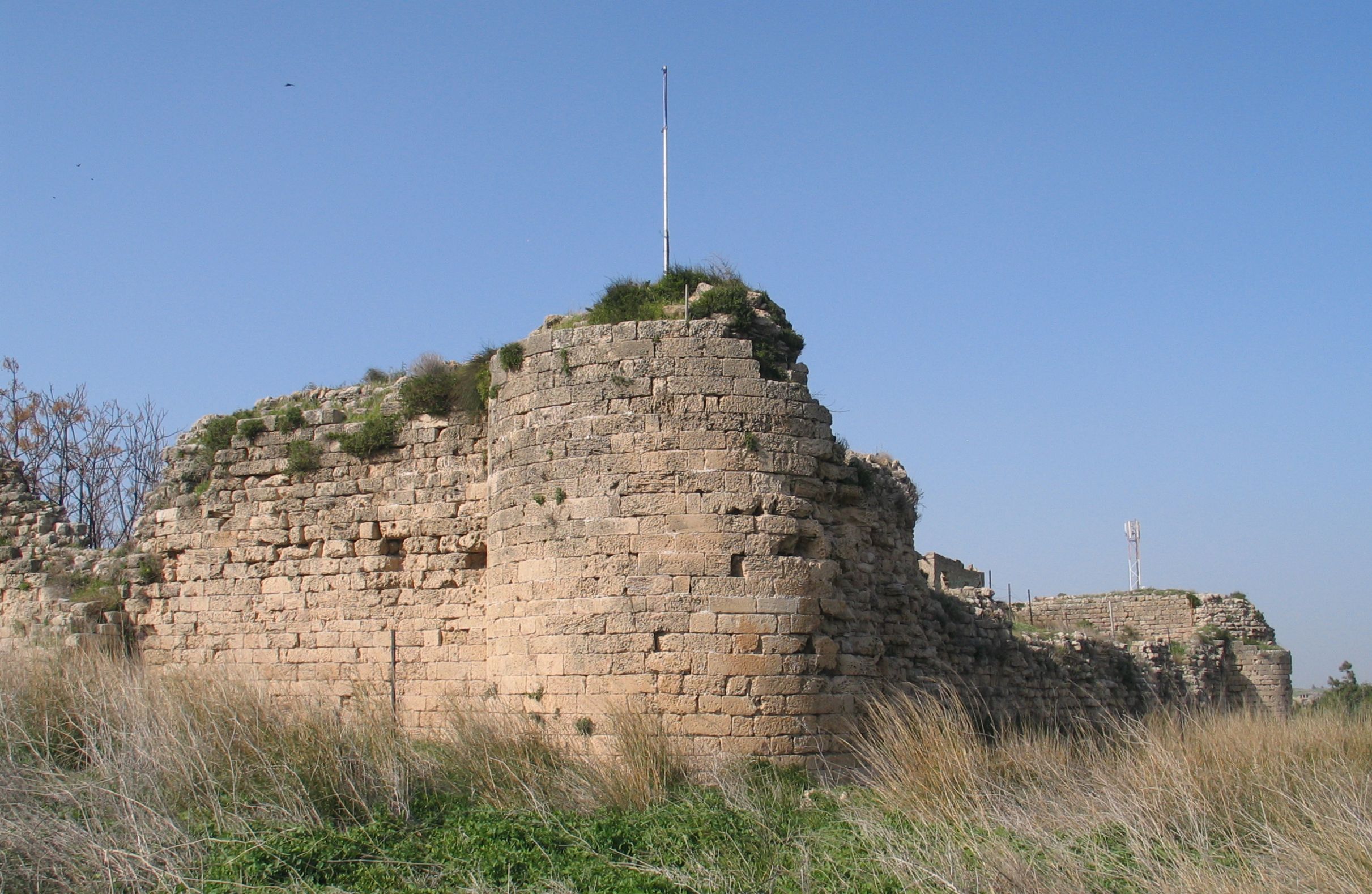
Kafr Lam (Arabic: كفر لام‎) was a Palestinian Arab village located 26 kilometres (16 mi) south of Haifa on the Mediterranean coast. The name of the village was shared with that of an Islamic fort constructed there early on in the period of Arab Caliphate rule (638-1099 CE) in Palestine. To the Crusaders, both the fort and the village, which they controlled for some time in the 13th century, were known as Cafarlet. Kafr Lam was depopulated during the 1948 Arab-Israeli war. While the village was largely destroyed, some of its former structures and their ruins can be seen in the Israeli moshav of HaBonim, established on the lands of Kafr Lam in 1949.
Moshav Habonim stands on the ruins of Kafr Lam. The secretariat building of the cooperative community was apparently the village school. A few ruins peek out from between the trees at the edges of the well-tended, peaceful community, close to the monument in memory of “our family members who perished in the Holocaust” and near archaeological excavations.
An elderly woman is hoisting the flag in front of the secretariat to its full height. On the eve of the 1948 war – a year before the moshav was founded – the village had a population of 390. iNakba has a video testimony of a village refugee; the woman relates how all the residents were placed on trucks and taken away.
Moshav Tzrufa nearby was founded a year later, in 1949. A biblical text is inscribed on the sign at the entrance: “The word of the Lord is pure [tzrufa]; He is a shield to all them that take refuge in him” (Psalms 18:30). But the name of this cooperative community is not taken from Psalms. It derives from the name of the Palestinian village, Al-Sarafand, on whose ruins it was built. The cemetery of Tzrufa lies opposite the cemetery of Sarafand, separated by the coastal highway.
It was here that we saw the most piteous sight. All that remains of the mosque is the floor, yet miraculously there were rolled-up carpets, folded chairs, bottles of water and paper cups there. People apparently still make pilgrimages here and continue to pray – in a mosque without a turret, without a ceiling and without walls, in which not a stone remains in place. An inscription has been spray-painted on the water tower next to the floor of the mosque: “And you shall love your neighbor as yourself – the whole Torah in a nutshell.”
Below, Israel Rail trains flash by. Not far away is the elegantly designed facility of Paradive, a “gallery of flight” and an “aerial reserve,” which has a runway for light planes and a school for skydiving.
A deathly silence prevails on the hill opposite the sea, broken only by the hiss of cars on the highway. The graves are mute, the sea breeze refreshing. The dead of Sarafand, the dead of Tzrufa and the Independence Day holiday-makers on Habonim beach – all of them constitute one image, engraved deep in the heart, very deep.

Israel in 1948 versus Zion at 68


In Israel’s first decades, phone access was a luxury. Now, 96 percent of Israelis own cellphones.


Independence Day ceremony 2016

. 


As waves of immigrants inundated Israel in itss ounding years, many were settled in temporary camps on Rishon Lezion’s sandy outskirts. The arrivals braved rainy winters in tents and subsisted on the national food rationing program, which limited Israeli consumption of eggs and meat.


Not seven decades later, Rishon Lezion is Israel’s fourth largest city, a bustling hub of nearly 250,000 freckled with malls, high rise buildings and rent tiled roofed houseswithin walking distance of some  of Zion's finest beaches in the 270 kms of golden sands fours seas  to choose from...... Meditteranean, Red Sea, Sea of Galilee and the Dead Sea.
.
Rishon LeZion rise mirrors the meteoric growth experienced by Israeli society in the 68 years since the nation’s founding. Though Israel faces social, cultural, religious and military challenges, it has burgeoned economically, technologically and militarily. As the nation readies to celebrate its Independence Day on Wednesday, here are six statistics that show how.

Israel’s population has grown tenfold since 1948.Israel was founded with a population of 806,000. Today there are 8.5 million Israelis, about 75 percent of them Jews.

In 1948, just over a third of Israelis were native born, or “sabras.” The rest were immigrants either from war-torn Europe or the Middle East and North Africa. Today, three-quarters of Israelis are native born. Hey that is also 75% .

But immigration, or aliyah, continues to swell the numbers: 30,000 immigrants arrived in Israel in 2015, including almost 8,000 from France, 7,000 from Ukraine and about 3,800 from the United States and Canada. In total, some I would prefer the word just  2.5 percent of Israel’s population — approximately 200,000 people — are from the US,  This percentage over 70 year should be much, much higher. 58,000 including their children are from South Africa, and just 42,000 from the UK.

Israel’s cities have grown apace. West Jerusalem, in 1948, had less than 100,000 residents. Now the city’s eastern and western halves include more than 800,000 residents. Sixteen Israeli cities boast more than 100,000 residents, and eight have more than 200,000.

A higher percentage of Israelis  than Americans own cellphones.96% versus 73% if you were wondering.

In Israel’s first decades, phone access was a luxury. Through the 1970s, new immigrants sometimes waited years to get a landline in their apartment. In the meantime, they lined up at the local pay phone with a handful of tokens.

Now, 97 percent of Israelis own cellphones, more than the 90 percent in the US. A swarm of Israeli phone companies compete for customers’ shekels, while Israeli technological innovation has made cellphones more powerful.

Since 1948, Israel’s economy has grown even faster than its population. The country’s GDP in its founding year was $6.6 billion in today’s dollars. Now Israel produces about 44 times as much — nearly $290.6 billion a year. In 2010, the country joined the Organization for Economic Cooperation and Development, a group of the world’s most affluent countries and today ranks 16 in a list of 222 ..

Standards of living have also risen. Israel’s GDP per capita today is approximately $36015 — 6.7 times what it was in 1948, adjusted for inflation. Nine years after the state’s founding, just one-tenth of Israelis had an air conditioner for the country’s sweltering summer. Now, thankfully, almost nine in 10 Israelis have the machines at home. The country boasts nearly 3.23 million cars, compared to 34,000 in 1948.

Israel’s Air Force grew from nothing to be the region’s most powerful.

When Israel’s provisional government declared independence, a militia, the Haganah, was in place to defend it. But the new state had a total of zero combat aircraft. The first shipment of 25 planes came a few weeks after Independence Day from Czechoslovakia.

The Israel Air Force has since established itself as the best in the Middle East. At 680 combat aircraft, it isn’t the region’s largest fleet, but technological prowess, training and Israel’s stability make it the most formidable by far.

Helpfully, Israel receives more than $3 billion of US. military aid every year, allowing it to maintain its advantage. This will more than likely rise to $5 billion once President  Hillary Clinton takes the oath of office on 21st January 2016 at noon. 83 current senators have already endorsed the new military aid package.

Israel’s yeshiva student population is 300 times bigger than in 1948.

When Israel’s first prime minister, David Ben-Gurion, exempted full-time yeshiva students from Israel’s military draft, the pass applied to just 400 haredi Orthodox young men studying Torah all day. But Israel’s yeshivas have been fruitful and multiplied. Today, more than 120,000 yeshiva students skip the army, according to the religious pluralism advocacy group Hiddush. Good or paid or some like I think this statistic is horrific and is the cause for the ultra Orthodox Community ranking lowest in terms of per capita income in Zion..

Haredi Jews make up 9 percent of Jewish-Israeli society, and their numbers are growing. According to a March study by the Pew Research Center, 91 percent of them have more than four children, while half of secular Jews have two or fewer.

The draft exemption has been a heated political issue in Israel for years, with many Israelis calling on the government to “equalize the burden” of military service. The centrist Yesh Atid party became Israel’s second largest in 2013 by promising draft reform. Its legislation passed in 2014, but was deranged last year after Israel’s most recent election, which swept haredi parties back into power and sent Yesh Atid into the opposition.

The number of women in the Knesset has tripled.

Women fought alongside men in Israel’s prestate battles and the War of Independence. But when the first Knesset convened in 1949, just 11 of the body’s 120 members were women — less than 10 percent. One of them was Golda Meyerson, who would leave her mark on the world as Golda Meir, Israel’s first female prime minister.

While no woman has followed Meir to Israel’s top post, more women than ever are members of Knesset. Women, who make up a majority of Israel’s population, are still underrepresented. But the body now includes a record 32 women, more than a quarter of Israeli lawmakers. That’s compared to the 19 percent of the US Congress that’s female.

Ben Gurion Airport welcomes 16 million travelers a year.

As the Israeli-Palestinian conflict has festered, Israeli fears of international boycott have risen. But you wouldn’t know it from Israel’s main link to the outside world, Ben Gurion Airport. Fifteen million travelers passed through the hub in 2015, up from 10 million in 2010.


Tourism rose 7.2 percent from 2013 to 2016,despite a 51 day Gaza War.in 2014 But the war also showed the importance to Israelis of international travel. Some of the war’s tensest days came in late July, when many flights to Israel were canceled due to missile threats, severing some links between Israel and the world.Independence when  the coastal city of Rishon Lezion was a hardscrabble settlement with fewer than 20,000 inhabitants.

Thursday, May 5, 2016

King Abdullah I and 1944 Zionism

Amman, Jordan- Members of the royal family are shown standing behind the flag-draped coffin of assassinated King Abdullah of Jordan, as prayers are offered ...

Jordan, is not being at all helpful in the matter of maintaining calm in Jerusalem, especially over the Temple Mount status quo.  It is also not promoting coexistence.But that's not new.
Let's go back to 1944:
867N.00/3–344
[Document 635]
Amir Abdullah of Transjordan to President Roosevelt
Amman, March 3, 1944.
The deliberations of Congress affecting Palestine and the formation of a Jewish State therein have caused a great and heartfelt distress throughout the East. I say and I am convinced that the absence of sufficient information in the House of Congress respecting the true situation has facilitated the way to those in sympathy with the Zionist cause to further these deliberations. Remembering the great respect and admiration in which I hold you, your country and the American people, I say that while you are fighting with the United Nations for the freedom of the world and the removal of oppression at the same time the present deliberations are I feel contrary to that principle and would lead to the greatest sorrow and suffering if the intentions of the promoters of those deliberations were to be realized. I mention this personally in my capacity as a close neighbor of Palestine and as a loyal friend of the United Nations.
Abdullah
And , the reply:
In so far as Palestine is concerned, I am glad to convey to you the assurance that in the view of the Government of the United States no decision altering the basic situation of Palestine should be reached without full consultation with both Arabs and Jews.”   Hull


Abdullah I
Cecil Beaton Photographs- Political and Military Personalities; Abdullah, King of Jordan; Abdullah, King of Jordan CBM1666.jpg
King of Jordan
Reign25 May 1946 – 20 July 1951
PredecessorOffice established (formerlyEmir of Transjordan)
SuccessorTalal
Emir of Transjordan
Reign1 April 1921 – 25 May 1946
PredecessorOffice Established
SuccessorOffice changed to King of Jordan
BornFebruary 1882
Mecca, Ottoman Empire
Died20 July 1951 (aged 69)[1][2]
Al Aqsa Mosque, Jerusalem
BurialRaghadan Palace
Consort
Junior wives
Musbah bint Nasser
Suzdil Khanum
Nahda bint Uman
IssuePrincess Haya
Talal I
Prince Naif
Princess Munira
Princess Maqbula
Princess Naifeh
HouseHashemite
FatherHussein bin Ali
MotherAbdiyya bint Abdullah
ReligionSunni Islam
Abdullah I bin al-Hussein, King of Jordan (Arabic: عبد الله الأول بن الحسين‎, Abd Allāh ibn al-Husayn, February 1882 – 20 July 1951) born in Mecca, Hejaz, Ottoman Empire (in modern-day Saudi Arabia) was the second of three sons of Hussein bin Ali, Sharif and Emir of Mecca and his first wife Abdiyya bint Abdullah (d. 1886). He was educated in Istanbul and Hejaz. From 1909 to 1914, Abdullah sat in the Ottoman legislature, as deputy for Mecca, but allied with Britain during World War I. Between 1916 to 1918, working with the British guerrilla leader T. E. Lawrence, he played a key role as architect and planner of the Great Arab Revolt against Ottoman rule, leading guerrilla raids on garrisons. He was the ruler of Transjordan and its successor state, Jordan, from 1921 to 1951—first as Emir under a British Mandate from 1921 to 1946, then as King of an independent nation from 1946 until his assassination in 1951.

Early political career

In 1910, Abdullah persuaded his father to stand, successfully, for Grand Sharif of Mecca, a post for which Hussein acquired British support. In the following year he became deputy for Mecca in the parliament established by the Young Turks, acting as an intermediary between his father and the Ottoman government. In 1914, Abdullah paid a clandestine visit to Cairo to meet Lord Kitchener to seek British support for his father's ambitions in Arabia.

Abdullah maintained contact with the British throughout the First World War and in 1915 encouraged his father to enter into correspondence with Sir Henry McMahon, British high commissioner in Egypt, about Arab
independence from Turkish rule. (see McMahon-Hussein Correspondence). This correspondence in turn led to the Arab Revolt against the Ottomans. During the Arab Revolt of 1916–18, Abdullah commanded the Arab Eastern Army.Abdullah began his role in the Revolt by attacking the Ottoman garrison at Ta’if on 10 June 1916.The garrison consisted of 3,000 men with ten 75-mm Krupp guns. Abdullah led a force of 5,000 tribesmen but they did not have the weapons or discipline for a full attack. Instead he laid siege to town. In July he received reinforcements from Egypt in the form ofhowitzer batteries manned by Egyptian personnel. He then joined the siege of Medina commanding a force of 4,000 men based to the east and north-east of the town. In early 1917, Abdullah ambushed an Ottoman convoy in the desert, and captured £20,000 worth of gold coins that were intended to bribe the Bedouin into loyalty to the Sultan. In August 1917, Abdullah worked closely with the French Captain Muhammand Ould Ali Raho in sabotaging the Hejaz Railway. Abdullah's relations with the British Captain T. E. Lawrence were not good, and as a result, Lawrence spent most of his time in the Hejaz serving with Abdullah's brother Faisal who commanded the Arab Northern Army.
Founding of the Emirate of Transjordan

Abdullah I of Transjordan during the visit to Turkey withTurkish President Mustafa Kemal

When French forces captured Damascus at the Battle of Maysalun and expelled his brother Faisal, Abdullah moved his forces from Hejaz into Transjordan with a view to liberating Damascus, where his brother had been proclaimed King in 1918.Having heard of Abdullah's plans, Winston Churchill invited Abdullah to a famous "tea party" where he convinced Abdullah to stay put and not attack Britain's allies, the French. Churchill told Abdullah that French forces were superior to his and that the British did not want any trouble with the French. Abdullah acquiesced and was rewarded when the British created a protectorate for him, which later became the Emirate of Transjordan. On March 8, 1920, Abdullah was proclaimed King of Iraq by the Iraqi Congress but he refused the position. After his refusal, his brother who had just been defeated in Syria and was in need of a kingdom, accepted the position.

Although Abdullah established a legislative council in 1928 its role remained advisory leaving him to rule as an autocrat. Prime Ministers under Abdullah formed 18 governments during the 23 years of the Emirate.

Abdullah set about the task of building Transjordan with the help of a reserve force headed by Lieutenant-Colonel Frederick Peake, who was seconded from the Palestine police in 1921.The force, renamed the Arab Legion, in 1923 was led by John Bagot Glubb between 1930 and 1956 During the Second World War Abdullah was a faithful ally of the British, maintaining strict order within Transjordan, and helping to suppress a pro-Axis uprising in Iraq. His army, the Arab Legion assisted in the occupation of Iraq and Syria.

Abdullah embarked on negotiations with the British to gain independence; on 25 May 1946 the Hashemite Kingdom of Transjordan (renamed the Hashemite Kingdom of Jordan on 26 Apr 1949) was proclaimed independent and Abdullah crowned king inAmman.
Expansionist aspirations
Coronation of King Abdullah in Amman. Right to left: King Abdullah, Emir 'Abd al-Ilah (Regent of the Kingdom of Iraq), and Emir Naif (King Abdullah's youngest son), 25 May 1946.

Abdullah, alone among the Arab leaders of his generation, was considered a moderate by the West It is possible that he might have been willing to sign a separate peace agreement with Israel, but for the Arab League's militant opposition. Because of his dream for a Greater Syria comprising the borders of what was thenTransjordan, Syria, Lebanon, and the British Mandate for Palestine under a Hashemite dynasty with "a throne in Damascus," many Arab countries distrusted Abdullah and saw him as both "a threat to the independence of their countries and they also suspected him of being in cahoots with the enemy" and in return, Abdullah distrusted the leaders of other Arab countries.

Abdullah supported the Peel Commission in 1937, which proposed that Palestine be split up into a small Jewish state (20 percent of the British Mandate for Palestine) and the remaining land be annexed into Transjordan. The Arabs within Palestine and the surrounding Arab countries objected to the Peel Commission while the Jews accepted it reluctantly.Ultimately, the Peel Commission was not adopted. In 1947, when the UN supportedpartition of Palestine into one Jewish and one Arab state, Abdullah was the only Arab leader supporting the decision.

In 1946–48, Abdullah actually supported partition in order that the Arab allocated areas of the British Mandate for Palestine could be annexed into Transjordan. Abdullah went so far as to have secret meetings with the Jewish Agency (future Israeli Prime Minister Golda Meir was among the delegates to these meetings) that came to a mutually agreed upon partition plan independently of the United Nations in November 1947. On 17 November 1947, in a secret meeting with Meir, Abdullah stated that he wished to annex all of the Arab parts as a minimum, and would prefer to annex all of Palestine.This idea of secret Zionist-Hashemite negotiations in 1947 was expanded upon by New Historian Avi Shlaim in his book Collusion Across The Jordan: King Abdullah, the Zionist Movement, and the Partition of Palestine. This partition plan was supported by British Foreign Secretary Ernest Bevin who preferred to see Abdullah's territory increased at the expense of the Palestinians rather than risk the creation of a Palestinian state headed by the Mufti of Jerusalem Mohammad Amin al-Husayni

The claim has, however, been strongly disputed by Israeli historian Efraim Karsh. In an article in Middle East Quarterly, he alleged that "extensive quotations from the reports of all three Jewish participants [at the meetings] do not support Shlaim's account...the report of Ezra Danin and Eliahu Sasson on the Golda Meir meeting (the most important Israeli participant and the person who allegedly clinched the deal with Abdullah) is conspicuously missing from Shlaim's book, despite his awareness of its existence".[ According to Karsh, the meetings in question concerned "an agreement based on the imminent U.N. Partition Resolution, [in Meir's words] "to maintain law and order until the UN could establish a government in that area"; namely, a short-lived law enforcement operation to implement the UN Partition Resolution, not obstruct it"

On 4 May 1948, Abdullah, as a part of the effort to seize as much of Palestine as possible, sent in the Arab Legion to attack the Israeli settlements in the Etzion Bloc. Less than a week before the outbreak of the 1948 Arab–Israeli War, Abdullah met with Meir for one last time on 11 May 1948.Abdullah told Meir, "Why are you in such a hurry to proclaim your state? Why don't you wait a few years? I will take over the whole country and you will be represented in my parliament. I will treat you very well and there will be no war". Abdullah proposed to Meir the creation "of an autonomous Jewish canton within a Hashemite kingdom," but "Meir countered back that in November, they had agreed on a partition with Jewish statehood." Depressed by the unavoidable war that would come between Jordan and the Yishuv, one Jewish Agency representative wrote, "[Abdullah] will not remain faithful to the 29 November [UN Partition] borders, but [he] will not attempt to conquer all of our state [either]."Abdullah too found the coming war to be unfortunate, in part because he "preferred a Jewish state as Transjordan's neighbor to a Palestinian Arab state run by the mufti."

The Palestinian Arabs, the neighboring Arab states, and the promise of the expansion of territory and the goal to conquer Jerusalem finally pressured Abdullah into joining them in an "all-Arab military intervention" against the newly created State of Israel on 15 May 1948, which he used to restore his prestige in the Arab world, which had grown suspicious of his relatively good relationship with Western and Jewish leaders. Abdullah was especially anxious to take Jerusalem as compensation for the loss of the guardianship of Mecca, which had traditionally held by the Hashemites until Ibn Saud had seized the Hejaz in 1925. Abdullah's role in this war became substantial. He distrusted the leaders of the other Arab nations and thought they had weak military forces; the other Arabs distrusted Abdullah in return. He saw himself as the "supreme commander of the Arab forces" and "persuaded the Arab League to appoint him" to this position. His forces under their British commander Glubb Pasha did not approach the area set aside for the new Israel, though they clashed with the Yishuv forces around Jerusalem, intended to be an international zone. According to Abdullah el-Tell it was the King's personal intervention that led to the Arab Legion entering the Old City against Glubb's wishes.

After conquering the West Bank, including East Jerusalem, at the end of the war, King Abdullah tried to suppress any trace of a Palestinian Arab national identity. Abdullah annexed the conquered Palestinian territory and granted the Palestinian Arab residents in Jordan Jordanian citizenship.In 1949, Abdullah entered secret peace talks with Israel, including at least five with Moshe Dayan, the Military Governor of West Jerusalem and other senior Israelis. News of the negotiations provoked a strong reaction from other Arab States and Abdullah agreed to discontinue the meetings in return for Arab acceptance of the West Bank's annexation into Jordan.

Assassination

On 20 July 1951, Abdullah, while visiting Al-Aqsa Mosque in Jerusalem, was shot dead by a Palestinian from the Husseini clan. On 16 July, Riad Bey Al Solh, a former Prime Minister of Lebanon, had been assassinated in Amman, where rumours were circulating that Lebanon and Jordan were discussing a joint separate peace with Israel. The assassin passed through apparently heavy security. Abdullah was in Jerusalem to give a eulogy at the funeral and for a prearranged meeting with Reuven Shiloah and Moshe Sasson. Abdullah was shot while attending Friday prayers at the Al-Aqsa Mosque in the company of his grandson, Prince Hussein. The Palestinian gunman fired three fatal bullets into the King's head and chest. Abdullah's grandson, Prince Hussein, was at his side and was hit too. A medal that had been pinned to Hussein's chest at his grandfather's insistence deflected the bullet and saved his life. Once Hussein became king, the assassination of Abdullah was said to have influenced Hussein not to enter peace talks with Israel in the aftermath of the Six-Day War in order to avoid a similar fate.

The assassin was a 21-year-old tailor's apprentice, Mustafa Ashi, who according to Alec Kirkbride, the British Resident in Amman, was a "former terrorist", Zakariyya Ukah a livestock dealer and butcher. Ten conspirators were accused of plotting the assassination and were brought to trial in Amman. The prosecution named Colonel Abdullah el-Tell, ex-Military Governor of Jerusalem, and Musa Abdullah Husseini as the chief plotters of "the most dastardly crime Jordan ever witnessed." The Jordanian prosecutor asserted that Col. el-Tell, who had been living in Cairo since January 1950, had given instructions that the killer, made to act alone, be slain at once thereafter to shield the instigators of the crime. Jerusalem sources added that Col. el-Tell had been in close contact with the former Grand Mufti of Jerusalem, Amin al-Husayni, and his adherents in Arab Palestine. El-Tell and Husseini, and three co-conspirators from Jerusalem were sentenced to death. On 6 September 1951, Musa Ali Husseini, 'Abid and Zakariyya Ukah, and Abd-el-Qadir Farhat were executed by hanging.

Abdullah was succeeded by his son Talal; however, since Talal was mentally ill, Talal's son Prince Hussein became the effective ruler as King Hussein at the age of seventeen. In 1967, el-Tell received a full pardon from King Hussein.

Marriages and children

Abdullah was a polygamist permitted by the Koran and was had three wifes

In 1904, Abdullah married his first wife Musbah bint Nasser (1884 – 15 March 1961) at Stinia Palace, İstinye, Istanbul, Ottoman Empire. She was a daughter of Emir Nasser Pasha and his wife Dilber Khanum. They had three children:
  • Princess Haya (1907–90). Married Abdul-Karim Ja'afar Zeid Dhaoui.
  • HM Talal I (26 February 1909 – 7 July 1972).
  • Princess Munira (1915–87). Never married.
In 1913, Abdullah married his second wife Suzdil Khanum (d. 16 August 1968), at Istanbul, Turkey. They had two children:

  • HE Damat Prince Nayef bin Abdullah Beyefendi (Ta'if, 14 November 1914 – Amman, 12 October 1983). A Colonel of the Royal Jordanian Land Force. Regent for his older half-brother Talal from 20 July to 3 September 1951). Married in Cairo or Amman on 7 October 1940 Princess Mihrimâh Selcuk Sultan (11 November 1922 – Amman, March 2000 and buried Istanbul, 2 April 2000), daughter of Prince Şehzade Mehmed Ziyaeddin Efendi (Ortaköy, Ortaköy Palace, 26 August 1873 – Alexandria, 30 January 1938) and fifth wife (m. 10 February 1923) Neshemend Hanım Efendi (1905 – Alexandria, 1 February 1934 and buried in Cairo), and paternal granddaughter of Mehmed V by first wife. Father of: Prince and Prince Sultanzade Asem bin Al Nayef Beyefendi (b. 27 April 1948), married firstly Firouzeh Vokhshouri and had three daughters. Married secondly Princess Sana Asem and they have two daughters and a son.
  • Princess Maqbula (6 February 1921 – 1 January 2001). Married Hussein bin Nasser, Prime Minister of Jordan (terms 1963–64, 1967).
In 1949, Abdullah married his third wife Nahda bint Uman, a lady from Sudan, in Amman. They had one child .

  • Princess Naifeh (1950–000). Married Samer Ashour.

Monday, April 18, 2016

The Putinisation of Zion

Nice work! We’ve shared your post on LinkedIn. Keep up the momentum by sharing with your other networks!

The Putinization of Zion
Stéphén Dǻrori

Finance and Marketing Whiz,Social Media Publicist, Strategist, Investor,Journalist,Author,Editor & Prolific Blogger

The Putinization of Zion

Sometimes journalistic shorthand can help distill complex ideas into easily digestible gobbets for non-specialists. Sometimes it reduces intricate phenomena to simplistic soundbites.
The latest buzz-word about Hungary is that the country, under the right-wing Fidesz government elected in April, is undergoing a kind of "Putinisation". An editorial in the 27th December 2010 Washington Post headlined "The Putinization of Hungary?" caused a huge stir here. The piece says that two media laws passed by the government "put Hungary in a league with Russia and Belarus on press freedom".
Under the laws, a new media authority, all of whose members have been nominated by Fidesz, will oversee broadcast, print and online media and can impose enormous fines for vague offences such as breaching "human dignity". Officials say the laws are in line with European norms and that critics should wait for their implementation before sniping.
Ahmad Tibi, a long-standing Arab member of the Knesset, once remarked that ‘Israel is democratic towards Jews, and Jewish towards Arabs.’ For many years, that soundbite nicely captured the contradictions of ‘Jewish democracy’: fair elections, press freedom, cantankerous debate and due process for some; land theft, administrative detention, curfews, assassinations and ‘muscular interrogations’ for others. Tibi meant to call attention to the hypocrisy of Israel’s claims to be a democratic state, but as he effectively admitted, Jewish democracy did work for Jews – even Jews radically opposed to the occupation and indeed to Zionism itself. For as long as it did, liberals in Tel Aviv could tell themselves that things weren’t so bad behind the Green Line, the border between Israel and the territory it captured in the 1967 war. Indeed, the resilience of Israel’s democratic institutions helped sustain the illusion that the Green Line was still a frontier, even as it vanished under the weight of the settlement project, launched when Labor was in power and subsidised by every subsequent government.
Colonial rule, however, is corrosive in its effects. Since the Second Intifada, Palestinian citizens in Israel have been reminded at every turn that they are not welcome, from the police killing of 13 extremely violent demonstrators throwing rocks indiscriminately at passing cars along the main thoroughway in Wadi ara leading to the Northern towns of Afula, Yokneam and Haifa,  in October 2000, to Benjamin Netanyahu’s election day warning last May: ‘Arab voters are coming out in droves to the polls. Left-wing organisations are busing them out.’ The spectre of ‘Arab voters’ was hardly new: the Israeli right has never looked fondly on Arabs exercising their voting rights, unless they can be presented as evidence of the virtues of ‘Jewish democracy’. What is novel is the intensifying campaign inside Israel against those ‘left-wing organisations’ Netanyahu mentioned: human rights NGOs and their (mostly) Jewish leaders. The campaign has been launched both in the Knesset and on the street, with an apparently high level of co-ordination between state officials and ultra-nationalist militants. Israel is increasingly ‘Jewish towards Arabs’, as Tibi said, but it’s also on its way to becoming less and less democratic for Arabs.
Consider the case of Michael Sfard, one of Israel’s best-known human rights lawyers, whose work focuses on land confiscation and the separation wall. According to a report by Uri Blau for Haaretz, between 2010 and 2013 a private detective was commissioned to gather information on Sfard. This ‘investigation’ was paid for by Regavim, a group that describes itself as ‘the only organisation’ fighting an ‘illegal land grab’ by Palestinians, acting in concert with the UN, the EU, and Israeli and American NGOs. Haaretz’s investigation revealed that Regavim had received about $2.8 million from various government bodies – mostly local councils in West Bank settlements. At the time, Regavim’s legal department was run by Bezalel Smotrich, now a member of the Knesset for the right-wing Jewish Home party. I am no fan at all of the extremely  left wing anti Zionism Haaretz Newspaper .... so I ask once again . What's your point?
Im Tirtzu is another pro-settler group prominent in the campaign against NGOs. It emerged among ultra-nationalist university students in 2006, and made a name for itself in 2010, when it published a document linking the New Israel Fund, a liberal NGO, to the Goldstone Report, the UN fact-finding mission on the 2008-9 war in Gaza, which found Israel, as well as Palestinian fighters, to be responsible for war crimes, and possibly crimes against humanity.  What Im Tirtzu found , is a no brainer, the Goldstone report is extensively annotated and referenced and NGO's in particular Btselem , finaced mainly by the New Israel Fund  were quoted extensively even though much  of it was hearsay and unsubstantiated.

Im Tirtzu  it also put up a large billboard depicting the NIF’s chairwoman, Naomi Chazan, ( a past Meretz Knesset member) with a devil’s horn on her forehead. In December it released a flagrantly inflammatory video, just over a minute long, which distills the message of the assault on the NGOs: they are accomplices to murder, and traitors. A young, bearded Arab man facing the viewer raises his arm to attack, then the image freezes and a female announcer tells us:
Before the next terrorist stabs you, he already knows that Yishai Menuhin, a planted agent belonging to Holland, will make sure to protect him from a Shin Bet interrogation. The terrorist also knows that Avner Gvaryahu, a planted agent belonging to Germany, will call the soldier who tries to prevent the attack a ‘war criminal’. He also knows that Sigi Ben-Ari, a planted agent belonging to Norway, will protect him in court. Before the next terrorist stabs you, he already knows that Hagai El-Ad, a planted agent belonging to the European Union, will call Israel a ‘war criminal’. Hagai, Yishai, Avner and Sigi are Israelis. They live here with us, and are implants. While we fight terror, they fight us. The ‘Planted’ law can outlaw them. Sign it.
Yishai Menuhin heads the Public Committee against Torture in Israel. Avner Gvaryahu is the outreach director for Breaking the Silence, a group that gathers soldiers’ testimonies of their actions in the occupied territories.94.3% of Israelis think that the NGO that calls itself Breaking the Silence is both anti Zionist and Anti semitic and its actions are treasonable and very pro vocable.  Hagai El-Ad and Sigi Ben-Ari work, respectively, for B’Tselem and HaMoked, human rights organisations known for exposing abuses in the occupied territories. (Their photographs all feature in the video which Btselem gave  by the hundreds to Palestinians and thereby created what is known as Pallywood.) The ‘Planted’ bill was recently proposed in the Knesset by Yoav Kish, a member of Likud. Under it, NGOs that receive funding from another state for allegedly ‘subversive’ activity would be defined as shtulim or ‘moles’, fined and potentially forced to dissolve.
Im Tirtzu describes itself as a ‘centrist’ group. This is not as far-fetched as it sounds: the centre in Israel has radically shifted, and Im Tirtzu has friends in high places. One of them is Naftali Bennett, Netanyahu’s education minister and a leader of the Jewish Home party. His campaign manager, Moshe Klughaft, produced the Im Tirtzu video, and Bennett shares its loathing of human rights organisations. In December he declared that representatives of Breaking the Silence would be banned from schools. His Ministry has also removed from the curriculum a novel about a love affair between a Jewish woman and an Arab man, on the grounds that ‘intimate relations between Jews and non-Jews threaten the separate identity’. This Novel generally is considered to be poorly written and structured by an insignificant author and was slipped into the syllabus by a Meretz supporting Ministry of Education  bureaucrat. Avigdor Lieberman, Netanyahu’s former foreign minister, has supported similar anti-NGO legislation, and Netanyahu himself once starred in an Im Tirtzu fundraising video. In November, Netanyahu’s Justice Minister, Ayalet Shaked, a cofounder of Jewish Home, introduced a ‘Transparency’ bill in the Knesset. It would require NGOs that receive at least 50 per cent of their funding from foreign governments to declare themselves; their members would also have to wear name-tags if they appeared in the Knesset. The bill applies only to States and not to the far more abundant ‘foreign funding’ that right-wing groups receive from wealthy Zionists in the diaspora, such as Sheldon Adelson, the Las Vegas casino magnate who owns the Israeli newspaper Israel Hayom.
The current darling of Im Tirtzu, however, is Netanyahu’s Culture Minister, Miri Regev, a former Brigadier-General in the Israel Defence Forces. The daughter of Moroccan immigrants, Regev made headlines in 2012 by taking part in protests against illegal African Trespassers in Zion demonstrations, and describing Sudanese immigrants as ‘a cancer in our body’. On 27 January she announced a ‘No Loyalty, No Budget for the Arts’ bill, which would deny public funding to those who fail to demonstrate loyalty to the Jewish state. Hours after the bill was introduced, Im Tirtzu released a list of supposed ‘moles’, including David Grossman, Amos Oz and other members of the liberal Zionist establishment.  Regev is often thought to be more in tune with the attacks against the old Ashkenazi elite who treated the Sephardi Immigrants of North Africa condescendingly to the point of been easily tagged as racialists. Instead of settling these 1.4 million Immigrants from North Africa, Yemin, and Iraq within existing communities that herded them in horrific Maabarot ( tent cities) and dispatched them to 'development'towns with quickly built sterotype blocks of flats without town planning, no parks and no industry. These actions by the Ashkenazi Elite headed by Ben Gurion Socialist and Marxist Mapai and later Gold Meir Labor party has resulted in what is structural poverty in Zion largely confined to these development towns in the South of the country. However these immigrants rebelled united  in 1977 and threw the Socialist  Labor Alignment out of power and voted Menachem Begin's Likud pro Capitalism into Government.These 1949 to 1952 immigrants and children of these immigrants are to old now to escape their structural poverty.... their grandkids however have wiseup in the bottleneck of the Israel Education system and in particular service in the IDF that levels the playing field and allows everyone an equal opportunity to social climb in Israeli society based on Service to Country (an IDF career) or Education. Whne the generation of the Maabarot eventually die , the innate structural poverty element that Israel is still tagged with will die with in. This will happen soon. These 1948 -1952 immigrants and children of immigrants are well into their 70's , 80's and 90's today.
‘Mole’ is not the worst epithet being hurled at Jews whose loyalty falls under suspicion, as Daniel Shapiro, the US ambassador to Israel, discovered last month at a security conference in Tel Aviv. ‘At times there seem to be two standards of adherence to rule of law, one for Israelis and one for Palestinians,’ Shapiro said – for an American official, a fairly blunt criticism. In return, in a TV interview, Avi Bushinsky, a former adviser to Netanyahu, called him a yehudoni – a Hebraisation of the derogatory Yiddish term yidele, usually translated as ‘little Jew boy who knows knowing’.
Here has always been a deep strain of contempt in Zionism for the Yiddish-speaking Jews of Eastern Europe, who lacked the will, or the muscle, to defend themselves against anti-Semitic violence. The veneration of the state and the worship of force that are the pillars of Jewish identity in Israel, as much as Judaism itself, grew out of an effort to wash away the shame of having once been yidele. But the cult of state and army was always tempered – behind the Green Line at least – by a nostalgic attachment to liberal European values, an attachment that was particularly strong among Jews of German origin, the so-called yekkes. But their power, their numbers and their cultural authority have declined over the years: they are an old elite, and viewed with the disdain and resentment that old elites tend to provoke. Of Israel’s six million Jews, nearly three million are Mizrahi, from Middle Eastern countries, and about a million and a half are Russian. A growing number of Jews are Religious  Zionists, and they have many more children than secular Jews and are far, far more Nationalist and Patriotic  . It is no wonder that, as Asher Schechter recently observed in Haaretz, ‘Israel is increasingly turning its back on Europe.
Writing in 2003, at a time of high Euro-optimism, Tony Judt described Israel as a ‘characteristically late 19th-century separatist project’ in ‘a world that has moved on, a world of individual rights, open frontiers and international law … Israel, in short, is an anachronism.’ Today, it is Judt’s cheerfully Hegelian description of ‘a world that has moved on’ that seems out of step with the neo-tribal spirit of the times. Israel does not seem like such an outlier in a world reshaped by the drive towards ethnic and religious separatism, the militarised policing of frontiers, and the emergence of authoritarian populist governments. For a country of its size, it has made a handsome contribution to the creation of this world, through its occupation and its wars – and through its high-profile involvement in the high tech, arms trade and the ‘security’ industry.
But its influence has also made itself felt by way of example. It is often argued that Israel lacks soft power in the Middle East, as a Jewish state in a predominantly Muslim region, and as an occupier of Arab land. But military and economic success create a soft power of their own, no less effective for being concealed. In 1963, Jalal Al-e Ahmad, who would become one of the spiritual fathers of the Islamic Revolution in Iran, travelled to Israel for two weeks. In a book about his trip, he described Israel’s fusion of religion and state power as a potential model for Iran. After the crushing defeat by Israel in the 1967 war, many Arabs asked themselves whether the Jews had won because they remained closer to their faith, and defected from the nationalist camp to Islamism. The ethnic cleansing from which the state of Israel emerged is now being repeated, with even more horrifying consequences, in other parts of the Middle East.
Israel has often been criticised for its refusal to integrate into the region, its (racist) insistence on being a ‘villa in the jungle’. Its politicians have responded by saying, essentially, what James Baldwin said in the 1960s: ‘Do I really want to be integrated into a burning house?’ The regional fires have led to a certain amount of gloating in Israel, and provided a welcome distraction from the occupation, which has grown only more entrenched. But it’s not clear that Israel can remain unscathed by the flames that are consuming its neighbours.
According to some Israeli pundits, the attacks on NGOs are symptoms of a deepening Putinisation. Israeli politicians have made no secret of their admiration for Putin, a tough, ruthless leader whose resolve – and preference for military solutions – stands in sharp contrast to the caution and indecision of Barack Obama. Putin is also, in Israeli eyes, refreshingly indifferent to human rights. As relations with the Obama administration have cooled – particularly in the aftermath of the Iran nuclear deal, which Netanyahu did his best to torpedo – Israel has increasingly turned to Russia, as well as to China, from which it now imports more than it does from the US.
But the unbridled, insular nationalism of Netanyahu’s Israel is also reminiscent of Sisi’s Egypt and Erdoğan’s Turkey, where there is constant talk of foreign plots hatched in Washington and Brussels, and a toxic mix of resentment and entitlement vis-à-vis their Western patrons. Netanyahu Nationalism  has also rejuvenated Jews in the Jewish Diaspora and their support of Zionism and Israel . This support is now far more open and visual. As Diana Pinto suggests in Israel Has Moved (2013), the Jewish state has tended to see its neighbours as ‘so many vaulting poles with which to catapult itself into a peaceful because distant globalisation’. Economically, it has succeeded in escaping the region; politically, that goal has proved far more elusive. ‘Israel is now just another Arab regime,’ the Syrian poet Adunis once said to me, and the proposed legislation against ‘moles’ is scarcely different in kind, if not degree, from anti-NGO campaigns in Cairo. The repression of Jewish dissent is the latest phase of what Pinto describes as the ‘turning inward of a state in the process of its own ghettoising’. As if it preferred to remain in that ghetto, Israel has stubbornly carried on a colonial project at the risk of harming its relations with Europe and the United States, both of which are finally realising that Israel has no intention of making a genuine peace with the Palestinian people.