Showing posts with label Abbas. Show all posts

Sunday, July 17, 2016

Tzipi Livni Versus the Kingdom of Elizabth R : Damn it why did they let her go ( again) and put her on a plane back to Zion

Tzipi Livni Versus the Kingdom of Elizabth R : Damn it why did they let her go ( again) and put her on a plane back to Zion

Tzipi Livni is unquestionably my least favorite politician. Her father was a Herut Mk was a personal friend of Menachem Begin and part of the inner operations circle of his Irgun Organisation,. She was a Likud Princess and entered the Knesset as a Likud Princess and served as a MK for the Likud Party between 1999 and 2005 then her narcissistic ego and wanna be Golda took over and she abandoned democracy and primaries and changed political parties like visits to winston churchill (WC) with a bad doze of diarrhea. Still why Livni rather than other Israeli Knesset Members a total 78 of 120 including Yair Lapid , Yitzchak Herzog and 8 Minsters have visited the United Kingdom in recent years .....

The recent attempt to investigate the Israeli politician for war crimes is yet another sign of Europe’s moral implosion

Europe is to Tzipi Livni what an ostentatious mansion is to a certain kind of rapper: a natural habitat, a status symbol, a promise of redemption. As a young woman, Livni was recruited by the Mossad and tasked with pretending to be the proprietress of a Paris apartment that doubled as a secret safe house. No slouches at judging character, the Mossad’s spymasters realized that Livni was precisely the sort of anodyne presence Europeans imagine as the platonic ideal of an Israeli: well-mannered, well-meaning, and inoffensive, promising in every gesture and every word the imminent emergence of a new Denmark on the shores of the Mediterranean.
Throughout her political career, Livni has played more or less the same role she did as a young secret agent: She was the one the Israeli government dispatched to Davos in 2008 to share the stage with then Palestinian Prime Minister Salam Fayyad; the one who negotiated peace with Abu Mazen; the one who sauntered from forum to forum in capitals the world over to represent the spirit of Israeli reasonableness.
She was supposed to embark on just such a good-will mission earlier this month, this time to an international conference in London, when she was informed by Scotland Yard’s war crimes unit that she was wanted for questioning regarding her service as foreign minister during Israel’s 2008-2009 war on Hamas in Gaza.
It wasn’t Livni’s first run-in with British law: In 2009, she was forced to cancel a visit to London after a local judge, consenting to an appeal by pro-Palestinian activists, issued a warrant for her arrest. The ensuing scandal drove the British government to apologize and promise to change the laws to prevent such unpleasantries from recurring. But the recent effort to seize Livni—by Scotland Yard, no less—proves British officialdom is still thick with civil servants bent on prosecuting a liberal Israeli politician who served as her nation’s top diplomat during a military conflict started by a terrorist organization.
How to respond to such folly? By now, it’s getting a bit exhausting to point out that representatives of Africa’s genocidal regimes, Asia’s tyrannies, and the Middle East’s murderous and repressive states can all visit London unharassed, while emissaries of the Jewish state are perpetually coming under attack.
Similarly, enumerating the astonishing breadth of British assaults on the liberty, limbs, and lives of men and women from Rhodesia to Rishikesh would be too easy. But a glance at more recent violations committed under the banner of the Union Jack is more telling. Should Israel—or, for that matter, the United States—follow Scotland Yard’s lead and summon British officials for questioning concerning their role in, say, the execution of an unarmed and wounded Taliban fighter in Helmand Province, Afghanistan, by a Royal Marines sergeant in December of 2013? Should we seek to indict the Oxford-knotted dons of British diplomacy for that afternoon in September of 2003 in Basra, Iraq, when the men of the First Battalion of the Queen’s Lancashire Regiment arrested a 26-year-old hotel receptionist named Baha Mousa, detained him, and tortured and beat him so badly that he died several days later with fractured ribs, a broken nose, and 93 other injuries?
The answer, to all but a heated gaggle of self-righteous ninnies, should be obvious. As those of us who’ve fought them know all too well, wars are complex, and they generate conditions that cause even the best among us to do regrettable things. When these things cross the line of the permissible, when unnecessary violence flares out, thriving democracies have mechanisms in place to punish those responsible and address whatever root systemic issues. This is what Israel routinely does to discipline its small minority of wayward soldiers, and what Britain does as well: Almost three years to the day after Mousa’s death, his jailor, Corp. Donald Payne, pleaded guilty to treating his prisoner inhumanely. He was sentenced to a year in prison and immediate expulsion from the army. A further public investigation found no evidence of an “entrenched culture of violence” among the Lancashire Regiment. This is how mature and well-functioning justice systems operate. The recent display by Scotland Yard is something very different, a politically motivated bit of folly that further proves, if any further proof were needed, how dangerous, delusional, and deprived the regressive anti-Israel crowd has grown.
But let us not spend too much time lamenting this recent calamity. Like all teachable moments, this one, too, brings with it an uncommon clarity: The officials who sought to indict Livni cared little for any distinction between a dovish diplomat and a hawkish ex-general, for the intricacies and complexities of the conflict, for the gray zones in which adults live and practice politics. To the self-appointed, stiff-upper-lipped agents of the Enlightenment, all Israelis are alike, and all culpable in crimes. There’s a name for such an attitude, but there’s hardly use in crying anti-Semitism. In making a mockery of the very values they are supposed to represent, Livni’s prosecutors, like too many educated people from the West End to the Upper West Side, have sentenced themselves to irrelevance.

Saturday, July 9, 2016

You Can't Always Get What You Want ... Abbas urges UN Security Council to reject quartet Report. Report filed in trash in Zion.

You Can't Always Get What You Want ... Abbas urges UN Security Council to reject quartet Report. Report filed in trash in Zion. 

Well, I saw her today at the reception
A glass of wine in her hand
I knew she would go meet her connection
At her feet was her footloose man

No, you can't always get what you want
aaaahhwaw
No, you can't always get what you want
aaaahhwaw
No, you can't always get what you want
aaaahhwaw
But if you try sometime, you just might find
You get what you need

And I went down to the demonstration
To get my fair share of abuse
Singing, "We're gonna vent our frustration
And if we don't, we are going to blow a 50-amp fuse", aaaahhwaw...

And no, you can't always get what you want
aaaahhwaw
No, you can't always get what you want
aaaahhwaw
Well, no, you can't always get what you want
aaaahhwaw
But if you try sometimes you just might find
You get what you need, baby

And I went down to the Chelsea drugstore
To get your prescriptions filled
I was standin' in line with Mr. Jimmy
And man, did he look pretty ill

We decided to have a soda
"Whatcha favorite flavor?", "Cherry red"
And I sung my song to my friend Jimmy
And he said one word back to me, that was "Dead"
I said

Oh, you can't always get what you want
aaaahhwaw
Oh, you can't always get what you want
aaaahhwaw
Oh, you can't always get what you want
aaaahhwaw
But if you try sometimes, you just might find
You get what you need

Oh, you can't always get what you want
aaaahhwaw
You can't always get what you want
aaaahhwaw
You can't always get what you want
aaaahhwaw
You can't always get what you want
aaaahhwaw

And I saw her today at the reception
In her glass was a bleeding man
And she was practised at the art of deception
I could tell by her blood-stained hands

Oh, you can't always get what you want
aaaahhwaw
Oh, you can't always get what you want
aaaahhwaw

Oh, you can't always get what you want
aaaahhwaw
Oh, you can't always get what you want
aaaahhwaw
Oh, you can't always get what you want
aaaahhwaw
Oh, you can't always get what you want
aaaahhwaw
But if you try sometimes you just might find
You get what you nee

Abbas urges UN Security Council to reject Quartet report

Visiting Arafat’s grave on Eid al-Fitr, Palestinian leader says world diplomats’ document ‘not fit for the task of peace’


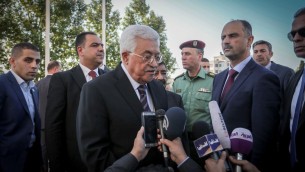
Palestinian Authority President Mahmoud Abbas lays a wreath on the grave of late Palestinian president Yasser Arafat ahead of the Eid al-Fitr holiday marking the end of Ramadan, in Ramallah on Wednesday, July 6, 2015

Palestinian Authority President Mahmoud Abbas on Wednesday harshly criticized a newly released report by the Quartet of Middle East peacemakers, saying it would not further the cause of peace, and called on the United Nations Security Council to reject the document.

The Quartet — the UN, United States, European Union and Russia — on Friday published its long-awaited report on the peace process, which saw for the first time a major international body cite Palestinian incitement to violence against Israel as a major obstacle to ending the conflict.

Incitement was one of the three “negative” trends highlighted in the report penned byUN envoy Nickolay Mladenov. The envoy said all three trends (settlements and the Palestinian Authority’s lack of control over the Hamas-ruled Gaza Strip being the other two) “severely undermine hopes for peace.”

But Abbas, visiting the grave of former Palestinian leader Yasser Arafat on the occasion of the Eid al-Fitr holiday, reiterated the PA’s rejection of the Quartet report.

“We have published our position on the Quartet commission, and we said this report is not fit for the task of peace,” Abbas said, according to the official PA news site Wafa.

“We are very sorry that this is the position, and we hope the United Nation Security Council will not adopt this report,” Abbas said.

The PA president also welcomed an usually harsh statement by the US State Department on Tuesday, in which it accused Israel of systematically seizing Palestinian land after the Jewish state approved the construction of 800 housing units in the West Bank and East Jerusalem.

“We would like it to be said that settlement building is illegitimate and illegal and must cease. This is what we demand, and if any country does so then that is welcome,” Abbas said.

His biting comments followed a report Tuesday that Ramallah had decided to stop working with the Quartet as an organization, but would keep working individually with the group’s separate members.

“It’s not only about the report, it’s more than that — but the report confirms how useless [the Quartet] is,” a Palestinian official said.

Senior PLO official and top Palestinian negotiator Saeb Erekat was quick to express disappointment Friday that the report criticized both sides rather than only Israel.

“It does not meet our expectations as a nation living under a foreign colonial military occupation,” he said, and criticized what he called the report’s attempt “to equalize the responsibilities between a people under occupation and a foreign military occupier.”


Palestinian Authority President Mahmoud Abbas takes part in a prayer session ahead of the Eid al-Fitr holiday marking the end of Ramadan, in Ramallah on Wednesday, July 6, 2016 (FLASH90)

Israel also slammed the Quartet report. A statement from Prime Minister Benjamin Netanyahu’s office said it only “perpetuates the myth that Israeli construction in the West Bank is an obstacle to peace. When Israel froze settlements (in 2009-10), it did not get peace.”

There was no formal response from the Quartet, but a source involved with the report said Wednesday there were positives to be drawn from the responses.

“If both President Abbas and Prime Minister Netanyahu find the report disturbing, then the report must contain some truths that both are uncomfortable with,” he said.

On Tuesday, despite the reported boycott of the Quartet, Abbas sent identical letters to the four representatives of the Quartet urging them to support the French initiative, a regional approach to conducting peace negotiations.

Israel has rejected the French initiative, saying only direct bilateral negotiations can be effective.

Wednesday, May 4, 2016

Zion's Catch 22 - Conflict Management versus Conflict Resolution


Israel has gradually come to realize that the Palestinians are neither a partner for peace nor capable of establishing a viable state. Therefore, Israel's recent governments have adopted a de facto conflict-management approach, rather than a conflict-resolution strategy. This prompts several questions. Should Israel continue to speak explicitly about the prospects of a two-state solution, or play along with the illusory preferences and pretensions of the international community? Should Israel apply more “stick” than “carrot” to the hostile Palestinian Authority? Would the collapse of the Palestinian Authority serve Israel's interests? And how diplomatically active should Israel be on the Palestinian issue?

Ever since the Palestinian terrorist wave began in September 2000, the Israeli body politic increasingly has resigned itself to the probability that there is no partner on the Palestinian side with which to reach a historic compromise with the Jewish national (Zionist) movement. The hopes for peace that were generated by the Oslo process in 1993 have been replaced by the stark realization that violent conflict will not end soon.

Moreover, the hostile messages about Israel purveyed in the Palestinian Authority (PA) educational system and official media leave little doubt about the rabid anti-Semitism prevalent in Palestinian society, which ensures that conflict with the Jews will continue. And thus, the central premise of the Oslo process seems exceedingly improbable. The premise was that partition of the Land of Israel and the establishment of a Palestinian political entity (what is known as the two-state paradigm) would bring peace and stability. Alas, this paradigm has been deeply discredited.

Aside from and beyond the assessment that the PA has no intention of accepting a Jewish state in any borders, the fact remains that the two sides remain far apart on most of the concrete issues to be resolved. Palestinian demands for control of the Temple Mount and the so-called “right of return,” for example, are insurmountable obstacles. Any pragmatic impulse that might otherwise have emerged in Palestinian politics is consistently countered by Hamas, whose growing influence reflects the Islamist tide that is surging across the wider region.

To make matters worse, the assumption that the Palestinians are capable of establishing a state within the parameters of a two-state paradigm has not been validated. The PA was unable to get rid of multiple militias and lost Gaza to Hamas, mirroring the inability of other Arab societies in the region to sustain statist structures.

Finally, protracted ethno-religious conflicts end only when at least one of the sides becomes war-weary, and runs out of energy for sustaining the conflict. That is not true of either Israeli or Palestinian society.

As a result of these trends, Israel essentially, if not formally, has given up on conflict resolution in the short run, and instead effectively has adopted a strategy of patient conflict management. But such a strategy brings policy dilemmas of its own.

The first dilemma is whether or not to admit that Israel no longer believes that negotiations can lead to a durable agreement in the near term.

Truth has its virtues, but much of the world does not want to hear this particular truth and is still committed to an unworkable formula. There is, in any case, something to be said for acceding to the wishes of the international community by continuing to participate in negotiations. Doing so signals that Israel is ready to make concessions, which maintains the domestic social cohesion necessary for protracted conflict (management) while projecting a positive image abroad.

On the other hand, negotiations toward the doubtful “two-state solution” keep a fictitious formula alive and prevent fresh thinking about alternative solutions from emerging. Moreover, the “peace process” requires moderation, which entails swallowing Palestinian provocations and restraining punitive action.

A second dilemma is related to the “carrot and stick” approach toward the Palestinians. In the absence of meaningful negotiations, Israel, particularly Prime Minister Benjamin Netanyahu, has advocated the promotion of “economic peace” as a part of conflict management, on the assumption that Israel has nothing to gain from hungry neighbors. This is why Israel does not oppose international financial support for the PA, despite the corruption and inefficiency of the latter. Jerusalem also provides water and electricity to the PA, and to Hamas-ruled Gaza, so that Israel’s Palestinian neighbors do not dive into total desperation.

But the carrot mitigates the impact of the stick. The Palestinians, it must be recalled, wage war on Israel. Exacting pain from opposing societies is what war is all about, and pain can have a moderating effect on collective behavior. Egypt, for example, decided to change course with regard to Israel because it grew reluctant to pay the costs of maintaining the conflict.

Since the Palestinians have chosen to pursue their goals by causing Israel continued pain – rather than by accepting generous peace deals offered by Ehud Barak (2000) and Ehud Olmert (2007) – Israel has every right to punish them, in the hope that a bit of pain might influence their future choices in a productive direction. But by adopting an “economic peace” approach, Israel creates disincentives to Palestinian moderation, and signals its desperation at the prospect of changing Palestinian behavior.

A third dilemma implicit in the conflict management approach is what to do about the hostile PA, which survives largely because of Israel’s security measures and economic backing. The collapse of the PA is one possible outcome of a succession struggle after Mahmoud Abbas leaves the political arena.


Whether or not the collapse of the PA is desirable is debatable. On the one hand, the PA propagates vicious hatred toward Israel in its educational system, conducts an ongoing campaign of international delegitimization against Israel, and denies Jewish links to the Land of Israel and to Jerusalem in particular. It glorifies terrorists and allows them to be role models in its schools. It deliberately reinforces the hostility that fuels the conflict, preventing the emergence of a more pragmatic Palestinian leadership.

On the other hand, the PA conveniently relieves Israel of the burden of responsibility for more than one million Palestinians living in the West Bank. PA security forces help combat Hamas influence in the West Bank (although far less than the PA is given credit for). The functioning of the PA, however imperfect, also keeps the Palestinian issue off the top of the international agenda – something that is very much in Israel’s interests. A descent into chaos resulting from the total collapse of the PA would invite international intervention.

An additional question for Israel to consider relates to the appropriate level of diplomatic activism on the Palestinian issue. Many advocate Israeli diplomatic initiatives in order to prevent unfavorable plans from being placed on the agenda by global actors. The nature of such initiatives is usually unclear, but activism is part of the Israeli Zionist ethos and “taking initiative” appeals to the impatient Israeli temperament.

On the other hand, a patient wait-and-see approach allows others to make mistakes and gives Israel the latitude to wait on a more favorable environment. In fact, this was the approach favored by David Ben-Gurion. He believed in buying time to build a stronger state and in hanging on until opponents yield their radical goals.

Each of these dilemmas leads to a policy gamble. The short-term existential security imperatives of a small state further complicate Israel’s choices. Even if Israel’s leaders are correct in opting for a conflict management approach for the moment, they are in an unenviable position.