Some reflections from an unapologetic Rip Roaring Zionist, an Urban Scavenger for the unexpected. Stephen Darori (#stephendarori,@stephendarori) is a Finance and Marketing Whiz,Social Media Publicist, Strategist ,Investor. Journalist,Author, Editor & Prolific Blogger.
International governments have made a power play against Donald Trump by ratifying an international climate deal earlier than expected, effectively preventing him from “canceling” the deal as he has promised to do.
The European Union’s Tuesday decision to join the Paris climate deal will push the deal over the threshold for ratification; it will formally take effect in 30 days.
That means Trump, should he be elected president in November, could not “cancel” or renegotiate the terms of the agreement.
President Obama committed the United States to reduce its emissions by 26 percent to 28 percent by 2025 as part of the deal. The agreement is nonbinding, so Trump would be free to ignore it if he wins the White House.
Some say Trump’s rhetoric about the deal helped speed up ratification.
Most officials expected the climate deal, negotiated in December in Paris, to take effect no earlier than next year. A similar international climate accord, the Kyoto Protocol, wasn’t ratified for five years.
But the specter of a Trump presidency appears to have spurred the deal along.
“His threat stimulated this rapid series of ratifications — China, the USA, Europe, and many others,” Robert Stavins, the director of the Harvard Project on Climate Agreements, wrote in an email.
John Coequyt, the global climate policy director at the Sierra Club, said foreign leaders likely moved quickly to join the deal to close off any future debate over the need for international climate action.
“They want to be on the right side of the issue, and I believe that Trump showed the world that that isn’t a foregone conclusion,” Coequyt said, noting a summer study concluding that Trump would be the only head of state in the world to doubt the science behind climate change.
“I think having that idea out there, that the world still is debating this in some way, I think puts pressure on countries to act quickly, to solidify the process and continue to move forward.”
Once the deal takes effect, the United States cannot back out of the plan — or force changes to it — for at least four years.
Trump has opposed the Paris deal since before the United Nations meeting on the matter in December.
Once negotiators struck the agreement, the Republican presidential nominee ramped up his criticism. First he said he would renegotiate the agreement to get a more favorable deal for the United States. Then he told the energy industry in a May speech that he would “cancel” it if he were elected.
International officials pushed back.
In May, Patricia Espinosa, the U.N.’s new climate chief, said it wouldn’t be “feasible” for Trump to change the terms of the pact. And the possibility of a Trump presidency reverberated among international climate negotiators, with Obama’s international climate envoy this spring saying he had to reassure other countries the U.S. could meet its commitments under the deal despite domestic politics.
Before the U.S. joined the agreement in September, Obama’s top climate change adviser, Brian Deese, said the dynamics of a change in presidential administration is “certainly a discussion we have.”
“The history of these agreements is: Once they’re in place and once the United States has not only supported and signed the agreement, but has formally joined the agreement, that we stay in the agreement that we commit to,” Deese told reporters in early September.
“We’re quite confident that the United States will continue to be a part of the agreement going forward.”
Still, Trump could ignore the goals that Obama has set — and some conservatives expect he would do just that.
William Yeatman, a senior fellow at the conservative Competitive Enterprise Institute, said Trump could also insist the Senate needs to ratify the deal and send it to lawmakers, who would likely vote it down.
Environmental groups, though, predict that Trump would find there are limits to how much of the climate push he can stop.
Coequyt predicted world leaders would use diplomacy to pressure countries that don’t join the deal into taking action on climate anyway. Stavins predicted that several environment-related measures, like fuel standards for cars or regional climate efforts, would remain on the books.
“Yes, he could slow down action on climate change, but not as dramatically as he may think he could.”
But Trump would have the power to shape American policy in other ways, including by nominating a ninth justice to the Supreme Court.
The high court is likely to decide the fate of Obama’s biggest climate change regulation, likely in its next term.
If the court struck down the rule, the U.S. might have a hard time meeting its commitments under the Paris deal.
“If you control the presidency, then you can exert a huge amount of power,” Yeatman said. “You can basically not implement your commitments, and you’re not going to suffer anything on the world stage.”
Netanyahu Calls UN 'Moral Farce,' Says Israel Will Not Accept Any Dictates Netanyahu, at UN address, says Israel welcomes the 'spirit' of the Arab Peace Initiative, thanks Obama for vetoing past Security Council resolution critical of Israel. Netanyahu speaks at the UN General Assembly in New York on September 22, 2016.Drew Angerer, AFP Abbas: Palestinians will present Security Council resolution against settlements Analysis Obama’s anti-Israeli farewell speech at the UN A phony invite from Netanyahu to Abbas Obama and Netanyahu met; Settlement spat refused to go away Prime Minister Benjamin Netanyahu attacked the UN at his General Assembly address on Thursday. In his speech, Netanyahu said he will resist any attempt by the UN to dictate terms to Israel and said he welcomes "the spirit" of the Arab Peace Initiative and boasted that most of the Arab world was already in talks with Israel, despite the way they vote at the UN. Netanyahu also invited Palestinian President Mahmoud Abbas to the Knesset. Netanyahu was harshly critical of the UN, for what he said was its "obsessive bias against Israel." He described the General Assembly as a "disgrace," the UN Human Rights Council as a "joke" and UNESCO, the UN's cultural organization as a "circus." "Began as a moral force, the UN has become a moral farce," the prime minister said. Netanyahu addresses the 71st session of UN General Assembly in New York on September 22, 2016.Jewel Samad, AFP Despite his criticism, Netanyahu said that things were changing at the UN and predicted that "a decade from now an Israeli prime minister will be applauding the UN. Israel has a bright future at the UN." More and more nations around the world see Israel as a partner, the prime minister said. "Everything will change and a lot sooner than you think," he said. "Lay down your arms," Netanyahu told his audience. "The war against Israel at the UN is over." The reason, he explained, was Israel's diplomatic contacts with countries around the world which had previously scorned the Jewish state – most importantly in the Arab world. "The biggest change is taking place in Arab world. For first time in my lifetime many other states recognize us not as the enemy but as an ally," he said. Today, he explained, more nations see Israel as potent partner, "fighting terrorism today and developing technologies for tomorrow." Israel currently has relations with over 160 countries and those are getting broader and deeper every day, he said. "I believe that the day is not far off when Israel will be able to rely on many, many countries to stand with us at the UN," Netanyahu said. Speaking after Abbas, who in his speech said he intends to present the UN Security Council a resolution against the Israeli settlements, Netanyahu said that Israel will not accept any attempt by the UN to dictate terms. Netanyahu thanked U.S. President Barack Obama for vetoing a 2011 UN Security Council resolution criticial of Israel. "You have a choice to make," he said in a public call to Abbas. "You can continue to stoke hatred or you can finally confront hatred and work with me to establish peace between our two peoples." Proclaiming that he was "ready to begin negotiations today," the prime minister invited Abbas to address the Knesset in Jerusalem and said he would "gladly speak in Ramallah." That said, he sharply criticized Abbas' speech and described the breadth of what he said was Palestinian incitement in great detail. The Palestinians, he said, "still refuse to recognize Jewish rights – to a homeland, a state, everything." He described the Palestinians as being "persistent in their refusal to recognize the Jewish state in any boundary" and stressed that the "conflict raged for decades before there were any settlements." The settlements the Palestinians really want are in "Haifa and Tel Aviv," he said. Netanyahu deplored what he said was the Palestinian "culture of hate." "How can we expect young Palestinians to support peace when their leaders poison them against peace?" he asked. The prime minister acknowledged that "like all societies, we have fringe elements," but the profound difference, he said, is that "Israel's leaders condemn Jewish terrorism while the Palestinian leaders celebrate. We jail terrorists, while they pay them." In keeping with his previous addresses to the UN General Assembly, Netanyahu lambasted both Iran and Islamic terrorism, saying that "peace has no greater enemy than militant Islam." Militant Islam must be fought relentlessly, he said, adding that Israel fights it every day on the border with Syria, in Lebanon and in the West Bank and Gaza. The greatest threat, he stated, remains the "militant Islamic regime of Iran." He accused Iran of seeking Israel's annihilation, firing ballistic missiles in defiance of the UN and continuing "to build a global terror network on five continents." Israel, he vowed will not allow Iran to develop nuclear weapons – "not now, not next decade and not ever." His usual Schtick Benjamin Netanyahu is lucky that his competition comes from such an underwhelming orator as Mahmoud Abbas. Besides the fact that the Palestinian president prefers to speak in Arabic in a decidedly, excuse the pun, subdued manner, Abbas always sounds as if he’s more concerned what the guys in Hamas and Islamic Jihad at home will say than how his speech will be received by diplomats and public opinion in Paris or New York. Conventional Israeli wisdom once held that Arab leaders tell their public one thing in Arabic and sound much more moderate when they speak to international audiences in English, but it seems to be the other way around. Palestinians don’t allow their leaders to tailor their words to please foreign ears nor are they willing to make allowances for the sake of hasbara, as most Israelis do. It’s highly doubtful, after all, if there are many Israelis who actually believe Netanyahu when he says he is full committed to a two-state solution. All but the most delusional of Israelis understand that someone who depicts evacuation of settlers as “ethnic cleansing,” who has no intention of giving the Palestinians an inch in Jerusalem, who insists that the Israeli army will remain responsible for security in every nook and cranny inside the so-called “Palestinian territories” doesn’t really mean “two states for two peoples” in any ordinary sense of the term. But for the sake of hasbara, for the show that Netanyahu puts on every year at the United Nations, for the hope that our winning arguments will melt hearts and break down walls, even right wing parties such as Habayit Hayehudi and its Tekuma faction are willing to turn a blind eye, as long as they can discern that Netanyahu himself is winking. This time Netanyahu invited Abbas to Jerusalem and himself to Ramallah, as he has in the past, and the novelty, such as it was, lay in his promotion of a regional framework for peace which the Palestinians can join or not, it’s up to them. Everyone knows such a proposal isn’t serious, that Netanyahu’s new friends in Cairo, Riyadh or Amman wouldn’t dare come to talks unless the Palestinians take center stage. But it gives the prime minister’s fans an opportunity to cheer his rhetorical prowess, to admire how he put the bad world in its place, to clap at his exposure of Abbas and the Palestinians for the terrorists that they are. Each and every member of the cheerleader squad that traditionally accompanies Netanyahu to his General Assembly speech - and which had to work extra hard this year to make up for the nearly empty UN auditorium - probably walked up after his address to tell him he was at his best. In fact, he wasn’t. Without an awesome gimmick such as a caricature of a nuclear bomb or diagrams from Auschwitz or a full minute of silence from the podium, Netanyahu’s speech lacked a tag line or peg or a surprise or an innovation that will etch it in anyone’s memory. It was a polished speech, of course, but one that wandered rather dramatically from high points to low, manic-depressive style, from a strange new dawn about to rise over Israel’s stature at the UN to the familiar complaints that the whole world is against us. Most world leaders use their General Assembly speeches to show solidarity with the persecuted and downtrodden throughout the world or to address some universal challenge, such this year’s blockbuster, global warming, but Netanyahu sticks to Israel and himself. We are alternatively greater and smarter than everyone else, but, concurrently, the helpless nebbish that everyone is ganging up on. It’s true, however, that Netanyahu had good reason to be smug this year, and the best evidence of that was, in fact, the scores of UN diplomats who abandoned their seats in favor of a lunch at some posh East Side restaurant or solid schmoozing over a sandwich outside in the hall. They didn’t leave because of anti-Semitism, God forbid, but to prevent themselves from falling asleep in their seats. Netanyahu, in a surprising collaborative effort with Abbas, has managed to exhaust just about everyone. After nearly 50 years of occupation, most of the international community is fed up with both leaders, with both nations, with one state or two-states, with direct negotiations, regional conferences, outside mediation and all that peace process mumbo jumbo. Do whatever you want, the world is saying, kill each other if you are so inclined; just leave us alone because we’re dealing with bigger problems. This was especially true this year, in a twilight zone between a departing U.S. president and the fateful decision by American voters between his two potential successors; because the Iran nuclear issue is effectively off the table for the next few years, despite Netanyahu’s bombastic warnings that “we’ll never allow” etc. and the GOP stirring up trouble in the Senate; because the spate of Palestinian knifing attacks that put Israelis on edge doesn’t cross the threshold of what interests the world; and because there’s a limit to how many times the world can hear the listless speeches of Abbas or the verbal acrobatics of Netanyahu, when nothing on the ground ever changes. Maybe that’s the reason Netanyahu could extract $38 billion from the U.S. without Washington asking for anything in return: they knew there was no point. The measured smile on Obama’s face as he met Netanyahu on Wednesday said it all: his frustration at failing to change the Israeli-Palestinian conflict was tempered by his relief that he won’t have to deal with Netanyahu’s perennially self-satisfied speeches any more.
You Can't Always Get What You Want ... Abbas urges UN Security Council to reject quartet Report. Report filed in trash in Zion.
Well, I saw her today at the reception A glass of wine in her hand I knew she would go meet her connection At her feet was her footloose man No, you can't always get what you want aaaahhwaw No, you can't always get what you want aaaahhwaw No, you can't always get what you want aaaahhwaw But if you try sometime, you just might find You get what you need And I went down to the demonstration To get my fair share of abuse Singing, "We're gonna vent our frustration And if we don't, we are going to blow a 50-amp fuse", aaaahhwaw... And no, you can't always get what you want aaaahhwaw No, you can't always get what you want aaaahhwaw Well, no, you can't always get what you want aaaahhwaw But if you try sometimes you just might find You get what you need, baby And I went down to the Chelsea drugstore To get your prescriptions filled I was standin' in line with Mr. Jimmy And man, did he look pretty ill We decided to have a soda "Whatcha favorite flavor?", "Cherry red" And I sung my song to my friend Jimmy And he said one word back to me, that was "Dead" I said Oh, you can't always get what you want aaaahhwaw Oh, you can't always get what you want aaaahhwaw Oh, you can't always get what you want aaaahhwaw But if you try sometimes, you just might find You get what you need Oh, you can't always get what you want aaaahhwaw You can't always get what you want aaaahhwaw You can't always get what you want aaaahhwaw You can't always get what you want aaaahhwaw And I saw her today at the reception In her glass was a bleeding man And she was practised at the art of deception I could tell by her blood-stained hands Oh, you can't always get what you want aaaahhwaw Oh, you can't always get what you want aaaahhwaw Oh, you can't always get what you want aaaahhwaw Oh, you can't always get what you want aaaahhwaw Oh, you can't always get what you want aaaahhwaw Oh, you can't always get what you want aaaahhwaw But if you try sometimes you just might find You get what you nee Abbas urges UN Security Council to reject Quartet report Visiting Arafat’s grave on Eid al-Fitr, Palestinian leader says world diplomats’ document ‘not fit for the task of peace’
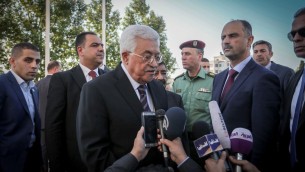
Palestinian Authority President Mahmoud Abbas lays a wreath on the grave of late Palestinian president Yasser Arafat ahead of the Eid al-Fitr holiday marking the end of Ramadan, in Ramallah on Wednesday, July 6, 2015
Palestinian Authority President Mahmoud Abbas on Wednesday harshly criticized a newly released report by the Quartet of Middle East peacemakers, saying it would not further the cause of peace, and called on the United Nations Security Council to reject the document.
The Quartet — the UN, United States, European Union and Russia — on Friday published its long-awaited report on the peace process, which saw for the first time a major international body cite Palestinian incitement to violence against Israel as a major obstacle to ending the conflict.
Incitement was one of the three “negative” trends highlighted in the report penned byUN envoy Nickolay Mladenov. The envoy said all three trends (settlements and the Palestinian Authority’s lack of control over the Hamas-ruled Gaza Strip being the other two) “severely undermine hopes for peace.”
But Abbas, visiting the grave of former Palestinian leader Yasser Arafat on the occasion of the Eid al-Fitr holiday, reiterated the PA’s rejection of the Quartet report.
“We have published our position on the Quartet commission, and we said this report is not fit for the task of peace,” Abbas said, according to the official PA news site Wafa.
“We are very sorry that this is the position, and we hope the United Nation Security Council will not adopt this report,” Abbas said.
The PA president also welcomed an usually harsh statement by the US State Department on Tuesday, in which it accused Israel of systematically seizing Palestinian land after the Jewish state approved the construction of 800 housing units in the West Bank and East Jerusalem.
“We would like it to be said that settlement building is illegitimate and illegal and must cease. This is what we demand, and if any country does so then that is welcome,” Abbas said.
His biting comments followed a report Tuesday that Ramallah had decided to stop working with the Quartet as an organization, but would keep working individually with the group’s separate members.
“It’s not only about the report, it’s more than that — but the report confirms how useless [the Quartet] is,” a Palestinian official said.
Senior PLO official and top Palestinian negotiator Saeb Erekat was quick to express disappointment Friday that the report criticized both sides rather than only Israel.
“It does not meet our expectations as a nation living under a foreign colonial military occupation,” he said, and criticized what he called the report’s attempt “to equalize the responsibilities between a people under occupation and a foreign military occupier.”
Palestinian Authority President Mahmoud Abbas takes part in a prayer session ahead of the Eid al-Fitr holiday marking the end of Ramadan, in Ramallah on Wednesday, July 6, 2016 (FLASH90)
Israel also slammed the Quartet report. A statement from Prime Minister Benjamin Netanyahu’s office said it only “perpetuates the myth that Israeli construction in the West Bank is an obstacle to peace. When Israel froze settlements (in 2009-10), it did not get peace.”
There was no formal response from the Quartet, but a source involved with the report said Wednesday there were positives to be drawn from the responses.
“If both President Abbas and Prime Minister Netanyahu find the report disturbing, then the report must contain some truths that both are uncomfortable with,” he said.
On Tuesday, despite the reported boycott of the Quartet, Abbas sent identical letters to the four representatives of the Quartet urging them to support the French initiative, a regional approach to conducting peace negotiations.
Israel has rejected the French initiative, saying only direct bilateral negotiations can be effective.