Showing posts with label Gaza. Show all posts

Friday, July 15, 2016

Teach your Children Terror and Wrong Against Zion


Teach your Children Terror  and  Wrong Against Zion


'We are the soldiers of the future': Palestinian kindergarten holds shocking graduation ceremony with small children performing military-style terrorist drills

  • The six-minute video features small children dressed in military fatigues
  • During the film, the children are seen 'raiding' an Israeli home at gunpoint
  • The play's narrator urges the audience to 'stab and kill the occupier' 
  • A senior leader of terror group Islamic Jihad also addresses the audience

    These are the shocking scenes as a group of small Palestinian children perform military-style terrorist drills in a grotesque drama performance.

    The video claims to be from the graduation ceremony of at a Gaza Kindergarten filmed on May 30, 2016.

    The group of children are dressed in military-style fatigues and are seen with a mocked-up tank, mortar and even a drone.

    Gaza pupils brandish toy guns and call for violence in play


    During the shocking video, small children are dressed up as terrorists and raid a house with an Israeli flag


    The young boys spend five minutes moving around the stage in a tactical fashion as if they were terrorists

    Before the performance, a narrator stands on the stage and introduces the show: 'And now the number you have all been waiting for… the military training show, directed by brother Bilal Majed Ashour.

    ‘We salute his enormous effort.’

    During the six-minute long video, a group of small children ran onto the stage wearing black pyjamas, bandanas and keffiyehs, where they were handed toy assault rifles from a boy, not much older than a toddler.

    The youngsters then form up in a military fashion before advancing across the stage in a tactical fashion.

    Moments later, the leading child dives to the ground and lies prone, holding his toy gun in a sniping fashion.

    Other children are dressed in desert camouflage military fatigues and can be seen loading 'shells' into a toy mortar.

    The disturbing play continues for approximately five minutes.


    At the end of the shocking performance, the narrator urges the audience to attack Israelis


    The narrator then invited the leader of Islamic Jihad Khodhr Habib to the stage to address the parents

    When the narrator returns to the stage, he said: ‘Stab! Kill the occupier with stones and knives. Use any available weapon.

    ‘From the edge of fire, when the blood calls to arms, the morning rises.’

    The narrator then invites the leader of Islamic Jihad, Khodhr Habib to the stage.

    He tells the parents sitting in the crowd: ‘The message of the children of Palestine today is a message of love to the whole world.

    ‘Indeed the spokesman of these children is saying today: “The love that we bear in our hearts is enough to be distributed among all the people of Earth. However, it is this Zionist enemy that kills the children, the women and the elderly, and is occupying the land. It is the enemy that forces us to bear arms, and protect our mothers and fathers, our elderly and the honour of our womenfolk.”

    ‘The message that these children send the Zionist enemy today is: “We do not want to kill anyone. We are not terrorists or murderers. We do not want to kill you. Get out of our land. Palestine has its owners. Do not force us to kill you. Indeed, if you continue with your aggression, with the plundering of our land, and with the defiling of our Jerusalem, we shall bear arms. We shall be the soldiers of the future, God willing.’

Thursday, July 7, 2016

Quartet again blasted by octogenarian still without an heir Mahmoud Abbas

Abbas' Eid al-Fitr attack on the Quartet 

...It is due to the Oslo Accords that his mentor, Arafat, signed -- and which only Israel upheld -- that he controls a de facto state in Judea and Samaria. With all the foreign money that has been earmarked for its development, the PA should have been Singapore by now. Instead, its best-known commodity is "martyrdom." No reports or recommendations can alter that fact.


Palestinian Authority President Mahmoud Abbas marked Eid al-Fitr -- the end of Ramadan -- by making a ritual pilgrimage on Wednesday to a very holy site among his people: the grave of former PLO chief Yasser Arafat.

It was a fitting occasion for the PA leader to pay respects to his predecessor, a mass murderer whose greatest achievement was persuading the world that he had changed his stripes. Though Arafat's vision all along was to annihilate the Jewish state in stages -- which caused his internal rivals to consider him too moderate -- the West took his acquiescence to negotiate and sign the Oslo Accords to be a turning point.

Between the signing of Oslo I in 1993 on the White House lawn and Oslo II at Taba in 1995, the archterrorist was even awarded a joint Nobel Peace Prize with Israeli Prime Minister Yitzhak Rabin and Foreign Minister Shimon Peres in 1994.

At the Camp David summit in 2000, aimed at actually achieving the "peace" for which he had won the most prestigious global award, Arafat first blew up the talks with Israeli Prime Minister Ehud Barak and subsequently launched a five-year suicide bombing war against innocent Israelis.

Abbas never enjoyed the kind of popularity at home and abroad in which Arafat basked. But he is made of the same cloth, in spite of sporting a suit and tie, rather than a keffiyeh and phony medal-studded army fatigues.

It should have come as no surprise, then, when the PA leader took the occasion of the Muslim holiday and the site of Arafat's burial to blast the report, released last Friday by the Middle East Quartet, calling on Israel and the Palestinians "to independently demonstrate, through policies and actions, a genuine commitment to the two-state solution and refrain from unilateral steps that prejudge the outcome of final status negotiations."

Incensed that the Quartet -- comprised of the United Nations, the United States, the European Union and Russia -- had the gall to include the PA in its recommendations rather than single out Israel for wrongdoing, Abbas called on the U.N. Security Council to intervene and reject the document.


The 10 recommendations in question are as follows:

1. Both sides should work to de-escalate tensions by exercising restraint and refraining from provocative actions and rhetoric.

2. Both sides should take all necessary steps to prevent violence and protect the lives and property of all civilians, including through continuing security coordination and strengthening the capacity, capability and authority of the Palestinian Authority Security Forces.

3. The Palestinian Authority should act decisively and take all steps within its capacity to cease incitement to violence and strengthen ongoing efforts to combat terrorism, including by clearly condemning all acts of terrorism.

4. Israel should cease the policy of settlement construction and expansion, designating land for exclusive Israeli use and denying Palestinian development.

5. Israel should implement positive and significant policy shifts, including transferring powers and responsibilities in Area C, consistent with the transition to greater Palestinian civil authority contemplated by prior agreements. Progress in the areas of housing, water, energy, communications, agriculture and natural resources, along with significantly easing Palestinian movement restrictions, can be made while respecting Israel's legitimate security needs.

6. The Palestinian leadership should continue their efforts to strengthen institutions, improve governance, and develop a sustainable economy. Israel should take all necessary steps to enable this process, in line with the Ad Hoc Liaison Committee recommendations.

7. All sides must continue to respect the cease-fire in Gaza, and the illicit arms buildup and militant activities must be terminated.

8. Israel should accelerate the lifting of movement and access restrictions to and from Gaza, with due consideration of its need to protect its citizens from terrorist attacks.

9. Gaza and the West Bank should be reunified under a single, legitimate and democratic Palestinian authority on the basis of the PLO platform and Quartet principles and the rule of law, including control over all armed personnel and weapons in accordance with existing agreements.

10. Both parties should foster a climate of tolerance, including through increasing interaction and cooperation in a variety of fields -- economic, professional, educational, cultural -- that strengthen the foundations for peace and countering extremism.

That Abbas is furious about these recommendations, which put Israel on equal footing with its aggressor, is yet further proof, if any were needed, of his total belligerence. Laughably, the report calls for the PA leadership to "strengthen" its efforts to combat terrorism -- as though it ever engaged in such an endeavor. If he were alive to read such a clause, Arafat would have been chuckling all the way to the bank to pocket the billions poured into Palestinian "institution-building." Abbas can't even manage to do this with a smile.

It is crucial to stress the timing of the release of the Quartet's "findings" -- a day after 13-year-old Hallel Yaffa Ariel from Kiryat Arba was butchered in her bed as she slept, and on the same day that a father of 10 from Otniel, Rabbi Michael Mark, was killed in a shooting attack on his car. But these are just two of hundreds of incidents of Palestinian terrorist attacks that have rocked the Jewish state since Rosh Hashanah last September.

Abbas not only welcomed each and every one of the bloodthirsty stabbing, car-ramming, Molotov-cocktail-hurling assaults on innocent Israelis -- he encouraged and rewarded them.

It is due to the Oslo Accords that his mentor, Arafat, signed -- and which only Israel upheld -- that he controls a de facto state in Judea and Samaria. With all the foreign money that has been earmarked for its development, the PA should have been Singapore by now. Instead, its best-known commodity is "martyrdom."

No reports or recommendations can alter that fact.

Friday, July 1, 2016

The Differential Calculus 410 of the Turkish - Israeli Reconciliation Agreement with Zion


The Differential Calculus 410 of the Turkish - Israeli Reconciliation Agreement with Zion  

While the agreement is unlikely to reset relations between two leaders who have profoundly different worldviews, it may catalyze economic and security initiatives that benefit mutual Israeli, Turkish, Palestinian, and U.S. interests.

On June 29, the Israeli security cabinet approved a long-overdue deal restoring full diplomatic ties with Turkey by a vote of seven to three. The agreement effectively ends the Mavi Marmara saga that began in 2010, when a flotilla of ships led by a Turkish NGO sought to break Israel's maritime restrictions on Hamas-ruled Gaza. In the narrow sense, the negotiators focused on providing $20 million in compensation to the families of the nine Turks who were killed when Israeli forces raided the flotilla. Yet the deal, whose text has not been publicly released, will likely have much broader implications. Although no one anticipates that it will catapult the countries back to the golden age of their relations in the 1990s, an array of mutual interests make it a sine qua non to achieving other tantalizing political, security, and economic benefits in a volcanic Middle East.

MOUNTING SECURITY CONCERNS

The June 28 Istanbul airport attack was a reminder that Turkey faces many radical enemies. Ankara has alleged that members of the Islamic State perpetrated the attack in response to the brewing Israel-Turkey deal. In addition to needing more allies to combat the group's infiltration and other forms of violent radicalism, the Turks have bitterly opposed the rule of Syrian president Bashar al-Assad, bringing them into conflict with his various Shiite allies (for more on Ankara's calculus, .

For its part, Israel has come to believe that it needs as many friends as possible to deal with the region's turmoil. Thus when Turkish president Recep Tayyip Erdogan stated the need for closer relations with Jerusalem earlier this year, his comments received wide attention in Israeli media and policy circles. Previously, both Erdogan and Israeli Prime Minister Binyamin Netanyahu had avoided concluding the reconciliation negotiations because other concerns and suspicions outweighed their need for regional allies. For example, Netanyahu feared that an agreement would only reinforce Erdogan's tendency to vociferously criticize Israel and support its sworn enemy, Hamas.

PREVENTING ANOTHER GAZA FLARE-UP?
One of the deal's most important implications is that it could prevent another round of fighting in Gaza, mainly by alleviating the territory's worsening humanitarian conditions. The Israeli military believes that improving quality of life in Gaza is the best hope for avoiding future wars against Hamas, and the deal with Ankara will facilitate such efforts.

Specifically, Turkey will now be permitted to build a power plant in Gaza, which in turn will enable construction of a desalination plant to deal with the territory's water problems. To be sure, other restrictions will remain in place. For one, Israel will not allow Turkey to build a Gaza port or anchor a power-generating vessel offshore. Erdogan also realized that Israel would not end its economic restrictions on the territory, so he retracted his prior (and very public) insistence on that point -- a major change. Instead, the Turks agreed that all trade with Gaza would go through the Israeli port of Ashdod. Jerusalem has long insisted on such control due to security concerns about Hamas smuggling efforts. Interestingly, while Hamas routinely denounces any countries that improve their ties with Israel, the group did not criticize the Turkey deal, since it cannot afford to lose Erdogan's support.

The agreement also indicates that Israelis are coming to terms with the Palestinian Authority's apparent lack of interest in resuming control over Gaza. Israel therefore felt compelled to make a deal with Turkey even if it allows Hamas to claim credit for any improvement in Gaza. Previously, Israel had insisted that the PA receive credit for improvements in Gaza. Although Palestinian discourse often nurtures conspiracy theories about Israel supposedly wanting Hamas to prevail against the PA, such thinking makes little sense in light of Gaza's current situation.

Netanyahu has also been careful about avoiding any accommodation with Ankara that might anger Egypt. Hamas has long viewed itself as the Gaza branch of the Muslim Brotherhood, Cairo's bitter enemy, so President Abdul Fattah al-Sisi does not want to boost Turkey's influence in Gaza if it will help Hamas. Egypt is also furious at Ankara for not recognizing Sisi's government. While Netanyahu did not synchronize his position with Sisi in advance of the Turkey deal, he likely made sure that the agreement's terms contained no surprises for Cairo. Israel had no intention of institutionalizing a Turkish role in Gaza at Egypt's expense, and Cairo has developed a comfort level with Jerusalem given the extensive scope of their security relationship. Moreover, the deal comes at a time when Egyptians are preoccupied with more pressing economic matters at home.

Another Palestinian dimension to the deal is that Ankara will no longer permit Hamas military operatives to use Turkey as an operational base for attacks in the West Bank, even if the organization can retain an office there for other purposes. In Israel's view, Hamas operative Saleh al-Aruri was a key figure in the West Bank violence that led up to the 2014 war in Gaza, yet he was based in Turkey up until 2015 and was permitted to visit the country on more than one occasion over the past year. This issue was apparently one of the last sticking points in the negotiations.

ECONOMIC TIES
Netanyahu has devoted considerable effort to improving ties with Greece and Cyprus in the past few years, largely to ensure an optimal environment for Israel's natural gas development in the Mediterranean Sea. Similarly, the deal with Ankara should facilitate serious talks about exporting Israeli gas to Turkey. In addition to potentially serving as Israel's gateway to European gas markets, Turkey would welcome an inexpensive supplier to alleviate its own energy dependence on Russia -- particularly given the sharp tensions with Moscow that emerged last November after it shot down a Russian military jet. (One should not rule out the possibility that Netanyahu discussed the Turkey deal with Vladimir Putin during his June visit to Moscow; the timing of this week's Turkish "apology" for the shootdown is notable as well.)

Israeli energy minister Yuval Steinitz, who met with Erdogan on the margins of the multilateral nuclear summit in Washington this March, has said that gas is an important bilateral opportunity, and that pipeline deals with Turkey would enable Israel to develop its offshore resources even more. Moreover, ongoing speculation about a potential peace deal in Cyprus this year will only heighten hopes for economic growth in the Eastern Mediterranean.

Such growth is already evident -- Israel's trade with Turkey has more than doubled over the past several years and exceeded $5 billion in 2015. Over 13,000 trucks reportedly carried food, steel, machinery, medicine, and other items from Turkey to Israel last year, arriving at Haifa port and then moving on to Jordan via the Sheikh Hussein Bridge. These deliveries supplanted trucks that used to transit through Syria during more tranquil times.

Yet the economic gains do not erase the downturn in bilateral ties, which began before Mavi Marmaraand accelerated afterward. On several occasions over the past few years, Erdogan has made vitriolic statements against Israel, even accusing it of "war crimes." And the relationship remained frosty despite the fact some elements of this week's deal were already more or less settled long ago. For example, in a phone conversation orchestrated by President Obama in March 2013, Netanyahu met one of Turkey's key demands by apologizing for any "operational mistakes" in the maritime incident. And Jerusalem has insisted for years that Turkey neither press nor support criminal charges against Israeli security officials for the flotilla raid -- a demand that was not formally accepted by Turkey until this week. Earlier today, Israel's chief negotiator for the talks told Yediot Aharonot that the $20 million in victim compensation would not be forthcoming until the Turkish parliament passed a law against such charges.

In addition, three Israeli cabinet ministers voted against the deal, including newly appointed defense minister Avigdor Liberman. Education Minister Naftali Bennett also dissented, arguing that the principle of giving a compensation package to the Turkish flotilla victims sets a bad precedent on the Palestinian issue. While some ministers were upset that the deal was not linked to the return of two Israeli soldiers whose bodies are still in Gaza, Jerusalem apparently decided that any such linkage would give Hamas an effective veto over Israeli-Turkish relations.

THE U.S. DIMENSION
Washington has long been calling for such a deal between its allies in order to get a better handle on the region's growing turbulence. In addition to the Obama phone call in 2013, Vice President Joe Biden visited both countries this year (Ankara on January 21 and Israel on March 8), where he is believed to have discussed the need for rapprochement. In recent years, Turkey has used its membership in NATO to block different forms of outreach to Israel, so the new agreement should allow the organization to expand cooperation with Jerusalem.

The chances of Israeli-Turkish cooperation against jihadist groups are less certain, though recent statements offer some potential for movement in that regard. According to a May 9 report in Hurriyet Daily News, Israel's consul-general in Istanbul, Shai Cohen, noted, "Ultimately, we see eye to eye with Turkey on eliminating jihadist extremist organizations, particularly in Syria, but [also] in the region in general. There is a lot to cooperate on that." It remains to be seen whether Turkey's presumably intensified conflict with the Islamic State will lead to closer sharing of information with Israel, at least on discrete subjects. The Israeli media is rife with speculation that pre-2010 bilateral arms sales will be renewed in some reduced form, but this cannot be confirmed.

CONCLUSION
The Israel-Turkey agreement is unlikely to mean a "reset" between leaders who have profoundly different worldviews on political Islam and other issues. Yet by ending years of political deterioration and vociferous recrimination between the two governments, the deal could be the catalyst that enables them to seize bilateral and regional opportunities when their strategic interests converge.

Saturday, May 7, 2016

Hamas Nursery Rhyme- Fasten your bomb belt versus Golda Meir -We will only have peace with the Arabs when they love their children more than they hate us


A month ago the annual ‘Palestine Festival for Childhood and Education’ was held in the Gaza Strip. As the Meir Amit Intelligence and Terrorism Information Center reported, the five-day festival’s opening event was attended by a representative from the Gaza office of a British charity.
“On April 3, 2016, a ceremony was held at the University College of Applied Sciences in Gaza to announce the beginning of the Annual Palestine Festival for Childhood and Education. The opening ceremony was attended by college’s rector, Dr. Refaat Rustom, members of the faculty, Ahmed Hawajri, director of guidance and special education in the department of education in the Gaza Strip, Imad al-Ghalayini, representing the Bank of Palestine, Mahmoud Lubbad, Interpal representative in Gaza, and representatives of children’s organizations throughout the Gaza Strip. The festival began on April 3 and ran until April 7, 2016, and organized various activities for children throughout the Gaza Strip.” [emphasis added]
Lubbad’s participation is explained by the fact that the British charity Interpal co-sponsored the festival.
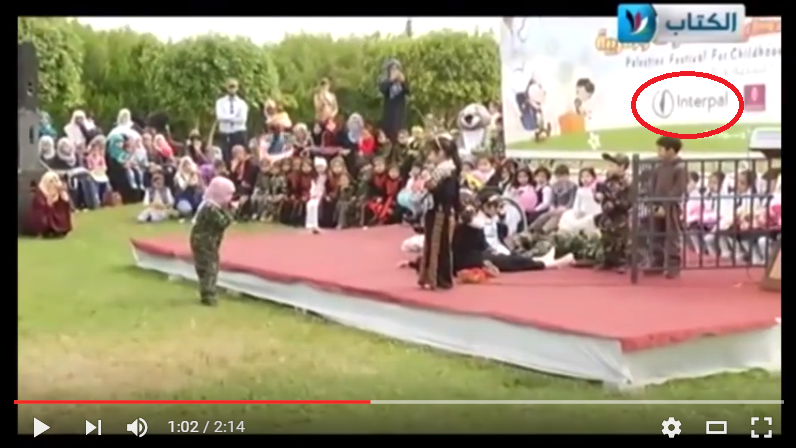
“The high point of the festival during Palestinian Children’s Day on April 5. One of the events was held in Khan Yunis, and was attended by many children and their teachers. Children came on stage in groups and put on shows they had prepared for the audience. There were dances and songs as well as displays with themes of hatred and violence against Israel, evidence of the indoctrination received by the younger Palestinian generation. The displays were accompanied by songs with themes of hatred and violence.
Three of the plays put on by the children were the following:
  1. A play in which a very young, veiled girl stabs an “IDF soldier” with a knife – In response the “soldiers” shoot her and she falls motionless to the ground. The play was related to the release of Palestinian prisoners (see below), and glorified the stabbing attacks which are a prominent form of attack in the current Palestinian terrorist campaign.
  2. A play showing a “Palestinian prisoner” incarcerated by “IDF soldiers.” A masked child wearing a uniform “shoots and kills the IDF soldiers” and releases the “prisoner”. The play reflects the Hamas’ efforts to abduct Israelis as bargaining chips for the release of Palestinian terrorists imprisoned in Israel.
  3. A display put on by another group of children showing an “IDF soldier” holding an Israeli flag. A little girl knocks him over, steps on him and picks up a Palestinian flag. Then she “releases” a Palestinian prisoner.”
As can clearly be seen in this video of clips from those shows, the stage backdrop displayed the Israel-erasing Interpal logo.
Interpal logo Gaza childrens festival
When approached by the Daily Mail, an Interpal representative stated that:
“…it did not support the play but instead ‘hosted some activities in Gaza City, as part of the larger event’, adding that it does not condone violence.”
And:
“Our logo was used in various materials for the festival, as we held our own activities as part of the larger umbrella of the festival in Gaza City,’ a spokesperson said. ‘We did not support this particular play and did not have any involvement with it.”
Ten years ago the BBC’s ‘Panorama’ made a very good programme about Interpal titled ‘Faith, Hate and Charity’ which opened with footage of Palestinian children performing similar ‘amateur dramatics’. Following that programme an investigation into Interpal was carried out (not for the first time) by the Charity Commission.
“Included in a wealth of material which Panorama passed to the Commission was video evidence of young girls at an event organised by one of Interpal’s partner charities being encouraged to sing: “We all sacrifice ourselves for our country” and “… we answer your call and make of our skulls a ladder to your glory, a ladder.”
Another clip shows girls dancing to a tune with the lyrics: “Fasten your bomb belt oh would-be martyr and fill the square with blood so that we get back our homeland.”
A woman, who was organizing another event was seen taking the microphone and telling the children: “To martyrs in every time and place… To the rich blood and to the wounds which have drawn the identity of Islamic land.”
In paragraph 60 of its report, the Commission acknowledged that the material presented to it “seemed to indicate that certain local partners funded by the Charity promoted terrorist ideology or activities amongst their beneficiaries.”
Despite that Panorama report, Interpal continued to function and apparently very little has changed in the last decade – apart the BBC’s level of interest in the story, which it has not covered to date.

Another Good Week in Zion-- Bad, Bad , Bad for Hamas ... Thank Ms God ( why shouldn't she be a Woman)


The Israeli authorities announced this week ( Thursady)  the discovery of a another Hamas attack-tunnel running from the Gazan side of the border into Israel, the second such attack-tunnel to have been exposed in a month. The earlier one was considered
the first to be detected since the end of the last war in Gaza in 2014. The tunnel – about 30-40 metres deep, lined with concrete slabs and equipped with communication lines, air supply and rails for further excavation – was uncovered last week although its existence was confirmed only on Monday. The tunnel reportedly entered Israel in an area some distance from Israeli military bases and civilian homes. Speaking at a media briefing, Lt Col Peter Lerner said the tunnel extended several hundred metres under Israel and was large enough for a man to stand in. ["Israeli military uncovers first Hamas tunnel into Israel since 2014 war", The Guardian, April 18, 2016]
This week's came accompanied with some interesting side stories:
  • Israel's Shin Bet revealed just a few hours before Thursday's announcement of the second tunnel that it had captured Mohammad Atuna, 29, a terrorist from Gaza in the service of Hamas and possessing "large amounts of information about the tunnel network". He had been taken into custody in early April, before the report of the first tunnel discovery, though at the time, a Haaretz report, referring to him as Sami al-Atawna, implied that Hamas was denying that he was in Israeli hands.
  • There were and are heavy hints in the Israeli media about the extent to which this Atuna has been helpful to their inquiries. He has detailed "the existence of a warren of Hamas tunnels within Gaza itself to be used to ferry fighters and equipment around the Gaza Strip, including rooms for relaxation equipped with showers and mess halls in order to improve the lives of the fighters." 
  • It's reported that Atuna has also given up detailed tunnel locations and routes, as well as related information about the techniques used in tunnel construction and other logistical aspects of Hamas’ tunnel strategy. This includes disclosure of the workings of the so-called "Nakba" terrorist unit which is trained "for fighting within Israeli territory".
  • Ynet says he gave up details of Hamas's use of private homes and other buildings to hide tunnel construction activity, and pointed out where digging projects were occurring, and the locations of tunnel shafts to be used in the planned attacks. In addition, he handed over the names of many Hamas operatives and their positions within the organization, detailed locations of weapons storage facilities, many of them inside civilian homes. 
  • Ynet: "Atuna admitted to having massive amounts of arms at his house, including IEDs, rifles, and suicide vests. He was supposed to give these items out to fighters in the event of another round of fighting."
  • He described two classes of tunnel; those within Gaza via which its terrorists can maneuver to hide and to outflank IDF forces; and cross-border tunnels for carrying out attacks on Israeli forces and civilians. "Hamas has invested millions of dollars to enable their Special Forces operatives to stay underground for weeks at a time, lying in wait until the order is given to attack Israel."
Tunnel #2 is said to start some 100 feet, roughly 30 meters, inside the southern part of the Hamas-controlled Gaza Strip, and to stretch from there some as-yet-unspecified distance into Israel. It is constructed about 30 meters below the surface of the ground.

The jihadists have much to lose now that the offensive apparatus is revealed and being dismantled. So on Tuesday, Hamas
directed cross-border gun fire at an IDF engineering vehicle near southern Gaza [Jerusalem Post, May 5, 2016]
And then during, and since, yesterday's uncovering, Israeli communities in the Gaza envelope area have continued to come under fire from the Gazan side for what Haaretz, quoting the IDF, calls
the first time since the end of the 2014 war that Hamas had opened fire on Israeli operations on the ground. Both Hamas and Islamic Jihad released statements warning Israel against any escalation. Hamas’s armed wing, the Izz ad-Din al-Qassam Brigades, said it was ready to respond to Israeli strikes. “We will not permit this aggression to continue and the enemy should not invoke any reason, and should leave the Strip immediately”... [Haaretz, May 5, 2016]
Vehicles have been damaged on the Israeli side but we're pleased to say there have been no injuries to Israelis up until this point.

An IDF spokesperson said yesterday that the shooting is "a result of Hamas identifying that the Israel Defence Forces were closing in on those assets" i,e, the attack-tunnels. That fire, mortars so far, has continued this morning. A Times of Israel report says a mortar attack on Israeli soldiers this morning working on Gaza's southern-most flank was the twelfth such assault in the past four days.

The Arab media carry reports this morning [like this one] of both Hamas and Palestinian Islamic Jihad where they have boasted of their tunneling strategy, warning Israel to back off lest the IDF's "violence... pushes the resistance to reciprocate" and issuing a reminder that "Israeli crimes will not break the spirit" of the Gazan Palestinian Arabs. Hamas' arch-terrorist Ismail Haniyeh says today that the Israelis have penetrated "150 to 199 meters on the pretext of searching for tunnels" [source] and that his murderous group "will not under any circumstance accept these incursions".

Putting Haniyeh's absurd use of "pretext" into a factual context, it has only been a few weeks - certainly long enough for most reporters to forget - that he said Hamas
will never stop digging tunnels and upgrading rockets in preparation for any possible confrontation with Israel [Jerusalem Post]
Hamas is seriously committed to tunnels. It's estimated they have more than 1,000 of its loyalists working to build and extend them at an overall cost of hundreds of thousands of dollars each month. Workers are paid US $300 to 400 per month. It's not such a great deal for them, though they probably have little option. Arab media reports quoted by Israel National News in mid-April said the death toll from a series of "mysterious" Gazan tunnel collapses since January 2016 had reached 20, most of them actual terrorists - and not merely laborers - from its Izz ad-Din al-Qassam Brigades.

Wednesday, May 4, 2016

Zion's Catch 22 - Conflict Management versus Conflict Resolution


Israel has gradually come to realize that the Palestinians are neither a partner for peace nor capable of establishing a viable state. Therefore, Israel's recent governments have adopted a de facto conflict-management approach, rather than a conflict-resolution strategy. This prompts several questions. Should Israel continue to speak explicitly about the prospects of a two-state solution, or play along with the illusory preferences and pretensions of the international community? Should Israel apply more “stick” than “carrot” to the hostile Palestinian Authority? Would the collapse of the Palestinian Authority serve Israel's interests? And how diplomatically active should Israel be on the Palestinian issue?

Ever since the Palestinian terrorist wave began in September 2000, the Israeli body politic increasingly has resigned itself to the probability that there is no partner on the Palestinian side with which to reach a historic compromise with the Jewish national (Zionist) movement. The hopes for peace that were generated by the Oslo process in 1993 have been replaced by the stark realization that violent conflict will not end soon.

Moreover, the hostile messages about Israel purveyed in the Palestinian Authority (PA) educational system and official media leave little doubt about the rabid anti-Semitism prevalent in Palestinian society, which ensures that conflict with the Jews will continue. And thus, the central premise of the Oslo process seems exceedingly improbable. The premise was that partition of the Land of Israel and the establishment of a Palestinian political entity (what is known as the two-state paradigm) would bring peace and stability. Alas, this paradigm has been deeply discredited.

Aside from and beyond the assessment that the PA has no intention of accepting a Jewish state in any borders, the fact remains that the two sides remain far apart on most of the concrete issues to be resolved. Palestinian demands for control of the Temple Mount and the so-called “right of return,” for example, are insurmountable obstacles. Any pragmatic impulse that might otherwise have emerged in Palestinian politics is consistently countered by Hamas, whose growing influence reflects the Islamist tide that is surging across the wider region.

To make matters worse, the assumption that the Palestinians are capable of establishing a state within the parameters of a two-state paradigm has not been validated. The PA was unable to get rid of multiple militias and lost Gaza to Hamas, mirroring the inability of other Arab societies in the region to sustain statist structures.

Finally, protracted ethno-religious conflicts end only when at least one of the sides becomes war-weary, and runs out of energy for sustaining the conflict. That is not true of either Israeli or Palestinian society.

As a result of these trends, Israel essentially, if not formally, has given up on conflict resolution in the short run, and instead effectively has adopted a strategy of patient conflict management. But such a strategy brings policy dilemmas of its own.

The first dilemma is whether or not to admit that Israel no longer believes that negotiations can lead to a durable agreement in the near term.

Truth has its virtues, but much of the world does not want to hear this particular truth and is still committed to an unworkable formula. There is, in any case, something to be said for acceding to the wishes of the international community by continuing to participate in negotiations. Doing so signals that Israel is ready to make concessions, which maintains the domestic social cohesion necessary for protracted conflict (management) while projecting a positive image abroad.

On the other hand, negotiations toward the doubtful “two-state solution” keep a fictitious formula alive and prevent fresh thinking about alternative solutions from emerging. Moreover, the “peace process” requires moderation, which entails swallowing Palestinian provocations and restraining punitive action.

A second dilemma is related to the “carrot and stick” approach toward the Palestinians. In the absence of meaningful negotiations, Israel, particularly Prime Minister Benjamin Netanyahu, has advocated the promotion of “economic peace” as a part of conflict management, on the assumption that Israel has nothing to gain from hungry neighbors. This is why Israel does not oppose international financial support for the PA, despite the corruption and inefficiency of the latter. Jerusalem also provides water and electricity to the PA, and to Hamas-ruled Gaza, so that Israel’s Palestinian neighbors do not dive into total desperation.

But the carrot mitigates the impact of the stick. The Palestinians, it must be recalled, wage war on Israel. Exacting pain from opposing societies is what war is all about, and pain can have a moderating effect on collective behavior. Egypt, for example, decided to change course with regard to Israel because it grew reluctant to pay the costs of maintaining the conflict.

Since the Palestinians have chosen to pursue their goals by causing Israel continued pain – rather than by accepting generous peace deals offered by Ehud Barak (2000) and Ehud Olmert (2007) – Israel has every right to punish them, in the hope that a bit of pain might influence their future choices in a productive direction. But by adopting an “economic peace” approach, Israel creates disincentives to Palestinian moderation, and signals its desperation at the prospect of changing Palestinian behavior.

A third dilemma implicit in the conflict management approach is what to do about the hostile PA, which survives largely because of Israel’s security measures and economic backing. The collapse of the PA is one possible outcome of a succession struggle after Mahmoud Abbas leaves the political arena.


Whether or not the collapse of the PA is desirable is debatable. On the one hand, the PA propagates vicious hatred toward Israel in its educational system, conducts an ongoing campaign of international delegitimization against Israel, and denies Jewish links to the Land of Israel and to Jerusalem in particular. It glorifies terrorists and allows them to be role models in its schools. It deliberately reinforces the hostility that fuels the conflict, preventing the emergence of a more pragmatic Palestinian leadership.

On the other hand, the PA conveniently relieves Israel of the burden of responsibility for more than one million Palestinians living in the West Bank. PA security forces help combat Hamas influence in the West Bank (although far less than the PA is given credit for). The functioning of the PA, however imperfect, also keeps the Palestinian issue off the top of the international agenda – something that is very much in Israel’s interests. A descent into chaos resulting from the total collapse of the PA would invite international intervention.

An additional question for Israel to consider relates to the appropriate level of diplomatic activism on the Palestinian issue. Many advocate Israeli diplomatic initiatives in order to prevent unfavorable plans from being placed on the agenda by global actors. The nature of such initiatives is usually unclear, but activism is part of the Israeli Zionist ethos and “taking initiative” appeals to the impatient Israeli temperament.

On the other hand, a patient wait-and-see approach allows others to make mistakes and gives Israel the latitude to wait on a more favorable environment. In fact, this was the approach favored by David Ben-Gurion. He believed in buying time to build a stronger state and in hanging on until opponents yield their radical goals.

Each of these dilemmas leads to a policy gamble. The short-term existential security imperatives of a small state further complicate Israel’s choices. Even if Israel’s leaders are correct in opting for a conflict management approach for the moment, they are in an unenviable position.

Sunday, April 17, 2016

Hilary Israel and Clinton versus Bernie Sander on Israel - US Status Quo, Disproportionate Response to Indiscriminate Rockets attacks on Zion


A good politician can spin a position both ways bit the worst type of Antisemite is a Jew. Antisemitism is  Anti- Zionist. Zionism and Judaism have been inextricably linked since Zionism became Israel and more so with the rise of Fundamental Islam and second by second as it happens media coverage of events in the Middle East in social media in particular Facebook and Twitter. Bernie Sanders remarks can be interpreted as both. These aren't simply a Liberal Zionist remark. This is antiZionism, Anti Israel and hence anti- Semistic. Bernie Sanders has challanged the long time status quo of the US- Israel Relationship. Her track record on Zion isn't without blemishes but it comes with tremendous experience . Vote Hilary Clinton

Vermont Sen. Bernie Sanders -- the first Jewish candidate to win a presidential nominating contest -- believes Israel's response in the 2014 Gaza war was "disproportionate."

"Was Israel's response disproportionate? I think it was," he told CNN's Jake Tapper in an interview that aired Sunday on "State of the Union."

"Israel has a 100% -- and no one will fight for that principle more strongly than I will -- has the right to live in freedom, independently and in security without having to be subjected to terrorist attacks," he said. "But I think that we will not succeed to ever bring peace into that region unless we also treat the Palestinians with dignity and respect, and that is my view."

The seven-week conflict in 2014 was an Israeli response to Hamas rocket fire into southern Israel. More than 2,130 Palestinians were killed in the conflict, and it's not clear how many were civilians. At the time of the ceasefire, the United Nations estimated that more than 70% were civilians, but Israel reported a higher number of militants among the dead.

Tapper asked Sanders about an interview he gave to the New York Daily News earlier this month in which the Vermont senator said his recollection was that more than 10,000 innocent people were killed in the conflict. Sanders told Tapper that he wasn't sure what the death toll was, and when a Daily News editor clarified it to him, he accepted it.

But the claim attracted the attention of the Anti-Defamation League, whose CEO, Jonathan Greenblatt, released a statement on Thursday saying he had spoken with Sanders and that the senator had clarified that his recollection was "inaccurate."

"As you know, the number was much lower," Tapper said.
"Yes," Sanders said.

The Vermont senator then stumbled when Tapper asked Sanders about criticism of Michael Oren, the former Israeli ambassador to the U.S., over Sanders' views of the Gaza clash.
"Who is Mr. Oren?" Sanders asked, apparently unaware of Israel's top diplomat to the U.S. during President Barack Obama's first term.

"Michael Oren, the former ambassador of Israel to the United States. And now he's a politician in Israel," Tapper said.

"I see. And he's attacking me for a statement I did not make," Sanders said.

Later in the interview, Sanders, a secular Jew, said he hopes to provide a "balanced" view on issues related to Israel and Palestine than most U.S. politicians.

"It is interesting ... that the first Jew in American history to win a delegate, much less a primary, is taking this position with Israel," Tapper told Sanders. "Usually in American politics, everyone just supports Israel whatever Israel wants to do, but you are taking a more critical position."
"I'm taking a more balanced position," Sanders replied.

He added: "Whether you're Jewish or not Jewish, I would hope that every person in this country wants to see the misery of never-ending war and conflict ended in the Middle East. It's a difficult issue and good people have tried to deal with it for years."

Sanders said the United States must play a role in supporting Israel while not ignoring the challenges of the Palestinian people.

"Of course we are going to support Israel, but you cannot ignore the needs of the Palestinian people in Gaza right now: poverty, unemployment, their community has been decimated," Sanders said. "You can't ignore that fact. And you can't just be only concerned about

For the sake iof Zion: 10,000 reasons why never to vote for Bernie Sanders


He is a long-serving US senator, who seeks the Democratic nomination for president and whose words influence the public and certainly his own supporters.

Democratic US presidential candidate and US Senator Bernie Sanders speaks at the NBC News - YouTube Democratic presidential candidates debate. (photo credit:REUTERS)

As his white hair and demeanor let on, Bernie Sanders is no youngster or political novice.

He is a long-serving US senator, who seeks the Democratic nomination for president and whose words influence the public and certainly his own supporters.

But there are some who would write off his dangerous and shocking statements in that interview with the New York Daily News – in which he claimed among other things that Israel killed 10,000 innocent Palestinians in the summer of 2014. Sanders later said he’d merely made a mistake about the figure, that should be forgiven, as a mistake made by a child or an amateur would be.

The Anti-Defamation League, the primary Jewish organization which publicly demanded that Sanders issue a correction, appears to have taken this approach. It “welcomed” Sanders’ statement that he accepted the much lower number of deaths in Gaza mentioned by one of the Daily News interviewers later on in the interview.

The ADL’s attitude is essentially this: Sanders confused some numbers and then accepted he was wrong. It could happen to anyone.

It is true that much of the outrage focused on the grossly inaccurate “10,000” number Sanders gave for civilian deaths in Gaza. The ADL’s initial statement, for example, mentioned that Sander’s said Israel’s use of force was “disproportionate,” but was primarily dedicated to the highly exaggerated number of civilian deaths. David Horovitz’s attention-grabbing headline was, “Seven Times Worse than Hamas: Bernie Sanders by the Numbers,” and his article focused mostly on the claim of 10,000 killed.

Indeed, if it were just a question of getting a number right, then the indignation of Jewish organizations and Israeli politicians would be partially misplaced, as Jerusalem Post op-ed editor Seth Frantzman suggested in his recent column. It would also follow that having publicly accepted that 10,000 Palestinian civilians were not killed, those dedicated to countering the defamation of Israel should drop the matter, as the ADL has.

But Sanders’ did not just confuse numbers.

His accusation against Israel was more damning than any number could be. Sanders claimed that Israel indiscriminately killed 10,000 civilians.

“I think most international observers would say that the attacks against Gaza were indiscriminate,” Sanders said. With the technology available, “they could have been more discriminate in terms of taking out weapons that were threatening them,” he argued.

Then he gave the 10,000 number. Then he again said, “I do believe and I don’t think I’m alone in believing that Israel’s force was more indiscriminate than it should have been.”

So more than merely inflating the number of those killed by a factor of seven, Sanders essentially accused Israel of mass murder.

As to his numerical error, this too cannot be so easily written off.

Even considering how many have been slaughtered in Syria just next door, killing 10,000 people is no less of a slaughter, especially if done in the span of a few weeks, as Sanders believed.

What seems to have confused some people about whether Sanders is responsible for his statements were the myriad disclaimers Sanders tacked on to his many accusations to give himself cover, just like the politician he pretends not to be.

“My recollection is”; “Does that sound right?”; “I don’t have... [an exact] number but I think it’s over 10,000”; “My understanding is that a whole lot of apartment houses were leveled”; “Hospitals, I think, were bombed”; “So yeah, I do believe and I don’t think I’m alone in believing....”

But by going on record and repeating, exaggerating, and basing a political position on an accusation of wrongdoing, Sanders essentially endorsed that accusation, regardless of the disclaimers. If Sanders was as unsure as he made himself out to be, he ought not to have repeated such outrageous accusations at all.

At best Sanders readily accepted a claim that Israel committed mass murder. Had he any sympathy for Israel, the 10,000 number would not have left his mouth.

He might also have been aware that accusations like the one he repeated and embellished are constantly hurled at Israel to demonize it and would not have added to the anti-Semitic mob’s cry.

This was not just a misfired synapse or a lack of precise information. It was a presumption about who is terrorizing who in the conflict between democratic Israel and Palestinian terrorists.

This is not something that a little education can fix, as Sanders’ appointment of new Jewish outreach director, Simone Zimmerman, has confirmed. (In a recent op-ed in Haaretz, she wrote, “No public relations trick can save Israel’s image. The problem isn’t with the hasbara [public diplomacy]”). Sanders himself is no ignoramus. He’s a political veteran and like Zimmerman, an idealist with a definite world view. Israel just does not figure too highly in that world view.

In the Daily News interview, Sanders said he thought Israel should be recognized as a Jewish state.

But when asked why, he didn’t say, as even President Barack Obama has said, that the Jewish people need a state of their own or that Israel is their ancestral homeland.

Instead, Sanders replied, “that’s the status quo.”

The flip side of such reasoning being that if it were not the status quo, Sanders would not necessarily support the existence of a Jewish state.

Sanders’ answer to a bigoted question about “Zionist Jews” a few days later at the Apollo in Harlem, New York, seems to confirm this. Sanders responded that he was “proud to be Jewish,” but he added the proviso that “you’re not going to find any candidate running for president, for example, to talk about Zionism” – which is the rationale for the existence of a Jewish state in the land of Zion.

Sanders has also made clear how, as president, he would relate to Israel.

“[T]o the degree that they want us to have a positive relationship,” Sanders said of Israel in his discussion with the Daily News, “I think they’re going to have to improve their relationship with the Palestinians.”

According to Sanders, support for Israel should depend on how it gets along with the people who refuse to recognize its right to exist and constantly wage terrorism campaigns against it.

Under president Bernie Sanders all Palestinian terrorist groups will have to do to destroy Israel’s relationship with the United States is wage war on Israel, hide among their own civilian population to create a high level of civilian casualties and claim Israel is firing indiscriminately.

President Sanders will not doubt such claims and may even parrot them in a press conference. Palestinian spokesmen like Saeb Erekat won’t even have to falsify the casualty numbers. President Sanders might make up a number for them.

Believing, publicly repeating, exaggerating and essentially endorsing blood libels against Israel, as Bernie Sanders did and as he may do as president, is no mere error of arithmetic or memory to be quickly forgiven and forgotten.