Friday, April 7, 2017

Merrry de La Grey by the Bard of Bat Yam, Poet Laureate of Zion

Image may contain: cat and indoor
Cats are among life's precious jewels and kinship
They are sweet, funny cute, genuine and rare,
They are what we call loyalty and friendship
And has worth far far beyond dogs to compare

Neil Gorsuch’s Supreme Court Confirmation Five Things that are now empanticall


The Senate voted Friday to confirm Neil Gorsuch to the Supreme Court.

It’s over. The Senate has confirmed Neil Gorsuch to the Supreme Court on a largely party-line 54-45 vote, ending a months-long process marked by partisanship and a historic rule change that could have major implications for the future of the court. Now that the fight is finished — and Congress heads home for its Easter recess — here are some takeaways from the drama surrounding Gorsuch’s confirmation.

The standard for Supreme Court nominees is now undeniably political


Throughout its history, the Supreme Court always has been a red-hot political issue for the other two branches of government (google “FDR and Supreme Court” and “Nixon and Supreme Court”). But the Gorsuch nomination shows how profoundly the standard for judging SCOTUS nominees has shifted.

For nearly 40 years, the primary test for senators has been a Supreme Court nominee’s qualifications, character and past actions. That led to bipartisan support of justices from Antonin Scalia (98-0), whose seat Gorsuch will fill on the court, to Sonia Sotomayor (68-31). Those justices represented clear sides of the judicial spectrum, but were still supported by both parties because of their qualifications. This slide into politics arguably started with Justice Samuel Alito and continued with Justice Elena Kagan, both of whom received more partisan opposition than we’d seen in the past. It accelerated last year, when Senate Republicans refused to consider Merrick Garland, former President Barack Obama’s nominee to fill Scalia’s seat. Republicans defended the move; Democrats have decried it as a political power play, and a low point for the Senate.

But now, with Gorsuch, it is clear. Supreme Court nominations have become a sport measured as much by partisan philosophy as judicial merit.

Paralysis Explained: The failed compromise attempt on Gorsuch highlights the bigger problem in Congress

Last weekend, a group of some 10 senators tried to avoid parliamentary bloodbath and find a compromise over Judge Gorsuch, senators involved in the talk told NewsHour and other media outlets.

Led by Sens. Susan Collins (R-Maine), and Chris Coons (D-Del), the senators from both parties generally agreed to some big terms: Democrats would move Gorsuch forward, in exchange for a promise from Republicans to hold off on changing the confirmation rules for a certain number of years.

But the deal fell apart, Coons said, in large part because Republicans wanted an exception for “extraordinary circumstances,” among other conditions. And Democrats simply did not trust Republicans to set a high enough bar for that. “We are in a moment of bad faith,” Coons said, noting that every Democrat feels Republicans acted in bad faith by blocking Garland and nearly every Republican feels the same about how Democrats almost universally have opposed Gorsuch.

Conclusion: For nearly 20 years, razor-sharp politics and ever increasing campaign money battles were the prime forces causing Washington gridlock. Now, add to that, a deep and growing mistrust.


Senate Majority Leader Mitch McConnell, R-Ky., gives a thumbs up after the Senate invoked the “nuclear option” to confirm a Supreme Court justice nominee on Thursday, April 6. Photo By Tom Williams/CQ Roll Call.

Precedents still matter in the Senate. And the new key precedent is 2013

Leading up to the decision to “go nuclear” and alter how the rules work for Supreme Court nominations, we heard many lawmakers speak about what a sad day it was going to be in the Senate. But the truth is, the 2017 drama was barely a shadow of the intense emotion and electric divide of 2013, when Democrats first launched the “nuclear option” to get through a backlog of lower court and other presidential nominations.

The Senate remains a place of precedent. Which is why, technically, Republicans did not alter the words in the rules this week — they just changed the precedent for how the rules work. Now we’ll watch if any more precedents change.

The GOP has its first major accomplishment since Trump took office

It’s been a rocky first few months in power for President Donald Trump and the GOP-controlled Congress. The president’s travel bans have been blocked in court. Several high-profile investigations are underway into Russia’s interference in the 2016 election and its possible ties to Trump campaign associates. And House Republicans failed to pass a bill that aimed to repeal and replace the Affordable Care Act, dealing the party an embarrassing setback. This is not the start Republicans had hoped for in January, as they gained control of both chambers of Congress and the White House.

So Gorsuch’s confirmation was a much-needed win for the GOP, even if the confirmation process was ugly and controversial. Much of the attention now is on the “nuclear option.” That will always be a footnote to Gorsuch’s confirmation. But the focus on Senate rules will fade. What matters to Republicans and their base is getting a conservative judge on the court. Trump promised to do that if he won the election. With Gorsuch’s confirmation, Trump delivered. Whatever else happens on issues like immigration and health care — not to mention foreign policy — placing a justice (or possibly multiple justices) on the Supreme Court will be a major part of Trump’s legacy.

Gorsuch’s confirmation also brings short-term advantages. Gorsuch won’t change the balance of power on the court, but he does shore up its conservative wing. That will matter if cases on Trump’s orders on immigration and other policies come before the court in the next few years.

Republican SCOTUS strategy is working

Neil Gorsuch is 49. When Chief Justice John Roberts joined the court in 2005 he was 50. Justice Samuel Alito was 55 when he was confirmed the next year. Roberts and Alito are now in their sixties, but they could remain on the court for another two decades, if not longer. Gorsuch joins them as the court’s third relatively young conservative justice, forming a formidable group that could have a huge influence on American law for years to come.

Former President Barack Obama’s two Supreme Court appointments were also on the younger side. Justice Sotomayor was 55 when she joined the court in 2009, and Justice Kagan was 50 when she was confirmed in 2010. But with the addition of Gorsuch, the court’s conservative wing is now younger than the liberal wing. If Trump adds a fourth justice who is 60 or younger, that could tilt the balance of power for a very long time.

Neil Gorsuch's Confirmation and how it's fight changed politics


With Neil Gorsuch confirmed as a Supreme Court justice, it looks like a year of bitter partisan battles and congressional jiu jitsu has come to an end. But beneath the surface, the fight for late-Justice Antonin Scalia's seat left scars that will alter the federal government for years to come.

Newly-minted Justice Gorsuch brings the highest court in the land back to the 5-4 conservative-liberal split it had before Scalia passed away in February 2016. In many ways, he's a natural heir to Scalia: Gorsuch's core judicial philosophy and writing style are strikingly similar to the man he's replacing. Both are originalists, who interpret the Constitution based on the intent of the founders, and textualists, who look at the words of the document rather than legislative history. And both are known for their colorful language and incisive opinions.

But the path that took Gorsuch to that seat was anything but seamless.

The fight began in March 2016 when President Obama nominated Judge Merrick Garland to fill the seat. The same day, Majority Leader Mitch McConnell said the Senate wouldn’t act on the nomination and would instead wait until after the presidential election. Eight months of squabbling followed, as Democrats blasted Republicans for partisan obstruction and Republicans reminded Democrats that it was then-Sen. Joe Biden who argued in 1992 that Supreme Court vacancies in an election year shouldn’t be filled until after the election.

RELATED

SUPREME COURTWhat the Writer of a Play About Antonin Scalia Wants Neil Gorsuch to Know


Some thought there was a chance Garland, widely considered to be a moderate liberal, would be confirmed in a lame-duck session if Hillary Clinton won the election. Republican Sen. Orrin Hatch told National Journal that he privately met with Garland to tell him he’d vote for his confirmation “when Hillary won.”

But then Trump won instead, after trying to appease queasy Republicans by vowing to pick a conservative judge off a list he had circulated months before. Garland quietly returned to the bench on the Court of Appeals on the D.C. Circuit, but his ghost loomed over each fight in the next four months that ended in a Senate rule change nobody wanted.

Trump officially nominated Gorsuch at the end of January, saying he “took the task of this nomination very seriously” and that he selected a judge with “outstanding legal skills, a brilliant mind [and] tremendous discipline.” But he hadn’t even named Gorsuch yet before Democrats began saying they would filibuster anyone Trump put up. “This is a stolen seat,” Oregon Sen. Jeff Merkley said that week, fuming over Garland. “We will use every lever in our power to stop this.”


In the following weeks, Gorsuch met with more than 70 senators, trying to charm them with his general geniality and even distancing himself from Trump in certain areas. He largely avoided drama during his confirmation hearings at the end of March, using circumspect evasions and folksy humility to leave Senate Judiciary Committee Democrats without much to push against. But their anger over Garland was palpable. Nearly every Democratic member of the committee mentioned Garland in his or her questioning, with Vermont Sen. Patrick Leahy even asking Gorsuch directly if he thought Garland had been treated fairly.

“I can’t get involved in politics,” Gorsuch responded.

“I can express an opinion,” Leahy shot back. “I think it was shameful.”

Meanwhile, the Democrats were making a serious effort to filibuster Gorsuch’s nomination. Sixty votes are needed for cloture, which ends debate in the Senate. A filibuster is to deny cloture, thereby preventing a measure from ever getting an up-or-down vote. Republicans said they would change Senate rules in response, triggering the so-called nuclear option which would allow them to confirm Gorsuch without needing 60 bipartisan votes for cloture.

"The answer isn’t to change the rules, it’s to change the nominee,” Senate Minority Leader Chuck Schumer warned of the high-stakes game of chicken shaping up in the Senate.

Many Republicans didn’t want to go nuclear. "I believe our actions will haunt us," Arizona Sen. John McCain of Arizona said on the Senate floor Wednesday. "We will see more and more nominees from the extremes of both left and right." But they felt their hands were forced by the Democrats, who first invoked the nuclear option in 2013 for lower court nominees and were now set to pull off the first-ever partisan filibuster of a Supreme Court nominee.

“I have no choice,” McCain said. “Because we need to confirm Gorsuch.”

Thus the stakes were set for the final showdown in the first week of April. Democrats resented Republicans for holding open a Supreme Court seat for a record-breaking amount of time. Republicans were furious at Democrats for mounting an unprecedented political filibuster of a qualified nominee. Both sides were sliding towards an outcome they didn’t want.

On Thursday, they did it. Democrats denied the 60 votes needed to end debate, and Republicans changed the rules in response. It was a moment marked more by resignation than anger.

“There was a lividness that was on the floor,” Republican Sen. Bob Corker said of when Democrats went nuclear in 2013. “This time it was very sanitary. Unemotional. Telegraphed in advance, planned in advance.”

Scuttling the filibuster for Supreme Court nominees will give more power to the president in future nominations if his party also controls the Senate, because the nominee can be confirmed on a simple majority. And it means the Supreme Court could eventually become populated with more ideologically extreme judges, since there will be less incentive to nominate people who would get bipartisan support.

“The dark deed is done,” Merkley tweeted ominously Thursday. It was "one of my saddest days in the Senate," Democratic Sen. Richard Blumenthal said.

Trump said that if future vacancies come up during his term, he won’t let the events of this week affect his choice. “I don't think the nuclear option has anything to do with it at all,” he told reporters Thursday of his next pick.

At the very least, using the nuclear option to confirm Gorsuch cemented a conservative majority on the Supreme Court for the foreseeable future. There are still four more years before a Democratic president could potentially nominate a justice, and there are some aging members and retirement rumors on the liberal and swing-vote wings of the court.

The events of the past year have only increased the rage on both sides, and the steps each party took have changed this process forever.

“The truth is,” Schumer said wearily Thursday, “over the long history of partisan combat over
judicial nominations, there is blame on both sides.”

Thursday, April 6, 2017

נאום הבכורה של ח"כ שרן השכלSharren Haskel Inaugural Speech at the Knesset


Sharren Haskel
Sharren Haskel.JPG
Date of birth4 March 1984 (age 33)
Place of birthTorontoCanada
Year of aliyah1985
Knessets20
Faction represented in Knesset
2015–Likud
Sharren Haskel (Hebrewשרן השכל‎‎, born 4 March 1984) is an Israeli member of the Knesset for Likud. She is the youngest member of Likud and the second youngest member of the 20th Knesset. She speaks fluent French, English, and Hebrew.

Early life

Haskel was born in TorontoCanada to a jewish family. Her family immigrated to Israel a year after her birth. She was raised in Kfar Saba and studied theatre at Katznelson high school where she was a leader in scouts, and later transferred to Ankori high school where she studied Cinema. At the age of 18, Haskel served in the Israel Defense Forces where she was a combat soldier at the Israel Border Police during the time of the second intifada.

Haskel being promoted to sergeant after completing her commander's course

Education

Sharren Haskel Graduated from AVT Australia program for veterinary nursing. Haskel completed her bachelor's degree in political science and international relations at the Open University of Israel, where she was active in the debate team. In 2014, Haskel won the Israeli National Champion Debate for Juniors. She also an alumnus of the Jewish Statesmanship Center in Public Policy.

Social activism[

Haskel lived in Australia for six years where she worked as a veterinary nurse in Bondi Vet animal hospital, and volunteered most of her time to WIRES, an organization that rescue wild animals, treat them and release them back into the wild. She is active on environmental and animal rights issues, with a particular focus on water pollution coming out of areas under the control of the Palestinian Authority.Haskel supports de-criminalization of cannabis, and is an advocate for medical cannabis usage.

Political career

In 2013, Haskel tried to win a seat in Kfar Saba city hall. Although she lost, She continued to volunteer her time as an activist in the environmental committee in the Kfar Saba city hall. Prior to the 2015 Knesset elections she was placed 31st on the Likud list. Although she failed to enter the Knesset when Likud won 30 seats, she became an MK in 2015 as a replacement for Danny Danon following his appointment as Israel's envoy to the United Nations on August 14, 2015.

Haskel speaks at the European Summit in November 2015

Recognition

Sharren Haskel has been labeled by Liberal and Libertarian organizations, think tanks and media as the most active and influential MP for civil freedom, individual rights and economical freedom in Israel for 2016. She was also labeled as the "Israeli Margaret Thatcher" in Haaretz newspaper. On May 2016 MP Haskel was recognized by the "Jewish Journal" the United States as a leader of new generation of woman in politics, mainly for her extensive work around the world to defend Israel’s policy and government.

Committee Assignments

MK Haskel currently serves on these committees for the 20th Knesset:
  • Foreign Affairs and Defense Committee
  • special committee for internal and environmental affair
  • Special Committee on Drugs and Alcohol Abuse
  • Science and Technology Committee

Sunday, April 2, 2017

Arrow Intercepts a Syrian Missile: Technological, Operational, and Political Aspects By Uzi Rubin


2


BESA Center Perspectives Paper No. 437, April 2, 2017

EXECUTIVE SUMMARY: Israel’s Arrow recently made its combat debut with the interception of a Syrian anti-aircraft missile. Remarkably, the 1991 vintage Arrow missile defense system managed to track, engage, and destroy a type of target never envisaged during its design. This sent a powerful message that Israel's missile shield is reaching maturity. The political repercussions of the interception raised questions about its advisability, but the repercussions of a non-interception might have been even more severe.

On March 17, 2017, the Israeli public learned that the previous night, the Arrow missile defense system had successfully intercepted a Syrian antiaircraft missile that had been fired against Israel Air Force aircraft engaged in a deep penetration mission inside Syria. This was the operational debut of the Arrow weapon system.

The somewhat laconic announcement by the IDF left unanswered questions. How could Arrow – originally designed to down ballistic missiles – engage an antiaircraft missile? Was the Syrian missile in fact destroyed? Was this an intended interception? What exactly was intercepted? The absence of details was grist to the rumor mill. So was speculation by a leading defense publication that the intercepted weapon was a Syrian SCUD ballistic missile fired in retaliation against the Israeli air attack.

The IDF's disclosure was also an admission. For the first time since the onset of the Syrian civil war, Israel conceded that its Air Force had attacked targets deep within Syria. All previous reports of such attacks had come from international sources.

The admission raised questions about the wisdom of having intercepted the Syrian missile. Former Prime Minister and Minister of Defense Ehud Barak was quick to comment the next day that, "Upon reflection, perhaps it was not wise to launch an Arrow missile against an antiaircraft missile" because this "forced us to admit the (Israel Air Force) operation in Syria, due to the fall of the Arrow debris in Jordan." At the same time, Barak said the event "demonstrated our awesome capability."

The event had immediate political repercussions. Israel's ambassador in Moscow was summoned by the Russian Ministry of Foreign Affairs to explain Israel's action. Syria's ambassador to the UN observed that the Israel's freedom of action in Syria was no more, and many Israeli commentators agreed. At the same time, Prime Minister Netanyahu declared that all previous agreements with Russia where still in force.

Three days later, the IDF clarified some of Friday's mysteries. At a press conference, General Zvi Haimovitz, commander of the Israel Air Defense Command, disclosed that Israel's air and missile defense system had designated the Syrian missile – which he identified as a Syrian SA-5 antiaircraft missile – as a threat that was expected to hit Israel in the central Jordan valley district. "There was no question mark or hesitation" about the need to neutralize this threat, and the decision to intercept was taken "in seconds" by the local commander. Haimovitz’s statements confirmed that this was had not been an "accidental interception" but a deliberate act that neutralized an imminent danger.

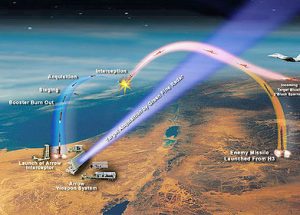
The full-scale development of Arrow started in 1991, and the system achieved initial operational capability in late 2000. It is optimized against medium and long range (in Israeli terms) ballistic missiles. The system comprises early warning and fire control "Green Pine" radars, the "Golden Citron" battle management system, launchers, and two types of interceptor missiles: Arrow 2 for high atmosphere interceptions and Arrow 3 for space interceptions.

The system was extensively tested but did not feature in any of the last decade's wars (the 2006 Lebanon War, Operation Cast Lead in 2009, Operation Pillar of Defense in 2012, and Operation Defensive Shield in 2014). The March 17 interception was thus its first-ever reported combat action.

A video clip recorded from a passing vehicle appears to show that only a single interceptor was launched from somewhere in central Israel. Images released in Jordan the next day showed an object resembling an Arrow missile rocket motor, much damaged by ground impact. From this evidence, it can be deduced that the Arrow system succeeded in destroying a long-range threat arriving from Syria by a single shot – an impressive feat.

But even more impressive is the fact that the destroyed threat was not a ballistic missile but an antiaircraft missile, which was not envisaged as a threat when the system was designed in the early 1990s.

Ballistic and antiaircraft missiles differ in this way: the former are designed to hit stationary targets on the ground, while the latter are designed to hit rapidly moving targets in the air. The disparate missions elicit disparate technical features, not least in their trajectories; hence the difference in the achievability of intercepting them.

While missile defense systems can now be found around the world, no missile defense system dedicated to the interception of antiaircraft missiles has yet been developed. That is because it is more feasible to neutralize them through "soft" defenses like electronic warfare and decoys. The March 17 firing of antiaircraft missiles against IAF planes was not the first such occasion: a previous incident took place in January 2017. In neither case was the Israeli plane hit, indicating that they carried sufficient "soft" defenses to thwart the Syrian missiles.

The air defense system that launched the Syrian missile is dubbed SA-5 by the West and S-200 Vega by Russia. The specific missile used against the IAF was probably the E (for Export) version, which carries a 217 kg warhead.

The S-200 system was developed in the 1960s and became operational in the USSR and among its allies and clients during the 1970s. The system is venerable and by no means ineffective. Its lethality was tragically demonstrated in October 2001 when a Ukrainian SA-5, launched during military exercises, destroyed a Russian airliner over the Black Sea, killing all 78 aboard.

Syria, Iran, and Libya were the Middle Eastern recipients of this weapon. Syria, which received it after the 1982 Lebanon War when its air defenses were largely destroyed by the IAF, was the first country outside the Soviet bloc to possess it. The USSR supplied three batteries that were deployed to permanent bases near Damascus and other priority targets in Syria.

Following the outbreak of the Syrian Civil War in 2011, the SA-5 sites were either abandoned or overrun by insurgents. With the Russian intervention in late 2015, however, a renovation of the Syrian SA-5 batteries was initiated (as conceded by the Russian Minister of Defense in October 2016). The SA-5 battery east of Homs became operational in July 2016, while the SA-5 site in Ghouta, east of Damascus, was retaken from the insurgents three months ago. This explains why no SA-5 missiles were fired at IAF incursions into Syria prior to January 2017.

The SA-5 interceptor is a rather hefty missile. It is initially accelerated by four large, solid rocket boosters, which are discarded three to five seconds after takeoff. Once the boosters are thrown away, the remaining core missile is dimensionally very similar to a SCUD. This core missile is powered by a large liquid propellant rocket motor that accelerates it to 2.5 km per second (nearly eight times the speed of sound).

Western antiaircraft missiles self-destruct automatically if they miss their targets to prevent the falling of live warheads into friendly territory. It is not clear whether the SA-5 has a self-destruct function, and if so, whether it is automatic or is activated by manual command from the ground.

If no self-destruct is activated after a miss, the SA-5 interceptor may well continue its flight in a stable, ballistic trajectory. It will hit the ground at a distance that is determined by its speed and inclination at the moment of rocket motor burnout. At a speed of 2.5 km per second, this distance could be more than 500 km. It stands to reason, though, that the actual range would be shorter, due to the peculiar trajectory and inclination of an antiaircraft missile. Even at a shorter range, the spent missile will be seen by missile defense radars as a ballistic threat.

It appears that what happened in the early hours of Friday, March 17, 2017 was this. An antiaircraft missile fired in a southwesterly direction from one of the renovated Syrian SA-5 sites missed its target, did not self-destruct, and continued to fly in a stable ballistic trajectory towards Israel. It was picked up at a distance by the "Green Pine" radars, its predicted impact point was seen to be within Israeli territory, and it was classified as an imminent threat. The decision to engage it was taken by the local commander as per his orders and the rules of engagement.

The Arrow system functioned properly and engaged the target by a single interceptor that shed its own rocket motor once its fuel was spent, as it was designed to do. The detached motor continued in its own trajectory and hit the ground near the Jordanian city of Irbid. The Arrow then continued its flight and neutralized the threat.

In brief: the Arrow weapons system detected, locked onto, and neutralized a threatening missile of a type never envisaged during its original design. This was a remarkable performance that verified Ehud Barak's "awesome capability" assessment, and broadcast the powerful message that Israel's missile shield has reached maturity.

The interception caused a political stir, which prompted Barak to question its wisdom. It must be recalled that the timeframe for decisions by the local commander whether or not to engage is measured in the tens of seconds. This leaves no time for dialogue with superior officers about the engagement’s advisability. The local commander must make a snap decision based on standing orders and established rules of engagement.

Thus, the question of the wisdom of the March 17 decision to engage is irrelevant. Even if, somehow, time had allowed for a more protracted decision-making process, it is not clear that any other decision would have been taken. The impact of a Syrian-fired, heavy SA-5 warhead might have caused damage and casualties in Israel, with consequences no less significant than – and possibly worse than – those actually incurred.

Once the decision to engage had been made, it became impossible to maintain official silence due to the high visibility of the interception and its capture by the video recording devices of civilians, both here and in Jordan. Still, one wonders why it was necessary to include the IAF attack in Syria in Israel's admission.


Uzi Rubin was founding Director of the Israel Missile Defense Organization, which managed the Arrow program. He is now a senior research associate at the Begin-Sadat Center for Strategic Studies.

BESA Center Perspectives Papers are published through the generosity of the Greg Rosshandler Family


Free Pesach Seder+ Free Shabbat Meals + Jewish Soulmate Join Shabbat.com


​Looking for a host for a free Shabbat meal ( with or without accommodation) or a invitation to a free Pesach seder or other chaggim meal near you or in other 123 countries ( with or without accommodation) ?? ​Whatever Movement of Judaism you follow , Secular, Traditional to Modern Orthodox Machmir ,Chabad, Haradi or Hassid ....Join http://www.shabbat.com/ ​( it is COMPLETELY free)​ For Pesach Hosts hosts near you http://www.shabbat.com/hosts/nearby/20/​ ( and redefine your search with the white search boxes at the top of the page) ​

Shabbat.com has been endorsed by both Chief Rabbi "s of Israel David Lau and Yitschak Yosef Israel)+ Rafi Peretz ( previous IDF Chief Rabbi) , Chief Rabbi Ephraim Mirvis ( Great Britain), Chief Rabbi Haim Korsia ( France) and Chief Rabbi Warren Goldstein ( South Africa) . Shabbat.com is not a commercial site and absolutely everything is completely free with no hidden charges . Shabbat.com matches Hosts with Guests for Shabbos and Chaggim Meals and because this service appeals most to singles ( as guests) there is also a dating ( matching module) . In Israel there are just over 3000 singles with dating profiles. The Dating ( Matching) module differs from other Jewish equivalents in that their is no anonymity , no silly lists that need to be completed , you write you own narrative and what you are looking for in your Match and Basheret and do your own matchmaking. Hosting Guests for Shabbat and Chaggim is a Mitzvah ....obviously for free . Matchmaking is a Jewish profession as old as time in memorial.... also a Mitzvah.... the Yenta in Fiddler on the Roof in the 21st Century has been replaced by Social Media ..... you can do your own matchmaking on Shabbat.com orR use or use Yenta,a Shmenta ( a modern day Yenta) Aunt, Sister, Best Friend or nagging Mom .Get them all to join and may the Chuppah be with You ( soon) with apologies to George Lucas.

Shabbat.com is the largest Jewish Social Media Patform in the world. It resembles Facebook in many ways. No advertising. No membership charges . 243,765 members in 122 countries , as of right now . 72% are singles .67% have dating files with pictures . Join Shabbat.com and find your George Cooney with payot . Your Bar Refaeli who wants to cover her hair and wear skirts .or perhaps them both without their religious statement. Shabbat,com caters for all different degrees of religious adherence from in the process of conversion, Secular, Traditional,Conservadox to National Religious ,Haradi, Chabadnik and Hassidi כמובן אפשר להירשם בעברית

http://www.shabbat.com

​Another free Jewish Matching site worth join is http://yamsuf.com/ ( it is also free) with over 51 shadchannim , matchmakers .... obviously for traditional to chassic people and not at all for secular Jews ​. Two Jewish matchmaking / dating sites ​also worth joining ( and which are Completely free) are SoulMatch http://www.jsoulmate.com​ ​and Supertova ​http://www.supertova.com​ ​JMatch appreciates a donation... anything you want ( but even that is optional) ..... in your profile you can say who you really are and how contact you including a phone number and email address.... you can also send messages ( unlimited and uncensored) http://www.jmatch.com/​.... and personal advice ..... use a picture of yourself that can pinpoint who you are via Google ( Search) Images ​... assuming you are serious about find your bashet or basher / match made in heaven or in a bikini on one of Zion's 270 named beaches

​and hey I am looking for (seriously) my basheret 2.0 in her late thirties , forties and maybe early 50's for another go at that big M (chuppah+ kids or and puppies to raise together ) Check out my own dating profile, investment portfolio and financial disclose to Receiver of Revenue in 8 different countries OR ( for your two barrel shotgun dad/ brother) and MI6,CIA, FBI, Mossad, Shin Bet files ( for that suspicious best friend/ and my family heritage from Poland, Latvia, Lithuania South Africa and Zion (for your Bobbie/ Yiddisha Mama ) ​. 72 references are also attached ....including 17 related to performance in bed ​. Yes , I am witty and wise, flirty and funny , self effacing and have a huge internet footprint that I cannot now escape ...... but equally serious about another go at the big M word ( chuppah with kids or a shared puppy or kitten, if your biological clock says hey ho hell no )


.......and hey if you reached this final line of my post ( I am the pro bono publicist of shabbat.com) .... do share it ..

How to Set a Passover Seder Plate

No automatic alt text available.