Tuesday, January 31, 2017

#OyVeydonaldTrumps key wingman.Steve Bannon is unquestionable the most Dangerous Political Operative in America

Republished with permission of the Author Joshua Green and Businessweek inwhich the article first appeared. Photographs  by Jeremy Liebman for Bloomberg Businessweek


This Man Is the Most Dangerous Political Operative in America

Steve Bannon runs the new vast right-wing conspiracy—and he wants to take down both Hillary Clinton and Jeb Bush.

It’s nearing midnight as Steve Bannon pushes past the bluegrass band in his living room and through a crowd of Republican congressmen, political operatives, and a few stray Duck Dynasty cast members. He’s trying to make his way back to the SiriusXM Patriot radio show, broadcasting live from a cramped corner of the 14-room townhouse he occupies a stone’s throw from the Supreme Court. It’s late February, the annual Conservative Political Action Conference is in full swing, and Bannon, as usual, is the whirlwind at the center of the action.

Bannon is the executive chairman of Breitbart News, the crusading right-wing populist website that’s a lineal descendant of the Drudge Report (its late founder, Andrew Breitbart, spent years apprenticing with Matt Drudge) and a haven for people who think Fox News is too polite and restrained. He’d spent the day at CPAC among the conservative faithful, zipping back and forth between his SiriusXM booth and an unlikely pair of guests he was squiring around: Nigel Farage, the leader of Britain’s right-wing UKIP party, and Phil Robertson, the bandanna’d, ayatollah-bearded Duck Dynasty patriarch who was accepting a free-speech award. CPAC is a beauty contest for Republican presidential hopefuls. But Robertson, a novelty adornment invited after A&E suspended him for denouncing gays, delivered a wild rant about “beatniks” and sexually transmitted diseases that upstaged them all, to Bannon’s evident delight. “If there’s an explosion or a fire somewhere,” says Matthew Boyle, Breitbart’s Washington political editor, “Steve’s probably nearby with some matches.” Afterward, everyone piled into party buses and headed for the townhouse.
“Honey badger don’t give a s---” is the Breitbart motto

Bannon, an ex-Goldman Sachs banker, is the sort of character who would stand out anywhere, but especially in the drab environs of Washington. A mile-a-minute talker who thrums with energy, his sentences speed off ahead of him and spin out into great pileups of nouns, verbs, and grins. With his swept-back blond hair and partiality to cargo shorts and flip-flops, he looks like Jeff Spicoli after a few decades of hard living, and he employs “dude” just as readily.

Ordinarily, Bannon’s townhouse is crypt-quiet and feels like a museum, as it’s faithfully decorated down to its embroidered silk curtains and painted murals in authentic Lincoln-era detail. When I first stopped by in January, about the only sign that I hadn’t teleported back to the 1860s was a picture on the mantle of a smiling woman on a throne with a machine gun in her lap (it was Bannon’s daughter Maureen, a West Point grad and lieutenant in the 101st Airborne Division; the throne belonged to Saddam Hussein—or once did). Until Bannon showed up, the only sounds I heard were faint noises from the basement, which might have been the young women he calls the Valkyries, after the war goddesses of Norse mythology who decided soldiers’ fates in battle. More on them later.

On this February night, however, the party is roaring. Along with his CPAC triumph, a secret project he’d conceived was nearing fruition: His lawyers were almost finished vetting a book about Bill and Hillary Clinton’s murky financial dealings that he’s certain will upend the presidential race. “Dude, it’s going to be epic,” he tells me. I sip my “moonshine”—his wink at the Dynasty guests—and wonder, as people often do, whether Bannon is nuts. On my way out, the doorman hands me a gift: a silver hip flask with “Breitbart” printed above an image of a honey badger, the insouciant African predator of YouTube fame whose catchphrase, “Honey badger don’t give a s---,” is the Breitbart motto.
Steve Bannon

Bannon’s life is a succession of Gatsbyish reinventions that made him rich and landed him squarely in the middle of the 2016 presidential race: He’s been a naval officer, investment banker, minor Hollywood player, and political impresario. When former Disney chief Michael Ovitz’s empire was falling to pieces, Bannon sat Ovitz down in his living room and delivered the news that he was finished. When Sarah Palin was at the height of her fame, Bannon was whispering in her ear. When Donald Trump decided to blow up the Republican presidential field, Bannon encouraged his circus-like visit to the U.S.-Mexico border. John Boehner just quit as House speaker because of the mutinous frenzy Bannon and his confederates whipped up among conservatives. Today, backed by mysterious investors and a stream of Seinfeld royalties, he sits at the nexus of what Hillary Clinton once dubbed “the vast right-wing conspiracy,” where he and his network have done more than anyone else to complicate her presidential ambitions—and they plan to do more. But this “conspiracy,” at least under Bannon, has mutated into something different from what Clinton described: It’s as eager to go after establishment Republicans such as Boehner or Jeb Bush as Democrats like Clinton.

“I come from a blue-collar, Irish Catholic, pro-Kennedy, pro-union family of Democrats,” says Bannon, by way of explaining his politics. “I wasn’t political until I got into the service and saw how badly Jimmy Carter f---ed things up. I became a huge Reagan admirer. Still am. But what turned me against the whole establishment was coming back from running companies in Asia in 2008 and seeing that Bush had f---ed up as badly as Carter. The whole country was a disaster.”

As befits someone with his peripatetic background, Bannon is a kind of Jekyll-and-Hyde figure in the complicated ecosystem of the right—he's two things at once. And he’s devised a method to influence politics that marries the old-style attack journalism of Breitbart.com, which helped drive out Boehner, with a more sophisticated approach, conducted through the nonprofit Government Accountability Institute, that builds rigorous, fact-based indictments against major politicians, then partners with mainstream media outlets conservatives typically despise to disseminate those findings to the broadest audience. The biggest product of this system is the project Bannon was so excited about at CPAC: the bestselling investigative book, written by GAI’s president, Peter Schweizer, Clinton Cash: The Untold Story of How and Why Foreign Governments and Businesses Helped Make Bill and Hillary Rich. Published in May by HarperCollins, the book dominated the political landscape for weeks and probably did more to shape public perception of Hillary Clinton than any of the barbs from her Republican detractors.

Jeb Bush is about to come in for the same treatment. On Oct. 19, GAI will publish Schweizer’s e-book, Bush Bucks: How Public Service and Corporations Helped Make Jeb Rich, that examines how Bush enriched himself after leaving the Florida governor’s mansion in 2007. A copy obtained by Bloomberg Businessweek examines Bush’s Florida land deals, corporate board sinecures, and seven-figure salary with Lehman Brothers, whose 2008 bankruptcy touched off the financial crisis. “It’s not as cinematic as the Clintons, with their warlords and Russian gangsters and that whole cast of bad guys,” says Bannon. “Bush is more prosaic. It’s really just grimy, low-energy crony capitalism.”

While attacking the favored candidates in both parties at once may seem odd, Bannon says he’s motivated by the same populist disgust with Washington that’s animating candidates from Trump to Bernie Sanders. Like both, Bannon is having a bigger influence than anyone could have reasonably expected. But in the Year of the Outsider, it's perhaps fitting that a figure like Bannon, whom nobody saw coming, would roil the national political debate.
Bannon’s Bulldogs, at the “Breitbart Embassy”: Alex Swoyer, Jarrett Stepman, Julia Hahn. Back row: Bigz Aloysious Bigirwa, Jordan Schachtel, Larry Solov, Alex Marlow, Bannon, Matthew Boyle, Edwin Mora.

Most days, Bannon can be found in his Hyde persona, in the Washington offices of Breitbart News. Operating from the basement of his townhouse—known to all as the Breitbart Embassy—Breitbart’s pirate crew became tribunes of the rising Tea Party movement after Barack Obama’s election, bedeviling GOP leaders and helping to foment the 2013 government shutdown. The site has also made life hell for Democrats by, for example, orchestrating the career-ending genital tweeting misfortune that cost New York Representative Anthony Weiner his seat in Congress in 2011. Tipped to Weiner’s proclivity for sexting with female admirers, Bannon says, the site paid trackers to follow his Twitter account 24 hours a day and eventually intercepted a crotch shot Weiner inadvertently made public. The ensuing scandal culminated in the surreal scene, carried live on television, of Andrew Breitbart hijacking Weiner’s press conference and fielding questions from astonished reporters.

On occasion, this partisan zeal has led to egregious errors. Just before our lunch in January, a Breitbart reporter published an article assailing Obama’s nominee for attorney general, Loretta Lynch—but went after the wrong woman. She wasn’t, as the site reported, the Loretta Lynch who was once part of Bill Clinton’s defense team. The embarrassed reporter asked for time off. Bannon, allergic to any hint of concession, refused: “I told him, ‘No. In fact, you’re going to write a story every day this week.’ ” He shrugs. “We’re honey badgers,” he explains. “We don’t give a s---.”

But Bannon realizes that politics is sometimes more effective when it’s subtle. So he’s nurtured a Dr. Jekyll side: In 2012 he became founding chairman of GAI, a nonpartisan 501(c)(3) research organization staffed with lawyers, data scientists, and forensic investigators. “What Peter and I noticed is that it’s facts, not rumors, that resonate with the best investigative reporters,” Bannon says, referring to GAI’s president. Established in Tallahassee to study crony capitalism and governmental malfeasance, GAI has collaborated with such mainstream news outlets as Newsweek, ABC News, and CBS’s 60 Minutes on stories ranging from insider trading in Congress to credit card fraud among presidential campaigns. It's essentially a mining operation for political scoops that now churns out books like Clinton Cash and Bush Bucks.
Featured in Bloomberg Businessweek, Oct. 12, 2015. Subscribe now.

What made Clinton Cash so unexpectedly influential is that mainstream news reporters picked up and often advanced Schweizer’s many examples of the Clintons’ apparent conflicts of interest in accepting money from large donors and foreign governments. (“Practically grotesque,” wrote Harvard Law School professor Lawrence Lessig, who’s running for the Democratic presidential nomination. “On any fair reading, the pattern of behavior that Schweizer has charged is corruption.”) Just before the book’s release, the New York Times ran a front-page story about a Canadian mining magnate, Frank Giustra, who gave tens of millions of dollars to the Clinton Foundation and then flew Bill Clinton to Kazakhstan aboard his private jet to dine with the country’s autocratic president, Nursultan Nazarbayev. Giustra subsequently won lucrative uranium-mining rights in the country. (Giustra denies that the Clinton dinner influenced his Kazakh mining decision.) The Times piece cited Schweizer’s still-unpublished book as a source of its reporting, puzzling many Times readers and prompting a reaction from the paper’s ombudswoman, Margaret Sullivan, who grudgingly concluded that, while no ethical standards were breached, “I still don’t like the way it looked.”

For Bannon, the Clinton Cash uproar validated a personal theory, informed by his Goldman Sachs experience, about how conservatives can influence the media and why they failed the last time a Clinton was running for the White House. “In the 1990s,” he told me, “conservative media couldn’t take down [Bill] Clinton because most of what they produced was punditry and opinion, and they always oversold the conclusion: ‘It’s clearly impeachable!’ So they wound up talking to themselves in an echo chamber.” What news conservatives did produce, such as David Brock’s Troopergate investigation on Paula Jones in the American Spectator, was often tainted in the eyes of mainstream editors by its explicit partisan association.

In response, Bannon developed two related insights. “One of the things Goldman teaches you is, don’t be the first guy through the door because you’re going to get all the arrows. If it’s junk bonds, let Michael Milken lead the way,” he says. “Goldman would never lead in any product. Find a business partner.” His other insight was that the reporters staffing the investigative units of major newspapers aren’t the liberal ideologues of conservative fever dreams but kindred souls who could be recruited into his larger enterprise. “What you realize hanging out with investigative reporters is that, while they may be personally liberal, they don’t let that get in the way of a good story,” he says. “And if you bring them a real story built on facts, they’re f---ing badasses, and they’re fair.” Recently, I met with Brock, who renounced conservatism and became an important liberal strategist, fundraiser, and Clinton ally. He founded the liberal watchdog group Media Matters for America and just published a book, Killing The Messenger: The Right-Wing Plot to Derail Hillary and Hijack Your Government. Brock’s attitude toward Bannon isn’t enmity toward an ideological opponent, as I'd expected, but rather a curiosity and professional respect for the tradecraft Bannon demonstrated in advancing the Clinton Cash narrative. What conservatives learned in the ’90s, Brock says, is that “your operation isn’t going to succeed if you don’t cross the barrier into the mainstream.” Back then, he says, conservative reporting had to undergo an elaborate laundering to influence U.S. politics. Reporters such as Brock would publish in small magazines and websites, then try to get their story planted in the British tabloids and hope a right-leaning U.S. outlet such as the New York Post or the Drudge Report picked it up. If it generated enough heat, it might break through to a mainstream paper.
“From their point of view, the Times is the perfect host body for the virus”

“It seems to me,” says Brock of Bannon and his team, “what they were able to do in this deal with the Times is the same strategy, but more sophisticated and potentially more effective and damaging because of the reputation of the Times. If you were trying to create doubt and qualms about [Hillary Clinton] among progressives, the Times is the place to do it.” He pauses. “Looking at it from their point of view, the Times is the perfect host body for the virus.”

It wasn’t the only one. In June, when the Clinton Cash frenzy hit its apex, Bannon said: “We’ve got the 15 best investigative reporters at the 15 best newspapers in the country all chasing after Hillary Clinton.” There’s more coming, Bannon reveals, including a graphic novel of Clinton Cash, in January, and a Clinton Cash movie set to arrive in February, just as the presidential primary voting gets under way.

In the ’90s, right-wing activists enjoyed a long period of ascendancy, and then collapsed. Then, as now, their prime target was a Clinton, their great ally the House Republicans. What halted this uprising was the sheer lunacy of its perpetrators. The classic example is House Oversight Chairman Dan Burton of Indiana, who became convinced that the 1993 suicide of White House Deputy Counsel Vince Foster was actually murder—a theory he sought to prove by reenacting the crime in his backyard with a pistol and a watermelon. Democrats seized on the episode to impugn his credibility, branding him “Watermelon Dan.” “We used the watermelon and the phantom Vince Foster sightings again and again," says Chris Lehane, a Clinton White House staffer and field marshal in the partisan wars of the ’90s. "The phrase didn’t exist then, but that’s when the right-wing conspiracy jumped the shark.”

Bannon believes that episodes like these killed conservatives’ credibility, and with it, their political influence. He’s set out to balance conservatives’ wilder impulses with professionalism, a running theme in his own life. Born into a working-class family within sight of the naval base in Norfolk, Va., he signed up straight out of college, and spent four years at sea aboard a destroyer, first as an auxiliary engineer in the Pacific, then as a navigator in the north Arabian Sea during the Iranian hostage crisis. By the time he arrived in the Persian Gulf in 1979, the U.S. was preparing its ill-fated assault on Tehran, and Bannon’s faith in his commander in chief had dimmed: “You could tell it was going to be a goat f---.” His battle group rotated out just before Carter’s Desert One debacle.

Bannon became a special assistant to the chief of Naval operations at the Pentagon, earning a master’s degree in national security studies at Georgetown University at night. But he was restless. The siren of Reagan-era Wall Street capitalism drained the military life of its luster, so he resolved to make the leap. “Somebody told me,” he says, “if you want to go to Wall Street, you have to go to Harvard Business School.” HBS accepted him, and Bannon, at 29, matriculated in 1983.

Bannon’s Harvard stint coincided with Wall Street’s boom, which fueled fantasies among his classmates of the full-on, debauched 1980s investment-banker lifestyle. Bannon became a grind, made first-year honors, and blanketed the top firms with applications for summer associateships. He was universally rejected. Classmates told him that his age and Navy background were obstacles—he hadn’t come up through the right schools.

One day, a Goldman Sachs representative invited Bannon to a campus recruiting party: Thinking he could talk himself into a job, he donned a suit and headed over. “I get there, and there’s like 700 people jammed into this tent,” he says. “I said, ‘F--- it. There’s no chance.’ So I stood off on the side with a drink and these two other schmendricks standing next to me. And I talk to these guys. We have the greatest conversation about baseball, and I find out after half an hour it was John Weinberg Jr., whose dad runs the firm, and a guy named Rob Kaplan, who became a senior partner.” That night the Goldman executives gathered to discuss prospective hires. One later recounted the scene. “They said, ‘Well, Bannon, I guess we’re gonna reject him. He’s too old for a summer job,’ ” Bannon says. “And these guys say, ‘Oh no, we talked to him. He’s terrific.’ Literally, a complete crapshoot. But I got a job.”

Bannon landed in Goldman’s New York office at the height of the hostile takeover boom. “Everything in the Midwest was being raided by Milken,” he says. “It was like a firestorm.” Goldman didn’t do hostile takeovers, instead specializing in raid defense for companies targeted by the likes of Drexel Burnham and First Boston. The first few years, he worked every day except Christmas and loved it: “The camaraderie was amazing. It was like being in the Navy, in the wardroom of a ship.” Later, he worked on a series of leveraged buyouts, including a deal for Calumet Coach that involved Bain Capital and an up-and-comer named Mitt Romney.

Two big things were going on at Goldman Sachs in the late ’80s. The globalization of world capital markets meant that size suddenly mattered. Everyone realized that the firm, then a private partnership, would have to go public. Bankers also could see that the Glass-Steagall Act separating commercial and investment banking was going to fall, setting off a flurry of acquisitions. Specialists would command a premium. Bannon shipped out to Los Angeles to specialize in media and entertainment. “A lot of people were coming from outside buying media companies,” he says. “There was huge consolidation.”

After a few years, in 1990, Bannon and a couple of Goldman colleagues set off to launch Bannon & Co., a boutique investment bank specializing in media. At the time, investors preferred hard assets—manufacturing companies, real estate—and avoided things like movie studios and film libraries, which were harder to price. Bannon’s group, drawing on data such as VHS cassette sales and TV ratings, devised a model to value intellectual property in the same way as tangible assets. “We got a ton of business,” he says.

When the French bank Crédit Lyonnais, a major financier of independent Hollywood studios, almost went bankrupt, Bannon & Co. rolled up its loan portfolio. When MGM went bust, it worked on the studio’s financing. When Polygram Records got into the film business, Bannon’s firm handled its acquisitions.

And then, serendipitously, Bannon wound up in the entertainment business himself. Westinghouse Electric, a client, was looking to unload Castle Rock Entertainment, which had a big TV and movie presence, including Billy Crystal’s films. Bannon reeled in an eager buyer: Ted Turner. “Turner was going to build this huge studio,” he says, “so we were negotiating the deal at the St. Regis hotel in New York. As often happened with Turner, when it came time to actually close the deal, Ted was short of cash. ... Westinghouse just wanted out. We told them, ‘You ought to take this deal. It’s a great deal.’ And they go, ‘If this is such a great deal, why don’t you defer some of your cash fee and keep an ownership stake in a package of TV rights?’ ” In lieu of a full adviser’s fee, the firm accepted a stake in five shows, including one in its third season regarded as the runt of the litter: Seinfeld. “We calculated what it would get us if it made it to syndication,” says Bannon. “We were wrong by a factor of five.”

After Société Générale bought Bannon & Co. in 1998, Bannon, no longer needing a day job, dove into Hollywood moguldom, becoming an executive producer of movies, including Anthony Hopkins’s 1999 Oscar-nominated Titus. He met a hard-partying talent manager named Jeff Kwatinetz who had discovered the band Korn and managed the Backstreet Boys. As Bannon was selling his company, Kwatinetz was launching one of his own, a management outfit called the Firm whose clients included Ice Cube and Martin Lawrence. Newly flush and sensing adventure, Bannon became a partner and a key player in the Firm’s great coup, its acquisition of former Disney chief Ovitz’s company, Artists Management Group. Ovitz had spent $100 million building a media giant he thought would conquer Hollywood, but AMG was bleeding money. Selling to the Firm was a last-ditch bid to save face. Instead, as Vanity Fair recounted, Bannon was dispatched to Ovitz’s Beverly Hills mansion to deliver the final humiliation in person, an offer for AMG of $5 million, less than the value of Ovitz’s home.

The Hollywood ether soon convinced Bannon that his passion wasn’t financing films, but making them. He was souring on Wall Street and what it had come to represent. “Goldman in the ’80s was like a priesthood, a monastic experience where you worked all the time but were incredibly dedicated to client services, to building and growing companies,” he says. He underwent a conversion like the one Michael Lewis has described, watching with horror as staid private partnerships such as Goldman Sachs became highly leveraged, publicly traded companies operating like casinos. “I turned on Wall Street for the same reason everybody else did: The American taxpayer was forced to cut mook deals to bail out guys who didn’t deserve it.”

Bannon’s political awakening was also spurred by the Sept. 11 attacks, which led him, in 2004, to make a Reagan-venerating documentary, In the Face of Evil (“A brilliant effort … extremely well done,” said Rush Limbaugh). This introduced him to Schweizer, a Cold War scholar whose book, Reagan’s War, was the basis of the film. It also brought him into Andrew Breitbart’s orbit. “We screened the film at a festival in Beverly Hills,” Bannon recalls, “and out of the crowd comes this, like, bear who’s squeezing me like my head’s going to blow up and saying how we’ve gotta take back the culture.”
His films are peppered with footage of lions attacking helpless gazelles, seedlings bursting from the ground into glorious bloom

Breitbart, who also lived in Los Angeles, had a profound influence on Bannon. When they met, Breitbart was starting his website, after having worked with Drudge and having helped Arianna Huffington launch the Huffington Post. Bannon lent his financial acumen and office space. He marveled at Breitbart’s visceral feel for the news cycle and his ability to shape coverage through the Drudge Report, which is avidly followed by TV producers and news editors.

“One of the things I admired about him was that the dirtiest word for him was ‘punditry,’ ” says Bannon. “Our vision—Andrew’s vision—was always to build a global, center-right, populist, anti-establishment news site.” With this in mind, he set out to line up investors.

Bannon continued making documentaries—big, crashing, opinionated films with Wagner scores and arresting imagery: Battle for America (2010), celebrating the Tea Party; Generation Zero (2010), examining the roots of the financial meltdown; The Undefeated (2011), championing Palin. In the Bannon repertoire, no metaphor is too direct. His films are peppered with footage of lions attacking helpless gazelles, seedlings bursting from the ground into glorious bloom. Palin, for one, ate it up and traveled to Iowa, trailed by hundreds of reporters, to appear with him at a 2011 screening in Pella that the press thought might signal her entrance into the 2012 presidential race. (No such luck.) Breitbart came along as promoter and ringmaster. When I spoke with him afterward, he described Bannon, with sincere admiration, as the Leni Riefenstahl of the Tea Party movement.
Andrew Breitbart in 2010.
Photographer: Reed Saxon/AP Photo

In 2010, Breitbart News hit a wall. The site published video, furnished by a conservative activist, of a speech to the NAACP by a Department of Agriculture official named Shirley Sherrod, in which she appeared to advocate anti-white racism. Within hours, she was fired, as the story blanketed cable news. It soon became clear that the Breitbart News video was misleadingly edited—that Sherrod’s point was the opposite of what was portrayed Fox News, which aggressively promoted the video, banned Andrew Breitbart as an on-air guest. Bannon, who was raising capital for the site’s relaunch, suddenly encountered “nuclear winter.”

But in a gauge of how media standards have shifted since the ’90s, the ostracization of Breitbart News didn’t last long. Less than a year later, when the site caught Weiner tweeting pictures of his genitals, Andrew Breitbart was welcomed back on Fox News. The experience taught Bannon the power of real news.

On the morning of March 1, 2012, with the relaunch just days away, Andrew Breitbart was walking in his Brentwood neighborhood when he collapsed. He died soon after of heart failure, at 43. Bannon got the news while in New York pitching investors. At the funeral, Drudge asked Bannon what he planned to do. “We’re going ahead with the launch,” he replied. Bannon stepped in as executive chairman.

Breitbart’s genius was that he grasped better than anyone else what the early 20th century press barons understood—that most readers don’t approach the news as a clinical exercise in absorbing facts, but experience it viscerally as an ongoing drama, with distinct story lines, heroes, and villains. Breitbart excelled at creating these narratives, an editorial approach that's lived on. “When we do an editorial call, I don’t even bring anything I feel like is only a one-off story, even if it’d be the best story on the site,” says Alex Marlow, the site’s editor in chief. “Our whole mindset is looking for these rolling narratives.” He rattles off the most popular ones, which Breitbart News covers intensively from a posture of aggrieved persecution. “The big ones won’t surprise you,” he says. “Immigration, ISIS, race riots, and what we call ‘the collapse of traditional values.’ But I’d say Hillary Clinton is tops.”

The website, which Breitbart News Network CEO Solov says draws 21 million unique users a month, has often managed to inject these narratives into the broader discourse. It was Breitbart News, for example, that first drew attention to the child migrant crisis at the U.S.-Mexico border last summer that killed any chance of Congress passing immigration reform. “They have an incredible eye for an important story, particular ones that are important to conservatives and Republicans,” says Senator Jeff Sessions, an Alabama Republican. “They’ve become extraordinarily influential. Radio talk show hosts are reading Breitbart every day. You can feel it when they interview you.”

Lately, the site has championed Trump’s presidential candidacy, helping to coalesce a splinter faction of conservatives irate over Fox News’ treatment of the Republican frontrunner.
Fighting crony capitalism from Bannon’s Lincoln-esque dining room.

Tallahassee is about as far as you can get in the U.S., geographically and psychically, from the circus of the presidential campaign trail. That’s why Bannon chose to locate the Government Accountability Institute there—that, and the fact that Schweizer had moved down from Washington. “There’s nothing to do in Tallahassee, so I get a lot more work done,” Schweizer jokes, on my recent visit. GAI is housed in a sleepy cul de sac of two-story brick buildings that looks like what you’d get if Scarlett O’Hara designed an office park. The unmarked entrance is framed by palmetto trees and sits beneath a large, second-story veranda with sweeping overhead fans, where the (mostly male) staff gathers every afternoon to smoke cigars and brainstorm.

Schweizer began his career as a researcher at the conservative Hoover Institution, digging through Soviet archives. In 2004 he co-authored a well-regarded history of the Bush family, The Bushes: Portrait of a Dynasty, that drew on interviews with many of its members, including Jeb. But Schweizer grew disillusioned with Washington and became radicalized against what he perceived to be a bipartisan culture of corruption. “To me, Washington, D.C., is a little bit like professional wrestling,” he told me. “When I was growing up in Seattle, I’d turn on Channel 13, the public-access station, and watch wrestling. At first I thought, ‘Man, these guys hate each other because they’re beating the crap out of each other.’ But I eventually realized they’re actually business partners.”

Schweizer’s interest turned toward exposing this culture, and his books became more denunciatory. In 2011 he published Throw Them All Out: How Politicians and Their Friends Get Rich Off Insider Stock Tips, Land Deals, and Cronyism That Would Send the Rest of Us to Prison. The book caught the attention of 60 Minutes and led Congress to pass a law, the STOCK Act, aimed at curbing the abuses Schweizer documented. Bannon encouraged these investigations and eventually offered Schweizer a job. “He told me, ‘I know people who will support this kind of work,’” Schweizer says. In 2012, GAI set up shop.

Schweizer, 50, is friendly, sandy-haired, and a little pudgy, the sort of fellow you’d meet at a neighborhood barbecue and instantly take a liking to. (Bannon nurses this regular-Joe appeal by forbidding him from wearing a tie when he’s on TV.) Bannon and Schweizer had two principles when they conceived the Clinton Cash project. First, it would avoid the nuttier conspiracy theories. “We have a mantra,” says Bannon. “Facts get shares, opinions get shrugs.” Second, they would heed the lesson Bannon learned at Goldman: specialize. Hillary Clinton’s story, they believed, was too sprawling and familiar to tackle in its entirety. So they'd focus only on the last decade, the least familiar period, and especially on the millions of dollars flowing into the Clinton Foundation. Bannon calls this approach “periodicity.”

As with many of the Clintons’ troubles, the couple’s own behavior provided copious material for investigators. When Clinton became secretary of state, the foundation signed an agreement with the White House to disclose all of its contributors. It didn’t follow through. So GAI researchers plumbed tax filings, flight logs, and foreign government documents to turn up what the foundation withheld. Their most effective method was mining the so-called Deep Web, the 97 percent or so of information on the Internet that isn’t indexed for search engines such as Google and therefore is difficult to find.
Bannon “weaponizes” scoops through mainstream outlets.

“Welcome to The Matrix,” says Tony, GAI’s data scientist, as he maps out the Deep Web for me on a whiteboard (we agreed I wouldn’t publish his last name). A presentation on the hidden recesses of the Web follows. “The Deep Web,” he explains, “consists of a lot of useless or depreciated information, stuff in foreign languages, and so on. But a whole bunch of it is very useful, if you can find it.” Tony specializes in finding the good stuff, which he does by writing software protocols that spider through the Deep Web. Since this requires heavy computing power, Tony struck a deal to use the services of a large European provider during off-peak hours. “We’ve got $1.3 billion of equipment I’m using at almost full capacity,” he says. This effort yielded a slew of unreported foundation donors who appear to have benefited financially from their relationship with the Clintons, including the uranium mining executives cited by the New York Times (who showed up on an unindexed Canadian government website). These donations illustrate a pattern of commingling private money and government policy that disturbed even many Democrats.

Clinton Cash caused a stir not just because of these revelations, but because of how they arrived. GAI is set up more like a Hollywood movie studio than a think tank. The creative mind through which all its research flows and is disseminated belongs to a beaming young Floridian named Wynton Hall, a celebrity ghostwriter who’s penned 18 books, six of them New York Times best-sellers, including Trump’s Time to Get Tough. Hall’s job is to transform dry think-tank research into vivid, viral-ready political dramas that can be unleashed on a set schedule, like summer blockbusters. “We work very long and hard to build a narrative, storyboarding it out months in advance,” he says. “I’m big on this: We’re not going public until we have something so tantalizing that any editor at a serious publication would be an idiot to pass it up and give a competitor the scoop. ”

To this end, Hall peppers his colleagues with slogans so familiar around the office that they’re known by their abbreviations. “ABBN — always be breaking news,” he says. Another slogan is “depth beats speed.” Time-strapped reporters squeezed for copy will gratefully accept original, fact-based research because most of what they’re inundated with is garbage. “The modern economics of the newsroom don’t support big investigative reporting staffs,” says Bannon. “You wouldn’t get a Watergate, a Pentagon Papers today, because nobody can afford to let a reporter spend seven months on a story. We can. We’re working as a support function.”

The reason GAI does this is because it’s the secret to how conservatives can hack the mainstream media. Hall has distilled this, too, into a slogan: “Anchor left, pivot right.” It means that “weaponizing” a story onto the front page of the New York Times (“the Left”) is infinitely more valuable than publishing it on Breitbart.com. “We don’t look at the mainstream media as enemies because we don’t want our work to be trapped in the conservative ecosystem,” says Hall. “We live and die by the media. Every time we’re launching a book, I’ll build a battle map that literally breaks down by category every headline we’re going to place, every op-ed Peter’s going to publish. Some of it is a wish list. But it usually gets done.”

Once that work has permeated the mainstream—once it’s found “a host body,” in David Brock's phrase—then comes the “pivot.” Heroes and villains emerge and become grist for a juicy Breitbart News narrative. “With Clinton Cash, we never really broke a story,” says Bannon, “but you go [to Breitbart.com] and we’ve got 20 things, we’re linking to everybody else’s stuff, we’re aggregating, we’ll pull stuff from the Left. It’s a rolling phenomenon. Huge traffic. Everybody’s invested.”
“We’ve got $1.3 billion of equipment I’m using at almost full capacity”

Over the summer, Hillary Clinton failed to emerge as the overwhelming frontrunner everyone expected. She’s been weighed down by the Clinton Foundation buckraking and the revelation that she kept a private e-mail server as secretary of state and destroyed much of her correspondence. Recently, the scandals have merged. In August e-mails surfaced showing that Bill Clinton, through the foundation, sought State Department permission to accept speaking fees in such repressive countries as North Korea and the Congo. A poll the same day found that the word voters associate most with his wife is “liar.” On Oct. 22, Hillary Clinton will testify on these matters before the Select Committee on Benghazi. Her troubles aren’t going away.

Veteran Democrats such as Lehane concede that Bannon and his ilk have been more effective than conservatives who targeted Bill Clinton 25 years ago. “They’ve adapted into a higher species,” he says. There’s more on the way. “We’ve got two more waves of stuff on Clinton corruption," says Bannon, including a focus on how the donors highlighted in Clinton Cash violated many of the principles liberals hold dear: “You look at what they’ve done in the Colombian rain forest, look at the arms merchants, the warlords, the human trafficking—if you take anything that the Left professes to be a cornerstone value, the Clintons have basically played them for fools. They’ve enriched themselves while playing up the worst cast of characters in the world.”

While this is surely unwelcome news for Clinton, Lehane argues that where the Clintons are concerned, their opponents invariably become consumed by partisan zeal and undermine their own cause. “Remember the old Pink Panther movies when Clouseau would walk in and the chief inspector would be there, and he’d just start losing his marbles, no matter what?” he says. “That’s how these guys are.”

Bannon does, indeed, have a touch of Clinton Madness. When we met in January, Bill Cosby’s serial predations had just exploded into the news after laying dormant for many years. Bannon was certain this signaled trouble for Bill Clinton, whose own sexual history some conservatives long to revive as a way of hampering his wife’s campaign. His conviction stems from the group of young, female Breitbart News reporters whom he’s dubbed the Valkyries. When I expressed skepticism about the value of reintroducing old scandals, Bannon countered that the Valkyries—a sort of in-house focus group of millennial voter sentiment—were unfamiliar with Clinton contretemps that most older people consider settled. "There’s a whole generation of people who love the news but were 7 or 8 years old when this happened and have no earthly idea about the Clinton sex stuff,” he says.
Bannon’s motto: “Honey badger don’t give a s---.”

It’s impossible to predict how Bannon’s plots and intrigues will ultimately affect the presidential race. It’s not even clear on whose behalf he’s acting—his own or someone else’s? Are Seinfeld royalties enough to take on Clinton and Bush? Or do others have a stake? Solov, the CEO, won’t say. “I can’t go into that,” he says. “It’s privately owned.” Bannon wouldn’t comment either. However, a prominent conservative says Robert Mercer, the reclusive co-founder of hedge fund Renaissance Technologies and a major donor to Texas Senator Ted Cruz, has invested $10 million. Mercer’s daughter, Rebekah, is listed in 2013 tax documents as a GAI board member.

Even without knowing the identity of his backers, Bannon’s designs are clear enough. While he’d blanch at the comparison, he’s pursuing something like the old Marxist dialectical concept of “heightening the contradictions,” only rather than foment revolution among the proletariat, he’s trying to disillusion Clinton’s and Bush’s natural base of support, recognizing, as Goldman Sachs taught him, that you’re more effective if others lead the way.

To succeed, Bannon will need to activate the anger and disgust with cronyism that’s as powerful among supporters of Sanders as it is among fans of Trump. In Tallahassee, as GAI’s phone keeps ringing, the vehicle for achieving this is clear. Editors and reporters at prominent magazines and newspapers, including ones that had passed when approached with Clinton Cash revelations, are calling to ask when the next salvo will arrive—and might they arrange an exclusive?

For many, the answer will be yes. “We’re going to go to the investigative units, not the political reporters, and just give them the stuff,” says Bannon. “We have faith they’ll take the stories and do the additional reporting.” The thought pleases him, and he grins. “Just like last time, we’ll go out and say, ‘Hey, here’s what we’ve got. You guys take it from here.’ ”

Monday, January 30, 2017

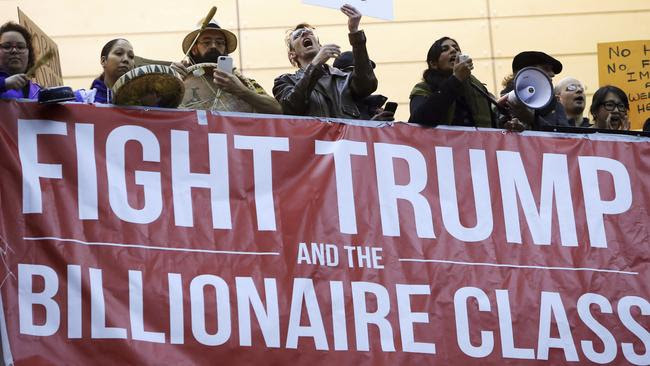
All 18 Executive Orders So Far ...#OyVey DonaldTrump's Rocky Horror Show Decree continues...18th Executive Order Signed,US Attorney General Fired , Obama and Fortune 500 Business Leader Rebuke , Protests and 2.1 Britains sign petition to retract Theresa May's State Visit Invitation #AmericaHangsItsHeadInShame

Related image


Donald Trump fired the acting US attorney-general Sally Yates on Monday night for defying his controversial travel ban, as he faced growing protests against the restrictions from business leaders and demonstrators, and a rebuke from Barack Obama. The move transforms the confirmation of Mr Trump’s attorney-general nominee, Jeff Sessions, into a referendum on the immigration order.


The Trump administration has sparked criticism from across the world over the executive order. In Britain, Theresa May defended the decision to invite Mr Trump on a state visit as thousands of protesters took to the streets across the UK on Monday night and more than 2.1 m people signed a petition to try to stop the trip. The UK was also left flailing by its closest ally after contradictory signals on the travel ban. The FT’s Janan Ganesh writes that “Mrs May’s tongue-tiedness of recent days is an extreme version of compromises to come elsewhere”.

President Trump also signed his 18th executive order on Monday — here is a list of every action so far.

President Donald Trump has spent his first days using his executive authority to rewrite American policy and undo a string of decisions made by former president Barack Obama. Here’s a running list of the new president’s executive actions:


1. Providing “relief” from the Affordable Care Act (January 20)
Trump’s first executive order on Inauguration Day involved “minimizing the economic burden” of the Affordable Care Act. This order allows the Secretary of Health and Human Services and the heads of other departments and agencies to waive or delay the implementation of any ACA provisions that would impose a financial burden or any state or a regulatory burden on any individuals.


2. Freezing all regulations (January 20)
Trump froze all pending regulations until they are approved directly by his administration or by an agency led by Trump appointees. The action, given in a memorandum from White House chief of staff Reince Priebus, delays all regulations with the exception of health, safety, financial or national security matters allowed by the Office of Management and Budget director.


3. Reinstating the “Mexico City” abortion policy (January 23)
The president reinstated the so-called “Mexico City Policy”, which blocks the use of U.S. taxpayer dollars to fund foreign non-governmental organizations that perform or promote abortions. It was established by former president Ronald Reagan and has been rescinded by Democratic presidents and reinstated by Republican presidents ever since.


4. Scrapping the Trans-Pacific Partnership (January 23)
Trump’s next executive action withdrew the United States from the Trans-Pacific Partnership, which former President Barack Obama negotiated with 11 other pacific nations. The deal was never ratified by the Senate, so it had not gone into effect. Instead, the Trump administration says it plans on negotiating bilateral deals with individual nations.


5. Freezing the federal workforce (January 23)
Trump issued a presidential memorandum Tuesday that prohibits government agencies from hiring any new employees, effective as of noon on January 22. The order does not apply to military personnel and the head of any executive department may exempt positions that include national security or public safety responsibilities.


6 & 7. Advancing the Dakota Access and Keystone XL Pipelines (January 24)

Trump’s next actions encouraged the construction of two controversial pipelines, the Dakota Access Pipeline and Keystone XL Pipeline. The DAPL action instructs an expedited review and approval of the remaining construction and operation of the pipeline by the Army for Civil Works and U.S. Army Corps of Engineers. The Keystone XL action invites TransCanada, the Canadian energy company behind the pipeline, to re-submit its application for a presidential permit to construct the pipeline. It also instructs the Secretary of State to reach a final determination within 60 days.


8. Expediting Environmental Reviews on Infrastructure Projects (January 24)
Trump issued an executive order to streamline environmental reviews of high-priority infrastructure projects. The action states that infrastructure projects in the U.S. “have been routinely and excessively delayed by agency processes and procedures.” The action instructs the Chairman of the White House Council on Environmental Quality to create expedited procedures and deadlines for environmental reviews and approvals for high-priority infrastructure projects.


9. Promoting “Made-in-the-USA” pipelines (January 24)
This memorandum instructs the Secretary of Commerce to create a plan for pipelines created, repaired or expanded in the United States to use materials and equipment produced in the country “to the maximum extent possible.” It establishes that all steel and metal used in such pipelines be completely produced in the United States, from the initial melting stage to the application of coatings.

10. Reviewing domestic manufacturing regulation (January 24)
Trump issued an action that instructs the Secretary of Commerce to contact stakeholders to review the impact of Federal regulations on domestic manufacturing. After the review, the Secretary of Commerce is instructed to create a streamlined Federal permitting process for domestic manufacturers.

11. Increasing border security measures (January 25)
Trump signed an executive order that directed the secretary of homeland security to:

Begin planning, designing and constructing a wall along the U.S.-Mexico border, including identify available federal funds and working with Congress for additional funding
Construct and operate detention facilities near the border to make adjudicate asylum claims, subject to the availability of existing funding,
Hire 5,000 additional Border Patrol agents, subject to the availability of existing funding,
End “catch and release” policy
Quantify all “sources of direct and indirect Federal aid or assistance to the Government of Mexico on an annual basis over the past five years”
Take action to empower state and local law enforcement to act as immigration officers

12. Pursuit of undocumented immigrants (January 25)
Trump signed an executive order that directed the secretary of homeland security to:

  • Prioritize certain undocumented immigrants for removal, including those with criminal convictions and those who have only been charged with a crime
  • Hire 10,000 additional immigration officers at U.S. Immigration and Customs Enforcement, subject to the availability of existing funding,
  • Prohibit federal funding, with the help of the attorney general, to “sanctuary” jurisdictions, where local officials have declined to help enforce federal immigration laws
  • Reinstate the Secure Communities program, which was terminated in 2014 and enables state and local law enforcement to effectively act as immigration agents
  • Sanction countries, with the help of the secretary of state, that refuse to accept the return of undocumented immigrants deported from the U.S.
  • Create a list, updated weekly, of crimes committed by undocumented immigrants in sanctuary jurisdictions
  • Create an “Office for Victims of Crimes Committed by Removable Aliens” to “provide proactive, timely, adequate and professional services to victims of crimes committed by removable aliens and family members of such victims”
13. Reevaluating visa and refugee programs (January 27)
Trump signed an executive order Friday evening making significant changes to the visa and refugee programs in the United States. It includes:

  • Cuts the number of refugees allowed into the United States in fiscal 2017 from 110,000 to 50,000
  • Suspends for 120 days the U.S. Refugee Admissions Program, which identifies and processes refugees for resettlement in the United States
  • Suspends the entry of all “immigrants and nonimmigrants” from Iraq, Iran, Sudan, Libya, Yemen, Somalia and Syria for 90 days.
  • Directs the secretary of homeland security, the director of national intelligence and secretary of state to put together a list of countries that do not provide adequate information to vet potential entry of foreign nationals into the United States. Foreign nationals from those countries will be banned from entering the United States.
  • Directs the secretary of state, the secretary of homeland security, the director of national intelligence, and the director of the FBI to implement uniform screening standards for all immigration programs
  • Directs the secretary of homeland security, upon the resumption of the U.S. Refugee Admissions Program, to “prioritize refugee claims made by individuals on the basis of religious-based persecution, provided that the religion of the individual is a minority religion in the individual's country of nationality.”
  • Directs the secretary of homeland security to implement a biometric entry-exit tracking system
  • Grants state and local jurisdictions, whenever possible a “role in the process of determining the placement or settlement” of refugees
  • Suspend the Visa Interview Waiver Program, which allows certain people renewing their visas to skip an in-person interview
  • Directs the secretary of state to expand the Consular Fellows Program
14. Strengthening the military (January 27)
The president on Friday issued a presidential memorandum directing the secretary of defense, James Mattis, to conduct a review on the military’s readiness in the next 30 days and develop a budget for fiscal 2018 capable of improving the “readiness conditions.” He also directed Mattis to complete a National Defense Strategy and to review the country’s nuclear capabilities and missile-defense capabilities


15. Reorganizing the National Security Council (January 28)
Trump signed a memorandum Saturday that reorganized the National Security Council, with the goal of making it more digitally-focused, as POLITICO previously reported. Part of the order allows some of the president’s staff, including chief of staff Reince Priebus and White House chief strategist Steve Bannon, to attend any NSC meeting, and widens the ability of appointees close to Trump to attend NSC meetings.

16. Implementing a lobbying ban (January 28)
This executive order bars “every executive appointee in every executive agency” from engaging in “lobbying activities with respect to that agency” for five years after leaving the agency. It also bars them permanently from lobbying for any foreign government or political party.


17. Defeating ISIS (January 28)
This memorandum instructs Defense Secretary Jim Mattis to create a plan to defeat ISIS and submit it to the president within 30 days. The plan must include a comprehensive strategy for defeating ISIS, changes to the rules of engagement, strategies to de-legitimize “radical Islamist ideology,” a plan for cutting off ISIS’ financial support and identification of new partners for the fight against the terrorist organization.


18. Reducing regulations (January 30)
This executive order requires any executive department or agency that proposes a new regulation to identify two regulations to be repealed. For fiscal 2017, it instructs that the total incremental cost of all new regulations and repealed regulations be no greater than zero. For fiscal 2018, the director of the Office of Management and Budget is required to issue for each agency a maximum total cost of all new regulations and repealed regulations for the fiscal year. No agency is allowed to issue a regulation whose costs exceed that maximum, “unless required by law or approved in writing by the Director.”

#OYVeyDonaldTrump's Rocky Horror Holocaust Statement spins out of control #AmericaHangsItsHeadInShame ( Again and Again and Again)

#OyVeyDonaldTrump's White House ( Or is it already Stephen Banon's taking the Jews out of the completely out of the Holocaust.The horrors of the mid-20th century destruction of European Judaism are indescribable, yet there are many words to describe it. In English, those terrible events are referred to by the word "Holocaust." The term became commonplace after 1978, when a miniseries by the same name aired on American television, bringing the carnage right into U.S. living rooms.Before the term Holocaust was used specifically to describe the organized killing of Jews, however, it was used by writers to describe other more moderate, but still horrific, bloodbaths.


So much for giving people the benefit of the doubt who offer no sign they deserve it. The Trump White House issued a statement on Friday commemorating Holocaust Remembrance Day, and the statement didn’t make specific mention of the Jewish people—who were the target of the Holocaust, or Shoah, which is a term devised after World War II to describe the effort by Nazi Germany to eradicate Jews from the face of the earth. After reading it, I thought to myself, “The Trump White House is an amateur operation, understaffed and without much executive-branch experience, and whoever wrote the statement and issued it blew it out of ignorance and sloppiness.”

I won’t be making that mistake again.

The White Statement by the President on International Holocaust Remembrance Day
“It is with a heavy heart and somber mind that we remember and honor the victims, survivors, heroes of the Holocaust. It is impossible to fully fathom the depravity and horror inflicted on innocent people by Nazi terror.
“Yet, we know that in the darkest hours of humanity, light shines the brightest.‎ As we remember those who died, we are deeply grateful to those who risked their lives to save the innocent.
“In the name of the perished, I pledge to do everything in my power throughout my Presidency, and my life, to ensure that the forces of evil never again defeat the powers of good. Together, we will make love and tolerance prevalent throughout the world.”
Jake Tapper of CNN reported Saturday night that Trump spokesperson Hope Hicks defended and even celebrated the White House statement. The decision not to mention the Jews was deliberate, Hicks said, a way of demonstrating the inclusive approach of the Trump administration: “Despite what the media reports, we are an incredibly inclusive group and we took into account all of those who suffered…it was our honor to issue a statement in remembrance of this important day.”
No, Hope Hicks, and no to whomever you are serving as a mouthpiece. The Nazis killed an astonishing number of people in monstrous ways and targeted certain groups—Gypsies, the mentally challenged, and open homosexuals, among others. But the Final Solution was aimed solely at the Jews. The Holocaust was about the Jews. There is no “proud” way to offer a remembrance of the Holocaust that does not reflect that simple, awful, world-historical fact. To universalize it to “all those who suffered” is to scrub the Holocaust of its meaning.

Given Hicks’s abominable statement, one cannot simply write this off. For there is a body of opinion in this country, and in certain precincts of the Trump coalition, who have long made it clear they are tired of what they consider a self-centered Jewish claim to being the great victims of the Nazis. Case in point: In 1988, as a speechwriter in the Reagan Administration, I drafted the president’s remarks at the laying of the cornerstone of the Holocaust Museum in Washington. As was the practice, the speech was sent around to 14 White House offices, including an office called Public Liaison staffed by conservatives whose job it was to do outreach to ethnic and religious groups. The official at Public Liaison who supported anti-Communist groups in Eastern Europe was tasked with the job of reviewing it. She sent the speech back marked up almost sentence by sentence. At the top, she wrote something like, “This must be redone. What about the suffering of the Poles and the Slovaks? The president should not be taking sides here.”

I was astonished, and horrified, and took the document to my superior, who told me to ignore it. “She has a bee in her bonnet about this,” he said of the Public Liaison official and one of #OYVeyDonaldTrumps 's inner inner wingmen..

On another occasion, in an article commissioned by a conservative magazine, I wrote a sentence in which I called the Jews “the most beleaguered people in history.” An editor there objected, and insisted we add the word “uniquely” between “most” and “beleaguered” because there was an element, he said, of “special pleading.”

I bring these anecdotes up to say that the Hope Hicks statement does not arrive without precedent. It is, rather, the culmination of something—the culmination of decades of ill feeling that seems to center on the idea that the Jews have somehow made unfair “use” of the Holocaust and it should not “belong” to them. Someone in that nascent White House thought it was time to reflect that view through the omission of the specifically Jewish quality of the Holocaust.

Now the question is: Who was it?

In those remarks at the cornerstone laying, President Reagan said this: “I think all of us here are aware of those, even among our own countrymen, who have dedicated themselves to the disgusting task of minimizing or even denying the truth of the Holocaust. This act of intellectual genocide must not go unchallenged, and those who advance these views must be held up to the scorn and wrath of all good and thinking people in this nation and across the world.” This was in reference to the new and horrifying field of Holocaust denial. It is heartbreaking to think these are words that can now be applied to the White House in which a Republican successor to Reagan is now resident, only 28 years after he departed it for the last time. Heartbreaking and enraging.

#OYVeyDonaldTrump's White House says it Deliberately Omitted Jews and well all other victims From Holocaust Rememberance Day Statement #AmericaHangsItsHeadInShame ( Again and Again and Again) h

Related image
Bergen-Belsen Concentration Camp c. 1945 --- The person standing in the middle of the dead bodies is Nazi physician Fritz Klein.

The White House is defending the statement it released on International Holocaust Remembrance Day on Friday that had no mention of the 6 million Jews that were killed.

Statement by the President on International Holocaust Remembrance Day
“It is with a heavy heart and somber mind that we remember and honor the victims, survivors, heroes of the Holocaust. It is impossible to fully fathom the depravity and horror inflicted on innocent people by Nazi terror.“Yet, we know that in the darkest hours of humanity, light shines the brightest.‎ As we remember those who died, we are deeply grateful to those who risked their lives to save the innocent.“In the name of the perished, I pledge to do everything in my power throughout my Presidency, and my life, to ensure that the forces of evil never again defeat the powers of good. Together, we will make love and tolerance prevalent throughout the world.”

Hope Hicks, the Donald Trump administration spokeswoman and in circle wingwoman of #OyVeyDonaldTrump, told CNN that, "despite what the media reports, we are an incredibly inclusive group and we took into account all of those who suffered."

Other than having no mention of the 6 million Jews killed, the statement also failed to mention anti-Semitism.

Instead, Hicks provided a link to a Huffington Post UK story that notes the 5 million other "priests, gypsies, people with mental or physical disabilities, communists, trade unionists, Jehovah's Witnesses, anarchists, Poles and other Slavic peoples, and resistance fighters," that were murdered in the genocide, according to CNN. When asked if asked if Trump purposely left out Jews in his statement to avoid offending anyone, Hicks simply said, "it was our honor to issue a statement in remembrance of this important day."

President Trump's statement is sharply different than those of his predecessors — namely Presidents George W. Bush and Barack Obama — who both had some mention of Jews or anti-Semitism in their statements.

Sunday, January 29, 2017

#OyVeyDonaldTrump ‘Muslim ban’: Why weren’t these countries included?


Priebus on immigration ban: 'perhaps we need to take it further'


#OyVeyDonaldTrump’s executive order banning the citizens of seven countries from entering the United States is supposed to protect the nation from “radical Islamic terrorists”.

But conspicuously, the order does not apply to several other Muslim-majority countries that suffer from well documented problems with terrorism.

On Friday, Mr Trump signed the order temporarily suspending the entry of people from Iraq, Syria, Sudan, Iran, Somalia, Libya and Yemen into the US for at least 90 days.

Mr Trump’s executive order also suspended the US refugee program for 120 days and ordered his administration to develop “extreme vetting” measures for migrants from the seven countries.

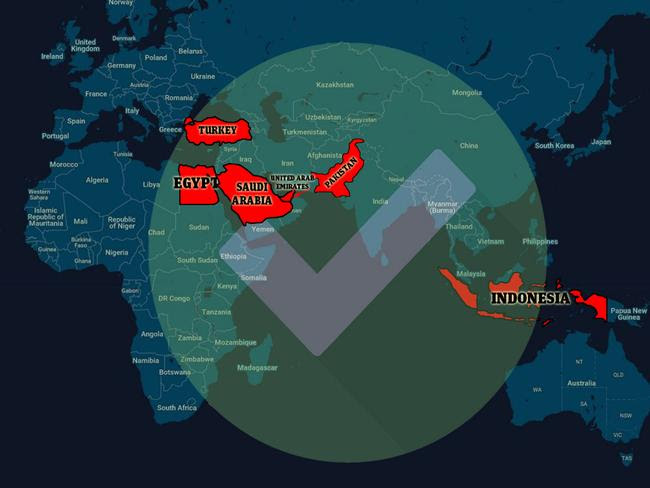
However, Egypt, Turkey, Saudi Arabia, Pakistan, the United Arab Emirates (UAE), Indonesia and Afghanistan were not included on the list, sparking speculation as to why. Was Mr Trump taking potential diplomatic fallout into account, or did he fail to include those nations because of his own business ties?

THE DOUBLE STANDARD

According to the American public policy institute Cato, Americans’ fear of foreign terrorists is over-inflated, as the chances of being killed in an attack committed by a foreigner are about one in 3.6 million per year.

In the past four decades, 3024 people have been killed by foreign terrorists on US soil. The September 11 attacks, perpetrated by citizens of Saudi Arabia, the UAE, Egypt and Lebanon, account for 98.6 per cent of those deaths. None of those countries are on Mr Trump’s list.

In fact, in that period, no American has been killed on US soil by anyone from the nations named in his executive order.


Not welcome in the USA.Source:Supplied


The countries conspicuously excluded from Mr Trump’s ban.Source:news.com.au

By contrast, several of the countries the president excluded are considered hotbeds of terrorism.

Just days ago, the US State Department updated a travel warning for Americans visiting Turkey, warning of an increased risk to its citizens. The country has suffered a wave of terror attacks in recent months, including the New Year’s Eve shooting at an Istanbul nightclub which left 39 revellers dead. Istanbul has been the target of many recent attacks by Islamic State and Kurdish extremist groups.

In December last year, 13 off-duty Turkish soldiers on a weekend shopping trip were killed and dozens more wounded in a car bombing. Dozens more people have been killed in other incidents in the past 12 months, including an attack which left 47 dead after a triple suicide bombing and gun attack at Istanbul’s Ataturk airport in June.

Mr Trump’s executive order also makes no mention of Saudi Arabia, despite the fact that 15 of the 19 September 11 hijackers once called it home.


29 Jan
Frank Luntz
✔ @FrankLuntz


Reminder: The 19 hijackers on 9/11 were from Saudi Arabia (15), the UAE (2), Egypt (1), and Lebanon (1)

None of those countries are listed. https://twitter.com/foxnews/status/825476891733794816 …


Follow
Frank Luntz
✔@FrankLuntz


The Boston bombers were from Russia, and 1 of the San Bern shooters was from Pakistan.

Neither country is listed. https://twitter.com/foxnews/status/825476891733794816 …
1:43 AM - 29 Jan 2017

322322 Retweets
331331 likes


Pakistan is not on the banned list despite a wave of terror attacks there, and long-running accusations that it’s been a state sponsor of terrorism.

The San Bernardino massacre, in which 14 people were killed, was perpetrated by Syed Rizwan Farook, who is of Pakistani descent, and his wife Tashfeen Malik, who grew up in Saudi Arabia.

The Pulse nightclub attack in Orlando, where 49 died, was carried out by Omar Mateen, a US citizen of Afghan descent.

The Boston Marathon bombing was orchestrated by the Tsarnaev brothers, both of whom were Russian.


US shooter Syed Rizwan, who is of Pakistani descent and wife Tashfeen Malik, who grew up in Saudi Arabia, were responsible for the San Bernardino massacre.Source:Supplied

BUSINESS LINKS

Mr Trump has been accused of excluding certain countries from the travel ban because he has business interests in those territories.

Liberal watchdog group Citizens for Responsibility and Ethics in Washington is among those accusing Mr Trump of a conflict of interest.

It has filed a lawsuit that alleges Mr Trump is in violation of a constitutional provision that bans federal officials from accepting payments from foreign officials, The Washington Post reports.

The group’s chairman, who is a former ethics adviser to Barack Obama, tweeted that the move was unconstitutional and pointed out the apparent hypocrisy of Mr Trump’s order.


Follow
Norm Eisen @NormEisen


1/ WARNING: Mr. Pres. your Muslim ban excludes countries where you have business interests.That is a CONSTITUTIONAL VIOLATION.See u in court
2:49 PM - 26 Jan 2017

9,0169,016 Retweets
14,70414,704 likes


According to Bloomberg, the list of banned countries doesn’t include Muslim-majority nations where the Trump Organization has done business or pursued potential deals. This includes golf courses in the UAE as well as two luxury towers in Turkey.

In a full list Mr Trump’s perceived conflicts of interest, Bloomberg also revealed Mr Trump had business interests or ties with Egypt, Indonesia, Turkey and Saudi Arabia. In 2015, he registered eight hotel-related companies in Saudi Arabia and also has two companies in Egypt.

Pakistan and Afghanistan, both of which have suffered a spate of terror atrocities in recent years, also did not make the list.


President Donald Trump’s executive orders have sparked backlash across the world. Picture: Alex Brandon/APSource:AP

REAL REASON BEHIND THE ORDER

Dr David Smith, of the University of Sydney United States Studies Centre, said the executive order was hypocritical in the extreme, and Mr Trump’s strategy revolved around keeping America’s strategic allies onside.

Dr Smith, a senior lecturer in American politics and foreign policy, said it wasn’t in the US’s interest for oil-rich Saudi Arabia, for example, to be included in the ban, despite it being the “land of beheadings” and having been described as “ISIS with borders”.

Nations such as Pakistan were also a strategic military ally, he noted.

Dr Smith said Mr Trump’s business interests were not the sole reason for the order.

“The fact that a lot of Americans have business interests in places like Saudi Arabia, the UAE and Turkey is another reason (along with military and political alliances) that these countries don’t get included in travel restrictions,” he said.

The seven countries listed in the executive order had long been regarded as terror hot spots under White House policy, but they were also, with the exception of Iran, “poorer” and not in control of their populations.

“The fact remains the UAE, Egypt and Turkey are relatively wealthy allies of the US,” Dr Smith said.

“They tend to get exempt from things like this because the US doesn’t want to cause offence.

“The cost to the US (from the seven) is small, so is something they can afford.”


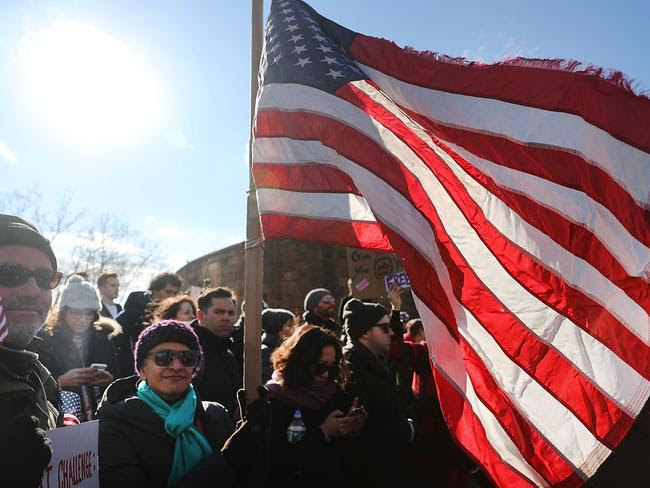
People attend an afternoon rally in Battery Park, New York, to protest Mr Trump’s new immigration policies. Picture: Spencer Platt/Getty Images/AFPSource:AFP

‘OBAMA DID THE SAME THING’

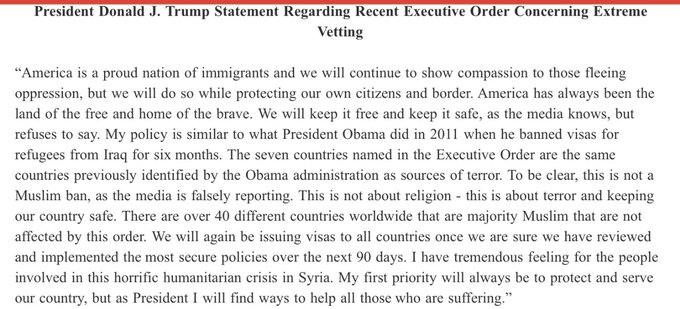
In a statement today, President Trump said America was “a proud nation of immigrants” and would “continue to show compassion to those fleeing oppression”.

Mr Trump said his executive order did not amount to a “Muslim ban” and the countries affected had previously been identified as “sources of terror” by the Obama administration. He also pointed out that Mr Obama levelled a “similar” ban against refugees from Iraq in 2011.


View image on Twitter


Follow
Zeke Miller
✔@ZekeJMiller


NEW: President Donald J. Trump Statement Regarding Recent Executive Order Concerning Extreme Vetting
11:37 PM - 29 Jan 2017

142142 Retweets
122122 likes


“This is not about religion — this is about terror and keeping our country safe,” Mr Trump said today.

“We will again be issuing visas to all countries once we are sure we have reviewed and implemented the most secure policies over the next 90 days.”

Mr Trump highlighted that there were at least 40 Muslim-majority countries that were not affected by this order.

Dr Smith said it was true that Mr Obama banned visas to Iraqis, but it was only for six months.

While the Obama White House, as did previous administrations, maintained a longstanding policy to identify all seven countries as terrorist hot spots, citizens from the other six nations were never banned from entering the country.

Dr Smith said Mr Trump’s comments on Mr Obama were “misleading” because this ban is much wider in scope but also because it had also included permanent residents of the United States, which is totally unprecedented.

The Department of Homeland Security has now retracted that part.


Donald Trump’s order restricting immigration to the US and puts an indefinite hold on a program resettling Syrian refugees has sparked reaction within the country. Picture: Genna Martin/seattlepi.com via APSource:AP

WHAT IT MEANS FOR AUSTRALIA

Dr Jiyoung Song, a director and research fellow at the Lowy Insitute’s Migration and Border Control Policy Project, said Mr Trump’s ban was hypocritical because it didn’t apply to other hot beds of terrorism.

“Trump is delivering on his campaign promises to ban Muslim immigrants,” Dr Song said.

“Some of those (orders) are temporary and some indefinite, but it’s a completely discriminatory and racist policy.”

Dr Song said while Australia had been given assurances that its refugee deal with the US would go ahead despite the executive order, it was now a question of how many would be accepted.

Under the deal reached with President Barack Obama last year, Australia agreed to take refugees from Central America if the US accepted a number of refugees in offshore detention centres. Dr Song said she expected the US wouldn’t take any of the single men on Manus but would look more towards taking refugees of a Christian background or families.

“Malcolm Turnbull will save face as the deal will still go ahead, but the critical issue will be the number of refugees taken,” she said.

‘THE WORLD IS ANGRY AS IT GETS’

Last week, in his first interview since taking office, Mr Trump told US broadcaster ABC News he didn’t believe his executive order would spark a backlash from the Muslim world.

ABC journalist David Muir questioned whether it was a Muslim ban, something Mr Trump denied. Instead, he insisted the executive order was about “countries that have tremendous terror”.

“You’re looking at people that come in, in many cases, in some cases with evil intentions. I don’t want that,” he said. “They’re ISIS (Islamic State). They’re coming under false pretence. I don’t want that.”

When asked why only certain countries would be included, Mr Trump said it would be “extreme vetting in all cases”.

“We are excluding certain countries. But for other countries we’re gonna have extreme vetting,” Mr Trump said. “It’s going to be very hard to come in. Right now it’s very easy to come in. It’s gonna be very, very hard. I don’t want terror in this country.”

Mr Muir also asked Mr Trump if he was concerned this move would spark anger in Muslim countries.

“There’s plenty of anger right now,” the President said. “How can you have more?

“The world is a mess. The world is as angry as it gets. What? You think this is gonna cause a little more anger? The world is an angry place.”

...... #OyVeyDonaldTrump's retake on Goldie Locks

No automatic alt text available.

Lets get the Facts and Fiction Sorted out before venturing into the Israeli -Palestinian Middle East Quagmire.


Model of Temple Mount, image by Galerie des Bois, Benjamin Wood, via Flickr

EXECUTIVE SUMMARY: The US is usually thought to be biased in favor of Israel, even after its recent acceptance of UNSC Resolution 2334. But for many years, the US has been a big part of the reason why the diplomatic world accepts a false narrative of the Arab-Israeli conflict that harms Israel and makes it harder to achieve peace. Washington should move to a truth-telling strategy to dismantle the structure of false views that slander Israel and stand in the way of peace.
The widely accepted false narrative of the Israeli-Palestinian conflict is built on the following premises:
  • Israel stole and now occupies Palestinian territory;
  • there are millions of “Palestinian refugees” who have a “right of return” to Israel;
  • Israel and the Palestinians have equal or comparable claims to Jerusalem;
  • the Palestinian community and its leadership are ready to accept a two-state solution that will end Palestinian efforts to eliminate the Jewish state.
The US has consistently either supported or been unwilling to contradict these premises.
Palestinian leaders have an additional false view on which they insist when they speak in Arabic, and which they often proclaim to international audiences. This view is that the Jewish people did not, in fact, live in and rule parts of Palestine, including Jerusalem, for hundreds of years long before the beginning of Islam. While this false claim is not generally accepted diplomatically, UNESCO recently endorsed the fiction that the ancient Jewish temples were not built on the Temple Mount – a site UNESCO calls “al-Aqsa Mosque/al-Haram al-Sharif" (Noble Sanctuary).
This Palestinian false history is not challenged by the US or by any other democracy. Had the US utilized an active strategy of telling the truth, the Palestinians would not have been able to continue to use their false picture to resist peace.
Rejecting false premises does not mean rejecting a peace agreement based on a two-state solution. The truth is compatible with a variety of ideas about what should be done in the future. Those who support a two-state solution can also support a strategy of telling the truth, as can those who doubt the feasibility of a two-state solution.
US policy has always been to ignore, and sometimes even to support, the falsity of these diplomatically accepted narratives in order to avoid contradicting the Palestinians and arousing the wrath of the Arab and Muslim nations. This longstanding American willingness to put reality aside to try to encourage negotiations has been unsuccessful thus far, and has become increasingly harmful.
For many years, US policy was to appear “even-handed” even at the expense of truth – that is, to be superficially even-handed between the arsonist and the firefighter, the terrorist and the victim of terror. Washington should switch to an even-handed policy of supporting truth, whether it comes from Palestinians or from Israelis: a policy of rejecting falsehood from both sides.
Of course, many statements are partly true and partly false, and often there are good reasons for different opinions about what is true. But there would be a great improvement in the diplomatic environment if the US took the lead in rejecting the most important and clearly false elements of diplomatic consensus.
A truth-telling strategy does not mean being absurd by always insisting on truth. The realities of human nature, and of politics and international relations, require substantial room for untruth. The US government cannot and should not act like an innocent who expects everyone to always tell the truth, and who views not doing so as evil.
The False Claim That There Is Such a Thing as “Palestinian Territory”
The biggest falsehood the US needs to expose is that there exists “Palestinian territory” that Israel refuses to “give back” because of its expansionist ambitions and purported security needs. It is controversial, rather than a falsehood, to say that justice and peace require Israel to turn over to a Palestinian state essentially all the land it seized in its defensive war in 1967. But there is a big difference between the controversial statement that the West Bank should become Palestinian territory as part of a peace agreement and the false statement that these areas are now, or ever were in the past, Palestinian territory.
The distinction between saying that the West Bank (including East Jerusalem) is Palestinian territory and saying that it should become Palestinian territory is important for both the past and the future. For the past, the statement that the West Bank is Palestinian means that Israel stole land that was not Jewish and should “give it back.” For the future, the distinction determines whether Israeli proposals to provide land for a Palestinian state are returning stolen property or are offers to give up disputed land to which it has serious claims, in order to make a healthy peace with its neighbor. From the Palestinian point of view, it differentiates between an immoral submission to a thief who has more power and a wise compromise with neighbors who have overlapping claims of right.
A US truth-telling strategy would not ignore Palestinian assertions about “Palestinian land,” but would point out that the land in question is disputed. It is not Palestinian territory – despite US acceptance of a UNSC resolution that refers to it as such – because there is no Palestinian territory and never has been. Palestinians have never ruled or been sovereign over any land. This is an indisputable fact, not a question of policy or interpretation.
The West Bank is disputed territory: it is territory for which Israel has historic and legal claims based on League of Nations resolutions endorsed by the US government in the 1920s and confirmed in Article 80 of the UN Charter. The most recent sovereigns before the West Bank came into dispute were the British Mandate from the League of Nations to promote a Jewish national home (1922-48) and the Ottoman Empire (1517-1917).
Individual Palestinians certainly own much land in the disputed area, just as they own land in Israel, in the US, and elsewhere. But ownership of land by individual Palestinians does not make it Palestinian territory, either in Nablus or in New York.
Palestinian national rights to the land do not come from international law, but from a principle that has become widely accepted over the last century: that the people who live in an area should govern it. But this principle is not automatic and self-executing. Implementing it presents difficulties that require exceptions (or else east Boston would have become part of Ireland). Who the majority is in an area depends on how the borders are drawn. For example, Israelis are the great majority of the population of Area C in the West Bank – a Jewish majority that was not created by removing Arabs.
The Falsehoods about “Palestinian Refugees”
The second most important part of a new truth-telling strategy would be to expose how the Arabs have abused what they call the “Palestinian refugees” in order to maintain them as a weapon for destroying Israel as a Jewish and democratic state.
The politely accepted story in diplomatic circles is that there are nearly 5 million “Palestinian refugees” from 1948, more than a million still living in UNRWA “refugee camps” because Israel refuses to let them return home despite the “right of return” granted them by the UN General Assembly.
The reality is that only some 50,000 of the “Palestinian refugees” are refugees as the world defines the term. The others are descendants of refugees who have died. The Palestinian leadership and the Arab states have prevented these descendants, who never lived in Israel, from settling and living normal lives in any Arab state (except Jordan).
Furthermore, UNGA Resolution 194 did not, in fact or in law, grant the right of return to all refugees, and would have had no authority to do so even if it had tried.
It is widely recognized in private that the Arab insistence on the “right of return” does not come from concern over the wellbeing of the “refugees,” who have not been given any choice about their unfortunate status. The miseries imposed on them for three generations are the result of the Arab world’s decision to prevent their resettlement in the hope that someday, Israel will be forced to take in so many “refugees” that it cannot continue to be both Jewish and democratic.
The false diplomatic story with which the US has been playing along for generations is that the Arab position on the “right of return” is a plausible negotiating position that might prevail in the final stage of peace talks. The issue should not yet be addressed, so the thinking goes, because it is so hard to resolve. The truth, which is widely understood in the diplomatic community although no country will admit it publicly, is that the “refugees” do not have any real legal “right of return,” and Israel cannot allow them to move to its territory if it is to survive. It is well understood that the “right of return” is a weapon to destroy Israel, not a normal negotiating demand that can be compromised.
A truth-telling strategy would declare that peace depends on finally settling the “refugees,” and that it is needless cruelty to keep them in refugee camps and without normal citizens’ rights any longer.
The US should start the process of closing down UNRWA, the UN agency that has made it possible to conceal the truth about Palestinian “refugees.” And it should be made clear to the Palestinians that they will never get international support for the notion of forcing Israel to take in millions of Palestinians.
It should be noted that the Israeli government has favored continued support for UNRWA. This is one of a number of instances where the government of Israel has chosen to appease international opinion rather than use the truth to defy it. It is time for Israel too to move away from such appeasement, which has not worked.
The more sophisticated diplomatic discussion of how peace might be negotiated asserts that the “refugee” issue does not prevent peace, because the Palestinian leadership already understands that no more than a token fraction of refugees will ever be allowed to move to Israel. The “refugees” will have to be satisfied with apologies and compensation – a premise widely acknowledged but never uttered out loud.
Diplomats around the world, particularly in the US, privately understand that Israel cannot and should never be forced to take in millions of “Palestinian refugees.” But no one says so officially, or tells that to the Palestinians. A truth-telling strategy would hold that it is time to say openly what everyone knows to be true.
Telling the truth that there is no “right of return” leaves open the question of compensation for Palestinian refugees from Israel and for Jewish refugees from the Arab countries. This does not have to be an obstacle to peace. It is indisputable that the creation of Israel led to at least as many Jewish refugees from Arab countries as Palestinian refugees from Israel. And the Jewish refugees, who were all resettled without international help (mostly in Israel), were forced to leave behind more assets than did the Palestinian refugees.
False “Even-Handedness” About Jerusalem
A much less important, but highly symbolic, piece of American truth-telling will be moving the US embassy in Israel to the country’s capital, Jerusalem. The US can further increase its truth-telling by allowing the passports of American citizens born in Jerusalem to record the fact that they were born in Israel. At present, Washington is unwilling to allow this truth to appear in American passports.
Because the US has been willing to ignore these truths for so long, there will be great Arab resistance to their being stated in public. The fiercer their protests, the more the Arabs will demonstrate the cost of having avoided truth-telling for so long. In the long run, a recognition that the US has a commitment to the truth will reduce the harm done by violent protests. Conversely, a policy of avoiding the truth in deference to threatened violence will lead to more such violence – or to US subservience to the rioters.
Jerusalem is a good example of the biased “even-handedness” that has long characterized the US stance. Official statements always refer to Jerusalem as sacred to both sides – sometimes adding that it is sacred to Christians as well – and typically imply that a fair solution will require equal treatment for Israel and the Palestinians on Jerusalem. But in reality, there is very little symmetry between the Israeli and Palestinian connections to Jerusalem.
The al-Aqsa Mosque, which is located in Jerusalem, has significance for the religion of Islam (although its origins are controversial) – but it is in no way central. The city of Jerusalem is not mentioned even once in the Koran, nor in regular Muslim prayers. On the other hand, Jerusalem is a central feature of the Jewish religion and of daily Jewish prayer and identity. The climax of every Jewish wedding ceremony is when the groom breaks a glass to symbolize the exile from Jerusalem and repeats a quotation from Psalm 137: “If I forget you, o Jerusalem, let my right hand wither.”
Jewish and Muslim performance in ruling Jerusalem since 1948 has also been very different. Under Israeli rule over Jerusalem (West Jerusalem for 19 years and the entire city for 50 years), there has been freedom of religion and protection of the holy sites of all religions. During the 19 years of Jordanian rule over East Jerusalem, Jews were not allowed entry even to the Jewish Quarter, and Jewish religious sites were destroyed.
The religion of Islam takes no notice of Jerusalem as a city. Muslims have expressed interest in Jerusalem only when it was ruled by non-Muslims. For over a thousand years of Muslim rule over Jerusalem, it was never made into the capital of any part of the Muslim empire, not even the local district. From 1948 to 1967, when it was ruled by Jordan, Jerusalem was treated as inferior to Amman. By contrast, the city of Jerusalem has always been a major concern of the Jewish religion and of Jewish identity, including throughout the nearly 2,000 years during which it was in the hands of others. Israel cannot survive as a Jewish state without Jerusalem as its capital.
Israeli and Palestinian interests in the future of Jerusalem are not at all symmetrical. Israel needs Jerusalem to continue to be a vibrant working city. The Palestinians, by contrast, would make an important gain in their effort to destroy Israel if they achieved new arrangements for Jerusalem that allowed its health as a city to be undermined by violent conflict.
To follow an even-handed truth-telling strategy about Jerusalem, the US should state that a fair disposition of the city will acknowledge it as the capital of Israel, protect the religious concerns of all religions, and assure that the city’s health will not be jeopardized by internal conflict. The Palestinian interest in having Jerusalem as the capital of a new Palestinian state should be satisfied in a way that is consistent with these three values.
The False Assertion that the Palestinians are Ready to Make Peace with Israel
A US truth-telling strategy would also address the question of whether the Palestinian community and leadership are in fact willing to make peace with Israel. While there cannot be any indisputable truth about such a hypothetical and complex question, there is evidence that can be examined in order to respectfully try to understand the point of view of the Palestinians.
A search for truth would ask why the Palestinian leadership (both intellectual and political) takes such pains to falsely deny the ancient Jewish presence in the land. It must be unpleasant and difficult for informed Palestinians to tell such obvious falsehoods that there never was a Jewish Temple in Jerusalem (from which Christ could chase the money-changers), or that Jews did not rule the land for centuries before most of them were exiled by the Romans 2,000 years ago. This denial of history is not part of the religion of Islam; it is a recent Palestinian invention. Older Muslim sources explain that the Dome of the Rock was built on the Temple Mount because it was the site of the Jewish Temple. One of the traditional Arab names for the Mount is Bayt al-Maqdis (The Temple).
One plausible explanation why the Palestinian leadership is so insistent on such an extreme denial of reality is that if the Palestinian people knew the truth, they might be more willing to accept Israel on part of the land. This suggests that it might be constructive for the US to remind the Palestinians that according to Islamic tradition, the Temple Mount was built by Jews as the site of the Jewish Temple. A public airing of the fact that there is no doubt that there were ancient Jewish kingdoms in the land a thousand years before Islam might increase the readiness of the Palestinian people to make peace with the Jewish people, who share their connection to the holy land.
Persistent US truth-telling would so undermine the Palestinian leadership’s efforts to deny basic historical truths that they would not be able to continue without embarrassing themselves before their own people. It would show the Palestinians that the US, and presumably other democracies, are not prepared to accept blatant falsehoods as justification to force Israel to accept a Palestinian victory. This would undermine one of the major Palestinian reasons for thinking they might still be able to destroy Israel: their hope that it is not too late to remove Israel from the land completely. That Palestinian hope is the fundamental obstacle to peace.
When Did the Palestinians Have an Internal Dispute about Making Peace with Israel?
If we are to gain a truthful answer to the question whether the Palestinians are now willing to make peace with Israel, we must also ask the following question: If the Palestinian leadership and public are now willing to make peace with Israel, when did they change? And what was the political process that produced the change?
Since before the establishment of Israel, despite the deep desire of many Palestinians for peace, the Palestinian community and its leadership were determined not to accept a Jewish state on any terms and were committed to struggle to destroy it until it was removed from land that had once been Muslim-ruled. Whatever some Palestinians might have thought or said in private or in English, any suggestion of a basis for accepting Israel or of allowing the “refugees” to be settled outside Israel was taboo in Arabic public discourse for many years.
This is a statement of fact, not an accusation. It could be disproved if one could point to Arabic public statements to the effect that it is necessary to end the struggle to destroy Israel, or that a major share of the “refugees” might not be allowed to enter Israel. There is no evidence of such statements. Nor can one find many Palestinian political voices who say such things in Arabic in public. The Palestinian political discourse is available translated into in English on MEMRI.
Before there can be any major change in Palestinian policy, there will have to be a sharp public debate among Palestinians. Certainly there would be strong voices initially rejecting any willingness to give up the war to destroy Israel or to settle the “refugees” outside of Israel. This debate would be visible in public channels, and it would be possible to see which side was eventually forced to retreat.
There has been no such debate. Palestinian discourse still maintains the taboo against suggesting it is necessary or desirable to give up the war against Israel on any terms. Nor is it acceptable to discuss the possibility of some “refugees” not being allowed to move to Israel.
A truth-telling US strategy would not continue to assume that peace can be negotiated with the Palestinians if Israel makes appropriate concessions. Truth-telling is consistent with urging negotiations between Israel and the Palestinians, but not from the position that the success of those negotiations will depend on what Israel does. A truth-telling strategy would recognize that agreement on peace can only happen after Palestinians have public debates about “refugees” and about accepting Israel.
Why the US Should Move Toward a Truth-Telling Strategy
A large edifice built on falsehood has come to define the diplomatic and policy environment of the Israeli-Palestinian conflict. This structure of unreality has failed to produce useful results. Perhaps, therefore, the new US president, who campaigned on making significant changes to US policy, should adopt a new strategy of truth-telling, which might lead to better results.
International pressure is one of the main weapons with which the Palestinians hope to destroy Israel. They will not give up that goal until it has become clear that there is no way it can succeed. Demonstrating that the world will no longer pretend to believe Palestinian falsehoods might lead more Palestinians to see that they have no chance of eliminating Israel. They might then seek the benefits of peace.
Furthermore, forcing Palestinians to acknowledge Israel’s historical and moral claim to the land would provide them with an honorable basis for compromise with Israel. If Israel were a stranger to the land, simply a colonial power taking Arab land by force, as the Palestinians falsely argue, it would be cowardly for them to yield.
When the American and European democracies accept Palestinian falsehoods, it creates a disincentive for the Palestinians and their supporters to face the realities of their situation. But these realities have to be the basis of any resolution of the conflict. A truth-telling strategy would offer a sound long-term foundation on which peace can eventually be built.
Why Israel Should Move Toward a Truth-Telling Strategy
Even with a new administration that has promised to break with the policies of the past, there may not be much chance that the US will depart radically from its policies of the last 50 years. But whether Washington alters past positions or not, Israel should advocate a truth-telling strategy for the US and the other democracies and pursue that strategy itself.
Israel is now imprisoned by an internationally accepted structure of falsehoods. It is tactically wiser for Israel to argue for truth-telling than to continue to appease the international consensus, for example by explaining why settlements are not the obstacle to peace, or that Israeli security requires that Israel occupy what people think of as “Palestinian land.”
Israel needs to go on the diplomatic offensive. Framing its position as an effort to get recognition for the truth is more likely to get its story heard than simply making demands and claims. And criticisms of the Palestinians that Israel needs to make to change the diplomatic consensus will be more effective if they are made as part of a broader strategy of urging democracies to face the truths about the conflict.
It is politically difficult for the US or other countries to take positions that are more “pro-Israel” than the positions of the Israeli government. If Israel would like other states to move toward more truth-telling about the conflict, it needs to stop holding back from presenting its own case out of fear that criticism of the Palestinians and assertions of Israeli rightful claims would seem to conflict with negotiations for peace.
It is notable that the US is thought to be biased in favor of Israel even though it does not stand for the truths essential to Israel’s position. Despite its longstanding alliance with Israel, the US under many presidents has allowed Israel to be forced to operate according to the international structure of falsehood that now dominates Israel’s diplomatic position. This policy should be replaced by a truth-telling strategy.
Briefly, some of the main truths that the US has been denying or ignoring, and that a truth-telling strategy should make prominent in the international discussion, are:
  • Although there are good reasons why there should eventually be “Palestinian territory,” there is not now, and never has been, any such thing. No territory was “taken from” the Palestinians; nor can any territory be “given back” to them. They have always lived in territory ruled by others.
  • West Jerusalem is located in Israel and is the capital of Israel. The Palestinian and Israeli connections to Jerusalem are neither equal nor symmetrical. Jerusalem is demonstrably more important to Israel than it is to the Palestinians.
  • The Jewish people lived in and ruled most of the area of Israel in ancient times. Israelis did not come to the land as European colonialists; they came as a people returning to its homeland. Israel’s rule over the land is not based only on its military strength; it has historical, legal, and moral claims.
  • The Jewish international legal right to settle in the land from the Jordan to the Mediterranean Sea was established by the League of Nations’ Mandate in 1922, in recognition of the Jewish People’s millenarian attachment to the Land of Israel. It is not based on Jewish suffering in the Holocaust.
  • The claim of a “right of return” for Palestinian “refugees” is not a humanitarian effort to provide help or justice to those unfortunate individuals, who are not truly refugees. It is an Arab weapon intended to destroy Israel via demographic subversion. And it is not a valid legal claim. Peace between Israel and the Palestinians requires resettling the “refugees” outside of Israel and ending UNRWA’s mandate. (While this truth is not indisputable, it is the understanding held by independent and informed people, most of whom do not publicly say what they personally believe.)
  • It is not an established truth that the Palestinian leadership and community have decided to give up the goal of destroying Israel and are ready to make a peace that accepts Israel if Israel makes appropriate concessions. The evidence for and against this generally accepted assumption needs to be examined. Much of it indicates that the Palestinian community is not willing to make peace with Israel on any terms.
The US should be more genuinely even-handed between Israel and the Palestinians than it has been in the past. It could advance the cause of peace by telling the truth. It is not even-handed for the US to let one side’s systematic falsehoods dominate the diplomatic discussion, when a truth-telling strategy could make the policy debate more realistic and improve the long-term prospects for peace.