Showing posts with label Trump Presidency. Show all posts

Wednesday, November 23, 2016

Trump Presidency showmanship via the bully pulpit of Twitter #RIPUSA,#americaHangsItsHeadInshame,$KeepTrumpInCheck


© Getty Images


Donald Trump has successfully sold himself as a businessman, an entertainer and a president. Now he’s ready to market his 2017 agenda.

The president-elect is signaling he’ll use Twitter, large rallies and a sharp tongue — the same weapons that won him the election — to advance his presidency.


Trump already has millions of social media followers and an ability to dominate the media.

Starting on Jan. 20, he will be in control of the most powerful force in politics: the presidential bully pulpit.

With a Republican-controlled House and Senate, the president-elect has an enormous opportunity to pass a slew of legislation that would could both shape Trump's legacy and torpedo at least some of what President Obama accomplished during his eight years in office.

Some Democrats believe that Trump will fail as commander in chief in spectacular fashion, which would of course help them in the 2018 and 2020 elections. But many Democrats don't grasp the potential power of Trump's White House messaging operation and what they are up against.

Republicans, for their part, are salivating at what could come next.

Many think Trump will be able to steam roll his agenda through Congress given GOP control of both chambers and the insecurity of Democratic senators up for reelection in 2018 in states won by Trump.

These members include Sens. Claire McCaskill (Mo.), Joe Donnelly (Ind.), Jon Tester (Mont.), Heidi Heitkamp (N.D.) and Joe Manchin (W.Va.). Trump won Missouri, Indiana and Montana by about 20 percentage points each. He captured North Dakota by more than 36 points and West Virginia by a margin of 42 points.

The real estate mogul, despite never having run for office, eviscerated his political rivals by portraying them as weak and beholden to Washington's “corrupt” ways.

He gave his 2016 challengers nicknames, such as “low energy” Jeb Bush, “lying” Ted Cruz and “crooked” Hillary Clinton.

Lawmakers, most notably Democratic leaders in Congress who get in Trump's way, could get their own nicknames.

If other red-state Democrats buck his nominees and/or his agenda, don't be surprised to see Trump visit their states to drive home his points. The president-elect loves rallies, and it's a good bet that he will be traveling outside the Beltway a lot.

There are already signs that Democrats could have trouble in holding a united front against Trump’s agenda.

Manchin, for example, was the first Democratic senator to back Sen. Jeff Sessions (R-Ala.), Trump's nominee for attorney general.

It’s not just Democrats who have to worry.

Trump showed he isn't shy in going after members of his own party throughout the 2016 presidential cycle. And that probably won't change in 2017 and 2018.

The conservative-leaning House Freedom Caucus and outside right-wing groups are wary of Trump's $1 trillion infrastructure proposal and want the 45th president to focus on reducing the nation's record debt levels. The Freedom Caucus was instrumental in pushing former Speaker John Boehner (R-Ohio) out the door, but picking a fight with Trump is another thing entirely. Most Republicans in the House don't worry about their November election — they worry about their primaries. And crossing Trump could risk a challenge from the right in the 2018 cycle.

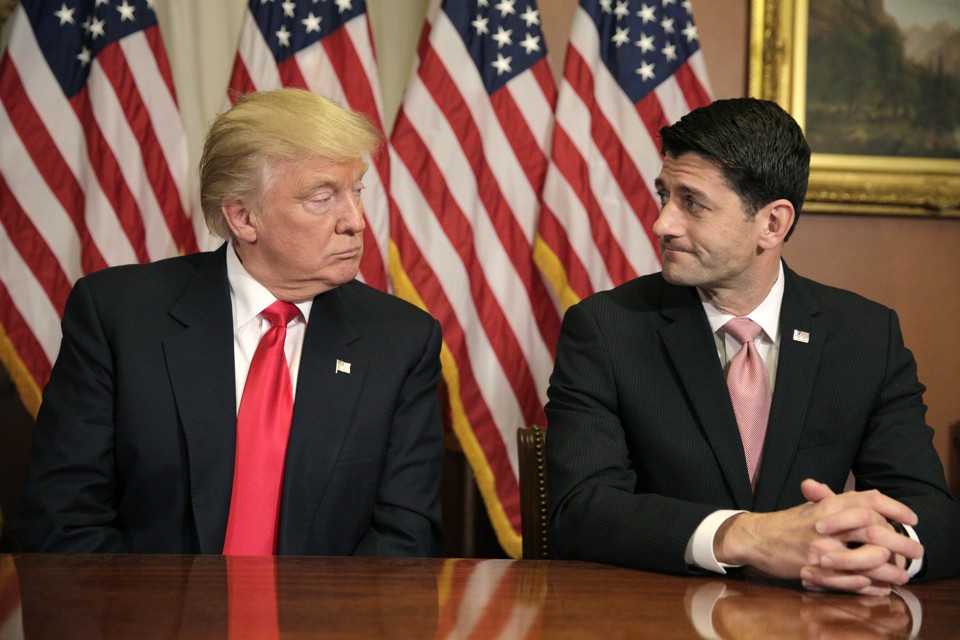
Speaker Paul Ryan (R-Wis.) and Trump feuded in 2016, but in the name of party unity and policy, they have put aside their differences. And in a related development, Ryan's approval rating just hit an all-time high earlier this month.

After the election, Ryan said it's time for the Republican Party to “go big” and “bold.” Trump wouldn't have it any other way, though there are inherent risks with an aggressive strategy without a supermajority in the Senate.

Republicans who publicly ripped Trump are now getting in line, so muscling big-ticket items through the upper chamber using budget reconciliation shouldn't be that challenging. Those bills, such as ObamaCare repeal, would only need 51 Senate votes to pass. But replacing ObamaCare, building a wall along the southern border and clearing a Supreme Court nominee will necessitate 60 votes.

That’s where Trump's bully pulpit will come in, calling out Democrats from both red and purple states that he won on Election Day.

While Trump may not be up to speed on the nuances of the legislative process, those mechanics will be handled by Senate Majority Leader Mitch McConnell (R-Ky.) and Ryan.

Still, the fate of pending bills isn't decided by tactics. It comes down to marketing and political muscle, which play to Trump's strengths.

Trump will surely have a slew of critics of anything he wants to do. They will throw everything they have to kill his agenda.

Trump's likely response: “This bill will help make America great again. It should be passed as soon as possible.”

Democrats will need to step up their messaging game to thwart Trump's agenda. Sen. Charles Schumer (D-N.Y.), who will be minority leader next year, had pledged to work with Trump on areas of common ground. He has also vowed to battle Trump when warranted, most notably on attempts to eradicate Obama's legacy laws.

Since the election, Schumer has called for Democrats to craft “a bold economic platform,” a clear acknowledgement that Clinton's muddled message was no match for Trump's “Make American Great Again.”

Sunday, November 13, 2016

#RIPUSA The Constitution -After Trump's Win, We're Going to Need It. Liberals have ceded too much ground to the constitutional interpretations of white men longing for the good ol' days #AmericaHangsItsHeadInShame , #ImpeachHimNow


Donald Trump rose to power by telling disaffected white people that the past represents the right and natural order. Joe Raedle/Getty
The rise of President-elect Donald J. Trump is a triumph for white supremacy and misogyny that too many of us believed was impossible in the United States in 2016. Trump's promise to "Make America Great Again" is a call to return us to a past in which white men of all classes could expect the government to protect their economic and social dominance relative to racial minorities and women.

Trump acts like he's running to be America's dictator rather than the president of a nation of laws

It's a harkening back to the "greatness" of a time when programs like the New Deal and the G.I. Bill created a path to a middle-class life through government benefits that were systematically denied to black people. When you didn't have to let black people live in your white apartment buildings. When it was difficult or dangerous for a person of color to participate in the political process by voting. When only white men were judges. When black men accused of sexual assault were presumed guilty and faced execution, but powerful white men were free to treat women's bodies as their property without facing legal consequences or even outrage. When men were men, and women knew their value depended on their attractiveness and subservience to those men. When a high school diploma entitled a white man to a good job without competition from people of color, women or robots.

Trump rose to power by telling disaffected white people that the past represents the right and natural order, and he can bring it back. He made no secret of who he would take our country back from: minorities, women, immigrants, Muslims, Jews. And despite his open disdain for the rule of law, he often justified his mission by invoking the language the reactionary right has long used to describe their quest to turn back time: "restoring the Constitution."

It is imperative that we stop letting the right own the Constitution. Given that we're about to have a president with dictatorial aspirations, and both houses of Congress controlled by the Republican Party from which he sprang, the public needs more than ever to understand and demand our constitutional protections. We must be a meaningful check on how much damage these people can do.

But for that to happen, liberals are going to have to stop letting the right's claims to constitutional authority for their preferred social order go unanswered. Too often, liberals and progressives treat the Constitution as an obsolete document written by white men who enslaved black people and treated women as property that has little relevance to our modern battles. In doing so, we've ceded the ground to white men longing for the good ol' days.

Yes, the Constitution was written by white guys who got a lot very wrong, and it would indeed be a bankrupt document if it were frozen in time. But while the Founders lacked the empathy or courage to recognize that "We the People" includes people of all colors, religions and genders, they enshrined revolutionary principles of what liberty entails and left room for us to interpret and amend the document to be more in keeping with those principles.

Liberals must articulate a vision of the Constitution, because what Americans understand the Constitution to say acts as a constraint on what politicians and courts can do. Historically, we've made major strides by getting our fellow citizens to accept evolved interpretations of the Constitution's text – for example, by arguing that segregation violates the right to equal protection of the law, and that forcing a person to carry a pregnancy to term against her will violates her 14th Amendment right to liberty.

The shocking election of Donald Trump tells us we haven't made nearly as much progress as we thought toward convincing our fellow citizens that all people are created equal and protected by the Constitution. It's a moment to remember that in the not-so-distant past a suffragette demanding the full rights of citizenship could be imprisoned and force-fed, and even more recently black people doing the same were beaten and lynched. In hindsight, it was somewhat naive to think the country had changed so much and so quickly that it would resoundingly reject Trump's misogyny, racism and xenophobia.

Right now, in the days and weeks and months after Trump's upset victory, we must articulate a vision of the Constitution to combat the idea that our changed country is a deviation from it. It is deeply unsettling to a large segment of Americans that they can suffer in economic malaise while a black man occupies the highest office, as the country becomes less white and Christian, and as women assume new roles. We need to be clear that there is no going back to when things were "great" just for white men – the changes we've seen are the inevitable result of moving closer to the equality the Constitution requires.

We're here, we're queer, we're female, we're black, we're brown, we're Jewish and we're Muslim. As dire as things feel today, Trump, his supporters and the Republicans who bred them will eventually have to get used to it. We must explain to change-resistant white people that an altered country is the inevitable result of adhering to the founding document they claim to revere.

But the more concrete and immediate reason we have to start talking about the Constitution is that many of the things Trump wants to do are not only terrible policy, but flagrantly unconstitutional. We just elected a man who has proposed torturing people, making religious discrimination official policy, banning abortion and "loosening up" the First Amendment, along with a Congress full of Republicans who have proven incapable of standing up to him. We cannot let shock and fear and defeatism paralyze us. When Trump proposes something that is off-the-table constitutionally, we the People must tell him early and often and loudly that we're not going to take it.

Saturday, November 12, 2016

#RIPUSA The U.S. Media Is Completely Unprepared to Cover a Trump Presidency Donald Trump and his surrogates have shown an uncanny ability to lie in the face of objective facts. They will now have the power of the federal government to help them. #AmericaHangsItsHeadInShame, #ImpeachHimNow


Joshua Roberts / Reuters

Saddam Hussein was allied with al-Qaeda, and helped finance the 9/11 terrorist attacks. The Hussein regime had sought uranium from Niger. Iraq had obtained aluminum tubes to be used to enrich uranium for nuclear weapons.

All of those assertions turned out to be false. But they echoed throughout the press in the months-long run-up to the 2003 invasion of Iraq, and only after the war turned to disaster did the media engage in soul-searching and self-criticism. And even then, many sought to deflect blame. Judith Miller, the Pulitzer Prize-winning New York Times reporter whose front-page story about the aluminum tubes bolstered the case for war in Iraq explained: “My job isn’t to assess the government’s information and be an independent intelligence analyst myself. My job is to tell readers of The New York Times what the government thought about Iraq's arsenal.”

During the 2016 presidential campaign, reporters marveled at the ability of Donald Trump and his surrogates to create an alternate reality in which statements made by the candidate had not been made at all—from his view that global warming is a hoax, to his nonexistent opposition to the Iraq War, to his refusal to say he would concede in the event of a loss, to his remarks about his relationship to Russian strongman Vladimir Putin. These are people who could argue that the sky is green without a blink. They were able to win a presidential election while doing so. Now they will have the entire apparatus of the federal government to bolster their lies, and the mainstream press is woefully unprepared to cover them.

The first reason is that political journalism is highly dependent on official sources, which are chased with abandon. Miller’s defense of stenography seems absurd in hindsight, but there is a grain of truth in it. Government sources are granted a high degree of credibility, and official lies can be difficult to dispute. Contrary leaks from highly placed sources can offer an important check on the official story, but the breadth of the surveillance state built by Bush and Obama, a surveillance state now in Trump’s hands, will make such leaks difficult.

For Trump administration mouthpieces, both public and anonymous, lies will now come with an officiality that will be difficult to contest. The total Republican control of government means that Democrats will struggle to get their objections to carry much weight, much as they did prior to the Iraq War.

Another obstacle is that media objectivity is not a fixed point. It is carefully calibrated to the perception of public opinion, because media organizations do not want to alienate their intended audience. MSNBC’s Chris Matthews offers a telling example of how media figures shift to identify with their perceived audience, which can ultimately mean cozying up to power. During George W. Bush’s absurd war pageantry in May 2003, Matthews remarked that Bush looked like a “high-flying jet star,” and that Bush “won the war. He was an effective commander. Everybody recognizes that, I believe, except a few critics.” The Iraq War is arguably still ongoing.

The Matthews episode illustrates that in addition to reporting itself being manipulated, members of the media themselves engaged in careful brand-management exercises in order to portray themselves as in touch with “Real America,” granting themselves permission to dismiss criticisms of the Bush administration as the ravings of pampered liberal elites. Only days after the 2016 presidential election, this process is already taking place, with prominent media figures seeking to defend the victorious Trump coalition against the slights of those religious and ethnic minorities who fear for their fate under a president who campaigned using them as scapegoats for the nation’s problems.

Adversarial coverage of the Bush administration notably increased once his approval ratings dipped so low that media figures felt as though they were reflecting public opinion when they criticized him. The Bush administration’s ability to shape the narrative in the aftermath of public crises like Hurricane Katrina was noticeably diminished, because unlike with Iraq, reporters could contrast official statements with what they saw with their own lives. Trump’s ability to forge an alternate universe of belief for himself and his supporters suggests that reality may prove far less of an obstacle for him than it was for Bush.

Nevertheless, the ability of the Bush administration to use its power to compel the press to adopt its alternate reality led to the greatest foreign-policy blunder since Vietnam, and the deaths of thousands of Americans and hundreds of thousands of Iraqis, as well as the rise of ISIS. The consequences are, arguably, immeasurable, and the stats I have mentioned simply cannot do them justice.The media is not ready to cover this president. And the American people, and possibly the rest of the world, will pay for it.

With Trump, the United States has elected a president who has shown a complete disregard for free speech, arguing that his detractors do not have a “right” to criticize him. He believes the First Amendment’s protections for the press are too strong. He has a thirst for vengeance against those whom he perceives as having wronged him, and now he has the power of the federal government to pursue his vendettas. The Bush administration’s ability to manipulate the press, and the media’s willing acquiescence in the name of relating to its audience, led to catastrophe.

I want to emphasize that all administrations lie. The Lyndon Johnson administration successfully snowed the press on Vietnam. The Obama administration continually underestimated the strength of ISIS. With Trump, however, we are entering an era in which a president, prior to taking office, has already shown an ability to be entirely unbound by facts, with no political consequences.

The temptation to accept the Trump administration’s unreality—particularly given increased distrust of the media and his ability to insulate his base from the truth—will be tremendous. His ability to use the powers of the federal government to bolster his dishonesty will magnify his powers of deception a thousandfold. And the inability of the Democratic opposition to affect the outcome given their marginal presence in the U.S. government will ensure that any dissent is muffled.

The media is not ready to cover this president. And unless something changes, the American people, and possibly the rest of the world, will pay for it.