Showing posts with label Martin Sherman. Show all posts

Friday, August 12, 2016

The New ‘Nuts’ — Jeffrey Goldberg, the Jerusalem Post and the Question of Sanity by Martin Sherman


The New ‘Nuts’ — Jeffrey Goldberg, the Jerusalem Post and the Question of Sanity by Martin Sherman


Jewish journalist Jeffrey Goldberg being interviewed by Charlie Rose on Bloomberg View, on March 5, 2014. Photo: Screenshot.

I think I’m getting ready to leave Ha’aretz … [its] cartoonish anti-Israelism and anti-Semitism can be grating. I find the @TimesofIsrael to be very reliable. Ha’aretz has some good reporters. Jpost is nuts. — Jeffrey Goldberg, national correspondent for The Atlantic, on Twitter, August 1 and 2.

We have supported a territorial compromise in the framework of a peace deal with the Palestinians…The Jerusalem Post editorial board backed the disengagement from the Gaza Strip in 2005 … — Yaakov Katz, editor of the Jerusalem Post, in a rebuttal to Goldberg’s slur, Jerusalem Post, August 2.

[H]ow can you claim to be objective if the Jerusalem Post editorial board backed the disengagement from the Gaza Strip in 2005?…Perhaps Goldberg has a point — David Sidman in a Facebook response to Katz’s rebuttal, August 2.


Last week, cyberspace was all atwitter, following several rather disparaging tweets from The Atlantic’s scribe, Jeffrey Goldberg, casting grave as persions on much of the English-language press in Israel.

Two major papers bore the brunt of Goldberg’s barbs — Haaretz and the Jerusalem Post. To the surprise of many, the normally decidedly left-leaning Goldberg took Haaretz to task for its “cartoonish anti-Israelism and anti-Semitism,” which he somewhat charitably designated as “grating.”

Not nearly as unhinged as Haaretz

Apparently the dollops of vitriol that the radical rag has been serving up lately to its readers against the Jewish state were too much even for him — and he announced that he was considering giving up reading it. Of course, it remains to be seen how resolute Goldberg will be in adhering to his intended abstinence, but at least he deserves some interim credit for taking and articulating umbrage at the blatant and baseless bile spewed out in pieces like Gideon Levy’s recent “Stop Living in Denial, Israel is an Evil State.” (July 31)

The attack on the JPost — and his denigration of it as “nuts” — was a little more puzzling. To be sure, it is nowhere nearly as “unhinged” as Haaretz, and is certainly a lot less monolithic and doctrinaire in the range of views it presents.

Unsurprisingly, the newly appointed editor, Yaakov Katz, leapt to his paper’s defense, hotly contesting Goldberg’s diagnosis of its journalistic sanity. Katz pointed out — not without justification — that the JPost’s reporting is generally objective and that a wide range of views are represented in its op-ed section. This is largely true, and although I have my disagreements with the JPost — which are likely to become dramatically more acrimonious, and public, in the not-too-distant future — the paper does have a solid line-up of competent opinion writers, with the few veritable “nutters” being the exception, rather than the rule.

Distinctly discordant defense

However, one element of Katz’s defense hit a distinctly discordant note — and as it is symptomatic of a far wider malaise that extends beyond the Goldberg-JPost–Haaretz brouhaha, I should like to dwell on it for a while.

As alleged proof of the JPost’s collective soundness of mind, Katz proudly announced that the paper had endorsed both the “land-for-peace” formula vis-à-vis the Palestinians, and the unilateral evacuation of Gaza.

To be fair to Katz, the allusion to this matter in the introductory excerpts has been somewhat truncated. His full reference to these matters, which included some reservations, omitted in the foregoing excerpts, was as follows: “We have supported a territorial compromise in the framework of a peace deal with the Palestinians, but only if it is a genuine and lasting peace with a real and complete end to violence and incitement…TheJerusalem Post editorial board backed the disengagement from the Gaza Strip in 2005, but fully supports Israel’s right to defend itself with force against attacks from Gaza or the West Bank.[a.k.a. Judea & Samaria-MS].”

This, of course, immediately raises a perverse — but unavoidable — question: In the political discourse in Israel, just how misguided do you have to admit you are to prove, somehow, that…well, you are not??

Flaunting failure?

After all, both the belief in territorial compromise and the unilateral evacuation of Gaza have proven colossal failures — wreaking tragedy and trauma on Jew and Arab alike.

Both have precipitated all the dangers their opponents warned of, and none of the benefits their proponents promised. Sadly, the tragic loss of life and limb was neither unpredictable nor unpredicted.

But all those who warned of the dire consequences of both these ill-conceived measures, were shunned, marginalized, spurned, belittled, disparaged — and deemed “nuts.”

Yet today, with all the foreseen, and foreseeable, death and devastation that these ideas have brought, past support for them is still — inconceivably — considered a proof of…sanity?? How insane is that??

Indeed, one might well ask: Isn’t it nuts to flaunt failure?

The reservations stipulated in Katz’s quote constitute no mitigating factor. After all, support for territorial compromise as a framework for peace with the Palestinians “only if it is a genuine and lasting peace with a real and complete end to violence and incitement” presupposes that such an amiable outcome was in some way plausible.

But of course it never was. There was no need for advance degrees in rocket science to comprehend this. All that was required was to set aside one’s feverish dovish prejudices and listen to what the Palestinians — even the allegedly “moderate” ones — were saying and doing to grasp that “genuine and lasting peace with a real and complete end to violence and incitement” was nothing but a perilous pipe dream. Just like the illusionary visions of a “New Middle East” and the empty promise of a new mirage-like El Dorado arising in the desert sands.

Depraved indifference?
With chances of success so manifestly slim and the cost of failure so predictably grim, surely there is good cause to deem the pursuit of such a policy tantamount to “depraved indifference” — i.e. conduct so wanton, so lacking in regard for the life or lives of others as to warrant the same criminal liability as that which the law imposes upon a person who intentionally causes a crime.

Surely, anyone wishing to debunk efforts to label him “nuts” should assiduously avoid parading his past support for a clearly disastrously defective (indeed, the less charitable might suggest, “depraved”) policy.

Yet for some reason, it would seem that the JPost’s endorsement of precisely such a policy — albeit under manifestly implausible reservations — is somehow considered by Katz as proof of… good judgement?!

Of course much the same — perhaps more so — could be said of “the Jerusalem Post editorial board’s back[ing] the disengagement from the Gaza Strip in 2005.”

It is totally beyond my comprehension why anyone would wish to recall his backing of such a manifestly myopic, moronic and malevolent measure as the “disengagement” — and as credentials of his sober-mindedness, mind you!

Why would anyone want to remind the public that he supported the egregious eviction of thousands of hardworking, devoted citizens, from thriving productive communities, providing gainful employment to the neighboring Arab residents — turning them into traumatized and homeless refugees? Why would he want to dredge up from depths of the past his endorsement of a policy that converted Gaza into an Islamist terror enclave; a fearsome arsenal bristling with long-range weapons capable of hitting nearly every urban center in the country; with its borders honeycombed with deadly attack tunnels, potentially menacing every kindergarten in the adjacent Jewish communities; with ongoing interaction with the radical jihadi gangs roaming the Sinai, pressing up against Israel’s long southern border stretching to the approaches of Eilat?

That’s a badge of journalistic honor? Really?

“…supports Israel’s right to defend itself”

True, Katz conditions the JPost’s backing of the disengagement with a proviso stating that it “fully supports Israel’s right to defend itself with force against attacks from Gaza or the ‘West Bank.’”

But it is difficult to know what that even means — or whether it makes such support more or less troubling and perverse.

After all, since territorial “compromise” (read “concessions”) became the unfortunate cornerstone of Israeli policy vis-a-vis the Palestinian Arabs, Israel has been compelled to undertake four major military campaigns — apart from the 2006 Second Lebanon War: one in Judea-Samaria (Katz’s “West Bank”) — Operation Defensive Shield (2002); and three in Gaza (Operations Cast Lead — 2008-9, Pillar of Defense — 2012; and Protective Edge — 2014). After each encounter, at least on the Gaza front, the enemy emerged undefeated and defiant, with its will to engage unbroken, and its capabilities significantly enhanced. Israel is now bracing for a fourth round — spending billions to prepare for it.

So, was the JPost’s declared support for “Israel’s right to defend itself with force against attacks from Gaza or the West Bank” the product of ex-ante foresight or ex-post hindsight?

Clearly, if it was the former, such support could well be deemed irresponsible recklessness; if the latter, lamentable myopia.

Jerusalem Post, December 9, 1992

Interestingly, if, prior to conferring its backing to the 2005 Gaza evacuation and eviction, the JPost editorial board had browsed through back copies of the paper, it may have come across an opinion piece, written over a decade prior to the disengagement, predicting precisely what would happen pursuant to a unilateral abandonment of the area.

The article, entitled “Why we can’t dump Gaza,” published almost a quarter-century ago, on December 9, 1992, and penned by one Martin Sherman, then considerably younger and trimmer than today. It warned that:

— The unilateral withdrawal will bring “great peril to Israelis and [Gazan] Arabs alike;”

— “In the ensuing political vacuum, the most radical and violent elements would…seize power [and] all the more moderate elements would be speedily eliminated either politically or physically;”

— Gaza would face the grave water crisis that now threatens it, cautioning that “its water resources are being increasingly salinated through overuse;”

It predicted that, for security reasons, Israel would have to impose a quarantine on Gaza creating increasingly onerous conditions for the population there, and “a deepening sense of hopelessness, misery…which will inevitably be directed against Israel.” It warned of the dangers emanating from smuggling arms across fronts that Israel could not fully supervise “from the west (the sea) and south (Sinai).”

It forecast that “the frustration and despair will manifest itself in violent action against Israel…; our southern settlements and towns will be the targets of frequent attacks…compel[ling] Israel to retaliate;” and cautioned of the international censure that would result from such action: “Air strikes or artillery shelling on civilian population centers would cause heavy casualties among the dense, destitute masses in [which] the attackers conceal themselves,” asking rhetorically, “How would the world react?”

The new “nuts” — time for redefinition?

Back then, a quarter of a century ago, the article foretold what should have been clear to anyone with a rudimentary grasp of the basic fundamentals of political science, international relations and the theory of nations and nation-states: “A unilateral withdrawal from Gaza will do nothing to ease the socio-economic plight of the local inhabitants, nor will it reduce the politico-security problems of Israel; rather it will be likely to exacerbate them.” How many will dispute that this forecast has been borne out by later realities?

So what should be the criterion for being “nuts”? Getting it right — or getting it wrong?

Moreover, given past precedents and future probabilities – and in the absence of any compelling counter-arguments — there is no persuasive or plausible reason to believe that any prospective self-governing Palestinian entity will emerge as anything but yet another homophobic, misogynistic, Muslim-majority tyranny, whose socio-cultural and political hallmarks would be gender discrimination against women and girls, persecution of homosexuals and pursuit of political dissidents.

Now if you happen to subscribe to progressive liberal values of pluralism and tolerance, who is nuts — those who support the establishment of such an entity — or those who oppose it?

One wonders whether either Goldberg or the JPost editorial board will address this challenge.


Dr. Martin Sherman served for seven years in operational capacities in the Israeli Defense establishment.  He was a ministerial adviser to Yitzhak Shamir's government and lectured for 20 years at Tel Aviv University in Political Science, International Relations and Strategic Studies.  He holds several university degrees: a B.Sc. (Physics and Geology), an MBA (Finance), and a PhD in political science and international relations. He was the first academic director of the internationally renowned Herzliya Conference and is the author of two books and numerous articles and policy papers on a wide range of political, diplomatic and security issues. He was born in South Africa and has lived in Israel since 1971. Dr. Martin Sherman (www.martinsherman.net ) is founder and executive director of the Israel Institute for Strategic Studies (www.strategicisrael.org).

Friday, August 5, 2016

What if the GOP wins? – Potential payoffs and pitfalls for Israel By Martin Sherman

Image result for Cartoon what if  Trump wins

INTO THE FRAY:What if the GOP wins? – Potential payoffs and pitfalls for Israel

By Martin Sherman

The changes in the Republican platform are a welcome development, but they create new challenges for Israel & much depends on how it meets them 
 Rejecting decades-old policy, the Republican Party approved on July 12 a [2016] platform that does not include a call for a two-state solution to the Israeli–Palestinian conflict.—Forward, July 10, 2016
We believe the establishment of a Palestinian state on the West Bank would be destabilizing and harmful to the peace process. – 1980 Republican platform that brought Ronald Reagan to the White House.
We oppose the creation of an independent Palestinian state; its establishment is inimical to the security interests of Israel, Jordan, and the US. We will not support the creation of any Palestinian entity that could place Israel’s security in jeopardy. – 1988  Republican platform that brought George H. W. Bush to the White House.
These three excerpts spanning over a quarter-century relating to the GOPs attitude towards the establishment of a Palestinian state include two important lessons for Israel.
Breathtaking erosion
One of these lessons relates to the past; the other to the future.
Israel will ignore either at its peril—or at least, to its grave detriment.
With regard to the past, these excerpts underscore the breathtaking erosion that has taken place since the late 1980s in the GOPs opposition to Palestinian statehood—from utter rejection; to retraction of opposition (1996); to explicit—albeit conditioned—endorsement in 2002.  It is only now that the GOP is setting aside its ill-considered support, and has thankfully begun to revert—albeit it still partially—to its former position.
What makes this spectacular erosion—from un-conditional rejection to conditional acceptance—even more remarkable is the fact that it took place over a period in which for the overwhelmingly greater proportion  of time, the incumbent Israeli government was headed by Likud, which until mid-2009 (Netanyahu’s Bar-Ilan Speech) explicitly opposed the establishment of a Palestinian state.
Indeed, for the twenty-two years (between 1980 to 2002), Likud-led coalitions were in power for about double the time that Labor-led ones were.
This is clearly a grave indictment of the Israeli “Right’s” inability to convincingly convey the validity of its political credo, and to undermine that of its ideological adversaries on the “Left”.
The need for soul-searching
The gravity of this indictment is further compounded by two factors that make it even more damning.
The first is that this dismal outcome emerged despite the highly favorably point of departure, which opponents of Palestinian statehood enjoyed.  After all, no effort was required to win over the GOP to this “rejectionist” position, for it was a priori staunchly behind it to begin with.  Yet despite this, the “Right” was unable to sustain this like-minded support, which by 2002, had for all intents and purposes, been totally eroded.
The second is that this erosion occurred despite the fact that the “Right’s”  opposition to Palestinian statehood was completely validated by facts on the ground – i.e. by the bloody events that tragically arose from the fatally failed attempt to implement it.
So, sadly, the “Right” was not able to marshal the distinct dual advantage it had of a highly favorable point of departure and overwhelming empirical corroboration of its credo to sustain the GOP’s natural inclination to oppose the establishment of a Palestinian state.
This in itself is reason enough for intense soul-searching among “Right” wing activists, but it acquired even greater pertinence and urgency, precisely because of the encouraging signs that  the GOP is reverting—at least, partially and cautiously—to its past position of opposition to Palestinian statehood.
For today, the challenges Israel may have to face in a post-two-state era could well be as dire—perhaps even most so—than those that the perilous two-state paradigm posed.
A word of warning
It is no secret that enthusiasm for the two-state concept is waning—even among ardent erstwhile adherents. Indeed, recently, some obsessive two-staters such as New York Times’s Tom Friedman (February 10, 2016),  New York University’s Alon Ben Meir (Huffington Post, April 7, 2016), and recently the Jerusalem Post’s Gershon Baskin (July 20, 2016)  have acknowledged that, (gasp!), the Palestinians may actually have contributed to the accelerated irrelevance of the two-state idea.
Thus, and without wishing in any way to diminish the sterling efforts of those who helped bring about the welcome change in the 2016 GOP platform, this was, to some extent, as Rafael Medoff points out(Algemeiner, July 20, 2016)  a sober and clear-sighted response to the changing realities on the ground.
Of course, according to conventional wisdom in “Right-wing” circles, the changes in the GOP platform are a development that bodes well for Israel, as it signals growing awareness of the futility and dangers entailed in continued pursuit of the two-state chimera as the only route to a resolution of the conflict with the Palestinian-Arabs.
While this, of course, is undoubtedly true, a word of warning is called for.
With the passing to the two-state paradigm as a relevant policy option, new perils will immediately emerge. Planning on how they should be contended with is a pressing imperative for the Israeli “Right”—and one that, hopefully, it will display greater acumen and competence in contending with than it did in dealing with the two-state menace.
If not two-states, what?
With the growing prospect of the two-state option being abandoned, the question of what alternative paradigm Israel should adopt is becoming a question of increasing relevance.
It is also one which the Israeli “Right” has been appallingly remiss in addressing.
Indeed, for the better part of two decades, the “Right” limited itself to underscoring the myriad defects and dangers entailed in the two-state proposal, but largely refrained from articulating and advancing some cogent and comprehensive alternative prescription for its preferred vision of a permanent-status arrangement with the Palestinian-Arabs.
As a result, the “Right” found itself unable to respond effectively to the pointed and very pertinent question from adversarial two-state adherents: “So what’s your alternative?”
Failure to provide an adequate response to this question, eventually led to a drastic erosion of the Likud-led opposition to the two-state formula until its acceptance by Netanyahu in 2009.
But the recanting of support for the two-state formula by the GOP, and its waning attractiveness elsewhere,  will create a dramatically different and challenging reality for both the reluctant Likud-like two-staters on the one hand, and for still die-hard two-state opponents,  on the other.
For not only  will it be increasingly less plausible to invoke “irresistible international pressure” for reluctant acceptance, under duress, of a two-state compliant policy; but it will also no longer be possible to confine oneself to criticism and rejection of the two-state formula.
To the contrary, with the declining dominance of the two-state concept, its opponents will be obligated to proactively produce and present a plausible and practical Zionist-compliant alternative…or suffer the consequences of its generally accepted default option:  a multiethnic un-Jewish state-of-all-its-citizens.
Alternatives worse than two-state option?
As mentioned earlier, until lately, two-state opponents long eschewed presenting some persuasive, sustainable long-term blueprint for the outcome of the conflict with the Palestinian-Arabs.
In recent years, however, a spate of such alternative proposals has emerged. Sadly, not everything that is not a two-state compliant proposal is preferable to the perilous two-state principle itself.
And indeed, nearly all the major alternatives being advanced today by prominent figures on the “Right” are – notwithstanding the sincere goodwill of their authors—no less inimical to the long-term survival of Israel as the nation state of the Jewish people.
Thus while I bear none of them any personal rancor, I am firmly convinced that if these “alternatives” are advanced as tangible policy options to replace the two-state  concept, the consequences for Israel and the Zionist ideal will be grave.
Indeed, in broad brush strokes, these proffered “alternatives” to setting up a Palestinian state can be divided into three major categories.
The first is that proposed by those who favor “managing—rather than resolving–the conflict”, which basically consists of “kicking the can down the road”. In effect, it calls for letting the problem fester, until some unspecified event(s) occur to—hopefully and inexplicably—facilitate resolution.
The other two—somewhat more proactive—suggestions can be divided into those that will, almost inevitably and demonstrably, lead to either:
(a) the Lebanonization (and later Islamization) of Israel by incorporating the Palestinian-Arab residents of the territories across the pre-1967 lines, into the permanent enfranchised population of Israel; or
(b) the Balkanization of Israel by trying to encapsulate the Palestinian-Arab population in disconnected autonomous enclaves in these areas.
None of these three categories can pave the way for Israel—as the nation-state of the Jews—to a sustainable long-term situation that is any less menacing than that entailed in the two-state scenario.
“What’s wrong with ‘The Right’…”
In a series of past articles, I have—with varying degrees of acerbity/exasperation—laid out in considerable detail, the manifest shortcomings of these alternative proposals, to which I urge readers to refer. See:
What’s Wrong With The Right — Part I: As demented and disastrous as the two state “solution” is, most alternatives proffered by the Right would be no less calamitous.
What’s Wrong With The Right – Part II:The Right must realize that between the river and the sea, either exclusive Jewish or exclusive Arab sovereignty will eventually prevail.
Brain Dead On The Right?The only thing more dangerous, delusional and disastrous than the Left’s proposal for a two-state solution, is the proposal now bandied about by the Right – for a one-state solution
To My Colleague Caroline, A Caveat:I strongly concur with Caroline B. Glick’s diagnosis of the fatal failings of the two-state formula, and disagree just as strongly with the prescription she offers to remedy them.
Sovereignty? Yes, But Look Before You LeapExtending Jewish sovereignty over Judea-Samaria is imperative, but some proposals for this imperil Israel no less than the two-state folly.
Islamizing Israel – When The Radical Left And Hard Right Concur:The almost unavoidable result of annexing the territories & enfranchising their Arab population would be to eventually create a Muslim-majority tyranny.
Annexing Area C: An Open Letter To Naftali Bennett:Between the Jordan River and Mediterranean Sea, there can — and eventually will — prevail either exclusively Jewish, or exclusively Arab, sovereignty.
Sovereignty? Yes, But Beware Of Annexing Area CPartial annexation of Judea-Samaria will solve none of the problems Israel faces today, and exacerbate many
The most urgent & important issue today
 In these articles I show why:
– “managing the conflict” is an exercise in futility—and self-delusion—that will only carry the country on a perilous downward spiral, with prevailing problems increasing in both scale and intensity;
– proposals that prescribe including the Palestinian Arabs in the permanent population of a post-two-state Israel would almost inevitably turn the country into a Muslim-majority tyranny within a few generations—even if the optimistic demographers are right and, initially, the Muslim population will comprise a 35-40% minority;
– proposals that advocate partial annexation and limited autonomy for the Palestinian Arabs, concentrated in disconnected mini-enclaves will result in wildly torturous and contorted borders, virtually impossible to demarcate  and secure, thus emptying  “sovereignty” in the annexed areas of any meaningful content.
None of these proposals offer a sustainable alternative paradigm to the two-state formula that can ensure Israel’s survival as a viable nation-state of the Jewish people.
The GOP’s new platform can indeed herald a great new opportunity for Israel, especially—but not necessarily, only—if it wins the November elections.
But to reap the potential benefits that this entails, Israel must prepare.  It must formulate a cogent, comprehensive paradigm to replace the two-state folly, which addresses both its geographic and demographic imperatives for survival—lest it promote a proposal that threatens to make it untenable geographically or demographically–or both.
It must be a proposal that ensures that Israel retains its vital geo-strategic assets in Judea-Samaria and drastically reduces the presence of the hostile Arab population resident there—preferably by non-coercive means such as economic inducements…which, by the way, is what brought the bulk of the Arab population here in the first place.
Initiating debate on this is a matter of paramount urgency and importance. I can only hope that this essay will help initiate it.
Martin Sherman (www.martinsherman.org) is the founder and executive director of the Israel Institute for Strategic Studies. (www.strategic-israel.org)

Is Israel’s US Ambassador Serious?

Israeli Ambassador to the US Ron Dermer. Photo: Facebook.
“There is no reason, concretely and in principle, why Jews should not be able to live in a future Palestinian state”-–  Ron Dermer, Israel’s Ambassador to the United States, July 28, 2016.
“Only two things are infinite, the universe and human stupidity, and I’m not sure about the former.” attributed to Albert Einstein
I realize, of course, that juxtaposing these two excerpts might seem to some to be an overly caustic castigation of our esteemed envoy in Washington. But things are getting out of hand. In recent weeks, the Israeli public has been subjected to a barrage of imbecility from its leaders — with each statement/declaration/proposal attaining new levels of naked absurdity. It is an absurdity that must be exposed and expunged from the political discourse in Israel.
Cavalcade of the crackpot and the crazy
In past columns, I have discussed some of the more demented ideas that have been raised in the national discourse by prominent individuals and/or organizations as allegedly serious policy proposals.
For example, in “Gaza: A port is no panacea for poverty” (May 27, 2016), I dealt with the harebrained and hazardous proposition made – among others, by Israel Katz, Minister of Intelligence(!) and Transport, to build a detachable port for Gaza on an artificial off-shore islet.
In “Imbecility squared:Parts 1 & 2” (June 10 &17, 2016), I wrote of the perils inherent in the “plan” advanced by a group of over 200 former senior security officers, called “Commanders for Israel’s Security,” to convert the areas of Judea-Samaria into a giant South Lebanon, unilaterally transforming “disputed territories” into “occupied” ones.
Likewise,  in “Utterly unconscionable” (July 1, 2016),  I detailed the fatal folly of the so-called “reconciliation” accord, concluded by the Netanyahu government with Erdogan’s Turkey, warning of its many ill-advised  defects — particularly giving the increasingly theocratic and tyrannical Islamist regime, closely allied to the Muslim Brotherhood, a firm foothold in Gaza.
So in some respects, Ambassador Dermer’s staggeringly stupid remark was merely another component in the continuing cavalcade of the crackpot and the crazy that has become the depressing norm in the conduct of Israeli politics.
Core essence of Zionism
But in some respects it was even more disturbing and detached from any grasp of reality.
Made at an event held by the S. Daniel Abraham Center for Middle East Peace at the Democratic National Convention in Philadelphia, the remark highlighted the impossible dilemma in which Likud-led coalitions have been trapped since Netanyahu’s ill-advised Bar-Ilan Speech, in which he declared his willingness — in violation of his electoral pledges — to accept the possibility of Palestinian statehood. Moreover, Dermer’s remark also reflected the dismaying degree by which the core values of Zionism have been obscured, eroded and forgotten
Sadly — but not unpredictably — the latter is an inevitable product of the former. In its barest essentials, Zionism comprises conveying Jews from living under alien sovereign rule to living under Jewish sovereign rule. This is particularly true for Jews living under an inhospitable alien sovereign authority. That is the verysine qua non of the Zionist ideal, enshrined in the words of the national anthem, Hatikvah:
Our hope of two thousand years will not be lost.
To be a free people in our own land, the land of Zion…
Absent this component, the notion of Zionism is left bereft of any substantive content. But this is precisely what Dermer’s remark is prescribing — and worse.
Perversion of Zionism’s essence
For it is not only suggesting that this core element of Zionism be set aside, but that, in fact, it be inverted. Perversely, this prospect of the sacrifice of Zionist essence is to be made at the altar of the disproven — but somehow never discredited, and certainly never discarded — political deity of “Two States.”
So Dermer is utterly wrong — on all counts.
There is every reason — both in principle and concretely — why the notion of Jews living in a Palestinian-Arab state, under Palestinian-Arab sovereignty would be unacceptable. Indeed, his envisioned outcome was made all the more preposterous — even grotesque — by his raising the possibility that “settlers living deeper in the West Bank should, in the event of Palestinian statehood, be given the option of gaining citizenship in that state.”
It is unacceptable, in principle because it entails not only the annulment — but the antithesis — of the quintessential Zionist aspiration. Not only does it not entail bringing Jews living under non-Jewish sovereignty to live under Jewish sovereignty, it entails the precise opposite — abandoning Jews living under Jewish sovereignty to life under non-Jewish sovereignty.
But when we move from the realm of “principle” to that of the “concrete,” the notion that Jews should live in a future Palestinian state becomes even more bizarre and unthinkable.
“…There is a Jew behind me, come and kill him…”
For when Dermer envisions Jews being left to live in a “future Palestinian state,” we are not talking about some benign Judeo-philic — or even Judeo-neutral — sovereignty, but a regime nurtured by decades of Judeo-phobic hatred and filled with Judeo-cidal intent.
Indeed, both the Hamas Charter and Fatah Constitution call for the eradication of all the Jews and the elimination of every vestige of Jewish life between the Jordan River and the Mediterranean Sea — by force of arms.
So, foremost among the “concrete reasons” for discounting the prospect of Jews living in some future Palestinian-Arab state is the rather “prosaic” one: the very tangible probability of them being torn limb from limb by some incensed mob, enraged by the very sight of their mere existence.
Indeed, the thought of leaving Jews — and Israeli citizens — to the tender mercies of a regime, that has demonstrated its true and heartless colors, is so appalling that it must be removed from the realm of acceptable debate before it gathers any currency.
Two things make raising this perverse possibility even more vexing. The first is that it was a clear slap in the face for the pro-Israel elements in the Republican Party, who had expunged the idea of the two-state formula from their party platform. The second was that it apparently was intended to mollify less supportive Democrats, still mindlessly obsessed with the macabre dogma of establishing yet another homophobic, misogynistic Muslim-majority tyranny as the panacea for all the ills of the Middle East.
Contorted politically-correct gobbledygook
It is a sad spectacle to see Israeli diplomacy so mired in the two-state morass of its own making that it has lost any semblance of coherence, thus inevitably resulting in the kind of anti-Zionist declarations made by Dermer.
Instead of channeling all efforts into removing the idea of Palestinian statehood from the discourse, Israeli diplomacy insists on sustaining it. By paying formal lip service to the doctrine of two-statism Israel has ensnared itself on an irresolvable contradiction — committed to the establishment of a Palestinian state, on the one hand; yet unable to make the perilous concession to allow its implementation, on the other.
It is this impasse that begets the kind of outlandish utterances made by Dermer. Instead, of making it clear that — absent some wildly implausible best-case scenario, with no realistic basis in fact — a Palestinian state is incompatible with its the long-term survival as the nation state of the Jews, Israel finds itself scrambling to square the circle, trying to defend an indefensible policy with indefensible arguments.
Instead of conveying to the world, and the Democratic Party, that Israel cannot relinquish — “in principle or concretely” — any portion of Judea-Samaria to Arab sovereignty, Dermer is forced into contorted politically correct gobbledygook — attempting to justify the construction of Jewish communities not on the basis of moral and historical rights — but on the basis of their possible future transfer to Arab rule.
Only the most fevered of minds  
Today, only the most fevered mind can suggest that the establishment of a Palestinian state in the hills that command the heavily populated coastal plain is even remotely in Israel’s national interest.  Not only would the Jews left behind in the Palestinian-Arab state be in deadly danger, so would those inside the Jewish state.
To grasp the veracity of this caveat, all one needs to do is look at the outcome of the failed experiment of trying to foist self-rule on the Palestinian-Arabs in Gaza. After three large scale military campaigns against Arab aggression since relinquishing the territory, and removing any remnant of Jewish presence there, Israel is again bracing for a fourth encounter.
Indeed, as time passes, instead of threats dissipating they intensify. Today, Israel is planning on surrounding Gaza not only with a 10-meter-high wall above ground but a 10-meter-deep one below it, to contend with the threat of attack tunnels. It not only recently completed a project to fortify over 10,000 homes in the communities adjacent to Gaza, providing them with newly constructed bomb shelters, but in the case of renewed fighting, plans to evacuate the civilian population in a 7 km swathe around the Strip.
Hmm!! Remember how they told you Israel had to leave Gaza because the “occupation “was… expensive??
“Fraying Palestinian Political Entity in  ‘West Bank’…”
Now imagine having to duplicate that effort, if like Gaza, Judea-Samaria were surrendered to Arab sovereignty. Imagine if, instead of having to build a 10m barrier above and below ground along a 50 km. front, as in Gaza, Israel would have to do this along a 400-500 km front in Judea-Samaria. Imagine if instead of having to fortify 10,000 homes, Israel would have to fortify hundreds of thousands. Imagine if instead of planning to evacuate the civilian population in the sparsely populated largely rural South adjacent to Gaza, Israel would have to plan on evacuating the heavily populated largely urban areas adjacent to Judea-Samaria.
But if the sheer physical parameters are daunting, the socio-political processes inside Judea-Samaria are, if anything, more so.
In a new study, graphically entitled “The Fraying Palestinian Political Entity in the West Bank,” veteran Arab affairs analyst Pinchas Inbari paints a gloomy picture of socio-political realties in Judea-Samaria, and of the direction of the developing trends there.
He describes a society descending into inter-clan rivalry and gang violence against the backdrop of declining authority of any semblance of centralized governance. He cautions: “The Palestinian Authority is failing to control extensive parts of the West Bank. As a result, some districts of the West Bank are developing in different directions…accelerating the process of the PA’s disintegration…”
Stop already!
So there you have it. Both bitter experience of past precedents and the dismal prospects of future trends portend ill for the two-state paradigm. To understate the case, its chances of success are slim and the cost of failure, grim. It therefore seems inexplicable that the Government of Israel persists in the shabby charade of supporting it.   Perversely, many holding senior office today built their political careers on opposition to Palestinian statehood. Yet now that their positions have been vindicated, they persist in feigning support for it.
The time has come to stop this masquerade. Instead of trying to artificially sustain the dangerous delusion of a future Palestinian state, coexisting in peace and prosperity with a Jewish state, instead of nurturing this ill-fated illusion among overseas audiences, Israeli diplomats should be engaged in efforts to apprise them of the fatal flaws of the failed doctrine of two-statism.
That — and not consigning Jews to Arab governance – is the true challenge of Israeli diplomacy today.
Martin Sherman (www.martinsherman.org) is the founder and executive director of the Israel Institute for Strategic Studies. (www.strategic-israel.org)
.

Tuesday, August 2, 2016

The Self - Cannibalization of Europe ( Revisited)


The self-cannibalization of Europe (revisited) by  Dr Martin Sherman
The West’s socio-cultural heritage is undergoing a process of self-cannibalization, devoured by the very values that once made it so successful and influential.


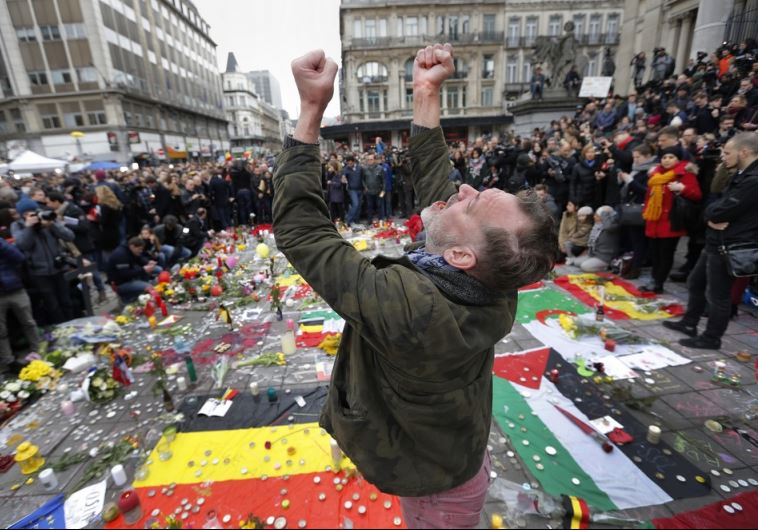
A man reacts at a street memorial following Tuesday's bomb attacks in Brussels. (photo credit:REUTERS)

It is useless for the sheep to pass resolutions in favor of vegetarianism, while the wolf remains of a different opinion
. – R. Inge, dean of St. Paul’s Cathedral, 1915


Unlimited tolerance must lead to the disappearance of tolerance. If we extend unlimited tolerance even to those who are intolerant, if we are not prepared to defend a tolerant society against the onslaught of the intolerant, then the tolerant will be destroyed, and tolerance with them. – Karl Popper, “On the Paradox of Tolerance,” in The Open Society and Its Enemies, 1945

Many Western Europeans, from the man on the street to the cop on the corner, from the politician in Parliament to the immigration official at the border, have long considered it their obligation... to tolerate intolerance
. – From “Tolerating Intolerance: The Challenge of Fundamentalist Islam in Western Europe,” Partisan Review, 2002

Several years ago, I used these excerpts as the introduction to a column titled, “A study in self-cannibalization” (November 11, 2011), in which I cautioned that the West in general, and Europe in particular, were devouring themselves, by attempting to apply the values on which their socio-cultural heritage was founded in situations, and against perils, where such applications are totally inappropriate.

Events since then have resoundingly affirmed that dire caveat.

Utterly ill-prepared – operationally & mentally

In mid-December 2015, numerous major media channels reported that a raid on a Brussels apartment where suspected jihadi terrorist Salah Abdeslam – accused of involvement in the November 2015 Paris attacks – was thought to be hiding, was delayed for hours. Incredibly, this was because the Belgium penal code prohibits such raids between 9 p.m. and 5 a.m., unless a crime is actually in progress.

Little could better illustrate how utterly ill-prepared – both operationally and mentally – the countries of the European Union are to contend with the rapidly emerging existential threat to their way of life, their cultural heritage and the value system on which they are based.

On Sunday, The New York Times outlined the dimensions of the EU’s rude and belated awakening: “The scale of the Islamic State’s operations in Europe are still not known, but they appear to be larger and more layered than investigators at first realized... the Islamic State appears to be posing a largely hidden and lethal threat across much of Europe...”

Sadly, as the influx of Muslim immigrants engulfs Western Europe and presses against the gates of North America, bringing with it much of what they were attempting to flee, the appalling truth is becoming increasingly clear.

A process of self-cannibalization

In November 2011, I wrote: “Across the Western world today, political liberalism [“liberal” as opposed to “illiberal,” not “conservative” – MS] is undergoing a process of self-cannibalization – devoured by the very values which made it into arguably the most successful and influential socio-political doctrine in modern history. At the very least, it has been complicit in actively facilitating its own demise through an unrestrained and undiscerning compulsion to apply these values universally – even when such application is not only inappropriate, but detrimental to those values.”

This week, the validity of this diagnosis received dramatic support from a most unlikely source – none other than the man widely credited for popularizing the term “Islamophobia” as a pejorative expression of unwarranted anti-Muslim bias, the former head of Britain’s Equalities and Human Rights Commission, Trevor Phillips. Indeed, for much of the week, cyberspace has been abuzz with Phillips’s stark admission of error: “Twenty years ago when... I published the report titled, “Islamophobia: A Challenge for Us All”... that first introduced the term Islamophobia to Britain... we thought that the real risk of the arrival of new communities was discrimination against Muslims...” Although the 1996 report did show ample evidence of such discrimination, Phillips concedes: “... we got almost everything else wrong.”

In the rest of his frank and manifestly contrite – some might say, distraught – mea culpa, Phillips reiterates, virtually point by point, almost everything raised in my November 2011 column, lamenting: “Liberal opinion in Britain has, for more than two decades, maintained that most Muslims are just like everyone else... But thanks to the most detailed and comprehensive survey of British Muslim opinion yet conducted, we now know that just isn’t how it is.”

Acknowledging diversity is... diverse

In light of the new “detailed and comprehensive” survey’s findings on the growing “chasm” between Muslims and non-Muslims in Britain on fundamental societal issues, Phillips acknowledges: “For a long time, I too thought that Europe’s Muslims would become like previous waves of migrants, gradually abandoning their ancestral ways, wearing their religious and cultural baggage lightly, and gradually blending into Britain’s diverse identity landscape,” confessing: “I should have known better.”

He bluntly puts erstwhile like-minded colleagues on notice: “Some of my journalist friends imagine that, with time, the Muslims will grow out of it. They won’t.”

In November 2011, I cautioned against disregarding the practical ramifications of “Otherness”: “Devotees of political liberalism fervently advocate – quite correctly – the need to acknowledge the diversity of humanity and to accept the existence of those different from us, i.e., the ‘Other.’ “However, they then go on to advocate – with equal fervor – something that in effect empties the previous acknowledgment of all significance, i.e., that we relate to all the diverse ‘Others’ as equals.

“For what is the point of acknowledging diversity if we are called upon to ignore the possible ramifications of that diversity and to relate to those discernibly different from us as if they were essentially the same as us? Prima facie, this is absurdly self-contradictory.

“For surely the awareness of difference raises the possibility that different attitudes (and actions) toward the ‘Other’ may well be called for.

“Although acknowledging diversity necessarily negates equality, this does not a priori mean that ‘Ours’ is morally superior to ‘Theirs’ – although the plausible assumption is that ‘We’ have a subjective preference for ‘Ours’ over ‘Theirs.’ “This, of course, might entail certain practical ramifications for the preservation of ‘Ours’ lest it be consumed by ‘Theirs’ – depending on ‘Their’ ‘appetites and aspirations.’”

‘Us’ as an item on ‘Their’ menu

I continued: “As the foregoing W.R. Inge citation counsels, it would be injudicious to relate to carnivores and herbivores with an undiscriminating sense of egalitarianism.

Indeed, if one is not mindful of the differences between oneself and the ‘Other’ (say with regard to dietary preferences or predatory predilections), disaster may well be unavoidable.

“Of course, such diagnosis of difference does not necessarily imply a value judgment as to the relative moral merits of devouring flesh or grazing grass. However, operationally, it is a distinction that is essential for the preservation of grass-grazers...

“For no matter how sympathetic to, or appreciative of, the untamed majesty of predators one might be, the fate of the flock is likely to be grim if it is left to graze in wolf-frequented territory with nothing more coercive to protect it than an appeal for understanding.”

Thus, in what Breitbart’s Raheem Kassam dubs “a nod to those who have long protested this to be the case in the face of political, media, and even police cover-ups,” Phillips – virtually on cue – charges: “The contempt for white girls among some Muslim men has been highlighted by... recent [widespread underage sexual abuse] scandals in Rotherham, Oxford, Rochdale and other towns. But this merely reflects a deeply ingrained sexism that runs through Britain’s Muslim communities.”

The ‘Other’ as...‘Other’

In November 2011, I diagnosed: “The major source of peril [to Western values of socio-cultural tolerance and individual liberty] today is the reluctance – indeed the resolute refusal – to acknowledge the emerging threat. Leading liberal opinion-makers in mainstream intellectual establishment appear totally incapable of conceiving (or at least, totally unwilling to acknowledge that they are capable of conceiving) of the ‘Other’ as anything but a darker skin-toned version of themselves – with perhaps more exotic tastes in dress and a greater penchant for spicy food, but with essentially the same value system as theirs, or at least one not significantly incompatible with it.”

Indeed, there seems to be an overriding inability to admit the possibility that the “Other” is in fact fundamentally different – i.e. genuinely “Other” – and may hold entirely different beliefs as to what is good and bad, what is legitimate and what is not.

Phillips points an accusatory finger in essentially the same direction: “... the biggest obstacles we now face in addressing the growth of this nation-within-a-nation are not created by British Muslims themselves. Many of our (distinctly un-diverse) elite political and media classes simply refuse to acknowledge the truth. Any undesirable behaviors are attributed to poverty and alienation. Backing for violent extremism must be the fault of the Americans. Oppression of women is a cultural trait that will fade with time, nothing to do with the true face of Islam.”

With commendable candor, he admits, “It’s not as though we couldn’t have seen this coming. But we’ve repeatedly failed to spot the warning signs,” adding disapprovingly: “Even when confronted with the growing pile of evidence to the contrary, and the angst of the liberal minority of British Muslims, clever, important people still cling to the patronizing certainty that British Muslims will, over time, come to see that ‘our’ ways are better.”

An Orwellian corruption of the discourse

It is of little practical consequence whether this lacuna is the product of an overbearing intellectual arrogance, which precludes the possibility of any alternative value system, or of an underlying moral cowardice, which precludes the will to defend the validity of one’s own value system.

The result is the ongoing retreat from the defense of liberty and tolerance in the face of ever-emboldened, intolerant Muslim militancy – not only across the Islamic world, but within the heart of many Western nations as well.

Even more seriously, it has undermined the capacity for honest debate, for accurate assessment of strategic geopolitical shifts... and for formulating timely and effective responses to deal with them.

The politically correct endeavor to shy away from harsh truths has introduced an almost Orwellian atmosphere of 1984 mind control into the debate on the ramifications of Islam for the West’s socio-cultural heritage.

Pronouncements almost on a par with the “War is Peace,” “Freedom is Slavery” and “Ignorance is Strength” employed by “The Party” to control the dystopian state of Oceania in George Orwell’s classic novel of pervasive dictatorship have emerged with disturbing frequency.

It is a phenomenon that is not confined only to the UK or EU. Its corrosive effect has crossed the Atlantic – particularly under the Obama administration.

Pronouncing religious fundamentalism secular

Thus, US Director of National Intelligence James Clapper, in effect, pronounced that religious fundamentalism is... secular (!), when he famously characterized the radical Muslim Brotherhood as an organization that is “largely secular.”

Similar convoluted, nonsensical gobbledygook came from current CIA director (then Obama-administration’s homeland security adviser) James Brennan, when he made the astounding claim that accurately defining the threat would exacerbate it: “Nor do we describe our enemy as jihadists or Islamists, because jihad is a holy struggle. [C]haracterizing our adversaries this way would actually be counterproductive.”

But perhaps the pinnacle of Orwellian endeavor came from then-British home secretary Jacqui Smith, in a 2009 Der Spiegel interview, who took it upon herself to bring home to radicalized UK Muslims that they were not who they thought they were! In a breathtaking stroke of self-contradictory double talk, she presumed to dub the acts of terrorism perpetrated by Islamists, in the name of Islam, as “anti-Islamic activity.”

All of this comprises the rhetorical context for the ongoing sycophantic oxymoronic drivel from Barack Obama and Hillary Clinton that there is “nothing Islamic” about the atrocities committed in the name of Islam by incontrovertibly Islamic organizations.

Clearly, in an intellectual climate such as this – where truth is condemned and dismissed as politically incorrect hate-speech – no effective response can be marshaled against the gathering storm facing Western civilization and the values of liberty and of tolerance that underpin it.

Epilogue

Allow me to conclude with the same observations with which I concluded my November, 2011 column, from a gay intellectual on the propagation of Islam in Europe, where private Islamic academies – subsidized by European governments – “reinforce the Koran based... morality learned at home that prescribes severe penalties for female adulterers and rape victims (though not necessarily for rapists), and that demands... that homosexuals be put to death.”

With foreboding, perhaps more pertinent today than ever, he remarked: “If fundamentalist Muslims in Europe do not carry out these punishments, it is not because they’ve advanced beyond such thinking, but because they don’t have the power.”

Not yet.

Dr. Martin Sherman (www.martinsherman.net ) is founder and executive director of the Israel Institute for Strategic Studies (www.strategicisrael.org)

Friday, July 29, 2016

Duma — One Year, and Three Arson Attacks, Later by Martin Sherman

Duma — One Year, and Three Arson Attacks, Later by Martin Sherman ( Guest)

The aftermath of a Duma arson attack. Photo: Wikipedia.
“I saw Sa’ad and Reham burning on the ground. Next to them were TWO masked men, one beside each of them. They were dressed in jeans and black long-sleeved shirts…“Their faces were covered with a balaclava, with only the mouth and eyes visible. The street light  shone directly on them. I was horrified by what I saw. They saw me and I was frightened and ran back home. I told my brother Bishar to get help and returned to Sa’ad’s house where I no longer saw the TWO masked men – Eye-witness account of Duma arson attack by Ibrahim Dawabsheh, a relative of the victims, Amira Hass, Haaretz,  July 31, 2015.
“According to the charge sheet, [on] the night of the attack on the Dawabsheh home, Ben-Uliel decided to proceed with the arson ALONE…He allegedly searched for a home that was inhabited and used his first firebomb on a two-storey building that turned out to be uninhabited. He then proce[e]ded to the Dawabshehs’ home, prepared his firebomb in the yard and spray-painted graffiti on the walls, before throwing the firebomb into the house and fleeing on foot.” – Chaim Levinson and Barak Ravid,Haaretz Jan. 3, 2016.
A year ago — almost to the day — on July 31, 2015, the entire country was horrified by reports of three members of the Dawabsheh family from the village of Duma being burnt to death in an arson attack on their home. Graffiti, in Hebrew script painted on the walls of the burnt out residence, led to the precipitous conclusion that the act was committed by “Jewish terrorists”. Since that deplorable attack, at least three more houses of the Dawabsheh clan have been torched –as were two prior to it–without any hint of involvement of “Jewish extremists.
But more on that later
Rabid reverse racism?
The ghastly tragedy ignited a flurry of self-righteous handwringing and sanctimonious self-recrimination across wide sections of Israeli society — and almost all sections of the mainstream media. In a stroke, all external threats to the nation faded into near insignificance. Attention was no longer focused on the looming specter of a nuclear Iran, or the threat of radical Islam pressing against the country’s beleaguered frontiers. Suddenly the existential threat facing Israel was that of “Jewish terror” — the “menace” of a few dozen, marginalized, scraggly youth that inhabit the desolate windswept hilltops of Judea-Samaria.
Without a shred of evidence to corroborate their accusations, journalist after journalist seemed to compete in the levels of acrimony in which they attacked the assumed perpetrators. With unquestioning confidence — as unequivocal as it was unsubstantiated–regarding the collective identity of the perpetrators, and the collective guilt of Israeli society at large for the heinous nature of the act, they launched into a savage frenzy of self-flagellation.
Thus, barely two days after the arson attack, in an astounding piece of rabid reverse racism entitled “We’re no better than our enemies,” Yediot Aharonot’s Sima Kadmon lamented: …let no one say that this is a lone incident… Jewish terrorists are just the messengers; there is a well-oiled system of incitement behind them… it’s time to tell the truth, the heartbreaking but inevitable one: After a generation of right-wing rule, we have developed a race…[n]ot proud, not generous, but definitely cruel…”
“Israelis identical with ISIS”
In a flash, all distinction between Israelis and ISIS was erased.
Think I am exaggerating? Think again! Here is a sampling of the” anguished” soul-searching that became the fashionable journalistic ritual in the mainstream media.
On the very night of the dreadful crime, Ynet news’s Ron Ben Yishai had already solved the case. In “How to stop Jewish jihad,” he determined — definitively — “…this is religious-messianic terrorism, committed by people who view themselves as acting according to God’s true will. In simpler words – this is Jewish jihadism, identical in every detail to Islamic jihadism.”
In her previously mentioned piece, Sima Kadmon concurred in “agonized” agreement: “It’s over. If we thought it couldn’t happen among us, that we’re not like that, that Jews don’t do such things, that only they can murder children, go into houses and shoot a baby point blank, burn families, execute murderous terror – that’s it, it’s over. We are, we can and we do. Burn children alive, execute murderous, inhuman, incomprehensible terror. And no, we’re no better than them.”
And then there was the ever-egregious Gideon Levy, the every-day Judeophobe’s dream-come-true, who, a day after the tragedy, published in Haaretz a collective condemnation, headlined: “All Israelis are guilty of setting a Palestinian family on fire.” According to Levy: “Israelis stab gay people and burn children. There isn’t a shred of slander, the slightest degree of exaggeration, in this dry description…”
It did not take long for this barrage to bear bitter fruit. Panicked by the media assault, the political echelons and the security forces threw due process to the wind.
Little but accusations of thought-crimes”?
Within days, administrative arrests were madeMeir Ettinger, Eviatar Slonim and Mordechai Meir were incarcerated without trial, reportedly on suspicion of involvement in the Duma arson.
The arrests were accompanied by ominous warnings of the impending perils to the nation, entailed in the nefarious deeds, both past and planned, of the detainees, who were held incommunicado for extended periods, without any specific charges being brought against them. Persistent rumors of the use of harsh interrogation techniques abounded — but no charges were ever brought.
One after the other, the detainees were eventually released  Meir in early January, Slonim in early February and Ettinger in June this year.
The case of Ettinger particularly reeks of needless mean-spiritedness. In April, in a ruling upheld by the Supreme Court, he was denied — after months in detention — permission to attend the circumcision ceremony (brit mila) of his newly born son. The grounds for the denial were that he still remained “a security threat to the public.” Yet barely a month later, it was announced that he would be released — without charge!
In a disturbing review of the Ettinger episode, Tablet’s Liel Leibovitz  wrote: “Having met with government officials as well as friends and family members, and having extensively reviewed Ettinger’s public and private writing alike, I’ve found plenty that might upset people who do not share his politics but nothing to suggest that the mystically-minded smiling young man had any concrete involvement whatsoever in planning or carrying out any concrete attacks against anyone.”
He added, damningly: “In fact, it is hard, reviewing the evidence, not to conclude that the charges against Ettinger amount to little else but accusations of thought-crimes.”
Deafening silence
The fate of the detainees — unsurprisingly but depressingly — has led to little or no outrage from the usually strident defenders of human rights.  Indeed, what is looking increasingly like draconian abuse of power, arbitrary violation of civil liberties and a troubling incarceration for little more than “thought crimes” has been greeted with deafening silence by the vociferous chorus of left-leaning voices, always eager to denounce any hint of excess use of governmental power.
Indeed, later developments are not more reassuring.
In early December 2015, the Israeli authorities detained 21-year-old Aviram Ben-Uliel, by administrative arrest. After keeping silent for almost three weeks, Ben-Uliel was, for reasons yet unclear, declared a “ticking time bomb” (i.e. a source of clear and present danger), and subjected to torture to extract a confession. On the basis of this confession, an indictment was filed (January 3, 2016) against him — and another unnamed minor, charged with aiding Ben-Uliel, but not of actually perpetrating the arson.
Based on the confession obtained under duress — which he subsequently retracted — the indictment against Ben-Uliel is troubling for a number of reasons. For as Chaim Levinson of Haaretz points out, it is significantly at odds with the eyewitness accounts of what took place on the night of the lethal arson.
Disturbing discrepancies  
All of these accounts refer to multiple assailants — at least two — as reflected in the opening excerpt from Ibrahim Dawabsheh, described as a “key witness” in the case. Yet in the confession-based indictment, Ben-Uliel is accused of acting alone!
Moreover, initial accounts mention the use of a motor vehicle — and some arrests were even made on the basis of those accounts – see “Jewish terror suspects indicted, but convictions, if any, will be long in the making” –Haartez, January 4, 2016.
Accordingly, it is difficult to resist raising the troubling question that, if the initial determinations in this case (multiple perpetrators, involvement of a motor vehicle) have apparently proved “unfounded,” could it not be within the bounds of possibility that other aspects of the original assumptions might prove equally unfounded, including not only the number of assailants, and their mode of mobility, but also their identity, and even, heaven forfend… their ethnicity?
In the past, I have dealt extensively with the Duma arson (i.e. the July 2015 one, as opposed to all the other previous-and subsequent-ones). I warned against:
(a) Drawing any equivalence between ideo-politically motivated crimes by Jewish extremists, and the Arab/Islamic terror Israel faces today — and hence between the measures that should be used to contend with them; and
(b) The almost Pavlovian-reflex to presume Jewish guilt in the lethal torching of the Dawabsheh home.
Jewish hate crimes and vandalism are NOT terrorism (8/6/2015); Trivializing ‘terror’(8/13/2015); Why now? The hypocritical hullabaloo over Jewish ‘terror’ (8/20/2015);Duma, ‘dirty dancing’ & deeply disturbing detention (12/31/2015);  Presumption of guilt(1/7/2016);  Jewish ‘terror’ – A guide for the perplexed (1/14/2016).
Drawing distinctions
I have little doubt that the arguments I raised then are still valid today. Accordingly, I would urge readers to review my analyses as to why it is imperative to draw a qualitative distinction between Arab terrorism and the terrorist organizations that perpetrate it, on the one hand, and the groups of Jewish radical religious renegades, on the other – as well as the detrimental consequences such misplaced parallels entail for Israel.
Likewise, I argued that state use of draconian extra-judicial powers – such as administrative detention without charge, holding detainees incommunicado for months and the denial of “due process” – may well be justified when dealing with threats involving state/quasi-state/state-backed foes, with massive budgets and international reach.
This, however, is certainly not the case when the alleged menace emanates from minuscule groups of youngsters in their teens (or barely out of them), marginal and marginalized not only in Israeli society at large, but in much of their closer societal environs as well, with no international reach and only the most meager of resources at their disposal.
Of course I do not know if Ben-Uliel is guilty as charged. But one thing is certain: he is no Bin Laden, or Hassan Nasrallah — and the measures needed to contend with him, or any group he may be affiliated with, are — or should be — very different from those needed to contend with the likes of Bin Laden/Nasrallah, their organizations or their minions.
What you need to believe
But to give credence to the claim that Ben-Uliel is indeed guilty as charged, what do you necessarily have to believe?
Well, you would have to believe that: Ben Uliel, a recently married man and the father of an infant girl, without any special forces training; (a) had the “cojones” and the skill, not only to walk over five kilometers — late at night — unnoticed, to reach the village; (b) but that he by-passed numerous, more-exposed, alternative targets on the outskirts of the village; (d) that he managed to infiltrate, undetected and unarmed, into the center of a unfriendly village; (e) set one uninhabited building ablaze; (f) then, still undetected, sprayed copious amounts of paint to write the incriminating Hebrew graffiti; (g) then torched the Dawabsheh home; and (h) finally, make a phantom-like escape, egressing the village without trace, never mind being apprehended, leaving no trail or clue to indicate where he had vanished to — all this entirely on his own!!
Is that really credible??
But that’s not all. If Ben-Uliel was merely looking for a random Arab target, why would he not choose a house on the outskirts of the village rather than one in the center, making escape easier? And why would he choose Duma – a village in which the Dawabsheh clan’s homes were being regularly targeted anyway? Perhaps under “enhanced interrogation,” he came up with a plausible answer?
These are troubling questions. One year — and three unsolved arson attacks — later, they are questions that must be faced.
Martin Sherman (www.martinsherman.org) is the founder and executive director of the Israel Institute for Strategic Studies. (www.strategic-israel.org)
.