
In a month’s worth of tweets from President Trump, perhaps none has packed more punch than his assertion that the “FAKE NEWS media ... is the enemy of the American People!”
The expression “enemy of the people” carries dark echoes of history, dating back to Roman times. The most brutal regimes of the 20th century invoked the phrase in sending millions to die.
For Mr. Trump, the use of such inflammatory language is clearly metaphorical. But in upping the rhetorical ante in his longstanding attacks on the Fourth Estate – specifically, as he said in his Friday tweet, the “failing” New York Times, NBC, ABC, CBS, and CNN – Trump is playing a game with potentially far-reaching consequences.
Public trust in media is at an all-time low, according to Gallup; reporters face a level of hostility from an administration not seen since President Nixon.
How the media work through this challenge will affect not only how this insurgent presidency is portrayed, but also how the American public sees the role of the press – as a biased meddler or an essential pillar of American democracy.
But it’s not all bad news for the media.
“In fact, contrary to the prevailing orthodoxy, Donald Trump is not the man who will kill the mainstream media. He is the man who could save it,” writes Amol Rajan, media editor at the BBC.
Paid subscriptions to news outlets have jumped during the Trump presidency. The New York Times reports a surge in digital subscriptions – 276,000 in the fourth quarter of 2016, the single best quarter since 2011, when its pay model launched.
Donations have spiked to the nonprofit investigative outfit ProPublica and to liberal standard-bearer Mother Jones. Online-only outlets have seen a surge in Web traffic, boosting ad revenue. CNN, perhaps the cable channel most reviled by Trump, reports 2016 was its best year for viewership.
How Trump has caused the media to overheat
Trump, the one-time reality TV star, clearly relishes performing for the cameras – including when sparring with reporters. He said as much in his pugilistic tour de force of a press conference last week.
“I sort of enjoy this back and forth, and I guess I have all my life,” Trump mused, before tossing in another dig at the press. “But I’ve never seen more dishonest media than, frankly, the political media.”
Before becoming president, Trump was famous for answering his own phone; back in the 1970s, ‘80s and ‘90s, he even posed at times as his own publicist.
As president, he has in some ways been more available to the media than his predecessor, frequently coming to the back of Air Force One to talk to the reporters traveling with him. At other times, he flouts convention by attending a public event without bringing the press “pool" – a rotating group of journalists who cover the president's daily activities.
Some of Trump’s media habits might be amusing if they didn’t involve the serious business of the presidency. Add to the mix his un-joking expressions of hatred toward the press, beginning early in his campaign, that raised the possibility of violence against reporters.
But even as he toys with journalists, his ultimate intent is clear: to use them as a foil by setting them up as “the opposition party.”
His declaration last Friday that certain major media outlets are “the enemy of the American people” was the logical conclusion of a long rhetorical escalation. Some media watchers have urged the press to focus on his actions, not his words. But with Trump, who recognizes the power of language, that’s not necessarily the best approach.
“Don't over-react or rage at every Tweet: good advice,” Jay Rosen, a journalism professor at New York University, tweeted Monday. “Pay attention to what he does, not what he says: dumb advice. Often, words are deeds.”
Standing up for media's role in a free society
For some in public life, Trump’s “enemy” tweet was a bridge too far. Sen. John McCain (R) of Arizona, who has emerged as one of Trump’s most vocal critics within the Republican Party, said on NBC’s “Meet the Press” that such talk is “how dictators get started.”
“In other words, a consolidation of power,” McCain elaborated. “When you look at history, the first thing that dictators do is shut down the press. And I'm not saying that President Trump is trying to be a dictator. I'm just saying we need to learn the lessons of history.”
Such a cautionary note may seem over the top. But across the media landscape, Trump’s attacks are being treated with dead seriousness. Conservative columnist Bret Stephens of The Wall Street Journal calls Trump’s approach to the media and to facts “darkly brilliant” – by effectively asserting that facts don’t matter.
How media can better tackle Trump's hostility
Reporters, too, are tackling Trump’s hostility head on. Some are trying to soften him up. “Just for the record, we don't hate you. I don't hate you,” CNN’s Jim Acosta, embroiled in a longstanding feud with Trump, told him at last Thursday’s press conference.
Others are standing by their journalistic brethren with the hashtag #NotTheEnemy, highlighting the important work reporters do in holding officials accountable, bringing injustice to light, and covering wars, at times losing their life.
Linguist George Lakoff appreciates journalists’ effort to defend themselves, but says they’re going about it in the wrong way. By putting the word “enemy” in the hashtag, they’re reinforcing the very concept that Trump is promoting – and thus, they are unwittingly helping Trump make his point.
It’s all about the “frame” – the way a subject is characterized, writes Professor Lakoffof the University of California, Berkeley, on his blog. “Avoid the language of the attacker,” he writes, “because it evokes their frame and helps make their case.”
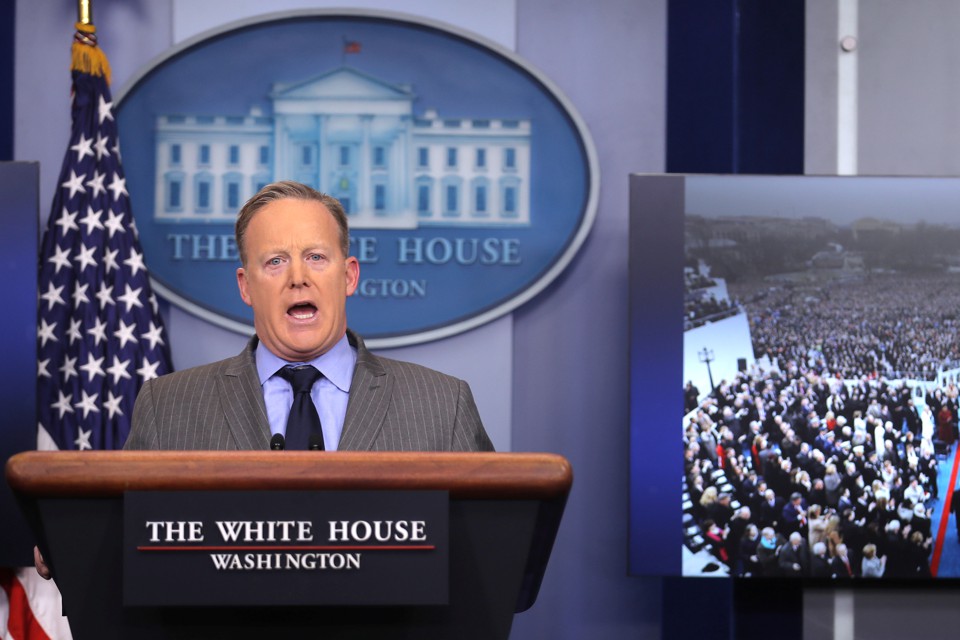
Kellyanne Conway, Trump’s senior counselor, called Press Secretary Sean Spicer’s first official press conference a “tour de force.” That’s not strange, because Trump advisers’ main rhetorical approach is to reflect their boss’ penchant for exaggeration. What’s strange is that much of the media seemed to agree.
Two days earlier, reporters from mainstream outlets had panned a bizarre appearance by Spicer in which, flanked by photographs of the inauguration, he loudly berated the media, saying that the press had “engaged in deliberately false reporting” for failing to note that “this was the largest audience to ever witness an inauguration––period––both in person and around the globe.” Spicer also berated a reporter for erroneously reporting that Trump had removed a bust of Martin Luther King Jr. from the White House, even though the reporter had apologized on social media, an apology Spicer accepted.
While many outlets reported that Spicer had “attacked the media,” many more emphasized that Spicer’s claims about crowd size were comically wrong, and reported that Spicer was lying. Spicer falsely stated that the Washington Metropolitan Transit Authority had concluded “that 420,000 people used the D.C. Metro public transit yesterday, which actually compares to 317,000 that used it for President Obama's last inaugural.”
The ridership on the day of Obama’s 2013 inaugural was 782,000, compared to 570,557 for Trump’s; there were 1.1 million rides on Metro on the day of Obama’s first inaugural in 2009. It was less Spicer’s incorrect numbers, though, than his demand that reporters disbelieve what they had seen with their own eyes, that sparked a backlash.
Spin, obfuscation, eliding context, or even lying by omission––these are normal acts of dishonesty expected from political spokespeople. It is the job of press secretaries to put a gloss on the facts that makes their boss look good. In administrations run by both parties, this has sometimes turned into outright lying or dishonesty.
Spicer’s behavior however, was so different in degree so as to be different in kind––he was demanding that reporters report that 2+2 =5, and chastising them for failing to do so. He was not merely arguing for a different interpretation of the facts, he was denying objective reality. Both Spicer and the mainstream press used that first encounter to establish the ground rules of their relationship, drawing lines for what each would allow the other to get away with.
But any suggestion that the Trump administration’s reliance on, in Conway’s coinage, “alternative facts,” would lead to the mainstream press adopting a more permanent adversarial approach to the White House dissipated the next day, as Spicer drew rave reviews for repeating many of the same lies he offered on Saturday, along with new ones, simply because he did so without yelling.
Consider: Spicer insisted that the WMATA numbers were correct based on what we “knew at the time,” but WMATA’s public statements on the day of the inauguration about ridership at 11 AM made it clear that Trump’s inauguration crowd was smaller than Obama’s two inaugurations.
Spicer went on to repeat his lie from Saturday about crowd size, then insisted that he was talking about online viewership numbers, while misstating those as well. He suggested that he’d been referring to the online viewership combined with the in-person crowds and not both. “Again I didn't say in person,” he said. “Both in person and around the globe, to witness it.” But that claim was belied by his attack on the press on Saturday for insisting that “photographs of the inaugural proceedings were intentionally framed in a way, in one particular tweet, to minimize the enormous support that had gathered on the National Mall.”
Later, Spicer repeated his attack on a reporter for misreporting that a bust of Martin Luther King Jr. had been removed from the White House, and then mischaracterized an apology he had previously publicly accepted.
SPICER: I think you guys might want to leave before I do. But look, I want to make sure that we have a healthy relationship. We saw the other day that -- and I'm not trying to rehash history, but you're asking the question so I'm going to answer it. You know, we had a Tweet go out about Martin Luther King.
Think about how racially charged that is. And someone rushes out and says to the entire press corps that the president of the United States has removed the bust from his office. Do you -- I mean, think about what the signal -- hold on, please.
QUESTION: (OFF-MIC) and apologized?
SPICER: No, no. He actually apologized to "my colleagues." That's the exact quote. OK? That quote, that report got Tweeted out around. And to report -- where was the apology to the president of the United States? Where was the apology to millions of people who read that and thought how racially insensitive that was? Where was that apology?
Both the reporter’s apology and Spicer’s acceptance of that apology remain visible on Twitter. Spicer apparently believes he is entitled to bring the full force of White House condemnation upon a reporter for a mistake for which he apologized, but despite being a public employee, declined to apologize for lying to the American people himself.
There were other absurdities in Spicer’s press conference Monday. He insisted that the CIA had given Trump a “five minute standing ovation” (they were never allowed to sit); after Trump had implied he would go back to Iraq to “take the oil” (which would be plunder, a war crime under the Geneva Conventions) Spicer said “I'm not gonna talk about what we may or may not do”; and he said that the millions of people who marched against Trump on Saturday were “there to protest an issue of concern to them and not against anything.”But none were more blatant than Spicer repeating the very falsehoods that had earned the widespread contempt of the press on Saturday.
The most important thing Spicer said, however, was that “our intention's never to lie to you.” A lie is intentional; it is the nature of the thing. Spicer’s statement indicates that the Trump administration intends to take advantage of much of the mainstream media’s stated ambiguity on falsehoods––that absent Professor Xavier’s telepathy, it is impossible to know if someone is lying or simply truly believes something that is not true, no matter how ludicrous the claim. But Spicer’s somewhat garbled apology, “I think sometimes we can disagree with the facts,” was a true Kinsley gaffe––an admission that the Trump administration intends to contest empirical reality, and expect deference from the press for doing so.
Indeed, by Tuesday, Spicer was defending the president’s contention that three to five million illegal votes were cast in the 2017 election. That would be the greatest act of election theft in American history, somehow carried out with such incompetence that it failed to occur in the states necessary to deliver the election to his opponent. His defense of this absurd falsehood was, essentially, that Trump believes it. "He continues to maintain that belief based on studies and evidence people have presented to him," Spicer said Tuesday.
Yet many reporters echoed Conway’s assessment that Spicer’s press conference on Monday was excellent. A reporter for the Washington Post said that Spicer “handled a difficult situation with “aplomb.” Another said he was doing a “solid, professional job.” A reporter from the Boston Globe said that “this Sean Spicer is closer to the one many of us have known than the one who appeared Saturday. Just one reason that ‘briefing’ was so odd.” A reporter for CNN described this version of Spicer as a “savvy political veteran,” contrasting him with the “propagandist” on display on Saturday.
The verdicts at the major cable-news networks were much the same, even though Spicer had stuck by the very same lies he told on Saturday. Reporters, like theater critics, reviewed his performance and concluded that he seemed very professional while doing it.
Whether it was intended or not, Spicer’s behavior on Saturday did much the same thing for him as Trump’s erratic behavior did for him during the campaign: it set the expectations so low that simply behaving like relatively ordinary press secretary was enough to earn him praise.
The point here is not to single out any individual journalists. The matter here is cultural and structural: Remaining in a permanent state of hostility with the White House goes against the instincts of most mainstream reporters, who seek to remain “objective,” and outlets, which want to attract as wide an audience as possible, and cannot do so as long as they are at war with the administration.
And so the Trump White House now knows that it can lie and get away with it, as long as it does so with a certain amount of “professionalism.” Journalists will have to either acquiesce to the discomfort of a hostile working relationship with the White House as long as the Trump administration insists on offering “alternative facts,” or quietly submit to the notion that two and two can make five. Yet there is simply, no point to political journalism if the press cannot tell the public when the government is lying.
