Showing posts with label The Atlantic. Show all posts

Wednesday, October 5, 2016

The Atlantic endorses Hillary Clinton. Only the third Presidential Candidate it has endorsed in its 160 year history. The other two were Abraham Lincoln in 1860 and Lyndon B. Johnson in 1964


Against Donald Trump ( Republished with permission of The Atlantic )

For the third time since The Atlantic’s founding, the editors endorse a candidate for president. The case for Hillary Clinton. The Atlantic previously endorsed Abraham Lincoln in 1960 and Lyndon B. Johnson in 1964.


In October of 1860, James Russell Lowell, the founding editor of The Atlantic, warned in these pages about the perishability of the great American democratic experiment if citizens (at the time, white, male citizens) were to cease taking seriously their franchise:

In a society like ours, where every man may transmute his private thought into history and destiny by dropping it into the ballot-box, a peculiar responsibility rests upon the individual … For, though during its term of office the government be practically as independent of the popular will as that of Russia, yet every fourth year the people are called upon to pronounce upon the conduct of their affairs. Theoretically, at least, to give democracy any standing-ground for an argument with despotism or oligarchy, a majority of the men composing it should be statesmen and thinkers.

One of the animating causes of this magazine at its founding, in 1857, was the abolition of slavery, and Lowell argued that the Republican Party, and the man who was its standard-bearer in 1860, represented the only reasonable pathway out of the existential crisis then facing the country. In his endorsement of Abraham Lincoln for president, Lowell wrote, on behalf of the magazine, “It is in a moral aversion to slavery as a great wrong that the chief strength of the Republican party lies.” He went on to declare that Abraham Lincoln “had experience enough in public affairs to make him a statesman, and not enough to make him a politician.”

Perhaps because no subsequent candidate for the presidency was seen as Lincoln’s match, or perhaps because the stakes in ensuing elections were judged to be not quite so high as they were in 1860, it would be 104 years before The Atlantic would again make a presidential endorsement. In October of 1964, Edward Weeks, writing on behalf of the magazine, cited Lowell’s words before making an argument for the election of Lyndon B. Johnson. “We admire the President for the continuity with which he has maintained our foreign policy, a policy which became a worldwide responsibility at the time of the Marshall Plan,” the endorsement read. Johnson, The Atlantic believed, would bring “to the vexed problem of civil rights a power of conciliation which will prevent us from stumbling down the road taken by South Africa.”

The Atlantic has endorsed only three presidential candidates in 159 years. Abraham Lincoln (1860) and Lyndon B. Johnson (1964) were the first two. 

But The Atlantic’s endorsement of Johnson was focused less on his positive attributes than on the flaws of his opponent, Barry Goldwater, the junior senator from Arizona. Of Goldwater, Weeks wrote, “His proposal to let field commanders have their choice of the smaller nuclear weapons would rupture a fundamental belief that has existed from Abraham Lincoln to today: the belief that in times of crisis the civilian authority must have control over the military.” And the magazine noted that Goldwater’s “preference to let states like Mississippi, Alabama, and Georgia enforce civil rights within their own borders has attracted the allegiance of Governor George Wallace, the Ku Klux Klan, and the John Birchers.” Goldwater’s limited capacity for prudence and reasonableness was what particularly worried The Atlantic.

We think it unfortunate that Barry Goldwater takes criticism as a personal affront; we think it poisonous when his anger betrays him into denouncing what he calls the “radical” press by bracketing the New York Times, the Washington Post, and Izvestia. There speaks not the reason of the Southwest but the voice of Joseph McCarthy. We do not impugn Senator Goldwater’s honesty. We sincerely distrust his factionalism and his capacity for judgment.

Today, our position is similar to the one in which The Atlantic’s editors found themselves in 1964. We are impressed by many of the qualities of the Democratic Party’s nominee for president, even as we are exasperated by others, but we are mainly concerned with the Republican Party’s nominee, Donald J. Trump, who might be the most ostentatiously unqualified major-party candidate in the 227-year history of the American presidency.

These concerns compel us, for the third time since the magazine’s founding, to endorse a candidate for president. Hillary Rodham Clinton has more than earned, through her service to the country as first lady, as a senator from New York, and as secretary of state, the right to be taken seriously as a White House contender. She has flaws (some legitimately troubling, some exaggerated by her opponents), but she is among the most prepared candidates ever to seek the presidency. We are confident that she understands the role of the United States in the world; we have no doubt that she will apply herself assiduously to the problems confronting this country; and she has demonstrated an aptitude for analysis and hard work.

Donald Trump, on the other hand, has no record of public service and no qualifications for public office. His affect is that of an infomercial huckster; he traffics in conspiracy theories and racist invective; he is appallingly sexist; he is erratic, secretive, and xenophobic; he expresses admiration for authoritarian rulers, and evinces authoritarian tendencies himself. He is easily goaded, a poor quality for someone seeking control of America’s nuclear arsenal. He is an enemy of fact-based discourse; he is ignorant of, and indifferent to, the Constitution; he appears not to read.
FROM OUR NOVEMBER 2016 ISSUE
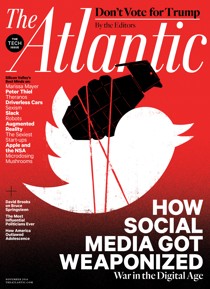


This judgment is not limited to the editors of The Atlantic. A large number—in fact, a number unparalleled since Goldwater’s 1964 campaign—of prominent policy makers and officeholders from the candidate’s own party have publicly renounced him. Trump disqualified himself from public service long before he declared his presidential candidacy. In one of the more sordid episodes in modern American politics, Trump made himself the face of the so-called birther movement, which had as its immediate goal the demonization of the country’s first African American president. Trump’s larger goal, it seemed, was to stoke fear among white Americans of dark-skinned foreigners. He succeeded wildly in this; the fear he has aroused has brought him one step away from the presidency.

Our endorsement of Clinton, and rejection of Trump, is not a blanket dismissal of the many Trump supporters who are motivated by legitimate anxieties about their future and their place in the American economy. But Trump has seized on these anxieties and inflamed and racialized them, without proposing realistic policies to address them.

In its founding statement, The Atlantic promised that it would be “the organ of no party or clique,” and our interest here is not to advance the prospects of the Democratic Party, nor to damage those of the Republican Party. If Hillary Clinton were facing Mitt Romney, or John McCain, or George W. Bush, or, for that matter, any of the leading candidates Trump vanquished in the Republican primaries, we would not have contemplated making this endorsement. We believe in American democracy, in which individuals from various parties of different ideological stripes can advance their ideas and compete for the affection of voters. But Trump is not a man of ideas. He is a demagogue, a xenophobe, a sexist, a know-nothing, and a liar. He is spectacularly unfit for office, and voters—the statesmen and thinkers of the ballot box—should act in defense of American democracy and elect his opponent.

Friday, September 30, 2016

The Newspapers Taking an Unprecedented Stand Against Trump.Across the country, Republican-leaning papers are breaking with their own history to warn their readers about the GOP nominee


The Newspapers Taking an Unprecedented Stand Against Trump.Across the country, Republican-leaning papers are breaking with their own history to warn their readers about the GOP nominee by Connor  Friedersdorf ( Republished with permission of the author and The Atlantic where the article first appeared)


Chuck Burton / AP


There is a lot of truth to the stereotype that the American media is centered in New York City and Washington, D.C., staffed by Democrats, and hostile to Republicans. Like other professionals, journalists run the gamut from hugely talented individuals doing great work to hacks producing crap, but journalism is unusual in its dearth of ideological diversity.

Simply by living 3,000 miles from the East Coast, leaning more libertarian than progressive, and opposing President Obama’s reelection, I am an outlier in my field. And neither my upbringing among Republicans I respect deeply nor my many differences with leftism gives me insight into what daily life is like in the vast swaths of the country where I’ve never lived or the many jobs I’ve never worked. So I get why tens of millions of Americans don’t give a damn what distant network news anchors with seven-figure net worths think about this election, or that the New York Times, which always endorses the Democratic nominee, endorsed Hillary Clinton.

I even get hating “the media.” Oh, I love my colleagues. And each week, I curate a newsletter full of journalism I admire, produced by print and audio journalists who make me jealous. But every time I’m compelled by my job to watch cable news, whether left, right, or center, I nearly always come away, unless I catch one of the very few hosts I respect, thinking that cable news is a wasteland of vapid thought that reflects poorly on most of those who produce it. As a journalist, it is a pet peeve of mine when people say, “I hate the media,” as if TMZ, Penthouse, The Christian Science Monitor, CNN, National Review, and NPR are coherently evaluated together. But when I watch TV, I sometimes catch myself thinking, “God, I hate the media.”

Many journalists feel that way!

Still, election day nears, so you’re paying more attention than usual to the news media, even if you do hate it. If you’ll indulge a few more paragraphs, I have three points I’d ask you to mull over. First, just as quality food can be found in a strange city if you venture away from the tourist traps and do a bit of searching, exceptional journalism can be found about the candidates in this election, if you seek it out. Don’t let the pizza stand at the train station convince you all the food is bad.

Second, you’re absolutely right to perceive that the vast majority of journalists want Donald Trump to lose this election. That should inform how you read our work. If a news article is well-sourced, or an opinion column is accurate and well-reasoned, don’t dismiss it. Glean facts! But stay alert, just as you would reading a New York sportswriter covering the Boston Red Sox. He’s trying. His bias may lead to an error, or he may be totally on point. Don’t be blind to what he gets wrong or right. If you read carefully and with an open mind, you’ll spot the good stuff.

Third, recognize the way that this year’s endorsements are different.

In theory, the arguments in an endorsement should be judged on their own merits, regardless of where it appears. But people have limited time.

I get the impulse to say, “The Washington Post endorses Hillary Clinton? So what. They would never endorse a Republican.” If part of you thinks that way, know that this year, even if you ignore all the TV people, plus all the print media outlets that always endorse Democrats, you’re still left with a noteworthy phenomena: A whole bunch of people who nearly always support the Republican nominee opposeDonald Trump; and a whole bunch of people who nearly always oppose the Democratic nominee support Hillary Clinton.

This year, there are staunch, lifelong members of the conservative movement—like George Will, Erick Erickson, David French, Jonah Goldberg, and Kevin Williamson—who oppose Trump, against tremendous pressure and contrary to their professional incentives. That seems like reason enough to give their anti-Trump arguments a hearing.

Or consider the editorial board of USA Today, a newspaper with clear business incentives to stay non-partisan, and a long history of doing just that. “In the 34-year history of USA TODAY, the Editorial Board has never taken sides in the presidential race,” it wrote. “We’ve never seen reason to alter our approach. Until now. This year, the choice isn’t between two capable major party nominees who happen to have significant ideological differences. This year, one of the candidates is, by unanimous consensus of the Editorial Board, unfit for the presidency.”

Wow.

Meanwhile, don’t mistakenly assume that all Hillary Clinton’s endorsers always back Democrats. Consider local and regional newspapers. Their employees are not distant scribes who do not understand life in the communities where their readers live.

They are locals.

Unlike the New York and Washington press, they frequently endorse Republicans. Yet this year, an astonishing number are telling their readers something different. My editor Yoni Appelbaum recently reflected on what’s happening and why it matters:


The old joke about newspapers is that today’s news is wrapped around tomorrow’s fish—that they’re ephemeral publications. The truth is that most newspapers are steeped in their history, with old clips around the office, and stacks of papers in the morgue. Most journalists I know love to see what their predecessors wrote at pivotal moments. Many papers have ‘on this day’ features. And this year, when most institutions of the Republican Party have fallen dutifully into line, newspapers are a notable exception.

For the first time since 1890, the Arizona Republic endorsed a Democrat. My point is, they looked it up. The Detroit News, around since 1873, has only not endorsed a Republican 3 times. It’s reportedly going for Johnson. Newspaper endorsements may not matter. But they’re institutions with long memories, expecting to be judged by posterity. Maybe they’re all making the wrong choice. But the trend is striking, bipartisan, and perfectly clear.

I’d only add my perspective as someone who got his start at the Inland Valley Daily Bulletin in Ontario, California, and the San Bernardino Sun, a bit farther east, before transitioning into national magazines. Both subcultures have strengths and weaknesses; and they are very different. Of course the staff of The New Yorker thinks you should vote for Hillary Clinton. And lots of smart people work there.

Their arguments are worth considering.

But talking about “the media” as a singular entity obscures that it means something different when Hillary Clinton is endorsed by Texans at the traditionally Republican Houston Chronicle; the Dallas Morning News, which last endorsed a Democrat in 1944 as Franklin Roosevelt led us through World War II; and the Cincinnati Enquirer, which opposed Roosevelt, having last endorsed a Democrat in 1916!

Earlier this week, Sean Hannity, the ultra-wealthy Fox News host, tweeted, “Now, my overpaid friends in the media, well, they have their chauffeured limousines, they like their fine steakhouses and expensive wine lifestyles.” That doesn’t describe any journalist I know. And it certainly doesn’t describe the underpaid people who’ve survived layoffs at struggling newspapers around the country. Many are now telling their readers that even though they’ve always backed Republicans, Trump is uniquely unfit to lead, lacking in character, and potentially dangerous. I’d never tell anyone to defer to their arguments, but do hear them out.