Showing posts with label Ted Cruz. Show all posts

Saturday, October 1, 2016

The silence of the lambs: Why sheepish GOP leaders have been conspicuously quiet since Donald Trump’s debate debacle Before Monday's debate, top Republicans were starting to vocally support Donald Trump, but since then? Crickets


The silence of the lambs: Why sheepish GOP leaders have been conspicuously quiet since Donald Trump’s debate debacle
Before Monday's debate, top Republicans were starting to vocally support Donald Trump, but since then? Crickets


Mitch McConnell; Paul Ryan (Credit: AP/Alex Brandon/J. Scott Applewhite/Photo montage by Salon)


Early last week, if you squinted hard enough it was possible to see the Republican Party beginning to unite behind presidential nominee Donald Trump. It was not overwhelming support. Nor was it the full-throated endorsement a partisan might want for the party’s nominee. It was more tepid, trending toward lukewarm.


Still, it was possible to read in the narrowing polling gap between Trump and Democratic presidential nominee Hillary Clinton the possibility that Republicans who had spent months declaring themselves #NeverTrump were now coming home to the GOP. Prominent elected officials like Sen. Marco Rubio, who just a few months nearly broke down in tears over Trump’s success, and radio talk-show host Mark Levin, among others, decided the mogul was the lesser of two evils after all and gave him their grudging endorsements.

For crying out loud, even Ted Cruz endorsed Trump, after the latter had derided Cruz’s wife’s attractiveness and suggested the Texas senator’s father might have been an associate of Lee Harvey Oswald. The endorsement was likely a craven career move by Cruz more than it was a sign of newfound warmth towards his party’s nominee. But considering his antics on the stage of the Republican National Convention two months ago, this might as well have been the Camp David accords.

Then came Monday night, and a Trump performance that ranked as likely the worst ever turned in by a major party nominee in a presidential debate. All of a sudden, you could not find anyone besides Rush Limbaugh and congressional back benchers like Marsha Blackburn to defend the GOP’s standard bearer.

For example, RNC chairman Reince Priebus has been missing in action since Monday. Ahead of the debate he tried his hardest to put a positive face on the pile of rotted orange peels in a suit that his party had nominated by suggesting that 14 season finales of Trump’s reality show “The Apprentice” had prepared him for the debate. Priebus’ Twitter feed, which he has regularly used to slam Clinton, has been almost entirely silent.

GOP congressional leaders have said as little as possible. House Speaker Paul Ryan, whose relationship with Trump has been tenuous, tried to have it both ways. Hecalled the nominee’s performance “a unique Donald Trump response to the status quo” — but also suggested he should actually, you know, prepare for the next debate. Senate Majority Leader Mitch McConell said Trump did “just fine,” which is what a Southerner says when he means the exact opposite.
McConnell’s caucus wasn’t much more forthcoming. Sen. John McCain, who has almost never met a reporter he wouldn’t chat up, would only say the debate was “interesting.” Sen. Lindsey Graham echoed Ryan by telling Trump to practice more. Rubio tried the time-honored dodge of telling reporters that he had missed the debate because he had been on a plane at the time but would catch the “highlights” later. As the British might say, pull the other one.


About the only well-known Republican to defend Trump, besides Limbaugh, was Cruz. The Texas senator, who seems to have gotten over his alleged hatred of the nominee, lavished praise on him while speaking to radio host Hugh Hewitt. But considering how low Cruz’s approval ratings are in Texas, this seems like a transparently desperate move.

If debates are an opportunity to excite your base, then Trump seems to have completely whiffed with the first one. But more than that, it seems that his terrible night may have repelled already-skittish allies who were just starting to finally come around to his candidacy. Now they are distancing themselves as fast as possible, and not worrying about how awkward they might look while doing so.

Meanwhile, newspapers that had not endorsed a Democrat for president in decades or even over a century are endorsing Clinton while calling Trump’s myriad character flaws “disqualifying.” Anonymous leaks from the campaign on Wednesday painted a picture of its staff second-guessing itself and the boss while suggesting that Trump’s kids are unhappy enough to push their father to fire his top lieutenants and start over. And it doesn’t look as if there is anyone in the Republican Party who can step in and smooth things over.

This does not happen with campaigns that are confident of impending victory.

With six weeks to go until the election, it seems likely that the Republican elite will now completely hunker down, smile politely while keeping Trump at arm’s length (so that he doesn’t drag down with him members locked in tight re-election battles) and hope that the GOP can hold onto its Senate majority. Then assuming he goes down to a resounding defeat, the Republican elite can maybe reclaim the party from the virulent Trumpism that has infected it.

It is not much of a plan. But at this point, even a sudden discipline and yen for practice is probably not going to help Trump give even a moderately competent performance in a debate with Clinton. Even if he could suddenly turn into the second coming of Stephen Douglas, this is unlikely to make a difference with the voters. The GOP, after a brief moment of hope, is trying to get clear of the explosion to minimize the damage. We will see if it is a successful effort.

Sunday, July 24, 2016

God Save America from Donald Trump....Snub of Trump revealed 'What would Cruz do?'

God Save America from Donald Trump....Snub of Trump revealed 'What would Cruz do?'


Ted Cruz
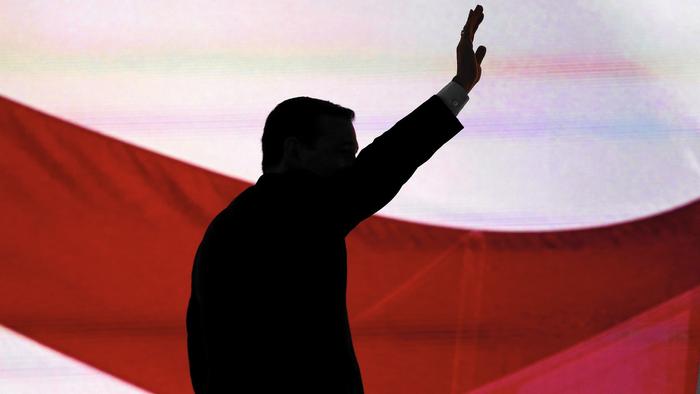
Sen. Ted Cruz leaves the stage after his prime-time speech at the Republican National Convention, having withheld endorsement of former GOP presidential rival and now-nominee Donald Trump. (Andrew Gombert / EPA)
In retrospect, the juvenile skirmish between Republican presidential nominee Donald Trump and Sen. Ted Cruz at the Republican National Convention should not have been a surprise. This is a campaign, after all, that at one point referenced penis size.
It pains me to type those words. But facts are facts, and ego has been the dominant theme of this presidential campaign. Not the national debt. Not deficit spending. Not Obamacare. Not terrorism. Not the economy. Ego.
From the moment in February when Marco Rubio commented on Trump's "small hands," an inappropriate and sophomoric reference to the male appendage, voters should have known a substantive exchange of ideas would not be forthcoming. Perhaps we should have known even before then, when a dust-up between Trump and Fox News host Megyn Kelly centered on menstruation.
You can't make this stuff up.
Photos: Republican National Convention in Cleveland
The Republican National Convention nominated Donald Trump as the GOP's presidential candidate in Cleveland the week of July 18, 2016.
So at a moment during the convention when they could have demonstrated a molecule of humility, it should be no surprise that they have not. Instead of politely supporting Trump, Cruz used his center-stage moment to twist the blade of revenge. He refused to endorse Trump at Trump's own convention during a prime-time speaking slot.
Ego, ego, ego.
Earlier Wednesday, while Cruz was addressing a rally near Quicken Loans Arena, Trump flew aboard his private, branded airplane directly above the event and drew attention away from Cruz. No reports yet if there was any curiously timed release of airplane lavatory waste.
Both Trump and Cruz at various points have behaved like crybabies in need of a sucking device. But Cruz's childish maneuver was particularly offensive given his dogmatic pronouncements about his faith.
No Cruz speech begins or ends without a recitation of Scripture or a reminder of how his faith guides his principles. And yet there was very little of "What would Jesus do?" in his decision to steal the spotlight Wednesday rather than accept the fact that voters did not choose him as the GOP nominee.
Ted Cruz
Sen. Ted Cruz leaves the stage after his prime-time speech at the Republican National Convention, having withheld endorsement of former GOP presidential rival and now-nominee Donald Trump. (Andrew Gombert / EPA)
Trump, for all his maniacal idiosyncrasies, doesn't fake an allegiance to the Holy Spirit. During a speech to conservatives in Iowa, he brashly admitted that he did not seek forgiveness from God and that he went to church sometimes to "drink my little wine and have my little cracker." No mystery there. Trump does not consider himself a servant of the Lord and he doesn't pretend to be one.
Cruz, on the other hand, wears it like a face tattoo.
Wednesday night at a moment when he could have embodied Scripture, he embodied self-centeredness. His inability to accept the Trump movement and simply respect it divulged more about him than Trump. Cruz's decision was calculated. It was driven by a need to stay true to his political power, not true to his heart. He was grinning as he did it.
A little advice to Cruz and Trump for their next speaking engagements, courtesy of a good book in my Cleveland hotel room:
"When pride comes, then comes shame; but with the humble is wisdom." Proverbs 11:2.
"Let nothing be done through selfish ambition or conceit, but in lowliness of mind let each esteem others better than himself." Philippians 2:3
"Be of the same mind toward one another. Do not set your mind on high things, but associate with the humble. Do not be wise in your own opinion." Romans 12:16.

Thursday, June 30, 2016

Presidential Candidates have come and gone each influencing others on the Palestians and Zion

Given the U.S. Presidential Candidates' Views on Palestinians, 

The more you listen to the candidates running for U.S. president, the more you understand why the Palestinians have given up on the United States.


Then-U.S. Secretary of State Hillary Clinton laughs as she meets with Israeli Prime Minister Benjamin Netanyahu, September 27, 2012

W hen it comes to Palestinian rights, America’s 44th president is hardly a radical. He has provided Israel with more security assistance than any president in history. He’s refused any dialogue with Hamas, even as Israel reportedly initiates its own. He’s repeatedly stymied Palestinian statehood efforts at the United Nations. But compared to almost all the candidates running to replace him, Barack Obama is a radical. He’s a radical because he admits that Palestinians have any rights at all.


Start with the Republicans. 

On the subject of Israel-Palestine, the GOP presidential candidates fall into three overlapping categories: Those who propose keeping Palestinians under Israeli military occupation indefinitely; those who propose expelling Palestinians from Israel; and those who deny that Palestinians exist at all.

In the first category sits Florida senator Marco Rubio, who last May told the Council on Foreign Relations, “I don’t think the conditions exist for” a Palestinian state “today.” Could that have anything to do with the fact that during Benjamin Netanyahu’s time as prime minister between 2009 and 2014, the settler population grew twice as fast as the population inside the Green Line? Not according to Rubio, who last year called Obama’s criticism of settlement building “deplorable” and whose largest funder also helps fund the settlement of Ariel.


Jeb Bush’s view is similar: Palestinian statehood must wait until the Palestinians are represented “by leaders who have the ability to uphold the promise made at the negotiating table –something the Palestinian people do not have right now,” a Bush spokesman said last March.


Ted Cruz is bluntest of all: “Israel is a sovereign nation. And I trust the leaders of Israel to determine whether they want to adopt a one-state solution or a two-state solution.” What the Palestinians want is supremely irrelevant.


These are the moderates. Among the hard-liners is retired neurosurgeon Ben Carson, currently in second place in national polls. On a 2014 trip to Israel, he said that while he wasn’t sure if a Palestinian state in the West Bank and Gaza Strip “makes a lot of sense,” perhaps “Egypt” might provide “a place for the Palestinians.”


Former Arkansas governor Mike Huckabee agrees. If there must be a Palestinian state, he explained in 2008, “Let them take it out of Egypt. Let’s take it out of Syria. Let ’em take it out of Jordan.” Neither Carson nor Huckabee has explained how he’d get Palestinians in the West Bank and Gaza Strip to Egypt, Syria or Jordan. Luckily for them, Meir Kahane wrote an entire book on the subject.

It’s also unclear how Huckabee would determine which people to transfer to Egypt, Syria or Jordan, given that he’s previously declared that “there’s really no such thing as a Palestinian.” That’s the view of fellow candidate Rick Santorum, too. “All the people that live in the West Bank are Israelis,” the former Pennsylvania Senator declared in 2011. “They are not Palestinians. There is no Palestinian.” It evidently hasn’t dawned on Santorum that once you call West Bank Palestinians “Israelis,” you’ve embraced the logic of a binational state.

There is a Republican candidate who once diverged from the Naftali Bennett-esque perspective of his rivals. It’s Rand Paul, who in 2011 proposed eliminating all foreign aid, Israel’s included. But now, after intensively wooing Jewish donors, the Kentucky senator has changed his mind. Today, he supports aid to Israel. It’s aid to the Palestinian Authority he wants to end.

Where does Donald Trump fit in all this? As on most issues, specifics aren’t his strong suit. But this summer he insisted, “I’ve been loyal to Israel from the day I was born.” Trump, it’s worth noting, was born in 1946.

The truly shocking part


But that’s not the shocking part of the 2016 campaign. The shocking part is Hillary Clinton. Obama and Clinton encountered Jews and Israel in very different ways. Before Obama began dealing with AIPAC, he had already forged close bonds to Jews like Newton Minow, who gave him his first legal job; Abner Mikva, who offered him a judicial clerkship; Bettylu Saltzman and Marilyn Katz, who organized the 2002 rally where he denounced the war in Iraq; Arnold Wolf, the rabbi at the synagogue across the street from his house; and David Axelrod, his longtime political consultant.


Having been born to a Kenyan father, having grown up partly in Indonesia, and having had a college roommate from Pakistan, Obama easily grasped the semi-colonial plight of Palestinians who lack citizenship in their own country. And his Chicago Jewish friends didn’t undermine that perspective; they reinforced it. Every one opposed settlement growth. And either loudly or quietly, each broke with the American Jewish establishment over its refusal to criticize Israeli policy in the West Bank. So it’s not surprising that during his pre-presidential years, Obama was, in Wolf’s words, on “the line of Peace Now.”


Hillary Clinton’s introduction was more conventional, and more painful. After saying as First Lady in 1998 that she supported a Palestinian state, which was not yet the official American position, her own husband’s administration disavowed her. Then, the following year, she kissed Suha Arafat after the Palestinian leader’s wife accused Israel of using “poison gas” against Palestinian children, and became the subject of Republican attack ads.


The lesson Hillary learned, and has remembered ever since, is that in American politics, associating yourself with the Palestinian cause never pays. By the time she began campaigning for the Senate in New York in 2000, Hillary had adopted a very different approach to Palestinian statehood. She said that if the Palestinians “unilaterally” declared it, the United States should cut off aid. As a candidate, Hillary also defended Ariel Sharon’s September 2000 visit to the Temple Mount, slammed her husband’s administration for not vetoing a resolution critical of Israel’s response to the violence that followed, pledged to move America’s embassy to Jerusalem and said she was concerned that Israeli spy Jonathan Pollard had been denied “due process.” Most strikingly, during the first weeks of the second intifada, when Israeli soldiers fired 1.3 million bullets, Hillary, in the words of one campaign reporter, did not “earmark a syllable of compassion [even] for the most explicitly blameless of Palestinians” – Palestinian children.


In that Senate campaign, Hillary forged stronger ties to establishment American Jewish groups than Obama did while running in Illinois. And she expressed barely any of his skepticism of Israeli policy. In 2004, candidate Obama said, “The creation of a wall dividing the two nations is yet another example of the neglect of this administration in brokering peace.” Hillary, by contrast, declared herself “a strong supporter of Israel’s right to build a security barrier to try to keep those who would do harm to Israel out of Israel.” She never mentioned that most of the barrier isn’t in Israel proper but rather in the West Bank, through which it snakes in order take in as many settlements as possible.

During the 2008 presidential campaign, her aides launched sub rosa attacks on Obama for receiving advice from Bill Clinton’s National Security Council aide Rob Malley and Jimmy Carter’s former National Security Adviser Zbigniew Brzezinski, two foreign policy hands distrusted by mainstream Jewish groups. In the words of one well-placed congressional staffer, “every Jewish member [of Congress] knew where AIPAC was” during the 2008 Democratic primary: supporting Hillary.
But all this pales next to what Hillary has done so far in this campaign. In summer 2014, she unofficially launched her presidential bid with a book, “Hard Choices,” about her time as secretary of state. “Hard Choices” is striking both for the way it describes reality and the way it distances Hillary from the policies of the administration she served. Its discussion of Israel begins with the Obama administration’s push for a freeze on settlement growth in 2009, a freeze that Hillary calls “unprecedented.” She admits that this description “caused outrage in Arab countries,” where “people thought I was being too generous toward an offer that was qualified, short term and excluded Jerusalem.” But Hillary then congratulates herself for “telling a hard truth that would cause me trouble.” The implication is that Hillary’s Arab critics just wouldn’t give Israel a break.
But Hillary’s Arab critics were right. It’s not just that the settlement freeze excluded East Jerusalem, which is being severed from the rest of the West Bank by Israeli construction. The “freeze” also exempted buildings on which construction had already begun. This loophole proved crucial, because, as the Israeli press reported at the time, settlers spent the months preceding the freeze feverishly breaking ground on new construction, on which they continued to build during the 10-month freeze, before breaking new ground once it expired. As a result, according to the NGO Peace Now, there was more new settlement construction in 2010 – the year of the freeze – than in 2008. As Hillary’s own Mideast envoy, George Mitchell, admitted to Palestinian negotiator Saeb Erekat, the Obama administration had wanted a freeze that truly stopped settlement growth, but “we failed.”

The real coup

Hillary’s omissions are equally striking when it comes to Gaza. She says that Hamas has “controlled [the Strip] since forcing out its rival Palestinian faction, Fatah, in 2007.” The implication is that Hamas took power in a coup. But Hamas actually won an election. In January 2006, four months after the last settlers left Gaza, Palestinians there, as well as in the West Bank and East Jerusalem, chose representatives to the Palestinian Authority’s parliament. After 10 years of dishonest and authoritarian Fatah rule, a plurality chose Hamas. According to pollster Khalil Shikaki, two-thirds of voters cited either corruption or law and order as their top issue, and 85 percent called the Fatah-dominated Palestinian Authority corrupt.

After its victory, Hamas called for a national unity government with Fatah “for the purpose of ending the occupation and settlements and achieving a complete withdrawal from the lands occupied [by Israel] in 1967, including Jerusalem, so that the region enjoys calm and stability during this phase.” Fatah’s Mahmoud Abbas, who had been elected separately the year before, would have remained president. To be sure, Hamas did not recognize Israel, accept past peace agreements or forswear violence. But former Mossad chief Ephraim Halevy urged Israel to negotiate a long-term truce with the militant group (something Israel reportedly began doing this year). Israel could also have continued negotiating a two-state deal with Abbas so long as Hamas pledged to accept the outcome of a Palestinian referendum on such a deal, something the group’s leaders later promised to do.

Instead, Bush administration officials pressured Abbas to dissolve the Palestinian parliament and rule by emergency decree. Knowing Hamas would resist Abbas’ efforts to annul the election – especially in Gaza, where it was strong on the ground – the Bushies also began urging Abbas’ former national security adviser, Mohammed Dahlan, to seize power in the Strip by force. Then-Secretary of State Condoleezza Rice pushed Egypt, Jordan, Saudi Arabia and the United Arab Emirates to buy weapons for Dahlan. But when the battle for Gaza began, Hamas won it easily, and brutally.
The real coup, in other words, was not launched by Hamas. It was launched by Fatah and the United States. Instead of acknowledging that decisions in Washington, Tel Aviv and Ramallah helped enable Hamas’ takeover of Gaza, Hillary leaves the reader thinking it was all just the product of Palestinian pathology.

Even more remarkable is Hillary’s near-total omission of any discussion of Israel’s blockade. Because Fatah controlled the West Bank and Hamas controlled Gaza, she writes in her memoir, “Both sides were able to test their approach to governing. The results could be seen every day in Palestinian streets and neighborhoods. In Gaza, Hamas presided over a crumbling enclave of terror and despair. It stockpiled rockets while people fell deeper into poverty. Unemployment ran to nearly 40 percent, and was even higher among young people. Hamas impeded international assistance and the work of humanitarian NGOs and did little to promote sustainable economic growth.”


What Hillary doesn’t mention is that during this “test” of Hamas and Fatah’s “approach to governing,” Israel almost totally shut down Gazan exports to Israel and the West Bank, which had accounted for 85 percent of the Strip’s external market. In the year Hillary’s book was published, according to the Israeli human rights group Gisha, less than one percent as many trucks left Gaza as had before Hamas took over.


Israeli officials justify these measures as necessary for security. And even without the blockade, it’s entirely possible that Hamas would have proved a lousy steward of Gaza’s economy. But to describe Gaza’s descent into “poverty” and “despair” without mentioning the blockade that prevented Gazans from exporting to their biggest markets is wildly dishonest. The implication, once again, is that there is only one true cause of Palestinian suffering: Palestinian depravity.


Embracing Netanyahu

In her book, Hillary also implies that Obama pressured Netanyahu too much. In 2009, in a widely reported encounter, Malcolm Hoenlein, executive vice chairman of the Conference of Presidents of Major American Jewish Organizations, told Obama, “If you want Israel to take risks, then its leaders must know that the United States is right next to them.” Obama disagreed. “When there is no daylight,” he said, “Israel just sits on the sidelines, and that erodes our credibility with the Arab states.” In “Hard Choices,” Hillary takes Hoenlein’s side. “I learned,” she writes, “that Bibi would fight if he felt he was being cornered, but if you connected with him as a friend, there was a chance you could get something done together.”

So eager is Hillary to prove that Netanyahu responded to her reassurances that she abandons the parameters for a two-state solution her husband famously laid out in 2000. In “Hard Choices,” she mentions that Abbas “said that he could live with an Israeli military deployment in the Jordan Valley for a few years beyond the establishment of a new state,” while Netanyahu “insisted that Israeli troops remain along the border for many decades without a fixed date for withdrawal.” Hillary deems these two perspectives equally valid, and even sees in Bibi’s a glimmer of hope. “I thought that was a potentially significant opening,” she writes. “If the conversation was about years, not decades or months, then perhaps the right mix of international security support and advanced border protection tactics and techniques could bridge the gap.”


What Hillary doesn’t mention is that Abbas’ approach conforms to the Clinton parameters – the very document she elsewhere in the book slams Yasser Arafat for not accepting – which propose that Israel leave the Jordan Valley in three years. Netanyahu’s approach, by contrast, flagrantly contradicts those parameters.


In the year since Hillary released her book, she’s done this again and again: Embraced Netanyahu’s perspective even though it eviscerates her husband's, and Obama’s, vision of a viable Palestinian state. Two months after her book release, in an August 2014 interview with The Atlantic’s Jeffrey Goldberg, Hillary noted that “in my meetings with them I got Abbas to about six, seven, eight years on continued IDF presence [in the Jordan Valley] … I got Netanyahu to go from forever to 2025. That’s a negotiation, okay?” Yes, it’s a negotiation. But it’s a negotiation in which Hillary’s strategy of hugging Bibi close, and not making him feel “cornered,” allows him to lead the United States further and further away from an even modestly sovereign Palestinian state.


As the campaign has gone on, in fact, Hillary’s perspective has moved ever closer to Netanyahu’s. “I know what the hard decisions are,” she declared at a campaign stop in Iowa last month. “For the Israelis it is security … For the Palestinians, it is autonomy.” Perhaps Hillary just chose her words poorly. But what Palestinian leaders have been demanding for decades now is emphatically not autonomy; it’s sovereignty. Or, put another way, it’s the individual and national rights that sovereignty might bring. “Autonomy,” by contrast, is what Israeli leaders have periodically offered in lieu of a state. “Would the Palestinian Arabs accept autonomy?” asked Netanyahu in a 1994 Jerusalem Post op-ed entitled “The Alternative is Autonomy." He wrote: “My answer is that they would accept it if they knew Israel wouldn’t give them an independent state.”


In 2009, Netanyahu supposedly reversed this position and declared himself in favor of a Palestinian state. But this year, in a series of statements, he has publicly flipped back and made it clear he doesn’t favor Palestinian sovereignty anytime soon. Is it mere coincidence that now that Netanyahu is back to favoring “autonomy,” and Hillary is courting hawkish Jewish voters and donors, she’s aping his view?

Netanyahu’s current position is that while he still wants a Palestinian state one day, “the dramatic changes that have occurred in the last few years in the region” have made that impossible for the time being. That’s now Hillary’s view, too. In Iowa she declared that, “It is very difficult to figure out how either the Palestinians or the Israelis can put together a deal until they know what is going to happen in Syria, and until they know if Jordan will remain stable.” If that’s really Hillary’s perspective, it constitutes an utter repudiation of the Obama administration’s. And it means that her position is now almost identical to that of Rubio, the man most likely to be her general election opponent, who said last May, “I don’t think the conditions exist for” a Palestinian state “today.”

Hawkish stance

One can defend Hillary’s new point of view. After all, the Middle East is more chaotic than it was during her husband’s administration. Harder to defend is her almost total refusal to publicly acknowledge Palestinian rights and dignity. In her Middle East policy speech at the Brookings Institution two months ago, Hillary mentioned Israel 40 times and the Palestinians not once. She referred to Hamas three times but never mentioned the people of Gaza. The “national security” section of her campaign website mentions Israel five times and the Palestinians none. Even when her website endorses two states, the Palestinians are absent. Hillary, the site promises, will “partner with Israel to advance the two-state vision of a Jewish and democratic Israel with secure and recognized borders.” There’s no reference to working with Palestinians, or fulfilling their aspirations.

Hillary’s response to the rising violence in Israel has been to declare herself “alarmed by the recent wave of attacks against Israelis … Men and women living in Jerusalem, Tel Aviv, and elsewhere cannot carry groceries or travel to prayer without looking over their shoulder.” Reading the statement, you wouldn’t know a single Palestinian had died.


It’s a far cry from Obama, who in “The Audacity of Hope” affirmed the common, and equal, humanity of both Palestinians and Jews. “Traveling through Israel and the West Bank,” he wrote, “I talked to Jews who’d lost parents in the Holocaust and brothers in suicide bombings; I heard Palestinians talk of the indignities of checkpoints and reminisce about the land they had lost. I flew by helicopter across the line separating the two peoples and found myself unable to distinguish Jewish towns from Arab towns, all of them like fragile outposts against the green and stony hills.”


When Obama travelled to Israel in 2013, he affirmed Palestinian humanity again. He asked his mostly Jewish Israeli audience to “Put yourself in their [the Palestinians’] shoes. Look at the world through their eyes. It is not fair that a Palestinian child cannot grow up in a state of their own. Living their entire lives with the presence of a foreign army that controls the movements not just of those young people but their parents, their grandparents, every single day.”


Why won’t Hillary say anything like this? Partly, I suspect, it’s because her overall foreign policy outlook is simply more hawkish. Obama is the first American president with a deep experience of the developing world. He also became an adult after Vietnam, and was thus less scarred by the experience of seeing Democrats lose elections for being too dovish. Hillary, by contrast, had a far more conventional upbringing in a mostly white, middle class suburb of Chicago. While in law school, she worked on the campaign of George McGovern, who denounced the Vietnam War as immoral, and lost 49 states. Then, in her husband’s administration, she became a booster of military force in Bosnia and Kosovo. Israel isn’t the only issue on which she has leaned away from Obama and toward the GOP. In 2002, she backed the Iraq War. Like John McCain, she’s demanding a no-fly zone in Syria now.


The Democratic shift

But the irony of Hillary’s current stance is that while she’s drifting toward Netanyahu, ordinary Democrats are drifting away from him. Between early 2014 and early 2015, according to Gallup, the percentage of Democrats who said they identified more with Israelis than Palestinians dropped 10 points. A Pew Research Center poll last March found that while Republicans have an overwhelmingly favorable opinion of Netanyahu, Democrats view him negatively by a margin of two to one. Among liberal Democrats, who play a disproportionate role in the primary process, it’s three to one.
This shift is part of a larger ideological and cultural change. The Democratic Party, which once had a strong working class white base, is increasingly dominated by minorities, professionals and the secular young, who tend to distrust nationalism, military force and conservative religion, all of which Americans identify with Israel. On almost every domestic issue – from crime to guns to Wall Street to the environment – this new coalition is pushing Hillary to the left. Yet on Israel, so far, it’s giving her a total pass.

That’s partly because most Democrats just don’t care that much about Israel. Except when Americans are dying overseas, voters as a whole – and liberals in particular – mostly focus on the domestic concerns that affect them day-to-day. The Democrats who do care most about Israel, and who have the resources to get a candidates’ ear, are people like Haim Saban, the hawkish billionaire who helps fund Hillary’s campaigns.


But anti-Netanyahu Democrats would care more if they had a presidential candidate who did. Instead, they have Bernie Sanders, who has drawn huge crowds talking about income inequality and financial corruption, but talks as little as possible about the Jewish state. Unlike Hillary, Sanders does acknowledge Palestinian suffering. His website calls on Israel to “end the blockade of Gaza, and cease developing settlements on Palestinian land.” But Sanders gives entire speeches without mentioning anything having to do with foreign policy. Until September, his campaign website didn’t say anything about it at all.


Sanders’ relative silence is something of a mystery. Despite being Jewish and having reportedly spent time early in life on a kibbutz, he doesn’t express much concern about the Israeli-Palestinian conflict. And until recently, as an obscure senator from a liberal and not very Jewish state, he didn’t need to. But the consequences of this idiosyncrasy are quite large. If Sanders challenged Hillary on Israel, many liberal activists would back him, thus pressuring her to halt her rightward drift. In a Democratic primary, holding the same position as Marco Rubio isn’t easy to defend. If Sanders made Israel-Palestine an issue, he might at least force Hillary to distinguish herself from the GOP and restate her commitment to a Palestinian state. Unfortunately, there is no reason to believe he will.

The harsh truth, therefore, is that the next president will almost certainly care less about the Palestinians than the current one. And when it comes to progress toward basic rights for the millions of people who live without citizenship and the right to vote under Israeli authority today, even this current president has accomplished almost nothing.

Is it any wonder why the Palestinians have given up on the United States?