Showing posts with label CNN. Show all posts

Saturday, September 10, 2016

Oy Vey God Save america from Donny T Trump and the media: An outrageous celebu-candidate, plus the debased culture of journalism, produced this disaster


Image result for Cartoon Trump media
Trump and the media: An outrageous celebu-candidate, plus the debased culture of journalism, produced this disasterIs the media to blame for Trump? Not exactly. But Matt Lauer's craven idiocy highlights its massive failure

Jake Tapper; Matt Lauer; Megyn Kelly (Credit: AP/Andrew Harnik/Charles Sykes/Getty/Alex Wong)
In the wake of Matt Lauer’s dismal performance as moderator and/or Trump-enabler during this week’s presidential campaign forum, we’ve gotten to experience another round of hand-wringing about the nature of the parasitic or symbiotic relationship between the Republican nominee and the media. Most of this hand-wringing occurred in the media, of course, and there’s nothing the members of that tribe (OK, it’s my tribe too) enjoy more than inflating their own importance, gazing into their navels at great length and telling each other to repent of their evil ways and don sackcloth and ashes.

Still, there are important questions at play here, in a year when American democracy seems to be on the critical list and journalists seem torn between playing doctor, playing priest and playing the drunk guy at the wake who barely knew the deceased but makes a long speech anyway. (That was a deeply Irish analogy; I apologize.) Some of the questions are obvious and have easy answers: Matt Lauer is a lightweight TV personality (i.e., an idiot) who should never have been allowed near such an important gig, and everybody who approved that idea should immediately be reassigned to “Weather and Traffic on the 6’s” at the third-biggest market in Tennessee.


Other questions are more complicated: Why haven’t journalists done their jobs with respect to Donald Trump — easily the least qualified presidential candidate in the history of everything? If Lauer was especially craven in his desire to look impartial and his unwillingness to ask Trump any meaningful follow-up questions or challenge outrageous falsehoods, he’s not alone. Jake Tapper of CNN, whom I know to be a journalist of decency and integrity (he was once Salon’s Washington correspondent), has defended his courteous demeanor toward Trump as both fair and necessary. But Tapper’s measured, cordial interviews with Trump have undeniably played into the candidate’s hands and burnished his image, at least in a semiotic sense: Never mind the nonsensical content of Trump’s responses; there he is chatting amiably with a CNN anchor, looking more or less “presidential.”

Even Megyn Kelly’s feud with Trump, back in the days when Roger Ailes still ran Fox News (and badly wanted some other Republican to win), ended in retreat and confusion. Trump’s ugly, misogynistic attacks on Fox’s star anchor briefly made Kelly into an unlikely feminist hero and threatened to torpedo Trump’s campaign early in the cycle. But Kelly was stilted and awkward in her later interactions with Trump, first as a debate moderator and then in a one-on-one interview. She seemed trapped between competing roles and competing demands: She was a journalist with a reputation for straight shooting, she was an accidental symbol of American womanhood and she was the leading voice of a right-wing network whose audience was eager to swallow Trump’s snake oil. At least you could tell Kelly really wanted to rip Trump’s face off, while Lauer just looked defeated and confused and Tapper was too consumed in perfecting his Sam Donaldson impression.

But let’s get back to the questions: What if some journalists have done their jobs, and it’s just that the public hasn’t noticed or doesn’t care? What is the media’s job in 2016, anyway? How has that changed, and why? Are we entertainers, public servants, speakers of truth to power or flunkeys on the outer edges of celebrity culture? Are we responsible for inflicting this dangerous buffoon on the country in some significant way, or are we just along for the ride?

I don’t think any of those have entirely straightforward answers, but my conclusion (self-serving as it may be) is that blaming the media for the rise of Donald Trump is a form of lazy intellectual shorthand that avoids the larger cultural, political and economic picture. It’s not entirely false, because Trump could not possibly be where he is today without the endless amounts of airtime and verbiage and bandwidth devoted to his unlikely ascendancy. But the media, and even the “corporate media,” is not some baleful monolith operating all by itself, with no context. The “Human Centipede”-style dialectic between Trump and the media, where he feeds us and we feed him — if you click that link, don’t say you weren’t warned — is fueled by intense demand on all sides. People who love Trump want more Trump to love, people who hate Trump want more to hate, and people who think we cover Trump way too much want more Trump coverage to excoriate.

Donald Trump and the media was a marriage made in heaven, or perhaps in the other place. To use Marxist terminology, it was overdetermined — driven by external and inexorable factors no one could control. Once they were together, there was no tearing them apart. If you want to argue that mainstream journalism in the United States is often mendacious and shallow, too easily distracted by meaningless scandal, false drama or superficial factoids to pay attention to what’s really going on, I’m right there with you. Has Trump’s erratic and outrageous campaign persona appealed to many of the mainstream media’s worst instincts? Absolutely. Has Trump exploited a longtime institutional weakness in the media, its internal conflict between an increasingly outmoded ethical code and a ravenous appetite for ratings at any cost? Yes, with almost surgical precision. (I’m talking to you, Jake Tapper.)

Dan Rather, who can remember every presidential campaign since Franklin D. Roosevelt’s fourth and final run in 1944, recently told Chris Hayes of MSNBC that Trump can dominate and manipulate the news cycle more effectively than any candidate he’s ever seen. Trump doesn’t always do so to his own benefit, but even when he contradicts himself, spins outrageous lies or insults the grieving parents of a fallen American soldier, he sucks up all the oxygen in the media-sphere and keeps his opponents off the stage. Trump’s farcical jaunt to Mexico City last week, followed by his rage-fueled immigration speech in Phoenix, succeeded in shoving a supposedly major foreign-policy speech by Hillary Clinton into limbo.

But when Clinton supporters wonder plaintively why the media hasn’t told the truth about Trump’s hateful and incoherent proposals or his dreadful record as a person and a businessman, I would say that many reporters and commentators have done that repeatedly, and Trump’s supporters either don’t believe it, don’t notice or don’t care. (Some of all three, but mostly the latter.) Anyone who waded through the long New York Times investigative article about Trump’s disastrous business operations in Atlantic City, for instance, wasn’t voting for him anyway.

When agonized Democrats retreat to the opposite rhetorical corner — if only the media had ignored Trump from the beginning, he might have gone away! — well, now they know how Jeb Bush felt. That one requires an elaborate alternate universe: If we didn’t live in a consumer-capitalist society where everyone walks around glued to screens all day long desperate for sensation, or in a nation with a paralyzed political system that is profoundly divided by race, economics, geography and culture, then sure. But there’s no Trump in that universe in the first place.

As I have previously argued, it’s too simplistic to say that the media created Trump, or willed him to win because he was telegenic. Trump was the right guy (or the wrong guy) to capture the attention of a large and disgruntled demographic of downscale white voters at this historical moment. Conditions had to be right, particularly the zombie-like brain-body split within the Republican Party, whose electoral base had turned against its Washington leadership. CNN and Fox News and the New York Times didn’t compel all those people to show up at Trump’s rallies or drive the turnout in state after state that produced the most votes for any candidate in GOP history. Donald Trump ran for president and millions of Americans responded with enthusiasm. It’s no good pretending they’re a bunch of brainwashed sheeple who didn’t understand what he was really like. They understood perfectly well, and they dug it.

At the same time, Trump is a media creature, who came to the 2016 race as a prefabricated personality, molded by years of reality TV, gossip shows, the business press and the New York tabloids. Trump knows almost nothing about government or world affairs or any aspect of foreign or domestic policy, and his expertise in business is debatable. But he understands the media, at least in its mass-consumption mode: He understands its cynical cast of mind and its widespread contempt for the public. He understands its ingrained belief that American cultural and political life is a symbolic spectacle with little reference to the real world. He understands its obsession with itself, a quality he shares.

There’s no question that Trump coverage has driven ratings and page views, which has driven more Trump coverage. Love her or hate her, Hillary Clinton is simply not capable of moving the dial to that extent — unless she’s being subjected to a public pillory about Benghazi and the emails, as Lauer feebly tried to do on Wednesday night. But that didn’t happen because I decided, or because Jake Tapper and Megyn Kelly decided, that we couldn’t possibly get enough Trump and wanted to cover nothing else week after week. It happened because we have a sick democracy, a debased standard of public discourse and a deeply damaged culture. All of that came together in one awful man and his awful presidential campaign, and none of us can look away.


Oy Vey God Save america from Donny T Trump and the media: An outrageous celebu-candidate, plus the debased culture of journalism, produced this disaster

Image result for Cartoon Trump media
Trump and the media: An outrageous celebu-candidate, plus the debased culture of journalism, produced this disasterIs the media to blame for Trump? Not exactly. But Matt Lauer's craven idiocy highlights its massive failure

Jake Tapper; Matt Lauer; Megyn Kelly (Credit: AP/Andrew Harnik/Charles Sykes/Getty/Alex Wong)
In the wake of Matt Lauer’s dismal performance as moderator and/or Trump-enabler during this week’s presidential campaign forum, we’ve gotten to experience another round of hand-wringing about the nature of the parasitic or symbiotic relationship between the Republican nominee and the media. Most of this hand-wringing occurred in the media, of course, and there’s nothing the members of that tribe (OK, it’s my tribe too) enjoy more than inflating their own importance, gazing into their navels at great length and telling each other to repent of their evil ways and don sackcloth and ashes.

Still, there are important questions at play here, in a year when American democracy seems to be on the critical list and journalists seem torn between playing doctor, playing priest and playing the drunk guy at the wake who barely knew the deceased but makes a long speech anyway. (That was a deeply Irish analogy; I apologize.) Some of the questions are obvious and have easy answers: Matt Lauer is a lightweight TV personality (i.e., an idiot) who should never have been allowed near such an important gig, and everybody who approved that idea should immediately be reassigned to “Weather and Traffic on the 6’s” at the third-biggest market in Tennessee.


Other questions are more complicated: Why haven’t journalists done their jobs with respect to Donald Trump — easily the least qualified presidential candidate in the history of everything? If Lauer was especially craven in his desire to look impartial and his unwillingness to ask Trump any meaningful follow-up questions or challenge outrageous falsehoods, he’s not alone. Jake Tapper of CNN, whom I know to be a journalist of decency and integrity (he was once Salon’s Washington correspondent), has defended his courteous demeanor toward Trump as both fair and necessary. But Tapper’s measured, cordial interviews with Trump have undeniably played into the candidate’s hands and burnished his image, at least in a semiotic sense: Never mind the nonsensical content of Trump’s responses; there he is chatting amiably with a CNN anchor, looking more or less “presidential.”

Even Megyn Kelly’s feud with Trump, back in the days when Roger Ailes still ran Fox News (and badly wanted some other Republican to win), ended in retreat and confusion. Trump’s ugly, misogynistic attacks on Fox’s star anchor briefly made Kelly into an unlikely feminist hero and threatened to torpedo Trump’s campaign early in the cycle. But Kelly was stilted and awkward in her later interactions with Trump, first as a debate moderator and then in a one-on-one interview. She seemed trapped between competing roles and competing demands: She was a journalist with a reputation for straight shooting, she was an accidental symbol of American womanhood and she was the leading voice of a right-wing network whose audience was eager to swallow Trump’s snake oil. At least you could tell Kelly really wanted to rip Trump’s face off, while Lauer just looked defeated and confused and Tapper was too consumed in perfecting his Sam Donaldson impression.

But let’s get back to the questions: What if some journalists have done their jobs, and it’s just that the public hasn’t noticed or doesn’t care? What is the media’s job in 2016, anyway? How has that changed, and why? Are we entertainers, public servants, speakers of truth to power or flunkeys on the outer edges of celebrity culture? Are we responsible for inflicting this dangerous buffoon on the country in some significant way, or are we just along for the ride?

I don’t think any of those have entirely straightforward answers, but my conclusion (self-serving as it may be) is that blaming the media for the rise of Donald Trump is a form of lazy intellectual shorthand that avoids the larger cultural, political and economic picture. It’s not entirely false, because Trump could not possibly be where he is today without the endless amounts of airtime and verbiage and bandwidth devoted to his unlikely ascendancy. But the media, and even the “corporate media,” is not some baleful monolith operating all by itself, with no context. The “Human Centipede”-style dialectic between Trump and the media, where he feeds us and we feed him — if you click that link, don’t say you weren’t warned — is fueled by intense demand on all sides. People who love Trump want more Trump to love, people who hate Trump want more to hate, and people who think we cover Trump way too much want more Trump coverage to excoriate.

Donald Trump and the media was a marriage made in heaven, or perhaps in the other place. To use Marxist terminology, it was overdetermined — driven by external and inexorable factors no one could control. Once they were together, there was no tearing them apart. If you want to argue that mainstream journalism in the United States is often mendacious and shallow, too easily distracted by meaningless scandal, false drama or superficial factoids to pay attention to what’s really going on, I’m right there with you. Has Trump’s erratic and outrageous campaign persona appealed to many of the mainstream media’s worst instincts? Absolutely. Has Trump exploited a longtime institutional weakness in the media, its internal conflict between an increasingly outmoded ethical code and a ravenous appetite for ratings at any cost? Yes, with almost surgical precision. (I’m talking to you, Jake Tapper.)

Dan Rather, who can remember every presidential campaign since Franklin D. Roosevelt’s fourth and final run in 1944, recently told Chris Hayes of MSNBC that Trump can dominate and manipulate the news cycle more effectively than any candidate he’s ever seen. Trump doesn’t always do so to his own benefit, but even when he contradicts himself, spins outrageous lies or insults the grieving parents of a fallen American soldier, he sucks up all the oxygen in the media-sphere and keeps his opponents off the stage. Trump’s farcical jaunt to Mexico City last week, followed by his rage-fueled immigration speech in Phoenix, succeeded in shoving a supposedly major foreign-policy speech by Hillary Clinton into limbo.

But when Clinton supporters wonder plaintively why the media hasn’t told the truth about Trump’s hateful and incoherent proposals or his dreadful record as a person and a businessman, I would say that many reporters and commentators have done that repeatedly, and Trump’s supporters either don’t believe it, don’t notice or don’t care. (Some of all three, but mostly the latter.) Anyone who waded through the long New York Times investigative article about Trump’s disastrous business operations in Atlantic City, for instance, wasn’t voting for him anyway.

When agonized Democrats retreat to the opposite rhetorical corner — if only the media had ignored Trump from the beginning, he might have gone away! — well, now they know how Jeb Bush felt. That one requires an elaborate alternate universe: If we didn’t live in a consumer-capitalist society where everyone walks around glued to screens all day long desperate for sensation, or in a nation with a paralyzed political system that is profoundly divided by race, economics, geography and culture, then sure. But there’s no Trump in that universe in the first place.

As I have previously argued, it’s too simplistic to say that the media created Trump, or willed him to win because he was telegenic. Trump was the right guy (or the wrong guy) to capture the attention of a large and disgruntled demographic of downscale white voters at this historical moment. Conditions had to be right, particularly the zombie-like brain-body split within the Republican Party, whose electoral base had turned against its Washington leadership. CNN and Fox News and the New York Times didn’t compel all those people to show up at Trump’s rallies or drive the turnout in state after state that produced the most votes for any candidate in GOP history. Donald Trump ran for president and millions of Americans responded with enthusiasm. It’s no good pretending they’re a bunch of brainwashed sheeple who didn’t understand what he was really like. They understood perfectly well, and they dug it.

At the same time, Trump is a media creature, who came to the 2016 race as a prefabricated personality, molded by years of reality TV, gossip shows, the business press and the New York tabloids. Trump knows almost nothing about government or world affairs or any aspect of foreign or domestic policy, and his expertise in business is debatable. But he understands the media, at least in its mass-consumption mode: He understands its cynical cast of mind and its widespread contempt for the public. He understands its ingrained belief that American cultural and political life is a symbolic spectacle with little reference to the real world. He understands its obsession with itself, a quality he shares.

There’s no question that Trump coverage has driven ratings and page views, which has driven more Trump coverage. Love her or hate her, Hillary Clinton is simply not capable of moving the dial to that extent — unless she’s being subjected to a public pillory about Benghazi and the emails, as Lauer feebly tried to do on Wednesday night. But that didn’t happen because I decided, or because Jake Tapper and Megyn Kelly decided, that we couldn’t possibly get enough Trump and wanted to cover nothing else week after week. It happened because we have a sick democracy, a debased standard of public discourse and a deeply damaged culture. All of that came together in one awful man and his awful presidential campaign, and none of us can look away.


Sunday, August 28, 2016


Trump media feud moves from Megyn Kelly to ‘Morning Joe’


Donald Trump’s media feuds have moved from Fox News’s Megyn Kelly to Joe Scarborough and Mika Brzezinski of MSNBC’s “Morning Joe.”

The Republican presidential nominee's fights with television personalities and reporters have been a consistent theme of his campaign, and one that has been a way to rally voters to his side.


Trump can still draw roars from a crowd by ripping the press, but political strategists say Trump’s feuds are limiting his efforts to build out his brand as he seeks to make a comeback in polls and bring in new supporters.

Much of Trump’s base watch him on Fox News, but Jennefer Witter, chief executive officer for the New York-based public-relations firm the Boreland Group, said he’ll have a hard time attracting undecided voters without appearing on other channels and shows.

“There simply are not enough voters within that category to get him into the Oval Office,” said Witter. “He needs independents and disaffected Democrats to build his numbers.”

While Trump battled with members of the media during the presidential primaries, he also had a strategy of appearing everywhere and doing countless interviews. That has now changed.

Trump has appeared on Fox News and Fox Business 18 times in August — and on all other networks twice.

Trump was interviewed by Anderson Cooper on Thursday, his first appearance on CNN since June 13. He also did a phone interview this month with CNBC.

Once a regular guest on “Morning Joe,” Trump has now gone 100 days without an appearance on the program.

The fighting between Trump and the widely watched hosts has also become intensely personal. On Monday, Trump tweeted that he would “tell the real story” of Scarborough and “his very insecure long-time girlfriend” Brzezinski. In another tweet, he called Brzezinski “a neurotic and not very bright mess!”

Scarborough fired back: “Neurotic and not very bright? Look in the mirror.”

Trump hasn’t been on CBS since July 17, when he introduced Indiana Gov. Mike Pence as his presidential running mate on “60 Minutes.”

He was last on NBC on July 24 for an interview with Chuck Todd on “Meet the Press,” and he appeared on ABC one week later for an interview with George Stephanopoulos on “This Week.”

Experts who spoke to The Hill were almost unanimous in saying that it would be difficult for Trump to broaden his audience without appearing on more networks.

According to the RealClearPolitics average of polls, Trump currently trails Democratic presidential nominee Hillary Clinton by 6 points nationally and in every battleground state by varying margins.

“Trump’s recent media strategy is odd, to say the least,” said Brian Hart, founder of Flackable, a national public-relations agency based in Wyomissing, Pa.

Hart noted that Clinton has her own press problems.

She hasn’t held a formal press conference since Dec. 4, 2015, and has come under increasing criticism from the media for avoiding questions.

“It’s left the door wide open for the Trump campaign, but instead of dominating the cable news circuit, as he did so effectively during the primaries, Trump has allowed his surrogates and members of his campaign to replace him on those networks,” Hart said.

Kelly was the first personality in the media with whom Trump really fought during the primaries, and the battle appeared to pay off for him, as he won headlines and emerged as an anti-establishment force within the Republican Party.

He, Kelly and Fox have for the most part put their ill feelings aside, though a few weeks ago he told Kelly to “get your facts straight” on his Islamic State in Iraq and Syria strategy.

Trump’s attacks on the media have gone well beyond the broadcast networks since he began his unorthodox campaign more than 14 months ago. He's also revoked the press credentials of The Washington Post, BuzzFeed, The Huffington Post and Politico.

Once a ubiquitous presence on CNN, Trump now rarely appears on the network. “Don Lemon is a lightweight — dumb as a rock,” Trump tweeted on Aug. 10 of the CNN host, who once frequently interviewed him.

Witter said Trump should cast a broader net and “reach out to outlets that he has banned such as the Washington Post; to those with which he has disagreements, such as MSNBC; and to the black and Latino media — TV One and Telemundo among many — that he has thus far shunned.”

Trump was once a regular on “The Howard Stern Show,” where he discussed a number of topics you wouldn’t expect a presidential candidate to talk about.

Nonetheless, some observers think it wouldn’t be crazy for Trump to go back on Stern.

“I think it would be wise for Trump to go back and appear on ‘The Tonight Show’ and ‘Jimmy Kimmel Live’ and other non-predictable broadcast outlets,” said Chad Wilkerson, a former cable news executive producer and current CEO of Philadelphia-based Liberty Media Strategies.

Clinton appeared on Kimmel’s show this week and made fun of Trump’s questions about her health.

“I also think Trump should appear on 'The Howard Stern Show.' Howard is a great interviewer and the two have always had great chemistry on the air,” Wilkerson said.

Jeff McCall, a professor of media studies at Depauw University, agrees there's an opportunity for Trump to draw a sharp contrast with Clinton, who also has issues engaging with the press as a whole.

“If Trump were to more broadly engage the broader media landscape, he can provide a clear contrast to Hillary Clinton, who is clearly playing a 'run out the clock' strategy with regard to the press,” McCall said.

“Trump should speak to any and all news outlets and mention during each of those interviews that he is there to speak to the electorate while Hillary ducks the tough questioning and won't even hold a press conference.”

But a more-exposed Trump, McCall said, only works if he stays on the narrative the campaign wishes to articulate.

“If he expands his media range, but has flimsy or off-target messages, he will just contribute to the perception that his messaging and campaign are rather untethered,” he said.

Tuesday, August 2, 2016

God save America from Donny T. ,,,,#TrumpTheRump sets up Israeli campaign HQ to secure overseas votes

God save America from Donny T. ,,,,TrumpThe Rump sets up Israeli campaign HQ to secure overseas votes
Republican presidential candidate reportedly hires local advisers in bid to court votes of Americans living in Israel • Trump accuses CNN of bias in Twitter rant • Russia denies interfering in U.S. elections following leaked DNC emails that hurt Clinton.


Republican presidential candidate Donald Trump is set to visit Israel at the height of his election campaign 
|
 Photo credit: AP

God save America from Donny T .... the Meshuganah TrumptheRump gets his knickers in a knot with CNN


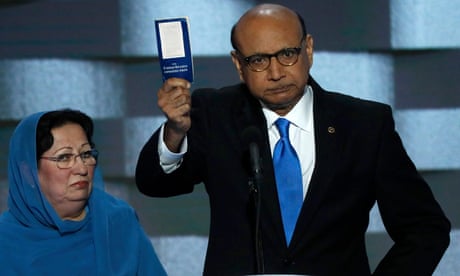
Have you read the Constitution, Mr. Trump?

Donald Trump attacks CNN in tweetstorm

Trump: Khan has 'no right' to claims


By the looks of Donald Trump's Twitter feed, you might think he is running against CNN, not Hillary Clinton.

On Monday afternoon Trump fired off six tweets in a row attacking CNN's news coverage and accusing the network of being the "press shop for Hillary Clinton."


He commented that "people believe CNN these days almost as little as they believe Hillary....that's really saying something!"

Later Monday, he returned to the subject again with three new tweets accusing the network of biased coverage.

It is unclear if Trump personally posted the messages or if a campaign staffer posted them under his name.

Some of the anti-CNN tweets were posted at the exact same time the network was televising an interview with a high-profile Clinton critic -- Pat Smith, the mother of an American who was killed during the terrorist attack in Benghazi, Libya, in 2012. But Trump made no mention of that.

The tweets came just a couple of hours before CNN was due to release a new national poll about the presidential race, leading to speculation that perhaps Trump was pre-emptively assailing CNN in an attempt to discredit the poll results.

The timing was also noteworthy because Trump has been playing defense for days amid widespread coverage of Khizr Khan's anti-Trump speech at the Democratic National Convention.

Khan, the father of a Muslim-American Army captain slain in Iraq in 2004, repudiated Trump and paid tribute to his son in the Thursday night speech.

Khan's speech -- and Trump's critical comments about the Khan family -- have been a top story on CNN and other channels ever since.

Trump has repeatedly claimed that he does not watch CNN, but his tweets seem to hint otherwise.

On July 17, he said "I don't watch," but one week later, after the Republican convention, he wrote, "The @CNN panels are so one sided, almost all against Trump. @FoxNews is so much better and the ratings are much higher. Don't watch CNN!"

Then the Democratic convention happened and Khan's speech made news. On Sunday evening Trump tweeted, "Wow, it is unbelievable how distorted, one-sided and biased the media is against us. The failing @nytimes is a joke. @CNN is laughable!"

On Monday morning he tweeted a fresh complaint about Khan "viciously" attacking him at the same time Khan was on CNN.

Then on Monday afternoon, shortly before taking the stage at a town hall event in Ohio, Trump lashed out in his tweetstorm of sorts.

"CNN anchors are completely out of touch with everyday people worried about rising crime, failing schools and vanishing jobs," he wrote.

He asked if CNN would "send its cameras to the border to show the massive unreported crisis now unfolding -- or are they worried it will hurt Hillary?"

In fact, CNN and other news outlets have covered border issues in depth for years.

Trump also asked, "When will we see stories from CNN on Clinton Foundation corruption and Hillary's pay-for-play at State Department?"

CNN has published numerous investigations into Clinton controversies, including issues involving the family foundation and connections between foundation donors and State Department activities. So have many other news outlets.

Some of CNN's stories about these subjects have quoted Trump.

At the rally on Monday afternoon, Trump said he is refusing to grant any interviews with CNN, calling the channel's reporting dishonest, and saying Fox News has been better.

For more than a month, Trump has been appearing regularly on Fox and eschewing most other TV network interview requests.

Accusations of media bias tend to rally Trump supporters to his side.

Monday's tweetstorm was just the latest salvo in a year-long anti-media campaign by Trump. The GOP nominee has taken media criticism to new heights -- or new lows, depending on your perspective. He frequently uses the news media as a foil during his speeches and interviews.

Last week, he aroused a crowd by falsely claiming that CNN had turned off its camera in the back of the room.

The anti-media messaging, while effective with Trump's base of supporters, may get in the way of his other general campaign themes.

Journalist Justin Green of Independent Journal called Trump's CNN complaints "exhausting" in a tweet on Monday.

He noted that "7 out of Trump's 15 tweets in last 24 hours have been about CNN."