Showing posts with label Elizabeth Warren. Show all posts

Friday, February 10, 2017

The Rules That Stopped Elizabeth Warren Are Waiting for#OyVeyDonaldTrump, Too Senate norms have never been more important in our democracy

Image result for Cartoon Donald trump Elizabeth Warren


Under Senate rules, President Donald Trump’s proposals will have to get through the chamber based on the merits of his policies, not the volume of his arguments. 

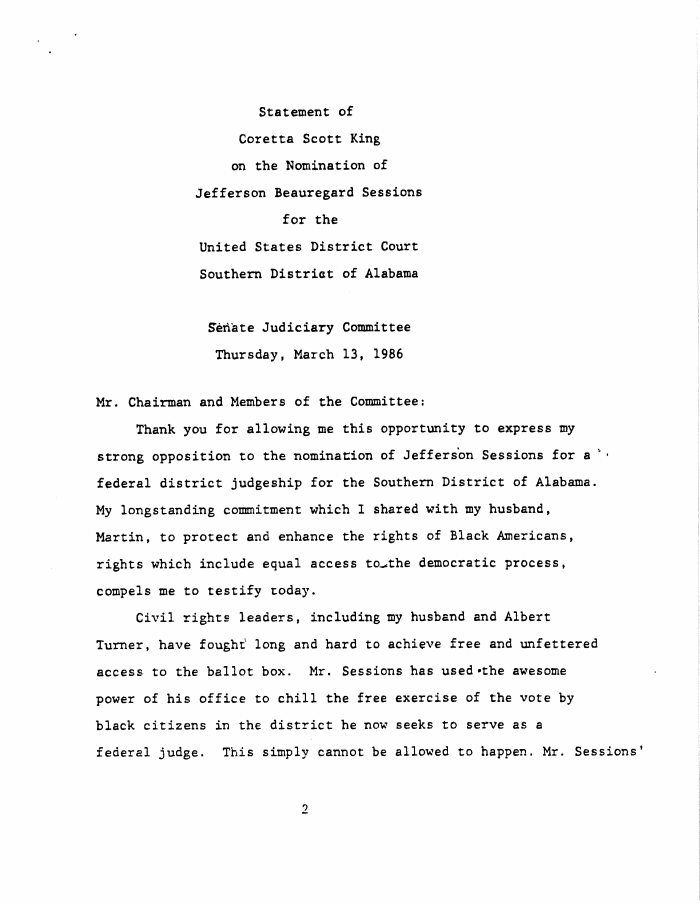
Rule 19 had its close-up this week, didn’t it? To be specific, Section 3 of Rule 19, did, when Senate Majority Leader Mitch McConnell informed Sen. Elizabeth Warren that she had “impugned the motives and conduct” of her fellow senator, Jeff Sessions, when she read a letter that Coretta Scott King had written about him many years ago.

When Warren was told, “The senator shall take her seat,” she took the Coretta Scott King letter, marched a few feet off the Senate floor, and took a different seat in front of a Facebook Live feed that went out to millions. The standoff launched a battle cry for any woman who has ever felt marginalized, belittled or silenced — which, by the way, is nearly all of us. A thousand hashtags bloomed. #SheWasWarned #ShePersisted #LetLizSpeak. You get the picture.

But the moment also led people to ask how and why Warren, a legitimately elected U.S. senator, could be tossed from a Senate debate for doing something that seemed so inoffensive compared to the rhetoric of today’s politics. President Donald Trump can call former prisoner of war Sen. John McCain a compulsive loser but Warren can’t read a letter from Coretta Scott King? It made not just McConnell, but the entire U.S. Senate and its rules, seem outdated and sexist. The only things missing were powdered wigs and a duel at 10 paces. But the reality is that the Senate rules are more relevant now than they have ever been.

It’s important to first note that the rules didn’t prevent Warren from having her voice heard. Instead, she used the Senate rules to her favor, as any skilled legislator does, and essentially dared McConnell or anyone else to try to keep her from repeating the words of a female civil rights icon. Once she was silenced by the Senate rules, Warren and Facebook Live took it from there.

But following the rules of the Senate does not mean senators have to sanitize their message. The Sessions debate was also the scene of a quieter, but no less powerful, speech from Sen. Tim Scott. As Scott stood to support Sessions’ nomination, he read aloud from messages he had gotten since he’d announced how he would vote. As the only black Republican in the Senate, Scott is nearly always tasked with the impossible — to live up to the demands of his state, his party, his race, and his conscience, even when they disagree with each other.

“You are a disgrace to the black race,” Scott read from one message. “You are an ‘Uncle Tom Scott’. You are for Sessions. How does a black man turn on his own?” said another. “Sen. Tim Scott is not an Uncle Tom. He doesn’t have a shred of honor,” Scott read about himself. “He is a house Negro.”

Scott’s decision to support Sessions brought him far less of a hero’s welcome than Warren got on Twitter. If there’s a hashtag about Scott’s vote for Sessions, I’m not sure it’s fit for print, but Scott stood by his vote for Sessions anyway. Despite the accusations and vile invective that came his way, he persisted, too, in his own way.

I wouldn’t have expected Sessions’ nomination to offer lessons on progress in America, but it’s there for us anyway — with a female senator refusing to remain quiet and an African-American senator standing up for what he believes is right, even in the face of detractors.

The Senate that Jeff Sessions was sworn into — the Senate in 1997 — included nine women and one African-American, who also happened to be a woman. Five years before that, there were two women in the Senate. The Senate that Sessions leaves now includes 21 women, four Latinos, three Asian-American women, and three African-Americans. (The latter two categories include California’s Kamala Harris who is of both African-American and Asian-American heritage.) Slowly but surely, the membership of Senate is beginning to look like the country it represents.

But the Senate itself, especially the underpinnings of its rules and traditions, are mostly unchanged. The rules do stifle free-form speeches on senators who are also Cabinet nominees, but they are also designed, as the founders intended, to slow the progress of legislation unless it is broadly accepted by the American people.

The rules will become enormously important over the next several months. Like every president before him, Trump, together with his team, will have to find a way to get his agenda through the chamber’s complicated rules. He will quickly become as frustrated as every president before him when he believes 51 votes should be enough to get his way, but realizes he’ll need 60.

Even with his Twitter feed at full throttle, Trump’s proposals will have to get through the Senate based on the merits of his policies, not the volume of his argument. The Senate rules will require not just a simple majority, but also an effective strategy and a coalition broad enough to truly represent the country in all of its diversity.

President Trump has already said that he hopes that McConnell will throw away the filibuster rules for his Supreme Court nominees. It’s only a matter of time before the famously impatient president tells McConnell he wants to scrap all of the rules, especially once a piece of legislative agenda runs into a roadblock on cloture.

But if McConnell demonstrated anything this week when he stopped Warren’s speech, it was that the Senate rules remain in place and operational. They may seem antiquated in a modernizing political and media landscape, but the Senate’s rules have never been more important in our democracy.

Thursday, February 9, 2017

US Constition Threatened .Senate joins #OyVeyDonaldTrump in suppressing 1st Amendment .Here's the letter from Coretta Scott King that just got Warren banned from speaking during debate.


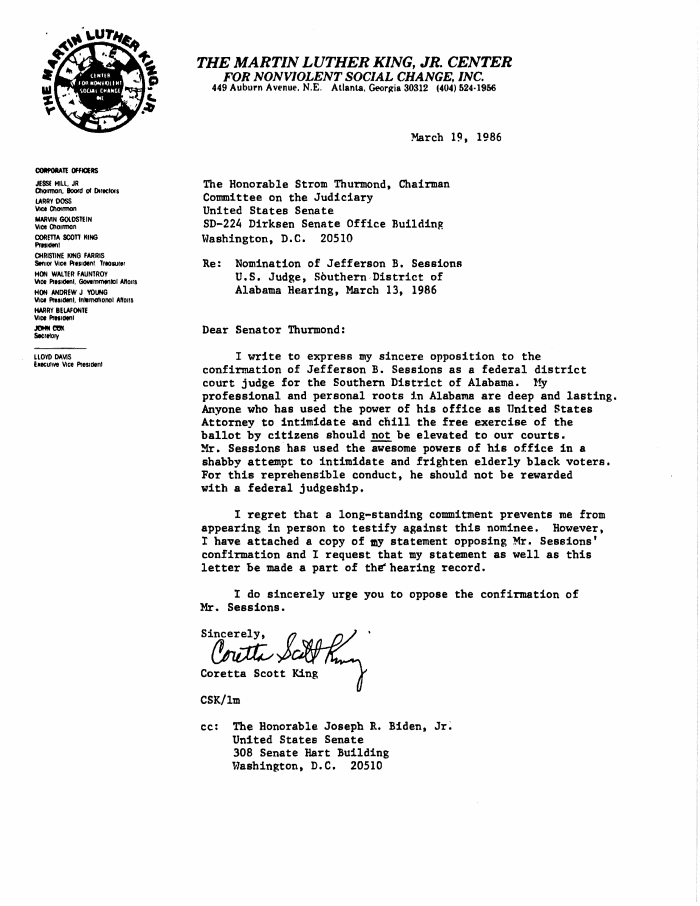
Here's the letter Coretta Scott King wrote opposing Sessions’s 1986 federal nomination

The civil rights case that haunts Donald Trump’s pick for attorney general

The career of Jeff Sessions, President-elect Donald Trump's nominee for attorney general, has been shadowed by his prosecution of the "Marion Three." Sessions brought forth the voter fraud case as a U.S. attorney in 1985, and his critics alleged the charges to be racially motivated. (Video: Dalton Bennett/Photo: Dalton Bennett/The Washington Post)

Coretta Scott King, the widow of civil rights leader Martin Luther King Jr., urged Congress in a letter to block the 1986 nomination of Jeff Sessions for federal judge, saying that allowing him to join the federal bench would “irreparably damage the work of my husband.” The letter, previously unavailable publicly, was obtained on Tuesday by The Washington Post.

“Anyone who has used the power of his office as United States Attorney to intimidate and chill the free exercise of the ballot by citizens should not be elevated to our courts,” King wrote in the cover page of her nine-page letter opposing Sessions’s nomination, which failed. “Mr. Sessions has used the awesome powers of his office in a shabby attempt to intimidate and frighten elderly black voters. For this reprehensible conduct, he should not be rewarded with a federal judgeship.”

Thirty years later, Sessions, now a senator, is again undergoing confirmation hearings as President-elect Donald Trump’s nominee for attorney general, and he is facing fierce opposition from civil rights groups.

In the letter, King writes that Sessions’s ascension to the federal bench “simply cannot be allowed to happen,” arguing that as a U.S. attorney, the Alabama lawmaker pursued “politically-motivated voting fraud prosecutions” and that he “lacks the temperament, fairness and judgment to be a federal judge.” She said Sessions’s conduct in prosecuting civil rights leaders in a voting-fraud case “raises serious questions about his commitment to the protection of the voting rights of all American citizens.”

“The irony of Mr. Sessions’ nomination is that, if confirmed, he will be given a life tenure for doing with a federal prosecution what the local sheriffs accomplished twenty years ago with clubs and cattle prods,” she wrote, later adding, “I believe his confirmation would have a devastating effect on not only the judicial system in Alabama, but also on the progress we have made toward fulfilling my husband’s dream.”

During the 1986 hearing, the letter and King’s opposition became a crucial part of the argument against Sessions’s confirmation.

Sen. Warren reads Coretta Scott King's letter about Jeff Sessions outside the Senate

After Sen. Mitch McConnell (R-Ky.) struck down Sen. Elizabeth Warren's (D-Mass.) attempt to read a letter from Coretta Scott King on the floor of the Senate during the debate on attorney general nominee Jeff Sessions, Warren read the letter outside the doors of the Senate and streamed it live. (Facebook/Sen. Elizabeth Warren)

BuzzFeed News first reported the existence of the letter earlier Tuesday, noting that it was never entered into the congressional record by then-Judiciary Committee Chair Strom Thurmond.


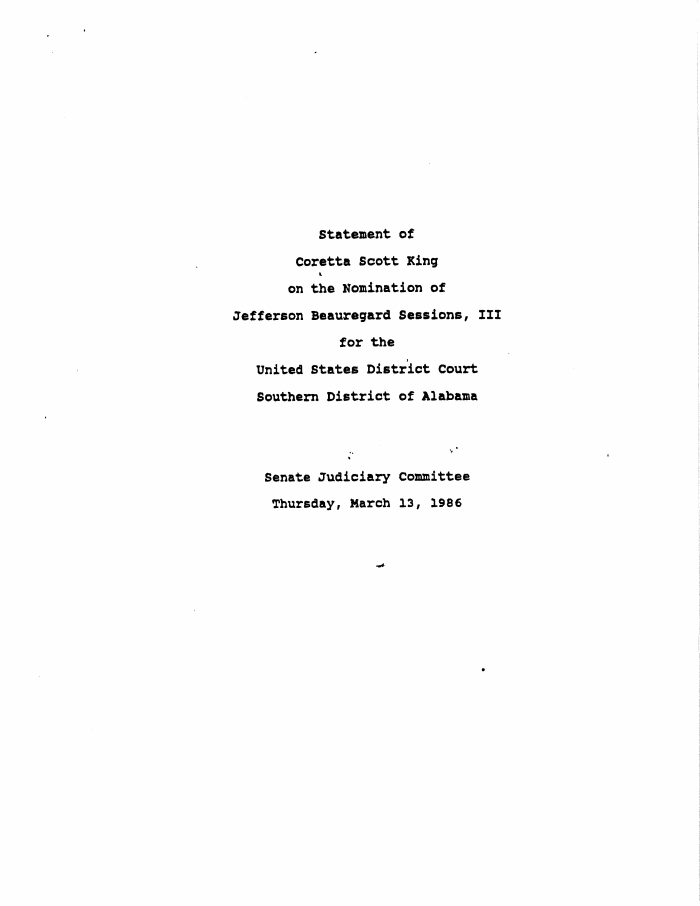
1Full 10 page letter of Coretta Scott King opposing Session's 1986 nomination


Sunday, September 18, 2016

Frantic Finish Clinton Versus Trump to be the 45th President of the USA


50 days: Clinton, Trump plot paths for campaign's frantic finish


Only 50 days remain in the presidential race between Hillary Clinton and Donald Trump, one of the most volatile and unpredictable political battles in U.S. history.

And there's just one week to go before the first, pivotal debate.


National polls show Clinton and Trump running neck and neck. Clinton begins with an advantage in the Electoral College, but Trump is closing fast in a number of battleground states, including Florida and Ohio.


The campaign has been unrelentingly negative and both Trump and Clinton are disliked by a number of voters, suggesting a nasty fight to the finish.


Clinton will have an advantage in money and ground game, but she is struggling mightily to energize the Democratic coalition that turned out for President Obama.


Trump’s supporters are enthused, but his favorability rating is even lower than Clinton’s. Vast swaths of the electorate don’t view him is presidential.

An unprecedented number of voters remain undecided, and third-party candidates are pulling more support than they have in decades.

Libertarian nominee Gary Johnson and Green Party nominee Jill Stein appear to be hurting Clinton, who polls suggest is struggling to win over young voters.

But neither Johnson nor Stein will make the stage at the first debate next Monday in Hempstead, N.Y. because both failed to meet polling criteria for inclusion.


The debate is the first of three that will take place over a 25-day period, with a vice presidential matchup also coming up on Oct. 4. It is widely expected to attract more viewers than any other debate in history.

Clinton, who is enduring one of the roughest patches of her campaign and who just returned to the campaign trail on Thursday from a dramatic illness, is raising the stakes for the next 50 days.


“The next 53 days will shape the next 50 years,” she said at a press conference in Washington, D.C. on Friday.


Clinton is looking to reclaim her standing after falling ill to pneumonia and a serious gaffe. She had to express regret for saying half of Trump’s supporters belonged in a “basket of deplorables.”

She has also had difficulty shaking controversies at the State Department and Clinton Foundation.


Democrats say that over final 50-day stretch, Clinton needs to focus on turning out the African-American, Hispanic and young voters that formed the core of the Obama coalition.


Polls show Democrats are not excited about voting for Clinton and there are worries those voters will stay home on Election Day.


Clinton has acknowledged that she needs to give voters a reason to cast a ballot for her and not just against Trump. But Democrats say she has struggled to make that case.


“It’s amazing to me that after all this time she hasn’t been able to come up with anything better than we’re ‘stronger together’ and don’t vote for him,” said Douglas Schoen, an adviser to former President Clinton’s 1996 reelection campaign. “She simply doesn’t have a message that is catching on.”


Clinton will get an assist in that department from an all-star cast of surrogates.


President Obama and first lady Michelle Obama, both hugely popular among black voters, hit the hustings for Clinton this week.


Progressive favorites Bernie Sanders and Elizabeth Warren are also campaigning for Clinton in Ohio, where polls show Trump has moved into the lead.


“Barack Obama and Bernie Sanders are as strong of allies as you can have,” said Democratic strategist Joe Trippi, a veteran of Howard Dean’s 2004 campaign. “There’s nobody even remotely as connected to the millennial generation on the Republican side.”


Trump’s challenge is different.


The GOP nominee, famous for becoming entangled in unnecessary controversies, appeared to right the ship after bringing in a new campaign team over the summer. He uses teleprompters at rallies now and has cut back on press conferences and media interviews.


But Trump was blown off course once again this week, getting into a spat with the female pastor at a black church in Flint, Mich. He also reignited the “birther” controversy, ultimately holding a press conference at his new hotel in Washington, D.C. to acknowledge publicly for the first time that he believes Obama was born in the U.S.


“He needs to stay on message,” said Grover Norquist, the president of the conservative group Americans for Tax Reform. “He needs to focus on the issues where he has the advantage, like the economy and how he would be the agent of change over Clinton, who is the status quo. He can’t become distracted when Hillary or the press throw shiny objects into the air.”


Trump also faces a stiff commander-in-chief test at the first debate, as polls show the public does not view him as presidential.


Trump must address that challenge in substance, in tone and in temperament, Republicans say.


“There is an acceptability threshold he has to pass,” said veteran GOP operative Charlie Black. “At the debate, he needs to gentlemanly and serious. We’ve seen more of that from him lately and he’s done good to shore this up with his policy proposals.”


There are any number of wildcards that could come into play in the final stretch.


Russian hackers and Wikileaks have already left their mark on the election, embarrassing former secretary of State Colin Powell and contributing to the ouster of the head of the Democratic National Committee. Both sides are bracing for further email dumps.


Then there’s the chance that Johnson or Stein could play spoiler to Clinton, a development that Democrats are starting to take seriously.


They vividly remember the 2000 election and still blame Ralph Nader for costing Al Gore the presidency in what turned out to be the closest presidential election in history.


“It’s entirely plausible to think that Johnson and Stein could tip one or two states to Trump,” said Democratic strategist Craig Varoga. “As disappointing as that outcome was in 2000, it pales in comparison with the prospect of an election accidentally in favor of a guy with an impulse-control disorder.”