Friday, April 29, 2016

Shmaltzying tearfully (again) Zion at 30 Barbara Speaks to Golda.Israel at 60 Bush, Kissinger, Henri-Levi, Cruise, Stiller salute Zion


On May 13th, a marquee gathering began in Jerusalem to celebrate Israel’s sixtieth anniversary. Over three days, political leaders and writers including Henry Kissinger, Bernard Henri-Levi, Amos Oz, and President George W. Bush made speeches, and symposia on weighty topics, ranging from the scientific foundation of creation to the nature of Jewish identity, were held. Also this month, in New York and Los Angeles, live concerts featuring Matisyahu, David Broza, and Paul Shaffer marked the occasion. In Times Square, videos featuring stars such as Tom Cruise, Ben Stiller, and Dakota Fanning wishing Israel a happy birthday are appearing on two giant screens twice every hour. And on June 1, New York’s annual Salute to Israel parade will offer birthday wishes, as will yet another concert—this one on the Mall in Washington, D.C., hosted by Mandy Patinkin and featuring Regina Spektor.
But while the cable news channels are broadcasting the speeches of international dignitaries in Israel, and PBS stations will have some specialty programming—New York’s WNET will show Visions of Israel, an aerial tour of the country—the big networks are pretty much avoiding the occasion. Typical of the cable coverage: CNBC packaged a series of reports on the Jewish State under the banner “Israel at 60: Business Under Fire”; CNN International, for its part, ran Israel at 60, which showcased the country’s technological achievements, its ethnic mix, and its struggle “for acceptance and peace with its neighbors.”
All this is well and good, but certainly a far cry from the thirtieth-anniversary celebration that ABC broadcast—in prime time—on Monday, May 8, 1978, and simulcast in Israel. The two-hour extravaganza, The Stars Salute Israel at 30, featured icons of the day: Mikhail Baryshnikov, Carol Burnett, Sammy Davis Jr., Kirk Douglas, Gene Kelly, Billie Jean King, Barry Manilow, Paul Newman, Bernadette Peters, and more. Sally Struthers of All in the Family cheerfully sang “Happy Birthday Israel” with a group of children. Henry Winkler, who played the Fonz on ABC’s number one sitcom, Happy Days, was paired with Henry Fonda in an unlikely skit: a sabra (Winkler) encountering an Old West cowboy (Fonda) in the desert.
Barbra Streisand phones Golda Meir on 'The Stars Salute Israel at 30'
Yet this was mere prelude to the big finish: Barbra Streisand. With a big head of era-appropriate permed hair, she first sang three standards (“Tomorrow,” “People,” and “Happy Days Are Here Again”), then conducted a conversation via satellite with Israel’s former prime minister, Golda Meir, who appeared on a gigantic video screen, holding a clunky telephone receiver, gracefully answering Streisand’s fawning questions. (“How did you manage all these years to have so much energy? Did you take vitamins?”) After the chat came the pièce de résistance: Streisand singing “Hatikvah,” Israel’s national anthem. Introducing the song, whose title means “the hope,” Streisand said, “Let us light candles on both sides of the world in the hope that people everywhere will be inspired to work for peace and love and the betterment of all men.” Attendees in Los Angeles’s Dorothy Chandler Pavilion held aloft light sticks as their counterparts in Israel raised candles. No fewer than 18.7 million American households tuned in. Now Streisand’s performance is enjoying a second life: More than 366,000 people have watched it on YouTube since it was posted in 2006.
Streisand had been scheduled to sing at the festivities in Israel this year, but in late April she backed out, citing “personal obligations.” If she had made it to Israel this time around, it’s unlikely that as many people would have seen her appearance as back in a time when network TV really meant something—when shows in the top twenty attracted at least fifteen million viewers. (These days a show can reach the number twenty spot with just eleven million viewers.)
Two months before the thirtieth anniversary, Israel had suffered its deadliest terrorist attack. Palestinian terrorists who came by boat from Lebanon killed thirty-five Israeli civilians. Israel responded by invading Lebanon, a weeklong incursion that ended when the United Nations Security Council mandated Israel’s withdrawal and the posting of UN troops.
But this was also, as Streisand said, a historical moment of hope: six months earlierSadat had traveled to Jerusalem, raising the possibility of lasting peace. And two years prior, Israel had succeeded in rescuing all but three of 105 hostages from a hijacked Air France plane in Entebbe, Uganda—a daring raid that became the subject of two made-for-TV movies, one of which appeared on ABC. The chief and founder of ABC, Leonard Goldenson, was an outspoken advocate of Israel (according to one account, when he showed up unannounced at Golda Meir’s doorstep in the 1960s, she thanked him for his devotion to the nation and invited him in), so it’s no surprise he greenlighted the thirtieth-anniversary spectacular. ABC also had a proclivity for quirky programming, like Battle of the Network Stars, the biannual special in which you could see, say, Scott Baio and Billy Crystal competing in an obstacle course race, with Howard Cosell announcing.
One of the writers of The Stars Salute Israel at 30 was Buz Kohan, who wrote or cowrote dozens of TV award shows and celebrations, as well as a variety program marking Israel’s twenty-fifth anniversary five years earlier, The Stars Salute Israel—25. That program—filmed at the Western Wall, with Alan King hosting—aired on ABC on a Thursday, at 11 p.m. in some markets and 11:30 p.m. in most. It featured performances by Rudolf Nureyev, Isaac Stern and, in one of her final appearances,Josephine Baker. (Because of its late night airtime, its Nielsen ratings aren’t available today.)
Five years later, Israel’s embassy turned to Charles Fishman, a jazz producer who had formerly served as the national director of Young Judaea, for help in planning the thirtieth-anniversary celebration. Fishman had brought Stan Getz to Israel in 1977, a trip filmed for the 1978 documentary Stan Getz: A Musical Odyssey. “How do you break away from the late night television?” Fishman remembers asking himself. “I sat back and said, ‘What would be the hippest thing to do? What would be the biggest star-power thing to do?’”
No other Jewish American performer of the time was as big as Streisand. This was little more than a year after the release of A Star Is Born, which had garnered her an Oscar for the song “Evergreen.” Fishman enlisted producer James Lipton, now famous for Inside the Actors Studio, and director Marty Pasetta, another award-show veteran, and set to work getting Streisand. She was interested, but had her own conditions: She wanted to sing accompanied by Zubin Mehta and the Los Angeles Philharmonic. So that’s exactly what she got. And with the strength of Streisand’s name, Fishman and company sold the show to ABC.
Barbra Streisand sings 'Hatikvah' on 'The Stars Salute Israel at 30'
In the days before the show aired, Kohan and Mehta went to Streisand’s home to help her prepare. “She wanted to sing ‘Hatikvah,’ only she didn’t know” the song, Kohan recalls. Kohan picked up the phone, called his wife, Rhea, and asked her to sing the song to Streisand. “I hope she’s not intimidated,” Rhea quipped before launching into it.
Streisand’s preparation worked. For the organizers, the result was transcendent. “She was remarkable,” says Kohan. “Everybody was impressed with the last twenty minutes of the show.”
Even with all of this year’s celebrations, including the celebrity testimonials in Times Square, it’s hard to believe that Israel’s birthday was once celebrated with a TV program watched by more than eighteen million Americans. “To this day,” Fishman says, “it’s the only time that a foreign nation has been honored on network TV on prime time.”

The Worst type of Anti-Zionists =Anti Semites are Jewish ones.... meet Bernie Sanders and his Jewish outreach side kick Simone Zimmerman


Befitting his “revolutionary” campaign, Sen. Bernie Sanders uttered something revolutionary at the Brooklyn Democratic presidential debate before his loss in the New York primary last week: He spoke up on behalf of the Palestinian people.

“As somebody who is 100 percent pro-Israel,” the Vermont socialist averred, “we are going to have to treat the Palestinian people with respect and dignity.” Sanders added that Israel’s response to Hamas rocket attacks in 2014 was “disproportionate,” that “we are going to have to say that [Israeli Prime Minister Benjamin] Netanyahu is not right all of the time,” and took a swipe at his rival, former Secretary of State Hillary Clinton, scolding her for having “barely mentioned the Palestinians” in a speech to the American Israel Public Affairs Committee (AIPAC).

Within seconds, hosannas from the herd of independent minds poured forth. “Historic” declared The Huffington Post. “Bernie Sanders just shattered an American taboo on Israel,” gushed Vox’s Zack Beauchamp, whose knowledge of the Middle East is so voluminous as to include the imaginative, like the “bridge” connecting Gaza to the West Bank (which, naturally, Israel “limits traffic on.”) “Bravo to Sanders for saying that Israel’s assault on Gaza was disproportionate!” exclaimed Nicholas Kristof of the New York Times. “Truth in a campaign! Wonders never cease!”

In reality, standing up for “Palestinians’ humanity,” as Beauchamp wrote, is as much a “taboo” as being in favor of healthy school lunches or cleaner air and water. To think otherwise, one would have to inhabit a world where ABC, CBS, NBC, NPR, the Washington Post, the New York Times, the BBC, The Guardian, every major European broadcast network and newspaper, Vox, Salon, Slate, American academia, the United Nations, Amnesty International, Human Rights Watch, Oxfam, and countless other media outlets and international institutions don’t exist. George W. Bush, remember, was the first American president to call for the creation of a Palestinian state.

But to a particular type of commentator, and a particular type of Jew, the relevance of Sanders’ remarks lay not in what he said. Rather, it is the act of virtue-signaling—only we, the righteous Jews, as opposed to those cold-hearted tribalists, appreciate another people’s suffering—that sends the proverbial thrill down the leg. Expressing approval for Sanders’ supposedly heretical pabulum is simply an easy way to distinguish oneself from one’s supposedly less sophisticated co-religionists.

While Sanders’ even-handedness on the Israeli-Palestinian conflict is utterly banal, there is one sense in which his campaign is genuinely historic: He is the most successful Jewish presidential candidate in American history. But unlike Joe Lieberman, who was the first Jew to appear on a major party ticket in 2000, Jewishness—religious, cultural, political—is not something that Sanders likes to discuss. More often than not, it has been a source of awkward embarrassment, which he often tries to avoid by identifying himself as “Polish.” In an interview last June, NPR’s Diane Rehm asked Sanders to address his “dual citizenship with Israel.” When Sanders informed Rehm that he is “an American citizen, period,” the host protested that his name appeared on a “list” of American-Israeli dual nationals. (Rehm later apologized, though why she and her producer accepted as fact the assertions of neo-Nazis on the Internet has not been sufficiently explained.)

Earlier this month, anti-Semitism again reared its ugly head in the form of a questioner who confronted Sanders at the Apollo Theater in Harlem. “As you know,” the man asked, “the Zionist Jews—and I don’t mean to offend anybody—they run the Federal Reserve, they run Wall Street, they run every campaign.” Struggling to finish over the audience’s loud booing (the only hopeful sign in an otherwise dispiriting moment of an already dispiriting campaign season), the man asked, “What is your affiliation to your Jewish community? That’s all I’m asking.”

As my Tablet magazine colleague Yair Rosenberg noted, Sanders’ answer was disappointing. Rather than use the outburst as an opportunity to rebuke blatant bigotry and leave it at that, Sanders thought it necessary to express his pro-Palestinian bona fides—so, you know, no one might think he was that kind of Jew. “Talking about Zionism and Israel,” Sanders said, “I am a strong defender of Israel, but I also believe that we have got to pay attention to the needs of the Palestinian people.” Of course, the questioner was not talking about the subtleties of the Middle East conflict when he alleged that “Zionist Jews” control everything from the nation’s money supply to its political system. His use of “Zionist,” as is so often the case when anti-Semites wish to disguise their anti-Semitism, was plainly conspiratorial.

Bernie Sanders’ campaign has illuminated the new rules that govern Jewish participation on the progressive left. One cannot simply be a Jew: One must be a Jew who loudly and proudly declaims his distance from Israel and the American Jewish “establishment” at every possible opportunity. And unlike every other member of the progressive coalition, Judaism and Jewish peoplehood must only be expressed through a universalist vision of “social justice” that emphatically proclaims that Jewish causes and rights are no more (or usually less) worthy than those of Black Lives Matter, the Palestinians, La Raza, etc., and which sees this self-abnegation as the price of entry—for Jews alone.

Bernie Sanders’ campaign has illuminated the new rules that govern Jewish participation on the progressive left. One cannot simply be a Jew: One must be a Jew who loudly and proudly declaims his distance from Israel and the American Jewish “establishment” at every possible opportunity.
The Sanders campaign is important as a space in which the left’s universalistic pretensions are coming into conflict with the particularistic concerns of Jewish nationalism—as many on the left single out Israel for opprobrium and demand that their Jewish comrades do the same. English novelist Howard Jacobson ridiculed “ ‘As a Jew’ Jews” as those who invoke their ethnic identity solely to criticize Israel and their ethno-religious brethren. It is a species hardly unique to the Jewish tribe, but one that is certainly louder—and the recipient of more disproportionate and fawning media coverage—than any other genus of self-styled ethnic dissenter, a type that when found in other communities is generally ridiculed as an Uncle Tom or a puppet of the patriarchy.

Sanders’ snub of the bipartisan AIPAC conference (he was the only presidential candidate not to address its nearly 20,000 members) was a defining mark of this tendency. So too was its hiring of a Jewish outreach director, Simone Zimmerman, whose key qualification for the job of liaising with American Jewry was antagonizing her fellow Jews. When it was revealed that Zimmerman had attacked Clinton’s AIPAC speech as “racist and orientalist,” called on Hillel to provide a platform for anti-Zionists and other supporters of the Boycott, Divestment and Sanctions movement against Israel, and authored an expletive-laden Facebook tirade condemning Netanyahu as an “asshole” who had “sanctioned the murder of over 2,000 people,” the Sanders campaign suspended her. Rushing to Zimmerman’s defense was the chameleon-like Peter Beinart (Rhodes Scholar, Marshall “declined”), who, having grown tired of being a leading liberal hawk shape-shifted into a left-wing critic of American imperial hubris, now bears the burden of being the self-appointed conscience of American Jewry. He told the Times that Zimmerman’s suspension amounted to “the American Jewish community eating its own”; Beinart elaborated that, “She cares deeply and wants to make [the Jewish community] live up to its own stated ideals.” If only American Jews were as conscientious and caring as Peter Beinart and Simone Zimmerman.

A more revealing aspect of the Sanders phenomenon concerned his notorious interview with the Daily News editorial board, in which he incorrectly asserted that 10,000 civilians had been killed in the 2014 Gaza War. After Sanders consulted with the Anti-Defamation League, his campaign revised the number down to the United Nations estimate of some 1,500 civilians (The number of innocents killed is substantially lower). The questioning of casualty figures, however, is beside the point, because to Sanders and his supporters, the number doesn’t matter. Even five hundred or one hundred Palestinians killed by Israel in Gaza—in the midst of a racist war started by a genocidal terrorist organization—would have been “disproportionate.”

Which in turn brings up a very important point: If the numbers are irrelevant, and the need for moral outrage is not based on the quantity of the dead, then what is it based on, exactly? Why are Bernie Sanders and his Jewish surrogates not permanently outraged by the nearly half a million dead civilians in Syria? The answer, apparently, is that there exists a special kind of math in which even one dead Palestinian—killed unintentionally by Israeli forces in the midst of an ethically justified, defensive war provoked by its adversary—is proof of some horrible moral outrage committed not by the Palestinians but by Israel. Meanwhile, these selfsame critics have little or nothing to say about the incessant American drone strikes, dramatically intensified by a president they idolize, which have killed far more innocent people than the Israeli Defense Forces, never mind the atrocities committed by Russia, China, Iran, Syria, Egypt, and practically every other country on the planet.

Last month, the Village Voice published a cover story titled, “The Heresy and Evangelism of Bernie Sanders,” which explicitly put forth the sociologically accurate if hardly morally binding proposition that, to be good leftists, Jews must denounce Israel. The article’s author, Jesse Alexander Myerson, correctly complained about a dichotomy of “good and bad Jews” that, for centuries, was inflicted upon Jews by the governments under which they lived. In the 20th century, “bad Jews” were socialists, who carried the virus of Bolshevism with them wherever they traveled. “Good Jews” were Zionists, directing their utopian desires abroad, to Palestine, and later, Israel. Over time, Myerson argues, Jews themselves began to internalize this form of discrimination, casting out of their own community those Jews who opposed Zionism. “The internationalism of the prewar American Jewry was supplanted by nationalism,” he writes with dismay. “Our egalitarian commitment was replaced by exceptionalism. Our agitation against war was undermined by ceaseless colonialism in Palestine. Jews have been instructed that the cluster bombs and night patrols blanketing the Holy Land are necessary to preserve our heritage.”

To combat this unfair, externally imposed fissure, Myerson essentially argues for adopting its opposite: that is, Jews should embrace socialism and reject Zionism. And in Sanders, Myerson sees a candidate who, whatever his perfunctory endorsements of Israel’s right of self-defense, is an avatar of a new, post-Zionist Jewish identity. Myerson’s argument lacks any nuance, ignoring entirely the left-wing Zionist tradition that founded the state of Israel and exists to this day. Yet what’s most revealing about Myerson’s article is that only Jews are expected to give up their particularist concerns. Myerson would never contemplate asking Black Lives Matter activists to shut up and stop complaining about police brutality, or gays to stop whining about religious liberty laws. Yet that is essentially what he and other leftists are asking of Jews: put aside your concerns qua Jews, because you are standing in the way of the people’s revolution. Speaking of the enduring need for a Jewish State, drawing attention to anti-Semitic incitement on college campuses—all this is special pleading.

This is not a new phenomenon for Jews on the left, who have always had to balance their commitment to cosmopolitan principles with their communal concerns. But it seems to be the case that the scales are tipping on the side of post-national universalism, and that it is becoming ever more exclusionary of Zionism. For many left-wing Jews, distancing oneself from Israel and the American Jewish majority has become a marker of enlightenment and urbanity not unlike the way German Jews looked down upon shtetl Ostjuden from Poland and Russia. Contemporary Western liberal Jewish criticism of Israel’s “right wing drift” also has an unspoken racial component, as the vast majority of American Jews are of Ashkenazi descent while more than half of Israeli Jews are of Sephardi or Mizrahi lineage. And so the tension that long existed (and to some extent, still exists) between the old, Ashkenazi Israeli elite and the dispossessed Mizrachim is now being grafted onto the American-Israeli relationship—with the “good leftist” in the role of the racist Ashkenazi snobs.

Bernie Sanders and his Jewish devotees can distance themselves from Israel and Zionism all they want. But as has always been the case, it will make no difference to the people they are trying to please, who continue to reduce them to a single factor of their identity which in their minds has attained the totalizing force of an epithet: Jew.

Groucho Marx- Wisdom , Jewishness ( some) and Zionism ( does an occasional check for JNF Trees count?)


Huh? What? Why'd you wake me up? I was having this wonderful dream about Thelma Todd and Kitty Carlisle and they were...

Oh, a Marx Brothers thread.

There was a "Hebrew" comic stereotype in the early days of vaudeville, just as there were Irish, Italian, "Dutch" (German), black, and others. Groucho did his time as a "Hebrew" with a heavy accent, although he also played Dutch. Weber and Fields and Smith and Dale were probably the most famous Hebrew acts, but there were lots of others.

As immigrants settled in, the heavy stereotypes became less funny in and of themselves. Although Chico kept the Italian accent forever, he did so as part of a larger troupe of comic types. Merely having an accent and being a naive immigrant wasn't as funny to second-generation Americans who grew up speaking English.

Being Jewish remained a selling point in the heart of vaudeville and, later, Broadway, because New York City was as much as one-third Jewish in those days. Yiddish expressions entered show-biz language because everybody used them and the whole audience would understand them. The lines quoted from the Marx Brothers aren't ones they came up with: it was all those Jewish writers of theirs - George S. Kaufman, Morrie Ryskind, S. J. Perelman, Arthur Sheekman, Al Boasberg, and on and on. If they ever used a non-Jewish writer, it must have been late in their careers and we all know how that ended.

The problem was that this humor didn't carry over very well when the vaudevillians traveled out of New York City or a few other large eastern cities. It was especially hated in the South and deep Midwest, where anti-Semitic prejudice was rampant. Movies just exacerbated the problem. The heavily Jewish acts never made it out of vaudeville, and the few single stars who tried - Al Jolson, Eddie Cantor, Fanny Brice - couldn't get a major movie career started. (Brice became a radio star, but mostly because of her Baby Snooks character, not her Jewish adult pose.)

And the movie moguls, every last one of whom were Jewish, were deathly afraid of offending a single person in the audience. They ruthlessly cut out every piece of Jewishness of out their films and their stars. A few lines dropped into the endless babble of the Marx Brothers could go by almost unnoticed in the crowd, but that was it.

Like the Three Stooges, the Marz Brothers  started out as literal stooges, plants in the audience who would heckle the star, Ted Healy, and be brought on stage to be abused by him. (Healy was another one who started out doing blackface but gave it up when that stereotype stopped crowd-pleasing.) There was no need for Healy's stooges to be Jewish or anything else: they were there to be slapped around. Eventually, of course, the Howard brothers and Mr. Fine got sick and tired of Healy, his stinginess, his ego, and everything else about him and went off on their own. But they never saw any reason to change the act, nor would their studio bosses have let them.

It's not clear to me just how much the general American audience understood the pervasive Jewishness of the Hollywood hierarchies. The moguls played down their religion to the point of self-loathing, although in their personal lives they all went to synagogue, got married by rabbis, had their kids Bar Mitvahed, and ate Seders at Passover. Same with the stars. Most of that generation were striving to be assimilated Americans, though, and were more nominally Jewish than fervent believers. It's hard to name any Orthodox, kosher-keeping Jews among the stars. And remember that many of them anglo-ized their names, like John Garfield, Edward G. Robinson, Joan Blondell, Douglas Fairbanks, and downplayed any ethnicity. 


Zions's Strict Adherence to (Groucho) Marxism
Zion 's policy toward the Palestinians could be summed up by tweak of Groucho's famous credo: 'Anyone who claims to be ready to talk with us proves, by saying so, that he is not worthy to be a negotiating partner.'

Denial, delusion and Jewish settlements are killing the two-state solution.... all I ( that's mean, Stephen Darori now speaking) ... all I can say ... is Hey Ho Go Settlements. Let themmultiply and expand.... and kill the academic Two State Fantasy that no one supports anymore.... and hey this was Groucho Marx's view point as well.

Now we know: the State of Israel has adopted Groucho Marxism as its official policy.
For those with short memories, here is a reminder of the history and main points of the Groucho Marxist philosophy. It originated at the time when country clubs in the United States would not allow Jews to become members. The late Mr. Groucho Marx (one of the greatest Jewish-American humorists) nevertheless received an offer to join one of those anti-Semitic clubs despite the fact that he was Jewish. His (Jewish) answer was: “I don’t want to belong to any club that will accept me as a member.”

This rule has now become the guiding principle for the Israeli government, which has made no changes to it except the ones dictated by circumstances. The new Israeli version of the Groucho Marxist philosophy is as follows: “We don’t want to talk with anyone who is willing to talk with us.” Or, to put it a bit more bluntly: “Anyone who claims to be ready to talk with us proves, by saying so, that he is not worthy to be a negotiating partner” (and, for that reason, deserves to be thrown in prison, deported, blown up, poisoned or removed from the agenda in any way possible).

At a superficial glance, this policy seems nothing more than an amusing paradox. A deeper look will show that it contains quite a bit of truth. After all, who knows the real quality and nature of the Israeli government better than the Israeli government itself? In the inner recesses of its heart, the government knows very well that the lip service it pays here and there to “its indefatigable quest for peace” is nothing but straw and stubble. So anyone stupid enough to buy its hypocritical chatter about peace cannot be considered a serious partner.

Or, as we said above: Anyone who is willing to talk to me proves that he is too stupid for me to talk with him.

We must admit that adopting Groucho Marxism has already gotten the desired result: the prisons are full of people who are willing to talk with us, but from the moment the king of Jordan announced that he had nothing to talk about with us (regarding the West Bank), he has been the only one we are willing to talk to.

Full disclosure: Everything I wrote above — with only technical changes — is pure journalistic plagiarism. It appeared long ago in Haaretz — or, to be more precise, in Haaretz’s weekend supplement, on Friday, August 26, 1988. That was 26 years ago.

Logic would seemingly dictate that a trick exposed 26 years ago would have lost its power and charm. But Israel’s adherence to Groucho Marxism has only grown deeper, more sophisticated and more efficient, trapping the foolish and naïve in its net again and again. 

Over and over Zion  succeeds in leading both the nation and the world by the nose.And so, thanks only to its enemies who foolishly  and naïvely get trapped this time, everybody has sunk once again into the heated and hackneyed dispute over “who is to blame for the failure of the talks.” Zion will never be forced into an agreement that bucks the thinking ofthose who live in Zion. Might it be the violation of the prisoner-release agreement? Lets hope so... these agreement have been pointless and sickeningly one sided.   The voracious construction in the territories? Hey Ho Let in continue at an exponential rate .Zions built-in refusal to part with the real estate? The Yiddos around the world are experts at accumulation and part only when superprofits come into pay in a really big way.  Heaven forbid! It is the Palestinians’ fault.Of course the Camel Keepers of Greater Israel are their Goats , Donkeys and Camel dung quagmire .The Startup Nation leads the world in terming sewerage waste into drinkable water and making a buck from recycling the Liberal Zionists Two State Shit. So the Groucho Marx Marxism  ''By announcing that they were willing to talk with us, they proved once again that they were unworthy of having us talk with them.''

Every true Groucho Marxist understands this.But serious , when it came to Israel and Zionism, Groucho Marx wouldn't have been able to locate Zion even if it was the only country on the map. American Jewishness, Groucho  acknowledged...anything out of those wonderful States South and West of Canada .... Groucho Marx couldn't have given a damn . He simply was never asked and never offered an opinion , at least public-ally.

There is nothing more depressing or disheartening, more ludicrous or embarrassing, than having to learn yet again that Groucho Marxism was, is and evidently will remain the most sanctified ideology of (most of) Israel’s governments throughout the country’s history. For 30 years at least, and maybe more.


Julius Henry Marx (October 2, 1890 – August 19, 1977), known professionally as Groucho Marx, was an American comedian and film and television star. He was known as a master of quick wit and is widely considered one of the best comedians of the modern era.His rapid-fire, often impromptu delivery of innuendo-laden patter earned him many admirers and imitators.

He made 13 feature films with his siblings the Marx Brothers, of whom he was the third-born. He also had a successful solo career, most notably as the host of the radio and television game show You Bet Your Life.

His distinctive appearance, carried over from his days in vaudeville, included quirks such as an exaggerated stooped posture, glasses, cigar, and a thick greasepaint mustache and eyebrows. These exaggerated features resulted in the creation of one of the world's most ubiquitous and recognizable novelty disguises, known as "Groucho glasses": a one-piece mask consisting of horn-rimmed glasses, large plastic nose, bushy eyebrows and mustache.
Julius Marx was born on October 2, 1890, in New York City, New York

Marx stated that he was born in a room above a butcher's shop on East 78th Street in New York City, "Between Lexington & 3rd", as told to Dick Cavett in a 1969 television interview.[5] The Marx children grew up on East 93rd Street off Lexington Avenue in a neighborhood now known as Carnegie Hill on the Upper East Side of the borough of Manhattan, in New York City. The turn-of-the-century building that his brother Harpo called "the first real home they ever knew" (in his memoir Harpo Speaks) was populated with European immigrants, mostly artisans. Just across the street were the oldest brownstones in the area, owned by people such as the well-connected Loew Brothers and William Orth. The Marx family lived at this location "for about 14 years", Groucho also told Cavett.

Marx's family was Jewish. Groucho's mother was Miene "Minnie" Schoenberg, whose family came from Dornum in northern Germany when she was 16 years old. His father was Simon "Sam" Marx, who changed his name from Marrix, and was called "Frenchie" by his sons throughout his life because he and his family came from Alsace in France. Minnie's brother was Al Schoenberg, who shortened his name to Al Shean when he went into show business as half of Gallagher and Shean, a noted vaudeville act of the early 20th century. According to Groucho, when Shean visited he would throw the local waifs a few coins so that when he knocked at the door he would be surrounded by adoring fans. Marx and his brothers respected his opinions and asked him on several occasions to write some material for them.

Minnie Marx did not have an entertainment industry career but had intense ambition for her sons to go on the stage like their uncle. While pushing her eldest son Leonard (Chico Marx) in piano lessons she found that Julius had a pleasant soprano voice and the ability to remain on key. Julius's early career goal was to become a doctor, but the family's need for income forced him out of school at the age of twelve. By that time young Julius had become a voracious reader, particularly fond of Horatio Alger. Marx would continue to overcome his lack of formal education by becoming very well-read.

After a few stabs at entry-level office work and jobs suitable for adolescents, Julius took to the stage as a boy singer in 1905. Marx reputedly claimed that he was "hopelessly average" as a vaudevillian, but this was typically Marx, wisecracking in his true form. By 1909 Minnie Marx had assembled her sons into a forgettable-quality vaudeville singing group billed as "The Four Nightingales". The brothers Julius, Milton (Gummo Marx) and Arthur (originally Adolph, from 1911 Harpo Marx) and another boy singer, Lou Levy, traveled the U.S. vaudeville circuits to little fanfare. After exhausting their prospects in the East the family moved to La Grange, Illinois, to play the Midwest.


An early photo of the Marx brothers with their parents in New York City, 1915; from left: Groucho, Gummo, Minnie (mother), Zeppo, Frenchie (father), Chico, and Harpo

After a particularly dispiriting performance in Nacogdoches, Texas, Julius, Milton, and Arthur began cracking jokes onstage for their own amusement. Much to their surprise, the audience liked them better as comedians than as singers. They modified the then-popular Gus Edwards comedy skit "School Days" and renamed it "Fun In Hi Skule". The Marx Brothers would perform variations on this routine for the next seven years.

For a time in vaudeville all the brothers performed using ethnic accents. Leonard, the oldest, developed the Italian accent he used as Chico Marx to convince some roving bullies that he was Italian, not Jewish. Arthur, the next oldest, donned a curly red wig and became "Patsy Brannigan", a stereotypical Irish character. His discomfort speaking on stage led to his uncle Al Shean's suggestion that he stop speaking altogether and play the role in mime. Julius Marx's character from "Fun In Hi Skule" was an ethnic German, so Julius played him with a German accent. After the sinking of the RMS Lusitania in 1915, public anti-German sentiment was widespread, and Marx's German character was booed, so he quickly dropped the accent and developed the fast-talking wise-guy character that became his trademark.

The Marx Brothers became the biggest comedic stars of the Palace Theatre in New York City, which billed itself as the "Valhalla of Vaudeville". Brother Chico's deal-making skills resulted in three hit plays on Broadway. No comedy routine had ever so infected the Broadway circuit.

All of this predated their Hollywood career. By the time the Marxes made their first movie, they were major stars with sharply honed skills, and when Groucho was relaunched to stardom on You Bet Your Life, he had already been performing successfully for half a century.

Career

The Marx Brothers in 1931 (from top, Chico, Harpo, Groucho, and Zeppo) Hollywood

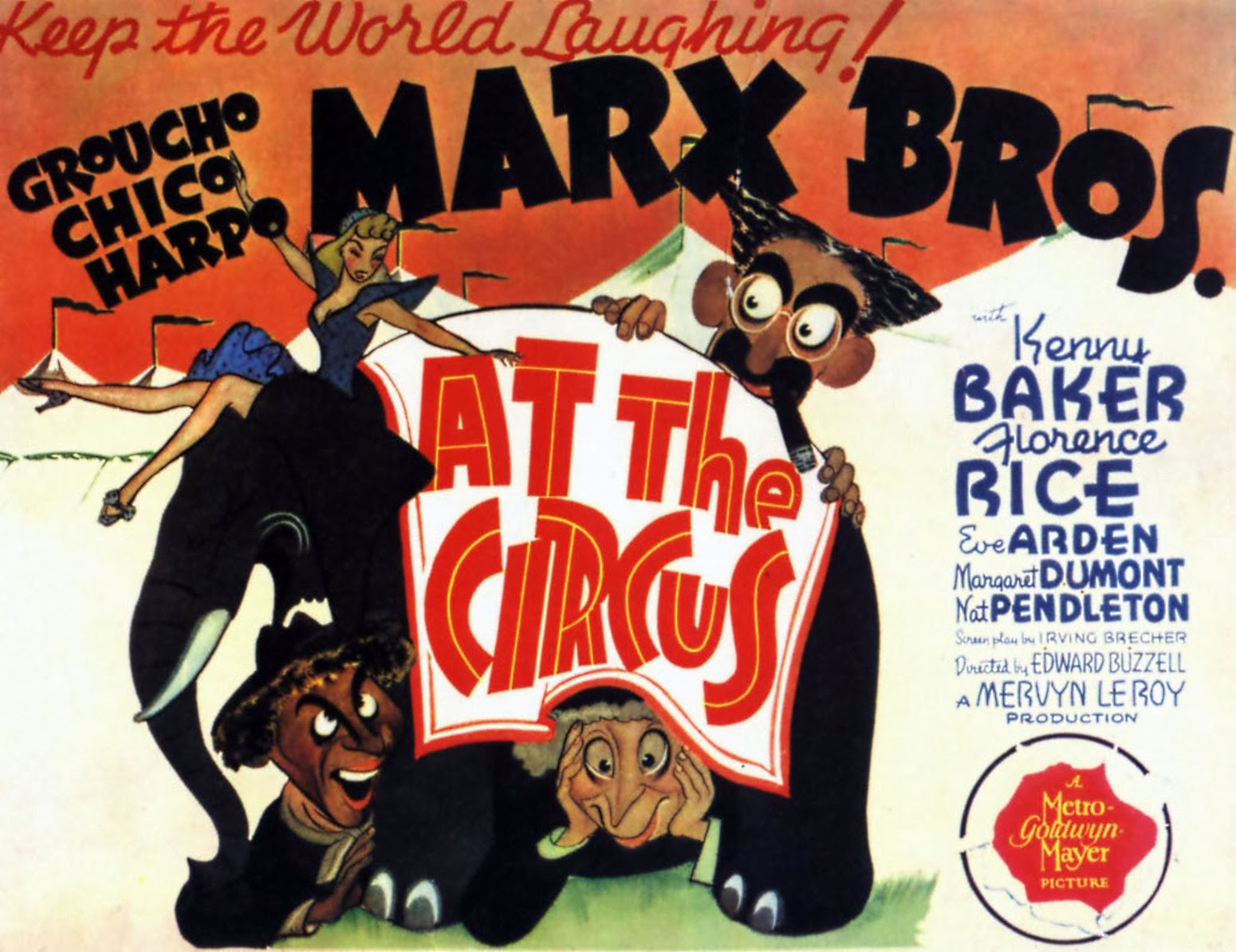
Groucho Marx made 26 movies, 13 of them with his brothers Chico and Harpo.[8] Marx developed a routine as a wisecracking hustler with a distinctive chicken-walking lope, an exaggerated greasepaint mustache and eyebrows, and an ever-present cigar, improvising insults to stuffy dowagers (often played by Margaret Dumont) and anyone else who stood in his way. As the Marx Brothers, he and his brothers starred in a series of popular stage shows and movies.

Their first movie was a silent film made in 1921 that was never released, and is believed to have been destroyed at the time. A decade later, the team made some of their Broadway hits into movies, including The Cocoanuts and Animal Crackers Other successful films were Monkey Business, Horse Feathers, Duck Soup, and A Night at the Opera.


The film diminished the lawless “do anything for a laugh” mentality of their earlier pictures. But what it gained was a picture with greater emphasis on controlled storytelling. The cast was crafted to have no unnecessary characters, the narrative structure is strong, and each brother manages to shine with their trademark humor. Groucho still verbally assaults most people with whom he shares a conversation, Harpo’s silent boyishness pairs well with his unrestrained mischief, and Chico, ever Harpo’s partner, swindles and tricks his way through the film. It is signature Marx comedy with a more impressive stage.

 One quip from Marx concerned his response to Sam Wood, the director of A Night at the Opera. Furious with the Marx Brothers' ad-libs and antics on the set, Wood yelled in disgust: "You can't make an actor out of clay." Groucho responded, "Nor a director out of Wood."

Marx also worked as a radio comedian and show host. One of his earliest stints was a short-lived series in 1932, Flywheel, Shyster, and Flywheel, costarring Chico. Though most of the scripts and discs were thought to have been destroyed, all but one of the scripts were found in 1988 in the Library of Congress. In 1947 Marx was asked to host a radio quiz program You Bet Your Life. It was broadcast by ABC and then CBS before moving to NBC. It moved from radio to television on October 5, 1950 and ran for eleven years. Filmed before a live audience, the show consisted of Marx bantering with the contestants and ad-libbing jokes before briefly quizzing them. The show was responsible for popularizing the phrases "Say the secret woid [word] and the duck will come down and give you fifty dollars," "Who's buried in Grant's Tomb?" and "What color is the White House?" (asked to reward a losing contestant a consolation prize).

Throughout his career he introduced a number of memorable songs in films, including "Hooray for Captain Spaulding" and "Hello, I Must Be Going", in Animal Crackers, "Whatever It Is, I'm Against It", "Everyone Says I Love You" and "Lydia the Tattooed Lady". Frank Sinatra, who once quipped that the only thing he could do better than Marx was sing, made a film with Marx and Jane Russell in 1951 entitled Double Dynamite.

Mustache, eyebrows, and walk
In public and off-camera, Harpo and Chico were hard to recognize, without their wigs and costumes, but it was almost impossible for fans to recognize Groucho without his trademark eyeglasses, fake eyebrows, and mustache.

The greasepaint mustache and eyebrows originated spontaneously prior to a vaudeville performance in the early 1920s when he did not have time to apply the pasted-on mustache he had been using (or, according to his autobiography, simply did not enjoy the removal of the mustache every night because of the effects of tearing an adhesive bandage off the same patch of skin every night). After applying the greasepaint mustache, a quick glance in the mirror revealed his natural hair eyebrows were too undertoned and did not match the rest of his face, so Marx added the greasepaint to his eyebrows and headed for the stage. The absurdity of the greasepaint was never discussed on-screen, but in a famous scene in Duck Soup, where both Chicolini (Chico) and Pinky (Harpo) disguise themselves as Groucho, they are briefly seen applying the greasepaint, implicitly answering any question a viewer might have had about where he got his mustache and eyebrows.

Marx was asked to apply the greasepaint mustache once more for You Bet Your Life when it came to television, but he refused, opting instead to grow a real one, which he wore for the rest of his life. By this time, his eyesight had weakened enough for him actually to need corrective lenses; before then, his eyeglasses had merely been a stage prop. He debuted this new, and now much-older, appearance in Love Happy, the Marx Brothers's last film as a comedy team.


Groucho and Eve Arden in a scene from At the Circus (1939)

He did paint the old character mustache over his real one on a few rare performing occasions, including a TV sketch with Jackie Gleason on the latter's variety show in the 1960s (in which they performed a variation on the song "Mister Gallagher and Mister Shean," co-written by Marx's uncle Al Shean) and the 1968 Otto Preminger film Skidoo. In his late 70s at the time, Marx remarked on his appearance: "I looked like I was embalmed." He played a mob boss called "God" and, according to Marx, "both my performance and the film were God-awful!"

The exaggerated walk, with one hand on the small of his back and his torso bent almost 90 degrees at the waist was a parody of a fad from the 1880s and 1890s. Fashionable young men of the upper classes would affect a walk with their right hand held fast to the base of their spines, and with a slight lean forward at the waist and a very slight twist toward the right with the left shoulder, allowing the left hand to swing free with the gait. (Edmund Morris, in his biography The Rise of Theodore Roosevelt, describes a young Roosevelt, newly elected to the State Assembly, walking into the House Chamber for the first time in this trendy, affected gait, somewhat to the amusement of the older and more rural members.)[citation needed] Groucho exaggerated this fad to a marked degree, and the comedy effect was enhanced by how out of date the fashion was by the 1940s and 1950s.

Personal life

Groucho's three marriages all ended in divorce. His first wife was chorus girl Ruth Johnson. He was 29 and she 19 at the time of their wedding. The couple had two children, Arthur Marx and Miriam Marx. His second wife was Kay Marvis (m. 1945–51), née Catherine Dittig,former wife of Leo Gorcey. Groucho was 54 and Kay 21 at the time of their marriage. They had a daughter, Melinda Marx. His third wife was actress Eden Hartford.She was 24 when she married the 63-year-old Groucho.

During the early 1950s, Groucho described his perfect woman: “Someone who looks like Marilyn Monroe and talks like George S. Kaufman.”
Groucho was denied membership in an informal symphonietta of friends (including Harpo) organized by Ben Hecht, because he could play only the mandolin. When the group began its first rehearsal at Hecht's home, Groucho rushed in and demanded silence from the "lousy amateurs". The musicians discovered him conducting a recorded performance of Tannhäuser in Hecht's living room. Groucho was allowed to join the symphonietta

Later in life, Groucho would sometimes note to talk show hosts, not entirely jokingly, that he was unable to actually insult anyone, because the target of his comment would assume that it was a Groucho-esque joke, and would laugh.

Despite his lack of formal education, he wrote many books, including his autobiography, Groucho and Me (1959) and Memoirs of a Mangy Lover (1963). He was a friend of such literary figures as T. S. Eliot and Carl Sandburg. Much of his personal correspondence with those and other figures is featured in the book The Groucho Letters (1967) with an introduction and commentary on the letters written by Groucho, who donated[14] his letters to the Library of Congress.

Groucho made serious efforts to learn to play the guitar. In the 1932 film Horse Feathers, Groucho performs the film’s love theme “Everyone Says I Love You” for costar Thelma Todd on a Gibson L-5.
Irving Berlin quipped, "The world would not be in such a snarl, had Marx been Groucho instead of Karl". In his book The Groucho Phile, Marx says "I've been a liberal Democrat all my life", and "I frankly find Democrats a better, more sympathetic crowd.... I'll continue to believe that Democrats have a greater regard for the common man than Republicans do". Marx & Lennon: The Parallel Sayings was published in 2005; the book records similar sayings between Groucho Marx and John Lennon.

Later years
You Bet Your Life
Groucho's radio life was not as successful as his life on stage and in film, though historians such as Gerald Nachman and Michael Barson suggest that, in the case of the single-season Flywheel, Shyster, and Flywheel (1932), the failure may have been a combination of a poor time slot and the Marx Brothers' returning to Hollywood to make another film.

In the mid-1940s, during a depressing lull in his career (his radio show Blue Ribbon Town had failed, he failed to sell his proposed sitcom The Flotsam Family only to see it become a huge hit as The Life of Riley with William Bendix in the title role, and the Marx Brothers as film performers were well past their prime), Groucho was scheduled to appear on a radio show with Bob Hope. Annoyed that he was made to wait in the waiting room for 40 minutes, Groucho went on the air in a foul mood.


Groucho as host of You Bet Your Life, 1953
Hope started by saying "Why, it's Groucho Marx, ladies and gentlemen! (applause) Groucho, what brings you here from the hot desert?" Groucho retorted, "Hot desert my foot, I've been standing in the cold waiting room for forty minutes!" Groucho continued to ignore the script, and although Hope was a formidable ad-libber in his own right, he could not begin to keep up with Groucho, who lengthened the scene well beyond its allotted time slot with a veritable onslaught of improvised wisecracks.

Listening in on the show was producer John Guedel, who had a brainstorm. He approached Groucho about doing a quiz show, to which Groucho derisively retorted, "A quiz show? Only actors who are completely washed up resort to a quiz show!" Undeterred, Guedel explained that the quiz would be only a backdrop for Groucho's interviews of people, and the storm of ad-libbing that they would elicit. Groucho said, "Well, I've had no success in radio, and I can't hold on to a sponsor. At this point, I'll try anything!"
You Bet Your Life debuted in October 1947 on radio on ABC (which aired it from 1947 to 1949), sponsored by costume jewelry manufacturer Allen Gellman;[18] and then on CBS (1949–50), and finally NBC, continuing until May 1961—on radio only, 1947–1950; on both radio and television, 1950–1960; and on television only, 1960–1961. The show proved a huge hit, being one of the most popular on television by the mid-1950s. With George Fenneman as his announcer and straight man, Groucho entertained his audiences with improvised conversation with his guests. Since You Bet Your Life was mostly ad-libbed and unscripted—although writers did pre-interview the guests and feed Groucho ready-made lines in advance—the producers insisted that the network prerecord it (instead of it being broadcast live).[citation needed] There were two reasons for this: prerecording provided Groucho with time to fish around for funny exchanges and any intervening dead spots to be edited out; and secondly to protect the network, since Groucho was a notorious loose cannon and known to say almost anything. The television show ran for 11 successful seasons until it was canceled in 1961. Automobile marque DeSoto was a longtime major sponsor. For the DeSoto ads Marx would sometimes say: "Tell 'em Groucho sent you", or "Try a DeSoto before you decide".

The program's theme music was an instrumental version of "Hooray for Captain Spaulding", which became increasingly identified as Groucho's personal theme song. A recording of the song with Groucho and the Ken Lane singers with an orchestra directed by Victor Young was released in 1952. Another recording made by Groucho during this period was "The Funniest Song in the World", released on the Young People's Records label in 1949. It was a series of five original children's songs with a connecting narrative about a monkey and his fellow zoo creatures.

The show's most infamous remark supposedly occurred as Groucho was interviewing Charlotte Story, who had borne 19 children. When Marx asked why she had chosen to raise such a large family, Mrs. Story is said to have replied, "I love my husband"; to which Marx responded, "I love my cigar, but I take it out of my mouth once in awhile." The remark was judged too risqué to be aired, according to the anecdote, and was edited out before broadcast.[19]

Marion and Charlotte Story—parents of 20 children, not 19—did in fact appear as contestants on the radio version of the show, in 1950. Audio recordings of the interview exist, and a reference to cigars is made ("With each new kid, do you go around passing out cigars?"), but there is no evidence of the famous line. Marx and Fenneman both denied that the incident took place. In a 1972 Esquire interview, Marx told Roger Ebert, "I never said that." Marx's 1976 memoir recounts the episode as fact,] but co-writer Hector Arce relied mostly on sources other than Marx himself — who was by then in his mid eighties and mentally compromised — and was probably unaware that Marx had specifically denied making the legendary observation.

Other work
By the time You Bet Your Life debuted on TV on October 5, 1950, Groucho had grown a real mustache (which he had already sported earlier in the films Copacabana and Love Happy).

During a tour of Germany in 1958, accompanied by then-wife Eden, daughter Melinda, Robert Dwan and Dwan's daughter Judith, he climbed a pile of rubble that marked the site of Adolf Hitler's bunker, the site of Hitler's death, and performed a two-minute Charleston.[26] He later remarked to Richard J. Anobile in The Marx Brothers Scrapbook, "Not much satisfaction after he killed six million Jews!"


Groucho as Koko, 1960
In 1960, Groucho, a lifelong devotee of the comic operas of Gilbert and Sullivan, appeared as Koko the Lord High Executioner in a televised production of The Mikado on NBC's Bell Telephone Hour. A clip of this is in rotation on Classic Arts Showcase.

Another TV show, Tell It To Groucho, premiered January 11, 1962 on CBS, but only lasted five months. On October 1, 1962, Groucho, after acting as occasional guest host of The Tonight Show during the six-month interval between Jack Paar and Johnny Carson, introduced Carson as the new host. In 1965, a weekly show for British TV titled Groucho was poorly received and lasted only 11 weeks.

In 1964, Marx starred in the "Time for Elizabeth" episode of Bob Hope Presents the Chrysler Theatre, a truncated version of a play that Groucho Marx and Norman Krasna wrote in 1948.

Groucho appeared as a gangster named God in the movie Skidoo (1968), directed by Otto Preminger, and costarring Jackie Gleason and Carol Channing. It was released by the studio where the Marx Brothers began their film career, Paramount Pictures. The film received almost universally negative reviews. As a side note, writer Paul Krassner published a story in the February 1981 issue of High Times, relating how Groucho prepared for the LSD-themed movie by taking a dose of the drug in Krassner's company, and had a moving, largely pleasant experience. Four years later came Groucho's last theatrical film appearance, a brief, uncredited cameo in Michael Ritchie's The Candidate (1972).

Groucho developed friendships with rock star Alice Cooper—the two were photographed together for Rolling Stone magazine—and television host Dick Cavett, becoming a frequent guest on Cavett's late-night talk show, even appearing in a one-man, 90-minute interview.[27] He befriended Elton John when the British singer was staying in California in 1972, insisting on calling him "John Elton." According to writer Philip Norman, when Groucho jokingly pointed his index fingers as if holding a pair of six-shooters, Elton John put up his hands and said, "Don't shoot me, I'm only the piano player," thereby naming the album he had just completed. A film poster for the Marx Bros. movie Go West is visible on the album cover photograph as an homage to Groucho. Elton John accompanied Groucho to a performance of Jesus Christ Superstar. As the lights went down, Groucho called out, "Does it have a happy ending?" And during the Crucifixion scene, he declared, "This is sure to offend the Jews."[citation needed]

Groucho's previous work regained popularity; new books of transcribed conversations were published by Richard J. Anobile and Charlotte Chandler. In a BBC interview in 1975, Groucho called his greatest achievement having a book selected for cultural preservation in the Library of Congress. As a man who never had formal schooling, to have his writings declared culturally important was a point of great satisfaction. As he passed his 81st birthday in 1971, however, Groucho became increasingly frail, physically and mentally, as a result of a succession of minor strokes.

In 1972, largely at the behest of his companion Erin Fleming, Groucho staged a live one-man show at Carnegie Hall that was later released as a double album, An Evening with Groucho, on A&M Records. He also made an appearance in 1973 on a short-lived variety show hosted by Bill Cosby. Fleming's influence on Marx was controversial. Some close to Marx believed that she did much to revive his popularity, and the relationship with a younger woman boosted his ego and vitality. Others described her as a Svengali, exploiting an increasingly senile Marx in pursuit of her own stardom. Marx's children, particularly Arthur, felt strongly that Fleming was pushing their weak father beyond his physical and mental limits.[29] Writer Mark Evanier concurred.

On the 1974 Academy Awards telecast, Marx's final major public appearance, Jack Lemmon presented him with an honorary Academy Award to a standing ovation. Noticeably frail, Groucho took a bow for his deceased brothers. "I wish that Harpo and Chico could be here to share with me this great honor," he said. He also praised the late Margaret Dumont as a great straight woman who never understood any of his jokes.[27][31] Groucho's final appearance was a brief sketch with George Burns in the Bob Hope television special Joys in 1976. His health continued to decline the following year; he was never told of his brother Gummo's death, at age 84 on April 21, 1977, for fear of eliciting still further deterioration.

Groucho maintained his irrepressible sense of humor to the very end, however. When a nurse approached him with a thermometer during his final hospitalization, explaining that she wanted to see if he had a temperature, he responded, "Don't be silly—everybody has a temperature." George Fenneman, his radio and TV announcer, good-natured foil, and lifelong friend, often related a story of one of his final visits to Groucho's home: When the time came to end the visit, Fenneman lifted Groucho from his wheelchair, put his arms around his torso, and began to "walk" the frail comedian backwards across the room towards his bed. As he did, he heard a weak voice in his ear: "Fenneman," whispered Groucho, "you always were a lousy dancer."] Actor Elliott Gould recalled a similar incident: "I was privileged to be Groucho Marx’s friend in his latter days," he said. "And I recall the last time I saw Groucho, he was in the hospital, and he had tubes in his nose and what have you. And when he saw me, he was weak, but he was there; and he put his fingers on the tubes and played them like it was a clarinet. Groucho played the tubes for me, which brings me to tears."

Death

Marx was hospitalized at Cedars-Sinai Medical Center with pneumonia on June 22, 1977 and died at the age of 86 on August 19, four months after Gummo.

Marx was cremated and the ashes were interred in the Eden Memorial Park Cemetery in Los Angeles. Groucho had the longest lifespan of all the Marx Brothers and was survived by his children and younger brother Zeppo, who outlived him by two years. His death was somewhat overshadowed by the death of Elvis Presley, three days earlier. His gravestone bears no epitaph; but in one of his last interviews, he suggested one: "Excuse me, I can't stand up."

Protracted court battles over the disposition of his estate lasted well into the 1980s. Eventually, Arthur Marx was awarded the bulk of the estate's assets, and Fleming was ordered to repay $472,000 Fleming died of a self-inflicted gunshot wound in 2003

Legacy

Marx and Lennon on a 1994 Abkhazia stamp parodying Marxism-Leninism
Groucho Marx was, and remains, the most recognizable and well-known of the Marx Brothers. Groucho-like characters and references have appeared in popular culture both during and after his life, some aimed at audiences who may never have seen a Marx Brothers movie. Groucho's trademark eyeglasses, nose, mustache, and cigar have become icons of comedy—glasses with fake noses and mustaches (referred to as "Groucho glasses", "nose-glasses," and other names) are sold by novelty and costume shops around the world.

Nat Perrin, close friend of Groucho Marx and writer of several Marx Brothers films, inspired John Astin's portrayal of Gomez Addams on the 1960s TV series The Addams Family with similarly thick mustache, eyebrows, sardonic remarks, backward logic, and ever-present cigar (pulled from his breast pocket already lit).[citation needed]

Two albums by British rock band Queen, A Night at the Opera (1975) and A Day at the Races (1976), are named after Marx Brothers films. In March 1977, Groucho invited Queen to visit him in his Los Angeles home; there they performed "'39" a cappella. A long-running ad campaign for Vlasic Pickles features an animated stork that imitates Groucho's mannerisms and voice. On the famous Hollywood Sign in California, one of the "O"s is dedicated to Groucho. Alice Cooper contributed over $27,000 to remodel the sign, in memory of his friend.

Actor Frank Ferrante has performed as Groucho Marx on stage for more than two decades. He continues to tour under rights granted by the Marx family in a show entitled An Evening with Groucho in theaters throughout the United States and Canada with supporting actors and piano accompanist Jim Furmston. In the late 1980s Ferrante starred as Groucho in the off-Broadway and London show Groucho: A Life in Revue penned by Groucho's son Arthur. Ferrante portrayed the comedian from age 15 to 85. The show was later filmed for PBS in 2001. In 1982, Gabe Kaplan filmed a version of the same show, entitled Groucho.

Woody Allen's 1996 musical Everyone Says I Love You, in addition to being named for one of Groucho's signature songs, ends with a Groucho-themed New Year's Eve party in Paris, which some of the stars, including Allen and Goldie Hawn, attend in full Groucho costume. The highlight of the scene is an ensemble song-and-dance performance of "Hooray for Captain Spaulding"—done entirely in French.


The BBC remade the radio sitcom Flywheel, Shyster, and Flywheel, with contemporary actors playing the parts of the original cast. The series was repeated on digital radio station BBC7. Scottish playwright Louise Oliver wrote a play named Waiting for Groucho about Chico and Harpo waiting for Groucho to turn up for the filming of their last project together. This was performed by Glasgow theatre company Rhymes with Purple Productions at the Edinburgh Fringe and in Glasgow and Hamilton in 2007–08. Groucho was played by Scottish actor Frodo McDaniel.

Paradox of All Secular Jews especially those in Zion


Dov Ber Borochov (Russian: Дов-Бер Борохов; July 4, 1881 –December 17, 1917) was a Marxist Zionist and one of the founders of the Labor Zionist movement as well as a pioneer in the study of Yiddish as a language.

He was born in the town of Zolotonosha, Russian Empire (currently in Ukraine).[1] As an adult he joined the Russian Social Democratic Labor Party but was expelled when he formed a Zionist Socialist Workers Union in Yekaterinoslav.] Subsequently, he helped form the Poale Zion party and devoted his life to promoting the party in Russia, Europe, and America. When the Russian social democrats came to power, Borochov returned to Russia in March 1917 to lead the Poale Zion. He became ill and died in Kiev of pneumonia in December 1917.

Borochov became highly influential in the Zionist movement because he explained nationalism in general, and Jewish Nationalism in particular in terms of Marxist class struggle and dialectical materialism. Borochov predicted, correctly, that nationalist forces would be more important in determining events than economic and class considerations, especially as concerned the Jews. Borochov argued that the class structure of European Jews resembled an inverted class pyramid where few Jews occupied the productive layers of society as workers. The Jews would migrate from country to country as they were forced out of their chosen professions by a "stychic process" which would ultimately force migration to Palestine, where they would form a proletarian basis in order to carry out Marxist class struggle.

A key part of Borochovian ideology was that the Arab and Jewish working classes had a common proletarian interest and would participate in the class struggle together once Jews had returned to Palestine


Ber Borochov
Ber Borochov loved Passover. Ordinarily, the Marxist, Zionist, and Yiddishist had no patience for the superstitions of his forefathers, but in the haggadah he found a hero for his time: the Wicked Son. The Passover story’s obdurate loner, Borochov wrote enthusiastically, rejects collective destiny for individual liberation, and is therefore no less than “the foundation for the construction of new Jewish life.”

It’s a curious line for many reasons, its jagged provocation the least among them. Why would Borochov, for whom that sphere of spiritual stirring frequently referred to as religion was occupied by nothing but dreams of universalist socialism, bother with a bit of ancient liturgy?

Call it the Apikores paradox, after the derogatory term for a nonbeliever: For all of his staunch rejection of Judaism’s theological underpinnings, Borochov, educated in a Russian public high school and taken with revolutionary politics from an early age, could most comfortably refuse his faith only by embracing its ideas and terminology. He was hardly alone among Zionism’s founding fathers in embodying this strange predicament: A popular song in the yishuv, the pre-state Jewish community in Palestine, stressed the same self-reliance theme as Borochov by declaring that
https://www.youtube.com/watch?v=-1V3SUGkYoc

אנו נושאים לפידים 
עממי 
מילים: אהרון זאב
לחן: מרדכי זעירא
קיים ביצוע נוסף לשיר זה 


אָנוּ נוֹשְׂאִים לַפִּידִים
בְּלֵילוֹת אֲפֵלִים.
זוֹרְחִים הַשְּׁבִילִים מִתַּחַת רַגְלֵינוּ
וּמִי אֲשֶׁר לֵב לוֹ
הַצָּמֵא לָאוֹר -
יִשָּׂא אֶת עֵינָיו וְלִבּוֹ אֵלֵינוּ
לָאוֹר וְיָבוֹא!

נֵס לֹא קָרָה לָנוּ -
פַּךְ שֶׁמֶן לֹא מָצָאנוּ.
לָעֵמֶק הָלַכְנוּ, הָהָרָ עָלִינוּ,
מַעַיְנוֹת הָאוֹרוֹת
הַגְּנוּזִים גִּלִּינוּ.

נֵס לֹא קָרָה לָנוּ -
פַּךְ שֶׁמֶן לֹא מָצָאנוּ.
בַּסֶּלַע חָצַבְנוּ עַד דָּם -
וַיְּהִי אוֹר!
 

We carry our torches
In darkest depths of night.
The paths beneath our feet are bright.
Anyone who has a heart
Which for light is parched
Should lift up to us his eyes and heart.
Join us, towards the light! 

No miracle befell us -
No cruse of oil found by us.
We walked to vale, climbed mountain high,
And there springs unearthed 
Of hidden lights of yore.

No miracle befell us -
No cruse of oil found by us.
We quarried rock until we bled -
And then there was light!

The song is played to this day in Israel as Yom Hazikaron, or Memorial Day, turns to Yom Ha’atzmaut, Independence Day—means to set the modern-day Zionists apart from those old and quivering Jews who needed divine intervention to secure their victories. But to express this sentiment it had to remain firmly in conversation with the story of Hanukkah. Just when you thought you were out, religion pulls you back in.

It’s an old story, and it goes on still; ask Abbi and Ilana, the stars and creators of Broad City, the funniest TV show in recent memory. On the third season’s two-part finale, which aired last week, the two found themselves on a Birthmark trip to Israel, modeled after you-know-what. It was, quite possibly, the Jewiest hour ever aired on popular American television, with wordplay and quips that would delight all Hebrew school graduates and, quite possibly, no one else. (Sample: Ilana, pledging her discretion after having fellated a gentleman in the airplane’s bathroom: “Don’t worry, I won’t Tel Aviv”; the gentleman, slightly panicked: “You know Aviv?”) But the jokes, like all the best of their kind, delivered more than just chuckles: Listen to these two embodiments of young, hip, urban, educated, secular American Judaism trading punchlines, and you’ll hear, veiled in puns and profanities, a surprising testament of faith.

Consider the show’s comic centerpiece. Introducing herself to her fellow Birthmarkers—they’re wearing Star of David T-shirts and chanting “Jews! Jews! Jews!”—Ilana says that her goal for the all-expenses-paid trip to the Motherland is to join the Mohel Chai Club. It’s a good line: Ilana is a sexual adventurer, and it’s natural that on a flight to Israel the Mile High Club, reserved for those who have unleashed their libidos in the skies, will receive an amusing Hebrew twist. But returning to her seat, Ilana explains to Abbi the deeper meaning behind her desire: Mohel Chai is no play on Mile High; rather, it’s an allusion to metzizah b’peh, the controversial custom some mohels practice of sucking the newborn’s penis after the ritual circumcision. Basically, Ilana explains to an increasingly troubled Abbi, she’s just in the mood for some oral loving—not with babies, of course, but with a fellow member of the Abrahamic covenant.

Are you troubled by these vulgarities? Read the exchange once again. Here are two of our generation’s most prodigious comics, reaching deep down for joke material and coming up with the intricacies of an ancient religious ceremony. Sure, the laugh they go for is on the easy side, making our ancient tribal customs seem absurdly incongruous with modernity. But that’s where the Apikores paradox kicks in: To show how irreligious they are, the two sophisticated comedians reached inside and grasped, well, religion.

It shouldn’t necessarily be so. We are now five or six decades into what could, without too much hyperbole, be called the Golden Age of American Jewish secularism. Three generations of writers, maybe four, have stretched out at their keyboards since Philip Roth examined his anxieties with the old traditions. Hundreds of comics have taken the stage after Lenny Bruce. You would think that the passage of time and the powers of assimilation would’ve forged some other sensibility, a line more refined. You would think that laughing at the musty squares who seriously believed all that silly stuff about divine election and golden calves would’ve faded with the generations, even more so as most young American Jews kicking about today were raised by parents and grandparents who’ve already cast off the yoke of tradition. But here are the best and brightest among the Millennials, tearing into tradition like it was 1959 and there was a graying establishment of small-minded shul-going bubbies and zaydes to scandalize.

The reason for that is sad as it is simple. It’s because secular Judaism was always a mood, never an ideology. It had no ideas of its own to promote beyond the ripe fruit of universal humanism, and no real rewards to offer beyond the momentary thrill of a pat on the back from the Smiths and the Joneses. That was all good and well for the first and second generations of American Jews who delighted in their newfound deracinated Americanism; the third and fourth generations, however, mine and that of Abbi and Ilana, began asking what else this Jewish American dream entailed, and the answer, tragically, was this: nothing much.

Hence jokes about mohels. Say what you will about the old virtues, but at least they offer a coherent vision of life, liberty, and the pursuit of holiness. They’re easy to embrace, reject, or negotiate with because they are, like those iconic tablets on which they were delivered, present and concrete. Try grappling with Jewish secularism and I doubt you’ll achieve anything more meaningful than a Freudian analysis of Woody Allen’s early work.

Martin was in Children's Hospital awaiting an operation. He was sharing a room with another boy who was also waiting for an operation. The boy turned to Martin and said, "What operation are you having?"
Martin responded, "I'm here to have my tonsils removed."
"That's a great operation. I had mine out a year ago. They let you play computer games. They give you all the ginger ale and ice cream you want. They treat you like a King."
Martin looked at his companion and asked, "What operation are you having?" The boy looked at Martin and said, "I'm here for a circumcision."
Martin paused for a moment and then said, "Gosh, that's too bad. That's a terrible operation. I was circumcised the first week I was born and I didn't walk for a year!"

I say all this not as a eulogy but as an invitation. For decades, too many of the sharpest among us maintained that there were, at the very least, two ways of being Jewish: The zealots could go on with their amulets and their groupthink and their suspicion of any and all outside their closed circuits, while the enlightened could pursue a form of Judaism that was more worldly, that contained multitudes, that was sophisticated and modern and eminently more suitable to the way we live now. But pay attention to the uneasy snickering around you, and you may begin to suspect that it’s not true, and that enlightened Judaism defines itself mainly by arm wrestling with the other kind. What if we rejected this rejection? What if we agreed that we were all orbiting the same sun, and as that’s the case, might as well learn a thing or two about it? What if instead of slow-clapping Marx or the Marx Brothers those liberated Jews took up Maimonides or the Mishnah? Not that they would have to believe every word; that has never been the point, neither for observant Jews nor for anyone else. But instead of fashioning their own mythology and their own pantheon and their own scriptures and reveling in their ignorance of the old sources, what if secular Jews conceded that secularism was, at best, a state of mind, and focused instead on having a serious, mature, and meaningful discussion with the Mother Faith?


Hannah Arendt, of all people, was hinting at something like this reckoning when she wrote that the thrust toward modernity robbed those Jews eager to get to the other side of their essence. “Without chosenness,” she wrote, “which charged one specific people with the redemption of the world, Messianic hope evaporated into the dim cloud of general philanthropy and universalism which became so characteristic of specifically Jewish political enthusiasm.” From that dim cloud to dick jokes it’s but a short step; both, like the best of sound and fury, signify nothing.

Instead of clowning with or clawing at Judaism, then—like Abbi and Ilana, like Ber Borochov—why not really grapple with it? Pick up a Bible and read a few chapters; if you fail to be moved by the moral transformation of Abraham or the wise stoicism of Kohelet you would, at the very least, find more than your share of amusing anecdotes involving genitalia. And if you go even further and read a page of Talmud, you’ll find that much of it is the account of arguments, of points and counter-points, of divergent answers to the same questions, the ones that truly matter.

This coming together in learning shouldn’t be too hard to pull off. Our denominations, for the most part, are already dead or dying, in part because the distinctions that they offer no longer hold up, if they ever did in the first place. And even our most young and prodigious and rebellious are telling us that they care enough about our traditions to mock them in hilarious two-part season finales. Let’s do something, anything, with this energy, and live up to the most profound of history’s directives to the
Jews: Argue better.

A rabbi, a priest and a minister are discussing when life begins. The priest says: "In our religion, life begins at conception." The Minister says: "We disagree. We believe that life begins when the fetus is viable away from the mother's womb." The rabbi responds: "You both are wrong. In our religion life begins when the kids graduate college and the dog dies."